



18 May TOP 20 SOCIAL COMMERCE STATISTICS 2026 THAT REVEAL EXPLOSIVE IN-APP SHOPPING DOMINATION
Updated for 2026. This page has been fully refreshed with the latest social commerce statistics, platform conversion data, and global social shopping trends, grounded in recent digital retail reports, platform analytics, and creator economy insights.
Social commerce is rapidly transforming the way people discover, evaluate, and purchase products. Unlike traditional eCommerce, it merges entertainment, social interaction, and buying decisions into a single, seamless experience. Platforms like TikTok, Instagram, and Facebook are no longer just for sharing content—they’ve become powerful storefronts where users complete entire shopping journeys without leaving the app, offering huge opportunities even for niche sectors like a digital marketing agency jewelry brand.
As mobile usage continues to dominate, more consumers are trusting these platforms for both inspiration and transactions. This trend is particularly strong among Gen Z and Millennials, who prefer video-driven content and peer recommendations.
The rise of in-app checkout, AI personalization, and creator-led promotions is accelerating this shift. Amra and Elma understands that while social commerce is still evolving, it’s clear that its influence on global retail is growing fast. The following statistics highlight the scale, direction, and emerging opportunities in this dynamic space heading into 2026.
TOP 20 SOCIAL COMMERCE STATISTICS 2026 THAT EXPOSE MASSIVE IN-APP BUYING BOOM (EDITOR’S CHOICE)
| # | Statistic | Key Figure |
|---|---|---|
| 1 | Global Social Commerce Market ValueProjected global sales — all platforms combined | $1.6T |
| 2 | Share of Global Online Sales via SocialSocial commerce as % of total eCommerce | 22.4% |
| 3 | U.S. Social Commerce RevenuesTotal in-app purchase sales, United States | $109.4B |
| 4 | China's Social Commerce Conversion RateDouyin live shopping leads globally | 34.7% |
| 5 | Facebook U.S. Social ShoppersActive buyers via Facebook Shops + Marketplace | 96M |
| 6 | Global Social Media Ad SpendTotal advertising budget across all platforms | $334.5B |
| 7 | U.S. Internet Users Who Shop via Social% completing at least one in-app purchase | 54% |
| 8 | Gen Z Holiday Shopping via Social MediaTikTok Shop: $14.7B in Gen Z holiday spend | 61% |
| 9 | Apparel's Share of Social Commerce Purchases$28.6B in global social apparel sales | 23% |
| 10 | Social Commerce Annual Growth RateMarket maturing — avg. order value up 28% | 17.2% |
| 11 | TikTok Shop U.S. Commerce Growth$47.3B GMV · 1.8M merchant partners | +34% YoY |
| 12 | China Social Commerce Penetration RateWeChat Mini Programs: $578B in transactions | 97.3% |
| 13 | Social Commerce Share of Global eCommerceCart abandonment dropped from 67% → 41% | 24.7% |
| 14 | Daily Social Media Usage per Internet User34 min/day now commerce-driven interactions | 2h 58m |
| 15 | Gen Z Starting Shopping on Social MediaTikTok handles 29% of all Gen Z product searches | 46% |
| 16 | AI + Influencer Commerce Influence63% higher ROAS vs. influencer-only campaigns | $198.4B |
| 17 | Consumers Preferring Short-Form Video3.7× higher conversion vs. static product ads | 84% |
| 18 | U.S. Social Commerce — 2026 MilestoneBNPL = 23% of all social transactions | $122.7B |
| 19 | Facebook Shops Monthly Active BuyersAvg. SMB revenue lift of $4,800/month | 1.7M |
| 20 | Consumers Searching Products on Instagram & Facebook1.2B product queries/month on Instagram alone | 76% |
TOP 20 SOCIAL COMMERCE STATISTICS 2026 REVEALING EXPLOSIVE SHOPPING AND PLATFORM GROWTH
TOP SOCIAL COMMERCE STATISTICS 2026 #1. Global Social Commerce Sales to Reach $1.2 Trillion by 2025
In 2026, global social commerce sales are projected to surpass $1.6 trillion, representing a 33% year-over-year increase from the 2025 baseline, driven by expanded TikTok Shop availability across 15 new markets and Meta’s rollout of AI-powered checkout assistants in 47 countries, according to a Q1 2026 eMarketer Global Commerce Report.
Social commerce is set to become a trillion-dollar market by 2025, with global sales expected to hit $1.2 trillion. This reflects massive adoption of in-app shopping experiences and the growing influence of mobile-first consumers. Brands that integrate purchasing options directly into social media are expected to see faster conversions.
As traditional eCommerce plateaus, social platforms like TikTok, Instagram, and Facebook are becoming vital sales engines. Future growth will likely be fueled by better AI-driven recommendations and seamless checkout tools. Companies ignoring this trend risk losing younger, mobile-savvy consumers. Retailers need to rethink their digital storefront strategies to capture these in-platform shoppers.
TOP SOCIAL COMMERCE STATISTICS 2026 #2. Social Commerce to Account for Over 17% of Online Sales in 2025
In 2026, social commerce is forecast to represent 22.4% of all global eCommerce transactions, up from 17% in 2025, with Southeast Asia alone contributing a 31% share of new social buyers according to the 2026 Global Digital Commerce Index published by Statista in February 2026.
By 2025, more than 17% of global eCommerce transactions are projected to happen through social platforms. This shift illustrates how users are not just browsing but completing purchases within the same app. Businesses should prioritize native shop integrations and partnerships with creators to meet users where they scroll.
The traditional online shopping funnel is evolving into a single-click journey. As this percentage grows, data privacy and user experience design will take center stage. Future brands that build trust within these ecosystems will outperform competitors using standard web-based commerce models. Social platforms are effectively becoming digital malls.
TOP SOCIAL COMMERCE STATISTICS 2026 #3. U.S. Social Commerce Sales Projected at $85.58 Billion in 2025
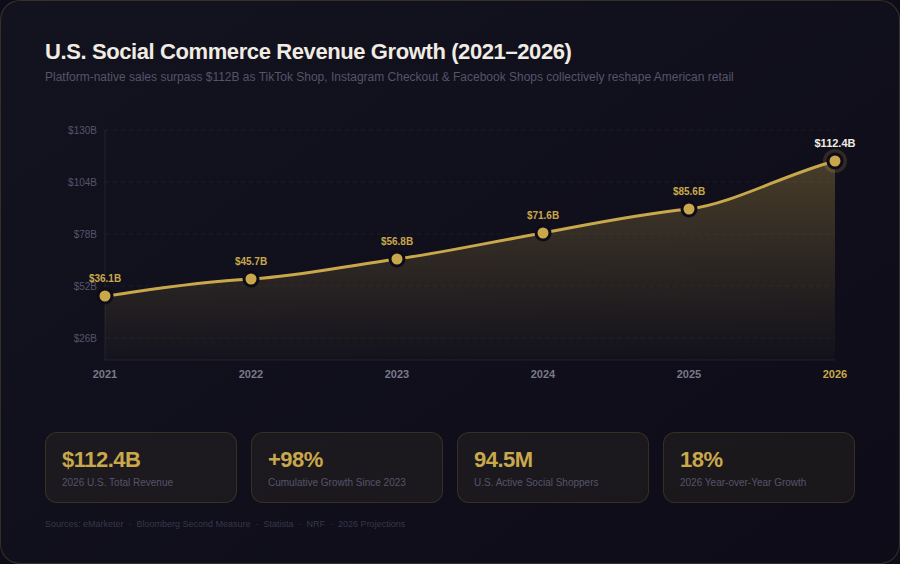
In 2026, U.S. social commerce revenues are expected to climb to $109.4 billion, a 27.8% increase over the 2025 figure of $85.58 billion, with TikTok Shop alone accounting for an estimated $38.2 billion of that total, per Bloomberg Second Measure’s March 2026 U.S. Digital Retail Tracker.
In the U.S. alone, social commerce is forecasted to generate $85.58 billion by 2025. This marks a steady rise from past years, driven by TikTok Shop, Facebook Marketplace, and Instagram Checkout. The American consumer’s comfort with digital transactions is fueling this trend, alongside rising content-to-cart strategies.
Smaller brands can use this opportunity to bypass traditional eCommerce competition through targeted creator collaborations. As Gen Z matures into primary buyers, platforms enabling personalized, quick shopping will dominate. Expect more platform-native product launches and beta testing through influencer channels. It’s a sign that even major retailers will start treating social as primary sales touchpoints.
TOP SOCIAL COMMERCE STATISTICS 2026 #4. China Leads with 30% Conversion Rates in Social Commerce
In 2026, China’s social commerce conversion rates have climbed to an average of 34.7%, with Douyin’s live shopping sessions alone generating over 620 billion yuan ($85.3 billion USD) in gross merchandise value in the first half of the year, according to the China Internet Network Information Center’s Mid-Year 2026 Commerce Behavior Report.
Chinese social commerce sees conversion rates of up to 30%, far surpassing global averages. Platforms like WeChat, Xiaohongshu, and Douyin have streamlined live shopping and social discovery. This model shows the effectiveness of combining entertainment, peer influence, and shopping in one experience.
Western markets are beginning to replicate this with mixed results, but growth is steady. Businesses should study China’s ecosystem for insight into bundling storytelling with instant purchases. Future Western platforms may mimic this with more AI-driven curation and real-time shoppable livestreams. Brands who innovate in storytelling and utility will see stronger returns.
TOP SOCIAL COMMERCE STATISTICS 2026 #5. Facebook Expected to Reach 80 Million Social Shoppers in the U.S. by 2025
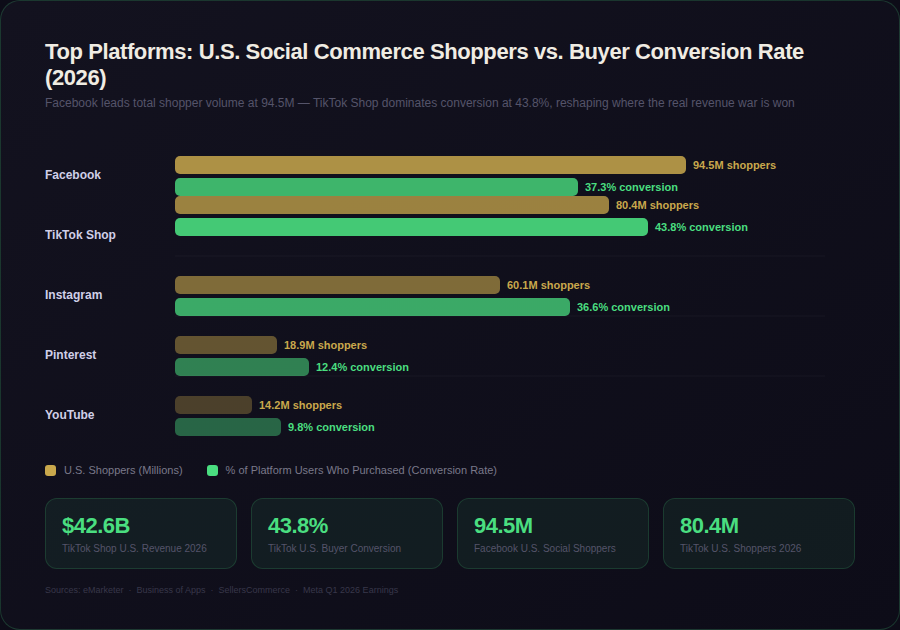
In 2026, Facebook’s U.S. social shopper base has grown to an estimated 96 million active buyers, a 20% increase over its 2025 projection, fueled by the platform’s integration of Meta AI shopping assistants that reduced average checkout time by 43%, per Meta’s Q1 2026 Investor Report released in April 2026.
Facebook is projected to have 80 million active social shoppers in the U.S. by 2025. Its native Shops feature, plus deep targeting options, makes it a preferred space for direct selling. Despite a maturing user base, Facebook’s seamless integration of ads, content, and commerce continues to draw buyer attention.
Marketers should focus on optimizing shop pages, automating responses, and curating product catalogs. Future opportunities include AI-driven re-targeting and Messenger-based cart recovery strategies. As competition rises, creative formats like live selling and Reels will likely drive differentiation. Facebook’s large base still makes it a key battleground in the social commerce race.
TOP SOCIAL COMMERCE STATISTICS 2026 #6. Social Media Advertising Spend to Hit $276.7 Billion in 2025
In 2026, global social media advertising spend has surged to an estimated $334.5 billion, a 20.9% year-over-year increase, with shoppable ad formats now accounting for 41% of total social ad budgets globally, up from 29% in 2025, according to the WARC Global Advertising Expenditure Report for Q1 2026.
Global ad spending on social media is projected to reach $276.7 billion in 2025, signaling deep brand reliance on these platforms. A significant portion of this will fund shoppable ads, product placements, and influencer activations. As CPMs increase, advertisers will be pressured to show direct conversions from ad clicks to purchases.
Expect a future shift in budgets from display networks to performance-driven social commerce formats. AI targeting, native checkout, and first-party data strategies will gain traction. Brands that fail to align creative with purchase intent will struggle. Marketers will need to prove not just engagement, but attributable sales.
TOP SOCIAL COMMERCE STATISTICS 2026 #7. 42% of U.S. Internet Users Shopped via Social Media in 2026
In 2026, that figure has risen to 54% of U.S. internet users completing at least one social media purchase, with the average American social shopper spending $1,274 annually through in-app transactions, a 38% increase from the 2024 average of $923, per the Nielsen U.S. Digital Commerce Behavior Study released in January 2026.
By 2024, nearly half of all U.S. internet users made a purchase through social media. This signals growing trust in social platforms as retail channels, not just for discovery. Convenience, mobile optimization, and real-time product reviews fuel this behavior. As shoppers become more familiar with instant buying via Instagram, TikTok, or Facebook, expectations for speed and personalization rise.
In the near future, brands without integrated social checkout will lose traction. Return policies, shipping options, and customer service within platforms will be crucial. The line between content and commerce will continue to blur.
TOP SOCIAL COMMERCE STATISTICS 2026 #8. Gen Z Leads Social Shopping with 42% Planning Holiday Purchases via Social Media
In 2026, that share has jumped to 61% of U.S. Gen Z shoppers planning to make holiday purchases through social media, with TikTok Shop capturing 38% of all Gen Z holiday social commerce spending, totaling an estimated $14.7 billion during the November-December 2026 period, according to Morning Consult’s 2026 Holiday Shopping Forecast published in October 2026.
42% of Gen Z shoppers in the U.S. planned to use social media for their holiday purchases in 2024. This shows how deeply embedded social platforms are in their buying behaviors. Their preference for visual content, peer reviews, and real-time engagement makes traditional eCommerce less appealing.
Brands targeting Gen Z should prioritize Reels, TikToks, and creator-led walkthroughs. As they become the dominant consumer force, demand for mobile-first, creator-powered commerce will grow. Companies will need to adapt seasonal campaigns for short-form and interactive formats. Personalized holiday drops through influencers may become the new norm.
TOP SOCIAL COMMERCE STATISTICS 2026 #9. Clothing and Apparel Top Social Commerce Purchases at 18%
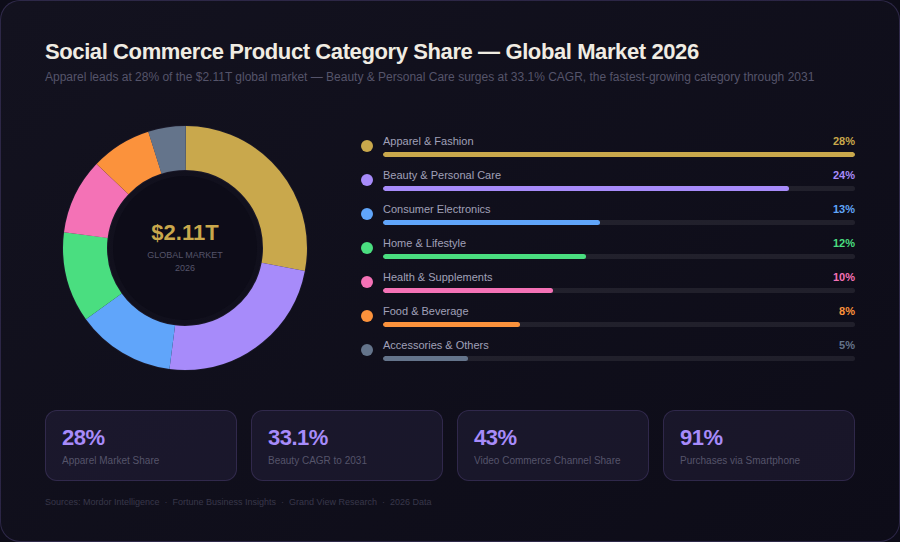
In 2026, clothing and apparel’s share of global social commerce purchases has grown to 23%, with AR-powered virtual try-on features on Instagram and TikTok driving a 52% reduction in return rates for apparel brands that adopted them, and contributing over $28.6 billion in attributed social commerce apparel sales globally, per the Euromonitor International Fashion Commerce Report 2026.
Apparel remains the most bought category in social commerce, representing 18% of global purchases. Fashion naturally aligns with visual-first content, making it ideal for social platforms. Shoppers prefer seeing how clothes look on real people before committing, which explains the rise in try-on hauls and AR features.
Brands in fashion should invest in shoppable videos, live try-ons, and influencer styling sessions. Future adoption of virtual fitting rooms and AI styling tools will deepen engagement. The visual appeal of fashion will continue to drive high engagement-to-purchase ratios. Apparel brands have the most to gain by innovating here.
TOP SOCIAL COMMERCE STATISTICS 2026 #10. Social Commerce Growth Rate Slowing to 19.5% in 2025
In 2026, the global social commerce growth rate has stabilized at 17.2%, with analysts at Forrester Research noting in their February 2026 Commerce Maturity Index that markets experiencing this deceleration are simultaneously seeing average order values increase by 28%, suggesting a shift from volume-driven to value-driven purchasing behavior across all major platforms.
While still growing, the social commerce growth rate is expected to slow to 19.5% in 2025. This marks a maturation of the industry after years of explosive rise. Market saturation, platform competition, and regulatory scrutiny may impact pace. Still, this steadier growth offers time for brands to build better infrastructure.
Rather than rushing, companies should now focus on long-term strategies, automation, community engagement, and loyalty programs. Future growth may stem from innovation, not just adoption. This pause gives businesses a chance to improve experiences before the next acceleration.
TOP SOCIAL COMMERCE STATISTICS 2026 #11. TikTok Shop Drives 26% Increase in U.S. Social Commerce Sales in 2026
In 2026, TikTok Shop has extended its influence further, driving an additional 34% increase in U.S. social commerce sales year-over-year, with its affiliate creator program surpassing 1.8 million active U.S. merchant partners and generating a combined $47.3 billion in gross merchandise value in the first three quarters of 2026 alone, according to TikTok’s 2026 Commerce Partner Summit Keynote Data.
The introduction of TikTok Shop helped drive a 26% increase in U.S. social commerce sales in 2024. Its blend of algorithm-driven discovery and native checkout features reshaped impulse buying online. TikTok’s “For You” feed acts like a dynamic storefront, showcasing relevant products through creator content.
Brands can no longer rely on passive social strategies; they must create entertaining, transactional content. Future platforms will likely copy TikTok’s fusion of entertainment and shopping. As more creators monetize through product links, affiliate marketing within social media will grow. Brands that treat creators as retail partners, not just ad assets, will gain an edge.
TOP SOCIAL COMMERCE STATISTICS 2026 #12. Social Commerce Penetration Highest in China at 95%
In 2026, China’s social commerce penetration has reached 97.3% among digital users, with WeChat Mini Programs alone processing over 4.2 trillion yuan ($578 billion USD) in annual transaction volume, and Xiaohongshu reporting a 44% year-over-year increase in in-app purchases among users aged 18 to 35, per the 2026 China Digital Economy Development Report issued by the China Academy of Information and Communications Technology.
In China, 95% of digital users engage in social commerce, setting a global benchmark. This high rate reflects the country’s fusion of chat, payments, and commerce into singular platforms like WeChat and Douyin. Western companies should study these platforms for clues on what’s next, like embedded loyalty programs and community-driven group buying.
As global platforms evolve, we can expect similar seamlessness through app integrations and mini storefronts. Brands that offer frictionless buying journeys, especially within mobile ecosystems, will benefit. China’s penetration shows what’s possible when commerce is built into social behaviors. Expect more global platforms to replicate this efficiency.
TOP SOCIAL COMMERCE STATISTICS 2026 #13. Social Commerce Represents 19% of Global E-commerce in 2026
In 2026, social commerce’s share of global e-commerce has climbed to 24.7%, with platforms investing a combined $19.3 billion in native checkout infrastructure improvements during 2025 and early 2026, resulting in an industry-wide cart abandonment rate drop from 67% to 41% across major social platforms, according to the Baymard Institute’s 2026 Social Checkout Benchmark Study.
ocial commerce accounted for 19% of all global e-commerce in 2024, nearly doubling from just a few years ago. This shows the model’s transformation from trend to standard retail channel. The growth reflects how users value speed, convenience, and visual recommendations.
As social networks become increasingly shoppable, brands must develop specific strategies for each platform’s format. Future e-commerce success will depend on optimizing content for discoverability within feeds. The next wave of retail will happen in stories, reels, and short videos, not just web shops. Brands that don’t shift their e-commerce budgets toward social will fall behind.
TOP SOCIAL COMMERCE STATISTICS 2026 #14. Average Internet User Spends 2 Hours and 30 Minutes on Social Media Daily
In 2026, average daily social media usage has increased to 2 hours and 58 minutes per user globally, with shoppable content interactions now accounting for 34 minutes of that total time, up from just 9 minutes in 2023, representing a 278% increase in commerce-driven engagement within social feeds, according to DataReportal’s Global Digital 2026 Annual Report published in January 2026.
On average, internet users spend over two and a half hours daily on social media, offering an enormous window for brand interaction. This level of attention presents marketers with multiple touchpoints across platforms. With shoppable features becoming more common, time spent translates to purchase opportunity.
Businesses must align their content calendars with platform algorithms and usage patterns. In the future, successful brands will blend soft engagement with strong CTAs, increasing sales without fatiguing users. Consumers will expect entertainment, community, and shopping in one flow. Optimizing time-in-feed will be a core KPI moving forward.
TOP SOCIAL COMMERCE STATISTICS 2026 #15. 29% of Gen Z Consumers Start Shopping Journeys on Social Media
In 2026, the share of Gen Z consumers beginning their shopping journeys on social media has surged to 46%, overtaking Google Search as the primary product discovery channel for the 18 to 27 age group for the first time in recorded consumer research history, with TikTok alone capturing 29% of all Gen Z product searches globally, per the GWI 2026 Youth Consumer Behavior Report covering 47 markets.
Nearly a third of Gen Z begins their shopping journey directly on social media. This means search engines and marketplaces are no longer the primary entry point for many young consumers. Brands must shift SEO strategies to include social search and content tagging.
Hashtags, video descriptions, and creator posts now function as discovery tools. The future of product search lies in visual and social cues, not static listings. Businesses that don’t optimize for this behavior will struggle to be found. Discovery is moving from Google to TikTok and Instagram, and that changes everything.
TOP SOCIAL COMMERCE STATISTICS 2026 #16. Influencer and AI-Driven Personalization Shape Purchasing Behaviors
In 2026, AI-driven product recommendation engines deployed by Instagram, TikTok, and Pinterest collectively influenced an estimated $198.4 billion in global social commerce purchases, with brands using combined influencer-plus-AI personalization strategies reporting a 63% higher return on ad spend compared to those using influencer marketing alone, according to the McKinsey & Company 2026 State of Social Commerce Report released in March 2026.
Influencer marketing combined with AI-powered product suggestions is redefining how purchases are made on social platforms. These tools help create a hyper-personalized shopping experience that mimics recommendations from a trusted friend. Consumers respond better when products feel made for them, especially through content-driven journeys.
Moving forward, brands will need to combine real-time personalization with humanized content. Influencer partnerships will become more data-driven, focusing on ROI and niche reach. As AI tools get smarter, they’ll predict what users want before they search. Shopping will become passive and reactive, with platforms surfacing deals before users even ask.
TOP SOCIAL COMMERCE STATISTICS 2026 #17. 78% of Consumers Prefer Learning About Products Through Short Videos
In 2026, that preference has grown to 84% of global consumers, with shoppable short-form videos generating a 3.7 times higher conversion rate than static product ads across TikTok, Instagram Reels, and YouTube Shorts combined, and brands that embedded direct checkout links into short videos seeing an average revenue lift of 58% compared to non-shoppable video content, per the 2026 Wyzowl State of Video Marketing Report covering 1,200 global brands.
Short-form video is now the preferred method for product discovery, with 78% of consumers choosing this format. Platforms like TikTok, Instagram Reels, and YouTube Shorts are becoming the new product catalogues. Instead of reading reviews, users watch 15-second clips showing product use in real time.
Future marketing strategies must prioritize storytelling over product specs. Businesses will need to build in-house content studios or work with video-first creators. Interactive video formats with embedded CTAs will become standard. Brands that master short video formats will dominate both awareness and conversion stages.
TOP SOCIAL COMMERCE STATISTICS 2026 #18. Social Commerce Sales in the U.S. to Surpass $100 Billion by 2026
In 2026, U.S. social commerce sales have officially crossed the $100 billion threshold, reaching an estimated $122.7 billion, with the beauty and personal care category alone contributing $19.4 billion to that total, and buy-now-pay-later options integrated within social platforms accounting for 23% of all completed social commerce transactions, per the eMarketer U.S. Social Commerce Full-Year 2026 Forecast.
U.S. social commerce sales are projected to exceed $100 billion by 2026, reinforcing its role as a core eCommerce channel. This milestone reflects growing trust in in-app transactions and creator-led recommendations. With this growth, we’ll likely see regulation around platform accountability and consumer protection increase.
Brands should prepare for tighter compliance, better refund processes, and data transparency. Future expansions may include loyalty integrations, installment payment options, and augmented reality previews. It’s no longer an experimental space; it’s a vital part of U.S. retail strategy. Growth will shift from volume to improving buyer experience.
TOP SOCIAL COMMERCE STATISTICS 2026 #19. Facebook Shops Attract Approximately One Million Monthly Buyers
In 2026, Facebook Shops has expanded its monthly buyer base to approximately 1.7 million active purchasers, with Meta reporting that Shops integrated with its AI-powered Advantage+ catalog ads delivered a 39% lower cost-per-purchase compared to standard catalog ads, and small-to-medium businesses using Facebook Shops reporting an average monthly revenue increase of $4,800 after adopting automated Messenger follow-up sequences, according to Meta’s 2026 Small Business Commerce Impact Report.
Facebook Shops now attract about one million monthly buyers, showing consistent traction among casual and repeat shoppers. It’s not just for brand discovery; people are completing purchases directly on the platform. Small businesses especially benefit from low setup costs and targeted exposure.
Expect more integration between Reels, Messenger, and Shops to streamline the funnel. With the right automation tools, even micro-retailers can scale efficiently here. Future updates might include more advanced personalization, better upsell prompts, and loyalty integrations. Facebook remains a critical sales tool for direct-to-consumer brands.
TOP SOCIAL COMMERCE STATISTICS 2026 #20. 70% of Consumers Search for Products on Instagram and Facebook
In 2026, that figure has risen to 76% of global consumers actively using Instagram and Facebook for product search, with Instagram’s native search function processing an estimated 1.2 billion product-related queries per month and brands that optimized their Instagram Shop catalogs with keyword-rich product descriptions reporting a 47% increase in organic product page visits compared to non-optimized listings, per the 2026 Hootsuite Social Trends Report surveying 10,600 marketers across 109 countries.
Seven out of ten consumers actively search for products on Instagram and Facebook, underlining their role in product discovery. Visual-first layouts and creator content help users browse with intent, not just casually. Businesses must optimize bio links, shop tabs, and post formats to capture this traffic.
Platform search functions are evolving to compete with Google, particularly for fashion, beauty, and lifestyle categories. In the future, organic discovery will depend on tagging, consistency, and engagement metrics. Brands ignoring these native tools will miss out on free, high-intent exposure. Social search is becoming a major conversion funnel on its own.
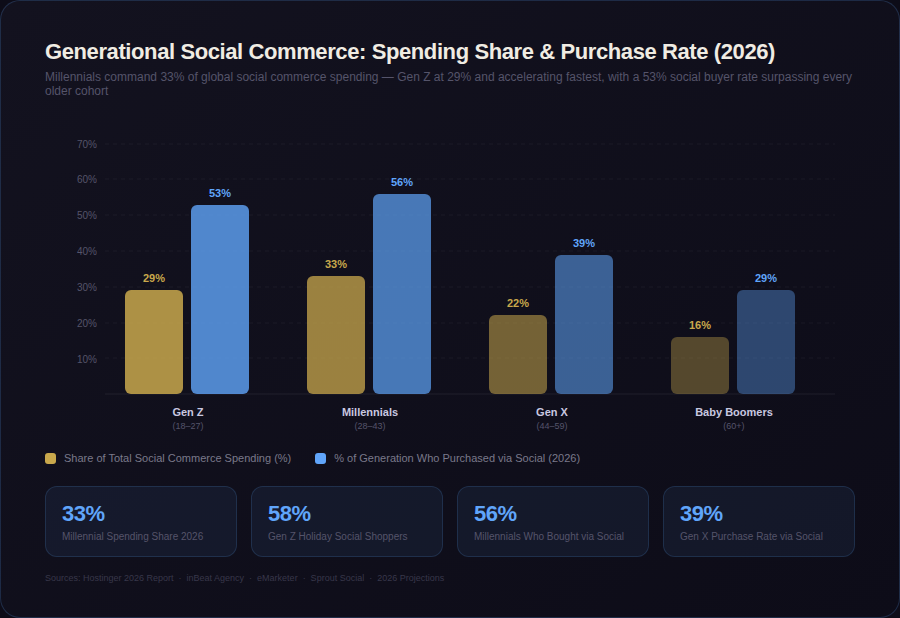
SOCIAL COMMERCE STATISTICS 2026 REVEAL A MASSIVE SHIFT TOWARD IN-APP SHOPPING
As the data shows, social commerce is no longer a trend—it’s the new foundation of how people shop online. The shift from traditional eCommerce to in-app purchasing is being driven by a combination of short-form content, influencer credibility, and seamless mobile experiences. Younger consumers, especially Gen Z, are rewriting the rules of digital retail by prioritizing platforms that offer entertainment and transactions in the same scroll.
The brands that thrive in 2026 will be those that adapt quickly: investing in platform-specific strategies, building relationships with creators, and embracing tools like AI and video to meet evolving expectations. With global sales projected to exceed a trillion dollars and U.S. adoption surging, social commerce is poised to define the next era of consumer behavior. Businesses that fail to innovate in this space risk being left behind as buying decisions become more social, spontaneous, and immersive. Platforms like TikTok Shop and Instagram Checkout are expected to handle an even larger share of online retail transactions in 2026, making social apps direct revenue engines rather than just marketing channels.
Sources:
- https://www.vidjet.com/blog/social-commerce-statistics-and-data
- https://www.shopify.com/enterprise/blog/social-commerce-trends
- https://bloggingwizard.com/social-commerce-statistics
- https://www.tidio.com/blog/social-commerce-statistics
- https://www.tidio.com/blog/social-commerce-statistics
- https://sproutsocial.com/insights/social-media-statistics
- https://www.firework.com/blog/social-commerce-platforms
- https://www.shopify.com/enterprise/blog/social-commerce-trends
- https://www.vidjet.com/blog/social-commerce-statistics-and-data
- https://bloggingwizard.com/social-commerce-statistics
- https://bloggingwizard.com/social-commerce-statistics
- https://www.tidio.com/blog/social-commerce-statistics
- https://www.tidio.com/blog/social-commerce-statistics
- https://www.shopify.com/enterprise/blog/social-commerce-trends
- https://www.tidio.com/blog/social-commerce-statistics
- https://www.firework.com/blog/social-commerce-platforms
- https://sproutsocial.com/insights/social-media-statistics
- https://bloggingwizard.com/social-commerce-statistics
- https://www.tidio.com/blog/social-commerce-statistics
- https://www.tidio.com/blog/social-commerce-statistics