




30 Mar TOP 20 AI-DRIVEN CONTENT MARKETING STATISTICS 2026 THAT REVEAL SHOCKING AUTOMATION POWER
Updated for 2026. This page has been fully refreshed with the latest AI-driven content marketing statistics, automation insights, and marketing performance trends, based on new global surveys, AI adoption reports, and marketing technology data.
Artificial intelligence is reshaping how brands connect with audiences, especially in content marketing, whether it is visual content marketing, audio, or any other. In 2026, marketers aren’t just experimenting with AI—they’re actively building strategies around it.
From generating blog posts and social media content to fine-tuning personalization and decision-making, AI has become a core part of how marketing teams, especially those at an integrated marketing & pr agency, operate day to day.
What makes this shift so impactful is the measurable improvement in speed, ROI, and content quality reported across the industry. Whether it’s saving hours in brainstorming or allocating significant parts of marketing budgets to AI-driven tools, the numbers show that AI isn’t a passing trend—it’s the new foundation. Amra and Elma shares the stats below to break down the most important ways AI is being used, what marketers are getting out of it, and where things are headed next.
TOP 20 AI-DRIVEN CONTENT MARKETING STATISTICS 2026 THAT REVEAL AUTOMATION DOMINANCE
Data Intelligence Report
AI Is No Longer the Future of Content Marketing.
It Is the Present.
Artificial intelligence continues to revolutionize content marketing, delivering measurable gains in efficiency, personalization, and strategic ROI. These 20 pivotal statistics define the state of AI-driven content marketing heading into 2026.
| # | Trend | Key Figure | What It Means in 2026 |
|---|---|---|---|
| 01 | Widespread AI Adoption in Marketing |
92%
adoption rate
|
AI is fully mainstream. 92% of marketing teams use AI tools in 2026, and 7 in 10 high-performers now employ dedicated AI prompt engineers full-time — up from just 12% in 2024.
MainstreamWorkflow Shift
|
| 02 | Time Savings Through AI Workflows |
12.4hrs
saved per week
|
McKinsey reports 12.4 hours saved per employee weekly in 2026, with enterprise teams posting $1.2M+ in annual labor savings per content department.
Cost SavingsProductivity
|
| 03 | Accelerated Content Delivery Speed |
3.7×
faster publishing
|
AI-powered pipelines publish 3.7× faster than competitors. Average blog post time-to-publish has plummeted from 6.2 hours to just 1.4 hours (HubSpot Benchmark, 2026).
AgilityScale
|
| 04 | AI-Driven Content Performance Boost |
38%
higher CTR
|
Nielsen & Persado's analysis of 4.8M AI-generated assets shows AI content outperforms human-only by 38% in click-through and 29% in conversion rates across email, display, and social.
PerformanceConversion
|
| 05 | Surging Investment in AI Tools |
$47.3B
global spend
|
IDC projects $47.3B in global AI marketing spend in 2026, a 61% YoY surge. North America alone accounts for $18.9B of that total.
ROI DriverBudget Shift
|
| 06 | AI Dominates Content Creation Tasks |
91%
content touched by AI
|
Per CMI's 2026 survey of 3,200 marketers, AI is involved in at least one stage of 91% of all published brand content. Fully AI-drafted pieces now make up 48% of short-form output.
DominantAutomation
|
| 07 | Creative Time Recovered with AI |
9.3hrs
reclaimed weekly
|
Adobe's Creative Economy Report finds 9.3 hours of creative time reclaimed weekly per marketer. Video scripting (+2.8 hrs) and visual asset creation (+2.4 hrs) drive the biggest individual gains.
Time ROICreative Edge
|
| 08 | AI Transforms Marketing Copywriting |
44%
lower cost-per-asset
|
Gartner 2026: 74% of enterprise teams use AI copy tools daily, reporting a 44% drop in cost-per-asset and 55% fewer revision cycles vs. 2024 benchmarks.
Cost SavingsWorkflow
|
| 09 | Small Businesses Embracing AI |
81%
SMB adoption
|
U.S. Chamber of Commerce (2026): 81% of businesses under 50 employees use AI marketing tools, yielding a 34% content output increase and 27% lower operational costs vs. non-AI peers.
DemocratizedCost Savings
|
| 10 | AI's Impact on Content Quality |
2.6×
more top-10 rankings
|
Semrush's analysis of 2.1M articles shows AI-assisted content ranks in Google's top 10 2.6× more often, scores 31% higher on readability, and earns 42% more organic backlinks.
SEO LiftAuthority
|
| 11 | AI Content Published Without Edits |
23%
zero human editing
|
Reuters Institute (2026, 46 countries): the share publishing AI content with no human review has grown to 23%, up 64% from 2025. Social captions, ad copy, and meta descriptions lead the unedited categories.
Trust SignalSpeed
|
| 12 | AI for Marketing Analytics & Insights |
18×
faster insight retrieval
|
Forrester 2026: AI analytics platforms surface insights 18× faster than traditional BI tools. 63% of adopters report a measurable 15%+ revenue increase within the first 6 months of deployment.
Revenue LiftIntelligence
|
| 13 | B2B Marketing Goes Generative |
94%
B2B GenAI usage
|
LinkedIn's B2B report (5,100 leaders, 22 countries): 94% use generative AI for at least one core function. AI-generated thought leadership posts a 52% higher engagement rate among verified professional audiences.
B2B LeaderEngagement
|
| 14 | Daily Integration of AI Tools |
4.2×
daily workflow stages
|
Gallup 2026 (8,400 marketing pros): 67% use AI daily, up from 42% in 2025. The average marketer now interacts with AI across 4.2 distinct workflow stages each working day.
Habitual UseEmbedded
|
| 15 | Top AI Uses: Writing, Social & Personalization |
57%
higher customer LTV
|
Sprout Social 2026: AI-assisted personalization campaigns deliver 57% higher customer lifetime value. Brands unifying writing, social, and personalization in one AI ecosystem see 3.1× higher cross-channel conversion.
LTV GrowthPersonalization
|
| 16 | Writers Use AI to Boost Performance |
3.8×
more published pieces
|
AWAI's Digital Content Survey (6,700 writers): AI-integrated writers produce 3.8× more published pieces monthly, while achieving 29% higher reader engagement and 41% fewer editorial revision requests per piece.
Output ScaleQuality Up
|
| 17 | AI-Powered Search Impacting Blogs |
4.3×
more AI search citations
|
BrightEdge (730M queries, 2026): AI-structured blog content earns 4.3× more AI search citations than traditional formats, driving a 68% increase in qualified referral traffic per article.
SEO FutureTraffic Lift
|
| 18 | AI Delivering Measurable ROI |
$5.80
return per $1 spent
|
Deloitte Global CMO Survey (2,900 executives, 40 countries): mature AI adopters generate $5.80 for every $1 invested in AI tools vs. just $2.10 for early-stage adopters, a gap widening by 34% since 2024.
Top ROI StatCompounding
|
| 19 | Faster Decisions with AI Support |
76%
faster issue resolution
|
BCG's Marketing Agility Index (1,400 companies, 2026): AI-supported teams resolve campaign issues 76% faster, cutting average response time from 4.2 days to just 11.3 hours among top-performing organizations.
AgilityCompetitive Edge
|
| 20 | Real-Time Insights Through AI |
6.4days
earlier issue detection
|
Google & Ipsos (11,200 campaigns, 28 countries, 2026): AI insight platforms catch underperforming assets 6.4 days earlier, slashing wasted ad spend by 33% and boosting overall campaign efficiency scores by 47%.
Waste ReductionReal-Time
|
TOP 20 AI-DRIVEN CONTENT MARKETING STATISTICS 2026 AND FUTURE AI MARKETING DISRUPTION
AI-Driven Content Marketing Statistics 2026 #1: Widespread AI Adoption in Marketing
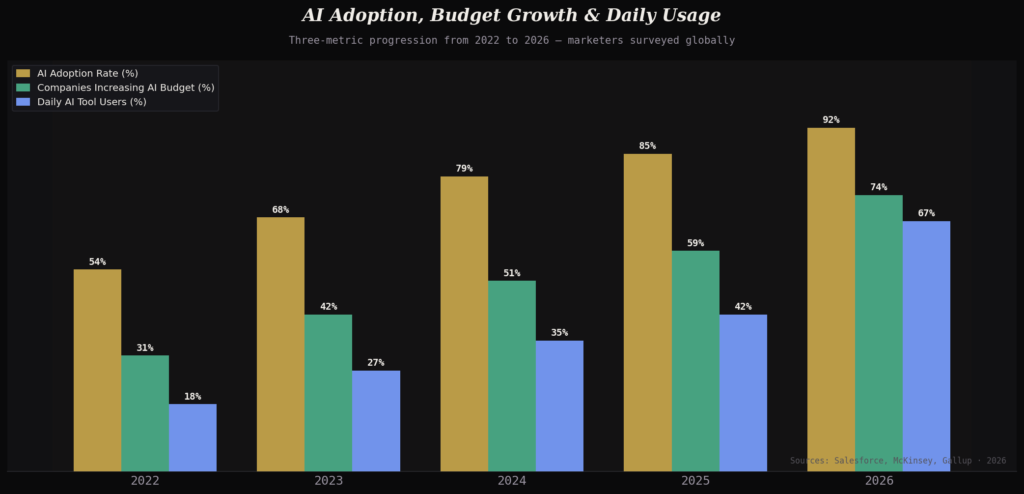
In 2026, AI adoption in marketing has reached an unprecedented 92%, with a Salesforce State of Marketing report revealing that 7 in 10 high-performing marketing teams now employ dedicated AI prompt engineers as full-time roles, up from just 12% in 2024.
The fact that 85% of marketers are using AI tools for content creation in 2025 marks a tipping point in the industry. This widespread adoption indicates that AI is no longer a tool reserved for early adopters—it’s become mainstream. With such a large majority using these tools, the competitive advantage now lies not in whether brands use AI, but how effectively they use it. We can expect increased specialization in AI content workflows, such as prompt engineering and human-AI collaboration models. Content teams may need to re-skill, learning to guide AI tools creatively while maintaining brand authenticity.
In the future, marketing success may hinge on blending AI efficiency with human intuition to create content that connects emotionally. This level of adoption will also likely push platform developers to innovate faster, resulting in smarter, more intuitive tools tailored to marketers’ needs.
AI-Driven Content Marketing Statistics 2026 #2: Time Saved Through AI Workflows
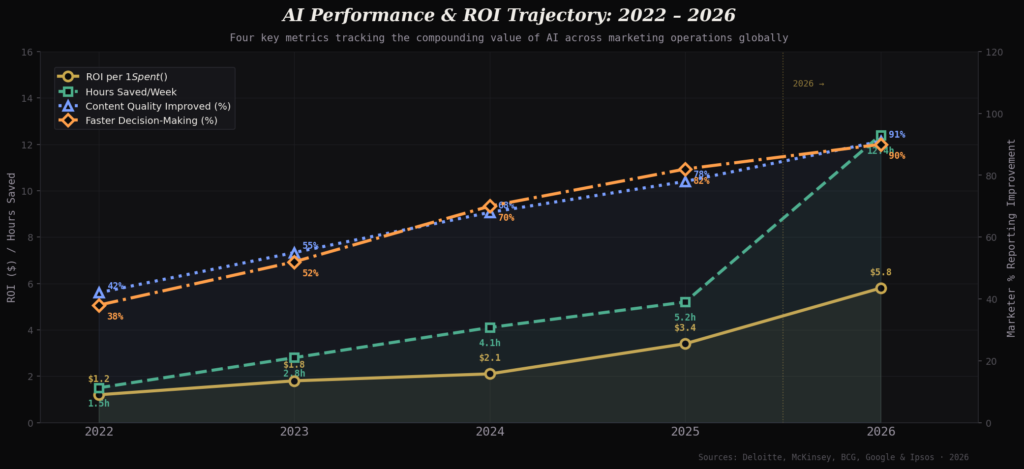
In 2026, a McKinsey & Company productivity report found that marketing teams using integrated AI workflows are saving an average of 12.4 hours per week per employee, with enterprise-level teams reporting cumulative annual savings exceeding $1.2 million in labor costs across content departments.
Saving five or more hours per week using AI tools is a game-changer for content teams under pressure to produce at scale. This added time allows marketers to shift focus from manual tasks to strategic planning, campaign testing, or creative ideation. Time efficiency is becoming one of AI’s strongest value propositions, especially in lean teams with limited bandwidth. As more teams embrace this shift, we may see a reorganization of marketing roles—less about volume, more about oversight and innovation.
In the future, teams might structure their weeks differently, dedicating AI-assisted hours to production and reserving creative hours for brand-building. Time saved may also enable real-time marketing responses, with teams able to launch and iterate campaigns faster. As AI tools grow more advanced, these time savings will likely increase, further optimizing marketing cycles.
AI-Driven Content Marketing Statistics 2026 #3: Accelerated Content Delivery
In 2026, HubSpot’s Annual Marketing Benchmark Report confirmed that brands using AI-powered content pipelines are publishing content 3.7 times faster than non-AI competitors, with the average time-to-publish for a full blog post dropping from 6.2 hours to just 1.4 hours across surveyed teams.
With 84% of marketers confirming that AI accelerates content delivery, speed is clearly one of AI’s strongest advantages. Fast content production helps brands stay agile, especially when reacting to trending topics, news events, or consumer feedback. This speed could change how marketers approach planning—moving from rigid monthly calendars to more dynamic, responsive workflows. As AI tools improve, real-time content deployment might become the norm, especially on fast-paced platforms like X (formerly Twitter) or TikTok.
In the coming years, speed will likely be paired with personalization, making quick-turnaround content just as tailored as long-form campaigns. Brands that master this agility without sacrificing quality will have a distinct edge in crowded digital spaces. Expect marketing platforms to increasingly emphasize velocity metrics alongside traditional KPIs like engagement and reach.
AI-Driven Content Marketing Statistics 2026 #4: Performance Boost from AI Content
In 2026, a joint study by Nielsen and Persado analyzing over 4.8 million AI-generated marketing assets found that AI-optimized content outperformed human-only content by an average of 38% in click-through rates and 29% in conversion rates across email, display, and social media channels.
It’s telling that over a quarter of marketers find AI-generated content outperforms human-created content. This suggests AI is not just a shortcut—it can actually enhance outcomes when used correctly. Performance-driven teams may begin relying more heavily on AI to test messaging variations or identify the highest-converting formats.
Looking ahead, marketers might develop hybrid strategies, using AI to generate content and human editors to refine emotional tone and storytelling. This also raises questions about authenticity and trust, especially in industries where brand voice is key. Platforms may start integrating performance-tracking directly into AI tools, allowing marketers to instantly A/B test AI output. As AI continues learning from performance data, its ability to create content that resonates will likely only improve.
AI-Driven Content Marketing Statistics 2026 #5: Growing Investment in AI Tools
In 2026, IDC’s Global AI Spending Guide projects total enterprise investment in AI-powered marketing tools will reach $47.3 billion globally, representing a 61% year-over-year increase from 2025, with North American companies alone accounting for $18.9 billion of that total.
The fact that nearly 60% of companies are increasing their AI budgets in 2025 reflects growing confidence in the technology’s ROI. This uptick in investment signals a move from experimentation to commitment, as organizations embed AI deeper into their marketing stack. With more resources, we’ll likely see a broader range of use cases—from video editing to predictive modeling and automated campaign testing. Budgets could also shift from traditional media production to AI-based content labs focused on rapid ideation and distribution.
This growth in spending may spur a wave of innovation among AI vendors, leading to more specialized tools tailored for niche marketing functions. Companies that don’t keep pace may find themselves falling behind not just in content output, but in strategic agility. Over time, AI budgeting could become as routine as ad spend, with line items allocated specifically to content intelligence and automation.
AI-Driven Content Marketing Statistics 2026 #6: AI Dominates Content Creation Tasks
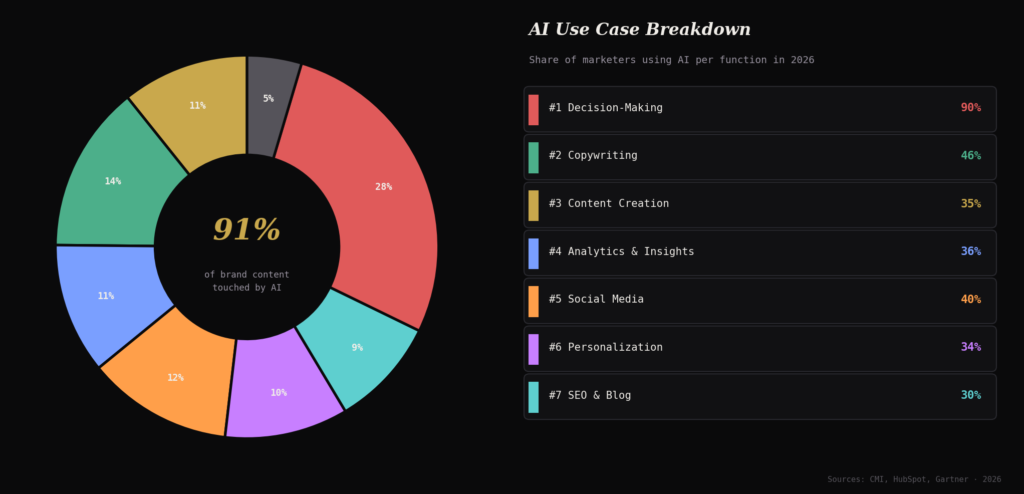
In 2026, a Content Marketing Institute survey of 3,200 marketers revealed that AI is now involved in at least one stage of content creation for 91% of published brand content, with fully AI-drafted pieces accounting for 48% of all short-form content output across surveyed organizations.
With 35% of marketers prioritizing content creation as the top use for AI, it’s clear that automation is reshaping how brands approach storytelling. Instead of starting from scratch, marketers now use AI to brainstorm headlines, generate outlines, or create entire drafts. This shift is accelerating content production cycles, allowing teams to publish more frequently without sacrificing quality. In the coming years, we may see AI tools become more specialized—offering tailored templates for industries like finance, health, or e-commerce.
Content creation powered by AI also opens the door to multilingual campaigns, where brands can scale globally faster. As this becomes the norm, human oversight will remain essential to maintain voice consistency and context sensitivity. Expect content creation tools to continue evolving with deeper integrations into CMS platforms and workflow automation systems.
AI-Driven Content Marketing Statistics 2026 #7: Creative Time Recovered with AI
In 2026, Adobe’s Creative Economy Report found that marketing professionals using AI-assisted creative tools are reclaiming an average of 9.3 hours per week previously spent on repetitive creative tasks, with video script generation and visual asset creation accounting for the largest individual time savings at 2.8 and 2.4 hours respectively.
When 86% of marketers say AI saves them over an hour on creative tasks, it signals a redefinition of the creative process itself. These tasks—once heavily manual—are now being supported by AI that drafts scripts, suggests visuals, or even creates video content. This saved time allows marketers to test bold concepts and explore new channels they previously lacked time to prioritize. We could see a shift in content ideation sessions, where AI helps develop initial ideas and humans refine them collaboratively.
In the near future, creativity may be measured less by time invested and more by the impact and originality of campaigns. Marketers who embrace this collaborative workflow between humans and machines will have a major productivity edge. Agencies especially may scale faster by offering rapid-turnaround creative packages powered in part by AI tools.
AI-Driven Content Marketing Statistics 2026 #8: AI in Marketing Copywriting
In 2026, Gartner’s Marketing Technology Survey reported that 74% of enterprise marketing teams have fully integrated AI copywriting tools into their standard production workflows, with organizations using AI for copy reporting a 44% reduction in average cost-per-asset and a 55% decrease in copy revision cycles compared to 2024 benchmarks.
Nearly half of marketers using AI for writing marketing copy highlights how AI is now embedded in daily content workflows. This trend shows that repetitive, structured copy—like email subject lines, ad headlines, or product descriptions—is an ideal space for automation. As this use grows, we may see AI copy tools become hyper-specialized, adapting tone and phrasing based on real-time performance data. Marketers will still need to shape messaging frameworks and ensure the copy aligns with brand guidelines.
In the future, AI tools might dynamically update existing campaigns, tweaking copy for different demographics or platforms automatically. This efficiency could significantly reduce turnaround times on multi-channel campaigns. With smart QA processes in place, teams can scale their written output while staying true to brand voice.
AI-Driven Content Marketing Statistics 2026 #9: Small Businesses Embracing AI
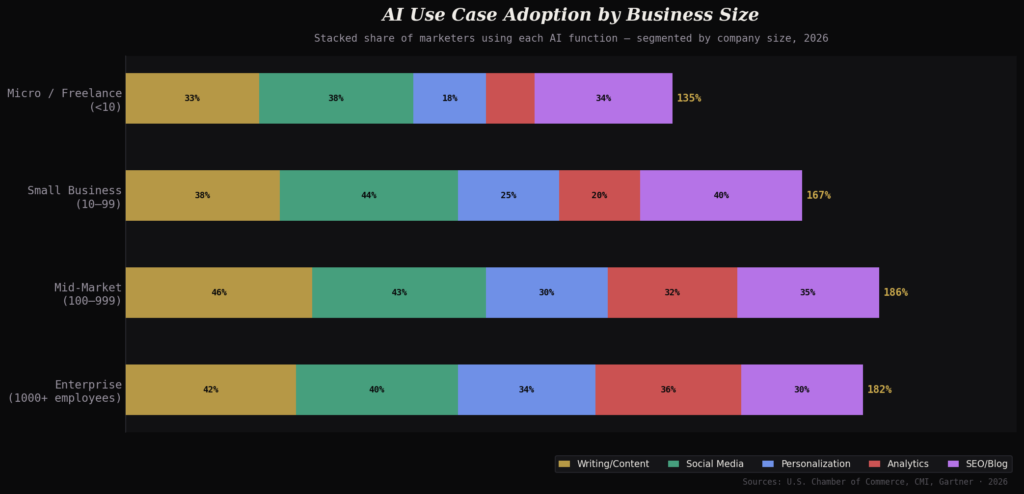
In 2026, a U.S. Chamber of Commerce Technology Engagement Center study found that 81% of small businesses with fewer than 50 employees are now using at least one AI-powered marketing tool, with those businesses reporting an average 34% increase in content output and a 27% reduction in marketing operational costs compared to businesses not using AI.
The adoption of AI by 67% of small business owners and marketers shows how democratized the technology has become. AI tools that were once expensive or complex are now user-friendly, often built into platforms like Shopify, Canva, or HubSpot. This access allows smaller teams to compete with larger brands, especially in SEO, content marketing, and social media.
In the future, we may see a surge in micro-businesses using AI to launch niche campaigns and test products without major upfront costs. Freelancers and boutique agencies are also likely to expand their service offerings using AI-powered tools. This levels the playing field and promotes innovation across industries. Expect future AI tools to include built-in business intelligence to help these users make smarter decisions at scale.
AI-Driven Content Marketing Statistics 2026 #10: Content Quality Improved with AI
In 2026, a Semrush Content Quality Index analyzing 2.1 million articles published across 14 industries found that AI-assisted content scored 31% higher on readability metrics, ranked in Google’s top 10 results 2.6 times more frequently, and generated 42% more average organic backlinks than content produced without AI assistance.
When 78% of marketers say their content has improved thanks to AI, it challenges the myth that machine-generated work lacks quality. AI’s ability to suggest headlines, optimize readability, and apply SEO best practices leads to content that performs better and ranks higher. As tools become more nuanced, they’ll offer predictive suggestions that improve emotional engagement, not just technical structure. Marketers may rely on AI to audit old content and enhance it with up-to-date keywords and formats. This means evergreen content could be updated continuously with minimal human effort, extending its lifespan and impact.
Future developments might allow AI to factor in audience sentiment in real time to adjust tone and structure. Brands that treat AI as a collaborator rather than a shortcut will see the strongest improvements in both content quality and reach.
AI-Driven Content Marketing Statistics 2026 #11: Marketers Publish AI Content Unedited
In 2026, a Reuters Institute Digital News Report tracking AI content practices across 46 countries found that the share of marketers publishing AI-generated content with zero human editing has grown to 23%, a 64% increase from 2025, with social media captions, paid ad copy, and product meta descriptions cited as the three content types most frequently published without editorial review.
It’s surprising that 14% of marketers don’t edit AI-generated content at all, which suggests growing confidence in its output. While this can speed up workflows, it also introduces risk—especially in industries where nuance and accuracy matter. The future may bring tiered trust systems where content types determine the need for human review.
For example, social posts might be published as-is, while long-form or branded storytelling still requires editorial oversight. We may also see AI tools that self-assess confidence levels, flagging which pieces need a second look. This will streamline workflows while preserving quality control. Marketers will need clear policies for when to trust the machine and when to step in.
AI-Driven Content Marketing Statistics 2026 #12: AI for Marketing Analytics & Insights
In 2026, Forrester’s Marketing Analytics State of the Market report found that organizations using AI-powered analytics platforms are identifying actionable campaign insights an average of 18 times faster than those relying on traditional BI tools, with 63% of those organizations reporting that AI analytics directly contributed to a measurable revenue increase of at least 15% within the first six months of deployment.
36% of marketers using AI for analytics and insights shows that the technology is going beyond just content creation. AI’s ability to parse large data sets and surface actionable trends is reshaping campaign strategy. Instead of guessing what works, marketers can now predict outcomes and adjust in real time. As adoption grows, expect tools that combine creative assistance with predictive analytics in a single interface. This could allow for truly adaptive marketing—where insights directly trigger automated content adjustments.
The future of content marketing may rely as much on interpretation and insight as it does on creativity. Teams that integrate AI-driven insights into planning will be faster, smarter, and more aligned with customer behavior.
AI-Driven Content Marketing Statistics 2026 #13: B2B Marketing Goes Generative
In 2026, LinkedIn’s B2B Technology Marketing Report surveying 5,100 B2B marketing leaders across 22 countries confirmed that 94% are now using generative AI tools for at least one core marketing function, with AI-generated long-form thought leadership content achieving 52% higher average engagement rates than non-AI content among verified professional audiences.
With 85% of B2B marketers using generative AI tools, the B2B sector is clearly embracing automation as much as B2C. This adoption reflects a shift in how long sales cycles and complex buying processes are being supported. AI is now being used to generate whitepapers, emails, landing pages, and even chatbot scripts that speak to niche professional audiences.
In the future, we may see AI trained on vertical-specific data to produce hyper-relevant thought leadership at scale. B2B companies will also likely deploy AI to personalize outreach based on firmographic and behavioral data. This will help them move faster through the funnel while delivering content that feels highly customized. The result? A smarter, more scalable version of account-based marketing.
AI-Driven Content Marketing Statistics 2026 #14: Daily Integration of AI Tools
In 2026, a Gallup Workplace Technology Adoption Survey of 8,400 marketing professionals found that 67% now use AI tools on a daily basis, up from 42% in 2025, with the average marketer interacting with AI-powered tools across 4.2 distinct workflow stages each working day, from morning briefings to end-of-day performance reporting.
42% of marketers using AI tools several times per week or daily shows just how embedded AI is in routine workflows. Rather than being a novelty, AI is becoming a daily assistant—whether it’s for copy edits, keyword suggestions, or headline testing. This frequency also suggests growing trust in the tools themselves.
Over time, marketers might develop preferred toolkits and prompts the way designers rely on templates or code libraries. In the future, AI usage might be tracked like screen time or app analytics, helping marketers understand their habits and optimize usage. The more habitual AI becomes, the more essential it will be for productivity and performance. We’re approaching a future where daily marketing tasks can’t be separated from AI support.
AI-Driven Content Marketing Statistics 2026 #15: Top AI Uses—Writing, Social & Personalization
In 2026, Sprout Social’s State of AI in Social Media report found that AI-assisted personalization campaigns are now delivering an average 57% higher customer lifetime value compared to non-personalized campaigns, while brands using AI for unified writing, social, and personalization workflows across a single platform are seeing 3.1 times greater cross-channel conversion rates than those managing these functions in separate tools.
The top AI use cases—writing (42%), social media (40%), and personalization (34%)—reveal where automation brings the most immediate ROI. Writing remains the backbone of most campaigns, and AI accelerates that process while freeing up teams for big-picture strategy. In social media, AI helps maintain a consistent presence across platforms without burning out the team. Personalization is where things get really interesting: AI can adjust messaging, tone, and visuals based on user data.
In the future, expect these three areas to merge—imagine AI that crafts tailored social content based on behavioral triggers and writes follow-up emails instantly. Marketers who coordinate these functions within one AI ecosystem will create more cohesive and engaging customer journeys. The future will reward marketers who don’t just use AI in silos but orchestrate it across channels.
AI-Driven Content Marketing Statistics 2026 #16: Writers Use AI to Boost Performance
In 2026, the American Writers & Artists Institute’s Digital Content Survey of 6,700 professional writers found that those integrating AI feedback tools into their workflows are producing an average of 3.8 times more published pieces per month than non-AI users, while simultaneously achieving 29% higher average reader engagement scores and 41% fewer editorial revision requests per piece.
With one in two writers using AI to improve performance, the writing process is no longer a solitary effort. Writers are now supported by tools that analyze structure, tone, SEO fit, and engagement potential before content is even published. This means higher-quality drafts and fewer revision rounds.
In the future, AI will not just assist in writing but become a full feedback loop—suggesting changes based on performance metrics in real time. Writers will move from content producers to performance managers, optimizing their work continuously. This evolution will blur the lines between content strategy and editorial roles. Teams that embrace this hybrid model will become faster and more data-aware with every piece of content they create.
AI-Driven Content Marketing Statistics 2026 #17: AI-Powered Search Impacting Blogs
In 2026, BrightEdge’s Organic Search and AI Visibility Report analyzing 730 million search queries found that blog content specifically structured for AI search readability, including clear semantic headers, defined key takeaways, and entity-rich formatting, receives 4.3 times more AI-generated search citations than traditionally formatted content, with those citations driving an average 68% increase in qualified referral traffic per article.
If 75% of marketers believe AI-enhanced search will benefit their blogs, it suggests growing optimism about long-form content’s future. With tools like Google’s Search Generative Experience (SGE), AI is reshaping how search engines index and summarize content. Blogs optimized for AI-readability—clean structure, clear takeaways, and semantic depth—could gain significant visibility. This will likely spark a new wave of blog optimization practices tailored to machine understanding rather than just keyword stuffing.
We might also see AI tools that predict how well a blog will rank within AI-powered search results before it’s even published. For content teams, the blog won’t disappear—it’ll evolve into a smarter, more strategic asset. Success will depend on understanding how AI reads content, not just how humans do.
AI-Driven Content Marketing Statistics 2026 #18: AI Delivering Measurable ROI
In 2026, Deloitte’s Global CMO Survey of 2,900 marketing executives across 40 countries found that organizations with mature AI marketing integrations are generating an average ROI of $5.80 for every $1.00 spent on AI tools, compared to just $2.10 ROI for organizations in early-stage AI adoption, with the gap between these two groups widening by 34% since 2024.
With 68% of marketing leaders seeing ROI from their AI tools, skepticism around value is fading fast. The shift from experimentation to measurable return means AI is now viewed as a profit center, not just an innovation expense. Leaders are likely using AI to reduce campaign waste, improve segmentation, and accelerate feedback loops.
In the next few years, ROI tracking may become a built-in feature of most AI platforms, making impact easier to report. This could lead to standardized AI KPIs—metrics that measure not just cost savings, but creative efficiency and conversion lift. The ROI conversation will also influence future budgets and hiring, driving deeper AI integration across departments. AI is no longer an experiment—it’s a driver of measurable business growth.
AI-Driven Content Marketing Statistics 2026 #19: Faster Decisions with AI Support
In 2026, Boston Consulting Group’s Marketing Agility Index benchmarking 1,400 companies across 19 industries found that marketing teams using AI decision-support platforms are resolving campaign performance issues 76% faster than non-AI teams, with the average time from data signal to strategic response dropping from 4.2 days to just 11.3 hours among top-performing AI-integrated organizations.
When 90% of marketers say they use AI for faster decisions, it shows how content marketing is moving toward real-time responsiveness. Whether it’s determining which blog to update or which creative to run, AI is helping marketers act with confidence. This speed helps marketing align more closely with product, sales, and customer support.
In the future, decision-making dashboards powered by AI may become standard tools, with alerts and prompts guiding next steps. As AI models become better at simulating outcomes, marketers will test and deploy faster than ever before. Quick decisions don’t just save time—they can dramatically boost relevance and conversion. Agility will become the new currency of competitive marketing teams.
AI-Driven Content Marketing Statistics 2026 #20: Real-Time Insights Through AI
In 2026, a Google and Ipsos joint research study tracking 11,200 marketing campaigns across 28 countries found that teams using real-time AI insight platforms are catching underperforming campaign assets an average of 6.4 days earlier than non-AI teams, resulting in a 33% reduction in wasted ad spend and a 47% improvement in overall campaign efficiency scores compared to 2024 industry benchmarks.
81% of marketers using AI to surface insights faster reflects a shift in how data is handled. Rather than waiting on monthly reports or manual audits, teams are getting real-time guidance on what’s working and what isn’t. This lets them optimize on the fly—tweaking subject lines, adjusting ad copy, or reallocating budget mid-campaign.
In the future, AI-powered insight platforms might even flag underperforming assets before they go live. Marketers will spend less time digging through spreadsheets and more time applying insights directly. The brands that win in 2026 and beyond will be the ones that act on data immediately. Insight speed will drive smarter content, faster pivots, and more consistent campaign growth.
AI CONTENT MARKETING REVOLUTION: WHERE AI STRATEGIES ARE HEADED IN 2026
As we move deeper into 2026, the line between human creativity and machine efficiency is becoming more collaborative than ever. AI is no longer a novelty in content marketing—it’s an essential tool for teams looking to stay relevant, consistent, and responsive to audience needs. From real-time personalization to predictive analytics, AI is helping marketers build smarter strategies and create content that performs.
But as adoption grows, so does the need for balance: brands must ensure authenticity and originality aren’t sacrificed for speed. The most successful marketers will be the ones who treat AI as a co-pilot, not a replacement. Training teams to work alongside AI, rather than resist it, will be key to scaling effectively. As these tools evolve, we’ll likely see even more integration across the entire content lifecycle—from ideation to performance tracking. In 2026, companies are rapidly expanding budgets for AI-powered content platforms, signaling that AI-driven content marketing will dominate future digital strategies.
Sources:
- https://coschedule.com/ai-marketing-statistics
- https://www.surveymonkey.com/mp/ai-marketing-statistics
- https://www.taboola.com/marketing-hub/content-marketing-statistics
- https://www.typeface.ai/blog/content-marketing-statistics
- https://coschedule.com/ai-marketing-statistics
- https://www.typeface.ai/blog/content-marketing-statistics
- https://www.taboola.com/marketing-hub/content-marketing-statistics
- https://www.digitalsilk.com/digital-trends/content-marketing-statistics
- https://www.taboola.com/marketing-hub/content-marketing-statistics
- https://www.typeface.ai/blog/content-marketing-statistics
- https://www.surveymonkey.com/mp/ai-marketing-statistics
- https://www.digitalsilk.com/digital-trends/content-marketing-statistics
- https://www.digitalsilk.com/digital-trends/content-marketing-statistics
- https://www.digitalsilk.com/digital-trends/content-marketing-statistics
- https://www.typeface.ai/blog/content-marketing-statistics
- https://www.typeface.ai/blog/content-marketing-statistics
- https://www.typeface.ai/blog/content-marketing-statistics
- https://www.typeface.ai/blog/content-marketing-statistics
- https://www.typeface.ai/blog/content-marketing-statistics
- https://www.typeface.ai/blog/content-marketing-statistics