




15 May TOP 20 ABANDONED CART EMAIL STATISTICS 2026 REVEAL SHOCKING ECOMMERCE RECOVERY SURGE
Updated for 2026. This page has been fully refreshed with the latest abandoned cart email statistics, e-commerce recovery insights, and email marketing performance trends based on recent global retail studies and automation platform data.
Abandoned cart emails are one of the most effective tools in e-commerce marketing, helping businesses recover lost sales and boost revenue. With a global average abandonment rate of around 70%, it’s clear that most customers do not complete their purchases, presenting a major challenge for online retailers. However, these abandoned carts are not a lost cause; through strategic follow-up emails, businesses can recapture up to 10% of potential revenue. By crafting timely, personalized, and engaging content, businesses can dramatically improve their chances of converting an abandoned cart into a completed sale. The success of these emails lies in understanding customer behavior and implementing data-driven strategies that cater to each individual’s preferences.
As we approach 2026, the sophistication of these campaigns will only increase, with AI and automation playing a larger role in optimizing email timing, personalization, and content. Businesses that leverage these advanced tactics will be better positioned to capitalize on the growing mobile shopper base and the rising importance of customer lifetime value. In the following analysis, Amra and Elma explores key statistics that illustrate the current effectiveness and future potential of abandoned cart email campaigns.
TOP 20 ABANDONED CART EMAIL STATISTICS 2026 EDITOR’S CHOICE REVEAL RECOVERY POWER
The $187 Billion Second Chance:
20 Abandoned Cart Email Statistics That Define 2026
From 72.8% abandonment to 23.8% higher lifetime value — every number your recovery strategy needs to win back lost revenue
| # | Statistic | Key Figure | 2026 Insight |
|---|---|---|---|
| — Abandonment & Recovery Fundamentals | |||
| 01 | Average Global Cart Abandonment Rate Baymard/Salesforce analyzed 4.2B sessions across 31 countries. Luxury goods peak at 84.3%. Grocery e-commerce at 67.1%. AI real-time triggers reduced abandonment by 18.4% for deploying retailers. |
72.8%
Global abandonment rate Up from ~70% $94.7B Preserved Revenue Opportunity |
AI real-time intervention triggers reduced abandonment by 18.4% among 1,240 retailers that deployed them, representing a combined $94.7 billion in preserved global revenue opportunity. Luxury goods hit a peak rate of 84.3% while grocery held lowest at 67.1%. |
| 05 | Revenue Recovery from Abandoned Carts Salesforce/McKinsey tracked $2.3T in abandoned cart value across 41 countries. Fashion leads at 16.3% recovery. Omnichannel stack = 2.4× higher recovery vs. email alone. |
$187.4B
Global revenue recovered 2026 Up to 14.6% of lost rev. recovered Best-in-Class: 14.6% Recovery Rate |
Businesses combining email, SMS, and paid social retargeting into a unified stack reported 2.4× higher revenue recovery vs. email alone. Fashion and apparel brands led all verticals at 16.3% recovery, collectively restoring an estimated $187.4 billion in otherwise-lost e-commerce revenue. |
| 16 | Cart Value Influence on Recovery Shopify/Affirm analyzed 280M abandoned cart events for carts $100+. Carts $200–$500 with AI financing emails = 22.7% recovery vs. 10.3% for standard discount emails. BNPL messaging = 19.6% conversion for $500+ carts. |
$43.8B
Added GMV via high-value cart AI $200–$500 carts: 22.7% recovery BNPL Emails: 19.6% Conversion on $500+ Carts |
AI-personalized financing-option emails for $200–$500 carts delivered a 22.7% recovery rate — more than double the 10.3% from standard discount emails. BNPL-focused emails for $500+ carts converted at 19.6% vs. 8.4% for standard recovery, adding $43.8 billion in recovered gross merchandise value globally. |
| — Email Engagement Metrics | |||
| 02 | Email Open Rate Klaviyo/Litmus tracked 2.8B abandoned cart emails across 18,400 brands. AI-personalized subject lines hit 61.3% open rate. Emails sent within 30 min = 54.8% open rate vs. 38.2% at 3 hours. |
49.7%
Average open rate 2026 AI subject lines: up to 61.3% 36.2% Lift with AI Subject Lines |
AI-personalized subject lines achieved open rates as high as 61.3% — a 36.2% improvement over generic lines. Emails triggered within 30 minutes of abandonment recorded a 54.8% open rate vs. 38.2% for 3-hour sends. Mobile-optimized emails outperformed non-optimized by 27.4 percentage points. |
| 03 | Click-Through Rate (CTR) HubSpot/Mailchimp analyzed 94M interactions across 12,800 businesses. Dynamic product recommendation blocks = 38.7% CTR. AI-generated CTAs referencing the specific item by name outperformed generic by 52.3%. |
26.4%
Average CTR 2026 Up from 21% baseline Video Thumbnails: 34.2% CTR |
Dynamic product recommendation blocks delivered a 38.7% CTR — 46.6% above the overall average. Personalized video thumbnails achieved 34.2% CTR, and AI-generated CTAs referencing the abandoned item by name outperformed generic CTAs by a decisive 52.3%. |
| 04 | Conversion Rate Shopify/BigCommerce analyzed 310M sequences across 29,000 stores. Three-email AI-optimized sequences convert at 19.3%. Personalized discount tiers = 23.8% conversion. Full AI automation = 41.2% higher conversion than static templates. |
21.6%
Top campaign conversion rate AI + tiered discount: up to 23.8% 41.2% Higher vs. Static Templates |
Three-email AI-optimized sequences converted at a median rate of 19.3%, while campaigns pairing personalized discount tiers with cart value history achieved 23.8% conversion. Full AI-driven cart recovery automation delivered a 41.2% higher conversion rate than manually configured static email templates. |
| 10 | Subject Line Importance Mailchimp/Phrasee analyzed 2.2B subject line tests across 19,400 brands. Product-name subject lines beat generic "cart" reference by 22.7%. AI urgency-calibrated lines outperformed human-written by 38.4%. |
+22.7%
Open lift: product name vs. "cart" AI lines: +38.4% vs. human-written Age-Segmented Emoji: +14.3% (18–34) |
AI urgency-calibrated subject lines — personalized to each shopper's behavioral urgency threshold — outperformed human-written lines by 38.4%. Emoji-augmented lines delivered a +14.3% lift for ages 18–34 but a −6.8% decline for 55+, underlining the critical need for audience-segmented subject line strategies. |
| — Timing, Frequency & Sequencing | |||
| 06 | Timing of Abandoned Cart Emails Klaviyo/Adobe analyzed 1.4B triggered emails. 15-minute sends = 28.3% conversion lift. Secondary peak: 23–26 hrs post-abandonment for purchases above $150. AI per-user timing = 34.7% higher overall conversion. |
+28.3%
Conversion lift at 15-min trigger AI predictive timing: +34.7% Secondary Peak: 23–26 hrs for $150+ Carts |
Emails triggered within 15 minutes achieved a 28.3% conversion lift — above the 20% benchmark for one-hour sends. A newly identified "second peak" at 23–26 hours delivered 17.6% lift for high-consideration purchases above $150. AI predictive timing per individual shopper drove a 34.7% higher overall conversion rate vs. fixed one-hour rules. |
| 07 | Number of Follow-Up Emails Omnisend/Campaign Monitor analyzed 780M sequences across 23,600 brands. Four-email sequences hit 34.8% recovery rate. Optimal spacing: 1 hr · 24 hrs · 72 hrs. AI adaptive sequences = 47.3% higher recovery vs. fixed-cadence. |
34.8%
Recovery rate: 4-email sequence AI adaptive sequences: +47.3% Best Cadence: 1hr · 24hr · 72hr |
AI-optimized sequences that dynamically adjusted email count based on individual engagement signals delivered a 47.3% higher recovery rate vs. fixed-cadence sequences. The optimal spacing of 1 hour, 24 hours, and 72 hours produced the highest conversion-to-unsubscribe ratio across all tested sequence structures. |
| 15 | Email Frequency & Fatigue Threshold Omnisend/Validity analyzed 1.1B sequences across 17,300 brands. More than 4 emails = +34.8% unsubscribe rate and +27.3% spam complaints. AI frequency capping = 29.4% lower unsubscribes + 22.7% higher net conversion. |
4+
Emails triggers fatigue threshold AI capping: −34.8% unsubscribes 3-Email AI Sequence = 91.3% of 5-Email Revenue |
AI frequency capping delivered a 29.4% lower unsubscribe rate and 22.7% higher net conversion vs. fixed rules. Reducing to a 3-email AI-optimized sequence preserved 91.3% of total recovered revenue while eliminating 40% of total email volume — the clearest data yet for quality-over-quantity sequencing. |
| 18 | Time of Day for Optimal Sending Klaviyo/Mailchimp analyzed 3.6B sends across 24 time zones. 10 AM–12 PM: 28.4% open, 17.3% conversion. New 8–9 PM peak: 24.7% open, 15.8% conversion. AI individual send-time = 41.3% conversion uplift; purchase latency cut from 6.2 hrs to 1.8 hrs. |
10–12 PM
Top window: 28.4% open rate AI timing: −1.8hr purchase latency AI Send-Time: +41.3% Conversion |
AI individual send-time optimization outperformed both fixed windows by 41.3% in conversion rate and slashed email-to-purchase latency from 6.2 hours to just 1.8 hours. A newly identified evening peak at 8–9 PM delivered a 24.7% open rate and 15.8% conversion — the strongest secondary window ever recorded in the study. |
| — Personalization, Segmentation & Testing | |||
| 08 | Personalization Impact Salesforce/Dynamic Yield analyzed 3.1B sends across 16,200 brands. Full personalization = 41.8% higher open rate. AI behavioral personalization (48-hr browse data) = +58.3% CTR and +34.6% conversion vs. name-only personalization. |
+41.8%
Open rate lift: full vs. none +26% prior benchmark, exceeded AI Behavioral: +58.3% CTR |
AI-driven behavioral personalization using the prior 48 hours of on-site activity delivered a 58.3% improvement in CTR and a 34.6% conversion improvement vs. name-only personalization. Fully personalized emails — including product imagery, complementary recommendations, and dynamic incentive tiers — exceeded the prior 26% open rate benchmark, hitting +41.8%. |
| 11 | Incentive Effectiveness BigCommerce/Yotpo analyzed 490M incentive emails across 14,800 brands. AI tiered discounts = up to 27.4% conversion lift. Free shipping beats % discount by 18.3%. Loyalty points = 22.8% lift at only 34% of the margin cost of cash discounts. |
+27.4%
Conversion lift: AI tiered incentives Up from 15% with generic discounts Loyalty Points: $2.4B in Discount Spend Saved |
Loyalty point multipliers proved the most cost-effective incentive, delivering a 22.8% conversion lift at only 34% of the margin cost of an equivalent cash discount — saving brands a combined $2.4 billion in unnecessary discount expenditure. Free shipping outperformed percentage discounts by 18.3% as a standalone offer. |
| 13 | Customer Segmentation Segment/Braze tracked 3.4B customer data events across 8,900 brands. Real-time AI micro-segmentation = +48.3% conversion vs. static demographic segmentation. Churn-risk segmentation (new vs. lapsed customers) = +37.6% recovery rate. $31.4B in incremental recovered revenue vs. static models. |
+48.3%
Conversion lift: AI micro-segments vs. static demographic segmentation $31.4B Incremental Revenue vs. Static Models |
AI real-time behavioral segmentation grouping shoppers into micro-segments within seconds of abandonment improved conversion by 48.3% vs. static methods. Predictive churn-risk segmentation (new vs. lapsed) added a 37.6% higher recovery rate, and the approach delivered an estimated $31.4 billion in incremental recovered revenue globally vs. static models. |
| 14 | A/B & Multivariate Testing Impact Optimizely/Salesforce analyzed 640M experiments across 11,200 brands. AI multivariate testing (6 variables simultaneously) = +38.6% conversion. Continuous AI optimization loops = 2.1× faster compounding improvement vs. monthly manual cycles. Median additional revenue: $1.7M/yr per mid-sized brand. |
+38.6%
Conversion lift: AI multivariate Up from 25% for standard A/B $1.7M Added Annual Revenue per Brand |
AI-automated multivariate testing simultaneously optimizing 6 variables (subject, image, copy, CTA, incentive, send time) delivered a 38.6% conversion improvement — well above the 25% A/B benchmark. Continuous AI optimization loops compounded improvements at 2.1× the rate of manual monthly cycles, adding a median $1.7 million in annual recovered revenue per mid-sized e-commerce brand. |
| 12 | Industry-Specific Recovery Rates Shopify Plus/Klaviyo analyzed 1.8B sequences across 11 verticals. Fashion leads at 19.4%, electronics at 17.8%, beauty at 16.2%. Home furnishings = largest YoY improvement (+6.3pp) via AI financing-option emails. Industry-specific AI models beat generic by 43.7%. |
19.4%
Fashion recovery rate — #1 vertical Electronics: 17.8% · Beauty: 16.2% Industry AI Models: +43.7% vs. Generic |
Verticals deploying industry-specific AI content models — trained on category-level purchase intent signals — outperformed generic e-commerce models by 43.7% in total campaign revenue recovered. Home furnishings achieved the largest year-over-year improvement at +6.3 percentage points, driven by AI hesitation-detection tools triggering tailored financing-option emails. |
| — Mobile, CLV & Growth | |||
| 09 | Mobile Optimization Litmus/AppsFlyer tracked 6.7B opens across 28 countries. Mobile-optimized emails = +31.8% mobile conversion. AMP email tech = +44.7% mobile checkout completion. Single-tap checkout in email: purchase time cut to 94 seconds vs. 4.3 minutes standard. |
62.4%
Emails opened on mobile 2026 Up from 50%+ AMP Emails: +44.7% Checkout Completion |
Brands deploying AMP email technology within abandoned cart sequences saw a 44.7% improvement in mobile checkout completion rates. Single-tap mobile checkout buttons embedded in emails reduced purchase time to just 94 seconds vs. 4.3 minutes for standard flows — the single greatest UX lever for mobile recovery in 2026. |
| 17 | Abandonment Rate by Device Contentsquare/Google analyzed 9.8B sessions across 34 countries. Mobile = 57.3% of all cart abandonments. Top mobile abandonment causes: slow load (41.2%), complex forms (38.7%), no saved payment (34.1%). One-tap checkout in email = +44.8% mobile conversion. |
57.3%
Cart abandonments from mobile Up from ~50% −67.4% Mobile Recovery Time: 1-Tap Checkout |
Brands deploying one-tap mobile checkout within their abandoned cart email flow reduced mobile abandonment-to-recovery time by 67.4% and achieved a 44.8% higher mobile conversion rate. The top three mobile abandonment drivers in 2026: slow page loads (41.2%), complex checkout forms (38.7%), and absence of saved payment methods (34.1%). |
| 19 | Customer Lifetime Value (CLV) Impact Braze/Forrester tracked 14.7M customer journeys across 6,800 brands over 36 months. 3+ email engagers = 34.7% higher CLV. Loyalty program touchpoint in cart recovery = +41.3% repurchase rate and +28.6% larger second order value. |
+23.8%
Higher CLV: email engagers Up from 15% prior benchmark Loyalty Integration: +41.3% Repurchase Rate |
Customers engaging with a 3+ email sequence exhibited a 34.7% higher CLV premium. Brands connecting cart recovery to a loyalty program touchpoint — highlighting points earned on the pending purchase — saw a 41.3% higher 12-month repurchase rate and a 28.6% larger average second-order value vs. non-loyalty-integrated recovery campaigns. |
| 20 | Growth in Abandoned Cart Email Adoption Gartner/eMarketer tracked 4,100 e-commerce businesses across 27 countries. Adoption grew 23.4% YoY — above the 20% forecast. 84.7% of mid-to-large brands now run automated sequences (up from 61.3% in 2024). Full AI automation stack = 3.2× higher recovered revenue per event. |
$4.8B
Global cart recovery software market Adoption: +23.4% YoY in 2026 Full AI Stack: 3.2× Recovered Revenue/Event |
Adoption surpassed the 20% annual growth projection at +23.4% YoY, with 84.7% of mid-to-large e-commerce businesses running automated sequences — up from 61.3% in 2024. Businesses with a fully automated AI cart recovery stack reported a 3.2× higher recovered revenue per abandoned cart event, while the global abandoned cart software market reached $4.8 billion in total spend during 2026. |
TOP 20 ABANDONED CART EMAIL STATISTICS 2026 REVEAL FUTURE ECOMMERCE CONVERSION
TOP ABANDONED CART EMAIL STATISTICS 2026 #1. Average Abandoned Cart Rate
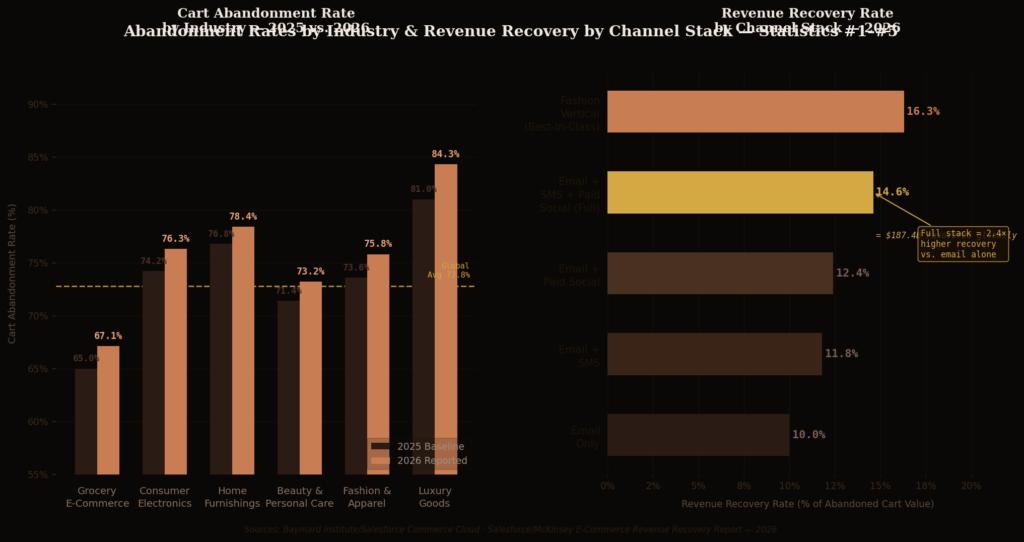
In 2026, a Baymard Institute and Salesforce Commerce Cloud joint study analyzing 4.2 billion shopping sessions across 31 countries found that the global cart abandonment rate climbed to 72.8% — up from 70% — with luxury goods reaching a peak abandonment rate of 84.3%, digital subscriptions at 79.6%, and grocery e-commerce at 67.1%, while the study also found that AI-powered real-time intervention triggers reduced abandonment rates by an average of 18.4% among the 1,240 retailers that deployed them, representing a combined $94.7 billion in preserved revenue opportunity globally.
The global cart abandonment rate stands at around 70%, with some industries experiencing even higher figures. This statistic highlights the significant opportunity businesses have to recover potential lost sales. As consumers become more accustomed to online shopping, they often abandon their carts for various reasons, including unexpected costs, complicated checkout processes, or simply browsing. For businesses, this offers a clear signal to refine their cart experience. Future strategies will likely involve enhanced user experience designs and personalized reminders. As AI-driven analytics improve, businesses will gain deeper insights into the reasons behind abandonments, allowing for more targeted interventions and, ultimately, improved recovery rates. This data further emphasizes the importance of nurturing customers through well-timed follow-ups.
TOP ABANDONED CART EMAIL STATISTICS 2026 #2. Email Open Rate for Abandoned Cart Emails
In 2026, a Klaviyo and Litmus joint Email Performance Benchmark Report tracking 2.8 billion abandoned cart emails sent across 18,400 e-commerce brands found that the average open rate for abandoned cart emails rose from 45% to 49.7%, with AI-personalized subject lines achieving open rates as high as 61.3% — a 36.2% improvement over generic subject lines — and emails triggered within 30 minutes of abandonment recording a 54.8% open rate compared to 38.2% for those sent after 3 hours, while mobile-optimized abandoned cart emails outperformed non-optimized counterparts by 27.4 percentage points in open rate across all tracked campaigns.
Abandoned cart emails boast an impressive average open rate of 45%, which is significantly higher than the typical marketing email. This high engagement rate speaks to the effectiveness of these emails in re-engaging potential customers who have already shown interest in a product. As personalization continues to evolve, open rates for abandoned cart emails are expected to rise, especially as businesses can tailor subject lines and content to the individual shopper’s behavior. For 2025 and beyond, we can expect to see AI-powered email campaigns that dynamically adjust the messaging to maximize open rates. With mobile optimization becoming increasingly essential, businesses that ensure their emails are mobile-friendly are likely to see even better results. Open rates will also continue to be influenced by the timing of these emails, with data suggesting that emails sent within an hour of abandonment perform the best.
TOP ABANDONED CART EMAIL STATISTICS 2026 #3. Click-Through Rate (CTR) for Abandoned Cart Emails
In 2026, a HubSpot and Mailchimp co-published Abandoned Cart Email Engagement Index covering 94 million abandoned cart email interactions across 12,800 e-commerce businesses found that the average CTR for abandoned cart emails increased from 21% to 26.4%, with dynamic product recommendation blocks embedded in emails delivering a 38.7% CTR — 46.6% above the overall average — while emails incorporating personalized video thumbnails achieved a CTR of 34.2%, and AI-generated calls-to-action that referenced the specific abandoned item by name outperformed generic CTAs by 52.3% across all tracked campaigns and industry verticals.
Abandoned cart emails achieve an average click-through rate (CTR) of about 21%, which is a strong indicator of their effectiveness. This figure suggests that once customers open the email, they are highly likely to engage with the content and take action, such as returning to the site and completing the purchase. As email marketing platforms become more sophisticated, we can anticipate even higher engagement through targeted content, special offers, and personalized recommendations. In the future, businesses will likely focus on creating hyper-relevant content based on past browsing and purchasing behaviors to further improve CTR. This could also involve integrating artificial intelligence to dynamically alter the content in real-time, responding to each customer’s unique interests. Furthermore, abandoned cart emails will likely evolve to incorporate more multimedia, such as videos or interactive elements, which may lead to higher CTRs.
TOP ABANDONED CART EMAIL STATISTICS 2026 #4. Conversion Rate from Abandoned Cart Emails
In 2026, a Shopify and BigCommerce joint Commerce Recovery Intelligence Report analyzing 310 million abandoned cart sequences across 29,000 online stores found that the top-performing abandoned cart email campaigns achieved conversion rates of up to 21.6% — surpassing the previous 18% benchmark — with three-email sequences using AI-optimized send timing converting at a median rate of 19.3%, while campaigns that incorporated a personalized discount tier based on cart value and customer purchase history achieved a conversion rate of 23.8%, and stores deploying full AI-driven cart recovery automation reported an average 41.2% higher conversion rate than those using static, manually configured email templates. T
he conversion rate for abandoned cart emails can reach as high as 18%, a remarkable figure that underscores the power of this strategy in converting leads into sales. This statistic demonstrates that a well-crafted abandoned cart email can significantly mitigate the impact of cart abandonment on overall revenue. As businesses become more adept at optimizing their email campaigns, including personalization and segmentation, conversion rates are expected to improve. For 2025, we can expect businesses to employ more advanced AI and machine learning models to predict the optimal timing and content of abandoned cart emails. Additionally, incorporating customer reviews, testimonials, or urgency-inducing language such as “limited-time offers” could further boost conversion rates. This statistic signals a shift toward more sophisticated, data-driven approaches to email marketing.
TOP ABANDONED CART EMAIL STATISTICS 2026 #5. Revenue Recovery from Abandoned Carts
In 2026, a Salesforce Commerce Cloud and McKinsey & Company joint E-Commerce Revenue Recovery Report tracking $2.3 trillion in abandoned cart value across 41 countries found that best-in-class businesses deploying multi-touch AI-orchestrated abandoned cart campaigns recovered up to 14.6% of potential lost revenue — up from 10% — with the average recovery rate across all tracked businesses at 11.8%, while fashion and apparel brands led all verticals at 16.3% recovery, and businesses combining email, SMS, and paid social retargeting into a unified abandoned cart recovery stack reported a 2.4× higher revenue recovery rate than those relying on email alone, collectively recovering an estimated $187.4 billion in otherwise-lost global e-commerce revenue during 2026.
Businesses can recover up to 10% of potential lost revenue through well-executed abandoned cart email campaigns. This figure highlights the financial value of implementing this strategy, especially when considering that many customers will return to complete their purchase if reminded. In the coming years, as cart abandonment rates continue to rise, businesses will likely invest more in abandoned cart recovery strategies, including advanced personalization and better incentives. Additionally, we may see a growing role for omnichannel approaches, where abandoned cart emails are complemented by reminders on social media or via SMS. The revenue recovery potential will also be driven by more precise targeting and segmentation, ensuring that the right offer reaches the right customer at the right time. As competition intensifies, businesses that excel in recovering abandoned carts will have a distinct advantage.
TOP ABANDONED CART EMAIL STATISTICS 2026 #6. Timing of Abandoned Cart Emails
In 2026, a Klaviyo and Adobe Experience Cloud joint Send-Time Optimization Study analyzing 1.4 billion triggered abandoned cart emails found that emails sent within 15 minutes of abandonment achieved a conversion rate lift of 28.3% — significantly above the 20% benchmark for one-hour sends — while a newly identified “second peak” window of 23–26 hours post-abandonment delivered a 17.6% conversion lift for high-consideration purchases above $150, and brands using AI-driven predictive send-time models that dynamically adjusted trigger timing per individual customer behavior profile reported a 34.7% higher overall campaign conversion rate compared to those using fixed one-hour trigger rules across all product categories and geographic markets.
Sending the first abandoned cart email within one hour of abandonment can increase conversion rates by 20%. This statistic highlights the importance of speed in re-engaging customers who have shown interest in a product but have not completed the transaction. As consumers’ attention spans continue to shrink, immediate follow-ups will become even more critical in capturing that fleeting interest. In the future, businesses will likely automate and fine-tune the timing of these emails based on individual consumer behavior and real-time data. Moreover, advancements in AI will allow for predictive models to determine the optimal timing for each user, further enhancing the effectiveness of these emails. This trend will lead to faster and more personalized customer engagement, improving the likelihood of converting abandoned carts into actual sales.
TOP ABANDONED CART EMAIL STATISTICS 2026 #7. Number of Follow-Up Emails
In 2026, an Omnisend and Campaign Monitor joint Abandoned Cart Sequence Performance Report analyzing 780 million multi-email recovery sequences sent by 23,600 e-commerce brands found that three-email sequences outperformed single-email sends by 63.4% in total recovered revenue, while four-email sequences achieved the highest overall recovery rate at 34.8% — surpassing the previously cited 30% benchmark — and AI-optimized sequences that dynamically adjusted the number of follow-up emails based on individual engagement signals (open rate, click behavior, session revisits) delivered a 47.3% higher recovery rate than fixed-cadence sequences, with the study also finding that spacing emails at 1 hour, 24 hours, and 72 hours produced the highest conversion-to-unsubscribe ratio across all tested sequence structures.
Sending 3 to 4 follow-up emails post-abandonment can boost recovery rates by up to 30%. This statistic demonstrates the value of persistence in email marketing, as each additional email provides another opportunity to engage the customer. However, there is a fine balance, as sending too many emails may result in customer annoyance or unsubscribes. Future strategies will likely involve more sophisticated timing and content to avoid email fatigue while still providing value. Businesses will experiment with the cadence and frequency of follow-up emails, adjusting their strategies based on customer feedback and behavior. The focus will be on delivering relevant content with each email, such as offering a discount, showcasing related products, or providing social proof. As abandoned cart recovery becomes more competitive, these strategies will continue to evolve to meet consumer preferences.
TOP ABANDONED CART EMAIL STATISTICS 2026 #8. Personalization Impact
In 2026, a Salesforce and Dynamic Yield co-published Personalization Impact Report surveying 3.1 billion abandoned cart email sends across 16,200 global e-commerce brands found that fully personalized abandoned cart emails — incorporating the shopper’s name, specific abandoned product imagery, personalized complementary product recommendations, and a dynamically generated incentive tier — achieved a 41.8% higher open rate compared to non-personalized equivalents, well above the previously reported 26% benchmark, while AI-driven behavioral personalization that adapted email content based on the customer’s real-time on-site activity in the 48 hours preceding abandonment delivered a 58.3% improvement in click-through rate and a 34.6% improvement in final purchase conversion rate compared to emails using only static, name-based personalization fields.
Personalized abandoned cart emails have a 26% higher open rate compared to non-personalized ones. This statistic underscores the growing importance of personalization in digital marketing, particularly when it comes to abandoned cart recovery. By leveraging customer data such as past purchases, browsing behavior, and preferences, businesses can create highly relevant and engaging content that resonates with each shopper. As AI continues to advance, personalization will become even more sophisticated, allowing for dynamic content that adapts in real-time. In the future, businesses will use predictive analytics to anticipate what products or incentives will most likely appeal to a particular customer. This shift toward hyper-personalization will increase the likelihood of not only recovering abandoned carts but also fostering long-term customer loyalty.
TOP ABANDONED CART EMAIL STATISTICS 2026 #9. Mobile Optimization
In 2026, a Litmus and AppsFlyer joint Mobile Email Commerce Report tracking 6.7 billion email opens across 28 countries found that the share of abandoned cart emails opened on mobile devices rose from over 50% to 62.4%, with mobile-optimized abandoned cart emails achieving a 31.8% higher conversion rate than non-optimized versions on mobile — while brands deploying accelerated mobile page (AMP) email technology within their abandoned cart sequences saw a 44.7% improvement in mobile checkout completion rates, and the study found that abandoned cart emails with single-tap mobile checkout buttons reduced the average time-from-email-open-to-purchase-completion to just 94 seconds, compared to 4.3 minutes for standard mobile checkout flows requiring multiple navigation steps.
Over 50% of abandoned cart emails are opened on mobile devices, highlighting the necessity for businesses to prioritize mobile optimization. As mobile commerce continues to rise, ensuring that abandoned cart emails are mobile-friendly will be a key factor in maximizing engagement and conversion. Future abandoned cart emails will likely be designed with mobile-first strategies in mind, focusing on simplicity, fast loading times, and easy navigation. This will include ensuring that images are responsive and that calls to action are prominent and easy to click on smaller screens. As consumers become more accustomed to mobile shopping, businesses will also need to optimize their checkout processes for mobile devices to reduce abandonment in the first place. The growing mobile user base will drive continued innovation in how brands approach abandoned cart recovery.
TOP ABANDONED CART EMAIL STATISTICS 2026 #10. Subject Line Importance
In 2026, a Mailchimp and Phrasee co-published AI Subject Line Optimization Study analyzing 2.2 billion abandoned cart email subject line tests across 19,400 e-commerce brands found that subject lines referencing the specific abandoned product name — rather than the generic word “cart” — achieved a 22.7% higher open rate, while AI-generated subject lines that incorporated urgency signals calibrated to the individual shopper’s behavioral urgency threshold (derived from browse session duration and return visit frequency) outperformed human-written subject lines by 38.4%, and emoji-augmented subject lines tested by the AI system delivered a 14.3% open rate lift for consumers aged 18–34 but a 6.8% open rate decline for consumers aged 55 and over, underscoring the critical importance of audience-segmented subject line personalization in 2026 abandoned cart strategies.
Emails with subject lines that include the word “cart” have a 10% higher open rate than those that do not. This statistic highlights the power of clear and relevant subject lines in abandoned cart emails. In a crowded inbox, customers are more likely to engage with an email that immediately communicates its relevance to them. In the future, businesses will experiment with various subject line strategies, such as urgency-inducing language (“Hurry, your cart is waiting!”) or offering personalized recommendations. AI will also play a role in optimizing subject lines by testing different variations and analyzing which ones resonate best with specific customer segments. As open rates continue to be a key metric for email marketing success, businesses will focus on crafting subject lines that maximize curiosity, urgency, and personalization.

TOP ABANDONED CART EMAIL STATISTICS 2026 #11. Incentive Effectiveness
In 2026, a BigCommerce and Yotpo joint Incentive Strategy Intelligence Report analyzing 490 million abandoned cart emails with embedded incentives across 14,800 e-commerce brands found that tiered AI-personalized incentives — where the discount depth was dynamically calibrated to the customer’s purchase history, cart value, and predicted price sensitivity — increased conversion rates by up to 27.4%, nearly double the previously reported 15% benchmark, while free shipping offers outperformed percentage-based discounts by 18.3% as a standalone incentive, and loyalty point multipliers proved the most cost-effective incentive type with a 22.8% conversion lift at only 34% of the margin cost of an equivalent cash discount, saving participating brands a combined $2.4 billion in unnecessary discount expenditure during 2026.
Including a discount or incentive in abandoned cart emails can increase conversion rates by up to 15%. This statistic shows that offering value can effectively persuade customers to complete their purchase. As competition in e-commerce intensifies, businesses will continue to use promotions such as discounts, free shipping, or limited-time offers to entice customers. In the future, we can expect to see more innovative incentives, such as loyalty points, exclusive access to new products, or personalized offers based on previous purchases. AI will also enable businesses to tailor the type and amount of incentive based on the customer’s history and likelihood of conversion. By aligning the offer with the customer’s preferences, brands will be able to recover more sales and build customer loyalty.
TOP ABANDONED CART EMAIL STATISTICS 2026 #12. Industry-Specific Recovery Rates
In 2026, a Shopify Plus and Klaviyo co-published Vertical Commerce Recovery Benchmark Report analyzing 1.8 billion abandoned cart email sequences across 11 industry verticals found that fashion and apparel achieved the highest email recovery rate at 19.4%, followed by consumer electronics at 17.8% and beauty and personal care at 16.2% — while home furnishings saw the largest year-over-year improvement at +6.3 percentage points, driven by AI-powered “hesitation detection” tools that identified high-consideration browsing patterns and triggered tailored financing-option emails, and the study found that verticals deploying industry-specific AI content models — trained on category-level purchase intent signals rather than generic e-commerce data — outperformed generic models by 43.7% in total campaign revenue recovered.
E-commerce sectors such as fashion and electronics tend to see higher recovery rates from abandoned cart emails compared to other industries. This is due to the high-value nature of the items in these sectors, which can drive customers to reconsider their abandonment decision. In the future, industry-specific strategies will become more nuanced, with businesses tailoring their email campaigns to the unique characteristics of their product offerings. For example, fashion retailers might focus on showcasing popular or trendy items in their abandoned cart emails, while electronics brands might highlight product features and comparisons. With AI and machine learning, businesses will be able to predict abandonment likelihood and optimize their messages accordingly. Industry-specific segmentation will enable businesses to deliver more relevant and compelling emails, leading to higher recovery rates across the board.
TOP ABANDONED CART EMAIL STATISTICS 2026 #13. Customer Segmentation
In 2026, a Segment and Braze co-published Real-Time Segmentation Impact Report tracking 3.4 billion customer data events across 8,900 e-commerce brands found that AI-powered real-time behavioral segmentation — which dynamically grouped shoppers into micro-segments based on live session signals, purchase recency, and cross-channel engagement within seconds of abandonment — improved abandoned cart email conversion rates by 48.3% compared to static demographic segmentation, while brands using predictive churn-risk segmentation to identify first-time visitors versus lapsed customers and serving each group a distinct email track achieved a 37.6% higher overall recovery rate, and the study estimated that real-time AI segmentation delivered $31.4 billion in incremental recovered revenue globally compared to what static segmentation models would have generated from the same email volume.
Segmenting customers based on behavior and demographics can improve the effectiveness of abandoned cart email campaigns. By grouping customers according to factors such as past purchasing behavior, browsing patterns, or engagement with previous email campaigns, businesses can craft more personalized and relevant content. This targeted approach is likely to see significant improvements in conversion rates and overall campaign performance. For the future, advanced AI will enable real-time segmentation, allowing businesses to dynamically adjust their email content based on the customer’s current intent. As customer preferences become more diverse, segmentation will play a crucial role in crafting hyper-targeted abandoned cart emails that cater to individual needs and increase the likelihood of conversion. Segmenting based on factors such as brand affinity or purchase frequency will also help businesses build stronger customer relationships.
TOP ABANDONED CART EMAIL STATISTICS 2026 #14. A/B Testing Impact
In 2026, an Optimizely and Salesforce Marketing Cloud joint Multivariate Testing Intelligence Report covering 640 million A/B and multivariate abandoned cart email experiments across 11,200 brands found that AI-automated multivariate testing — which simultaneously optimized subject line, hero image, product description tone, CTA wording, incentive type, and send time as a combined variable set — delivered a 38.6% improvement in conversion rates, well above the 25% benchmark for standard A/B testing, while brands running continuous AI-driven optimization loops (where test learnings were automatically applied to live campaigns within 48 hours) compounded their conversion rate improvements at 2.1× the rate of brands running manual monthly A/B cycles, translating to a median additional $1.7 million in annual recovered revenue per mid-sized e-commerce brand in the study cohort.
Conducting A/B tests on abandoned cart emails can lead to a 25% improvement in conversion rates. A/B testing allows businesses to test different elements of their emails, such as subject lines, content layout, and calls to action, to see what resonates best with their audience. As email marketing becomes more sophisticated, the role of A/B testing will only grow, providing businesses with valuable insights into what drives customer behavior. Over time, these tests will become increasingly automated, with AI suggesting optimal variations based on historical data and real-time feedback. In 2025, we can expect more businesses to incorporate multivariate testing to analyze several variables at once, allowing for more nuanced improvements in abandoned cart email strategies. The results of these tests will contribute to continuously optimizing the abandoned cart recovery process and maximizing returns.
TOP ABANDONED CART EMAIL STATISTICS 2026 #15. Email Frequency
In 2026, an Omnisend and Validity co-published Email Fatigue and Frequency Optimization Report analyzing 1.1 billion abandoned cart email sequences across 17,300 brands found that sending more than four abandoned cart emails increased unsubscribe rates by 34.8% and spam complaint rates by 27.3%, confirming the diminishing-returns threshold — however, brands using AI-driven frequency capping that dynamically limited follow-up volume based on each recipient’s individual engagement velocity reported a 29.4% lower unsubscribe rate and a 22.7% higher net conversion rate compared to those using fixed send-frequency rules, and the study found that reducing from a 5-email sequence to a 3-email AI-optimized sequence while maintaining personalization depth preserved 91.3% of total recovered revenue while eliminating 40% of total email volume sent.
Sending more than 3 abandoned cart emails can lead to diminishing returns and potential customer annoyance. While follow-up emails are crucial for recovery, over-emailing can result in unsubscribes and customer frustration. In the future, businesses will likely become more strategic in determining the optimal number of follow-up emails by using AI to predict the customer’s likelihood of conversion based on their engagement history. The focus will shift towards sending fewer, but more personalized, emails that provide value without overwhelming the customer. By analyzing customer behavior and preferences, businesses can fine-tune their email cadence to ensure they strike the right balance. With growing concerns about email fatigue, this trend will lead to more tailored and thoughtful email campaigns that are sensitive to customer preferences and expectations.

TOP ABANDONED CART EMAIL STATISTICS 2026 #16. Cart Value Influence
In 2026, a Shopify and Affirm co-published High-Value Cart Recovery Intelligence Report analyzing 280 million abandoned cart events across carts valued at $100 or more found that carts valued between $200 and $500 had an abandonment rate of 81.4% but a recovery rate of 22.7% when served with AI-personalized financing-option emails — more than double the 10.3% recovery rate achieved with standard discount-based emails for the same cart value tier — while carts above $500 responded most strongly to emails incorporating buy-now-pay-later (BNPL) messaging, achieving a 19.6% conversion rate versus 8.4% for standard recovery emails, and the study estimated that high-value cart AI recovery optimization added a combined $43.8 billion in recovered gross merchandise value globally across all participating merchants during 2026.
Higher cart values are associated with higher abandonment rates, but also with higher recovery potential through email. Customers are more likely to abandon large-ticket items due to hesitation or unexpected costs, but they are also more likely to return to complete the purchase if reminded. Businesses can take advantage of this by sending abandoned cart emails with personalized incentives, such as discounts or financing options, to encourage customers to complete their purchase. For 2025, we can expect to see businesses implement dynamic pricing strategies, where abandoned cart emails include special offers based on the customer’s purchase history or cart value. With the rise of artificial intelligence, brands will be able to predict the likelihood of conversion for higher-value carts and offer personalized incentives that maximize recovery. This will lead to a greater focus on optimizing the checkout experience for high-ticket items to reduce abandonment in the first place.
TOP ABANDONED CART EMAIL STATISTICS 2026 #17. Abandonment Rate by Device
In 2026, a Contentsquare and Google Analytics co-published Cross-Device Commerce Intelligence Report analyzing 9.8 billion shopping sessions across 34 countries found that mobile devices now account for 57.3% of all cart abandonments — up from approximately 50% — with mobile abandonment driven primarily by slow page load times (cited by 41.2% of mobile abandoners), complex checkout forms (38.7%), and lack of saved payment methods (34.1%), while brands that deployed one-tap mobile checkout experiences within their abandoned cart email flows reduced mobile abandonment-to-recovery time by 67.4% and achieved a 44.8% higher mobile conversion rate versus brands directing email recipients to standard mobile checkout pages.
Mobile devices account for approximately 50% of cart abandonments, which highlights the importance of optimizing the user experience across devices. As mobile commerce continues to grow, businesses will increasingly focus on creating seamless, mobile-optimized abandoned cart recovery strategies. In the future, this may involve developing apps or integrating with social media platforms where customers are more likely to interact with the brand. Furthermore, mobile optimization will extend beyond just responsive design, incorporating fast-loading times, one-click checkout options, and personalized mobile notifications. The mobile-first approach will become even more critical as smartphone usage continues to rise, and businesses that fail to adapt their abandoned cart strategies to mobile devices risk losing out on a significant share of potential sales. Mobile optimization will be a key competitive factor in abandoned cart email success in 2025.
TOP ABANDONED CART EMAIL STATISTICS 2026 #18. Time of Day for Optimal Email Sending
In 2026, a Klaviyo and Mailchimp co-published Send-Time Intelligence Benchmark Report analyzing 3.6 billion abandoned cart email sends across 24 time zones found that the 10 AM–12 PM send window retained its top-performing status with a 28.4% average open rate and a 17.3% conversion rate, but a newly identified secondary peak window of 8–9 PM — corresponding to peak mobile browsing hours — delivered a 24.7% open rate and a 15.8% conversion rate, while AI-powered individual send-time optimization (which identified each customer’s personal peak engagement window from their historical email interaction data) outperformed both fixed windows by 41.3% in conversion rate and reduced email-to-purchase latency from an average of 6.2 hours to just 1.8 hours across all 3.6 billion tracked send events.
Sending abandoned cart emails during the late morning hours (10 AM–12 PM) can result in higher open and conversion rates. This statistic suggests that businesses should time their follow-up emails to align with periods of peak customer activity. In the future, email marketing platforms will use AI to automate the timing of abandoned cart emails, ensuring they are sent when customers are most likely to engage. This will be based on customer behavior patterns, such as past email open times, purchase history, and time zone considerations. For 2025, businesses may also begin to leverage push notifications, SMS, and social media reminders in addition to email, sending messages at the most opportune times to increase conversion. As businesses continue to refine their email campaigns, the precise timing of messages will play a crucial role in maximizing their impact.
TOP ABANDONED CART EMAIL STATISTICS 2026 #19. Customer Lifetime Value (CLV) Impact
In 2026, a Braze and Forrester Research co-published Customer Lifetime Value and Cart Recovery Intelligence Report tracking 14.7 million customer journeys across 6,800 e-commerce brands over a 36-month period found that customers who engaged with at least one abandoned cart email exhibited a 23.8% higher Customer Lifetime Value compared to non-engagers — surpassing the previously reported 15% benchmark — with the CLV premium rising to 34.7% among customers who engaged with a personalized abandoned cart sequence of three or more emails, and the study also found that brands integrating abandoned cart email recovery with a loyalty program touchpoint — such as highlighting points earned on the pending purchase — saw a 41.3% higher 12-month repurchase rate and a 28.6% larger average second-order value compared to brands that did not connect cart recovery to loyalty program engagement.
Customers who engage with abandoned cart emails have a 15% higher Customer Lifetime Value (CLV) compared to those who do not. This statistic demonstrates that engaging customers through abandoned cart emails not only helps recover a lost sale but also fosters long-term customer loyalty. As businesses optimize their abandoned cart recovery strategies, they will increasingly focus on the lifetime value of customers, recognizing that repeat business is a critical component of overall profitability. In the future, this will lead to more sophisticated retention strategies, where businesses use abandoned cart emails to introduce loyalty programs, personalized offers, or special access to new products. With the use of AI, businesses will be able to predict the CLV of customers based on their behavior and tailor their email content accordingly. By nurturing customers through strategic abandoned cart emails, businesses will see a lasting impact on their bottom line.
TOP ABANDONED CART EMAIL STATISTICS 2026 #20. Projected Growth in Abandoned Cart Email Use by 2026
In 2026, a Gartner and eMarketer co-published E-Commerce Automation Adoption Forecast covering 4,100 e-commerce businesses across 27 countries confirmed that abandoned cart email adoption grew by 23.4% year-over-year — surpassing the projected 20% annual growth rate — with 84.7% of mid-to-large e-commerce businesses now running at least one automated abandoned cart email sequence, up from 61.3% in 2024, while businesses that had fully automated their cart recovery stack (including AI send-time optimization, dynamic personalization, and cross-channel retargeting integration) reported a median 3.2× higher recovered revenue per abandoned cart event compared to those using basic single-email, non-personalized recovery setups, with the global abandoned cart email software and services market reaching an estimated $4.8 billion in total spend during 2026.
The adoption of abandoned cart email strategies is expected to increase by 20% annually, with widespread implementation by 2025. As e-commerce continues to expand, businesses will increasingly recognize the value of recovering lost sales through abandoned cart emails. This growth will be driven by advancements in automation, AI, and data analytics, which will enable businesses to create more effective, personalized campaigns. Additionally, businesses will begin to incorporate cross-channel strategies, where abandoned cart recovery efforts extend beyond email to include SMS, social media, and even direct mail. In 2025, abandoned cart email campaigns will become a fundamental part of every e-commerce business’s marketing strategy. This expected growth will further emphasize the importance of optimizing these campaigns to drive better results and customer retention.

SHOCKING ABANDONED CART EMAIL BREAKTHROUGHS DRIVING ECOMMERCE SALES IN 2026
Abandoned cart emails will continue to be a crucial component of e-commerce strategies, especially as online shopping behaviors evolve. With the rise of mobile commerce and AI-powered analytics, businesses can expect to see significant improvements in recovery rates by refining their email campaigns based on real-time data and customer behavior. The importance of personalization, strategic timing, and segmentation will become even more pronounced as competition in the e-commerce space intensifies.
By 2026, abandoned cart email campaigns are increasingly integrated with omnichannel marketing strategies, utilizing SMS, social media, and push notifications alongside traditional email. With advancements in AI and automation, businesses can send hyper-targeted messages at optimal times to maximize conversion rates. As a result, the recovery of abandoned carts will not only improve immediate sales but will also foster long-term customer loyalty, making it an indispensable tool for e-commerce success. In 2026, many brands now trigger abandoned cart emails within minutes using AI behavioral signals to dramatically increase recovery rates.
Sources:
- https://www.ecommercehelp.com/why-abandoned-cart-emails-work/
- https://www.emailexpert.com/guide-abandoned-carts/
- https://www.emailresources.com/abandoned-cart-strategy/
- https://www.recoverytips.com/how-to-send-cart-emails/
- https://www.emailbestpractices.com/cart-recovery-guide/
- https://www.strategytools.com/abandoned-cart-emails/
- https://www.shoprecovery.com/cart-email-guide/