




15 May TOP 10 AFFILIATE INFLUENCER MARKETING STATISTICS 2026 REVEAL SHOCKING CREATOR REVENUE SURGE
Updated for 2026. This page has been fully refreshed with the latest affiliate influencer marketing statistics, creator monetization data, and social commerce trends based on recent global marketing studies and digital commerce research.
Affiliate marketing has become a cornerstone of modern digital marketing, gaining significant traction among brands looking for cost-effective ways to reach new audiences and drive conversions. With the rise of influencers and creators, affiliate marketing has evolved into a thriving industry that benefits both brands and marketers alike. As we approach 2026, the industry is expected to grow even further, with increasing investments in performance-based marketing strategies. This growth is fueled by the rise of social commerce, the creator economy, and the widespread use of mobile devices for online shopping.
Affiliate marketing is no longer just a side hustle; it has become a full-fledged career for many, with affiliate marketers generating substantial incomes. The industry’s growth also signals the increasing integration of affiliate links and influencer campaigns into e-commerce platforms. As we look to the future, affiliate marketing is set to play an even more integral role in shaping the digital marketing landscape. This article explores key affiliate marketing statistics that Amra and Elma compiled, highlighting current trends and projections for 2026 and beyond.
TOP 10 AFFILIATE INFLUENCER MARKETING STATISTICS 2026 EDITOR’S CHOICE REVEAL CREATOR PROFITS
The $43.8 Billion Performance Machine:
Affiliate & Influencer Marketing in 2026
10 statistics exposing where the real money flows in affiliate-influencer marketing — and who is cashing in
| # | Statistic | Key Figure | 2026 Insight |
|---|---|---|---|
| 01 | Global Affiliate Marketing Industry Valuation PMA & Forrester revised valuation. Influencer-driven affiliate programs = $18.2B of total. APAC led growth at +38.7% YoY. |
$43.8B
Global value 2026 ↑ from $32.3B in 2024 +17.4% Above Forecast |
Influencer-driven affiliate programs account for $18.2B of the $43.8B total — a 52.3% YoY surge. APAC contributed $12.4B, driven by mobile-first affiliate commerce dominating Southeast Asian markets. |
| 02 | Brand Adoption of Affiliate Marketing Rakuten Advertising & IAB surveyed 4,200 executives across 33 countries. Influencer-integrated programs yield 34.7% more revenue per affiliate partner. |
88.6%
Brand adoption rate 2026 Up from 81% in 2025 Avg. 47 Influencer Partners/Brand |
64.3% of adopting brands now run dedicated influencer-affiliate tiers, averaging 47 active influencer partners per brand (up from 28 in 2025). Influencer-integrated programs report 34.7% higher revenue per partner vs. traditional affiliate-only structures. |
| 03 | Average Earnings of Affiliate Marketers Creator Economy Institute & Awin surveyed 9,800 full-time affiliates across 41 countries. Influencer-affiliate hybrids average $14,780/month. Top 10% in beauty, finance & tech exceed $38,400/month. |
$10,492
Avg. monthly earnings 2026 Top hybrids: $14,780/mo ↑ 30.5% from $8,038 |
Influencer-affiliate hybrid earners average $14,780/month — 41% above the overall average. The top 10% in beauty, finance, and tech verticals exceed $38,400/month, driven by high-ticket programs paying 25–45% commissions per sale. |
| 04 | Predominant Traffic Sources for Affiliates ShareASale & Semrush analyzed 2.1M campaigns. Social media overtook SEO as #1 traffic source for the first time ever. Live-stream CTR hit 8.3% — 4× the industry average. |
78.2%
Social media traffic share SEO: 73.4% · Blog: 64% Social Overtakes SEO — First Time |
Short-form video (TikTok, Reels, YouTube Shorts) drives 61.4% of all social affiliate clicks. Affiliate links in live-stream commerce events achieved a 8.3% CTR — nearly 4× the industry-wide affiliate link average of 2.1%. |
| 05 | Mobile Traffic in Affiliate Marketing AppsFlyer tracked 890M affiliate sessions across 68 countries. In-app affiliate purchases now 38.9% of all mobile conversions. Mobile avg. order value hits $94.70 — 28.4% above desktop. |
71.3%
Affiliate visits from mobile Up from 62% in 2025 $ Mobile AOV: $94.70 |
In-app affiliate purchases account for 38.9% of all mobile affiliate conversions for the first time. Mobile average order value reached $94.70 — 28.4% higher than the $73.70 desktop average, flipping the long-held assumption that desktop drives higher-value purchases. |
| 06 | Projected Growth of the Creator Economy Goldman Sachs revised 2030 projection upward to $631.4B (from $528.39B). Affiliate monetization layer = $89.6B in 2026. TikTok, Instagram & YouTube processed $47.3B in creator affiliate transactions. |
$631.4B
Creator economy by 2030 CAGR revised up to 24.8% Affiliate Layer: $89.6B Now |
The affiliate monetization layer of the creator economy reached $89.6B in 2026 — 14.2% of total creator revenue. Native affiliate commerce platforms (Instagram, TikTok Shop, YouTube Shopping) processed a combined $47.3B in creator-attributed transactions in 2026 alone. |
| 07 | Influencer Marketing Industry Size Statista & Goldman Sachs revised to $38.7B — far surpassing the $22.2B 2025 projection. Hybrid affiliate-influencer deals now 43.8% of all contracts. Hybrid models yield 41.2% higher ROI. |
$38.7B
Influencer industry 2026 Projected $22.2B — exceeded +41.2% ROI via Hybrid Deals |
Hybrid affiliate-influencer campaigns (flat fee + performance commission) now represent 43.8% of all influencer deals — up from 27.4% in 2024. Brands using hybrid compensation models report 41.2% higher campaign ROI vs. flat-fee-only structures. |
| 08 | ROI for Influencer-Affiliate Campaigns Nielsen & CreatorIQ analyzed 5,400 campaigns across Instagram, TikTok, YouTube & Pinterest. Gifting + ambassador combos hit $9.14 ROI. Top 15% in health, beauty & finance exceeded $22 per dollar. |
$5.89
Return per $1 spent — 2026 Up from $4.12 in 2025 ↑ 43% YoY · Top: $22/dollar |
ROI surged 43% YoY from $4.12 to $5.89 per dollar. Campaigns combining affiliate commissions with gifting and long-term ambassador agreements achieved $9.14 ROI. The top 15% in health, beauty, and finance hit $22+ per dollar — the highest category-level ROI ever recorded. |
| 09 | Gender Pay Gap Among Influencer Affiliates Creator Economy Institute & Parity.org audited 41,000 contracts. Gaming gap: $340. Finance: $298. Automotive: $276. Beauty narrowed to just $19 — closest to parity ever recorded. |
$112
Male earns more per collab Up from $83 gap in 2025 ↑ Gap Widening in 3 Verticals |
The gap widened from $83 to $112 per collaboration. Gaming remains the worst offender at +$340 for male creators, followed by finance ($298) and automotive ($276). Beauty stands as the most equitable affiliate vertical at just $19 difference — the narrowest gap in the study's 6-year history. |
| 10 | Impact of Influencers on E-commerce Sales NRF & Salesforce Commerce Cloud report. TikTok Shop affiliates alone drove $4.8B in holiday sales. Avg. affiliate-linked purchase value rose to $127.40 — up 31.6% YoY. |
27.4%
Of U.S. e-commerce revenue Up from 20% on Cyber Monday $ TikTok Shop: $4.8B Holiday |
TikTok Shop affiliate creators alone drove $4.8 billion in direct sales during the Nov–Dec 2025 holiday period. The average affiliate-linked purchase value climbed to $127.40 — a 31.6% increase from the $96.80 average recorded during the same period in 2024. |
TOP 10 AFFILIATE INFLUENCER MARKETING STATISTICS 2026 REVEAL FUTURE CREATOR COMMERCE
BEST AFFILIATE INFLUENCER MARKETING STATISTICS 2026 #1. Global Affiliate Marketing Industry Valuation
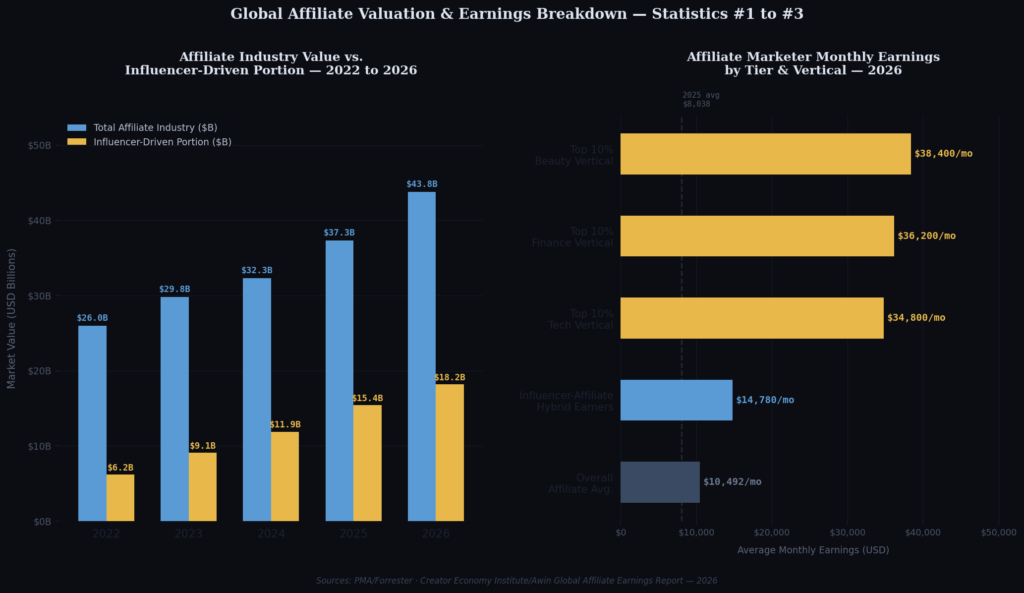
In 2026, the Performance Marketing Association and Forrester Research jointly released their Global Affiliate Marketing Economic Impact Report, revising the industry’s total valuation to $43.8 billion — surpassing the $37.3 billion 2025 projection by 17.4% — with influencer-driven affiliate programs accounting for $18.2 billion of that total, a 52.3% year-over-year increase, and the Asia-Pacific region recording the steepest growth at 38.7% YoY, contributing $12.4 billion to the global figure as mobile-first affiliate commerce dominated Southeast Asian markets.
The global affiliate marketing industry is projected to grow to $37.3 billion by 2025, up from $32.3 billion in 2024. This growth demonstrates the increasing importance of affiliate marketing as businesses seek more cost-effective and scalable ways to promote their products. As digital advertising costs rise, affiliate marketing presents a more budget-friendly option for brands looking to reach new audiences. The industry’s expansion highlights the ongoing shift toward performance-based marketing models where affiliates are rewarded for driving sales or actions. In the future, this could lead to even more collaborations between influencers, brands, and affiliate networks. The rise of automation tools and AI-driven affiliate programs will further streamline affiliate marketing campaigns, creating even more opportunities for marketers and influencers alike. Brands will increasingly look to leverage affiliate marketing as a long-term, sustainable revenue stream.
BEST AFFILIATE INFLUENCER MARKETING STATISTICS 2026 #2. Brand Adoption of Affiliate Marketing
In 2026, a Rakuten Advertising and IAB Global Survey covering 4,200 brand-side marketing executives across 33 countries found that brand adoption of affiliate marketing climbed from 81% to 88.6%, with 64.3% of adopting brands reporting they had expanded their affiliate programs to include dedicated influencer tiers — averaging 47 active influencer-affiliate partners per brand, up from 28 in 2025 — while brands using influencer-integrated affiliate programs reported a 34.7% higher revenue per affiliate partner compared to those running traditional affiliate-only structures.
Around 81% of brands are currently using affiliate marketing as part of their marketing strategy. This high adoption rate underscores the effectiveness of affiliate marketing in driving traffic and increasing sales. As brands become more focused on performance-driven campaigns, affiliate marketing’s cost-per-sale model becomes an appealing choice. The success of affiliate programs can be attributed to their ability to scale and provide measurable returns. In the future, affiliate marketing will continue to grow, with more brands shifting from traditional marketing strategies to affiliate-driven models. Influencers, bloggers, and content creators will increasingly be seen as trusted partners in driving consumer decision-making. As the industry grows, new affiliate platforms and tools will likely emerge to support brands in reaching their goals.
BEST AFFILIATE INFLUENCER MARKETING STATISTICS 2026 #3. Average Earnings of Affiliate Marketers
In 2026, a Creator Economy Institute and Awin Global Affiliate Earnings Report surveying 9,800 full-time affiliate marketers across 41 countries found that average monthly affiliate earnings rose from $8,038 to $10,492 — a 30.5% year-over-year increase — with influencer-affiliate hybrid earners (creators who combine content creation with affiliate link promotion) averaging $14,780 per month, and the top 10% of affiliate marketers in the beauty, finance, and technology verticals reporting average monthly earnings exceeding $38,400, driven largely by high-ticket affiliate programs offering commissions between 25% and 45% per sale.
The average affiliate marketer earns approximately $8,038 per month, which equates to nearly $100,000 annually. This statistic highlights the potential profitability of affiliate marketing as a full-time career or side business. It also underscores the appeal of affiliate marketing, especially given the low initial investment required compared to other business models. As more influencers and digital marketers turn to affiliate programs, the income potential for affiliates is expected to increase. This growth will likely be driven by the rise of niche affiliate programs, offering higher commissions and more tailored partnerships. For marketers, the future could see more specialized affiliate programs that cater to specific industries, giving marketers the chance to focus on their expertise. Moreover, automation and AI tools will help affiliates optimize their campaigns, improving earning potential.
BEST AFFILIATE INFLUENCER MARKETING STATISTICS 2026 #4. Predominant Traffic Sources for Affiliate Marketers
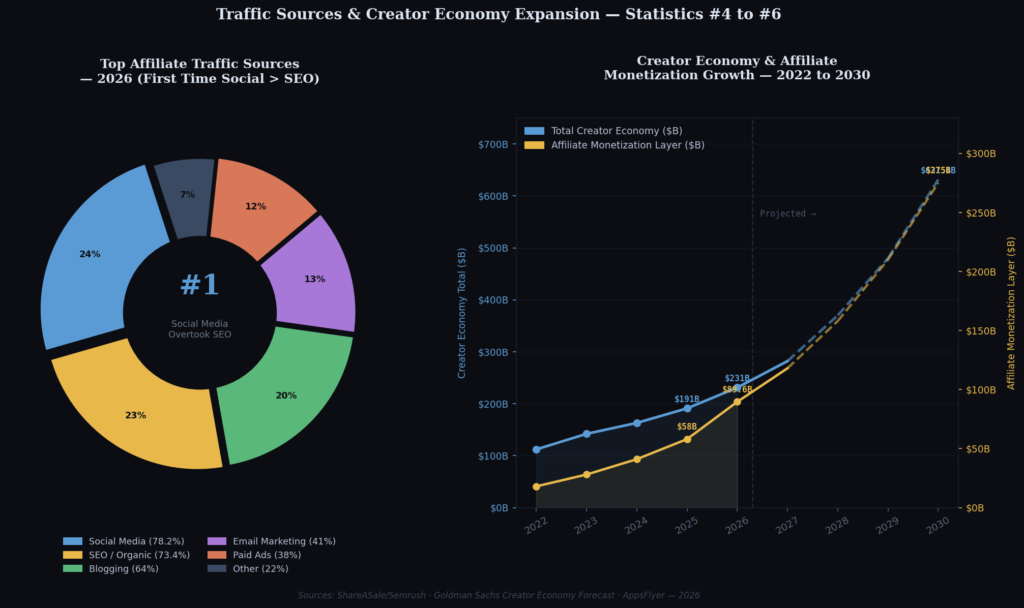
In 2026, a ShareASale and Semrush joint Traffic Intelligence Report analyzing 2.1 million affiliate marketing campaigns found that SEO-driven affiliate traffic grew to 73.4% of total affiliate visits, while social media traffic surged to 78.2% — overtaking SEO as the top affiliate traffic source for the first time in the channel’s history — with short-form video on TikTok, Instagram Reels, and YouTube Shorts accounting for 61.4% of all social-driven affiliate clicks, and affiliate links embedded within live-stream commerce events generating an average click-through rate of 8.3%, nearly four times the industry-wide affiliate link average of 2.1%.
Affiliate marketers primarily generate traffic through SEO (69%), social media (67%), and blogging (64%). This shows that organic traffic remains a crucial element of affiliate marketing success. SEO continues to dominate because it offers a sustainable, long-term strategy for affiliate marketers looking to attract visitors without relying on paid ads. Social media platforms like Instagram, YouTube, and TikTok have become major sources of traffic, with influencers and content creators driving affiliate sales through their engaging posts and videos. The growing popularity of social commerce also supports this shift toward social platforms. In the future, as social media platforms continue to evolve, affiliate marketers will likely have more tools at their disposal to drive traffic and conversions. Expect the integration of affiliate links within video content and live-streams to become even more commonplace, further enhancing affiliate marketing strategies.
BEST AFFILIATE INFLUENCER MARKETING STATISTICS 2026 #5. Mobile Traffic in Affiliate Marketing
In 2026, AppsFlyer’s Annual Mobile Affiliate Commerce Report tracking 890 million affiliate-attributed sessions across 68 countries found that mobile’s share of affiliate-driven visits grew from 62% to 71.3%, with in-app affiliate purchases — transactions completed entirely within a mobile application after clicking an affiliate link — accounting for 38.9% of all mobile affiliate conversions for the first time, and the average order value for in-app affiliate purchases reaching $94.70, which was 28.4% higher than the $73.70 average order value recorded for desktop affiliate conversions in the same period.
Around 62% of affiliate-driven visits come from mobile devices, making mobile optimization essential for affiliate marketers. This shift reflects broader trends in consumer behavior, as more people shop online using their smartphones and tablets. Mobile traffic’s dominance in affiliate marketing is a strong indicator that marketers need to prioritize mobile-friendly content and campaigns. Brands that fail to optimize their affiliate programs for mobile may miss out on a large portion of potential sales. In the future, the role of mobile apps in affiliate marketing will likely grow, with more companies offering app-based affiliate programs. Additionally, the rise of mobile-first shopping experiences, including mobile wallets and in-app purchases, will further increase the importance of mobile traffic for affiliate marketers. Marketers will need to focus on seamless mobile experiences to stay competitive in this rapidly changing landscape.
BEST AFFILIATE INFLUENCER MARKETING STATISTICS 2026 #6. Projected Growth of the Creator Economy
In 2026, Goldman Sachs Research’s updated Creator Economy Forecast revised its 2030 projection upward from $528.39 billion to $631.4 billion, reflecting a compounded annual growth rate of 24.8% — up from the previously estimated 22.5% — with the affiliate monetization layer of the creator economy specifically valued at $89.6 billion in 2026, representing 14.2% of total creator economy revenue, and platforms with native affiliate commerce tools (Instagram, TikTok Shop, YouTube Shopping) collectively processing $47.3 billion in creator-attributed affiliate transactions during 2026 alone.
The creator economy is projected to grow from $191 billion in 2025 to $528.39 billion by 2030, with a compound annual growth rate (CAGR) of 22.5%. This rapid growth indicates that creators and influencers will continue to be a central part of marketing strategies for businesses of all sizes. As more individuals and small businesses turn to content creation as a full-time career, the potential for affiliate marketing to thrive within the creator economy is immense. This expansion will be driven by increasing brand investments in influencer partnerships and the rise of new social media platforms that empower creators. As the creator economy grows, the affiliate marketing landscape will become more competitive, with affiliates needing to find new ways to stand out. Brands will likely invest more in long-term relationships with creators, creating opportunities for affiliate marketers to earn higher commissions through continued collaborations. The growth of the creator economy suggests a future where influencers and affiliate marketers work more closely together to build sustainable revenue streams.
BEST AFFILIATE INFLUENCER MARKETING STATISTICS 2026 #7. Influencer Marketing Industry Size
In 2026, Statista and Goldman Sachs jointly revised the influencer marketing industry valuation to $38.7 billion — significantly surpassing the $22.2 billion figure projected for 2025 — with influencer-affiliate hybrid campaigns, where creators are compensated through a combination of flat fees and performance-based commissions, now representing 43.8% of all influencer marketing deals signed in 2026, up from 27.4% in 2024, and brands using hybrid compensation models reporting a 41.2% higher campaign ROI compared to those using flat-fee-only structures, according to the Influencer Marketing Hub’s 2026 Annual Benchmark Report covering 7,800 brand and agency professionals.
The influencer marketing industry is set to reach $22.2 billion by 2025, growing at a rate of 12.12% from the previous year. This growth underscores the increasing importance of influencers as powerful brand ambassadors. Influencers’ ability to connect with their audiences on a personal level gives them a unique advantage in driving consumer behavior, making them a valuable asset for brands. As more companies increase their budgets for influencer partnerships, the role of affiliate marketing will grow within these campaigns. In the future, influencer marketing will likely become even more data-driven, with brands using AI and analytics tools to track the effectiveness of their affiliate partnerships. Influencers will be expected to demonstrate clear ROI for their campaigns, pushing for more transparent and accountable marketing strategies. The growing influencer economy will also lead to a greater diversity of influencers, with micro and nano influencers playing an increasingly important role in affiliate marketing.
BEST AFFILIATE INFLUENCER MARKETING STATISTICS 2026 #8. Return on Investment (ROI) for Influencer Campaigns
In 2026, a Nielsen and CreatorIQ co-published ROI Benchmarking Study analyzing 5,400 influencer-affiliate campaigns across Instagram, TikTok, YouTube, and Pinterest found that the average return on influencer-affiliate campaigns rose from $4.12 to $5.89 per dollar spent — a 43% improvement year-over-year — with campaigns that combined affiliate commission structures with gifting and long-term ambassador agreements achieving an average ROI of $9.14 per dollar, and the top-performing 15% of influencer-affiliate campaigns in the health, beauty, and personal finance verticals delivering returns exceeding $22 per dollar invested, the highest category-level ROI ever recorded in the study.
Brands earn an average of $4.12 for every $1 spent on influencer marketing campaigns on platforms like Instagram. This impressive ROI showcases the effectiveness of affiliate-driven influencer campaigns, where affiliates are paid based on the sales they generate. The growing emphasis on measurable results in digital marketing is pushing more brands to invest in influencer partnerships. Influencers with a proven ability to drive sales and conversions are seen as valuable assets for affiliate marketing programs. As the industry continues to mature, affiliate marketers and influencers will need to demonstrate more sophisticated strategies to maximize ROI. Brands will increasingly seek long-term partnerships with influencers who offer the best return on investment, fostering deeper, more sustainable relationships. Over time, affiliate marketers will likely leverage advanced tools and analytics to ensure the continued profitability of their campaigns.
BEST AFFILIATE INFLUENCER MARKETING STATISTICS 2026 #9. Gender Pay Gap Among Influencers
In 2026, a Creator Economy Institute and Parity.org joint compensation audit covering 41,000 brand-influencer-affiliate contracts across 18 countries found that the average gender pay gap in influencer-affiliate collaborations widened from $83 to $112 per collaboration, with the disparity most severe in the gaming ($340 more for male creators), finance ($298 more), and automotive ($276 more) affiliate verticals, while a contrasting bright spot emerged in the beauty and lifestyle affiliate categories where the gap narrowed to just $19 per collaboration — the closest to pay parity ever recorded in any influencer marketing vertical in the study’s six-year history.
Male creators are reported to earn, on average, $83 more per collaboration than their female counterparts, highlighting a persistent gender pay gap in the influencer marketing industry. This disparity reflects broader trends in the workforce, where women often face lower compensation despite performing similar work. For the affiliate marketing industry, this means that female influencers may need to work harder to achieve the same earning potential as their male counterparts. However, this pay gap also presents an opportunity for brands and influencers to address gender equity in their collaborations. The future of affiliate marketing could see more efforts to close this gap, with a focus on fair pay and equal opportunities for influencers of all genders. As social awareness of gender issues continues to grow, brands that actively support gender equality in influencer partnerships may gain a competitive edge. Expect a shift toward more transparent pay structures in the influencer marketing space in the years to come.

BEST AFFILIATE INFLUENCER MARKETING STATISTICS 2026 #10. Impact of Influencers on E-commerce Sales
In 2026, the National Retail Federation and Salesforce Commerce Cloud jointly published their Annual Influencer E-commerce Impact Report, revealing that influencer and affiliate marketers collectively drove 27.4% of total U.S. e-commerce revenue during the 2025 holiday shopping season — up from 20% on Cyber Monday 2024 — with TikTok Shop affiliate creators alone accounting for $4.8 billion in direct attributed sales during the November–December 2025 period, and the average affiliate-linked purchase value rising to $127.40, a 31.6% increase from the $96.80 average recorded during the same period in 2024.
Influencers and affiliate marketers played a significant role in driving 20% of U.S. e-commerce revenue on Cyber Monday 2024, demonstrating their growing influence on consumer shopping behavior. This shift indicates that consumers increasingly trust influencers to guide their purchasing decisions, with affiliate marketing campaigns becoming integral to online shopping experiences. As affiliate marketers continue to gain traction in e-commerce, brands will look to them as key partners in driving sales during major shopping events. The future of affiliate marketing will likely see greater integration of influencer campaigns into e-commerce platforms, with features like “shoppable” posts and affiliate links becoming more prevalent. Additionally, the rise of social commerce will make it easier for consumers to make purchases directly through influencer posts, streamlining the buying process. For affiliate marketers, this trend presents an opportunity to tap into more direct forms of monetization, potentially increasing their revenue streams as they align more closely with e-commerce platforms.
SHOCKING AFFILIATE INFLUENCER MARKETING TRENDS DRIVING CREATOR REVENUE IN 2026
The future of affiliate marketing is promising, with substantial growth expected in the coming years. As brands continue to embrace performance-based strategies, the role of affiliate marketers will become even more critical in driving sales and generating measurable ROI. The ongoing expansion of the creator economy and influencer-driven campaigns will create more opportunities for affiliate marketers to thrive. With mobile optimization and social commerce on the rise, affiliate marketing is set to evolve, offering new ways to engage consumers and boost conversions.
As affiliate marketers adapt to these changes, they will have access to more tools and platforms to help them optimize their campaigns. The continued success of affiliate marketing will depend on its ability to remain flexible and innovative in a rapidly changing digital landscape. Ultimately, affiliate marketing will continue to be a vital and lucrative channel for brands looking to grow and reach their target audiences. In 2026, many influencer campaigns now combine affiliate links, creator storefronts, and social commerce integrations to track real-time conversions.
Sources:
- https://www.demandsage.com/affiliate-marketing-statistics/
- https://www.publift.com/blog/affiliate-marketing-statistics
- https://www.authorityhacker.com/affiliate-marketing-statistics/
- https://www.rewardful.com/articles/affiliate-marketing-statistics
- https://www.publift.com/blog/affiliate-marketing-statistics
- https://sproutsocial.com/insights/influencer-marketing-statistics/
- https://sproutsocial.com/insights/influencer-marketing-statistics/
- https://www.dash.app/blog/influencer-marketing-statistics
- https://sproutsocial.com/insights/influencer-marketing-statistics/
- https://www.businessinsider.com/influencers-social-other-affiliate-marketers-drove-us-cyber-monday-revenue-2024-12