




16 Sep TOP 20 AFFLUENT MARKETING STATISTICS 2026 REVEAL HOW THE ULTRA-RICH REALLY BUY
Updated for 2026. This page has been fully refreshed with the latest affluent marketing statistics, luxury consumer behavior insights, and high-income spending trends, grounded in recent global surveys, wealth reports, and luxury brand market research.
When it comes to understanding today’s luxury and high-income consumer, few insights are as eye-opening as the latest affluent marketing statistics. These numbers go far beyond simple spending habits—they reveal lifestyle patterns, purchasing decisions, and the emotional triggers that influence affluent audiences around the world. As a marketing agency in New York, we’ve had the privilege of seeing firsthand how these statistics shape real campaigns, from luxury retail to financial services.
In this piece, I’ll walk you through the most telling numbers about the affluent segment and why they matter for brands looking to connect with consumers who value both quality and exclusivity.
TOP 20 AFFLUENT MARKETING STATISTICS 2026 THAT EXPOSE HOW THE WEALTHY REALLY SPEND
The $471 Trillion Affluent Economy
20 Affluent Marketing Statistics Defining Luxury Buyer Behavior in 2026
TOP 20 AFFLUENT MARKETING STATISTICS 2026 REVEAL LUXURY BUYER BEHAVIOR SHIFTS
Affluent Marketing Statistics #1: Affluent Consumers Represent 28% Of All U.S. Adults
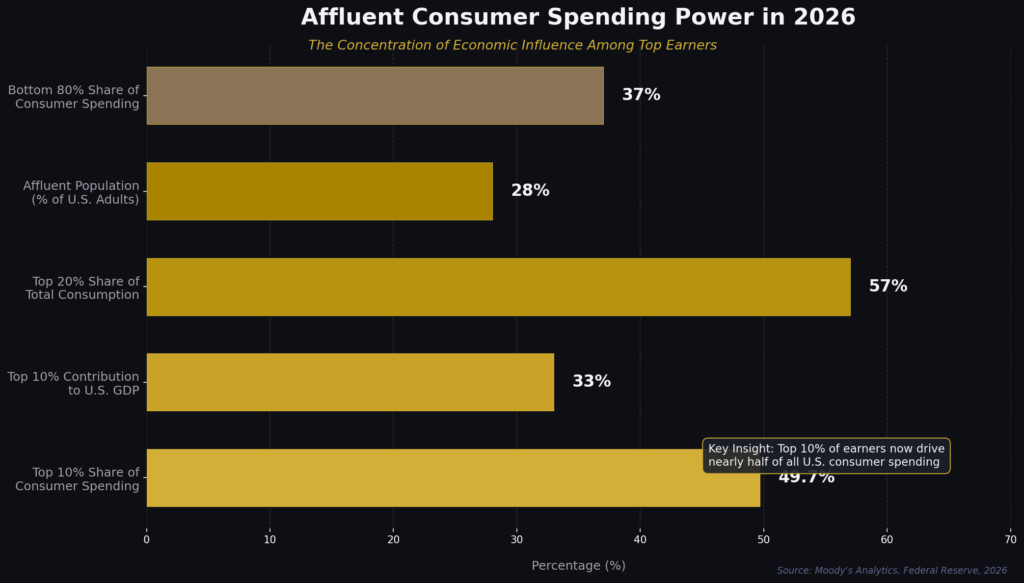
In 2026, the affluent segment’s economic dominance has intensified as Moody’s Analytics reports the top 10% of U.S. earners now drive a record 49.7% of all consumer spending, while the Federal Reserve Bank of Dallas confirms this concentration has pushed the top 20% to account for 57% of overall consumption, demonstrating that affluent consumers’ share of the economy continues to grow far beyond their population proportion.
Affluent consumers make up more than a quarter of the U.S. adult population, highlighting their significant impact on the economy. This demographic includes mass-affluent, highly-affluent, and super-affluent groups, each with different spending powers. With 28% of adults falling into this category, marketers must prioritize strategies that resonate with this group. Their purchasing habits often set trends that influence broader consumer behavior. For brands, this means that tailoring campaigns to affluent audiences can result in outsized returns.
Affluent Marketing Statistics #2: 613 Million Mass-Affluent Control $177.2 Trillion In Assets
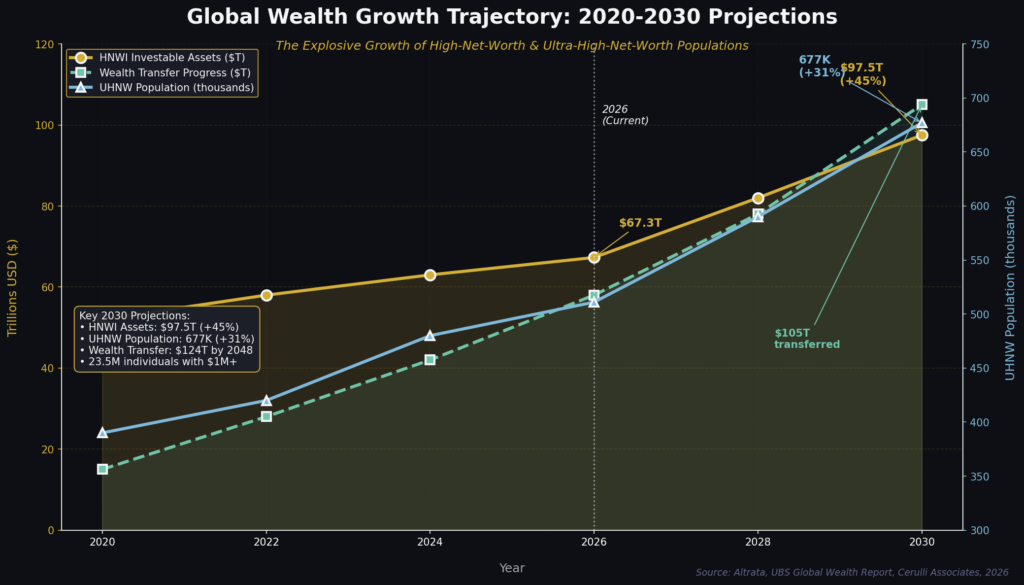
In 2026, UBS’s Global Wealth Report confirms that total personal wealth across 56 markets has reached $471 trillion, with individuals holding between $100,000 and $1 million (the upper-middle tier) now numbering 628 million adults who collectively control $184 trillion, representing 39.2% of global wealth, while Altrata projects the number of individuals with $1 million or more in investable wealth will grow to 23.5 million by 2030 with their collective assets reaching $97.5 trillion.
Globally, mass-affluent individuals hold an enormous $177.2 trillion in assets, underscoring their financial clout. This wealth represents nearly 40% of global assets, showing the concentration of resources in this group. With 613 million individuals in this category, they form a powerful consumer base across multiple markets. Companies that understand their needs can tap into sustained revenue opportunities. The scale of this wealth highlights why affluent consumers are so critical to long-term business growth.
Affluent Marketing Statistics #3: $124 Trillion Will Be Passed On In Wealth Transfer
In 2026, Cerulli Associates has revised its estimate of the great wealth transfer to $124 trillion that will change hands through 2048, with Gen X projected to inherit $39 trillion and Millennials expected to receive $46 trillion over the next 25 years, while Capgemini reports that 30% of HNWIs will receive an inheritance by the end of 2030, 63% will inherit wealth by the end of 2035, and 84% by 2040.
The great wealth transfer will see trillions passed from older generations to heirs. This shift is expected to reshape affluent consumer demographics, particularly benefiting younger generations. As millennials and Gen Z inherit wealth, their values and spending priorities will shape future markets. Brands must prepare for this generational change by aligning with sustainability, digital convenience, and exclusivity. This transition creates both challenges and opportunities for luxury and premium-focused industries.
Affluent Marketing Statistics #4: Top 10% Of Earners Account For Nearly 50% Of U.S. Spending
In 2026, the top 10% of U.S. earners have reached a record 49.2% of all consumer spending according to Moody’s Analytics, up from 46% in 2023 and roughly 43% in 2020, meaning this group now accounts for approximately 33% of total U.S. GDP since personal consumer expenditures represent 68% of economic output, while households in the middle 40th to 60th income percentile spent approximately $2.1 trillion in 2025, virtually unchanged from previous years.
The highest-earning 10% of U.S. households now drive almost half of all consumer spending. This dominance has grown over time, showing a widening gap between affluent and average consumers. Their spending covers luxury, travel, real estate, and lifestyle-driven purchases. For marketers, ignoring this group risks missing out on the largest source of consumer-driven revenue. Effective campaigns aimed at this segment must emphasize exclusivity and aspirational messaging.
Affluent Marketing Statistics #5: Affluent Americans Drive 47% Of Total Consumer Spending
In 2026, the affluent segment now accounts for approximately 50% of total U.S. consumer spending according to multiple industry analyses, with KPMG reporting that affluent consumers continue to buoy spending while low- and middle-income households tap credit and struggle to make ends meet, as the typical stockholder in the top 10% owned $1.1 million in equities in Q3 2025, up sharply from $624,000 at the end of 2022 according to University of Michigan survey data.
Although affluent Americans represent only 27% of the population, they contribute to nearly half of all spending. This statistic highlights their disproportionate economic influence. From retail to hospitality, affluent consumers are consistently the top spenders. Brands catering to their desires for premium experiences and products benefit the most. It is clear that their influence extends well beyond their population size.
Affluent Marketing Statistics #6: Average Household Income Is $185,924 With $110,059 Annual Spend
In 2026, the U.S. Bureau of Labor Statistics reports that average annual expenditures for all consumer units reached $78,535 in 2024, with housing and transportation accounting for over 50% of total spending at $26,266 and $13,318 respectively, while the threshold to be considered upper-class in 2026 now requires a net worth of at least $1.8 million or an annual income of $210,000 according to Visa’s analysis of Census Bureau data, and the Charles Schwab Modern Wealth Survey indicates Americans believe a net worth of $2.3 million is needed to be considered wealthy.
The average affluent U.S. household earns $185,924 annually and spends $110,059 per year. This spending covers essentials, discretionary purchases, and luxury experiences. Such high levels of disposable income give them unique buying power. Companies targeting this group must tailor products and services to match their lifestyle and values. For marketers, these numbers are a reminder of the sheer financial strength of affluent households.
Affluent Marketing Statistics #7: Affluent Were Last To Return To Pre-Pandemic Spending
In 2026, affluent consumers have fully rebounded and are now driving U.S. economic growth, with KPMG reporting that high-end spending has been buoyed by wealth effects as the top 20% of households hold approximately 87% of all directly and indirectly held corporate equities, and RBC Economics confirming that the top 10-20% of income earners have poured roughly $30 trillion into liquid income-generating assets since 2020, six times more than any other income group.
Affluent consumers delayed returning to pre-pandemic spending levels compared to other groups. They remained cautious about luxury travel, dining, and hospitality. However, once they re-engaged, spending rebounded strongly in these categories. This pattern reveals that affluent consumers are selective in their spending, waiting for optimal conditions. Marketers must note their tendency to delay, but also their ability to spend significantly once they do.
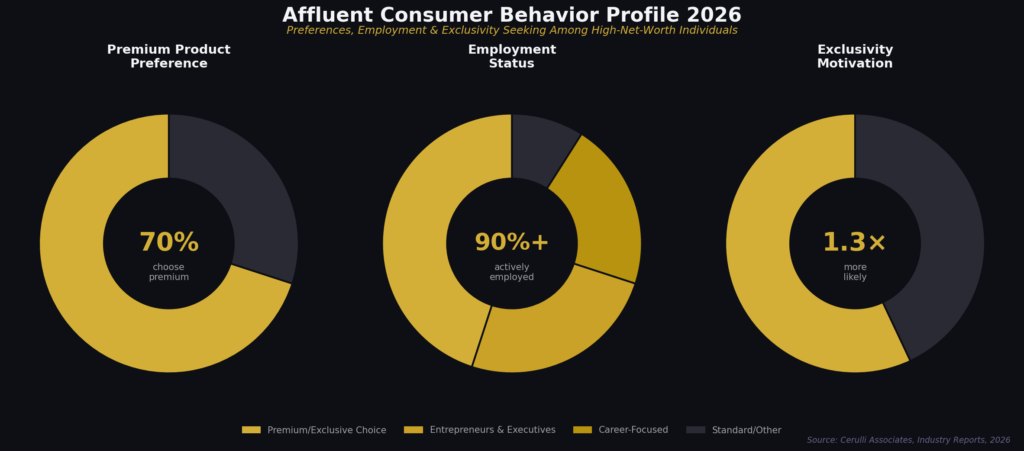
Affluent Marketing Statistics #8: 70% Prefer Premium Versions Of Products
In 2026, Deloitte’s Consumer Spending Forecast shows consumer spending expected to grow 2-3% overall but with extreme variance by income segment, with luxury goods up 8-12% while mass market products rise only 0-1%, and Mintel reports that more than 60% of luxury consumers continue purchasing premium items despite price increases, with affluent and high-net-worth individuals maintaining ties to ultra-luxury brands while seeking clear value propositions that balance quality, pricing, relevance, and brand affinity.
Seven out of ten affluent consumers opt for premium versions when given the choice. This demonstrates their inclination toward quality and exclusivity. Unlike average consumers, they place high value on brand reputation and product design. Companies that offer elevated experiences and high-end products will thrive with this group. This preference cements the importance of premium positioning in affluent marketing strategies.
Affluent Marketing Statistics #9: 1.3× More Likely To Seek Exclusive Content And Services
In 2026, Skift reports that luxury hospitality is now defined by exclusivity and restraint rather than abundance, with wealthy travelers paying premiums for less stimulation, less noise, and less congestion through what Hilton calls “hushpitality” and Accor frames as “quiet luxury,” while Pursuitist notes that high-net-worth travelers have moved beyond earn-and-burn point cycles as the true currency of luxury travel has become bespoke entry, securing luxury suites not on the map and services that do not appear on bills.
Affluent consumers are 1.3 times more motivated by exclusivity compared to average consumers. They value unique experiences, members-only access, and tailored services. This craving for exclusivity makes them prime targets for VIP programs and limited editions. Marketers who create scarcity and special access can strengthen brand loyalty. Exclusivity is not just an add-on; it is a driver of affluent consumer engagement.
Affluent Marketing Statistics #10: 90%+ Are Full-Time, Part-Time, Or Self-Employed
In 2026, the entrepreneurial path to wealth has diversified significantly, with Capgemini noting that younger entrepreneurs are on the rise and wealth firms are shaping advice to resonate with HNWIs of all ages, while 45% of premier financial advisors’ clients are now entrepreneurs, business owners, and corporate executives, 24% are inheritors with multigenerational family ties, and the share of millennial and Gen Z clients at high-net-worth-focused firms grew from just 8% in 2021 to 25% by 2024 according to Cerulli Associates.
The vast majority of affluent individuals are actively employed or self-employed. This reflects their strong career orientation and ambitious lifestyles. Many balance entrepreneurship with traditional employment to build wealth. Their career focus also drives their interest in networking, tools, and services that save time. For brands, aligning with their busy, success-driven lives is key.
Affluent Marketing Statistics #11: Affluent Are 89% More Likely To Own Smartwatches Or Smart Home Devices
In 2026, there are 562.86 million smartwatch users worldwide, marking a 23.7% increase from 454.69 million users in 2024 according to DemandSage, with the global smartwatch market projected to reach $55.16 billion in revenue by end of 2026, while 67% of smartwatches can now control smart home devices and 30.1% of Americans own a smartwatch device compared to 26% globally, with affluent consumers continuing to be early adopters who showcase status through cutting-edge wearable technology.
Affluent consumers are significantly ahead in adopting smart technology like watches and home devices. Their willingness to embrace new tech reflects both wealth and lifestyle priorities. They are early adopters, often showcasing status through cutting-edge devices. For marketers, this presents opportunities to integrate products into tech-driven lifestyles. Brands that innovate in smart solutions can capture affluent attention quickly.
Affluent Marketing Statistics #12: High-Income Households Pay More Attention To Ads
In 2026, American Express reports “remarkable resilience” in its affluent customer base, particularly in categories like fine dining and experiential purchases, while airlines such as United and Delta are reporting robust growth in premium cabin bookings according to Market Xcel research, indicating that high-income households continue engaging with premium brand messaging and are willing to pay for exclusivity in travel and experiences.
Households with higher income levels are far more likely to engage with ads, especially audio-based ones. They listen to podcasts and streaming services where targeted ads are effective. This makes audio channels particularly valuable for reaching affluent audiences. Marketers can tailor messaging to highlight exclusivity and premium experiences in these formats. This behavior underscores the importance of diversifying ad channels.
Affluent Marketing Statistics #13: Luxury Hotel Brands Score Highest In Favorability
In 2026, the luxury hotel market is valued at $150.22 billion and projected to reach $223.56 billion by 2031 at an 8.28% CAGR according to Mordor Intelligence, with STR data showing the luxury hotel segment posted year-to-date RevPAR growth of 5.3% through August 2025 while the economy segment declined 1.8%, and PwC reports that luxury and upper-upscale hotels were the only two chain scales to achieve positive RevPAR growth, with ADR up 5.0% year over year highlighting the strong spending propensity of higher-income households.
Among wealthy consumers, luxury hotel brands consistently stand out as favorites. This reflects their preference for personalized, high-quality experiences. Luxury travel is a key spending area for affluent audiences. Hotel chains that deliver beyond expectations often win long-term loyalty. For marketers, hospitality partnerships can be a gateway to connecting with affluent travelers.
Affluent Marketing Statistics #14: 40% Of U.S. Mass-Affluent Are Under 55
In 2026, the share of millennial and Gen Z clients at high-net-worth-focused firms has grown from just 8% in 2021 to 25% by 2024 according to Cerulli Associates, while UBS highlights a growing category of “EMILLIs” (Everyday Millionaires) with investable assets between $1 million and $5 million whose numbers have more than quadrupled since 2000, reaching around 52 million globally controlling approximately $107 trillion in total wealth, with younger wealth holders increasingly driving digital-first engagement preferences.
A large portion of mass-affluent consumers in the U.S. are younger than 55. This shows that affluence is no longer limited to older generations. Younger affluent individuals bring new digital habits and priorities to the market. Marketers must adapt to this shift by focusing on digital-first, innovative campaigns. Appealing to younger affluent buyers ensures future relevance for brands.
Affluent Marketing Statistics #15: 42% Of Affluent Gen Zs In China Purchase Clothing Online Monthly
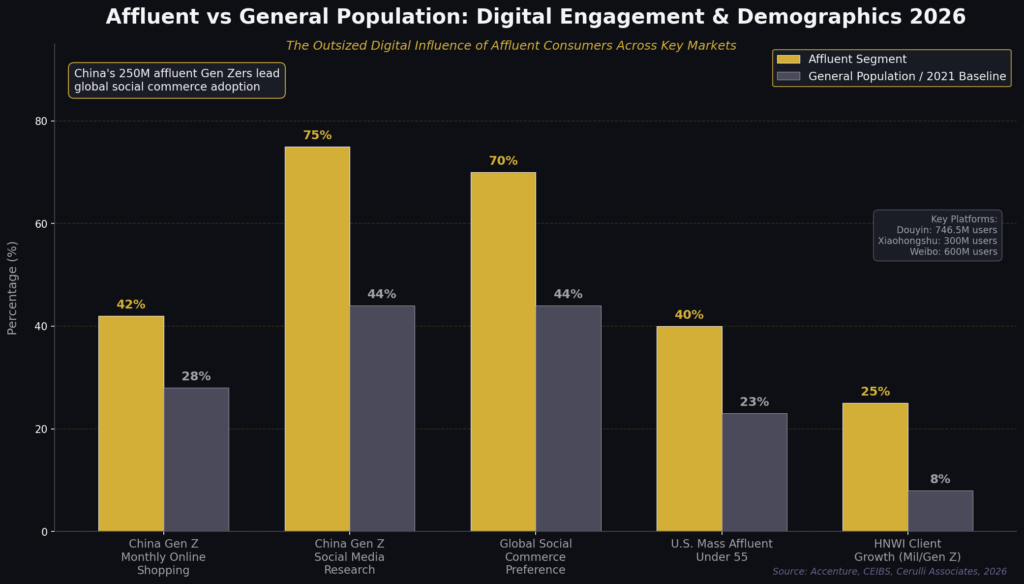
In 2026, Xiaohongshu (RedNote) has grown to over 300 million monthly active users with approximately 50% being post-1995 Gen Z and 35% being post-2000 users, while 70% of Chinese Gen Z consumers prefer to buy products directly via social media compared to a global average of 44% according to Accenture, and China’s 250 million Gen Zers who have grown up in affluent families as only children are less price-sensitive with greater purchasing power than previous generations according to CEIBS research.
Nearly half of affluent Gen Z consumers in China purchase clothing online each month. This demonstrates their strong integration of e-commerce into daily life. They also tend to spend more per purchase compared to average Gen Z consumers. For global brands, China’s young affluent market is a critical growth opportunity. Marketing campaigns must align with digital platforms that these consumers favor.
Affluent Marketing Statistics #16: 75% Of Affluent Gen Zs In China Use Social Media For Product Research
In 2026, Douyin (China’s TikTok) captivates over 746.5 million monthly active users, Xiaohongshu reaches nearly 200 million monthly active users where engagement rates surpass Instagram with an 8% comment-to-like ratio, and Weibo engages over 600 million monthly active users, while Chinese Gen Z consumers begin their shopping journeys on social platforms rather than search engines or brand websites, scrolling through Douyin, saving recommendations on RedNote, and watching live streams on Taobao Live according to Ashley Dudarenok’s consumer research.
Three out of four affluent Gen Zs in China rely on social media for research before purchasing. Platforms such as WeChat, Xiaohongshu, and Douyin dominate their decision-making process. This reliance highlights the power of influencer marketing in this demographic. Marketers must prioritize authenticity and creative campaigns on these channels. Winning trust here often translates directly into sales.
Affluent Marketing Statistics #17: 29% Of Affluent Own Two Or More Properties Outright
In 2026, younger affluent buyers are reshaping luxury real estate demand by prioritizing smart home technology, sustainability features, and wellness amenities such as home gyms and spa-like bathrooms, while multi-generational living has become more common with luxury homes designed to accommodate extended families, and fractional ownership has emerged as a flexible model where affluent clients trade multiple property ownership for equity-based arrangements with professional management that offer freedom to move between luxury locations.
Property ownership is a hallmark of affluence, with nearly a third owning multiple properties outright. These investments show the security and long-term mindset of affluent individuals. Real estate is both a status symbol and a financial strategy for them. Marketers targeting this group can emphasize exclusivity and lifestyle-driven communities. This trend highlights the importance of real estate in affluent marketing.
Affluent Marketing Statistics #18: Affluent Are Twice As Likely To Own Audi Or Mercedes-Benz
In 2026, KPMG reports that the new car market is now dominated by affluent buyers as vehicle prices have made new cars unaffordable for lower-income households, while Statista notes there has been a shift away from luxury cars toward hybrids among affluent consumers, reflecting a growing emphasis on sustainability alongside status, and used car prices continue moving up as new vehicles remain out of reach for the broader population.
Luxury cars are another area where affluent consumers stand out. They are twice as likely to own premium car brands like Audi or Mercedes-Benz. Cars serve not only as transportation but also as status markers. Affluent buyers seek vehicles that reflect their success and lifestyle. For marketers, this is a reminder of how deeply brand associations matter in this segment.
Affluent Marketing Statistics #19: Affluent Are More Likely To Be Male, Married, And Parents
In 2026, UBS’s Global Wealth Report highlights that women now constitute around 11% of global ultra-high-net-worth individuals, up from 8% less than a decade ago according to Altrata survey findings, while the $124 trillion great wealth transfer will see nearly $40 trillion of spousal transfers going to widowed women in the Baby Boomer and older generations, creating massive opportunities for wealth management providers to serve this growing female affluent demographic.
Demographic data shows that 56% of affluent are male, 65% are married, and 67% have children. These characteristics shape their purchasing behaviors and brand loyalties. Family-oriented spending often intersects with luxury travel, education, and home products. Understanding these demographics helps brands position their offerings strategically. Marketers must balance individual luxury with family lifestyle appeals.
Affluent Marketing Statistics #20: 37.7% Of Mass-Affluent Could Move Into HNWI Status By 2030
In 2026, Altrata forecasts the global ultra-high-net-worth population (those with $30 million or more) will grow to 676,970 individuals by 2030, up by 31% from 2025, while the number of high-net-worth individuals with $1 million or more in investable wealth is forecast to rise from 16 million to 23.5 million by 2030 with their collective stock of investable assets projected to increase 45% to $97.5 trillion, and Asia is expected to see the strongest UHNW population growth with India having four of the top ten growth cities including Bengaluru, Mumbai, Hyderabad, and Delhi.
Nearly 38% of the global mass-affluent population is projected to enter high-net-worth status by 2030. This upward mobility demonstrates the dynamic nature of wealth growth. Emerging affluent consumers will increasingly influence luxury markets. Companies should prepare for this growth by nurturing relationships with mass-affluent customers today. Capturing their loyalty early can yield long-term dividends as their wealth increases.
WHAT THESE AFFLUENT MARKETING STATISTICS 2026 REVEAL ABOUT LUXURY BUYERS
Looking at these affluent marketing statistics as a whole, one thing becomes clear: affluent consumers don’t just spend more—they think differently. They look for brands that speak to their aspirations, their lifestyles, and their desire for exclusivity. For marketers, this means moving past generic strategies and building campaigns that are as intentional and refined as the audience itself. If you can combine data-driven insights with authentic storytelling, you’ll find yourself connecting with one of the most influential consumer groups in the world. In 2026, luxury brands are increasingly using AI-driven personalization, private digital communities, and invite-only experiences to reach high-net-worth consumers more effectively.
SOURCES
- https://www.hubspot.com/marketing-statistics (HubSpot)
- https://www.gwi.com/blog/stats-to-know-on-affluent-consumers (GWI)
- https://www.salesforce.com/marketing/marketing-statistics/ (Salesforce)
- https://marketingdive.com/news/digital-marketing-statistics-2025-h1-by-the-numbers/751401/ (Marketing Dive)
- https://evokad.com/target-affluent-consumer-cpg/ (Evok Advertising)
- https://sohohospitality.com/blog-the-consumer-revolution-the-rise-of-the-mass-affluents/ (Soho Hospitality)
- https://www.socialsnowball.io/post/influencer-marketing-statistics (Social Snowball)
- https://blog.hubspot.com/agency/affluent-consumer-stats (HubSpot Blog)
- https://seoprofy.com/blog/digital-marketing-statistics/ (SeoProfy)
- https://www.optimizely.com/insights/blog/marketing-statistics/ (Optimizely)
- https://www.thebrandonagency.com/blog/how-affluents-are-consuming-media/ (Brandon)
- https://brentonway.com/top-influencer-marketing-statistics/ (Brenton Way)
- https://www.spielcreative.com/blog/marketing-statistics-2025/ (Spiel Creative)
- https://unitedlandmark.com/affluent-marketing-tips-and-tactics/ (United Landmark Associates)
- https://en.wikipedia.org/wiki/Ipsos_Affluent_Survey (Wikipedia)
- https://arxiv.org/abs/2502.12838 (arXiv)
- https://arxiv.org/abs/1811.10921 (arXiv)
- https://arxiv.org/abs/2506.14602 (arXiv)