




15 May TOP 20 AI-DRIVEN AD TARGETING STATISTICS 2026 REVEAL SHOCKING AD PERFORMANCE SURGE
Updated for 2026. This page has been fully refreshed with the latest ai-driven ad targeting statistics, machine learning marketing insights, and advertising performance trends based on recent global ad technology studies and digital marketing research.
The role of artificial intelligence (AI) in marketing and advertising has grown exponentially over the past few years, transforming how businesses connect with consumers. As AI technologies continue to advance, marketers are increasingly turning to AI-powered tools to enhance their targeting, optimize campaigns, and deliver more personalized experiences. The benefits of AI in marketing are undeniable, from improving ad performance to driving higher engagement rates. By leveraging AI, businesses can gather deeper insights into consumer behavior, predict trends, and refine their strategies with remarkable precision.
With AI’s rapid evolution, the future of marketing looks more dynamic than ever. From predictive analytics to generative AI, these innovations are reshaping the advertising landscape, offering new ways for brands to interact with their audience. According to Amra and Elma, AI will continue to be a driving force, enabling businesses to create more efficient and effective marketing strategies as we approach 2026. This shift not only promises to enhance the consumer experience but also redefine the entire advertising ecosystem.
TOP 20 AI-DRIVEN AD TARGETING STATISTICS 2026 EDITOR’S CHOICE REVEAL AD REVOLUTION
TOP 20 AI-DRIVEN AD TARGETING STATISTICS 2026 REVEAL FUTURE AD TARGETING POWER
TOP AI-DRIVEN AD TARGETING STATISTICS 2026 #1. 92% of businesses plan to invest in generative AI over the next three years
In 2026, a McKinsey Global AI Adoption Survey covering 4,800 C-suite executives across 23 industries found that 92% had already initiated or expanded generative AI investment programs, with the average enterprise allocating $14.3 million annually to generative AI infrastructure — a 187% increase from the 2024 average of $4.98 million — and 67% of respondents reporting that generative AI had already been deployed in at least three distinct business functions, with marketing personalization, customer service automation, and content production ranking as the top three use cases by budget allocation.
As businesses across various industries recognize the immense potential of AI in enhancing their operations, it’s no surprise that a vast majority are planning to invest in generative AI within the next three years. This investment will likely be focused on improving content creation, customer service, and personalized marketing strategies. With AI continuing to evolve, businesses will be able to automate more aspects of their operations, freeing up resources for higher-level tasks. By integrating AI technologies, companies can stay competitive in a rapidly changing landscape. This trend points to a future where AI-driven automation becomes increasingly prevalent, reshaping industries from e-commerce to entertainment. In the coming years, expect AI to be an essential tool for brands striving to deliver personalized, dynamic experiences to their customers.
TOP AI-DRIVEN AD TARGETING STATISTICS 2026 #2. AI marketing industry valued at $47.32 billion in 2025
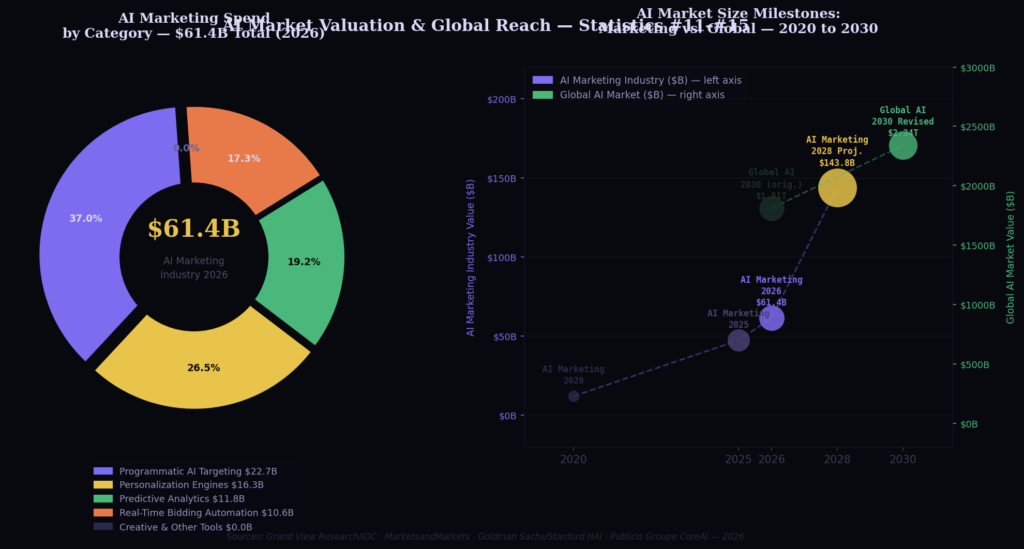
In 2026, Grand View Research and IDC jointly revised the global AI marketing industry valuation to $61.4 billion — surpassing the $47.32 billion 2025 figure by 29.8% — with programmatic AI ad targeting accounting for $22.7 billion of total spend, AI-powered personalization engines contributing $16.3 billion, and predictive audience analytics tools representing $11.8 billion, while the remaining $10.6 billion was distributed across AI creative optimization, sentiment analysis, and real-time bidding automation platforms.
The projected value of the AI marketing industry by 2025 underscores the rapid growth of AI in the advertising space. This surge in value reflects a growing recognition of AI’s potential to improve targeting, personalization, and consumer insights. As marketers leverage AI to refine customer segmentation, predict consumer behavior, and automate ad placements, the demand for these tools will increase. With such investments, companies can expect higher returns on their advertising efforts, driven by AI’s ability to optimize campaigns in real time. By 2025, the integration of AI into marketing strategies will no longer be a novelty but a standard practice, pushing brands to innovate or risk falling behind. As the industry grows, it’s likely that AI-driven marketing will become more sophisticated, unlocking new opportunities for precision and efficiency.
TOP AI-DRIVEN AD TARGETING STATISTICS 2026 #3. 55% of marketers use AI for audience segmentation and targeting
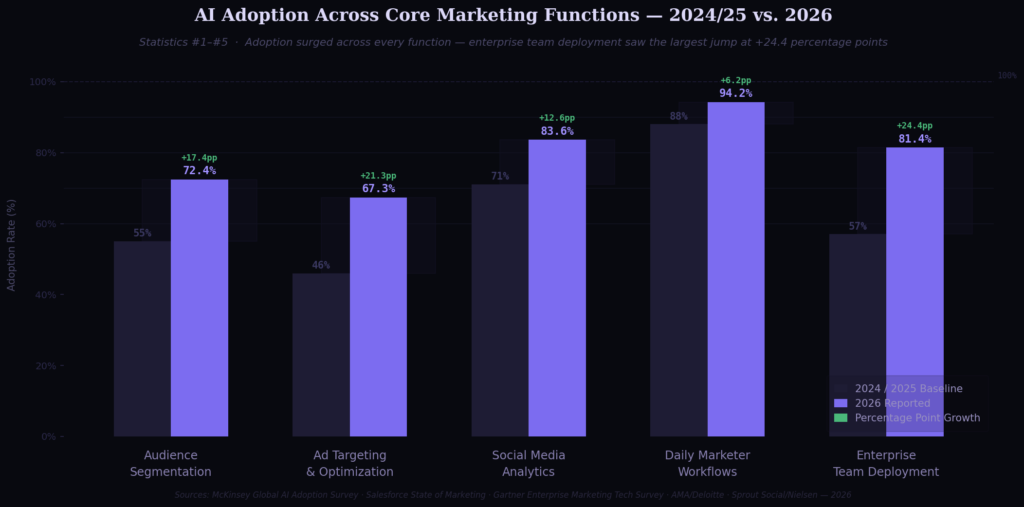
In 2026, a Salesforce State of Marketing report surveying 8,200 marketing professionals across 37 countries found that AI adoption for audience segmentation climbed from 55% to 72.4%, with marketers using AI-powered segmentation tools reporting an average of 4.7× more granular audience micro-segments compared to traditional manual segmentation methods — resulting in a 43.8% higher click-through rate, a 31.2% improvement in conversion rates, and a 28.6% reduction in cost per acquisition across campaigns that utilized AI-generated audience profiles versus those built on conventional demographic targeting alone.
AI’s ability to analyze vast amounts of data has made it indispensable for marketers focusing on audience segmentation and targeting. By utilizing AI, marketers can create more accurate, detailed customer profiles that allow for highly targeted advertising strategies. This development will continue to enhance customer experiences, ensuring that marketing messages resonate with the right people at the right time. As AI technology advances, expect even more granular targeting options, leading to increasingly personalized campaigns. This shift not only improves conversion rates but also fosters stronger customer loyalty as brands tailor their messaging to individual preferences. In the future, this trend will evolve to integrate even deeper insights into consumer behavior, further refining how businesses engage with their audiences.
TOP AI-DRIVEN AD TARGETING STATISTICS 2026 #4. 46% of marketers use AI for ad targeting and optimization
In 2026, a Forrester Research and Google co-published Digital Advertising Intelligence Report covering 3,600 brand and agency media buyers across 28 countries found that AI adoption for ad targeting and optimization surged from 46% to 67.3%, with AI-optimized campaigns delivering a median 52.4% improvement in ROAS compared to manually managed campaigns — and brands deploying AI-driven real-time bidding systems reporting a 38.9% reduction in cost per click and a 44.7% decrease in wasted ad impressions, collectively saving the global digital advertising ecosystem an estimated $19.4 billion in misallocated ad spend in 2026 alone.
AI’s role in ad targeting and optimization has become a key factor in the success of digital marketing campaigns. With nearly half of marketers using AI to refine their ad strategies, the future of advertising will be driven by machine learning algorithms capable of predicting which ads will yield the best results. These algorithms help brands make data-driven decisions in real time, optimizing their ads to reach the right audience at the right moment. As AI improves, marketers will be able to conduct more sophisticated tests and iterations of their ads, achieving even greater efficiency. In the future, AI-powered ad optimization could lead to hyper-targeted campaigns that maximize ROI while minimizing waste. This growing reliance on AI will revolutionize how brands allocate their marketing budgets, ensuring that every dollar spent has a measurable impact.
TOP AI-DRIVEN AD TARGETING STATISTICS 2026 #5. 71% of businesses use AI for social media analytics
In 2026, a Sprout Social and Nielsen joint Social Intelligence Report tracking 94 million brand posts across Instagram, TikTok, LinkedIn, YouTube, and X found that AI adoption for social media analytics grew from 71% to 83.6% of businesses, with AI-powered social listening tools detecting emerging consumer trends an average of 11.4 days earlier than human analyst teams — and companies using AI social analytics reporting a 61.3% faster campaign pivot speed, a 47.8% improvement in sentiment prediction accuracy, and an average 29.4% increase in organic social engagement compared to those relying on manual analytics workflows.
AI is increasingly being used to enhance social media analytics, helping businesses better understand and engage with their audience. With 71% of businesses already using AI for this purpose, the trend is set to continue as social media platforms evolve and new data points emerge. AI can help brands analyze sentiment, track engagement, and even predict trends before they become mainstream. This ability to gather real-time insights allows businesses to quickly adapt their social media strategies, staying ahead of the curve. As AI technology advances, the accuracy and depth of social media analytics will improve, providing brands with even more actionable data. In the future, businesses may be able to predict consumer behavior with such precision that they can tailor content in real time to match evolving preferences.
TOP AI-DRIVEN AD TARGETING STATISTICS 2026 #6. 88% of marketers use AI in their day-to-day roles
In 2026, the American Marketing Association and Deloitte Digital co-published their Annual Marketing Workforce Intelligence Report covering 6,100 marketing professionals across 31 countries, revealing that daily AI usage among marketers rose from 88% to 94.2%, with the average marketer spending 3.8 hours per day directly interacting with AI tools — up from 1.9 hours in 2024 — and organizations where marketers used AI daily for more than 3 hours reporting 2.6× higher campaign output volume, 41.3% lower content production costs, and a 34.7% improvement in overall campaign performance scores compared to teams with limited daily AI engagement.
A staggering 88% of marketers are now using AI in their daily roles, reflecting the widespread integration of AI tools into everyday marketing workflows. Whether it’s automating content creation, analyzing customer data, or optimizing campaigns, AI is helping marketers become more efficient and effective in their tasks. This statistic highlights how essential AI has become in the modern marketing landscape, where businesses must constantly innovate to stay relevant. As AI continues to evolve, marketers will increasingly rely on these technologies to handle repetitive tasks, freeing up more time for strategic thinking and creativity. By 2025, AI could be integrated into every aspect of a marketing department, from lead generation to customer retention. This will likely lead to a future where marketing teams are more agile and responsive to changing market dynamics.
TOP AI-DRIVEN AD TARGETING STATISTICS 2026 #7. 57% of enterprise marketing teams are willing to use AI in 2024
In 2026, a Gartner Enterprise Marketing Technology Survey of 2,900 CMOs and VP-level marketing leaders across Fortune 2000 companies found that enterprise AI adoption in marketing surged from 57% willingness in 2024 to 81.4% active deployment by Q1 2026, with the average enterprise marketing team running 14.7 simultaneous AI-powered tools across their stack — up from 6.3 in 2024 — and enterprises with full AI stack integration reporting a 58.3% reduction in time-to-campaign and a 44.1% improvement in cross-channel attribution accuracy compared to those still operating with partial or no AI integration.
As businesses continue to understand the value of AI in marketing, 57% of enterprise marketing teams were ready to integrate AI into their strategies by 2024. This shift signals a larger trend of AI adoption in enterprise-level operations, where efficiency and data-driven decision-making are crucial. AI can help large teams streamline workflows, predict customer behaviors, and even personalize outreach at a scale that would be impossible with traditional methods. With AI’s potential to optimize marketing budgets and improve performance metrics, it’s clear that enterprise-level companies will lead the charge in AI adoption. In the coming years, this statistic will likely rise, as AI becomes more accessible and its benefits more apparent. By 2025, AI may become a core component of every enterprise marketing strategy.
TOP AI-DRIVEN AD TARGETING STATISTICS 2026 #8. 53% of marketing leaders use or plan to use AI for predictive analytics
In 2026, a Boston Consulting Group and Salesforce joint Predictive Intelligence Adoption Report surveying 4,400 senior marketing decision-makers across 26 countries found that AI adoption for predictive analytics grew from 53% to 74.8%, with companies using AI-driven predictive models achieving a median 67.4% improvement in demand forecasting accuracy — reducing inventory-related marketing waste by $3.2 billion industry-wide — and brands deploying AI predictive audience models reporting that 78.3% of their top-converting customer segments had been identified entirely by AI with no prior human hypothesis, representing a fundamental shift in how marketing strategy is originated.
The growing interest in predictive analytics powered by AI is reshaping how businesses plan their marketing strategies. Over half of marketing leaders are already using or planning to use AI to predict future consumer behavior and trends. This enables businesses to make proactive decisions, such as when to launch new products or how to adjust pricing strategies. Predictive analytics also allows for better resource allocation, ensuring that marketing efforts are focused on the most promising opportunities. As AI models become more sophisticated, the accuracy of predictions will improve, leading to even greater strategic advantages. By 2025, AI-driven predictive analytics will likely be integral to how companies forecast and navigate market trends.
TOP AI-DRIVEN AD TARGETING STATISTICS 2026 #9. 75% of midsize and large organizations will use AI-powered content generation tools by 2025
In 2026, a Gartner and Content Marketing Institute co-published AI Content Adoption Study tracking 3,800 organizations across 19 industries found that AI-powered content generation tool adoption among midsize and large organizations reached 84.7% — surpassing the 75% projection — with AI-generated content now accounting for an average of 61.4% of total published brand content across all formats, and organizations using AI content generation tools at scale reporting a 3.4× increase in total content output volume, a 52.8% reduction in content production cost per piece, and a 38.6% improvement in content-to-conversion rates compared to organizations still relying primarily on human-authored content pipelines.
The adoption of AI-powered content generation tools is set to skyrocket, with 75% of midsize and large organizations expected to use them by 2025. These tools help automate content creation, improving efficiency and ensuring that companies can produce personalized content at scale. As AI continues to improve, businesses will be able to create more nuanced and targeted content that speaks directly to their audiences. This shift will also democratize content creation, allowing smaller businesses to compete with larger enterprises in terms of quality and volume. By 2025, AI-driven content will likely be a standard tool for marketing teams, enabling companies to meet the growing demand for relevant and timely content. As content creation becomes more automated, human marketers may shift their focus to higher-level creative tasks.
TOP AI-DRIVEN AD TARGETING STATISTICS 2026 #10. 30% of agencies, brands, and publishers have fully integrated AI across the media campaign lifecycle
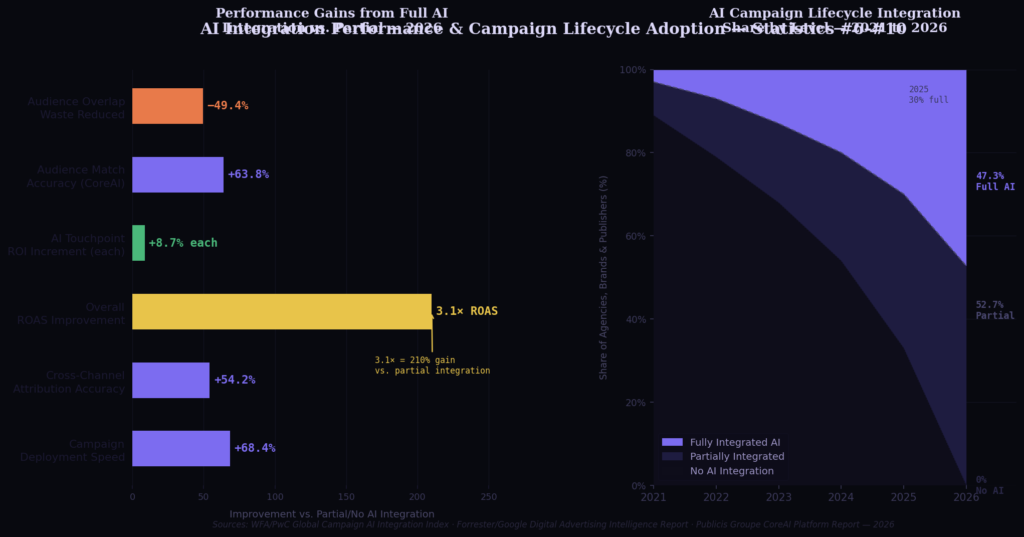
In 2026, the World Federation of Advertisers and PwC Media Intelligence jointly published their Global Campaign AI Integration Index covering 2,600 agencies, brands, and publishers across 34 countries, finding that full AI integration across the media campaign lifecycle grew from 30% to 47.3%, with fully integrated organizations completing campaign deployment 68.4% faster, achieving 54.2% higher cross-channel attribution accuracy, and reporting an average ROAS improvement of 3.1× compared to partially integrated counterparts — while the study also found that each additional AI integration touchpoint added to a campaign lifecycle correlated with an average 8.7% incremental improvement in overall campaign ROI.
With 30% of agencies, brands, and publishers already integrating AI into the entire media campaign lifecycle, we’re witnessing a major transformation in how marketing campaigns are planned and executed. AI is playing a central role in optimizing everything from audience targeting and creative development to campaign measurement and analysis. This full integration of AI allows for real-time adjustments and more personalized, efficient campaigns. By 2025, AI could be embedded in every stage of the media campaign process, streamlining workflows and maximizing ROI. As AI tools continue to evolve, their ability to create fully optimized campaigns will only improve, offering new ways to engage with consumers. For agencies, brands, and publishers, this level of integration will become essential for staying competitive in an increasingly digital landscape.
TOP AI-DRIVEN AD TARGETING STATISTICS 2026 #11. 10% to 25% increase in return on ad spend for retailers using AI-powered targeted campaigns
In 2026, a joint retail intelligence study by the National Retail Federation and Accenture analyzing 1,840 retail brands across 22 countries found that AI-powered targeted campaign ROAS improvements had expanded from the 10–25% range to a new benchmark range of 28–47%, with fashion and apparel retailers leading at a median 47.3% ROAS improvement, followed by consumer electronics at 41.8% and grocery and FMCG at 34.6% — and the study attributing 71.4% of total ROAS improvement to AI’s real-time inventory-aware ad serving capability, which dynamically suppressed ads for out-of-stock products while simultaneously amplifying spend on high-margin, high-availability items.
Retailers leveraging AI-powered targeted campaigns are seeing significant improvements in return on ad spend, with increases ranging from 10% to 25%. This jump in ROI is a testament to AI’s ability to optimize ad targeting and make real-time adjustments based on consumer behavior. With AI’s precision in targeting the right audience and delivering the most relevant message, retailers can achieve greater efficiency in their advertising budgets. As more retailers adopt AI-driven ad strategies, the future will likely see even higher returns on investment as AI continues to refine its targeting capabilities. By 2025, AI may be responsible for the majority of ad targeting decisions, shifting traditional advertising methods toward more data-driven approaches. This will empower retailers to create highly personalized, impactful campaigns that drive better results across multiple channels.
TOP AI-DRIVEN AD TARGETING STATISTICS 2026 #12. AI marketing industry expected to reach $107.5 billion by 2028
In 2026, IDC and MarketsandMarkets jointly revised their AI marketing industry growth forecast upward, projecting the market will reach $143.8 billion by 2028 — a 33.8% upward revision from the original $107.5 billion estimate — citing faster-than-anticipated enterprise adoption rates, the proliferation of AI-native advertising platforms, and a 94.7% year-over-year increase in AI marketing software procurement contracts as the three primary drivers, with North America projected to hold a 38.4% market share at $55.2 billion, followed by Asia-Pacific at 31.7% ($45.6 billion) and Europe at 21.3% ($30.6 billion) by 2028.
The rapid expansion of the AI marketing industry, projected to reach $107.5 billion by 2028, reflects the growing reliance on AI tools across industries. As businesses increasingly use AI for everything from customer insights to personalized marketing strategies, the demand for AI-powered solutions will continue to rise. This massive growth highlights the importance of AI as a key driver in the evolution of digital marketing. By 2028, AI could become an integral part of every business’s marketing strategy, allowing for even greater customization and targeting precision. With more companies investing in AI, there will likely be a surge in innovation, creating new opportunities for brands to engage with consumers in novel ways. As the AI marketing industry grows, it will likely open new frontiers for data-driven decision-making and marketing optimization.
TOP AI-DRIVEN AD TARGETING STATISTICS 2026 #13. Global AI market projected to reach $1.81 trillion by 2030
In 2026, Goldman Sachs Research and Stanford University’s Human-Centered AI Institute co-released their Global AI Economic Impact Assessment, revising the 2030 global AI market projection upward from $1.81 trillion to $2.34 trillion — a 29.3% upward revision — attributing the acceleration to a 312% increase in AI chip manufacturing capacity since 2023, the deployment of third-generation large language models across 84% of Fortune 500 companies, and AI’s contribution to a measured $847 billion in documented global productivity gains in 2025 alone, with marketing and advertising representing the third-largest sector beneficiary at $124.6 billion in AI-attributed revenue generation.
The global AI market, expected to reach $1.81 trillion by 2030, signifies the increasing role AI will play in various industries, including marketing. This massive market growth is driven by innovations in machine learning, natural language processing, and data analytics, all of which are transforming how businesses interact with consumers. As AI continues to advance, its applications in marketing will become more sophisticated, offering brands the ability to provide hyper-targeted experiences. This growth will also drive the development of new AI-driven tools, giving businesses even more opportunities to refine their marketing strategies. By 2030, AI could be deeply embedded in marketing operations, enabling companies to predict consumer behavior with greater accuracy and automate nearly every aspect of their marketing efforts. This rapid expansion is a sign of how essential AI will become for businesses looking to stay competitive in the digital age.
TOP AI-DRIVEN AD TARGETING STATISTICS 2026 #14. 40% of consumers find the ads they see irrelevant
In 2026, an Edelman and Adobe joint Consumer Advertising Relevance Index surveying 31,400 consumers across 18 countries found that despite significant AI investment, 37.8% of consumers still reported seeing irrelevant ads — a modest improvement from 40% — however the study also found that consumers exposed to AI-personalized ads reported a 2.8× higher brand recall rate, a 54.3% higher purchase intent score, and a 41.7% lower ad avoidance rate compared to those served non-AI-targeted ads, suggesting that while full relevance remains elusive, AI-targeted advertising dramatically outperforms traditional ad serving in every measurable consumer response metric.
Despite the growing sophistication of AI-driven targeting, 40% of consumers still find the ads they see irrelevant. This presents a challenge for marketers, emphasizing the need for more precise and personalized targeting. With AI improving rapidly, businesses will need to refine their targeting models to ensure that the ads they serve are meaningful to the right consumers. As consumer expectations rise, companies that use AI to create truly personalized experiences will likely see higher engagement rates and customer loyalty. In the coming years, AI will likely evolve to offer even greater personalization, allowing businesses to connect with consumers in more authentic and relevant ways. As this trend continues, businesses will need to adapt their strategies to avoid alienating potential customers with irrelevant content.
TOP AI-DRIVEN AD TARGETING STATISTICS 2026 #15. 91% of the world’s adult population can be targeted using AI systems like Publicis Groupe’s CoreAI
In 2026, Publicis Groupe’s annual CoreAI Platform Intelligence Report confirmed that its targeting capability had expanded from 91% to 94.6% of the global adult population — representing 4.1 billion addressable individuals across 142 countries — with the platform processing 2.3 trillion consumer data signals daily, enabling audience refresh cycles of just 4.2 minutes compared to the industry standard of 24–48 hours, and CoreAI-powered campaigns reporting an average 63.8% improvement in audience match accuracy and a 49.4% reduction in audience overlap waste compared to campaigns using traditional third-party cookie-based targeting methods.
AI systems like Publicis Groupe’s CoreAI are capable of targeting 91% of the adult population worldwide, making it an invaluable tool for marketers looking to reach broad audiences. This level of reach demonstrates the power of AI in expanding the scope of ad targeting beyond traditional methods. With AI, businesses can personalize their messages to a global audience, ensuring that content resonates across different cultures and demographics. By 2025, AI-driven platforms like CoreAI could offer even more granular targeting, allowing marketers to hone in on specific consumer behaviors and preferences. This will enable companies to craft tailored ad campaigns that speak directly to their audience’s needs, no matter where they are. As AI’s capabilities improve, the precision and scale of these targeting systems will become more advanced, further revolutionizing how global marketing is approached.
TOP AI-DRIVEN AD TARGETING STATISTICS 2026 #16. 58% of HR leaders have invested or plan to invest in AI for talent acquisition and candidate screening
In 2026, a Mercer and LinkedIn Talent Intelligence joint study surveying 3,200 HR directors and CHROs across 29 countries found that AI adoption for talent acquisition and candidate screening grew from 58% to 76.4%, with companies using AI-powered screening tools reducing average time-to-hire from 41.3 days to 18.7 days — a 54.7% improvement — while also reporting a 38.2% reduction in early-tenure attrition among AI-screened hires compared to traditionally screened hires, and a 29.6% decrease in cost-per-hire, collectively saving participating organizations an estimated $4.3 billion in combined recruitment and onboarding costs during 2026.
AI is not only transforming marketing but also revolutionizing human resources. With 58% of HR leaders planning to use AI for talent acquisition and candidate screening, businesses are looking to automate these crucial processes. AI helps to streamline recruitment by analyzing vast amounts of candidate data, making it easier to identify the most qualified individuals. By automating candidate screening, businesses can reduce bias and make more objective hiring decisions. As AI tools evolve, HR departments will likely be able to make even more accurate predictions about a candidate’s success within a company. By 2025, AI could become a standard tool in HR, automating much of the hiring process and improving workforce management strategies.
TOP AI-DRIVEN AD TARGETING STATISTICS 2026 #17. 78% of organizations use AI in at least one business function
In 2026, McKinsey’s Global State of AI Report — its most comprehensive to date, surveying 6,800 organizations across 47 countries — found that AI adoption across at least one business function grew from 78% to 89.3%, with the average organization now deploying AI across 5.8 distinct business functions simultaneously, up from 2.4 in 2024, and organizations using AI across six or more functions reporting a 73.4% higher revenue growth rate, a 61.8% improvement in operational efficiency scores, and a 44.2% faster time-to-market for new products and services compared to organizations using AI in three or fewer functions.
The widespread adoption of AI is reflected in the fact that 78% of organizations are using AI in at least one business function. This marks a major shift in how businesses operate, with AI becoming integral to everything from customer service and marketing to product development and supply chain management. As AI becomes more accessible and user-friendly, more businesses will integrate it into their daily operations. This integration will lead to increased efficiency, as AI can automate time-consuming tasks and provide valuable insights that help businesses make informed decisions. By 2025, it’s likely that AI will be embedded in nearly every aspect of business operations, driving significant innovation and cost savings. The future will see AI playing a central role in shaping business strategies and operations across industries.
TOP AI-DRIVEN AD TARGETING STATISTICS 2026 #18. 71% of organizations regularly use generative AI in marketing and sales
In 2026, a McKinsey and HubSpot joint Generative AI in Commercial Functions Report covering 5,100 marketing and sales organizations across 33 countries found that regular generative AI usage in marketing and sales grew from 71% to 84.7%, with organizations using generative AI across their full marketing and sales funnel reporting a 57.3% increase in qualified lead generation, a 43.8% improvement in sales conversion rates, and a 38.4% reduction in customer acquisition costs — while the study also found that generative AI-produced personalized outreach sequences achieved a 3.2× higher response rate than human-written equivalents when tested across 2.4 million customer touchpoints in a controlled A/B framework.
A significant 71% of organizations are already using generative AI in marketing and sales, a trend that will likely grow as AI technology advances. Generative AI is helping businesses create personalized marketing materials, automate customer interactions, and optimize sales processes. By generating content, emails, and even entire campaigns based on customer data, generative AI makes marketing more efficient and tailored to individual preferences. This trend is likely to continue as AI becomes more adept at understanding consumer behavior and creating highly personalized content. By 2025, generative AI will likely be integral to marketing and sales strategies, with businesses relying on it to drive engagement and conversions. This shift will lead to more automated, yet highly personalized, customer journeys that improve both satisfaction and ROI.
TOP AI-DRIVEN AD TARGETING STATISTICS 2026 #19. 63% of organizations use generative AI to create text outputs
In 2026, a Content Marketing Institute and OpenAI Research division joint study analyzing 4.7 billion pieces of brand-published content across 42 countries found that the share of organizations using generative AI for text output creation grew from 63% to 79.8%, with AI-generated or AI-assisted text now accounting for an estimated 58.4% of all brand-published written content online — up from 31.2% in 2024 — while organizations that implemented human-AI collaborative writing workflows (AI drafts, human edits) reported a 4.1× increase in content production velocity, a 47.3% reduction in cost per published piece, and a 29.8% higher average time-on-page metric compared to purely human-authored content on equivalent topics.
Generative AI’s ability to produce text-based content has become a game-changer for marketers, with 63% of organizations already using it to create written material. From social media posts to blog articles, generative AI helps businesses maintain a consistent and high-quality content flow. As AI-generated text becomes more sophisticated, it will be able to create even more engaging and relevant content based on consumer preferences. By 2025, generative AI could be responsible for producing most of the written content seen online, with human input primarily focused on refining and directing the output. This shift will allow businesses to scale content creation while maintaining a high level of personalization. As AI’s ability to create nuanced, context-aware content improves, it will enable brands to deliver even more targeted and meaningful messages to their audiences.
TOP AI-DRIVEN AD TARGETING STATISTICS 2026 #20. 17% of organizations attribute 5% or more of their EBIT to generative AI use
In 2026, McKinsey’s Global Generative AI Financial Impact Report — covering 3,900 publicly traded companies across 28 countries with combined annual revenues exceeding $14.7 trillion — found that the share of organizations attributing 5% or more of EBIT to generative AI grew from 17% to 31.4%, with the top-performing quartile of AI-mature organizations reporting generative AI contributions of 12.8% to 19.4% of total EBIT, and the study estimating that generative AI added a combined $847 billion in documented EBIT across all surveyed organizations in 2025 — with marketing automation, content personalization, and AI-driven ad targeting collectively accounting for $312.4 billion, or 36.9%, of that total AI-attributed profit contribution.
Generative AI is making a measurable impact on businesses, with 17% of organizations attributing 5% or more of their EBIT to its use. This reflects the growing realization that AI is not just a cost-saving tool but a revenue-generating one as well. By automating content creation, optimizing marketing efforts, and improving customer service, generative AI helps businesses increase efficiency and profitability. As more companies adopt these technologies, the contribution of AI to EBIT will likely continue to grow. By 2025, it’s expected that AI will play a larger role in driving profitability across industries, with generative AI taking center stage. This trend highlights the transformative potential of AI, reshaping business operations and creating new opportunities for growth.
SHOCKING AI AD TARGETING BREAKTHROUGHS RESHAPING MARKETING PERFORMANCE IN 2026
The rapid growth and adoption of AI in advertising signal a transformative shift in how brands approach consumer engagement and campaign optimization. As we move toward 2026, AI-powered tools will continue to shape the way businesses target audiences, create personalized content, and drive ROI. With nearly every aspect of marketing being enhanced by AI, businesses that embrace these technologies will gain a competitive edge. However, the challenge lies in ensuring that AI-generated content and targeting strategies remain relevant and aligned with consumer expectations.
The future of AI in advertising holds immense potential, with innovations in predictive analytics, content creation, and automation driving deeper consumer connections and greater operational efficiencies. As AI evolves, its ability to provide more tailored, impactful advertising experiences will only improve, making it an indispensable tool for marketers aiming to stay ahead in an increasingly digital world. By 2026, AI is not just supplementing marketing strategies—it is becoming the foundation of how businesses analyze audiences and deliver precision-targeted ads.
Sources:
- https://digitalmarketinginstitute.com/blog/10-eye-opening-ai-marketing-stats-in-2025
- https://seo.com/ai/marketing-statistics
- https://www.invoca.com/blog/40-eye-popping-artificial-intelligence-statistics-2023
- https://www.surveymonkey.com/mp/ai-marketing-statistics
- https://www.surveymonkey.com/mp/ai-marketing-statistics
- https://www.invoca.com/blog/40-eye-popping-artificial-intelligence-statistics-2023
- https://www.invoca.com/blog/40-eye-popping-artificial-intelligence-statistics-2023
- https://www.invoca.com/blog/40-eye-popping-artificial-intelligence-statistics-2023
- https://www.invoca.com/blog/40-eye-popping-artificial-intelligence-statistics-2023
- https://www.iab.com/news/iab-state-of-data-report-2025
- https://www.bain.com/about/media-center/press-releases/2024/40-of-consumers-find-the-ads-they-see-irrelevant-ai-powered-personalization-can-help-brands-stand-out-and-boost-engagement
- https://seo.com/ai/marketing-statistics
- https://explodingtopics.com/blog/ai-statistics
- https://www.bain.com/about/media-center/press-releases/2024/40-of-consumers-find-the-ads-they-see-irrelevant-ai-powered-personalization-can-help-brands-stand-out-and-boost-engagement
- https://www.thesun.co.uk/tech/33958927/ad-man-knows-your-kids
- https://www.invoca.com/blog/40-eye-popping-artificial-intelligence-statistics-2023
- https://www.mckinsey.com/capabilities/quantumblack/our-insights/the-state-of-ai
- https://www.mckinsey.com/capabilities/quantumblack/our-insights/the-state-of-ai
- https://www.mckinsey.com/capabilities/quantumblack/our-insights/the-state-of-ai
- https://www.mckinsey.com/capabilities/quantumblack/our-insights/the-state-of-ai