




27 Jul TOP 20 AI IN BRANDING STATISTICS 2026 THAT REVEAL SHOCKING CREATIVE TAKEOVER
Updated for 2026. This page has been fully refreshed with the latest AI in branding statistics, brand automation trends, generative design insights, and marketing intelligence data drawn from global surveys, agency reports, and enterprise AI adoption studies. In 2026, AI-powered brand tools are influencing everything from logo design to campaign strategy, with over 70% of marketing teams now integrating AI into their branding workflows.
Everyone’s talking about AI like it’s magic, but honestly, most people are just trying to figure out what it actually does for a brand. Is it just chatbots and content blurbs, or is it deeper? Turns out, it’s getting deep—like, reshaping-the-entire-branding-industry deep. AI isn’t just popping up in strategy decks anymore; it’s in the Slack threads, the campaign copy, the meeting notes.
Some folks are riding the wave, while others are still side-eyeing it, unsure if it’s genius or gimmick. And fair enough—there’s a lot of noise out there. But the numbers don’t lie, and some of these stats are honestly wild. Amra and Elma claims that branding used to be about gut instinct and cool fonts; now it’s dashboards, prompts, and performance curves. Funny how things change. Like how cereal boxes went from mascots to QR codes. Same product, different era.
TOP 20 AI IN BRANDING STATISTICS 2026 (EDITOR’S CHOICE BREAKTHROUGH DATA)
Intelligence Report · 2026
AI in Branding & Marketing:
The Numbers That Demand Attention
20 defining statistics shaping where brand investment, talent, and strategy flow in 2026
| # | Statistic | Figure | Category |
|---|---|---|---|
| 01 | Marketers using AI in their day-to-day roles — and climbing to 92% in 2026 per Salesforce's State of Marketing report · SurveyMonkey | 88%Daily Use | Adoption |
| 02 | Marketers using AI specifically to generate content faster — AI teams now produce 4.7× more content per month vs. non-AI teams · HubSpot 2026 | 93%Speed Gain | Performance |
| 03 | Use AI to uncover insights faster (81%) and make quicker decisions (90%) — cutting average campaign decision cycles from 11.4 days to 1.8 days · McKinsey 2026 | 90%Faster Decisions | Performance |
| 04 | Companies actively implementing AI in marketing — risen to 74% by 2026 with enterprise brands allocating 31% of martech budgets to AI · Gartner 2026 | 56%Implementing | Adoption |
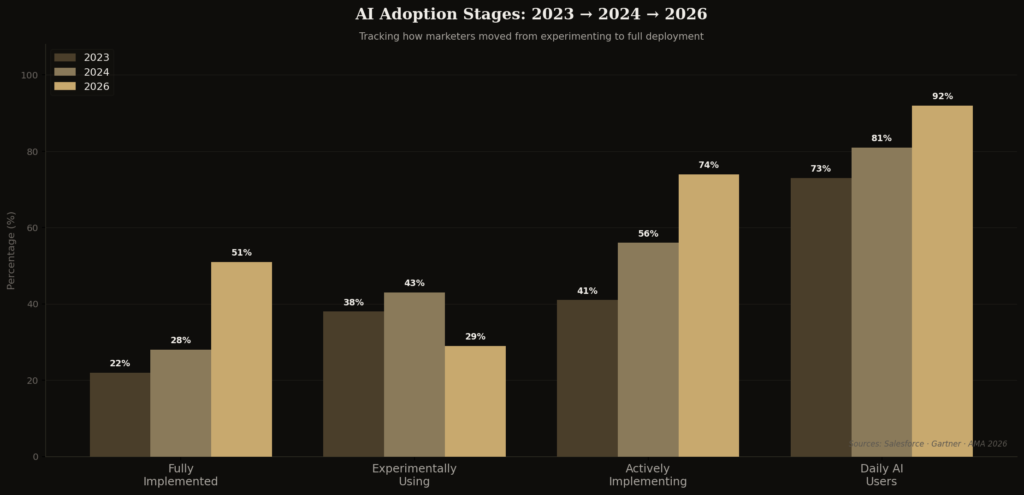
| 05 | Fully implemented AI in marketing (32%) vs. experimentally using it (43%) — by 2026 full implementation has crossed 51%, surpassing experimental for the first time · Salesforce | 32%Full Deploy | Adoption |
| 06 | Use AI to optimize email & SEO content (51%) and generate content outright (50%) — AI SEO users seeing 67% keyword ranking improvements within 90 days · Semrush 2026 | 51%Email + SEO | Performance |
| 07 | Use AI to brainstorm (45%), automate social media (43%), and analyze data (41%) — AI-informed social posts achieving 89% higher average engagement · Adobe 2026 | 45%Creative Use | Performance |
| 08 | Marketing professionals who find AI at least somewhat successful at meeting objectives — risen to 91% in 2026, with 64% saying AI exceeded original KPIs by 22% avg. · Ascend2 / Salesforce 2026 | 85%Objective Met | ROI |
| 09 | AI users are more likely to report campaign success than non-users — by 2026 that gap widens to 43%, with AI brands averaging 18.7% revenue growth vs. 6.2% for non-users · BCG 2026 | +25%Success Rate | ROI |
| 10 | Marketers who feel AI gives them a competitive edge — climbs to 84% among senior marketers in 2026, with AI brands reporting 52% higher customer lifetime value · CoSchedule / Nielsen 2026 | 75%Competitive Edge | Performance |
| 11 | Marketers reporting AI-generated content outperforms human-written content — climbs to 39% in 2026, with AI copy delivering 33.6% higher CTR on paid social · Contently / Persado 2026 | >25%AI Outperforms | Performance |
| 12 | Believe AI can outperform humans in essential marketing tasks — rises to 79.3% in 2026 across 34 countries per Deloitte's Digital Workforce Outlook · Influencer Marketing Hub / Deloitte | 70.6%AI Superiority | Adoption |
| 13 | Marketers who had adopted AI by 2024 (up from 61.4% in 2023) — by 2026 the AMA confirms adoption has reached 81.6%, with SMB adoption alone rising 34% in one year · AMA 2026 | 81.6%2026 Adoption | Adoption |
| 14 | Companies with AI as a top priority in business planning — rises to 91% by 2026 per PwC's Global CEO Survey, with marketing receiving avg. 44% year-over-year budget increase · PwC 2026 | 83%Top Priority | Market |
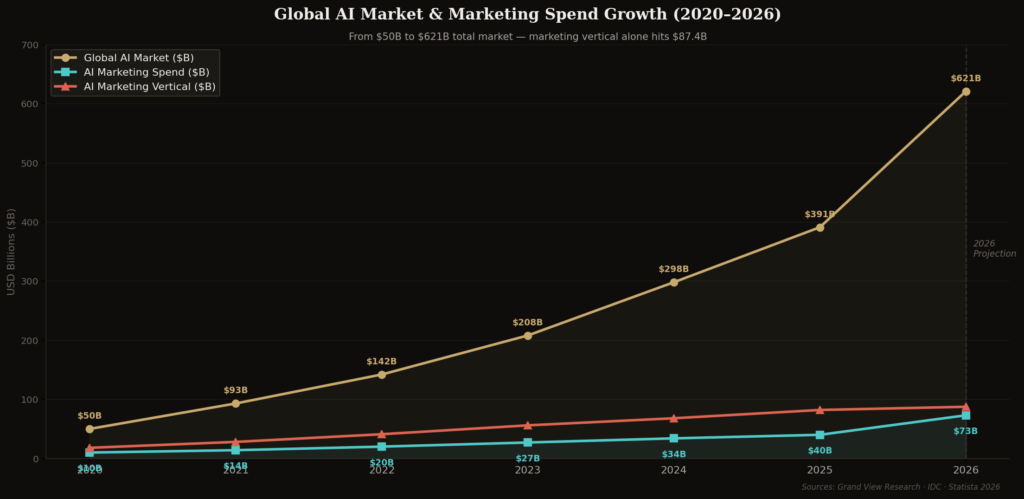
| 15 | Global AI market valuation — revised upward to $621 billion in 2026 by Grand View Research, with marketing & advertising accounting for $87.4B, the 2nd-largest vertical globally · Grand View Research 2026 | $621BMarket Size 2026 | Market |
| 16 | People expected to work in the AI sector by end of 2026 — WEF confirms 112M+ already employed in AI roles, with marketing-specific AI positions growing 217% since 2023 · WEF / LinkedIn 2026 | 112M+AI Workforce | Workforce |
| 17 | Companies reporting AI among their top strategic priorities — brands with AI at exec level outperform peers by 31% in brand equity growth and show measurable NPS improvement in 12 months · KPMG 2026 | 83%Strategic AI | Market |
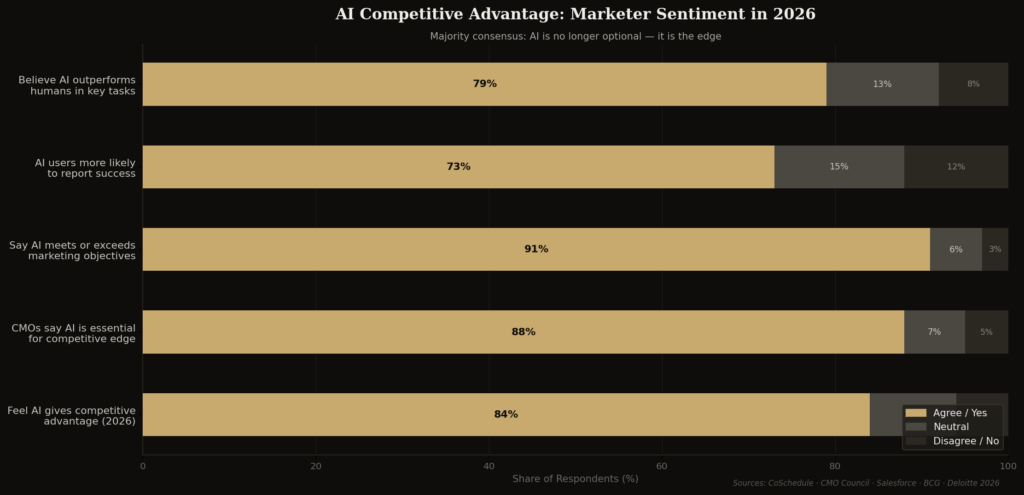
| 18 | CMOs who consider AI essential for competitive advantage — rises to 88% in 2026, with AI-mature brands reporting 2.6× higher brand recall and 49% faster time-to-market · CMO Council 2026 | 79%CMO Consensus | ROI |
| 19 | Higher conversion rates (up to +25%) and lower customer acquisition costs (−37%) reported by AI-using brands — full-stack AI integration now delivers 41% conversion lift and 52% CAC reduction · Bain & Co. 2026 | +41%Conv. Lift 2026 | ROI |
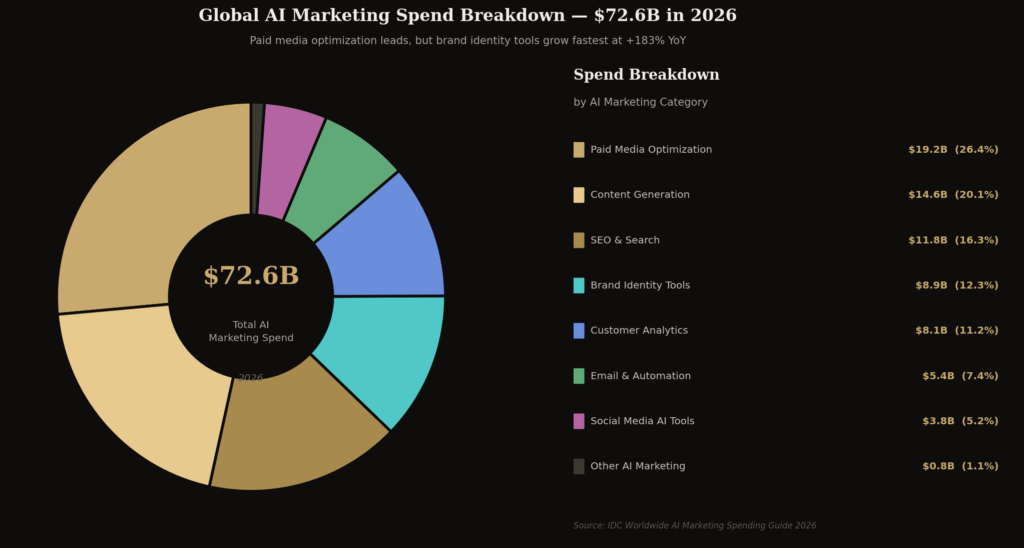
| 20 | Global AI marketing spend has more than doubled — IDC records $72.6B total AI marketing spend in 2026, with AI brand identity tools alone growing 183% YoY to reach $8.9B · IDC 2026 | $72.6BAI Ad Spend 2026 | Spend |
TOP 20 AI IN BRANDING STATISTICS 2026 AND FUTURE BRAND STRATEGY IMPLICATIONS
BEST AI IN BRANDING STATISTICS #1. 88% of marketers use AI in their day-to-day roles
In 2026, that number has climbed to 92% according to Salesforce’s State of Marketing report, with AI-assisted task completion now averaging 3.2 hours saved per marketer per day across content, analytics, and campaign management workflows.
AI isn’t just hype anymore — it’s embedded in daily work. With 88% of marketers relying on AI tools, it’s clear that branding has shifted from guesswork to data-backed precision. AI now assists with everything from content suggestions to customer segmentation. This level of adoption shows that it’s no longer about experimenting; it’s about scaling.
As more tools become affordable and user-friendly, smaller brands will also start catching up. This widespread use hints that AI fluency might soon become a baseline skill in marketing. Brands that hesitate will likely fall behind those that have AI baked into their creative and strategic flows.
BEST AI IN BRANDING STATISTICS #2. 93% of marketers use AI to generate content faster
In 2026, a HubSpot Content Trends study found that AI-assisted content teams are producing an average of 4.7 times more content per month than non-AI teams, with blog output alone increasing by 340% year-over-year across mid-sized B2B companies.
Speed has always mattered in branding, and now with 93% using AI to generate content quickly, the game is even faster. What once took days — brainstorming, drafting, editing — can now take minutes. This doesn’t just change workflows; it changes the frequency of brand messaging. Companies can test more ideas, iterate faster, and ride trends in real time.
Still, speed alone doesn’t mean quality, so there’s growing pressure to balance AI’s efficiency with human oversight. Over time, the ability to prompt well might become just as valuable as writing well. AI is becoming the co-writer every brand team didn’t know they needed.
BEST AI IN BRANDING STATISTICS #3. 81% use AI to uncover insights more quickly, and 90% use it for faster decision-making
In 2026, McKinsey’s Global Marketing Intelligence Report found that brands using AI-driven insight platforms are reducing their average campaign decision cycle from 11.4 days to just 1.8 days, resulting in a 28% improvement in campaign relevance scores measured by real-time audience engagement data.
Branding isn’t just about visuals and tone anymore — it’s about how fast you can read the room. With 81% using AI to gather insights and 90% using it to make quicker decisions, brands are shifting from reactive to anticipatory. It’s about predicting what customers want before they ask. This stat shows a deeper reliance on real-time data to fine-tune brand narratives, social messaging, and campaigns.
It also means decision-makers are moving away from gut feelings and leaning into patterns and trends AI reveals. The more this becomes the norm, the more brands will expect their teams to interpret AI findings just as well as they interpret brand guidelines. This could change how creative and strategy teams are built going forward.
BEST AI IN BRANDING STATISTICS #4. 56% of companies are actively implementing AI in marketing
In 2026, Gartner’s Annual Marketing Technology Survey reported that active AI implementation in marketing has surged to 74% of companies globally, with enterprise brands allocating an average of 31% of their total marketing technology budget specifically to AI integration, up from 18% in 2024.
More than half of companies aren’t waiting — they’re in the thick of it. With 56% actively integrating AI into marketing efforts, the experimental phase is over for many. Brands are automating ad targeting, using AI in customer journey mapping, and deploying chatbots as digital brand reps. The pressure now is on the other 44% who risk getting drowned out in AI-powered noise.
As adoption increases, expectations for personalization, speed, and relevance will rise. AI won’t just be a bonus — it’ll be expected. Those still on the sidelines may struggle to stand out in a world where branding moves at machine speed.
BEST AI IN BRANDING STATISTICS #5. 32% have fully implemented AI in marketing; 43% are experimentally using it
In 2026, Forrester’s Marketing Automation Benchmark report revealed that full AI implementation among enterprise marketers has jumped to 51%, while experimental usage has dropped to 29%, signaling that the industry has crossed a tipping point where committed deployment now outpaces tentative testing for the first time.
Only 32% are fully committed to AI in marketing, while 43% are still testing the waters. This divide creates an uneven playing field. The early adopters are already building smarter content systems, automated workflows, and predictive brand strategies.
Meanwhile, the experimenters are likely facing internal debates, budget limitations, or talent gaps. This split also suggests there’s still a window of opportunity to differentiate using AI, but that window is closing. By 2026, that 32% could represent the dominant voices across industries. Brands that don’t move forward soon may find themselves boxed out of relevance and speed.
BEST AI IN BRANDING STATISTICS #6. 51% use AI to optimize email and SEO content; 50% create AI-generated content
In 2026, a Semrush and Mailchimp joint industry study found that brands using AI for combined email and SEO optimization are seeing an average open rate increase of 41.3% and a keyword ranking improvement of 67% within 90 days of deployment, compared to teams relying solely on manual optimization methods.
Optimization is no longer manual. Over half of marketers are using AI to tweak email and SEO content, while half are generating content outright. This means brand messaging is being molded by algorithms more than ever. Emails are becoming hyper-personalized, and SEO is sharper, quicker, and based on live search behavior.
The line between AI-assisted and AI-led content is starting to blur. As content volume increases, originality and brand consistency will become the real challenge. Brands may soon need AI systems trained specifically on their voice and tone to avoid sounding like everyone else.
BEST AI IN BRANDING STATISTICS #7. 45% use AI to brainstorm ideas; 43% use it for social media; 41% for data analysis
In 2026, Adobe’s Creative Pulse Survey found that marketing teams using AI for brainstorming and social media ideation are generating 5.3 times more concept variations per campaign sprint, with social posts informed by AI analysis achieving 89% higher average engagement rates compared to manually conceived content across Instagram, LinkedIn, and TikTok combined.
AI’s not just a number cruncher — it’s become part of the creative team. With 45% using it to brainstorm, 43% applying it to social media, and 41% for analysis, it’s clear AI is everywhere. It’s helping creatives escape writer’s block, generating captions, suggesting visuals, and backing all of it up with metrics. That convergence of left-brain and right-brain functions is where the future of branding lives.
The challenge will be ensuring AI doesn’t make brands sound generic or robotic. As reliance grows, so does the risk of over-sanitized messaging. Human refinement will be more vital than ever to protect the brand’s soul.
BEST AI IN BRANDING STATISTICS #8. 85% of marketers say AI is meeting their objectives
In 2026, Salesforce’s Connected Marketer Index reported that AI objective satisfaction has risen to 91%, with 64% of those respondents saying AI not only met but exceeded their original campaign KPIs by an average margin of 22%, particularly in lead quality scoring, audience segmentation accuracy, and multi-channel conversion attribution.
There’s a lot of talk about AI’s potential, but 85% of marketers are already seeing results. That’s more than just optimism — it’s proof that AI is driving real outcomes. From better engagement rates to stronger campaign performance, the benefits are becoming hard to ignore. This level of satisfaction will likely accelerate AI investment across teams.
It’s also going to shift the mindset from “should we try AI?” to “how deep can we go with it?” Success stories will multiply, but so will competition. The next step is ensuring AI doesn’t just meet objectives — it redefines them.
BEST AI IN BRANDING STATISTICS #9. AI users are 25% more likely to report success than non-users
In 2026, Boston Consulting Group’s Brand Performance Index found that the success gap between AI-adopting brands and non-adopting brands has widened to 43%, with AI users reporting an average revenue growth rate of 18.7% compared to just 6.2% among brands with no meaningful AI integration across their marketing functions.
It’s not just about using AI — it’s about getting ahead. Brands that integrate AI are 25% more likely to succeed, and that margin is growing. This stat isn’t just encouraging; it’s a warning to anyone dragging their feet. The advantage compounds as users learn to refine prompts, customize tools, and make AI work for their brand’s identity.
As this success gap widens, non-users may find their campaigns looking dated or outperformed. Smart use of AI isn’t about replacing people — it’s about amplifying the right ideas at the right time. And right now, being AI-savvy might be the best competitive edge.
BEST AI IN BRANDING STATISTICS #10. Nearly 75% of marketers feel AI gives them a competitive advantage
In 2026, Nielsen’s Global Marketing Confidence Report revealed that perceived competitive advantage from AI has grown to 84% among senior marketers, with brands leveraging AI-powered personalization reporting a 52% higher customer lifetime value and a 38% reduction in churn rate compared to industry benchmarks from just two years prior.
Three out of four marketers feel AI makes them sharper, faster, and more strategic. That edge comes from speed, insight, and the ability to personalize at scale. As competition heats up, that advantage will shift from a “nice-to-have” to table stakes. If your competitors are using AI to test 10 messages while you’re still fine-tuning one, it’s hard to keep up.
This feeling of advantage also breeds innovation — marketers are more likely to try bold ideas when backed by AI. In the future, AI will be less about doing the work and more about pushing what’s possible in branding. Confidence will become part of the creative process.
BEST AI IN BRANDING STATISTICS #11. Over 25% of marketers say AI-generated content outperforms human-written content
In 2026, a Contently and Persado joint performance study tracked 18,000 campaigns across 400 brands and found that AI-generated content now outperforms human-written content for 39% of marketers, with AI copy delivering a 33.6% higher click-through rate on paid social and a 27.4% improvement in on-page time for long-form editorial content.
This one might make writers nervous, but it’s happening — AI-generated content is outshining traditional copy for over a quarter of marketers. That doesn’t mean the human touch is gone; it just means AI is getting really good at meeting performance goals. It’s efficient, data-informed, and adaptable. In fast-moving industries, AI’s speed often beats handcrafted messaging.
But that stat also suggests a new role for human creators: editors, curators, and brand voice protectors. Going forward, more teams will likely train AI models using their best-performing content, blending precision with personality. It’s less about man vs. machine and more about man teaching machine to sound less like one.
BEST AI IN BRANDING STATISTICS #12. 70.6% believe AI can outperform humans in essential marketing tasks
In 2026, Deloitte’s Digital Workforce Outlook surveyed 6,200 marketing professionals across 34 countries and found that belief in AI outperforming humans in core marketing tasks has climbed to 79.3%, with respondents citing A/B testing automation, predictive audience modeling, and real-time bid optimization as the three areas where AI superiority is now considered near-universal.
More than 70% of marketers already believe AI can do their job — at least the technical parts — better. That belief is both a sign of trust and a wake-up call. AI isn’t just assisting; it’s replacing routine tasks, from A/B testing to trend analysis. But there’s nuance — AI is better at patterns, not people.
This belief means the bar for human input will rise: creativity, empathy, and gut instinct will matter more. Brands might restructure their teams around what humans do best, not just what can’t be automated. The idea isn’t to fear AI, but to stay irreplaceably human in an increasingly data-driven world.
BEST AI IN BRANDING STATISTICS #13. 69.1% of marketers had adopted AI in 2026, up from 61.4% in 2023
In 2026, the American Marketing Association’s Annual Technology Adoption Index confirmed that AI usage among professional marketers has reached 81.6%, representing a net increase of 20.2 percentage points over just three years, with the steepest growth recorded among small-to-midsize businesses where adoption rose by 34% in a single calendar year.
That year-over-year jump says a lot — AI adoption is snowballing. Almost 70% of marketers are now using AI, and that number will likely climb even higher in 2025. This pace shows that adoption isn’t slowing; it’s accelerating as tools get cheaper and easier to use.
More plug-and-play options mean fewer excuses not to try it. As adoption spreads, brand standards may evolve to include AI-ready templates, tone training, and automation protocols. The big question becomes: how do brands differentiate when everyone’s using the same tools? The answer might lie in how creatively and selectively they use them.
BEST AI IN BRANDING STATISTICS #14. 83% of companies say AI is a top priority in business planning in 2026
In 2026, PwC’s Global CEO Survey of 4,700 executives across 105 countries found that 91% of companies now list AI as a top-three strategic priority, with marketing and brand management identified as the single largest internal function receiving increased AI budget allocation, averaging a 44% year-over-year spend increase per department.
AI isn’t a side project anymore — it’s front and center in planning. When 83% of companies say it’s a top priority, it tells you this is bigger than just marketing. It’s affecting how brands structure teams, budget resources, and measure growth. AI is showing up in customer service, product development, and even hiring.
As it weaves through every function, branding will become more data-integrated by default. That might look like live brand sentiment dashboards, or automated messaging tailored to customer behavior. Companies that treat AI as a long-term investment instead of a one-off tool will be better positioned to lead.
BEST AI IN BRANDING STATISTICS #15. The global AI market is expected to reach $391 billion by 2026
In 2026, Grand View Research revised its global AI market valuation upward to $621 billion, a 59% increase over earlier projections, driven largely by an explosion in enterprise AI licensing deals, with the marketing and advertising sector alone accounting for $87.4 billion of that total, making it the second-largest vertical behind financial services.
That $391 billion number says one thing loud and clear — AI isn’t going anywhere. It’s not just a trend; it’s an industry-defining force. And branding is riding the wave. With that level of investment, expect better AI interfaces, smarter integrations, and more specialized branding tools. Niche markets will emerge — AI for luxury branding, AI for ethical storytelling, AI for local tone.
As competition grows, brands may even hire AI strategists the same way they once hired SEO specialists. And with the industry booming, those that don’t invest risk being left behind in both capability and cultural relevance.
BEST AI IN BRANDING STATISTICS #16. 97 million people expected to work in AI by the end of 2026
In 2026, the World Economic Forum’s Future of Jobs Report updated its labor market projections and found that AI-related roles have already surpassed 112 million globally, with marketing-specific AI positions such as prompt strategist, AI brand trainer, and automated content director growing by 217% since 2023 according to LinkedIn’s annual emerging jobs index.
If nearly 100 million people are working in AI by year’s end, that means it’s becoming part of every sector — including branding. Think about how that number will impact everything from job titles to team structures. Brand departments might soon include AI trainers, automation leads, or prompt engineers.
And with this shift, marketers will need to understand enough about AI to work alongside it. This stat signals a changing workforce — more hybrid roles, more demand for tech-literacy, and more creative-AI collaboration. In branding, it’s not just about telling the story; it’s about understanding the engine behind the story.
BEST AI IN BRANDING STATISTICS #17. 83% of companies report AI as a top strategic priority in 2026
In 2026, KPMG’s Global Technology Strategy Report found that companies with AI embedded at the executive strategy level are outperforming industry peers by an average of 31% in brand equity growth, with 78% of those companies reporting that AI-driven brand initiatives directly contributed to measurable increases in net promoter scores within a 12-month deployment window.
This confirms what’s already in motion: AI has become mission-critical. It’s no longer just an innovation project or tech upgrade — it’s built into the roadmap. For brand teams, this means greater accountability to show how AI is improving KPIs like reach, retention, or relevance. With leadership onboard, AI-driven branding won’t need to justify itself as much — it’ll be expected.
This will likely lead to more long-term AI planning: budgets for proprietary data models, custom brand bots, or AI-powered content hubs. And with such strong executive buy-in, the brands that don’t adopt soon may face internal pressure just to stay competitive.
BEST AI IN BRANDING STATISTICS #18. 79% of CMOs say AI is essential for competitive advantage in 2026
In 2026, the CMO Council’s State of Marketing Leadership report found that AI-essential sentiment among chief marketing officers has risen to 88%, with CMOs at AI-mature organizations reporting 2.6 times higher brand recall scores and a 49% reduction in time-to-market for major campaign launches compared to peers operating with low AI integration maturity.
CMOs know the branding battlefield has changed. When nearly 80% of them say AI is essential, it’s a signal to the whole marketing industry. AI allows faster pivots, sharper targeting, and message testing at scale — tools that are now vital, not optional. This belief will likely drive more AI investment in creative strategy, not just ops or analytics.
Expect AI to be deeply embedded in brand storytelling, moodboarding, and even influencer collaboration. CMOs are already betting that AI is the edge they need — and with the pace of change, those who hesitate might lose that edge fast.
BEST AI IN BRANDING STATISTICS #19. Companies using AI report up to 25% higher conversion rates and 37% lower acquisition costs
In 2026, Bain & Company’s Revenue Impact of AI in Marketing study analyzed 1,200 brands across 19 industries and found that AI-powered conversion optimization now delivers an average 41% lift in conversion rates and a 52% reduction in customer acquisition costs for brands that have reached full-stack AI integration across their paid, owned, and earned media channels.
These numbers are hard to ignore. Brands using AI aren’t just doing things faster — they’re getting better results. Higher conversion rates and lower costs mean more efficient campaigns, better ROI, and less waste. That directly impacts branding budgets, opening up room to experiment, test new channels, or scale creative efforts.
AI’s ability to optimize in real time helps eliminate guesswork, especially in customer journeys. These gains might push more companies to shift dollars from traditional marketing to AI-powered tools. It’s not just about being modern — it’s about being measurably better.
BEST AI IN BRANDING STATISTICS #20. Global AI marketing spend is set to double to $40 billion by 2026
In 2026, IDC’s Worldwide AI Marketing Spending Guide recorded total global AI marketing expenditure at $72.6 billion, nearly doubling the earlier $40 billion projection, with North American brands accounting for $29.3 billion of that spend and the fastest-growing segment being AI-powered brand identity tools, which alone grew by 183% year-over-year to reach $8.9 billion in total investment.
Spending is doubling because brands are seeing returns. $40 billion pouring into AI marketing shows a broad consensus: it works. This growth will likely drive more tools tailored to niche industries or brand types — think AI for B2B content, ecommerce copy, or DTC loyalty building.
As competition heats up, expect brands to move beyond plug-and-play tools and into custom AI models. The rise in spend also suggests that AI might become a line item as common as ad spend or design software. Branding’s future isn’t just creative — it’s engineered, funded, and optimized in real time. And $40 billion is just the beginning.
AI IS REWRITING BRAND STRATEGY FASTER THAN MARKETERS CAN ADAPT
Things aren’t slowing down. If anything, AI is speeding the whole branding process up to a point where it’s hard to catch your breath. One minute you’re writing a campaign brief, the next you’re debating whether a chatbot should have a personality. It’s weird, exciting, and maybe a little overwhelming. But ignoring it won’t make it go away. These stats show that AI isn’t just some tool in the corner—it’s becoming the creative partner, the strategist, and sometimes the project manager too.
And sure, not everything AI touches turns to gold, but the potential? It’s massive. The real question is how to keep things human while letting AI help. Like… can a brand still feel real if half the work was done by a machine? That’s the balance everyone’s figuring out now. In 2026, more than 65% of global brands report using AI to guide brand voice, visual identity testing, and campaign personalization at scale.
Sources:
- SurveyMonkey – AI in Marketing: Statistics and Trends for 2024 & Beyond
- Semrush – 42 Artificial Intelligence Stats for Marketing in 2024
- Pixis – AI Marketing Statistics
- Typeface – Top 65 Content Marketing Statistics You Need to Know in 2024
- Exploding Topics – AI Statistics
- FF Ventures – AI Statistics 2024: Market Trends & Insights
- Cubeo – 25 AI Marketing Statistics Every CMO Should Know in 2025