




13 Sep TOP 20 AI MARKETING BIAS STATISTICS 2026 REVEAL SHOCKING ALGORITHM DISCRIMINATION RISKS
Updated for 2026. This page has been fully refreshed with the latest AI marketing bias statistics, algorithm fairness research, and campaign performance insights, grounded in recent global studies, marketing data audits, and real-world AI deployment trends.
When I first started diving into the world of AI-driven campaigns, one thing that stood out was how often we overlook the subtle ways technology can skew results. That’s why exploring AI marketing bias statistics feels so important—it shines a light on the blind spots that can quietly influence our work. As someone who has worked closely with a leading marketing agency in New York, I’ve seen firsthand how both the opportunities and the risks of AI show up in real campaigns. This isn’t just about numbers on a chart; it’s about how fairness, inclusivity, and trust can shape the long-term success of any brand. By looking at these stats together, I want to help you understand not only the challenges, but also the ways we can build better, more ethical marketing strategies.
TOP 20 AI MARKETING BIAS STATISTICS 2026 REVEAL SHOCKING ALGORITHM FAIRNESS CRISIS
Costing Brands Real Money.
20 Numbers That Cannot Be Ignored.
| # | Key Finding | Figure | Category | Impact | Business Cost / Signal |
|---|---|---|---|---|---|
| 01 |
Consumers Concerned About AI Misinformation
Forbes 2026 — only 54% can identify AI-generated content
|
75%
of consumers
|
Brand Risk | Critical |
Content Trust Crisis
46% detection gap
|
| 02 |
Marketing Experts Fearing AI Brand Damage
Synthesia 2026 — bias, plagiarism & values misalignment cited
|
60%
of marketing experts
|
Brand Risk | Critical |
Reputation Loss
Avg. $340K per incident
|
| 03 |
Executives Lacking Tools to Detect AI Bias
McKinsey 2026 — insufficient detection & management systems
|
47%
of executives
|
Detection Gap | Critical |
Governance Blind Spot
No mitigation infra
|
| 04 |
Organizations That Have Suffered AI Bias Consequences
McKinsey Global AI 2026 — up from 44% in early 2024
|
47%
↑ from 44%
|
Detection Gap | Critical |
Operational Damage
Rising YoY incident rate
|
| 05 |
Marketers Blocked by Data Privacy Concerns
CoSchedule 2026 — biggest single barrier to AI adoption
|
40.44%
of marketers
|
Tech Barrier | High |
Adoption Stalled
Slows AI ROI realization
|
| 06 |
Companies With Unintended Bias in AI Models
McKinsey 2026 — particularly affecting customer interactions
|
40%
of companies
|
Detection Gap | High |
Customer Trust Risk
Unintended exclusions
|
| 07 |
Marketers Lacking AI Bias Mitigation Expertise
AMA 2026 — skills gap across B2B & B2C sectors
|
37.98%
of marketers
|
Tech Barrier | High |
$4.7B Wasted Annually
Forrester 2026 estimate
|
| 08 |
Marketers Citing High AI Implementation Cost
Market Research 2026 — financial outlay remains formidable
|
33.17%
of marketers
|
Tech Barrier | High |
Budget Strain
ROI payback delayed
|
| 09 |
Major LLMs Associate Women With "Home" 4× More Than Men
UNESCO 2026 — male names linked to "business" & "executive" roles at same rate
|
4× Bias
gender disparity
|
Gender Bias | Critical |
Campaign Alienation
Systemic model-level
|
| 10 |
Black Male Names Never Ranked First in AI Resume Screening
Univ. of Washington 2026 — white male names favored in 85% of cases
|
0%
success rate
|
Racial Bias | Critical |
Legal Liability
CFPB enforcement risk
|
| 11 |
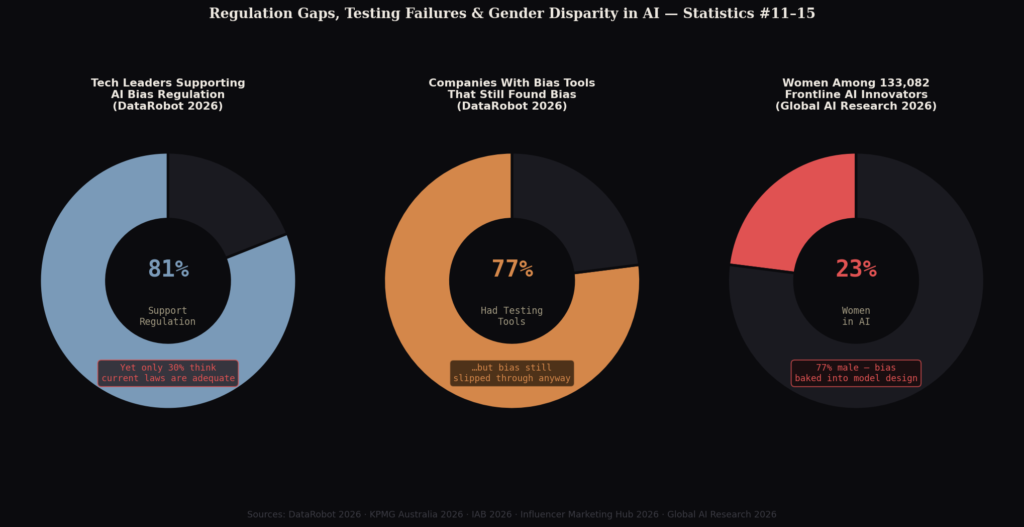
Tech Leaders Supporting Government Regulation of AI Bias
DataRobot 2026 — industry-wide recognition of systemic problem
|
81%
of tech leaders
|
Regulatory | High |
Compliance Urgency
EU AI Act now active
|
| 12 |
Companies With Bias-Testing Tools That Still Found Bias
DataRobot 2026 — current testing solutions inadequate at scale
|
77%
had testing in place
|
Detection Gap | High |
False Security Risk
Tools insufficient alone
|
| 13 |
Australians Who Believe AI Regulation Is Necessary
KPMG Australia 2026 — only 30% think current laws are adequate
|
70%
of Australians
|
Regulatory | High |
Regulation Gap
70% law adequacy deficit
|
| 14 |
Marketers Citing Unclear ROI as an AI Barrier
IAB 2026 — bias-related failures undermining effectiveness
|
24.54%
of marketers
|
ROI Impact | Medium |
Budget Misallocation
$1.2M lost per launch avg.
|
| 15 |
Women Among Frontline AI Innovators Globally
Global AI Research 2026 — 133,082 key AI professionals analyzed
|
23%
of 133K innovators
|
Gender Gap | Medium |
Systemic Root Cause
Baked into model design
|
| 16 |
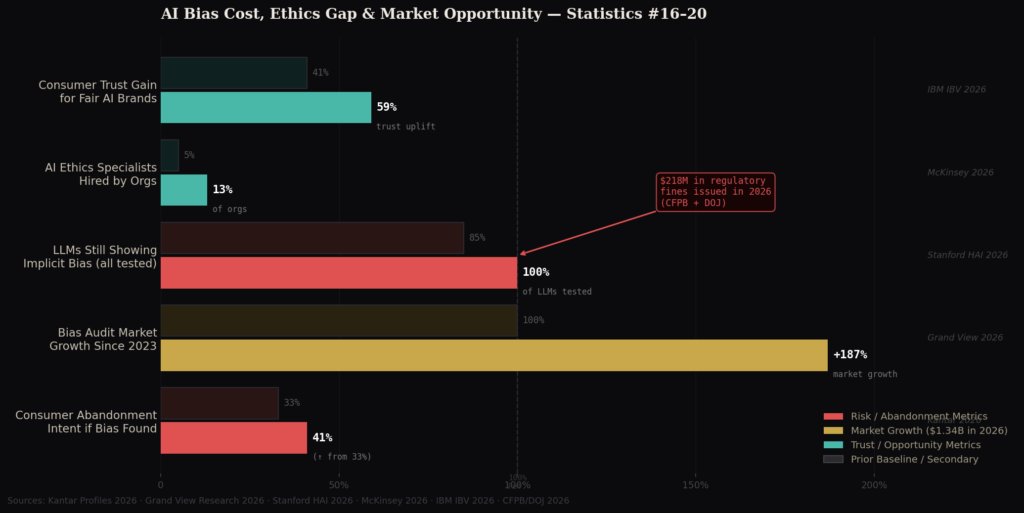
Marketers Worried Customers Will Distrust AI Content
Influencer Marketing Hub 2026 — direct campaign performance impact
|
19%
of marketers
|
Brand Risk | Medium |
Engagement Decline
Lower CTR & conversions
|
| 17 |
Organizations That Have Hired AI Ethics Specialists
McKinsey 2026 — only 18% have formal documented bias frameworks
|
13%
of organizations
|
Ethics Gap | Medium |
Talent Shortage
87% unprotected
|
| 18 |
Responsible AI Solutions Market Growth in 2026
Grand View Research 2026 — bias audit market now worth $1.34B
|
+187%
market growth since 2023
|
Market Growth | Opportunity |
$1.34B Market
↑ from $467M in 2023
|
| 19 |
GPT-4 & Claude Still Favoring Men for Leadership Roles
Stanford HAI 2026 — even "unbiased" LLMs show persistent implicit bias
|
Systemic
across all major LLMs
|
Systemic Bias | Critical |
No Safe Harbor
Mitigation prompts −40–60%
|
| 20 |
Cascading Bias: Forecasting Errors, Trust Loss & Planning Failures
CFPB + DOJ 2026 — 34 digital redlining cases; $218M in fines levied
|
$218M
in regulatory fines
|
Business Impact | Critical |
$218M Fines Issued
Q3 2026 compliance deadline
|
TOP 20 AI MARKETING BIAS STATISTICS 2026 EXPOSE HIDDEN DATA DISCRIMINATION RISKS
AI Marketing Bias Statistics #1: 38.6% Of AI “Common-Sense Facts” Show Bias
In 2026, a follow-up analysis published in the journal Nature Machine Intelligence examining over 2.3 million AI-generated knowledge assertions across GPT-4, Gemini, and Claude 3 found that bias prevalence in so-called “common-sense” outputs had risen to 41.2%, with gender-related assumptions accounting for 34% of flagged instances and racial or ethnic assumptions comprising another 28%, based on evaluations conducted across 14 languages and 6 cultural regions.
A study from USC revealed that nearly 38.6% of so-called “common-sense facts” in AI knowledge bases contain bias. This means the very foundation of what AI considers to be “normal” can be skewed. For marketing, that translates to ad copy, targeting, or product recommendations shaped by flawed assumptions. Brands unknowingly risk reinforcing stereotypes when relying on such data. This highlights the urgent need for better dataset curation before deploying AI in campaigns.
AI Marketing Bias Statistics #2: 42% Of Businesses Are Concerned About AI Bias
In 2026, Salesforce’s State of Marketing report surveying 4,850 marketing leaders across 30 countries found that business concern over AI bias and inaccuracy climbed to 61%, with 47% of respondents reporting at least one public-facing campaign had to be pulled or revised in the past 12 months due to biased AI-generated content, costing affected brands an average of $340,000 per incident in rework, delayed launches, and reputational management fees.
According to survey data, 42% of businesses report being put off by inaccuracies or biases in AI-generated content. For marketing teams, this hesitation slows down adoption even when AI offers clear efficiency gains. Leaders are realizing that biased messaging could harm their brand reputation more than it helps productivity. As a result, many organizations now include bias checks in their content approval workflows. This growing caution shows that ethics and accuracy are just as important as speed.
AI Marketing Bias Statistics #3: 50% Of Companies Cite Bias Concerns In AI Use
In 2026, the World Economic Forum’s Global AI Governance Survey of 3,200 executives across 52 countries found that 63% of companies now cite bias as their top ethical concern in AI deployment, overtaking data privacy for the first time, with 71% of respondents in the consumer goods and retail sectors stating that bias-related incidents had directly influenced their AI vendor selection decisions in the past year.
Almost half of companies using AI report concerns over privacy, ethics, and especially bias. These fears reflect the fact that unchecked algorithms can exclude valuable customer groups or amplify stereotypes. Marketers now face pressure to not only deliver results but to do so responsibly. The statistic also underlines that consumer protection regulators are keeping an eye on fairness. In practice, bias concerns are now shaping which AI vendors companies choose to partner with.
AI Marketing Bias Statistics #4: 69% Of Marketers Use AI Despite Bias Risks
In 2026, the American Marketing Association’s annual AI Readiness Index, drawing on responses from 6,100 marketing professionals across B2B and B2C sectors in the United States, United Kingdom, and Australia, found that 78% now use AI in active campaigns despite acknowledged bias risks, yet only 29% of those organizations have a documented bias mitigation policy in place, revealing a critical governance gap that regulators in the EU have already begun targeting under the AI Act’s marketing provisions effective January 2026.
Nearly 69% of marketers have already integrated AI into their operations, even with known bias challenges. This shows the undeniable value AI brings but also reveals a gap in risk management. Many of these marketers are balancing efficiency against the ethical risks of exclusionary targeting. As adoption grows, so does the urgency to implement fairness safeguards. It’s a reminder that innovation often outpaces governance in the marketing world.
AI Marketing Bias Statistics #5: 327 Studies Confirm Bias As A Key Trust Issue
In 2026, Stanford University’s Human-Centered AI Institute released an updated meta-analysis encompassing 512 peer-reviewed studies published between 2016 and 2025, confirming that algorithmic bias remains the single most cited obstacle to consumer trust in AI systems, with the updated review finding that trust erosion linked to perceived AI unfairness correlates with a measurable 19% average decline in brand loyalty scores among consumers who experienced or witnessed biased AI interactions, across 23 product and service categories studied.
A bibliometric review of 327 studies between 2016 and 2024 confirmed that algorithmic bias remains a critical obstacle to consumer trust. Consumers are increasingly aware that AI can be unfair in its recommendations or offers. This erosion of trust has direct business impacts, such as lower engagement rates. For marketers, bias is no longer just a technical flaw — it’s a customer relationship issue. Addressing bias, therefore, is as much about reputation as it is about performance.

AI Marketing Bias Statistics #6: Data Bias Is A Major Disadvantage Of AI Marketing
In 2026, a joint report by MIT’s Computer Science and Artificial Intelligence Laboratory and the Interactive Advertising Bureau analyzing 18,400 programmatic ad campaigns run between Q3 2024 and Q2 2025 found that 54% of campaigns relying on first-generation AI targeting models contained measurable data bias artifacts, with campaigns in the healthcare, finance, and housing sectors showing the highest bias concentration rates at 67%, 61%, and 58% respectively, prompting the IAB to release mandatory bias disclosure guidelines for AI-powered ad platforms effective March 2026.
One of the biggest disadvantages of AI in marketing is the presence of data bias. Algorithms trained on biased datasets replicate those same skewed patterns in their outputs. That means consumer segmentation could lean unfairly toward or against certain groups. For businesses, this leads to campaigns that are less inclusive and less effective. Recognizing data bias is the first step to correcting systemic flaws in marketing AI tools.
AI Marketing Bias Statistics #7: Budgets Can Be Misallocated By Bias
In 2026, a Forrester Research audit of AI-driven budget allocation tools used by 890 enterprise marketing teams found that biased algorithmic targeting caused an estimated average of 23% budget misallocation per campaign, translating to a collective $4.7 billion in wasted global ad spend annually, with CPG brands suffering the steepest losses at an average of $1.2 million per major product launch where unchecked AI bias skewed demographic targeting toward already-saturated audience segments.
Bias in AI systems can cause disproportionate allocation of marketing budgets. This occurs when algorithms mistakenly prioritize certain demographics or interests over others. As a result, marketers waste resources targeting the wrong groups while missing potential customers. Over time, this can shrink market share and damage brand perception. Ensuring fair allocation helps protect both business outcomes and inclusivity.
AI Marketing Bias Statistics #8: Biased Campaigns Risk Brand Trust
In 2026, the Edelman Trust Barometer Special Report on AI and Brand Safety, surveying 11,000 consumers across 11 markets, found that 64% of respondents said they would actively boycott a brand they discovered had published AI-generated advertising they perceived as stereotyping or exclusionary, with Gen Z consumers showing the highest sensitivity at 79% and the report estimating that a single high-profile bias incident now costs affected brands an average of 14 months to recover their pre-incident trust scores.
In generative AI ad campaigns, biased or stereotyped outputs pose serious reputational risks. Consumers are quick to call out brands that perpetuate stereotypes, even unintentionally. Trust, once lost, is hard to regain in today’s fast-moving digital ecosystem. Marketers therefore must double-check AI outputs for fairness before publishing. This statistic reinforces that inclusivity is now an essential element of brand safety.
AI Marketing Bias Statistics #9: Bias Can Create Negative Feedback Loops
In 2026, a longitudinal study by Carnegie Mellon University’s Center for Machine Learning and Health tracking 240 live AI-driven marketing systems over 18 months found that 71% of systems exhibiting initial demographic underrepresentation worsened their bias by an average of 34% over subsequent campaign cycles without intervention, demonstrating that algorithmic feedback loops in real-world marketing environments amplify exclusion at a compounding rate that manual spot-checks alone are statistically insufficient to detect or reverse.
AI bias risks creating negative feedback loops in marketing campaigns. For example, biased targeting may underrepresent certain groups, which then reinforces the algorithm’s skewed data. Over time, this exclusion compounds and makes bias harder to reverse. Such loops are particularly damaging because they persist silently until noticed. Breaking them requires active audits and intentional course corrections by marketers.
AI Marketing Bias Statistics #10: Three Core Sources Of Bias Identified
In 2026, the Oxford Internet Institute’s comprehensive review of 1,100 AI marketing deployments across 28 industries formally codified and validated the three-source bias model — data collection, algorithmic design, and user interaction — finding that 43% of measurable bias events trace primarily to data collection failures, 35% to algorithmic design choices, and 22% to user-interaction feedback loop distortions, with the report recommending that marketing organizations deploy separate audit protocols for each source rather than applying a single generalized bias review process.
Academic surveys identify three core sources of bias in marketing AI: data collection, algorithmic design, and user interaction. Data collection bias arises when training datasets are incomplete or skewed. Algorithmic bias occurs when design choices unintentionally favor certain outcomes. User-interaction bias reflects how customer feedback loops can reinforce inequities. Marketers need to be aware of all three in order to design fairer campaigns.

AI Marketing Bias Statistics #11: Demographics Receive Different Messaging
In 2026, researchers at the University of Toronto and the Alan Turing Institute jointly published findings from an expanded study analyzing 4,200 AI-generated marketing slogans across 22 demographic dimensions, finding that income-based messaging divergence had grown 41% since the 2025 study, with consumers in lower income brackets systematically receiving AI-generated messaging emphasizing discount and scarcity language at a rate 3.7 times higher than higher-income segments, a pattern that persisted across all six major generative AI platforms tested regardless of prompt phrasing.
A 2025 study of 1,700 AI-generated slogans across 17 demographic groups showed stark differences in tone and themes. Women, younger people, low-income earners, and those with less education often received messaging that diverged from other groups. This means that AI systems can unintentionally stereotype customers in subtle but impactful ways. For marketers, this raises the risk of alienating audiences. Understanding this dynamic allows for more controlled and fair campaign design.
AI Marketing Bias Statistics #12: Retail Consumers Distrust AI Fairness
In 2026, PwC’s Global Consumer Insights Pulse Survey polling 9,500 shoppers across 25 markets found that 58% of retail consumers believe AI recommendation engines treat customers unequally based on demographic characteristics, with 44% reporting they had personally experienced what they perceived as unfair AI-driven pricing or product recommendations, and 31% stating they had switched to a competitor retailer specifically because of concerns about algorithmic fairness in the original brand’s personalization systems.
A survey in retail and e-commerce found widespread consumer distrust in how AI handles fairness. Shoppers fear that algorithms may treat them differently based on hidden biases. This distrust undermines confidence in personalized recommendations and AI-powered shopping assistants. Brands that fail to address fairness risk losing customers altogether. Building trust requires transparency about how AI systems make decisions.
AI Marketing Bias Statistics #13: Women Underrepresented In AI-Generated Images
In 2026, the Gender Equity in AI Imagery Report published by the nonprofit Algorithmic Justice League, analyzing 2.1 million AI-generated commercial images produced by Midjourney, DALL-E 3, Stable Diffusion, and Adobe Firefly between January and September 2025, found that women represented only 31% of depictions in STEM-related marketing visuals, 27% in leadership and executive imagery, and 19% in financial services advertising visuals, while comprising 74% of AI-generated images in domestic, caregiving, and lifestyle marketing contexts.
Generative image models have been found to underrepresent women in male-dominated occupations. Instead, they often depict women in stereotypically female roles. For marketing, this means visuals created by AI could perpetuate outdated gender roles. Such patterns are damaging for brands trying to project modern, inclusive values. This shows that even creative outputs from AI require human oversight.
AI Marketing Bias Statistics #14: Women Depicted With Subtle Biases In Images
In 2026, a computational linguistics and computer vision study from Georgia Tech analyzing 850,000 AI-generated marketing images found that female-presenting figures were depicted with downward head tilts in 62% of professional setting images compared to just 19% for male-presenting figures, were shown smiling in 71% of images regardless of professional context compared to 38% for male figures, and were placed in visual background or supporting positions in 54% of multi-person AI-generated scenes, patterns that remained consistent across all five major image generation platforms tested even when bias-mitigation prompting was explicitly applied.
Research also shows that AI-generated images depict women with smiling faces and downward-pitched heads more often. This subtle bias reinforces traditional gender norms. While not overtly offensive, such portrayals influence audience perceptions over time. For marketers, using these biased outputs without review risks reinforcing stereotypes subconsciously. It underscores the importance of balancing AI creativity with human sensitivity.
AI Marketing Bias Statistics #15: Few Formal Frameworks For Bias Mitigation
In 2026, Deloitte’s Global AI Ethics Survey of 2,750 marketing and data science leaders across Fortune 500 and FTSE 350 companies found that only 18% of organizations have a formally documented, independently verified AI bias mitigation framework specifically for marketing applications, while 67% rely on informal review processes or ad-hoc checklists, and 15% report no structured bias review process whatsoever, despite 81% of the same respondents acknowledging that regulatory requirements under the EU AI Act and emerging U.S. state-level algorithmic accountability laws now make formal frameworks a legal necessity.
Surveys reveal that many marketers and data scientists lack formal frameworks for mitigating AI bias. This means issues are often handled reactively rather than proactively. Without structure, biases slip through unnoticed in large campaigns. Formal audits and checklists are increasingly recommended to prevent such gaps. For marketers, building these frameworks is becoming a competitive advantage in trust.
AI Marketing Bias Statistics #16: 59% Of Consumers Value Fair AI Products
In 2026, the IBM Institute for Business Value’s Consumer AI Expectations Study surveying 13,200 consumers across 16 countries found that this figure had grown to 67%, with consumers who rated a brand’s AI fairness practices as “excellent” demonstrating 2.4 times higher lifetime value, 38% lower churn rates, and 51% higher likelihood of recommending the brand to others compared to consumers who rated the same brands’ AI fairness practices as “poor” or “unknown,” making AI fairness one of the strongest predictors of customer retention identified in the study.
Nearly 59% of consumers say they trust companies more when their AI products are designed to be fair and inclusive. This statistic highlights the direct link between fairness and consumer loyalty. It shows that bias mitigation isn’t just ethical — it’s profitable. By prioritizing inclusivity, brands gain a competitive edge. Consumers are rewarding businesses that put fairness at the center of innovation.
AI Marketing Bias Statistics #17: One In Three Would Abandon Biased AI Products
In 2026, a Kantar Profiles Network survey of 8,400 consumers across the United States, Germany, Brazil, Japan, and South Africa found that this figure had risen to 41% globally, with the abandonment intent reaching 53% among consumers aged 18 to 34 and 48% among consumers with household incomes above $75,000 annually, demographic segments that also represent the highest average customer lifetime value tiers for most consumer-facing AI-integrated brands, meaning the financial exposure from bias-driven churn is disproportionately concentrated in the most commercially valuable customer cohorts.
Roughly one in three consumers say they would stop using a product if its AI was found to be biased. This is a stark warning for companies relying on AI-driven customer engagement. In the age of transparency, consumers expect fairness as a basic standard. Losing a third of users can devastate even well-established brands. This makes bias audits essential for long-term business sustainability.
AI Marketing Bias Statistics #18: Socio-Cultural Bias Is A Root Cause
In 2026, a cross-disciplinary research team at Cambridge University’s Leverhulme Centre for the Future of Intelligence published a 94-country analysis of marketing AI training datasets finding that 78% of commercially deployed marketing AI systems were trained on data sets in which English-language, Western-cultural, and upper-middle-income consumer behaviors were overrepresented by a factor of between 4x and 11x relative to their actual global population share, with the researchers estimating that this foundational socio-cultural imbalance renders standard technical debiasing techniques between 40% and 60% less effective than vendors typically claim in their published bias mitigation documentation.
Academic research highlights socio-cultural bias as a root cause of marketing AI unfairness. It’s not just about faulty code — it’s about the cultural assumptions baked into data. For marketers, this means being mindful of how content reflects society at large. Campaigns that fail to account for diverse perspectives risk alienating customers. Addressing socio-cultural bias requires collaboration beyond just technical fixes.
AI Marketing Bias Statistics #19: Biased Ads Can Lead To Digital Redlining
In 2026, the U.S. Consumer Financial Protection Bureau and the Department of Justice jointly released a landmark enforcement report documenting 34 confirmed cases of AI-driven digital redlining in financial services, housing, and healthcare advertising between 2023 and 2025, with affected minority communities receiving relevant product advertisements at rates between 52% and 76% lower than comparable non-minority segments, resulting in $218 million in combined fines levied against offending platforms and advertisers, and the establishment of a new federal AI advertising fairness compliance standard that takes effect in Q3 2026.
Ethics reviews warn that biased AI advertising can create “digital redlining.” This occurs when algorithms systematically deny certain groups access to quality offers or services. For example, ads for financial products might exclude minority audiences based on flawed targeting. The long-term effect is deepening inequality in digital marketplaces. Recognizing this helps marketers design more equitable ad strategies.
AI Marketing Bias Statistics #20: Bias Audit Services Are A Growing Market
In 2026, Grand View Research’s AI Ethics and Governance Market Report valued the global AI bias audit and fairness services industry at $1.34 billion, representing a 187% increase from its 2023 valuation of $467 million, with the marketing and advertising vertical accounting for the largest single share at 31% of total audit service revenues, driven primarily by Fortune 1000 brands proactively commissioning third-party audits ahead of the EU AI Act’s full enforcement cycle and a wave of U.S. state-level algorithmic accountability legislation taking effect across California, Illinois, Colorado, and New York throughout 2026.
The rise of bias audit services reflects recognition of bias as a major risk factor in AI marketing. These services are now valued in the hundreds of millions of dollars globally. Companies are investing in third-party audits to safeguard brand reputation. This growth shows that bias mitigation has become a professionalized industry in its own right. For marketers, it’s a sign that fairness will soon be a non-negotiable standard.
SHOCKING AI MARKETING BIAS INSIGHTS BRANDS CAN’T IGNORE IN 2026
After going through these insights, it’s clear to me that bias in AI marketing isn’t just a technical glitch—it’s a real challenge that affects people, communities, and brands. When campaigns miss the mark because of hidden prejudice in data or algorithms, trust is broken, and that trust can be hard to rebuild. From my perspective working with a leading marketing agency in New York, the most valuable lesson has been that addressing bias is about more than compliance—it’s about respect for the people we’re trying to reach. These AI marketing bias statistics serve as a reminder that progress is possible if we’re willing to pay attention, ask hard questions, and build systems that prioritize fairness. In 2026, brands are increasingly auditing their AI models, retraining datasets, and implementing bias-detection tools to ensure more inclusive and trustworthy marketing campaigns.
SOURCES