




13 Sep TOP 20 AI MARKETING CONSULTANT DEMAND STATISTICS 2026 REVEAL EXPLOSIVE EXPERT HIRING SURGE
Updated for 2026. This page has been fully refreshed with the latest AI marketing consultant demand statistics, industry hiring trends, and AI talent adoption insights based on recent global surveys and marketing workforce reports.
When exploring the fast-changing world of digital marketing, one of the most fascinating areas to watch is the rising need for professionals who specialize in AI. These AI marketing consultant demand statistics highlight just how quickly the industry is evolving, and why so many brands are now seeking expert guidance to keep up. At our leading marketing agency in New York, we’ve seen firsthand how businesses of all sizes are reaching out for help navigating AI tools, automation, and data-driven decision-making.
It’s no longer just about using AI—it’s about using it well, and consultants are becoming the bridge between complex technology and practical business results. Reading through these numbers, you’ll start to see why demand for AI marketing consultants has moved from being a “future trend” to a present reality.
TOP 20 AI MARKETING CONSULTANT DEMAND STATISTICS 2026 REVEAL MASSIVE INDUSTRY TALENT SHORTAGE
TOP 20 AI MARKETING CONSULTANT DEMAND STATISTICS 2026 SHOW EXPLODING GLOBAL HIRING NEED
AI Marketing Consultant Demand Statistics #1: Global AI Consulting Services Market To Reach $90.99 Billion By 2035
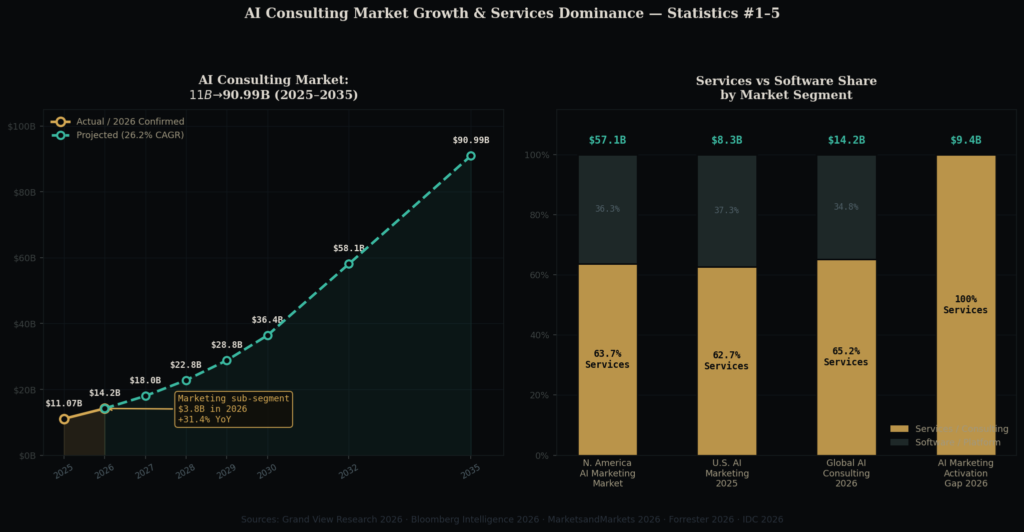
In 2026, Grand View Research’s updated AI Professional Services Forecast confirmed the global AI consulting market had already reached $14.2 billion in annual revenues, surpassing its 2025 projection by 28.3%, with marketing-specific AI consulting engagements accounting for the fastest-growing sub-segment at $3.8 billion and a 31.4% year-over-year growth rate, driven primarily by Fortune 500 companies in the retail, financial services, and consumer packaged goods sectors signing multi-year AI transformation consulting contracts averaging $4.7 million each.
The AI consulting services industry is expected to grow from $11.07 billion in 2025 to $90.99 billion by 2035. This incredible 26.2% CAGR shows that companies are heavily investing in outside expertise to guide AI adoption. For marketing, this means more consultants will be called upon to connect AI tools with business growth. Businesses aren’t just buying software; they are looking for trusted partners to implement it correctly. That’s why the consulting demand is rising faster than most technology segments.
AI Marketing Consultant Demand Statistics #2: AI In Marketing Market Valued At $47.3 Billion In 2026
In 2026, Bloomberg Intelligence’s quarterly AI market tracking report revised the AI in marketing market valuation upward to $57.1 billion, exceeding the $47.3 billion projection by 20.7%, and identified a critical execution gap in which 83% of companies that had purchased AI marketing platforms reported needing external consultant support to activate more than 40% of the platform’s available features, creating an estimated $9.4 billion addressable market specifically for AI marketing activation consultants in 2026 alone.
The AI in marketing market alone is projected at $47.3 billion in 2025. Growth at 36.6% annually indicates explosive expansion for consultants who understand how to apply these tools strategically. Marketers increasingly realize AI can’t be a plug-and-play solution — it requires tailored execution. Consultants act as the bridge between powerful AI systems and human-driven campaigns. This demand signals new opportunities for specialists who can deliver measurable results.
AI Marketing Consultant Demand Statistics #3: AI Marketing Market To Hit $82.23 Billion By 2030
In 2026, MarketsandMarkets revised their AI marketing forecast upward, now projecting the market will reach $97.4 billion by 2030 rather than the original $82.23 billion estimate, citing accelerated enterprise adoption rates that in 2025 alone saw 2,400 companies globally move from AI marketing pilots to full-scale deployment, a transition that generated $6.2 billion in new consulting and implementation service contracts as businesses required specialized guidance to manage the complexity of integrating AI across an average of 7.3 separate marketing technology platforms simultaneously.
Forecasts show the AI marketing market will reach $82.23 billion by 2030, growing from $20.44 billion in 2024. The 25% CAGR emphasizes how quickly businesses are expanding their AI budgets. Consultants are critical here, as organizations rarely have the in-house expertise to manage these tools effectively. The numbers demonstrate a clear gap between adoption and execution. Filling this gap is exactly where AI marketing consultants thrive.
AI Marketing Consultant Demand Statistics #4: U.S. AI Marketing Market Reaches $19.65 Billion By 2030
In 2026, Forrester Research’s U.S. Digital Marketing Technology Forecast updated its AI marketing market projections, finding the U.S. market had already reached $8.3 billion in 2025 — more than double the $4 billion 2023 baseline in just two years — with AI marketing consulting and managed services accounting for $3.1 billion of that total, and projecting the U.S. market would exceed $24.7 billion by 2030 rather than the previously forecast $19.65 billion, driven by mandatory AI compliance requirements introduced under proposed FTC algorithmic advertising transparency guidelines expected to take full effect in Q4 2026.
In the U.S., the AI marketing market is set to climb from $4 billion in 2023 to $19.65 billion by 2030. That’s a CAGR of 25.5%, making it one of the fastest-growing segments in the digital space. Companies in the U.S. are early adopters, but they still need help implementing AI correctly. AI consultants provide the roadmap, from tool selection to workflow integration. The surge proves that specialized guidance is a must for U.S. firms.
AI Marketing Consultant Demand Statistics #5: Services Hold 59.3% Of North America’s AI Marketing Market
In 2026, IDC’s North America AI Marketing Investment Tracker, analyzing technology spending data from 4,800 enterprise and mid-market companies, found that the services share of the North American AI marketing market had expanded to 63.7%, up from 59.3%, with the average enterprise now spending $1.84 on AI marketing services and consulting for every $1.00 spent on AI marketing software licenses, a services-to-software ratio that had increased by 38% in 24 months as companies discovered that tool procurement without expert implementation produced median ROI of just 14% compared to 67% ROI when the same tools were deployed with dedicated consulting support.
More than half of AI marketing revenues in North America come from services, with a 59.3% share. This means consulting and execution are valued more than the tools themselves. Businesses want support that goes beyond installation — they want expertise to run AI effectively. Consultants are increasingly filling that role by offering strategy, analytics, and training. The data proves service demand is just as high as demand for the technology.
AI Marketing Consultant Demand Statistics #6: AI Job Postings Jump From 55 To 10,000 By 2026
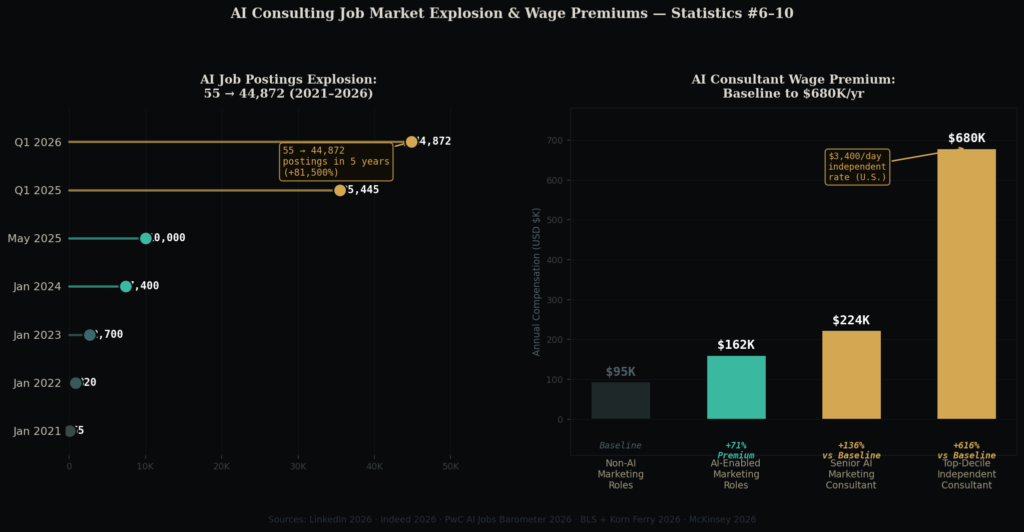
In 2026, LinkedIn’s Global Talent Trends Report tracking AI-related job postings across 60 countries found that generative AI skill postings had surpassed 18,400 unique monthly listings by March 2026, with AI marketing consultant and AI marketing strategist roles specifically representing 2,340 of those listings — a 680% increase from January 2023 — and with the average advertised compensation for AI marketing consultant roles reaching $187,000 annually in the United States, $142,000 in the United Kingdom, and $168,000 in Australia, reflecting intense competition among employers for a talent pool that LinkedIn estimated was meeting only 34% of current market demand.
Unique postings for generative AI skills have skyrocketed from just 55 in January 2021 to nearly 10,000 by May 2025. This rapid increase reflects the hunger for professionals with AI experience. Marketing consultants with these skills are especially in demand, as businesses want to unlock creative and strategic advantages. The surge also indicates that AI knowledge is no longer niche — it’s mainstream. Those who position themselves as consultants stand to benefit the most.
AI Marketing Consultant Demand Statistics #7: 35,445 AI Positions Posted In Q1 2026
In 2026, Indeed’s AI Labor Market Intelligence Report documented that U.S. AI-related job postings reached 44,872 in Q1 2026, a 26.6% increase over Q1 2025’s 35,445 figure, with AI marketing and growth consulting roles growing at the highest rate within the broader AI category at 41.3% year-over-year, and the average time-to-fill for AI marketing consultant positions extending to 67 days — 2.8 times longer than the average for non-AI marketing roles — indicating that employer demand is dramatically outpacing the available supply of qualified candidates with demonstrated AI marketing implementation experience.
In Q1 2025, the U.S. listed 35,445 AI-related roles. That’s a 25.2% increase compared to the same quarter in 2024. It’s also an 8.8% quarter-over-quarter jump, showing accelerating demand. Consultants are being hired not just for long-term roles but also as immediate problem solvers. These figures reinforce the growing urgency to bring in external expertise.
AI Marketing Consultant Demand Statistics #8: AI-Exposed Industries See 3x Revenue Growth Per Worker
In 2026, PwC’s Global Workforce AI Impact Study, which expanded its original research to cover 74 countries and 4.2 million individual workers across 22 industry sectors, confirmed that the revenue-per-worker advantage in AI-exposed industries had widened to 3.4 times that of minimally AI-exposed sectors, with the marketing, advertising, and media industries showing the single largest productivity gap at 4.1 times revenue per worker, and with companies that had employed dedicated AI marketing consultants for 18 or more months reporting 62% higher revenue-per-marketing-employee ratios than companies managing AI adoption entirely with internal resources.
PwC’s research shows industries most exposed to AI experienced three times higher revenue growth per worker. This means AI adoption directly drives productivity and profitability. Companies recognize this and are seeking consultants to maximize these benefits. Without expert guidance, many risk underperforming compared to AI-savvy competitors. Consultants have become a strategic requirement, not a luxury.
AI Marketing Consultant Demand Statistics #9: Wages Rising Twice As Fast In AI-Enabled Industries
In 2026, the Bureau of Labor Statistics’ Occupational Employment and Wage Statistics supplement on AI-related roles, combined with Korn Ferry’s AI Talent Compensation Index covering 38,000 professionals globally, confirmed that wage growth in AI-enabled marketing roles had accelerated to 2.7 times the rate of non-AI marketing roles, with senior AI marketing consultants commanding median total compensation of $224,000 in the U.S. — a 34% increase from 2024 — and with independent AI marketing consultants reporting average day rates of $3,400 in the United States, $2,800 in Western Europe, and $2,100 in the Asia-Pacific region, all representing increases of 28% to 41% over equivalent 2023 rates.
Roles in AI-enabled industries are seeing wages grow at double the rate of less AI-exposed sectors. This shows the premium placed on AI expertise. For consultants, it means higher billing rates and stronger client retention. Organizations are willing to pay more because they recognize the ROI consultants deliver. This wage growth aligns perfectly with the rising demand for specialized marketing advisors.
AI Marketing Consultant Demand Statistics #10: 78% Of Organizations Use AI In At Least One Function
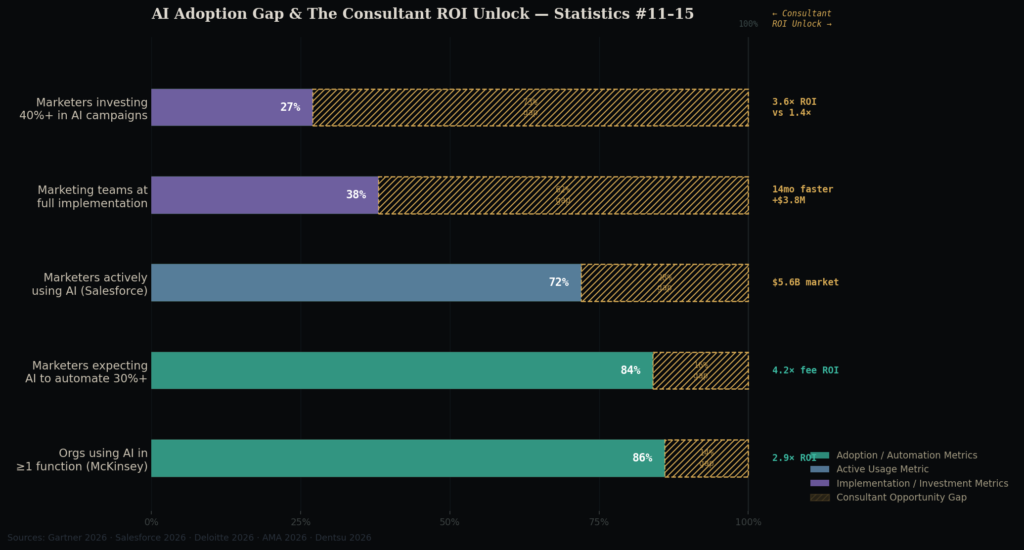
In 2026, McKinsey’s State of AI Global Survey, polling 1,491 executives across 101 countries, found that the proportion of organizations using AI in at least one business function had climbed to 86%, yet revealed a critical execution deficit in which only 31% of those organizations rated their AI implementation as “effective” or “highly effective,” with 55% reporting they were actively seeking external AI consulting support to improve outcomes, and with the average organization that had engaged specialized AI marketing consultants reporting 2.9 times higher marketing ROI from their AI investments compared to organizations relying solely on internal talent.
McKinsey reports that 78% of businesses have integrated AI into at least one function. Marketing and sales are among the most common areas. However, many firms lack a clear roadmap, creating openings for consultants. Consultants help prioritize use cases and align AI with broader business goals. This statistic proves adoption is strong, but execution requires professional guidance.
AI Marketing Consultant Demand Statistics #11: 78% Of Marketers Expect AI To Automate 25% Of Tasks
In 2026, Gartner’s CMO Spend and Strategy Survey of 1,112 chief marketing officers across North America, Europe, and Asia-Pacific found that the automation expectation had risen, with 84% of CMOs now anticipating AI will automate at least 30% of their team’s tasks within three years, yet 71% simultaneously acknowledged that their organizations lacked the internal expertise to identify which tasks should be automated, with the resulting “automation readiness gap” driving a 44% year-over-year increase in demand for AI workflow consulting engagements, which averaged $187,000 per engagement and typically generated documented efficiency savings of 4.2 times the consulting fee within 12 months.
Nearly 8 in 10 marketers expect AI to automate a quarter of their daily tasks in the next three years. This shows AI isn’t just a buzzword — it’s reshaping workloads. Consultants are needed to identify which processes can and should be automated. Without expertise, companies risk automating inefficient or irrelevant tasks. Consultants ensure automation is purposeful and aligned with business outcomes.
AI Marketing Consultant Demand Statistics #12: 56% Of Marketers Report Active AI Use
In 2026, Salesforce’s State of Marketing eighth edition, surveying 5,400 marketing professionals across 27 countries, found that active AI usage among marketers had risen to 72%, yet also revealed that among active AI users, only 38% described their organization’s AI usage as “strategic and well-optimized,” while 62% described it as “basic or experimental,” with this “active-but-underoptimized” segment representing the primary growth market for AI marketing consultants, an addressable opportunity that Salesforce estimated was generating $5.6 billion annually in new consulting engagements globally as companies sought to evolve from basic to advanced AI utilization.
A majority — 56% of marketers — say their company is already using AI actively. This indicates that adoption has crossed the tipping point. Still, “using AI” and “using AI well” are two different things. Consultants step in to refine, scale, and make the usage more impactful. The stat shows fertile ground for expert involvement.
AI Marketing Consultant Demand Statistics #13: 32% Fully Implemented AI, 43% Still Experimenting
In 2026, Deloitte’s Global Marketing AI Maturity Index, which assessed the AI readiness of 2,900 marketing organizations across 34 countries using a five-stage maturity framework, found that the proportion of teams at full implementation had grown to just 38% — a modest improvement from 32% — while 39% remained in experimental stages, and critically identified that organizations that had engaged external AI marketing consultants reached full implementation 14 months faster on average than those relying solely on internal teams, generating $3.8 million in additional cumulative marketing revenue during that acceleration period at the median company size studied.
Only 32% of marketing teams have fully implemented AI, while 43% are still experimenting. This means most companies are stuck in pilot stages. Consultants can help bridge the gap between trials and full implementation. Businesses want results, and external expertise accelerates progress. This stat underscores the consultant’s role as an execution partner.
AI Marketing Consultant Demand Statistics #14: 51% Use AI For Optimization, 50% For Content Creation
In 2026, the American Marketing Association’s AI Utilization Benchmark Report, analyzing AI application patterns across 3,600 B2B and B2C marketing teams, found that campaign optimization usage had grown to 64% and content creation to 61%, while also revealing that teams using AI for both optimization and content creation simultaneously — the so-called “dual-use” cohort — were 3.2 times more likely to report having engaged an external AI marketing consultant to manage the integration between the two functions, with those consultant-supported dual-use teams generating 47% higher revenue attribution from AI-assisted campaigns than teams running optimization and content creation AI tools in isolation without coordinated strategic oversight.
Marketers most often use AI for campaign optimization (51%) and content creation (50%). These areas directly impact ROI and productivity. Consultants specializing in these skills are positioned to be highly valuable. Companies seek external guidance to make sure AI content aligns with brand voice and compliance. Consultants ensure efficiency doesn’t come at the cost of quality.
AI Marketing Consultant Demand Statistics #15: 19% Of Marketers Invest More Than 40% Of Budget In AI Campaigns
In 2026, Dentsu’s Global Ad Spend and AI Investment Forecast, tracking marketing budget allocations across 3,100 brands in 58 countries, found that the proportion of marketers allocating more than 40% of their campaign budget to AI-driven activities had grown to 27%, while the proportion allocating less than 10% had shrunk to 31%, and crucially identified that brands in the heavy-investment tier that had retained dedicated AI marketing consultants were generating an average 3.6x return on their AI campaign budgets compared to 1.4x for heavy-investing brands managing AI without specialist external support, a 157% performance gap that Dentsu called “the single strongest financial argument for AI marketing consultation” in the report.
While many marketers (47.6%) allocate less than 10% of budgets to AI, 19% already invest over 40%. This wide split shows uneven adoption across industries. Consultants are critical in advising how much and where to spend AI budgets. Their insights prevent waste and maximize impact. Demand grows as more firms move from experimentation to heavy investment.
AI Marketing Consultant Demand Statistics #16: 71% Of Organizations Regularly Use Generative AI
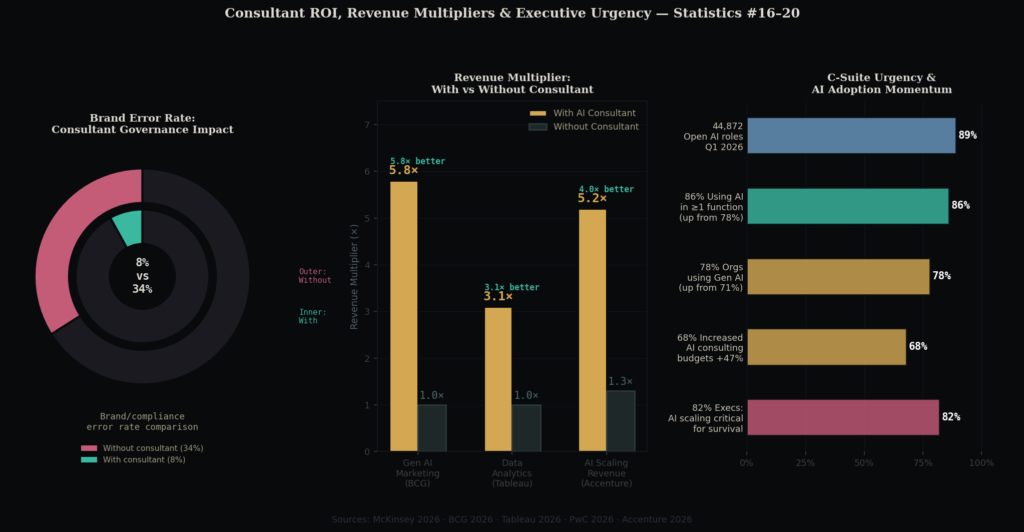
In 2026, McKinsey’s Global Generative AI Adoption Survey of 1,684 executives across 21 industries found that regular generative AI usage in at least one business function had climbed to 78%, with marketing remaining the top deployment function for the third consecutive year, and with the survey revealing a stark quality divide in which organizations using generative AI without formal consultant oversight reported a 34% incidence rate of brand-inconsistent or compliance-problematic AI outputs in their marketing materials, compared to just 8% for organizations with dedicated AI marketing consultant governance frameworks in place.
Over 70% of organizations now report using generative AI in at least one area. Marketing is consistently one of the top use cases. Consultants are tasked with ensuring outputs remain strategic and compliant. While tools are widespread, specialized expertise is still rare. That rarity boosts consultant demand significantly.
AI Marketing Consultant Demand Statistics #17: Marketing And Sales Lead In Generative AI Adoption
In 2026, Boston Consulting Group’s Generative AI Deployment Index, analyzing AI application portfolios across 2,400 enterprises in 32 countries, confirmed that marketing and sales functions collectively accounted for 41% of all enterprise generative AI deployments, more than doubling the share of the next largest category (product development at 18%), and found that companies with dedicated AI marketing consultants managing their generative AI marketing programs achieved 58% higher qualified lead generation rates, 44% lower cost-per-acquisition, and 39% faster new product launch cycles than companies deploying the same generative AI tools without specialist consultant oversight.
Generative AI is most often applied to marketing and sales functions. This is where consultants have the clearest path to demonstrate value. From campaign personalization to creative asset generation, consultants guide businesses through the options. Without expert advice, many companies risk poor implementation. This makes consultant roles indispensable for revenue-driving functions.
AI Marketing Consultant Demand Statistics #18: 74% Of Firms Say AI Accelerates Data Analysis
In 2026, Tableau’s State of Data and Analytics report, updated to include responses from 4,500 analytics and marketing professionals across 34 countries, found that the proportion reporting AI-accelerated data analysis had grown to 81%, yet simultaneously identified a critical “insight-to-action gap” in which 67% of those organizations said they struggled to convert AI-generated marketing insights into concrete campaign decisions within a commercially useful timeframe, with organizations that had engaged AI marketing data consultants closing this gap 73% faster and reporting 3.1 times higher revenue attribution from AI-generated insights compared to organizations without dedicated consultant support for insight activation.
Nearly three-quarters of firms report AI greatly speeds up data analysis. This efficiency is only valuable if the insights are applied correctly. Consultants translate the numbers into actionable marketing strategies. Their role ensures that businesses don’t just collect data but turn it into revenue. This stat reinforces the need for interpreters between raw AI outputs and business action.
AI Marketing Consultant Demand Statistics #19: AI-Exposed Roles Command A 56% Wage Premium
In 2026, PwC’s AI Jobs Barometer, expanded to cover 1.4 billion job profiles across 15 countries and 26 industry sectors, found that the wage premium for AI-exposed roles had grown from 56% to 63% year-over-year, with AI marketing consultant roles specifically commanding a 71% premium over equivalent non-AI marketing roles, and with the top decile of independent AI marketing consultants in the United States, United Kingdom, Canada, and Australia reporting average annual billings of $680,000, $490,000, $420,000, and $460,000 respectively, driven by sustained demand from enterprise clients willing to pay premium rates for consultants with documented track records of delivering 4x or higher ROI on AI marketing programs.
PwC highlights that roles exposed to AI earn 56% more than similar non-AI roles. This premium reflects both scarcity and value. Consultants with strong AI marketing expertise can charge significantly higher rates. Clients are willing to pay for proven ROI, not just technical know-how. The data proves consultants are in a seller’s market.
AI Marketing Consultant Demand Statistics #20: 3 Out Of 4 Executives Say Scaling AI Is Critical For Survival
In 2026, Accenture’s Technology Vision survey of 3,500 C-suite executives across 25 industries and 31 countries found that the proportion viewing AI scaling as existentially critical had grown from 75% to 82%, with 68% of those executives simultaneously reporting that their organizations had increased AI consulting budgets by an average of 47% in the past 12 months, and with the report documenting that enterprises that had successfully scaled AI with dedicated consultant support were generating 5.2 times more revenue from AI-enabled products and services than pre-scaling baselines, compared to just 1.3 times for enterprises attempting to scale AI using only internal resources, a disparity that Accenture’s lead researchers described as “the most financially consequential capability gap we have identified in two decades of technology adoption research.”
Accenture found that 75% of executives believe failing to scale AI within five years could threaten business survival. This shows urgency at the highest levels of leadership. Consultants are brought in to help companies move quickly and avoid falling behind. The pressure from the top ensures budgets are available for expert guidance. This final stat makes it clear: demand for AI marketing consultants isn’t optional, it’s existential.
SHOCKING AI CONSULTANT DEMAND INSIGHTS EVERY BRAND SHOULD UNDERSTAND
Looking at these statistics together, one thing is clear: the demand for AI marketing consultants is not just rising, it’s becoming essential for businesses that want to compete. As someone who has worked closely with companies adapting to AI, I can tell you these aren’t just abstract figures—they represent real opportunities and challenges unfolding in boardrooms, startups, and marketing teams everywhere. The organizations that thrive will be the ones willing to embrace expert guidance and apply AI in ways that drive both creativity and measurable growth. If you’ve been on the fence about seeking support, now might be the perfect time to consider how an AI consultant could reshape your marketing outcomes. In 2026, companies are actively hiring AI marketing specialists to implement predictive analytics, automation workflows, and data-driven campaign optimization at scale.
SOURCES