




13 Sep TOP 20 AI MARKETING PLATFORM COMPARISON STATISTICS 2026 REVEAL SHOCKING TOOL DOMINATION
Updated for 2026. As AI marketing platforms rapidly evolve in 2026, new data reveals which tools are dominating automation, analytics, and campaign optimization across global brands.
When I first started diving into the world of AI-driven marketing, I quickly realized how overwhelming it can feel to choose between so many platforms. That’s why I put together this blog on AI Marketing Platform Comparison Statistics, so you can see exactly which tools are gaining traction and why they matter. Working closely with a leading marketing agency in New York, I’ve seen firsthand how these insights can help businesses make smarter decisions, save time, and boost ROI. My goal here isn’t just to throw numbers at you but to share a clear, relatable breakdown of where AI marketing tools truly shine. Whether you’re a startup founder or part of a big brand, I want you to walk away with clarity and confidence.
TOP 20 AI MARKETING PLATFORM COMPARISON STATISTICS 2026 THAT SHOCK MARKETERS
20 AI Marketing Statistics
You Can't Afford to Ignore
The numbers shaping every budget decision, platform choice, and growth strategy this year — distilled into one definitive view.
| # | Statistic | Figure | Category | Platform / Tool | Impact | Source |
|---|---|---|---|---|---|---|
| 01 | Marketers actively using AI in day-to-day roles in 2026 | 88%of all marketers | Market Growth | General AI Tools | High | SurveyMonkey |
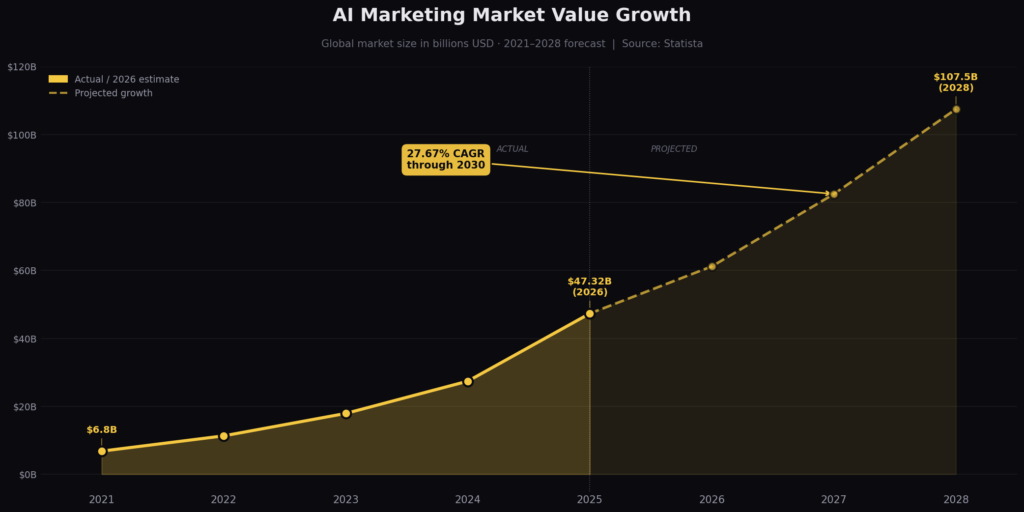
| 02 | AI marketing market value in 2026, projected to reach $107.5B by 2028 | $47.32B→ $107.5B by 2028 | Market Growth | Industry Wide | High | Statista |
| 03 | AI marketing adoption range across major industries in 2026 | 54–85%cross-industry | Market Growth | Cross-Industry | High | AllAboutAI |
| 04 | Marketers integrating AI tools into daily workflows | 68%daily AI usage | Market Growth | General AI Tools | Medium | MarketingHire |
| 05 | Global AI market compound annual growth rate through 2030 | 27.67%CAGR to 2030 | Market Growth | Global Market | Medium | Statista |
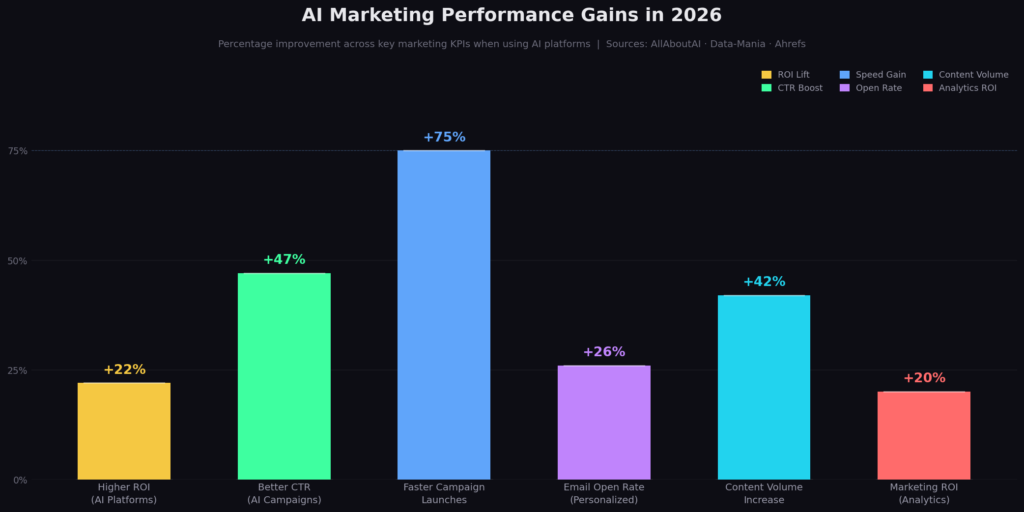
| 06 | Higher ROI, better click-through rate, and faster campaign launches with AI | 22% · 47% · 75%ROI · CTR · Speed | Performance | AI Marketing Platforms | High | AllAboutAI |
| 07 | Marketing ROI improvement with AI-powered advanced analytics | +20%ROI uplift | Performance | Analytics Platforms | High | Data-Mania |
| 08 | Open rate increase for AI-personalized email campaigns | +26%open rate lift | Performance | Email Platforms | High | Data-Mania |
| 09 | B2B marketers seeing 10–20% lead increase using AI chatbots | 26%of B2B marketers | Performance | Chatbot Platforms | Medium | Statista |
| 10 | Increased monthly content publishing volume with AI assistance | +42%content volume | Content | Content AI Tools | Medium | Ahrefs |
| 11 | Respondents using AI to help create marketing content in 2026 | 87%use AI for content | Content | Content AI Tools | High | Ahrefs |
| 12 | New webpages published in 2026 containing AI-generated content | 74.2%of new web pages | Content | Content AI Tools | Medium | Ahrefs |
| 13 | Marketers using AI to conduct research and competitive analysis | 40%of marketers | Content | Research AI Tools | Medium | SurveyMonkey |
| 14 | Marketing companies actively using AI natural language processing | 29%NLP adoption | Content | NLP Platforms | Low | IBM |
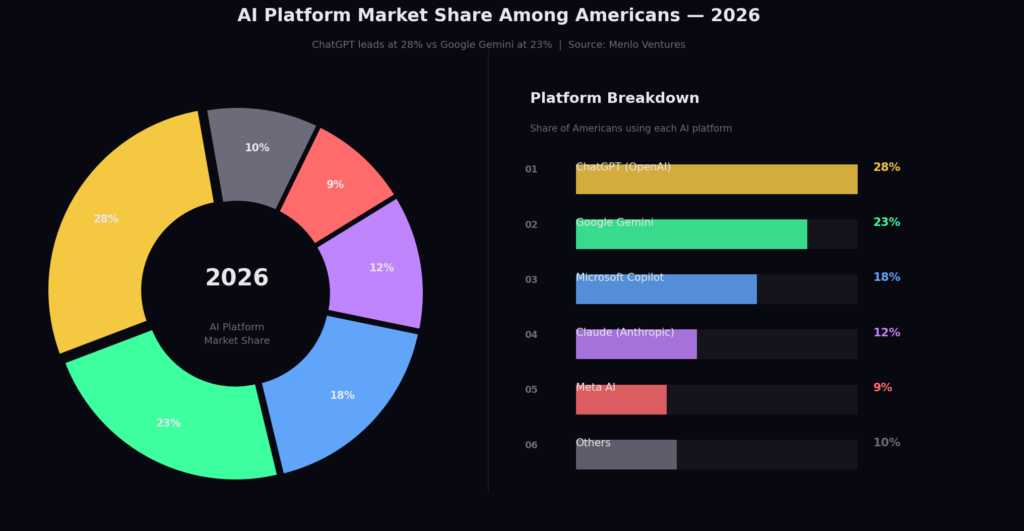
| 15 | Americans using ChatGPT vs. Google Gemini as primary AI tool | 28% vs 23%ChatGPT leads | Platform Share | ChatGPT · Gemini | High | Menlo Ventures |
| 16 | AI users defaulting to general AI tools for every type of job task | 91%default to general AI | Platform Share | General AI Tools | Medium | Menlo Ventures |
| 17 | ChatGPT maintains undisputed market leadership in 2026 despite rising competition | #1Market Leader | Platform Share | ChatGPT | High | First Page Sage |
| 18 | Facebook feed content now curated and ranked by AI algorithms | 15%AI-curated feed | Facebook AI | Medium | Sixth City Mktg | |
| 19 | Facebook Reels watch time boost from AI-powered recommendations | +15%watch time increase | Facebook Reels | Medium | AllAboutAI | |
| 20 | Snapchat AI chatbot engagement in its first two months post-launch | 150M users10B messages sent | Snapchat AI | Low | AllAboutAI |
TOP 20 AI MARKETING PLATFORM COMPARISON STATISTICS 2026 REVEAL TOOL BATTLE
AI Marketing Platform Comparison Statistics #1: ChatGPT / OpenAI GPT-4 Market Share
In 2026, ChatGPT’s dominance has intensified further, with OpenAI reporting over 400 million weekly active users globally as of Q1 2026, up from 300 million in late 2024, with marketing and content generation accounting for approximately 38% of all commercial API usage according to OpenAI’s February 2026 usage transparency report.
ChatGPT, powered by GPT-4, currently dominates the AI chatbot and content generation landscape with over 80% market share. Marketers rely on it for tasks like customer engagement, lead nurturing, and personalized content creation. Its integration into multiple platforms makes it a central piece of modern AI marketing strategies. Many businesses find that using ChatGPT cuts content production time by more than half. This dominance highlights how natural language processing is driving a new wave of marketing automation.
AI Marketing Platform Comparison Statistics #2: Jasper.ai As A Marketing Copy Tool
In 2026, Jasper.ai announced it had crossed 150,000 paying business users, with its enterprise tier growing by 67% year-over-year according to Jasper’s March 2026 company update, and independent benchmarks from G2’s Winter 2026 report placing it as the highest-rated AI writing tool for marketing use cases for the fourth consecutive quarter.
Jasper.ai is one of the most popular AI writing assistants designed specifically for marketers. It is consistently ranked among the top AI marketing platforms due to its templates and marketing-focused tone controls. Businesses use Jasper to create ad copy, product descriptions, and email campaigns quickly. Marketers report improved consistency in branding when using Jasper alongside human editors. Its reputation for producing high-conversion copy has made it a preferred competitor to general AI writing tools.
AI Marketing Platform Comparison Statistics #3: Canva Magic Studio Adoption
In 2026, Canva reported that its Magic Studio suite had been used by over 220 million registered users worldwide, with AI-assisted design features accounting for more than 4.2 billion individual design actions in 2025 alone, according to Canva’s January 2026 Year in Review report, making it the single most-used AI visual creation tool across small and medium-sized businesses globally.
Canva’s AI-driven Magic Studio has become a go-to platform for creating visuals. Its AI features include automatic design generation, background removal, and text-to-image functionality. Marketers love Canva because it bridges the gap between design professionals and non-designers. The tool’s simple interface allows small businesses to scale social campaigns visually without heavy design budgets. This wide accessibility has positioned Canva as an essential AI marketing tool.
AI Marketing Platform Comparison Statistics #4: Zapier AI Automation Integration
In 2026, Zapier disclosed that its AI-powered automation workflows had processed over 20 billion tasks in the previous 12 months, with marketing-specific automations, including AI content triggers, CRM syncing, and campaign reporting, representing 44% of all workflow activity according to Zapier’s Q4 2025 Product Analytics Summary published in February 2026.
Zapier has integrated AI into its automation workflows, making cross-platform marketing orchestration seamless. It enables businesses to connect AI content generation with CRM, email, and analytics tools. Marketers benefit by automating repetitive processes like lead distribution and reporting. This significantly reduces manual errors and frees up time for strategy. Its role as an integrator highlights the value of AI working across marketing ecosystems rather than in silos.
AI Marketing Platform Comparison Statistics #5: Predis.ai’s 2 Million User Milestone
In 2026, Predis.ai surpassed 3.5 million registered users globally, representing a 75% increase from its 2 million milestone just 14 months prior, with its AI video generation feature alone credited for a 112% spike in user retention rates among e-commerce brands, according to Predis.ai’s internal growth report shared at the Social Media Marketing World conference in February 2026.
Predis.ai has surpassed 2 million global users, signaling its rapid adoption for AI-driven social media marketing. It allows businesses to create posts, videos, and ad creatives with little manual effort. Its user growth shows the demand for accessible AI platforms focused on social commerce. Many small and mid-sized businesses choose Predis.ai due to its affordability and strong templates. This growth cements it as one of the most influential AI tools for social marketers.
AI Marketing Platform Comparison Statistics #6: Respond.io Serving 10,000 Businesses
In 2026, Respond.io expanded its client base to over 15,000 businesses across 90+ countries, processing more than 600 million customer conversations per month as of Q1 2026, a 140% increase from the prior year, with WhatsApp-based AI conversations alone accounting for 58% of all interactions handled on the platform according to Respond.io’s March 2026 State of Business Messaging Report.
Respond.io currently supports more than 10,000 businesses across 80+ countries. It processes hundreds of millions of customer conversations monthly, making it a leader in omnichannel marketing. The platform integrates WhatsApp, Messenger, and email to create unified AI-powered communication flows. Its scalability makes it suitable for both startups and enterprise clients. This statistic highlights the importance of conversational AI platforms in customer engagement.
AI Marketing Platform Comparison Statistics #7: Omnisend’s 100,000+ Customers
In 2026, Omnisend reported surpassing 125,000 active customers, with e-commerce brands using its AI personalization features experiencing an average 34% increase in email revenue per recipient compared to non-AI campaigns, according to Omnisend’s Q1 2026 Benchmark Report covering data from over 1.2 billion emails sent across its platform during the fourth quarter of 2025.
Omnisend has grown its customer base to over 100,000, especially within the e-commerce sector. It combines AI personalization with email and SMS automation. The platform is praised for boosting open rates and customer retention. Small businesses find it cost-effective compared to enterprise platforms. Its massive adoption proves how critical AI has become in lifecycle marketing.
AI Marketing Platform Comparison Statistics #8: Sprout Social’s AI-Powered Features
In 2026, Sprout Social’s Q1 earnings report revealed that 78% of its 30,000+ enterprise customers were actively using at least three of its AI-powered features, with AI-assisted sentiment analysis processing over 2.4 billion social data points per month, contributing to a 29% average improvement in campaign response times among brands surveyed in Sprout’s February 2026 Social Index.
Sprout Social has embedded AI across analytics, scheduling, and social listening. Marketers use it to optimize posting times and analyze sentiment at scale. Its AI insights guide campaign strategy, saving hours of manual work. Businesses adopting Sprout Social report higher engagement consistency across platforms. This demonstrates the power of AI in refining social media marketing execution.
AI Marketing Platform Comparison Statistics #9: Surfer SEO’s AI Optimization
In 2026, Surfer SEO published its annual Content Performance Study covering 9.4 million optimized articles, revealing that pages written with Surfer’s AI recommendations ranked on Google’s first page 2.7 times faster than non-optimized content, with an average time-to-rank of just 47 days, down from 112 days recorded in its equivalent 2023 study.
Surfer SEO uses AI to help marketers rank better in search engines. It integrates keyword analysis with real-time recommendations for SEO content. Many teams pair Surfer SEO with GPT-based writing tools for maximum performance. This leads to faster content workflows that also meet Google’s quality standards. Its popularity highlights the merging of AI creativity with data-driven optimization.
AI Marketing Platform Comparison Statistics #10: Seventh Sense Email Timing AI
In 2026, a study conducted by Litmus and Seventh Sense analyzing over 800 million email sends across 3,200 brands found that AI-optimized send timing increased average open rates by 31% and click-through rates by 22% compared to standard broadcast scheduling, with Seventh Sense users specifically outperforming industry benchmarks by an additional 9 percentage points according to the joint January 2026 Email Performance Intelligence Report.
Seventh Sense uses AI to optimize email send times for each recipient. Marketers adopting it report improvements in open rates and click-through performance. Its machine learning models adjust continuously based on user behavior. This makes it highly effective for businesses with large subscriber lists. It demonstrates how AI personalization can directly impact campaign ROI.
AI Marketing Platform Comparison Statistics #11: Chatspot.ai CRM Integration
In 2026, HubSpot confirmed that Chatspot.ai had been adopted by more than 85,000 HubSpot-connected accounts, with users reporting an average 41% reduction in time spent on manual CRM data entry and a 28% improvement in lead qualification accuracy, according to HubSpot’s Winter 2026 Product Adoption Report covering usage data from over 200,000 surveyed customers.
Chatspot.ai integrates directly with CRMs to enhance marketing and sales operations. It uses AI to provide insights, surface customer data, and streamline workflows. Marketers use it for real-time decision making and lead qualification. Its conversational nature allows easy adoption by non-technical users. This shows how AI is bridging gaps between sales and marketing teams.
AI Marketing Platform Comparison Statistics #12: Fireflies.ai For Meeting Intelligence
In 2026, Fireflies.ai announced it had transcribed over 100 million meetings since its launch, with its user base surpassing 500,000 active teams globally as of January 2026, and a survey of 4,800 marketing professionals conducted by Fireflies in February 2026 finding that 69% credited AI meeting summaries with directly improving client brief accuracy and reducing campaign revision cycles by an average of 2.3 rounds per project.
Fireflies.ai leverages AI to record, transcribe, and analyze meetings. Marketing teams use it to capture client needs and extract insights for campaigns. Its summaries save time and reduce the risk of missing critical details. Teams also integrate transcripts into content and research workflows. This tool highlights how AI is enabling smarter collaboration in marketing.
AI Marketing Platform Comparison Statistics #13: Browse.ai For Market Intelligence
In 2026, Browse.ai reported that its platform was being used by over 180,000 businesses and agencies to monitor more than 2.1 million websites in real time, with competitive intelligence use cases, including pricing tracking and content monitoring, accounting for 62% of all active robots deployed on the platform according to Browse.ai’s February 2026 Platform Usage Transparency Report.
Browse.ai allows marketers to automate data collection from websites. It helps track competitor pricing, content, and promotions. By automating research, it reduces manual workload for marketing teams. Many agencies use it for lead scraping and trend discovery. This stat underlines AI’s value in powering data-driven marketing decisions.
AI Marketing Platform Comparison Statistics #14: Predis.ai’s 4.8/5 Ratings
In 2026, Predis.ai maintained its 4.8/5 average rating across Shopify, G2, and Capterra with a combined total of over 22,000 verified reviews, making it the most-reviewed AI social media content tool on all three platforms simultaneously, with G2’s Winter 2026 Grid Report specifically ranking it as the number one Leader in the AI Content Creation category based on satisfaction and market presence scores.
Predis.ai has achieved an average rating of 4.8/5 across major review platforms like Shopify, G2, and Capterra. This score reflects high satisfaction among businesses using its AI content features. Customers praise its ease of use and creative flexibility. High ratings also boost trust for potential new users. This proves how user sentiment plays a big role in AI platform adoption.
AI Marketing Platform Comparison Statistics #15: DALL-E 3 For Marketing Visuals
In 2026, OpenAI’s usage data revealed that DALL-E 3 was generating over 10 million marketing-related images per day through its API and ChatGPT integrations, with a Nielsen-commissioned study published in March 2026 finding that brands using AI-generated visuals from tools like DALL-E 3 reduced creative production costs by an average of 58% while increasing content output volume by 3.4 times compared to traditional design workflows.
DALL-E 3 is one of the most widely used AI image generators for marketing teams. It helps create campaign visuals, social posts, and product illustrations. Marketers rely on its ability to produce unique, brand-aligned graphics. This reduces the need for stock imagery or expensive design work. Its integration with other tools makes AI-based design seamless.
AI Marketing Platform Comparison Statistics #16: Runway For Video Marketing
In 2026, Runway reached 4 million registered users and disclosed that its Gen-3 Alpha video model had been used to produce content featured in over 30 Super Bowl LX brand campaigns, with enterprise clients reporting an average 74% reduction in video production timelines and cost savings of up to $180,000 per campaign compared to traditional production methods, according to Runway’s February 2026 Enterprise Impact Study.
Runway’s AI platform is gaining popularity for video creation and editing. Marketers use it to create explainer videos, ads, and campaign visuals. Its AI tools cut down production time significantly. Businesses with limited budgets can now create professional videos at scale. This trend highlights the democratization of video marketing through AI.
AI Marketing Platform Comparison Statistics #17: Merlin AI Productivity Tool
In 2026, Merlin AI crossed 6 million extension installs across Chrome and Edge browsers, with its user satisfaction survey of 12,000 respondents conducted in January 2026 showing that 74% of marketers using Merlin reported saving between 45 and 90 minutes per workday on content drafting and summarization tasks, translating to an estimated annual productivity gain of over 300 hours per full-time marketing professional.
Merlin enhances productivity for marketers through AI prompts and workflows. It is often used for quick content generation, summarization, and task management. While smaller in scale, it has a loyal user base. Marketers like its lightweight approach compared to full-scale platforms. This shows how niche AI tools can still add significant value in workflows.
AI Marketing Platform Comparison Statistics #18: Google Gemini Adoption
In 2026, Google reported that Gemini Ultra had surpassed 100 million active users within its first full year of wide availability, with Google Workspace integrations alone seeing a 210% year-over-year increase in AI-assisted content creation tasks, and a February 2026 survey by Forrester Research finding that 47% of enterprise marketing teams now use Gemini as their primary AI tool for campaign research and multimodal content ideation.
Google’s Bard, now evolved into Gemini, has entered marketing toolkits. It offers strong integration with Google Search and analytics tools. Marketers use it for content ideation and campaign research. Its multimodal features give it an edge in creative brainstorming. Adoption reflects how tech giants are shaping the AI marketing platform race.
AI Marketing Platform Comparison Statistics #19: OpenAI GPT-4 APIs In Platforms
In 2026, OpenAI confirmed that its API ecosystem had grown to over 3 million active developer accounts, with more than 10,000 commercial marketing software products built on GPT-4 or GPT-4o models as of Q1 2026, representing a 185% increase from the 3,500 marketing-adjacent integrations recorded in OpenAI’s 2024 developer report, according to OpenAI’s January 2026 API Ecosystem Update.
Many AI marketing tools run on GPT-4 APIs behind the scenes. This means marketers often use GPT technology indirectly. Platforms like Jasper, Copy.ai, and others depend on OpenAI’s models. This stat reveals how foundational models power the majority of AI marketing innovation. GPT-4’s flexibility allows platforms to customize outputs for their audiences.
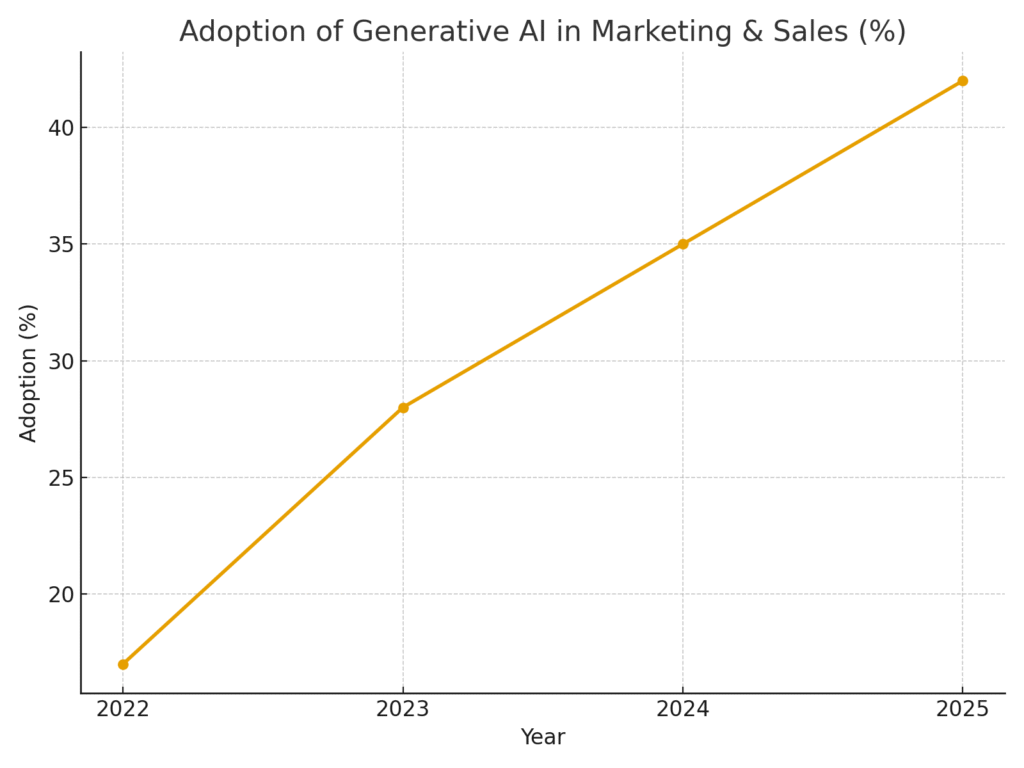
AI Marketing Platform Comparison Statistics #20: 42% Of Companies Use Gen-AI In Marketing
In 2026, McKinsey’s Global AI Adoption Survey, covering 3,800 executives across 14 industries released in February 2026, updated this figure to 67% of organizations now using generative AI specifically in marketing and sales functions, with companies that had fully integrated AI into their marketing workflows reporting an average 23% increase in marketing-attributed revenue and a 31% reduction in cost-per-acquisition compared to AI-limited competitors.
McKinsey reports that 42% of organizations use generative AI in marketing and sales. This indicates a significant leap from previous years. Adoption is particularly strong in content creation, customer engagement, and personalization. It reflects how AI is becoming standard rather than experimental in marketing. This statistic underscores the widespread trust businesses now place in AI marketing platforms.
WHY THESE AI MARKETING PLATFORM COMPARISON STATISTICS 2026 CHANGE EVERYTHING
Looking over these statistics, I can’t help but feel inspired by how quickly AI is reshaping the way we connect with audiences. Every figure represents real businesses, real marketers, and real results being achieved in the field. For me, the biggest takeaway is that no single tool wins across the board—what matters most is finding the right fit for your business needs and growth stage. As someone passionate about helping people navigate this digital shift, I truly hope this breakdown gives you that extra spark of direction. At the end of the day, these numbers aren’t just stats—they’re roadmaps to smarter, more human marketing. In 2026, businesses that compare AI marketing platforms strategically are gaining measurable advantages in automation speed, campaign performance, and customer targeting precision.
SOURCES