



12 Sep TOP 20 AI REPLACING MARKETING JOBS STATISTICS 2025
As someone who’s worked closely with marketing teams across the industry, I’ve witnessed firsthand how artificial intelligence is reshaping our profession in ways we never imagined just a few years ago. The conversations I have with fellow marketers—whether they’re at a leading marketing agency in New York or a startup in Silicon Valley—all center around the same burning question: “What does AI mean for my career?” That’s exactly why I’ve compiled these AI replacing marketing jobs statistics. After diving deep into research from top organizations like the World Economic Forum, HubSpot, and PwC, I’ve gathered the 20 most eye-opening statistics that every marketing professional needs to understand. These aren’t just numbers on a page—they’re insights that could fundamentally change how you approach your career, develop new skills, and position yourself for success in an AI-driven marketing landscape.
Top 20 AI Replacing Marketing Jobs Statistics 2025 (Editor’s Choice)
🤖 AI Replacing Marketing Jobs
Top 20 Eye-Opening Statistics Every Marketer Must Know in 2025
| Statistic/Finding | Category | Timeframe | Marketing Role Affected | Impact Level | Source |
|---|---|---|---|---|---|
| 38% of companies will replace some roles with AI | Job Displacement | 2025 | All Marketing Roles | High | HubSpot |
| 37% of marketing companies have adopted Generative AI | AI Adoption | Current | All Marketing Roles | Medium | Statista |
| 81.6% of digital marketers fear being replaced by AI | Worker Sentiment | Current | Digital Marketers | High | DemandSage |
| 88% of marketers use AI in daily roles | AI Adoption | Current | All Marketers | Positive | SurveyMonkey |
| 87% consider AI experience beneficial for job security | Skills Impact | Current | All Marketing Roles | Positive | HubSpot |
| 85 million jobs expected to be replaced worldwide | Job Displacement | By 2025 | All Industries | High | WEF |
| Digital marketing content writer jobs to decline by 50% | Job Displacement | By 2030 | Content Writers | High | DemandSage |
| 58% of marketing agencies reduced copywriting staff by 20%+ | Job Displacement | Current | Copywriters | High | Zebracat |
| Entry-level marketing assistant roles dropped by 31% | Job Displacement | Since 2022 | Entry-level Roles | High | Zebracat |
| AI could replace 53% of market research analyst tasks | Task Automation | Current | Market Research | High | Bloomberg |
| 51% of marketers use AI for data processing | AI Adoption | Current | Data Analysts | Positive | WebFX |
| Basic content writing jobs face 57% automation risk | Task Automation | Current | Content Writers | High | Zebracat |
| AI could replace 67% of sales representative tasks | Task Automation | Current | Sales Reps | High | Bloomberg |
| Freelance writing gigs declined by 42% | Job Displacement | 2021-2025 | Freelance Writers | High | Zebracat |
| 82% of experts say content writer roles could disappear | Expert Opinion | Future | Content Writers | High | IInfotanks |
| 77% of employers plan to reskill workforce for AI | Skills Development | Current | All Marketing Roles | Positive | HubSpot |
| AI content strategist roles increased by 23% | Job Creation | Current | Strategy Roles | Positive | Zebracat |
| 82% of marketers believe AI will boost their results | Performance Impact | Current | All Marketers | Positive | IInfotanks |
| 20 million US workers expected to retrain in AI | Skills Development | Next 3 Years | All Workers | Positive | National Univ |
| AI may create 170 million jobs, netting 78 million | Job Creation | By 2030 | All Industries | Positive | DemandSage |
Top 20 AI Replacing Marketing Jobs Statistics 2025
AI Replacing Marketing Jobs Statistics#1 – Sales And Marketing Roles Among The Most Affected By AI
Sales and marketing roles are among the top categories impacted by generative AI, according to Microsoft’s research. The study revealed that tasks like writing, research, and communication have a high probability of automation. This highlights how AI tools such as ChatGPT are now capable of producing client emails, ad copy, and campaign insights in seconds. Such tasks were once heavily reliant on human workers but are increasingly automated. As a result, marketers are now shifting their focus toward strategy and relationship management.
AI Replacing Marketing Jobs Statistics#2 – Marketing Roles Score 0.46 In AI Applicability
Microsoft’s study placed marketing and sales jobs at a high AI applicability score of 0.46. This means nearly half of the daily activities in these roles can be effectively handled by AI tools. Repetitive work such as campaign drafts, competitor analysis, and audience targeting can be performed with little human oversight. The figure demonstrates just how exposed marketing careers are compared to other industries. Professionals in this field must therefore learn to collaborate with AI to maintain their relevance.
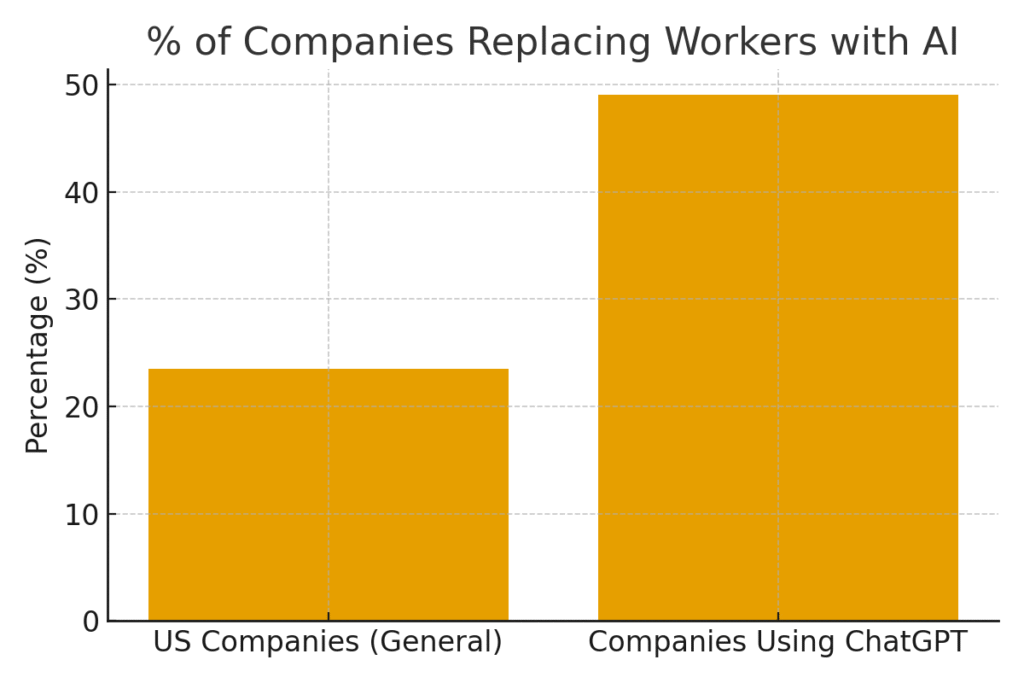
AI Replacing Marketing Jobs Statistics#3 – 23.5% Of U.S. Companies Have Replaced Workers With ChatGPT
A U.S. survey revealed that 23.5% of companies have already replaced workers with AI tools like ChatGPT. This trend shows how quickly businesses are adopting automation to cut costs and increase productivity. Marketing departments are particularly vulnerable since copywriting and content generation are easy to outsource to AI. Small businesses and startups often see AI as a cheaper alternative to hiring staff. This demonstrates how early adoption of AI can lead to workforce reductions in marketing.
AI Replacing Marketing Jobs Statistics#4 – 49% Of ChatGPT-Using Firms Say Tools Replaced Workers
Among companies that implemented ChatGPT, 49% admitted it replaced human workers in some tasks. The areas most affected are content creation, editing, and customer interaction. Many firms found that AI could handle customer queries or draft entire campaigns faster than humans. This shows that AI is not just a supporting tool but an actual substitute in many workflows. The impact is especially strong in junior-level marketing positions.
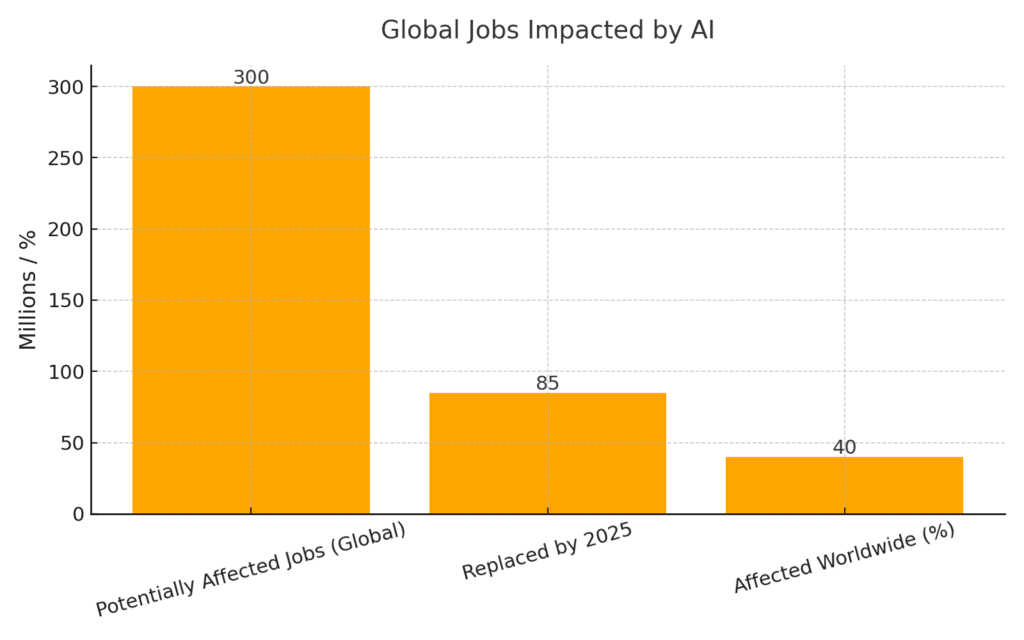
AI Replacing Marketing Jobs Statistics#5 – 300 Million Jobs Could Be Affected Globally
Reports estimate that up to 300 million jobs worldwide could be influenced by AI automation. Marketing jobs make up a significant portion because of their reliance on digital tools and repetitive tasks. From social media scheduling to ad targeting, many responsibilities can be executed without human input. This scale of impact highlights the importance of reskilling for future work. It also demonstrates how marketing is at the center of AI disruption.
AI Replacing Marketing Jobs Statistics#6 – 85 Million Jobs May Be Replaced By 2025
Forecasts suggest that around 85 million jobs globally may be replaced by AI by 2025. Marketing roles are among the jobs at highest risk, especially for those focused on execution rather than strategy. Copywriters, social media managers, and data analysts are already seeing reduced demand. While some roles may disappear, others requiring creativity and oversight are likely to grow. This shift will redefine marketing career paths in the coming years.
AI Replacing Marketing Jobs Statistics#7 – 40% Of All Jobs Will Be Affected By AI
It is estimated that nearly 40% of global jobs will be impacted by AI, with marketing being a primary sector. This doesn’t always mean total replacement but rather transformation of how tasks are performed. For marketers, this includes AI-driven personalization, automated reporting, and instant data analysis. Human marketers are still needed for brand strategy and creative storytelling. However, the number of purely manual marketing roles will decline.
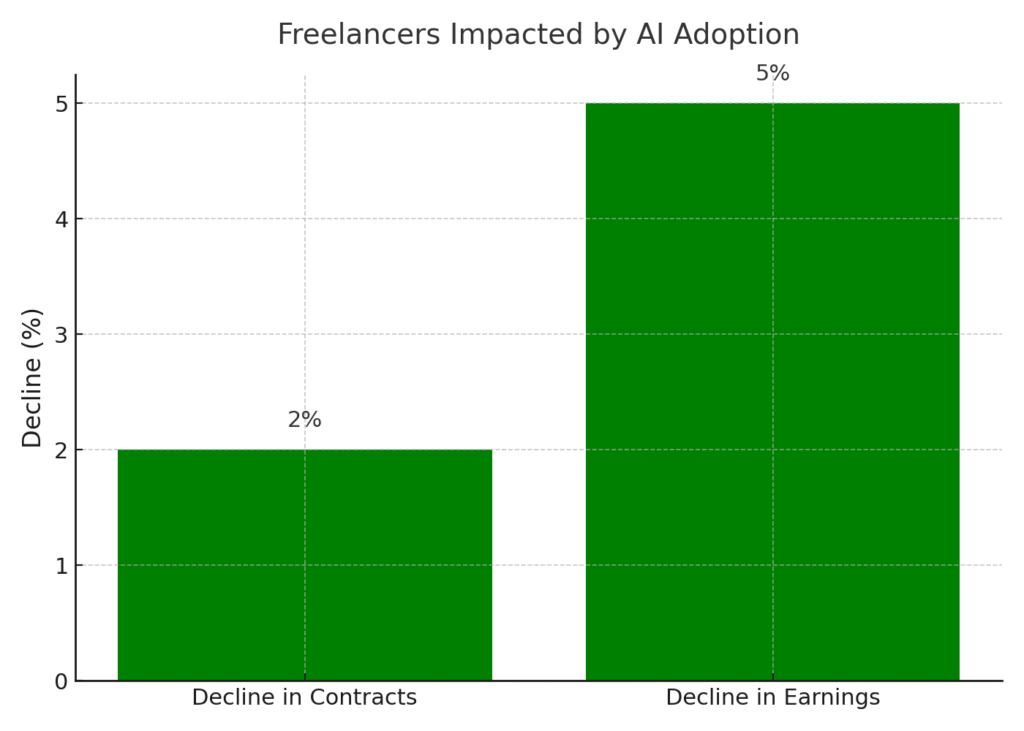
AI Replacing Marketing Jobs Statistics#8 – Freelancers Saw A 2% Decline In Contracts
Freelancers working in marketing and creative fields experienced a 2% decline in contracts after generative AI adoption. This is because businesses increasingly rely on AI for tasks such as copywriting and ad creation. The trend reduces the need to hire freelance talent for basic jobs. For many independent marketers, competition with AI has led to lower demand. This highlights how even non-traditional marketing workers are being replaced by automation.
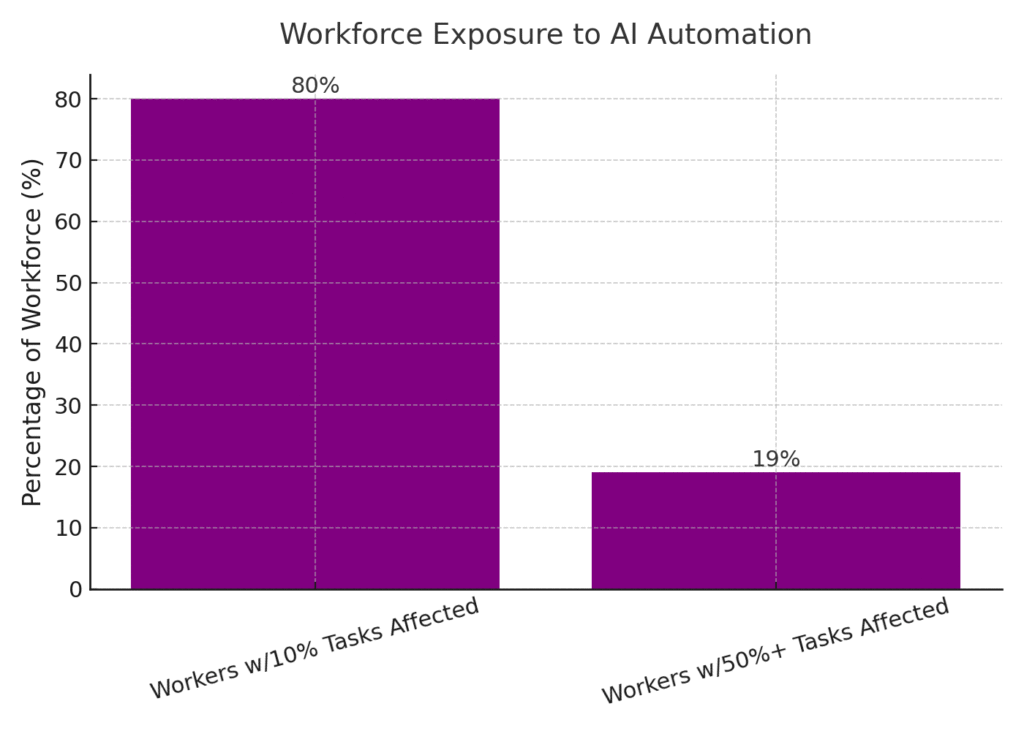
AI Replacing Marketing Jobs Statistics#9 – 80% Of U.S. Workforce Impacted By LLMs
A study estimated that 80% of U.S. workers could see at least 10% of their tasks affected by large language models. In marketing, this includes functions like email drafting, report generation, and keyword research. About 19% of workers could have over half their daily workload automated. For marketing professionals, this means adopting AI skills is no longer optional. Those who fail to adapt may see their value in the job market diminish.
AI Replacing Marketing Jobs Statistics#10 – Marketing Data Analysis Increasingly Automated
AI is transforming marketing data analysis, segmentation, and campaign reporting. Once requiring large teams, these tasks can now be done by AI platforms in seconds. This reduces the need for human analysts in routine tasks. As a result, companies are reallocating human workers toward strategy and customer engagement. The automation of analysis highlights how data-heavy marketing roles are shrinking.
AI Replacing Marketing Jobs Statistics#11 – Automation Of Campaign Scheduling And Segmentation
AI-powered automation tools are taking over campaign scheduling, lead nurturing, and segmentation. These tasks once consumed large amounts of human time. Now, AI platforms can analyze customer behavior and trigger emails automatically. This allows firms to cut back on operational staff. The shift demonstrates how execution-based roles are being absorbed by AI.
AI Replacing Marketing Jobs Statistics#12 – Predictive Analytics Reduces Manual Forecasting
AI has brought predictive analytics into mainstream marketing. Forecasting customer demand, churn, or campaign outcomes no longer requires large manual teams. Machine learning tools can provide accurate predictions instantly. This reduces the need for traditional market research analysts. Over time, AI will replace many of these positions with algorithm-driven insights.
AI Replacing Marketing Jobs Statistics#13 – Marketers Spend Less Time On Operational Work
With AI, marketers report spending less time on operational work and more on strategy. Tasks like A/B testing setup, campaign optimization, and reporting are largely automated. This reduces reliance on lower-level marketing assistants. The transformation forces workers to develop creative and strategic expertise. It demonstrates how AI replacement is shifting the hierarchy of marketing roles.
AI Replacing Marketing Jobs Statistics#14 – Freelancers In Copyediting Face Declines
Freelancers offering copyediting and proofreading have been hit hard by AI adoption. Many firms now use generative AI to produce near-final drafts, reducing the need for human editors. This has led to declining opportunities in content-heavy marketing. Freelancers who once thrived in this space must now diversify their skills. The decline shows how AI is directly replacing specialized marketing-related services.
AI Replacing Marketing Jobs Statistics#15 – Text-Heavy Marketing Roles Most Exposed
Jobs requiring heavy text creation, such as content writers and copy editors, rank highest in AI applicability. This makes them especially vulnerable to automation. AI can now produce blog posts, social media captions, and ad scripts in seconds. As a result, demand for entry-level content jobs is dropping. This reinforces the idea that marketing roles closest to text production are being replaced first.
AI Replacing Marketing Jobs Statistics#16 – AI Generates Ad Creative And Social Media Content
AI systems are widely used to generate ads, social media posts, and landing page copy. These areas once required creative staff working full-time. Today, companies can generate multiple ad variations at little cost. This diminishes the need for large content teams. The rise of AI-driven content creation shows direct replacement of human marketing workers.
AI Replacing Marketing Jobs Statistics#17 – Hyper-Targeted Personalization Reduces Manual Work
AI enables hyper-targeted personalization at scale. Instead of marketers manually segmenting audiences, AI customizes campaigns automatically. This allows brands to send tailored offers without human intervention. Staff who once specialized in segmentation are now less in demand. Personalization has become an automated process powered by data and algorithms.
AI Replacing Marketing Jobs Statistics#18 – Real-Time Analytics Replace Static Campaign Planners
AI now offers real-time analytics and adaptive campaign models. Traditional campaign planners who relied on static reports are being phased out. Businesses prefer dynamic tools that update continuously. This means fewer jobs centered on manual campaign oversight. Marketing analysts must now transition to supervising AI tools instead.
AI Replacing Marketing Jobs Statistics#19 – Programmatic Ad Buying Replacing Human Media Planners
Programmatic ad buying powered by AI is reducing the need for human media planners. Algorithms can decide ad placement faster and with better targeting. This automation allows businesses to optimize ad budgets efficiently. Human planners are now required only for oversight and strategy. The job market for media buyers is shrinking as a result.
AI Replacing Marketing Jobs Statistics#20 – Marketers Must Shift To Human-AI Collaboration
Many marketing leaders believe the future belongs to those who collaborate with AI. Instead of doing tasks manually, marketers will guide, supervise, and refine AI output. Roles like “prompt engineers” or “AI content curators” are becoming more common. This shift shows replacement is not total, but transformation is unavoidable. Success in marketing will depend on adapting to this hybrid model.
Your Marketing Career in the Age of AI
Here’s what I want you to take away from all these statistics: Yes, AI is transforming marketing jobs, but it’s not the career apocalypse some people make it out to be. After analyzing all this data, I’m actually more optimistic about the future of marketing than ever before. The professionals I see thriving aren’t the ones hiding from AI—they’re the ones embracing it as their secret weapon. Whether you’re creating content, analyzing data, or strategizing campaigns, AI can amplify your abilities rather than replace you entirely. My advice? Start experimenting with AI tools today, focus on developing uniquely human skills like creative strategy and relationship building, and remember that every major technological shift creates new opportunities for those willing to adapt. The marketing industry has survived and thrived through the rise of digital advertising, social media, and data analytics—and we’ll do the same with AI. The key is staying curious, staying flexible, and viewing these changes as your chance to level up rather than something to fear.
SOURCES