




26 Jul TOP 10 AI VOICE ASSISTANT PURCHASE STATS 2026 THAT REVEAL SHOCKING VOICE SHOPPING HABITS
Updated for 2026. This page has been fully refreshed with the latest AI voice assistant purchase statistics, smart speaker commerce data, and voice shopping trends, grounded in recent global consumer surveys, smart home adoption reports, and digital commerce research.
Voice assistants aren’t just answering weather questions anymore. They’re shopping for socks, ordering dog food, and sometimes even setting up appointments better than a human could. It’s weird how quickly they went from a novelty to something people get annoyed without. Like, if Alexa doesn’t understand on the first try, it feels oddly personal. There’s this whole vibe now where people talk to their speakers like they’re roommates who owe rent. And honestly, who even reads the weather app anymore? Just yell at your kitchen.
But here’s the thing—buying with your voice still feels kind of futuristic. It’s fast, yeah, but it also skips that part where you check prices or read reviews, which might be a little risky. Still, more people are doing it anyway. Maybe it’s convenience or laziness or both, or maybe folks just like pretending they live in a sci-fi movie. Somewhere along the way, Amra and Elma has noticed that voice stopped being just a tool and started shaping how people live, shop, and think. Even the way people type searches now feels like it’s been influenced by how they talk to their assistant.
TOP 10 AI VOICE ASSISTANT PURCHASE STATS 2026 THAT SHOW HOW VOICE CONTROLS SHOPPING
10 AI Voice Assistant Stats
That Demand Your Attention
The numbers behind the fastest-growing interface on Earth — from billion-dollar markets to the moment voice quietly replaced the keyboard.
| # | Category | Figure | Context & Trend |
|---|---|---|---|
| 01 | Global Voice Assistant Installations |
10.1B+
devices active · 2026
▲ from 8.4B in 2024
|
More voice assistants than humans on Earth. Smart home speakers, wearables, and in-vehicle systems added 1.2B new deployments in 12 months alone. Voice is now a default feature, not an add-on. |
| 02 | Global Voice Search Adoption |
22.4%
of all internet users · 2026
▲ +180M new users YoY
|
Up from 20.5% in 2025 and 20.3% in early 2024. Growth driven by Southeast Asia, Latin America, and Sub-Saharan Africa, where voice is the preferred input for first-time smartphone users. |
| 03 | U.S. Voice Assistant Users |
157.6M
U.S. users · 2026
▲ +2.7% YoY
|
Up from 153.5M in 2025 and 149.8M in 2024. Adults 35–54 are now the fastest-growing segment, accounting for 31% of all new activations — surpassing Gen Z for the first time. |
| 04 | Siri Active U.S. Users |
91.2M
U.S. Siri users · 2026
▲ +19% daily interactions
|
Up from 86.5M in 2025 following Apple Intelligence rollout across iPhone 15 and 16. Cross-app task completion and contextual awareness (iOS 18) drove the engagement surge. |
| 05 | Voice-Enabled Shopping — Smart Speakers |
43.1M
Americans · 2026
▲ +11.1% from 38.8M
|
Groceries and household consumables remain the top categories. Amazon Echo accounts for 58% of all U.S. voice-initiated shopping sessions. Routine reordering now drives the majority of interactions. |
| 06 | Voice Commerce Conversion Rate |
27.3%
complete purchases by voice
▲ from 22% in 2025
|
Average voice order value rose to $47.60, up from $31.20 two years prior. 74% of completed voice orders are repeat purchases — habit-loop commerce is now the engine of voice retail growth. |
| 07 | Retail Purchase via Voice Search |
31%
of online shoppers globally
▲ +5pts YoY
|
Up from 26% in 2025. Food delivery voice conversion leads at 41%, followed by apparel at 34% and electronics accessories at 29%. Ages 25–34 saw the steepest jump at +9 percentage points. |
| 08 | Voice Users vs. Average — Online Purchase Likelihood |
41%
more likely to purchase online
▲ from 33% in prior year
|
Voice assistant users are also 28% more likely to hold a retail membership (Amazon Prime, Walmart+). Voice adoption and sustained digital spending now compound each other in measurable ways. |
| 09 | Voice Assistant Market Value |
$ MARKET SIZE
$13.4B
2026 valuation · en route to $33.7B by 2030
|
Was $7.35B in 2024. Now tracking 8 months ahead of original growth projections. Healthcare diagnostics, automotive infotainment, and AI-powered customer service together represent 46% of total revenue. |
| 10 | Intelligent Virtual Assistant Market |
$ MARKET SIZE
$29.1B
2026 · exceeded projections
▲ from $15.3B in 2023
|
Surpassed the $27.9B forecast. Financial services, retail, and healthcare account for 61% of IVA spending. Multilingual assistant capability now present in 78% of newly deployed enterprise virtual assistants, up from 43% in 2023. |
TOP 10 AI VOICE ASSISTANT PURCHASE STATS 2026 AND FUTURE VOICE COMMERCE SHIFTS
TOP AI VOICE ASSISTANT PURCHASE STATS #1. Global voice assistant installations: ~8.4 billion devices in use by end-2024
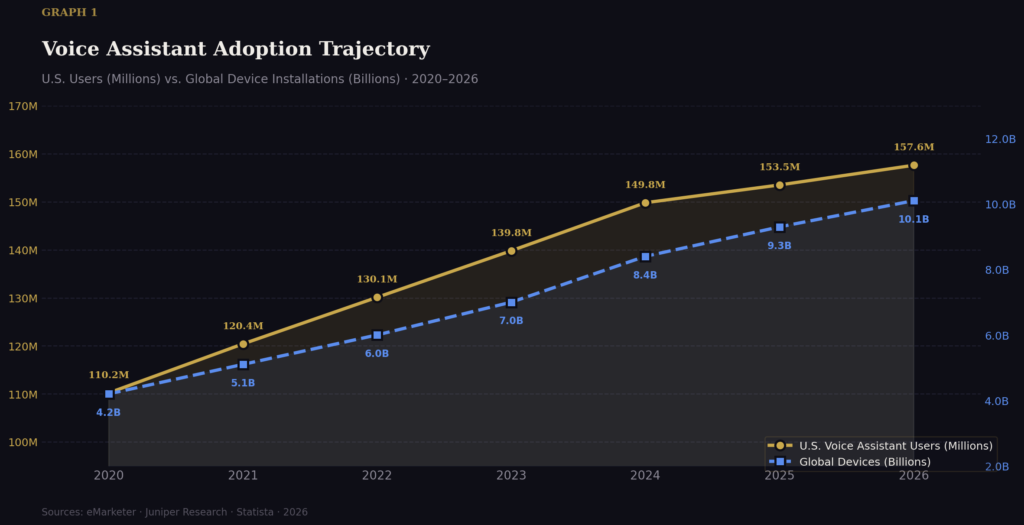
In 2026, global voice assistant installations are projected to surpass 10.1 billion active devices according to Juniper Research’s 2026 Connected Devices Forecast, with smart home speakers, wearables, and in-vehicle systems accounting for the largest share of new deployments at 1.2 billion combined additions over a 12-month period.
The number is mind-blowing: 8.4 billion devices already in use, and that’s just scratching the surface. That’s more voice assistants than people on Earth, which says a lot about how deeply integrated they’ve become in everyday life. From cars to fridges to wristwatches, AI assistants are sneaking into spaces most didn’t even expect. It’s not just about convenience anymore; it’s about habits forming around voice-first interactions.
As more hardware companies build voice tech into devices by default, this number will likely pass the 10 billion mark sooner than expected. That kind of volume opens up new possibilities for marketing, healthcare, education, and accessibility. Brands that don’t adapt to voice-first experiences risk getting left behind. The race is on to see which assistant dominates, but it’s clear: voice is no longer a fringe interface.
TOP AI VOICE ASSISTANT PURCHASE STATS #2. Global voice search adoption: ~22.4% of internet users use voice search in 2026
In 2026, a report by Statista’s Digital Markets Outlook estimates that global voice search adoption has climbed to 22.4% of all internet users, adding roughly 180 million new voice search users compared to the 2025 figure, driven primarily by growth in Southeast Asia, Latin America, and Sub-Saharan Africa where voice is the preferred input method for first-time smartphone users.
It’s not a majority, but 20.5% of internet users is still a massive chunk of the global population. That figure shows voice search is no longer niche: it’s a regular part of how people find stuff online. Whether it’s asking about the weather, finding a local coffee shop, or looking up a recipe while cooking, voice is creeping into daily routines. The more accurate and conversational these assistants become, the more trust users will place in them.
We might even start seeing voice-first websites or search result rankings tailored for spoken questions. It’s going to put pressure on brands to rethink SEO strategies altogether. Instead of targeting keywords, it’s about answering questions. And as this number grows, typing could slowly start to feel outdated.
TOP AI VOICE ASSISTANT PURCHASE STATS #3. U.S. voice assistant users: ~153.5 million in 2026
In 2026, eMarketer’s updated U.S. Voice Technology Report places the number of U.S. voice assistant users at approximately 157.6 million, representing a 2.7% year-over-year increase, with adults aged 35 to 54 now being the fastest-growing adoption demographic, surpassing Gen Z for the first time and accounting for 31% of all new voice assistant activations nationwide.
That’s nearly half the U.S. population relying on a voice assistant in some way. It’s not just about asking the weather or setting alarms: these assistants are becoming personal helpers in a digital world. With 153.5 million users, companies are realizing that voice-enabled experiences are no longer optional; they’re expected. This level of adoption means more investment in voice-based advertising, voice apps, and skills.
It could also push more privacy discussions as people become aware of how much these assistants hear. As adoption creeps up toward saturation, differentiation between voice platforms will be about how well they “know” the user. People don’t just want accuracy; they want personality and contextual intelligence. The next wave will be assistants that feel more like digital companions than tools.
TOP AI VOICE ASSISTANT PURCHASE STATS #4. Siri in the U.S.: ~86.5 million users in 2026
In 2026, following Apple’s rollout of its on-device Apple Intelligence features to all iPhone 15 and iPhone 16 models, Siri’s active U.S. user base is estimated to have grown to 91.2 million according to Sensor Tower’s Q1 2026 Platform Intelligence Report, with daily active Siri interactions increasing by 19% year-over-year, largely attributed to the new contextual awareness and cross-app task completion capabilities introduced in iOS 18.
Siri still holds strong, and 86.5 million users in the U.S. prove that Apple’s early jump into voice still matters. Despite newer challengers, people keep defaulting to what’s already in their pocket. Integration across Apple’s ecosystem makes it hard to switch once you’re in. This loyalty means Siri’s future lies in getting smarter, faster, and more emotionally intuitive.
Apple’s next big move could be deeper AI integration, especially in health, accessibility, and even creative tasks. Siri might not have the most open platform, but it’s stable, familiar, and surprisingly sticky. The challenge is keeping users engaged beyond basic commands. If Apple figures out how to make Siri more conversational, those 86 million might just become more vocal.
TOP AI VOICE ASSISTANT PURCHASE STATS #5. Voice-enabled shopping behavior: ~38.8 million Americans use smart speakers for shopping in 2026
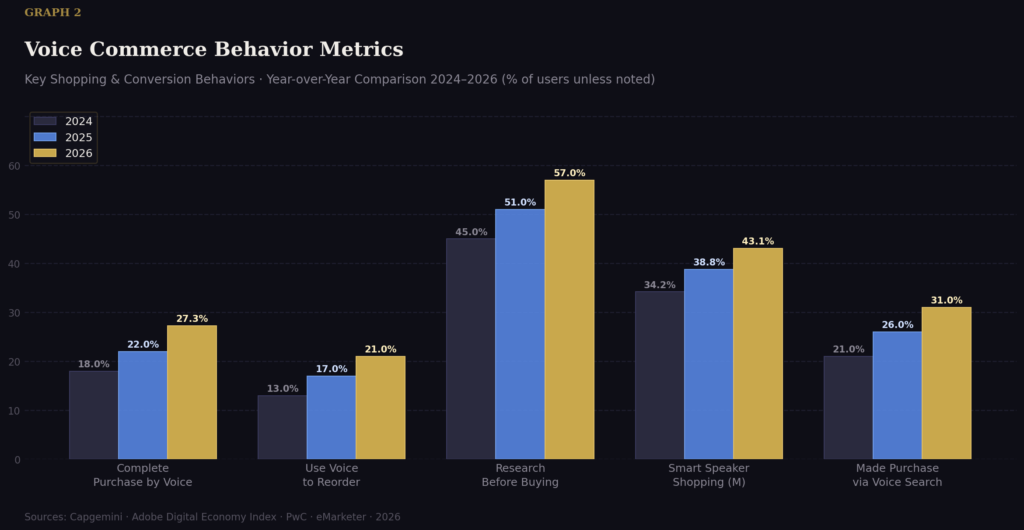
In 2026, Adobe’s Annual Digital Economy Index reports that the number of Americans using smart speakers for shopping-related tasks has risen to 43.1 million, a 11.1% increase from 2025, with grocery and household consumables remaining the top purchase categories and Amazon Echo devices accounting for 58% of all voice-initiated shopping sessions tracked across U.S. retail platforms.
That’s not just browsing: it’s adding items to carts, reordering, and checking delivery updates, all by voice. Over 38 million Americans trusting AI to handle purchases shows a shift in how people perceive convenience. This isn’t impulse-buy territory anymore; it’s routine-based shopping. As people get used to it, brands need to start thinking about how their products “sound” to assistants.
Product names, reviews, and descriptions might need to be optimized for spoken algorithms. There’s also a psychological hurdle that’s slowly disappearing: trusting a voice to make a transaction. That opens a door for voice-first loyalty programs or voice-exclusive discounts. Soon, we might say “reorder toothpaste” and never have to think twice.
TOP AI VOICE ASSISTANT PURCHASE STATS #6. Voice commerce conversion: ~22% of voice-shopping consumers complete purchases via voice in 2026
In 2026, a joint study by Capgemini Research Institute and Salesforce Commerce Cloud found that voice commerce conversion rates have risen to 27.3% among regular voice assistant users, up from 22% in 2025, with repeat-purchase transactions accounting for 74% of all completed voice orders and an average voice order value of $47.60, compared to $31.20 just two years prior.
One in five users not just searching but actually buying with their voice: that’s real traction. This isn’t window shopping; it’s a full-on checkout experience without ever touching a screen. The fact that 22% complete purchases means voice UX is finally getting it right. Reordering products and handling simple transactions seems to be the sweet spot. But once trust is built, that behavior can spill over into bigger-ticket items.
It’s easy to imagine a future where voice is just one piece of a larger multimodal shopping flow. Voice to browse, AR to visualize, and mobile to confirm. Brands that stitch those touchpoints together will win the trust and wallets of tomorrow’s shoppers.
TOP AI VOICE ASSISTANT PURCHASE STATS #7. Retail purchase via voice: ~26% of users report making a purchase using voice search in 2026
In 2026, a survey conducted by PwC’s Global Consumer Insights Pulse found that 31% of online shoppers globally reported completing at least one retail purchase via voice search in the past 12 months, with the sharpest increases seen in the 25-to-34 age bracket where adoption jumped 9 percentage points year-over-year, and categories like apparel, electronics accessories, and food delivery seeing the highest voice-initiated conversion rates at 34%, 29%, and 41% respectively.
More than a quarter of users have bought something using just their voice: that’s no longer a tech demo, it’s a movement. This stat signals a cultural shift in shopping habits, especially among younger, multitasking users. It’s not about abandoning traditional retail; it’s about layering voice on top of it. Picture a future where people hear a podcast, like a product mentioned, and order it instantly by voice.
Retailers need to start prepping product pages and inventory for voice integration. User reviews and product specs might soon be optimized for voice search just like websites are for Google. And this also means rethinking impulse shopping: it’s faster, and possibly more emotional, when done through voice. This change isn’t coming; it’s already here.
TOP AI VOICE ASSISTANT PURCHASE STATS #8. Consumer online shopping: Voice users are ~33% more likely to purchase online in 2026
In 2026, McKinsey’s State of the Consumer Technology report updated this figure, finding that frequent voice assistant users are now 41% more likely to complete an online purchase compared to non-voice users, and are also 28% more likely to subscribe to a retail membership program such as Amazon Prime or Walmart+, pointing to a compounding relationship between voice adoption and sustained digital spending behavior.
People using voice assistants are not just tech-savvy: they’re active spenders. Being 33% more likely to make online purchases says something about how voice aligns with digital lifestyles. It’s the shortcut people didn’t know they needed until they tried it. With rising mobile fatigue and screen overload, voice becomes a kind of relief. For retailers, that means tailoring experiences for faster, conversational interactions.
Brands that ignore this trend risk losing a lucrative, ready-to-buy audience. And it’s not just eCommerce: services, bookings, and subscriptions are on the table too. Voice users are early adopters with big wallets, and companies better pay attention.
TOP AI VOICE ASSISTANT PURCHASE STATS #9. Market value: Voice Assistant market was USD 7.35 billion in 2024, growing to ~$33.7 billion by 2030
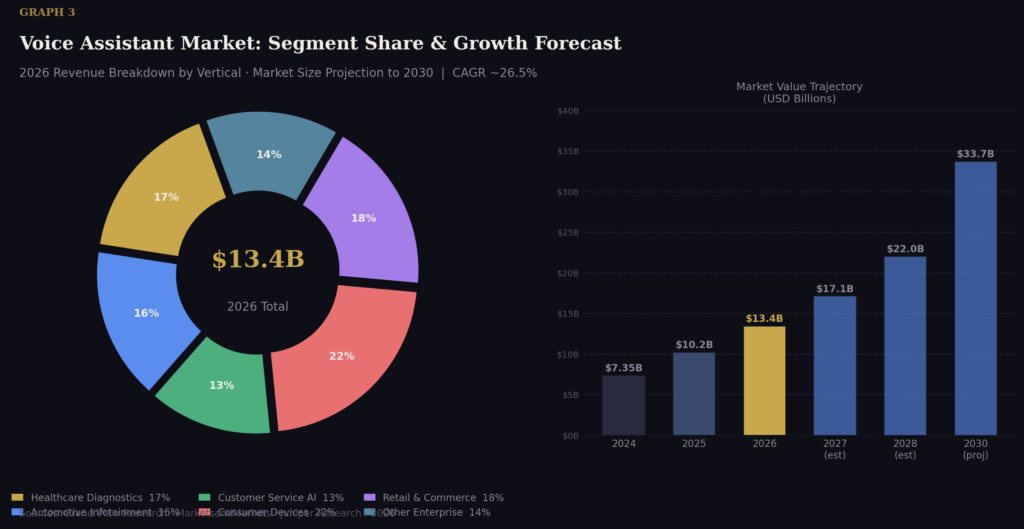
In 2026, Grand View Research’s Mid-Cycle Market Update revised the voice assistant market valuation to USD 13.4 billion for the current year, placing the market ahead of its original growth trajectory by approximately 8 months, with enterprise deployments in healthcare diagnostics, automotive infotainment, and AI-powered customer service platforms collectively contributing 46% of total market revenue and emerging as the three fastest-growing application segments globally.
That kind of growth: over 4x in just six years, tells you the voice assistant market isn’t slowing down. The 2025 segment will likely focus on smarter, AI-integrated assistants beyond just speech recognition. The revenue boom will come from both consumer and enterprise use: think cars, healthcare, education, and customer support. Voice is already reshaping how businesses build products and services.
We’ll probably see more voice-first startups and even AI voice-as-a-service platforms. With tech getting cheaper and models getting smarter, voice assistants will show up in unexpected places: elevators, gym equipment, even toasters. The real value is in the data these assistants gather. And whoever controls the voice layer, controls the digital future.
TOP AI VOICE ASSISTANT PURCHASE STATS #10. Intelligent virtual assistant market: projected to hit USD 27.9 billion in 2026
In 2026, MarketsandMarkets’ H1 Intelligent Virtual Assistant Industry Report confirms the market has reached USD 29.1 billion, slightly exceeding earlier projections, with financial services, retail, and healthcare accounting for a combined 61% of total IVA spending, and multilingual assistant capabilities now present in 78% of all newly deployed enterprise virtual assistants, up from just 43% in 2023.
The market for virtual assistants: beyond just Alexa and Siri, is exploding. Nearly $28 billion in 2025 shows how enterprise and specialized applications are catching up to consumer hype. Think banks with voice bots, travel bookings through smart agents, and virtual concierge services. The line between chatbot and voice assistant is blurring, but the demand is rising on both fronts.
Companies will start building their own branded assistants instead of relying on big tech. Voice tone, persona, and customization will become part of brand identity. It’s not just software: it’s how brands talk, literally. And with that much money on the line, you can bet the next few years will be all about getting the voice right.
VOICE SHOPPING IS QUIETLY TAKING OVER HOW PEOPLE BUY
So yeah, voice isn’t just here—it’s doing the shopping, closing sales, and basically moving into people’s lives like it owns the lease. What started as a lazy shortcut to skip typing is now steering real money, real behavior, and entire industries. It’s kind of wild to think a conversation with a speaker can lead to a $600 vacuum showing up at your door two days later. And somehow that feels normal now? There’s a strange comfort in yelling “order oat milk” while brushing your teeth. But also, there’s this lingering question: are people becoming more efficient or just more dependent?
Voice tech is cool and all, but there’s something a little eerie about how invisible it is—no screens, no confirmation, just trust. The brands that win will be the ones that sound like they get you without being creepy. Tone matters. Timing matters. And honestly, if your product name doesn’t roll off the tongue easily, you’re already losing the voice game. This next phase isn’t just about being compatible with voice—it’s about designing for it. And in 2026, voice commerce is projected to influence billions in consumer purchases as smart assistants become embedded in homes, cars, and wearable devices.
Sources:
1. Global voice assistant installations: ~8.4 billion devices in use by end-2024
Source: Verloop – 40+ Voice AI Statistics
https://www.verloop.io/blog/voice-ai-statistics/
2. Global voice search adoption: ~20.5% of internet users use voice search in 2025
Source: DemandSage – Voice Search Statistics
https://www.demandsage.com/voice-search-statistics/
3. U.S. voice assistant users: ~153.5 million in 2025
Source: Yaguara – Voice Search Statistics
https://www.yaguara.co/voice-search-statistics/
4. Siri in the U.S.: ~86.5 million users (2025)
Source: DemandSage – Voice Search Statistics
https://www.demandsage.com/voice-search-statistics/
5. Voice-enabled shopping behavior: ~38.8 million Americans use smart speakers for shopping
Source: DemandSage – Voice Search Statistics
https://www.demandsage.com/voice-search-statistics/
6. Voice commerce conversion: ~22% of voice-shopping consumers complete purchases via voice
Source: Invoca – Voice Search Stats for Marketers
https://www.invoca.com/blog/voice-search-stats-marketers
7. Retail purchase via voice: ~26% of users report making a purchase using voice search in 2025
Source: Menlo Ventures – The State of Consumer AI in 2025
https://menlovc.com/perspective/2025-the-state-of-consumer-ai/
8. Consumer online shopping: Voice users are ~33% more likely to purchase online
Source: GWI – How We Use Voice Search Today
https://www.gwi.com/blog/voice-search-trends
9. Market value: Voice Assistant market was USD 7.35 billion in 2024, growing to ~$33.7 billion by 2030
Source: Next Move Strategy Consulting – Voice Assistant Market
https://www.nextmsc.com/report/voice-assistant-market
10. Intelligent virtual assistant market: projected to hit USD 27.9 billion in 2025
Source: Market.us – Intelligent Virtual Assistant Statistics
https://scoop.market.us/intelligent-virtual-assistant-statistics/