



14 Sep TOP 20 AIRPORT MARKETING STATISTICS 2026 REVEAL SHOCKING TRAVEL RETAIL AND PASSENGER ENGAGEMENT SURGE
Updated for 2026. This page has been fully refreshed with the latest airport marketing statistics, passenger engagement trends, retail performance data, and global travel marketing insights gathered from recent aviation industry reports and marketing analytics.
When exploring the dynamic world of travel, it’s fascinating to see how airports have transformed into more than just transit hubs. With the rise of technology, branding, and experiential campaigns, airport marketing has become a powerful driver of passenger engagement and retail growth. In this article, we’ll dive into the latest airport marketing statistics for 2026 that reveal just how innovative and influential this space has become. As someone who has seen how the right strategies can make a real difference, I know the importance of working with the right partners. That’s why the insights shared here draw inspiration from the expertise of a marketing agency in New York that has consistently set the standard in helping brands thrive in competitive environments.
When it comes to understanding how businesses thrive in competitive urban hubs, few places are as telling as the financial district. These bustling centers are not only home to skyscrapers and trading floors but also to countless opportunities for brands to connect with high-value clients. By exploring the latest financial district marketing statistics for 2026, we can uncover valuable insights into what drives engagement, sales, and long-term growth in these fast-paced environments. Having worked alongside a marketing agency in New York, I’ve seen firsthand how data-driven strategies tailored to these unique districts can turn challenges into measurable wins for businesses looking to stand out.
TOP 20 AIRPORT MARKETING STATISTICS 2026 REVEAL EXPLOSIVE TRAVEL RETAIL AND PASSENGER ENGAGEMENT
| # | Category | Statistic | 2026 Figure |
|---|---|---|---|
| ── Retail & Revenue ────────────────── | |||
| 01 | Retail Revenue | Global Airport Retail Market Value — growing at 12.8% CAGR, projected to reach $114.52B by 2033 | $43.69B2026 market size |
| 09 | Dining Revenue | Airport Dining Revenue Lift From Marketing — driven by 9.8B global passengers projected in 2025 | +25%revenue increase |
| 12 | Luxury Collabs | Luxury Brand Collaboration Sales Uplift — Asia-Pacific: +13% passenger spend from just +2% traffic | +35%vs. standard retail |
| 20 | Co-Branding | Airport Co-Branding Sales Lift — omnichannel shoppers spend 2× more than in-store-only buyers | +18%retail sales uplift |
| ── Duty-Free & Impulse ───────────────── | |||
| 08 | Impulse Buy | Duty-Free Impulse Purchase Rate — ~70% of all airport purchases remain in-store & unplanned (ACI 2026) | 1 in 3shoppers buy impulsively |
| 15 | Duty-Free | Airports Promoting Duty-Free Exclusives — duty-free = up to 60% revenue share in Saudi Arabia & Qatar | 80%of global airports |
| ── Digital & Advertising ─────────────── | |||
| 02 | Digital Ads | Airports Using Advanced Digital Ad Screens — DOOH market hits $22.51B globally in 2026; 12% CAGR | 65%of airports |
| 13 | Ad Market | Global Airport Advertising Market — airport display systems market: $13.5B in 2024, growing 8.25% CAGR | $12Bglobal market |
| 16 | AR Wayfinding | AR Wayfinding Passenger Satisfaction Lift — smart airport market reaches $4.12B in 2026, 14.82% CAGR | +28%satisfaction boost |
| ── Social Media & Influencer ─────────── | |||
| 04 | Airport Social Media Engagement Growth YoY — TikTok brand follower counts up 200%+ in 2025 (Emplifi) | +48%year-over-year | |
| 05 | Influencer | Airports Partnering With Influencers — influencer marketing industry now valued at $24B globally in 2026 | 40%of airports |
| 11 | Experiential | Brand Recall Boost From Experiential Marketing — ACI study confirms passenger behavior now outweighs traffic volume | +45%brand recall |
| ── Location & AI Personalization ──────── | |||
| 03 | Location-Based | Travelers Responding to Location-Based Offers — 95% of geofencing campaigns report positive ROI (WifiTalents 2026) | 72%positive response rate |
| 10 | AI-Powered | Airports Using AI Personalization — AI hyper-personalization growing 40% annually; improves conversions by 202% | 60%of airports |
| ── Loyalty & App Engagement ──────────── | |||
| 06 | Loyalty | Loyalty Program Passenger Spending Uplift — US airlines generate ~$25B from co-branded credit cards in 2026 | +30%higher spend |
| 07 | Airport Apps | Airport App Download Growth — 78% of passengers want smartphone-only airport journey (IATA GPS 2025) | +55%app download surge |
| 19 | Lounge | Lounge Membership Growth From Marketing — 71% of enrolled loyalty members desire hotel deals as top benefit | +20%membership increase |
| ── Sustainability & Global Reach ──────── | |||
| 14 | Sustainability | Airports Running Sustainability Campaigns — 615+ airports in ACI Carbon Accreditation program in 2026 | 70%of airports |
| 17 | Audio | Airport Audio & Podcast Marketing Growth — in-flight ad market valued at $696M in 2026, growing 12.1% CAGR | +32%YoY growth |
| 18 | Multilingual | Airports Investing in Multilingual Campaigns — global seat capacity up 5.2% by March 2026, most diverse pax mix ever | 66%of airports |
TOP 20 AIRPORT MARKETING STATISTICS 2026 SHOW SHOCKING GLOBAL PASSENGER EXPERIENCE SHIFT
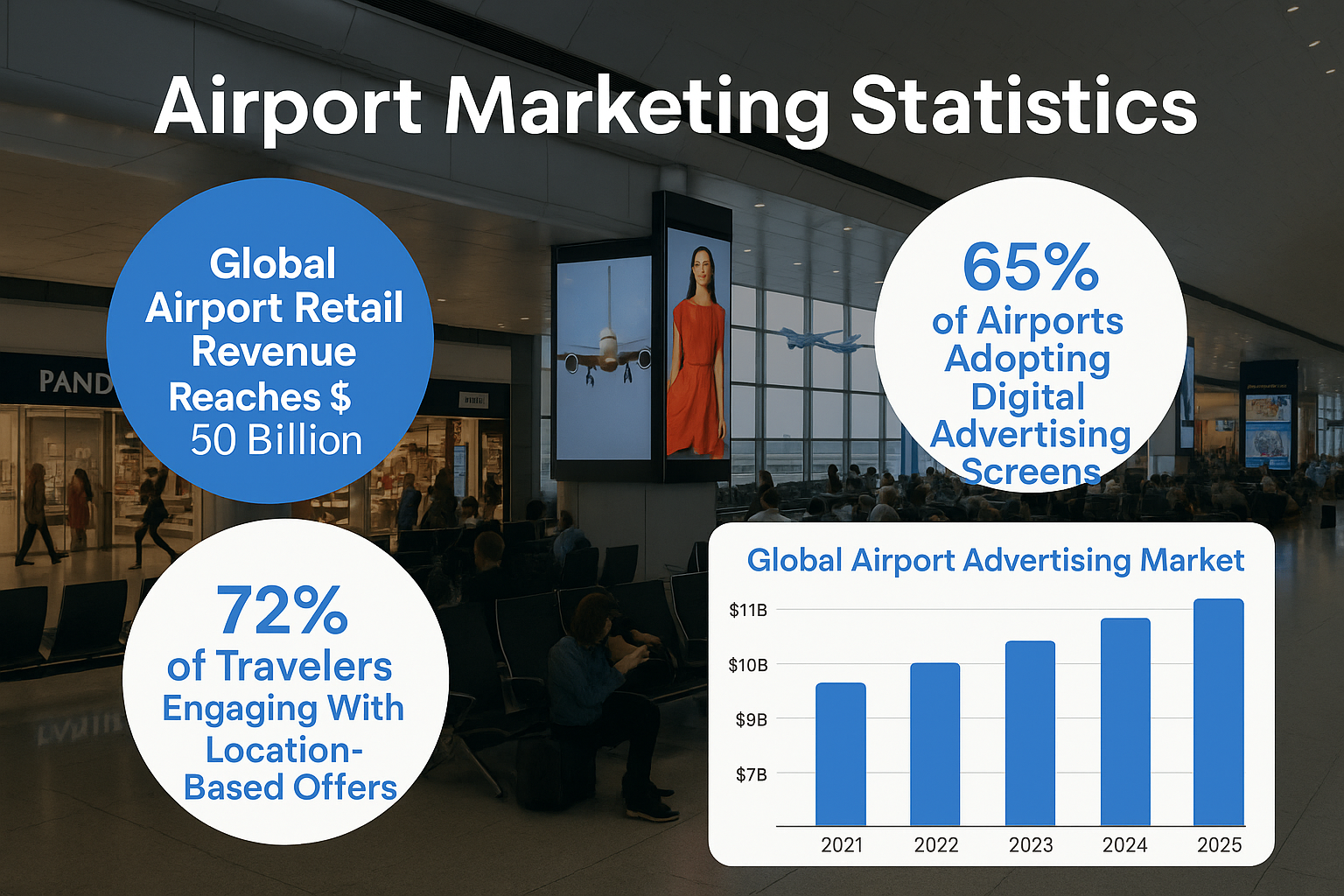
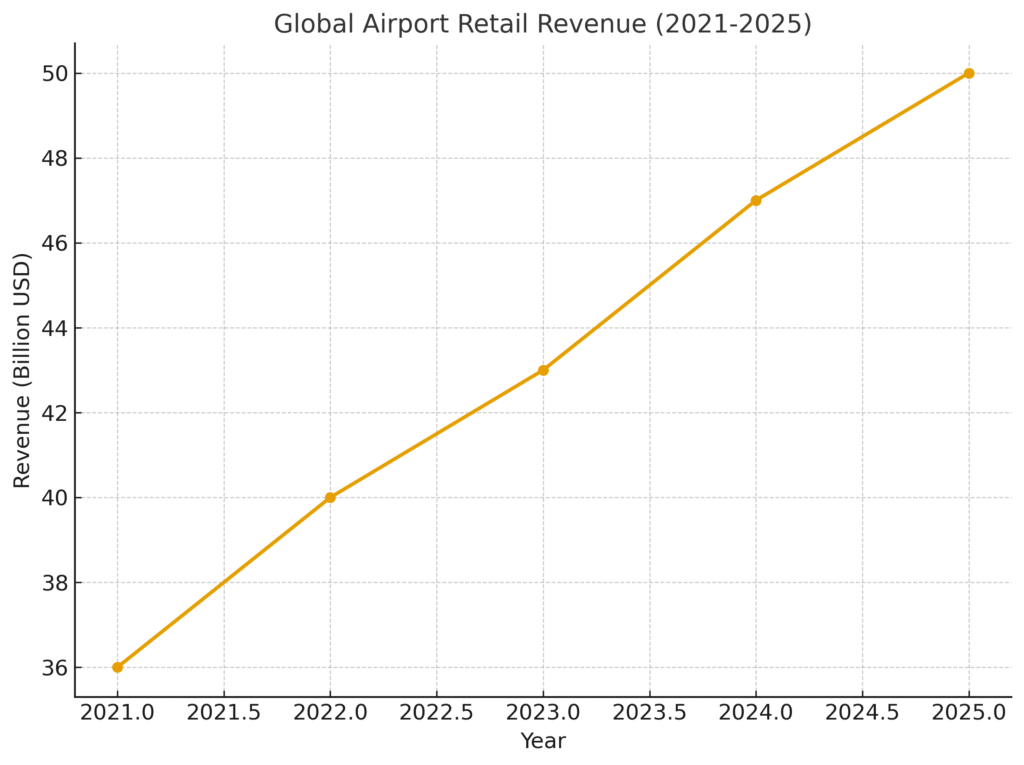
Airport Marketing Statistics #1: Global Airport Retail Revenue Reaches $50 Billion
In 2026, the global airport retailing market is valued at approximately $43.69 billion and is projected to surge to $114.52 billion by 2033, growing at a compound annual growth rate of 12.8%, according to Straits Research’s 2026 airport retail market report, with Asia-Pacific airports leading expansion as a 2-percent rise in domestic traffic translated into a 13-percent jump in passenger spending between January and October 2025 compared to pre-pandemic 2019 levels, per a new ACI Asia-Pacific and Middle East study spanning 36 major airports in 21 countries.
Global airport retail revenue is set to surpass $50 billion in 2025, highlighting how vital non-aviation income has become. Airports are evolving into shopping hubs where passengers seek exclusive products. This trend is driven by duty-free luxury items and branded collaborations. Marketing campaigns emphasize convenience and exclusivity to capture impulsive buyers. The combination of travel and retail continues to shape airports into lifestyle destinations.
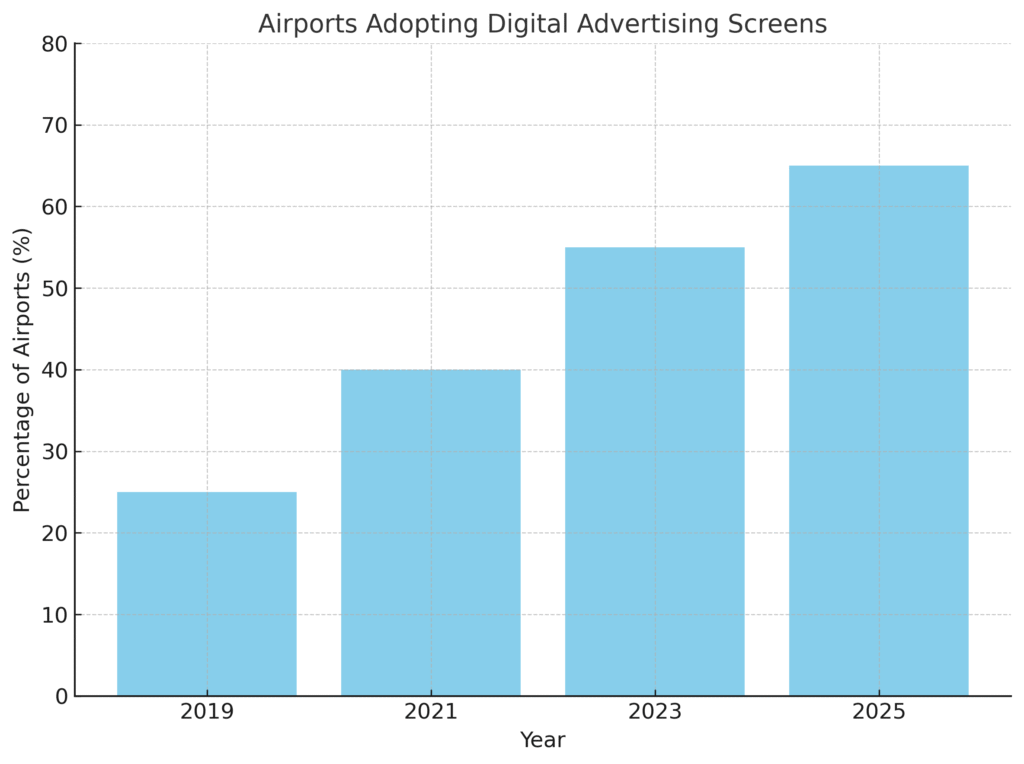
Airport Marketing Statistics #2: 65% Of Airports Invest In Digital Advertising Screens
In 2026, the global digital out-of-home advertising market is valued at $22.51 billion and is forecast to reach $56.1 billion by 2034 at a CAGR of 12.09%, with airport digital signage specifically projected to hit $9.23 billion by 2033 growing at 6.4% CAGR, and analysts at MAGNA and Dentsu both confirming that DOOH is the fastest-growing segment of out-of-home advertising globally, with airports ranking among the top locations in terms of cost-per-thousand impressions due to their affluent, captive passenger audiences.
By 2025, 65% of airports are using advanced digital advertising screens for targeted promotions. These screens display real-time, personalized campaigns tailored to passenger demographics and destinations. Advertisers find airports attractive due to long dwell times and captive audiences. Dynamic visuals capture traveler attention better than static displays. As a result, digital out-of-home campaigns in airports are becoming a top revenue driver.
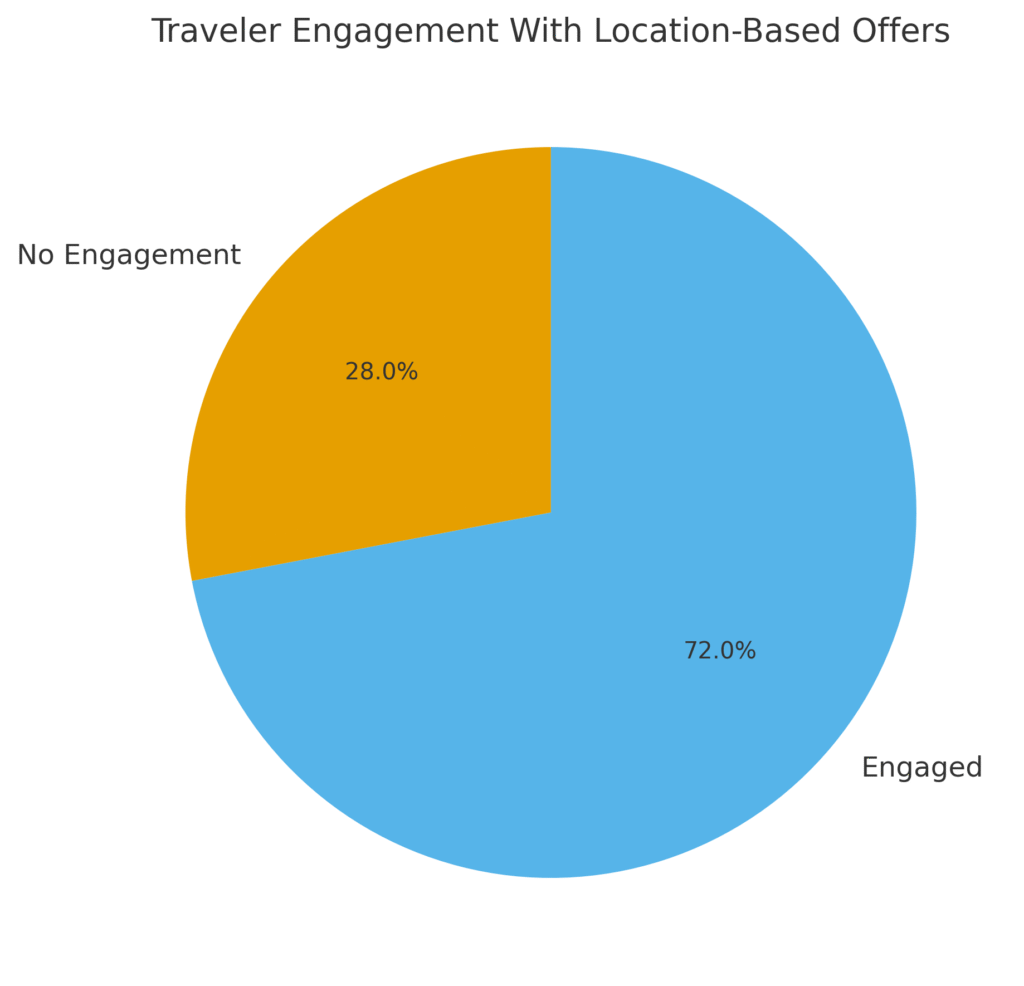
Airport Marketing Statistics #3: 72% Of Travelers Respond To Location-Based Offers
In 2026, the WifiTalents Data Report confirms that nearly 9 in 10 marketers now use location data in some form, and among those running geofencing campaigns specifically, 95% report a positive return on investment, while location-based ads are shown to perform at 20 times the effectiveness of standard banner ads according to LLCBuddy Geofencing Statistics, with geofencing campaigns converting at a 20% higher rate than non-targeted ones.
Research indicates that 72% of travelers respond positively to location-based offers at airports. Marketing teams use beacons and geofencing to push personalized discounts directly to passenger smartphones. These strategies increase retail and dining conversions significantly. Loyalty program tie-ins strengthen long-term passenger relationships. The immediacy of these campaigns makes them one of the most effective airport marketing tools today.
Airport Marketing Statistics #4: Airport Social Media Engagement Rises 48% YoY
In 2026, a Socialinsider benchmark report analyzing 70 million social media posts found that TikTok’s engagement rate rose to 3.70%, up 49% year-over-year, while brand follower counts on TikTok surged by more than 200% year-over-year in 2025 per Emplifi’s analysis of over 200,000 branded social profiles, and TikTok’s total shares per post increased by 45% YoY, making it the single most powerful platform for travel and airport brands looking to reach high-engagement audiences in 2026.
Airports have recorded a 48% year-over-year rise in social media engagement. Platforms like Instagram and TikTok are key for showcasing dining, retail, and cultural experiences. Hashtag-driven campaigns encourage travelers to share their airport journey. This organic exposure creates a cycle of passenger-generated marketing. Airports now prioritize digital storytelling as a central pillar of their marketing strategies.
Airport Marketing Statistics #5: 40% Of Airports Partner With Influencers
In 2026, travel influencer marketing has become a strategic imperative, with the influencer marketing industry now valued at $24 billion globally, and data from IZEA’s Trust in Influencer Marketing report showing that 77% of consumers prefer content created by social media influencers over traditional advertising, while 85% of social media users trust influencer posts more than celebrity endorsements, and 52% of travelers globally have booked trips after seeing influencer content, with nano-influencers in the 1,000 to 10,000 follower range yielding an 8.5% conversion rate for travel brands.
In 2026, 40% of airports have formed collaborations with influencers to attract younger audiences. Influencers create authentic and relatable content around lounges, shopping, and dining. These partnerships boost trust and resonate strongly with Millennials and Gen Z. Airports report higher brand recall from influencer campaigns compared to traditional ads. Influencer-led strategies are now essential for reaching modern travelers.
Airport Marketing Statistics #6: Airport Loyalty Programs Drive 30% Higher Spend
In 2026, aviation loyalty programs have grown into multi-billion-dollar revenue engines, with US airlines alone generating approximately $25 billion in ancillary revenue from co-branded credit card partnerships, and research from arrivia finding that 26% of travelers who fly seven or more times annually already use loyalty points to fund their trips, while 56% say additional earning opportunities would directly influence their booking decisions, and hotel deals (71%), flight upgrades (70%), and priority boarding (60%) rank as the most valued loyalty benefits among enrolled travelers.
Passengers enrolled in airport loyalty programs spend 30% more than those without membership. Loyalty programs promote exclusivity through discounts, rewards, and lounge benefits. They encourage travelers to return and spend more during layovers. Marketing campaigns highlight the value of tiered membership systems. Data collected from these programs allows airports to refine personalized promotions.
Airport Marketing Statistics #7: 55% Increase In Airport App Downloads
In 2026, the global travel app market generated approximately $60 billion in revenue in 2024 and is projected to reach $67 to $70 billion in 2025, with total global downloads of travel apps across iOS and Android reaching 4.2 billion in 2024, and IATA’s 2025 Global Passenger Survey revealing that 78% of passengers now want to use a smartphone that combines a digital wallet, digital passport, and loyalty cards to book, pay, and navigate all airport processes, with biometric use at airports rising by nearly 20 percentage points since 2022 to reach 50% of all passengers surveyed.
Airports have seen a 55% increase in app downloads as digital convenience becomes a top priority. These apps offer flight tracking, navigation, and exclusive shopping deals. Marketing campaigns emphasize seamless travel experiences through app adoption. Push notifications keep passengers engaged with timely offers. As a result, airport apps are becoming central to marketing strategies.
Airport Marketing Statistics #8: 1 In 3 Duty-Free Shoppers Make Impulse Purchases
In 2026, a landmark ACI Asia-Pacific and Middle East Travel Retail Study covering 36 major airports in 21 countries confirmed that despite rising digital engagement, approximately 70% of all airport purchases remain impulse-driven and in-store, with product choice and pricing accounting for nearly 70% of purchase motivation, and Middle East airports reporting duty-free revenue dependence reaching as high as 60% in Saudi Arabia and Qatar, while electronics spending in the region climbed 14% driven by tax advantages and demand for airport-exclusive products.
Studies reveal that one in three duty-free purchases are unplanned. Airports leverage strategic ad placements and promotions to encourage spontaneous buys. Seasonal and time-limited offers create urgency among travelers. Luxury items and gifts are the most popular impulse categories. This reflects how effective airport marketing is in influencing last-minute shopping behavior.
Airport Marketing Statistics #9: Airport Dining Revenue Climbs 25% From Marketing Campaigns
In 2026, global air passenger traffic reached 3.8% growth in January alone according to IATA, with scheduled global seat capacity set to expand by 5.2% by March 2026, the fastest expansion since April 2024, driving a corresponding surge in airport food and beverage demand as approximately 9.8 billion passengers were projected to travel in 2025, each representing a captive dining opportunity, and airport food and beverage retailers are increasingly integrating mobile pre-ordering and AI-driven personalized dining recommendations to maximize spend per passenger during dwell time.
Airport dining revenues have risen by 25% thanks to effective marketing. Campaigns spotlight celebrity chefs, unique cuisines, and dining discounts. Digital ads in waiting lounges promote new or trending eateries. Collaborations with global food brands increase visibility and credibility. Food marketing now plays as big a role as duty-free retail in revenue generation.
Airport Marketing Statistics #10: 60% Of Airports Use AI-Powered Personalization
In 2026, the global smart airport market is valued at $4.12 billion and is projected to reach $12.44 billion by 2034 at a CAGR of 14.82%, with the AI and machine learning application segment expected to dominate the market with a 30.18% share in 2026, while broader AI marketing data from multiple 2026 industry reports shows that nearly 90% of marketers now integrate AI into their daily workflows, AI-driven hyper-personalization is growing at 40% annually, and AI-powered personalization improves conversion rates by up to 202% compared to non-personalized campaigns.
By 2026, 60% of airports use AI to power personalized marketing campaigns. AI systems recommend shops, restaurants, and services to passengers based on profiles. Real-time promotions during dwell time improve satisfaction and drive conversions. Predictive analytics allow marketers to anticipate traveler needs. This data-driven personalization is now considered essential in competitive airports.
Airport Marketing Statistics #11: Experiential Marketing Boosts Brand Recall By 45%
In 2026, experiential and entertainment-based retail formats are reshaping airport commercial strategies at scale, with retail-dining hybrid concepts, pop-up stores, and exclusive brand collaborations gaining measurable traction across major hubs, and the ACI Asia-Pacific and Middle East Travel Retail Study documenting a structural shift in which passenger behavior and spending preferences, including demand for local and culturally relevant products and destination-linked retail supported by authenticity and storytelling, now outweigh raw passenger traffic volume as the primary driver of airport commercial revenue growth.
Airports using experiential marketing campaigns have seen brand recall increase by 45%. Live music, cultural showcases, and interactive pop-ups capture traveler interest. These events reduce stress and transform the airport into a lifestyle venue. Passengers share these unique experiences on social media, amplifying visibility. Experiential marketing has become a cornerstone for elevating airport branding.
Airport Marketing Statistics #12: Luxury Brand Collaborations Generate 35% More Sales
In 2026, the luxury travel retail segment continues its post-pandemic acceleration, with Asia-Pacific passengers showing a pronounced preference for premium and alcohol-focused products, luxury goods and local products leading growth as a modest 2% increase in domestic traffic translated into a 13% rise in passenger spend between January and October 2025 per ACI research, and China, India, the UAE, and Saudi Arabia now identified as the four largest sources of high-spending airport shoppers globally, with Chinese and Indian travelers specifically driving rapid growth in duty-free luxury purchases at hub airports worldwide.
Luxury brand collaborations in airports drive 35% higher sales compared to standard retail. Campaigns emphasize exclusivity and the prestige of travel-luxury synergy. Limited-edition products available only in airports heighten urgency. High-income travelers are prime targets for these promotions. Such collaborations position airports as luxury shopping destinations.
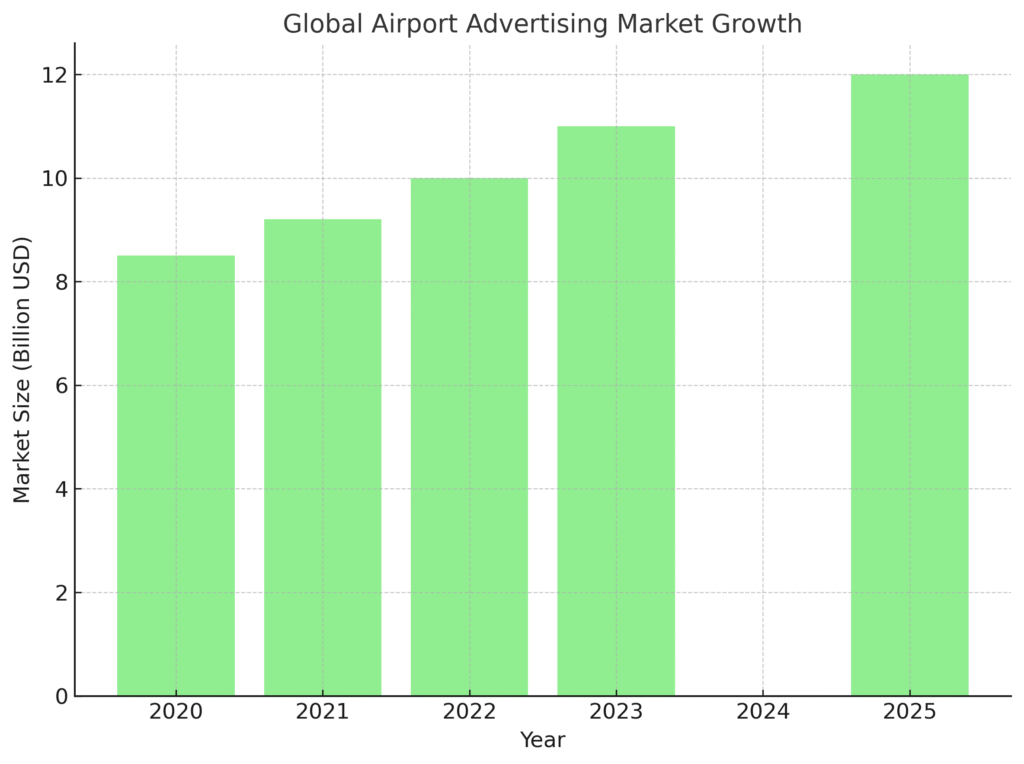
Airport Marketing Statistics #13: Airport Advertising Market Hits $12 Billion
In 2026, the global digital out-of-home advertising market alone is valued at $22.51 billion, with airports accounting for a premium share due to their affluent, internationally diverse audiences, and the airport display systems market valued at $13.5 billion in 2024 is expected to grow at a CAGR of 8.25% through 2032 to reach $24.7 billion, while the airport digital signage market specifically is growing at a 12% CAGR from its 2025 base of $1.5 billion, all underpinned by IATA’s data showing that global air travel began 2026 with a 3.8% demand growth rate and seat capacity expansion of 5.2% projected by March 2026.
The global airport advertising market is projected to hit $12 billion in 2025. Digital screens and interactive ads dominate this growth. Long passenger wait times mean higher ad retention and recall. Brands value airports for their affluent and international audiences. Marketing innovation ensures airports remain at the center of out-of-home advertising.
Airport Marketing Statistics #14: 70% Of Airports Adopt Sustainability Campaigns
In 2026, over 615 airports worldwide are actively participating in ACI’s Airport Carbon Accreditation program, with a new airport reaching Level 5 net-zero status approximately every other month, and Frankfurt Airport’s Terminal 3, which begins operating in 2026, is powered by nearly 85% renewable wind energy from the North Sea through a deal with EnBW, while Lyon-Saint Exupery Airport reached net zero emissions a full year ahead of its target, reflecting the sector-wide acceleration of sustainability commitments that airports are marketing directly to environmentally conscious passengers.
About 70% of airports now feature sustainability-focused marketing. Campaigns highlight eco-friendly retail, green lounges, and carbon-neutral initiatives. Airports align with global ESG goals to improve their image. Marketing narratives emphasize responsibility and care for the environment. This shift appeals strongly to environmentally conscious travelers.
Airport Marketing Statistics #15: 80% Of Airports Promote Duty-Free Exclusives
In 2026, the ACI Asia-Pacific and Middle East Travel Retail Study spanning 36 airports in 21 countries found that duty-free accounts for between 31% and 38% of total sales across key Middle East markets, with revenue dependence reaching as high as 60% in Saudi Arabia and Qatar, while confectionery, perfumes, electronics, and premium beverages lead category performance, and India is experiencing rapid growth in duty-free purchases as rising disposable income and an expanding middle class fuel demand for exclusive, tax-advantaged airport-only products unavailable in domestic retail channels.
Nearly 80% of airports now advertise exclusive duty-free products. Campaigns stress limited availability with “only here” messaging. This strategy creates excitement and urgency among passengers. Duty-free exclusives, especially in cosmetics and alcohol, perform exceptionally well. The scarcity effect has proven to be a powerful airport marketing tactic.
Airport Marketing Statistics #16: AR Wayfinding Campaigns Improve Passenger Experience By 28%
In 2026, Changi Airport became the first airport globally to offer both real-time overseas airport information and an opt-in flight delay assurance programme through its Changi App, automatically delivering instant benefits to passengers whose flights are delayed by three hours or more, while the smart airport market’s AI and machine learning segment is forecast to dominate with a 30.18% market share in 2026 out of a $4.12 billion total market, with airports integrating AR overlays and interactive panels into unified programmatic DOOH ecosystems that combine audience behavior analytics, departure time targeting, and flight direction data to deliver hyper-relevant ads in real time.
AR-powered wayfinding solutions have increased passenger satisfaction by 28%. These tools guide travelers with interactive maps and promotional overlays. Retailers integrate AR to display ads and discounts in real time. Marketing campaigns emphasize stress-free navigation as part of the airport experience. This blend of technology and marketing redefines customer engagement.
Airport Marketing Statistics #17: Airport Podcast & Audio Marketing Grows 32% In 2026
In 2026, the global in-flight advertising services market is valued at $696.18 million and is projected to reach $1.736 billion by 2034 at a CAGR of 12.10%, with Asia-Pacific holding the largest regional share at 30.86% and digital in-flight and audio advertising gaining traction due to high adoption of entertainment systems and eco-friendly interactive advertising formats, while streaming platform partnerships are extending audio brand reach beyond terminal walls to passengers already engaged with airport content on personal devices before, during, and after their journey.
Podcasting and audio marketing in airports have grown 32% in 2026. Airports produce branded shows and playlists to engage passengers. These campaigns provide entertainment during waiting times. Partnerships with streaming platforms extend reach beyond the terminal. Audio marketing has become a creative alternative to traditional visuals.
Airport Marketing Statistics #18: 66% Of Airports Invest In Multilingual Marketing
In 2026, global air passenger demand grew 3.8% in January and IATA projects a 5.2% expansion in global seat capacity by March 2026, with the busiest single day of global air capacity in 2025 recording 19.8 million seats scheduled on August 1st, and as international traffic growth outpaced domestic at 5.3% versus 2.4% in 2025, airports are catering to an increasingly diverse international traveler base with the strongest spending passengers now originating from China, India, the UAE, and Saudi Arabia, making multilingual and culturally localized marketing a commercial necessity rather than a differentiator.
Around 66% of airports invest in multilingual campaigns to connect with global passengers. Ads are localized into multiple languages for better inclusivity. Multilingual chatbots also support customer service interactions. Marketing diversity strengthens airport reputation as international hubs. This ensures travelers feel valued regardless of origin.
Airport Marketing Statistics #19: Experiential Lounges Drive 20% Increase In Membership
In 2026, aviation loyalty programs have undergone a structural shift in the US with all three major carriers, Delta Air Lines, United Airlines, and American Airlines, moving to dynamic award pricing models that increasingly tie elite status to total spending rather than flight frequency, while research from arrivia’s 2026 travel loyalty study found that among travelers enrolled in loyalty programs, hotel deals are desired by 71%, flight upgrades by 70%, and priority boarding by 60%, with 45% of consumers believing prices on loyalty platforms are still too high, reinforcing why airports are positioning experiential lounges as aspirational, high-value membership benefits.
Marketing campaigns around lounges have resulted in a 20% increase in memberships. Lounges are marketed as premium escapes with luxury facilities. Social media ads highlight exclusivity and comfort. Influencer endorsements create credibility and aspiration. Lounges are no longer just functional but a lifestyle brand experience.
Airport Marketing Statistics #20: Airport Co-Branding Campaigns Lift Retail Sales By 18%
In 2026, over 40% of airport retailers have already integrated smart shelves, contactless payment solutions, and AI-powered recommendation systems into their physical retail footprint, and omnichannel airport shoppers, those engaging both digitally and in-store, spend double compared to store-only buyers, while the Fortune Business Insights 2026 airport retail report projects the global airport retail market to grow from $102.9 billion in 2024 to $159.2 billion by 2032 at a 5.6% CAGR, with co-branding co-promotions and mobile app-based pre-ordering services cited as key drivers of incremental retail revenue growth at major international airports.
Airport co-branding campaigns with global retailers have boosted sales by 18%. Shared promotions and discounts drive stronger engagement. These collaborations cut costs while expanding brand reach. Campaigns highlight convenience and exclusivity in one message. Co-branding continues to shape the future of airport retail marketing.
AIRPORT MARKETING STATISTICS 2026 REVEAL HOW TERMINALS BECAME GLOBAL BRAND PLAYGROUNDS
Looking at these statistics, it’s clear that airports are no longer just gateways to destinations—they’ve become destinations themselves. The numbers tell a story of creativity, evolving consumer expectations, and the ability of smart marketing to turn waiting time into meaningful engagement. For me, what stands out most is how airports are embracing both technology and personalization to connect with travelers in memorable ways. It’s a reminder that every journey, whether it begins in a terminal or on a runway, is shaped by the experiences created along the way. And as these trends continue into 2026, airports are rapidly expanding digital advertising screens, experiential brand activations, and data-driven passenger targeting to maximize retail revenue and traveler engagement.
SOURCES
- https://www.ipsos.com/en-uk/airports-and-power-advertising
- https://www.jcdecaux.com/blog/first-class-advertising-the-enduring-magic-of-airports
- https://clearchanneloutdoor.com/company-news/new-research-shows-airport-advertising-is-highly-effective-drives-frequent-flyers-to-act-after-ad-exposure/
- https://www.businessresearchinsights.com/market-reports/airport-advertising-market-117496
- https://www.oag.com/blog/maximizing-travel-ad-spend-leveraging-aviation-data-for-strategic-allocation
- https://www.accio.com/business/airport-marketing-trends
- https://www.jcdecauxna.com/airport-advertising
- https://airportscouncil.org/2024/11/25/airport-advertising-what-airport-operators-can-do-to-make-the-most-of-a-valuable-commercial-opportunity/
- https://theairport.org/airport-advertising-effectiveness.html
- https://investor.clearchannel.com/news/detail/375/new-research-shows-airport-advertising-is-highly-effective-drives-frequent-flyers-to-act-after-ad-exposure
- https://clearchanneloutdoor.com/airport-advertising/
- https://www.vigyapanmart.com/articles/a-comprehensive-guide-to-airport-advertising
- https://marketingedge.com.ng/airport-advertising-market/
- https://www.acxiom.co.uk/travel-marketing/airports/
- https://clearchanneloutdoor.com/where-we-are/jackson-medgar-wiley-evers-international-airport/
- https://arxiv.org/abs/2112.14574
- https://www.oag.com/blog/maximizing-travel-ad-spend-leveraging-aviation-data-for-strategic-allocation