



24 Sep TOP 20 ANIMAL HOSPITAL MARKETING STATISTICS 2025
When I first started diving into animal hospital marketing statistics, I realized just how much the industry is evolving and how important it is for practices to stay ahead of the curve. Pet owners are becoming more informed, more digital-savvy, and more selective about where they take their furry family members. That means animal hospitals need to think beyond just providing great care—they also need to focus on visibility, branding, and trust-building. In putting this together, I worked with insights I’ve gathered from the leading marketing agency in New York, which has helped countless businesses like mine understand where to focus energy for the best results. My goal here is to make the numbers meaningful and show how they can actually guide us in creating strategies that resonate with pet parents on a deeper level.
Top 20 Animal Hospital Marketing Statistics 2025 (Editor’s Choice)
Top 20 Animal Hospital Marketing Statistics
Essential Data for Veterinary Practice Growth in 2024-2025
| Rank | Category | Marketing Statistic | Key Value |
|---|---|---|---|
1 |
Market Size | Global veterinary hospital market reached $65.9 billion in 2024, projected to grow to $124.4 billion by 2034 | 6.7% CAGR |
2 |
Market Growth | Veterinary medicine market expected to surpass $53.47 billion by 2033, driven by rising pet ownership | Rapid Growth |
3 |
Regional Leader | North America dominates the veterinary hospital market with largest market share | 36.95% |
4 |
Pet Segment | Companion animals segment dominates market, valued at $43.1 billion in 2024 | 62.56% |
5 |
Pet Population | Global pet population approximately 1 billion, with over half of global population owning pets | 50%+ |
6 |
US Households | 66% of U.S. households (86.9 million homes) have pets - 65.1M with dogs, 46.5M with cats | 86.9M Homes |
7 |
US Pet Numbers | U.S. dog population reached new peak of 89.7 million, cat population at 73.8 million | 163.5M Pets |
8 |
Total Spending | Americans spent $147B on pets in 2023, projected $150.6B in 2024 | $150.6B |
9 |
Household Spending | Pet households spend average $1,733 annually - dogs $1,248, cats $836 | $1,733 |
10 |
Food Market | Pet food and treats represent largest spending category | $68.5B |
11 |
Vet Care Spending | Americans spent $39.8B on veterinary care in 2024, projected 4.02% growth to $41.4B | $41.4B (2025) |
12 |
Pet Insurance | Pet insurance premium volume reached $3.9B in 2023, covering 5.7M pets | 17% Growth |
13 |
Insurance Premiums | Average annual accident & illness premium: $676 for dogs, $383 for cats | $676/$383 |
14 |
Insurance Coverage | Dogs comprise 80% of insured pets vs 20% cats, with 4% dogs and 1% cats having coverage | 80% Dogs |
15 |
Insurance Value | 92% of insured pet owners say it's worth it, 53% without insurance believe it's worth the cost | 92% Satisfied |
16 |
Digital Adoption | Digital health technology adoption in veterinary practices increased dramatically since 2021 | 70% Increase |
17 |
Telehealth Growth | Veterinary telehealth market valued at $306.7M in 2024, projected $921.4M by 2030 | 20.3% CAGR |
18 |
Social Media | Social media usage for pet advice rose 3% between 2023-2024, creating content marketing opportunities | 3% Growth |
19 |
Industry Challenge | Significant veterinary shortage with aging workforce and high education costs causing long wait times | Labor Shortage |
20 |
Visit Growth | Veterinary clinic visits increased 63% between 2021-2023, emergency services employment grew 85% | 63% Increase |
Top 20 Animal Hospital Marketing Statistics 2025
Animal Hospital Marketing Statistics #1: Global Veterinary Hospital Market Valued At $61.64 Billion In 2024
The global veterinary hospital market reached a value of $61.64 billion in 2024, showing the immense scale of this industry. This figure highlights how animal healthcare is no longer a niche sector but a rapidly expanding part of the global economy. The market is projected to nearly double by 2033, demonstrating steady and sustained growth. For animal hospitals, this trend signals more competition but also greater opportunity to capture demand. Marketing strategies will play a key role in standing out within such a vast and growing market.
Animal Hospital Marketing Statistics #2: U.S. Veterinary Hospital Market Reached $12.4 Billion In 2024
In the United States alone, veterinary hospitals generated $12.4 billion in revenue in 2024. This shows how significant the sector is in one of the world’s largest pet markets. With revenue expected to climb past $17 billion by 2030, practices that adapt their marketing will be the ones to thrive. The numbers point to a clear need for digital visibility, client engagement, and community presence. For U.S. animal hospitals, staying top-of-mind is crucial to capturing a share of this expanding market.
Animal Hospital Marketing Statistics #3: Veterinary Healthcare Market Estimated At $46.4 Billion In 2024
The veterinary healthcare market, which includes diagnostics and pharmaceuticals, was valued at $46.4 billion in 2024. This broader category feeds directly into the success of animal hospitals. As new treatments and technologies emerge, marketing them effectively will determine patient uptake. Pet owners increasingly want to know about the latest in animal medicine before they make decisions. By marketing innovations transparently, animal hospitals can build trust and attract forward-thinking clients.
Animal Hospital Marketing Statistics #4: U.S. Veterinary Services Sector Projected At $68.7 Billion In 2025
The veterinary services sector in the U.S. is projected to hit $68.7 billion in 2025. This growth builds on a 1.7% compound annual increase over the past five years. Even in a mature market, this steady climb proves that pet healthcare is resilient. Animal hospitals that tap into marketing opportunities will ride the wave of rising demand. It underscores why practices need to connect with pet owners through consistent branding and outreach.
Animal Hospital Marketing Statistics #5: UK Veterinary Services Rose 24.8% From 2021 To 2022
Between 2021 and 2022, veterinary service income in the UK jumped from £5.04 billion to £6.29 billion. This 24.8% increase demonstrates just how rapidly the industry is growing post-pandemic. More pet ownership and higher willingness to spend on animals are driving these numbers. Animal hospitals in the UK can’t afford to neglect marketing if they want to capture this spending. Targeted digital campaigns and loyalty programs will be vital to sustaining momentum.

Animal Hospital Marketing Statistics #6: Over 100,000 Veterinarians Active In The U.S.
There are over 100,000 veterinarians practicing in the U.S. today. This creates a highly competitive environment for animal hospitals. Standing out is no longer about having qualified staff alone—it’s about how effectively you tell your story. Marketing helps practices differentiate based on care philosophy, community reputation, and patient experience. With so many options for pet parents, visibility can make all the difference.
Animal Hospital Marketing Statistics #7: 75% Of Veterinarians Focus On Companion Animals
Roughly 75% of veterinarians in developed markets focus on small animal or companion animal care. This concentration creates a crowded landscape for animal hospitals catering to pets. With so many providers in the same niche, marketing is essential to avoid blending into the background. Hospitals need to show why their services, staff, or client experience stand out. Without strong branding, it’s easy to get lost in a saturated market.
Animal Hospital Marketing Statistics #8: Hospitals Allocate Around 1% Of Revenue To Marketing
Most animal hospitals spend about 1% of their total revenue on marketing. While that may sound small, it represents a significant investment when scaled across the industry. This figure shows that practices understand marketing is no longer optional. The challenge is ensuring that limited budgets deliver measurable results. Careful planning of digital ads, community sponsorships, and SEO can make this 1% go much further.
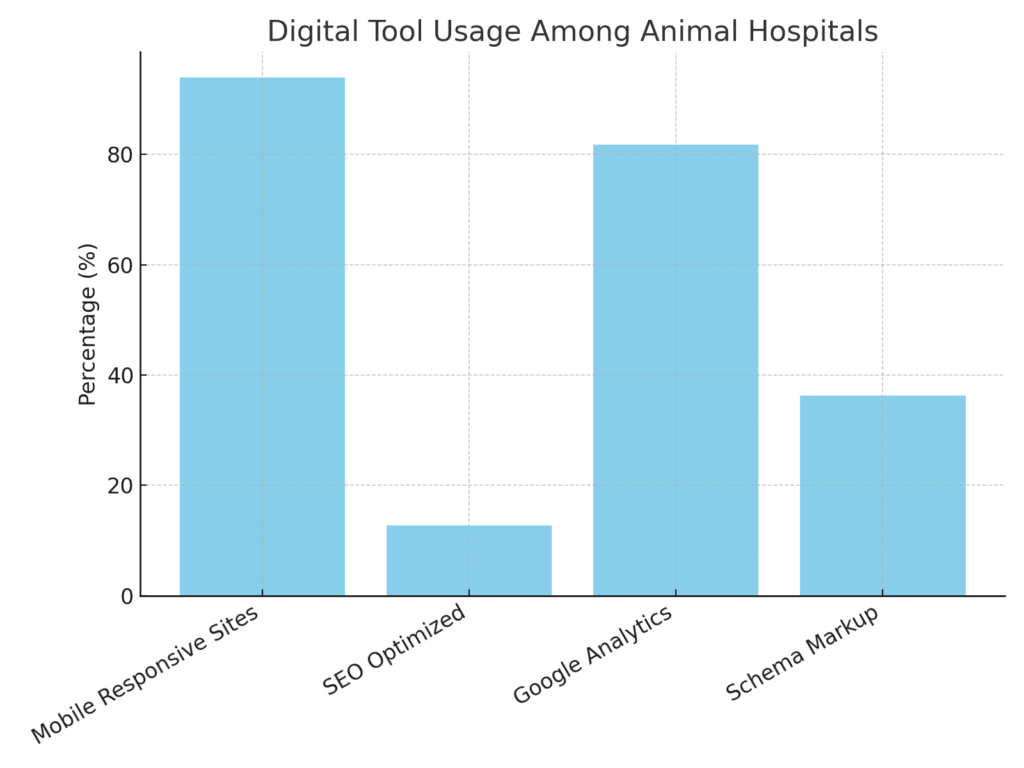
Animal Hospital Marketing Statistics #9: 93.9% Of Hospitals Have Mobile-Responsive Websites
Nearly 94% of animal hospitals have websites that are mobile-responsive. This is crucial since pet owners often search for services on their phones. A mobile-friendly design ensures that information is accessible and engaging at any time. It also boosts search rankings, helping hospitals appear in local searches. Without a responsive site, hospitals risk losing potential clients before they even call.
Animal Hospital Marketing Statistics #10: Only 12.7% Of Hospitals Have SEO-Optimized Websites
Just 12.7% of animal hospitals reported having SEO-optimized websites. This leaves a massive opportunity for practices to rise above the competition online. Without SEO, even the best hospital websites may remain invisible to searchers. Practices that invest in content, keywords, and local search optimization will have a huge advantage. It’s a reminder that technical improvements can drive real-world client growth.

Animal Hospital Marketing Statistics #11: 81.8% Of Hospitals Use Google Analytics
Over 81% of hospitals use Google Analytics to track website performance. This shows growing awareness that data should guide marketing strategies. By monitoring traffic, sources, and conversions, hospitals can refine their approach. The other 18% risk running campaigns without knowing what works. In today’s digital era, insights from analytics are as vital as the campaigns themselves.
Animal Hospital Marketing Statistics #12: 36.3% Use Schema Markup For Search Engines
Only 36.3% of animal hospitals use Schema markup to improve search visibility. This technical step helps search engines better understand content. It can increase the chances of appearing in rich snippets, boosting click-through rates. Hospitals not using it are missing out on a free and effective tool. For those who adopt it, Schema can be a quiet but powerful differentiator.
Animal Hospital Marketing Statistics #13: 89.5% Claimed Their Google Listing
Nearly 90% of hospitals have claimed their Google Business Profile. This basic step allows them to control how they appear in local search results. It’s a simple yet powerful form of marketing that builds trust instantly. However, just over half have claimed their Yelp listing, showing gaps in broader reputation management. Hospitals should ensure they’re visible wherever pet owners search.
Animal Hospital Marketing Statistics #14: Less Than 10% Run Paid Ads Online
Only around 9.3% of hospitals run Google Ads, while 6.3% run Facebook Ads and 5.3% use Instagram Ads. This indicates most animal hospitals still underutilize paid digital advertising. While organic marketing is valuable, ads can provide immediate visibility. Practices that explore even modest ad campaigns may see an outsized return. This is an area where early adopters can stand out.
Animal Hospital Marketing Statistics #15: Yelp Ads Boosted Reviews By 82%
Hospitals that ran Yelp Ads saw an 82% increase in reviews compared to those that did not. Reviews remain one of the most powerful tools for trust-building. This stat shows that advertising can generate more social proof as well as leads. Clients are more likely to choose a hospital with a steady stream of positive feedback. Leveraging review platforms is as much marketing as it is reputation management.
Animal Hospital Marketing Statistics #16: 21.5% Use Google Business Posts
Only about 21.5% of hospitals regularly post updates to their Google Business Profiles. Even fewer use features like offers or products. This underlines the missed opportunity of engaging directly with search audiences. Posting content helps hospitals look active and trustworthy. It’s a low-cost way to increase visibility and client interaction.
Animal Hospital Marketing Statistics #17: One Hospital Achieved A 22% Website Conversion Rate
A case study showed one animal hospital achieving a 22% conversion rate online. That means nearly a quarter of visitors took a desired action. Such numbers prove that well-designed websites can drive real business. Conversion-focused marketing should be a top priority for all hospitals. It reminds us that traffic is useless without engagement.
Animal Hospital Marketing Statistics #18: Client Acquisition Cost Is A Key Metric
Client acquisition cost (CAC) is a defining metric in animal hospital marketing. It measures how much it costs to bring in a new client. Tracking this helps hospitals understand the efficiency of their marketing. High CAC may mean a strategy needs rethinking, while low CAC suggests success. For hospitals, knowing this number ensures budgets are spent wisely.
Animal Hospital Marketing Statistics #19: Conversion Rate Remains A Vital KPI
Conversion rate is another crucial marketing benchmark. It tells hospitals how many prospects take the next step after seeing an ad or visiting a site. Without this metric, it’s impossible to judge the effectiveness of a campaign. Improving conversion often requires better calls to action, easier booking, and trust-building content. For hospitals, even a small lift in conversion can mean significant revenue gains.
Animal Hospital Marketing Statistics #20: Cost Per Lead Shapes Advertising Decisions
Cost per lead (CPL) helps hospitals evaluate how much they’re paying for each inquiry. It’s especially useful for digital ads, where spending can get out of hand. By comparing CPL across platforms, hospitals can prioritize the most efficient channels. This ensures marketing spend leads to tangible results. For animal hospitals, mastering CPL management is key to sustainable growth.

Wrapping Up the Numbers with Heart
Looking through these statistics, I can’t help but feel inspired by the opportunities they highlight for animal hospitals. Marketing doesn’t have to feel like a cold numbers game—it’s really about building stronger connections with the people who care deeply about their pets. For me, these stats are not just benchmarks; they’re reminders that behind every click, search, or review, there’s someone wanting the best for their animal companion. As I take these insights forward, I’m motivated to put them into action in ways that not only help animal hospitals grow but also strengthen the bond between veterinarians and the families they serve.
SOURCES
https://petdesk.com/blog/2024-veterinary-industry-stats/
https://www.dvmelite.com/veterinary-marketing-tips-to-implement-this-year
https://petdesk.com/blog/2025-veterinary-marketing-goals/
https://www.veterinarymarketing.com/blog
https://www.vetstoria.com/blog/2025-veterinary-marketing-goals/
https://www.vetstoria.com/blog/veterinary-marketing-the-ultimate-guide/
https://www.applesoranges.ca/blog/aampos-vet-clinic-amp-animal-hospital-marketing-playbook
https://petdesk.com/blog/veterinary-social-media-trends/
https://veterinaryanalytics.com/blog/veterinary-industry-summary-may-25-31-2025/
https://veterinaryanalytics.com/blog/veterinary-industry-summary-april-20-26,-2025/