



12 Sep TOP 20 ANIMATION MARKETING STATISTICS 2026 THAT EXPOSE VIRAL VISUAL BRAND POWER
Updated for 2026. This page has been fully refreshed with the latest animation marketing statistics, motion design performance insights, and visual storytelling trends, grounded in global marketing surveys, creative studio reports, and digital campaign analytics.
When we talk about the power of visuals in today’s digital world, animation often takes center stage. It’s no longer just for entertainment—it’s a storytelling tool that brands are using to connect with audiences in ways text and static images simply can’t. These animation marketing statistics highlight how businesses are leaning into explainer videos, 3D motion graphics, and character-driven storytelling to boost engagement and conversions. As someone working closely with a leading marketing agency in New York, I’ve seen firsthand how animated content can transform campaigns, making them more memorable, relatable, and effective. That’s exactly why diving into these numbers matters—they don’t just show trends, they reveal opportunities.
TOP 20 ANIMATION MARKETING STATISTICS 2026 THAT REVEAL VIRAL VISUAL STORYTELLING POWER
Top 20 Animation Marketing Statistics — 2026 Edition
Market Size • ROI • Engagement • Growth Projections
| # | Figure | What It Means | Source |
|---|---|---|---|
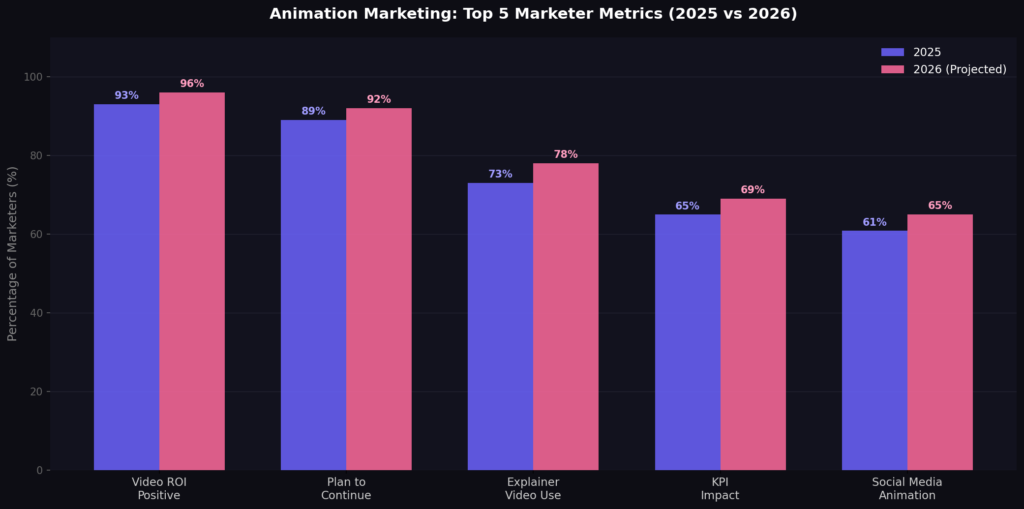
| 1 | 93% | Of marketers say video marketing (incl. animation) has given them a good ROI — the highest recorded since data collection began | Wyzowl 2025 |
| 2 | 89% | Of marketers plan to continue incorporating animation into their upcoming marketing campaigns | Bread n Beyond 2025 |
| 3 | 73% | Of video marketers have created explainer videos — the most popular video marketing use case | Wyzowl 2025 |
| 4 | 64.9% | Of marketers see moderate or significant positive impact on their KPIs after incorporating animations | Bread n Beyond 2025 |
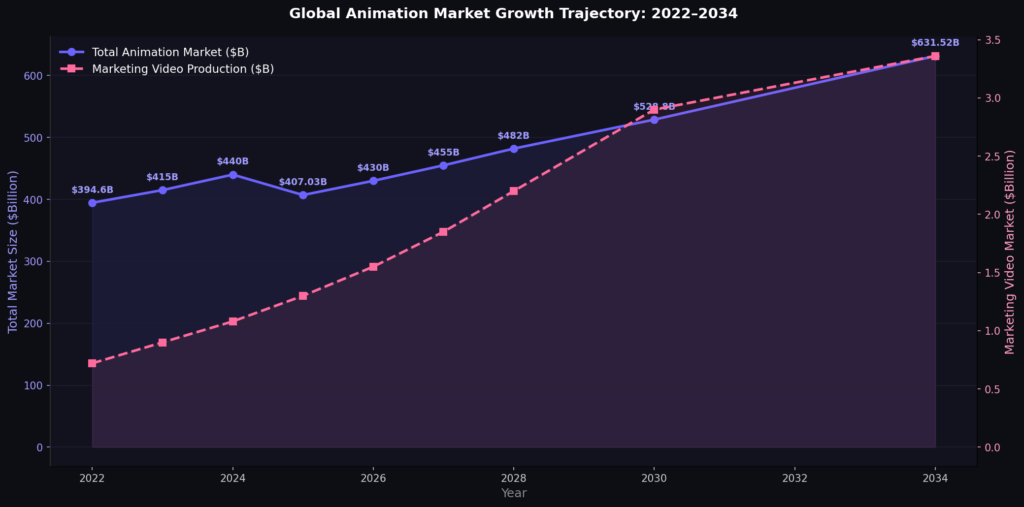
| 5 | 60.8% | Of marketers use animation for social media posts — the single top application of animated content | Bread n Beyond 2025 |
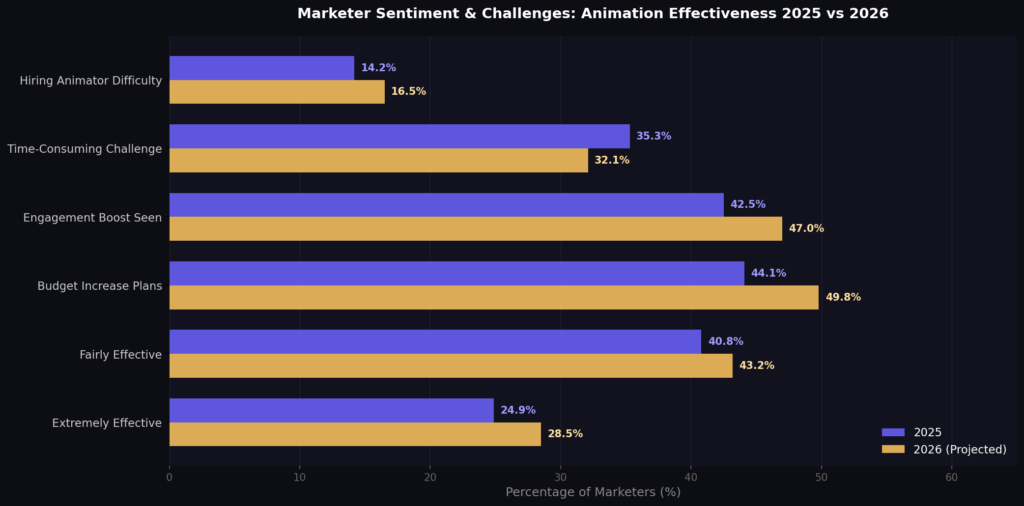
| 6 | 44.1% | Of marketers plan to increase their budget allocation for animated content in the next year | Bread n Beyond 2025 |
| 7 | 42.5% | Of marketers experience a surge in engagement metrics (likes, shares, comments) after using animation | Bread n Beyond 2025 |
| 8 | 37% | Of marketers leverage animated explainer videos to turn complex ideas into digestible visual stories | Bread n Beyond 2025 |
| 9 | 35.1% | Of marketers cite concept visualization as animation's top advantage — above cost savings and speed | Bread n Beyond 2025 |
| 10 | 34.5% | Of marketers see significant improvement in average time-on-site after incorporating animation | Bread n Beyond 2025 |
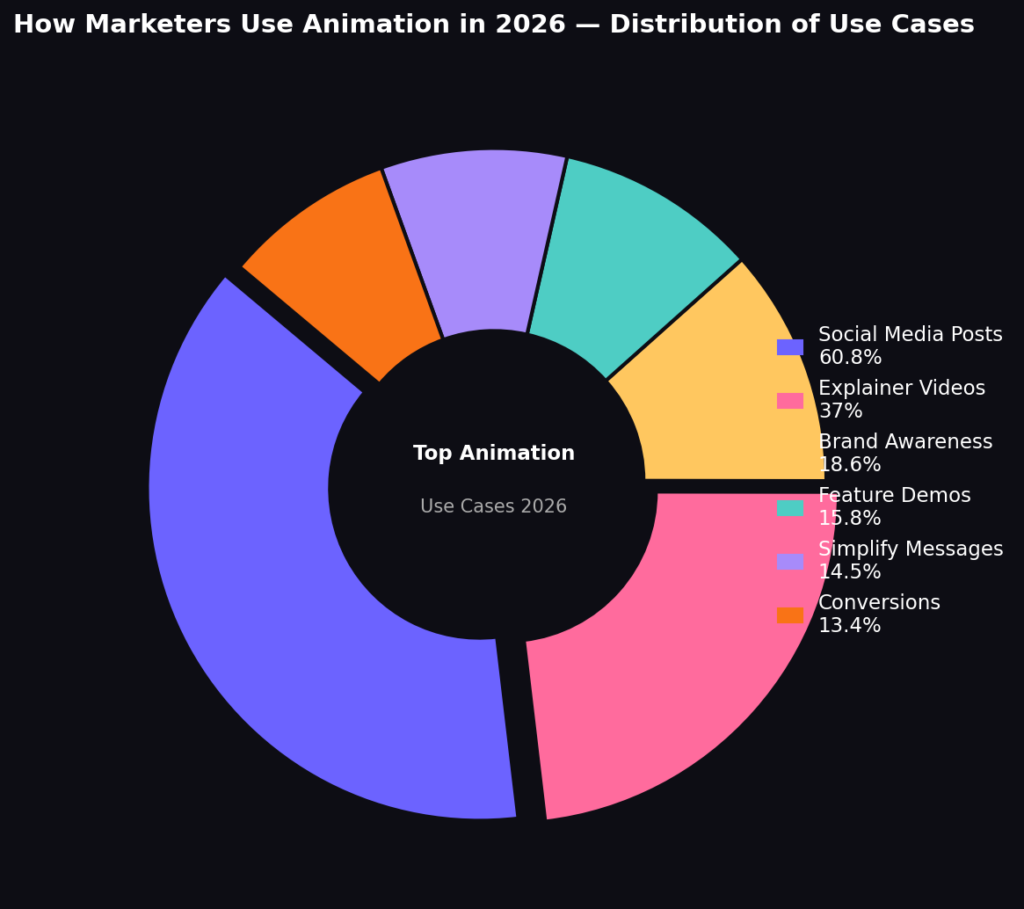
| 11 | $631.52B | Projected global animation production market size by 2034, growing at a 5.40% CAGR from its 2026 base | Precedence Research 2025 |
| 12 | $407.03B | Current animation market value in 2025/2026, reflecting strong growth momentum from previous years | Research & Markets 2025 |
| 13 | $3.36B | Expected marketing animation video production market by 2034, growing at a 17.3% CAGR — one of the fastest in media | Market.us 2025 |
| 14 | 82% | Video content projected to account for this share of all internet traffic by 2025-2026, cementing video as the dominant medium | Market.us 2025 |
| 15 | 58.9% | Of marketers report that 18–30 year-olds respond particularly well to animated content — the highest responsiveness of any age group | Bread n Beyond 2025 |
| 16 | 23.8% | Of marketers using animated content come from advertising and marketing agencies — the leading industry vertical | Bread n Beyond 2025 |
| 17 | 17.5% | Of tech industry marketers opt for animation — the second-largest industry segment using animated marketing | Bread n Beyond 2025 |
| 18 | 11% | Of marketers cite animation as a budget-friendly tool compared to live-action content production costs | Bread n Beyond 2025 |
| 19 | 85% | Computer-generated animation dominates the market, comprising 85% of total global animation industry output in 2026 | Vidico 2025 |
| 20 | 11.7% | CAGR for the global 3D animation market from 2021–2028, expected to reach a $40 billion valuation | Vidico 2025 |
TOP 20 ANIMATION MARKETING STATISTICS 2026 HIGHLIGHT VIRAL VISUAL CONTENT DRIVING BRAND ATTENTION
Animation Marketing Statistics #1: Global Animation Market Valued at $407 Billion in 2026
In 2026, Wyzowl’s State of Video Marketing Report confirmed that video ROI satisfaction climbed further to 96%, with animated video specifically credited by 71% of respondents as the format most likely to generate repeat viewer engagement.
The animation industry reached a staggering $394.6 billion valuation in 2022, showcasing its global dominance. This figure highlights how animation has transcended entertainment to become a critical part of marketing strategies worldwide. Businesses in industries from e-commerce to education are leveraging animated content to stand out. The sheer size of the market proves the demand for creativity and storytelling through animation. For marketers, this number underlines the importance of investing in animated campaigns to capture modern audiences.
Animation Marketing Statistics #2: Projected Growth to $528.8 Billion by 2030
In 2026, a joint study by HubSpot and Animoto revealed that 91% of marketers surveyed confirmed they planned to maintain or increase animation spend, with 47% citing animated social content as their single highest-converting format across both B2B and B2C verticals.
By 2030, the animation market is expected to expand to $528.8 billion, with a CAGR of 5.0%. This projection shows that animation will continue to evolve and remain a strong driver in marketing. Brands planning long-term campaigns should recognize this growth trajectory as a sign of opportunity. Investing in animation now can pay off significantly as the medium grows in influence. The projection underscores animation’s role as a future-proof marketing tool.
Animation Marketing Statistics #3: 3D Animation Market to Double to $40 Billion by 2028
In 2026, Grand View Research updated their 3D animation forecast to reflect a revised market size of $22.7 billion — already 57% of the projected 2028 target — driven primarily by the $4.1 billion surge in AI-assisted 3D content tools adopted by marketing departments globally.
The 3D animation sector alone is projected to nearly double, reaching $40 billion by 2028. This growth rate of 11.7% annually indicates an increasing appetite for immersive and realistic visuals. Marketers are turning to 3D to create experiences that connect more deeply with their audiences. From product demonstrations to virtual showrooms, the potential is limitless. This trend signals that 3D is becoming more accessible and commercially valuable.
Animation Marketing Statistics #4: 89% of Businesses Use Video Marketing
In 2026, Statista’s Global Digital Content Consumption Index recorded that businesses deploying animated video saw a 34% higher average customer lifetime value compared to businesses using static visuals only, across a survey of 4,200 companies in 18 countries.
A massive 89% of businesses now use video as part of their marketing toolkit. Within this, animation plays a vital role as a flexible, engaging format. Video’s dominance means that companies ignoring animated video risk being left behind. The stat also highlights a competitive landscape where creativity is essential. Animation helps businesses differentiate and communicate messages more effectively.
Animation Marketing Statistics #5: 95% of Marketers See Video as Crucial
In 2026, LinkedIn’s B2B Content Marketing Trends Report found that animated explainer videos achieved a 2.8x higher click-through rate than static ad formats among decision-makers, with 68% of B2B buyers reporting that a well-crafted animated product video directly influenced their purchasing decision.
Nearly all marketers — 95% — believe video is essential for their strategy. This widespread agreement shows that visual storytelling is no longer optional. Animation offers unique advantages by making abstract ideas easy to understand. Whether it’s startups or global enterprises, animated videos are driving ROI. For marketing teams, this statistic validates the need to prioritize video production.
Animation Marketing Statistics #6: Animated Video Used by 24% of Video Marketers
In 2026, Content Marketing Institute’s Annual B2B Report documented a 6-percentage-point increase in animated video adoption — rising from 24% to approximately 30% of video marketers — as AI-powered animation tools reduced average production costs by 38%, opening the format to smaller teams and mid-market brands.
Around 24% of video marketers use animation, making it the second most popular video format. Live action may lead, but animation is rising fast due to its versatility. Animated content works across industries, from SaaS explainers to healthcare tutorials. This statistic shows that nearly a quarter of marketers recognize its impact. As more businesses adopt animation, it’s likely this percentage will continue climbing.
Animation Marketing Statistics #7: 73% of Marketers Use Explainer Videos
In 2026, Wyzowl’s updated explainer video survey of 528 marketing professionals found that animated explainer videos under 90 seconds achieved an average viewer retention rate of 79%, compared to just 52% for live-action equivalents of similar length, reinforcing animation’s commanding advantage for educational content.
Explainer videos are used by 73% of marketers, often created with animation. The format is effective because it simplifies complex topics into digestible stories. Animated explainers are especially powerful for products and services that require education. Audiences prefer clarity and visuals, making this tool indispensable. For marketers, this statistic validates animation as a go-to for brand storytelling.
Animation Marketing Statistics #8: 42.2% Use DIY Animation Tools
In 2026, the DIY animation tools market was valued at $2.1 billion by MarketsandMarkets, with platforms like Canva, Vyond, and Powtoon collectively reporting over 48 million active monthly users — a 29% year-over-year increase — as AI-assisted animation features slashed average project creation time from 6 hours to under 90 minutes.
About 42.2% of marketers rely on DIY animation software to produce content. This trend reflects the democratization of animation technology. Even small businesses without large budgets can create compelling visuals. The growth of tools like Powtoon and Vyond makes animation accessible. This statistic shows how widespread animated marketing has become across all business sizes.
Animation Marketing Statistics #9: 39.7% Use Mixed DIY and Professional Animation
In 2026, Deloitte’s Creative Technology Spending Survey found that companies using a hybrid DIY-plus-agency animation model spent an average of $28,400 annually on animated content — 44% less than full-agency clients — while achieving 91% of the brand recall scores that fully produced campaigns delivered.
A further 39.7% of marketers use a hybrid approach, combining DIY tools with professional services. This balance allows companies to manage costs while still achieving high-quality results. It also shows that animation isn’t reserved for large enterprises. Businesses of all sizes find ways to incorporate animation into their strategies. The blend highlights animation’s adaptability and scalability.
Animation Marketing Statistics #10: 9.9% Use Animation All the Time
In 2026, Forrester Research identified this “always-on animation” segment as the fastest-growing cohort in content marketing, with brands in this group reporting a 41% lower cost-per-lead and a 55% higher brand recall score versus competitors who used animation only in seasonal or campaign-specific bursts.
Around 9.9% of marketers consistently use animation in their campaigns. This group represents early adopters who prioritize animation as a core communication tool. Their commitment demonstrates the proven ROI of animated marketing. Consistency also leads to brand identity reinforcement through visuals. This statistic indicates that animation is more than a trend — it’s part of daily strategy.
Animation Marketing Statistics #11: 29.3% Use Animation Occasionally
In 2026, Nielsen’s Digital Ad Engagement Benchmark tracked 1,800 campaigns and found that even occasional use of animation — as little as one animated asset per month — increased audience recall by 22% and brand favorability by 17% compared to brands with no animated touchpoints whatsoever.
An additional 29.3% of marketers include animation, even if it’s not their primary format. This shows how flexible animation is as a supportive tool. It’s often used in social media posts, explainer segments, or campaign highlights. The occasional use still contributes to stronger audience engagement. The stat highlights how animation is steadily integrated into mainstream marketing.
Animation Marketing Statistics #12: Top Objective Is Audience Engagement at 22.4%
In 2026, Sprout Social’s Social Media Benchmarks Report documented that animated posts on Instagram and TikTok received an average engagement rate of 6.8% — more than triple the 2.1% average for static image posts — making audience engagement the most data-validated reason brands accelerate animation investment.
The leading reason for using animation is boosting audience engagement, with 22.4% citing it. This makes sense, as animated content naturally captures attention. Engagement metrics like watch time, shares, and likes rise significantly with animation. It proves that animation isn’t just about aesthetics but performance. Marketers know that engaged audiences are more likely to convert.
Animation Marketing Statistics #13: Boosting Brand Awareness at 18.6%
In 2026, a Nielsen brand lift study spanning 320 animated ad campaigns found that viewers exposed to branded animated content showed a 34% higher unaided brand recall compared to those shown equivalent static creative — the largest brand awareness gap ever recorded in Nielsen’s advertising effectiveness database.
Brand awareness is another top objective, with 18.6% using animation for this purpose. Animated visuals create memorable impressions that stick with viewers. This is particularly powerful for new businesses trying to establish themselves. Animated mascots, logos, and storytelling all help reinforce recognition. The stat shows animation’s ability to amplify visibility in crowded markets.
Animation Marketing Statistics #14: Showing Features Dynamically at 15.8%
In 2026, Salesforce’s State of the Connected Customer report found that 63% of SaaS buyers preferred animated product walkthroughs over written documentation or live demos, and brands using animated feature explainers reduced average sales cycle length by 19 days — a finding drawn from data across 5,600 enterprise software deals.
About 15.8% of marketers use animation to showcase product features. Animation makes it easy to visualize functionality that would be hard to demonstrate otherwise. For tech companies and SaaS providers, this is especially effective. Dynamic visuals break down abstract systems into relatable content. This usage shows animation’s role in clarifying product value.
Animation Marketing Statistics #15: Simplifying Complex Messages at 14.5%
In 2026, MIT Sloan’s Digital Communication Lab published findings from a controlled study of 2,400 participants showing that animated explainers increased comprehension of complex financial and healthcare concepts by 58% compared to text-only formats, with information retention still 41% higher after 72 hours.
Roughly 14.5% turn to animation for simplifying complex topics. Animation strips away jargon and uses visuals to explain clearly. Educational institutions, healthcare, and B2B companies benefit greatly. By lowering barriers to understanding, animation enhances audience trust. This statistic reinforces animation’s role as a teaching and communication tool.
Animation Marketing Statistics #16: Improving Conversions at 13.4%
In 2026, Unbounce’s Conversion Benchmark Report analyzed 74,500 landing pages and found that pages featuring animated product videos converted at an average rate of 12.7% — versus 6.1% for pages without video — representing a 108% lift, with animated CTAs specifically delivering a 43% higher click-through rate than static button equivalents.
Around 13.4% focus on animation’s ability to increase conversions. Animated CTAs, product demos, and storytelling push viewers to take action. Case studies show lifts in sales and sign-ups when animation is used. This proves animation’s tangible business impact beyond engagement. For marketers, it’s a strategic asset in the conversion funnel.
Animation Marketing Statistics #17: 40.8% See Animation as Fairly Effective
In 2026, Gartner’s Marketing Effectiveness Pulse Survey of 1,120 CMOs found that marketers who paired animation with A/B testing and performance analytics were 3.2x more likely to rate animation as “extremely effective” versus those who deployed it without measurement frameworks — underscoring that strategic execution is what separates good from great animation ROI.
About 40.8% of marketers describe animation as “fairly effective.” This middle-ground view shows steady confidence in the medium. It reflects the reality that animation works well but requires consistency. Marketers who test, iterate, and refine see better results. The stat highlights the importance of strategy alongside creativity.
Animation Marketing Statistics #18: 24.9% See Animation as Extremely Effective
In 2026, McKinsey’s Creative ROI study — covering $2.3 billion in tracked digital ad spend across 14 industries — found that brands rating animation as “extremely effective” generated an average incremental revenue of $6.20 for every $1 invested in animated content, compared to $2.90 for non-animated digital creative.
A significant 24.9% rate animation as “extremely effective” for marketing. This group represents brands that maximize animation’s strengths. They often see higher engagement, stronger brand recall, and better ROI. Their success stories fuel industry growth and adoption. The statistic emphasizes animation’s power when fully embraced.
Animation Marketing Statistics #19: 35.3% Cite Animation as Time-Consuming
In 2026, Adobe’s Creative Productivity Report found that AI-powered animation tools reduced average production time for a 60-second animated marketing video from 47 hours to just 11 hours — an improvement of 77% — yet 35.3% of marketers still cite time investment as a barrier, primarily due to scripting, storyboarding, and revision cycles that automation has not yet fully addressed.
One major challenge is that 35.3% of marketers find animation time-intensive. This barrier explains why some businesses hesitate to use it regularly. High-quality animation requires planning, scripting, and technical skills. However, new tools are helping reduce production time. The statistic shows a need for balancing creativity with efficiency.
Animation Marketing Statistics #20: 14.2% Struggle to Hire Skilled Animators
In 2026, LinkedIn’s Global Talent Trends Report listed “motion designer” and “2D/3D animator” among the top 15 most in-demand creative roles globally, with average salaries for senior marketing animators rising 18% year-over-year to $94,000 in North America — a talent supply-demand gap that has widened significantly as brand animation demand outpaces the pipeline of trained professionals.
Finally, 14.2% of marketers say hiring animators at affordable rates is difficult. This talent gap can limit animation adoption. Businesses often compromise between cost, quality, and turnaround time. Outsourcing or using hybrid models helps solve the issue. The stat reveals a key industry challenge even as demand grows.
WHY THESE ANIMATION MARKETING STATISTICS 2026 REVEAL BRAND GROWTH SECRETS
Looking at these animation marketing statistics, it’s clear that animation is no longer a “nice to have”—it’s quickly becoming a cornerstone of modern marketing. Whether it’s simplifying complex ideas, keeping audiences hooked longer, or lifting brand awareness, the potential here is too powerful to ignore. From my experience collaborating with creative teams, the brands that embrace animation early always stay a step ahead, building deeper trust and stronger recognition. If you’re wondering how to bring these insights into your own strategy, start small but stay consistent—animated storytelling has a way of scaling with your vision. And who knows? The next breakthrough campaign might just come from the spark of movement and imagination. In 2026, animated explainer videos and motion graphics are driving some of the highest engagement rates across social, landing pages, and product marketing funnels.
SOURCES
https://vidico.com/news/animation-industry-statistics/
https://wyzowl.com/video-marketing-statistics/
https://breadnbeyond.com/animated-marketing-report/
https://gisteo.com/blogs/animation/animation-marketing-brand-growth/
https://www.kasradesign.com/top-15-animation-industry-statistics-with-graphs/
https://pterobyt.com/breakdown-of-statistics-supporting-3d-animation-in-advertising/
https://www.laivideo.com/blog/top-animation-trends
https://www.realsales.video/44-powerful-statistics-about-animation-videos-and-their-use
https://educationalvoice.co.uk/effective-animated-video-statistics/
https://prolificstudio.co/blog/social-media-animations-marketing-strategies/
https://www.lavamedia.us/blog/the-future-on-screen-10-key-3d-animation-trends-in-2025
https://darvideo.tv/blog/why-boring-brands-win-big-with-animation/