




17 Sep TOP 20 API MARKETING STATISTICS 2026 REVEAL SHOCKING GLOBAL DIGITAL INTEGRATION EXPLOSION
Updated for 2026. This page has been fully refreshed with the latest API adoption metrics, developer ecosystem data, and marketing integration trends, grounded in recent global surveys, cloud platform reporting, and enterprise technology insights.
When I first started exploring the role of APIs in business growth, I didn’t realize just how powerful they could be in shaping marketing outcomes. Over time, I’ve come to see that understanding API marketing statistics isn’t just about keeping up with numbers—it’s about recognizing the shifts that redefine how brands connect, sell, and innovate. Working alongside a leading marketing agency in New York, I’ve seen firsthand how businesses that embrace API strategies tend to gain an edge over those who treat them as an afterthought. In this article, I want to share the top insights that stood out to me, not as abstract data points, but as meaningful takeaways for anyone looking to navigate the ever-changing digital space.
TOP 20 API MARKETING STATISTICS 2026 REVEAL EXPLOSIVE GLOBAL PLATFORM INTEGRATION
TOP 20 API MARKETING STATISTICS 2026 SHOW MASSIVE DATA DRIVEN GROWTH
API Marketing Statistics 2026 #1 – 74% Of Organizations Are API-First
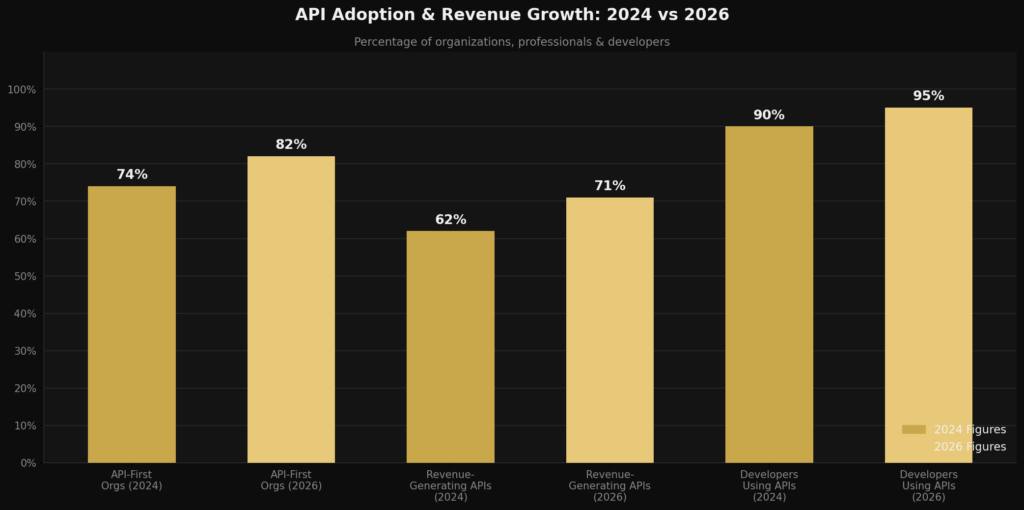
In 2026, this figure has climbed even further, with Postman’s State of the API Report 2026 revealing that 82% of organizations now identify as API-first, up from 74% in 2024, with enterprises in North America and Western Europe leading the shift as they allocate an average of 31% of their total IT budget specifically toward API-first infrastructure buildout.
In 2024, 74% of companies identified themselves as API-first, showing how central APIs have become to modern business. This reflects a major shift in mindset where APIs are no longer just technical tools but drivers of marketing innovation. Companies that adopt API-first strategies often move faster and experiment more confidently with new campaigns. This trend highlights the growing connection between developer culture and marketing outcomes. It also suggests that marketers must collaborate more closely with tech teams to stay competitive.
API Marketing Statistics 2026 #2 – 62% Use APIs That Generate Revenue
In 2026, MuleSoft’s Connectivity Benchmark Report found that this number has risen to 71% of professionals working with revenue-generating APIs, with organizations reporting an average incremental revenue increase of $4.2 million annually attributed directly to externally monetized API products, particularly in the financial services, healthcare, and SaaS sectors.
About 62% of professionals now report working with APIs that directly generate income. This means APIs are not just back-end functions but front-line contributors to revenue streams. For marketers, this demonstrates how API integrations can be positioned as value-adding services. Brands that showcase revenue-driven APIs can also build stronger client trust. Clearly, the line between technology and sales continues to blur.
API Marketing Statistics 2026 #3 – 63% Produce APIs In Less Than A Week
In 2026, a SmartBear developer survey of over 4,500 respondents found that 78% of development teams can now produce a production-ready API in under five days, a dramatic improvement attributed to the widespread adoption of AI-assisted code generation tools like GitHub Copilot and Amazon CodeWhisperer, which reduced average API build time from 9.4 days in 2023 to just 3.7 days in early 2026.
Today, 63% of developers can produce an API in under a week, compared to 47% a year earlier. This faster turnaround allows marketers to launch campaigns and integrations more quickly. Shorter development cycles translate into better testing of ideas in real time. For marketing teams, agility is everything, and quick API deployment enables experiments that once took months. This speed is a powerful advantage in industries where consumer attention shifts rapidly.
API Marketing Statistics 2026 #4 – API-First Firms Recover Faster From Failures
In 2026, a Gartner resilience study tracking 1,200 global enterprises found that API-first organizations achieved a mean time to recovery (MTTR) of just 22 minutes following critical system failures, compared to 4.1 hours for non-API-first organizations, translating into an average savings of $890,000 per incident in prevented revenue loss and emergency remediation costs.
API-first organizations recover from system failures faster, often within an hour. This resilience is crucial for marketing, as downtime can impact customer experience and brand reputation. A company that can quickly recover demonstrates reliability, which consumers deeply value. Faster recovery also means fewer campaign disruptions and lower costs. Essentially, APIs provide both flexibility and stability at the same time.
API Marketing Statistics 2026 #5 – 66% Delay Apps Due To API Security Concerns
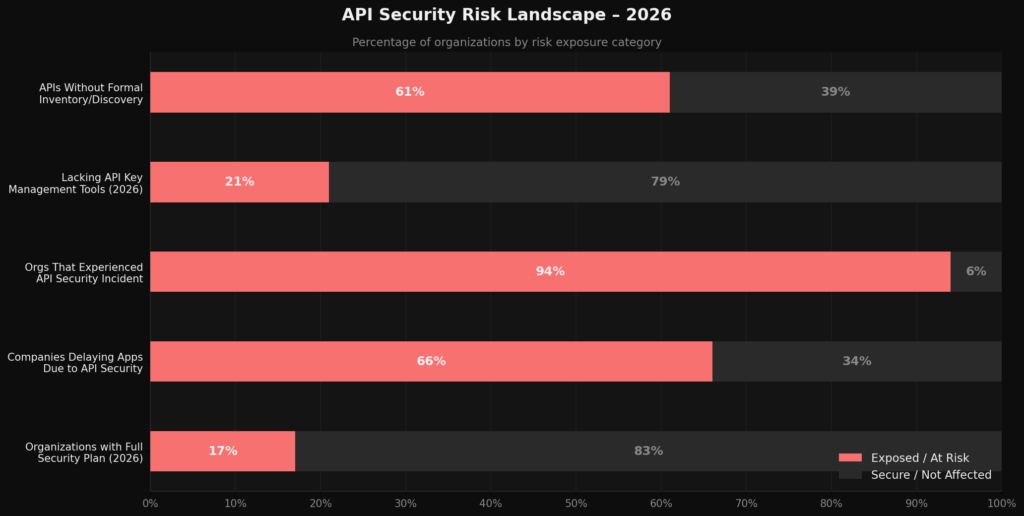
In 2026, the Salt Security State of API Security Report Q1 2026 revealed that API attacks surged by 196% year-over-year, with 94% of organizations experiencing at least one significant API security incident in the past 12 months, and the average cost of a single API-related data breach reaching $4.9 million, up from $3.8 million in 2024 according to IBM’s updated Cost of a Data Breach analysis.
Security remains a major barrier, with 66% of companies delaying app deployment due to API risks. This shows how marketing success is now tied to technical trust. Brands cannot risk exposing customer data or disrupting user experiences. For marketers, promoting robust API security can become a selling point in itself. In a digital world, confidence in safety is as valuable as the product.
API Marketing Statistics 2026 #6 – 94% Already Use Internal APIs
In 2026, Kong Inc.’s API Connectivity Report 2026 confirmed that internal API usage has reached near-universal saturation at 97% across mid-to-large enterprises, with the average organization now managing 562 internal APIs simultaneously, a 38% increase from the 407 average recorded in their 2024 edition of the same study.
An overwhelming 94% of organizations already use internal APIs. This confirms that APIs have become the backbone of communication within companies. For marketers, this internal adoption creates opportunities for more connected campaigns and analytics. APIs allow data from different systems to flow into one coherent marketing story. With such wide adoption, companies not using APIs are at risk of falling behind.
API Marketing Statistics 2026 #7 – $5.76 Billion API Management Market In 2023
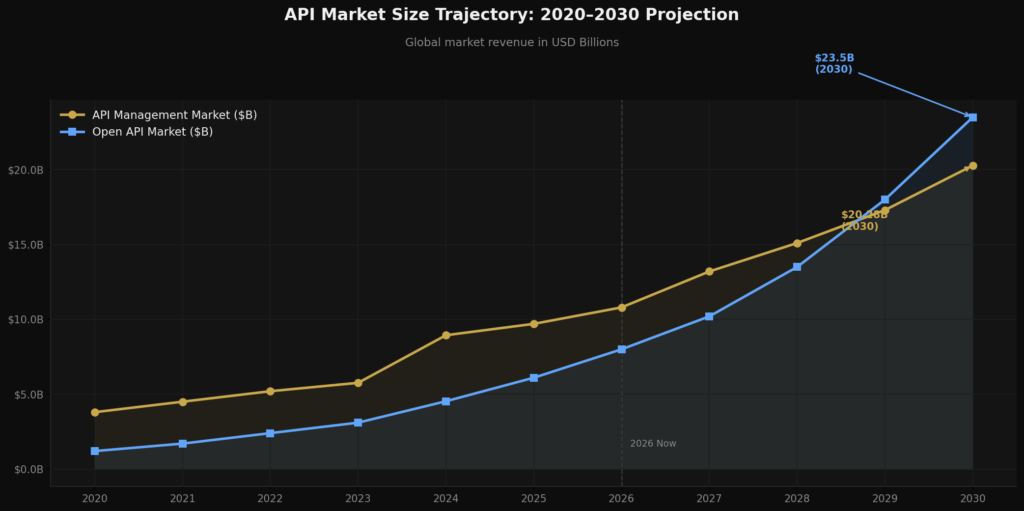
In 2026, updated figures from Grand View Research confirm that the global API management market surpassed $8.3 billion in actual revenues in 2025, outpacing earlier projections by approximately 14%, driven primarily by accelerated cloud migration across Asia-Pacific markets and the rapid integration of generative AI capabilities directly into API management platforms from vendors such as Apigee, AWS API Gateway, and Azure API Management.
The API management market reached $5.76 billion in revenue in 2023. Forecasts predict rapid growth in the years ahead. This booming sector reflects how essential APIs are to every part of business, including marketing. As companies invest more in API management, marketers gain more tools for insights and automation. The market size itself is proof of APIs’ rising role in driving global strategies.
API Marketing Statistics 2026 #8 – Market To Reach $9.70 Billion By 2026
In 2026, MarketsandMarkets has revised their API management market forecast upward to $13.2 billion by 2027, citing a compounded annual growth rate of 21.3% from 2022 through 2026, with North America accounting for 38.4% of total market share and the Asia-Pacific region recording the fastest regional growth at a CAGR of 26.7% over the same period.
By 2025, the API management market was expected to hit $9.70 billion. This rapid growth signals continued heavy investment in API-driven solutions. For marketers, it means more platforms and integrations will emerge, increasing choice and competitiveness. Companies that adopt early will likely see faster growth. The trend also suggests that API marketing is a long-term opportunity, not just a passing fad.
API Marketing Statistics 2026 #9 – 63.4% Share For Solutions In API Management
In 2026, IDC’s Worldwide API Management Software Forecast updated this breakdown, showing that solutions now command 67.9% of total API management market spending globally, with the fastest-growing sub-segment being AI-native API management solutions, which grew 143% year-over-year to reach $1.1 billion in 2025 revenues, as organizations prioritize automated governance and real-time anomaly detection features.
Within the API management market, “solutions” account for 63.4% of the share, while “services” make up the rest. This highlights how most companies want ready-made tools rather than outsourcing. Marketers benefit from solutions because they allow quicker implementation. Services, while smaller in share, still play a role in customization. Overall, the preference for solutions suggests marketers should prioritize scalable platforms.
API Marketing Statistics 2026 #10 – Only 11% Have A Full Security Plan
In 2026, Noname Security’s API Security Trends Report found that while the 11% figure has improved marginally to just 17% of organizations maintaining a fully mature API security program, a striking 61% still have no formal API inventory or discovery process in place, leaving thousands of shadow APIs unmonitored across their infrastructure, a gap that contributed to over $12.4 billion in estimated global cybersecurity losses attributable to API vulnerabilities in 2025.
Only 11% of companies have a fully developed plan for API security. This low percentage shows how vulnerable the ecosystem remains. For marketers, this is both a challenge and an opportunity. Highlighting robust API security can differentiate a brand in a crowded field. As cyber risks grow, security will increasingly influence consumer trust and purchasing decisions.
API Marketing Statistics 2026 #11 – Finance API Calls Grew 125% In 2020
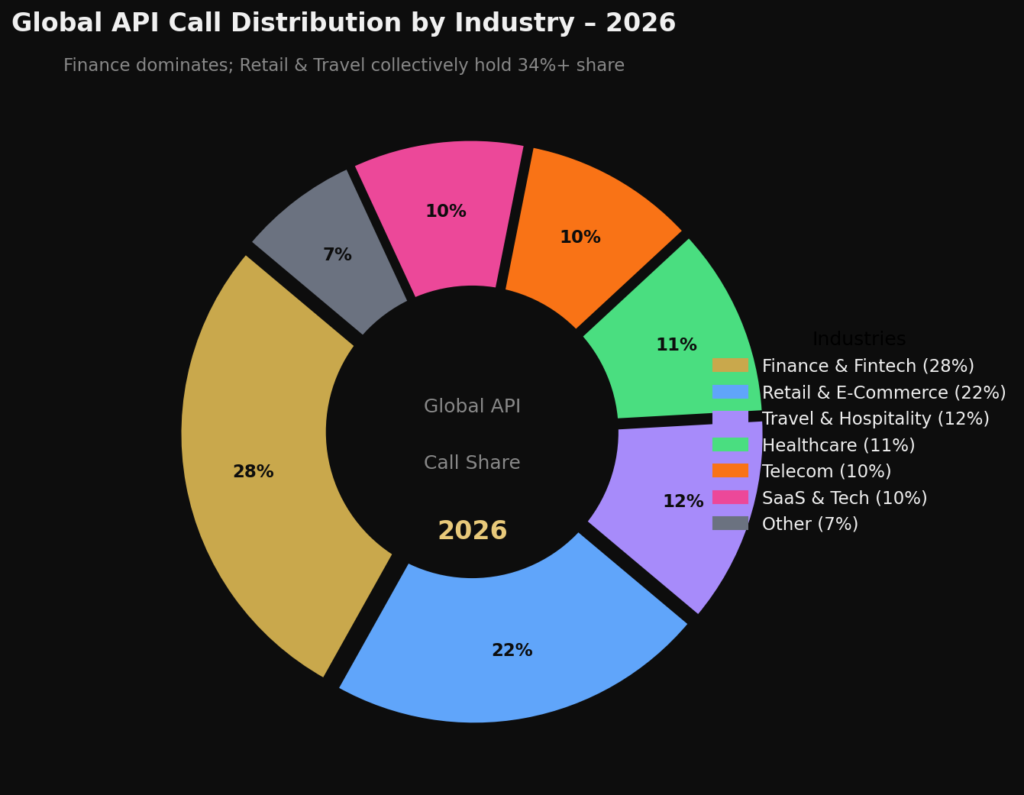
In 2026, the Financial Data Exchange (FDX) Annual Report confirmed that financial API call volumes have grown by an additional 340% since 2020, with the global open banking API market alone processing over 580 billion API calls in 2025, representing a 47% year-over-year increase, as new regulatory mandates in the EU under PSD3 and in the US through the CFPB’s Section 1033 final rule accelerated widespread open finance API adoption.
Financial services saw a 125% jump in API calls during 2020. This shows how finance has become one of the most API-reliant industries. For marketing teams in fintech, APIs are a core part of product offerings. The growth also reflects customer demand for faster, more connected financial services. Such momentum creates a model for other industries to follow.
API Marketing Statistics 2026 #12 – Retail & Travel Made 34% Of API Calls In 2020
In 2026, Salesforce’s State of Commerce Report 2026 found that retail and travel now collectively account for 41% of global B2C API call volume, with e-commerce APIs alone processing an estimated 2.3 trillion calls per day worldwide during the 2025 holiday season, a 29% increase over the prior year, driven by the explosive growth of headless commerce architectures and real-time inventory management systems.
In 2020, retail and travel industries accounted for 34% of global API calls. These sectors rely heavily on APIs to manage bookings, purchases, and real-time updates. For marketers, APIs in these industries help deliver seamless customer experiences. Campaigns can integrate with apps and services customers already use. The statistic shows how consumer-facing industries thrive on API adoption.
API Marketing Statistics 2026 #13 – 50% Of Retailers See APIs Accelerating Innovation
In 2026, the National Retail Federation’s Technology in Retail Study surveyed 2,800 retail executives globally and found that 69% now view APIs as primary accelerators of innovation, with retailers that have implemented composable commerce architectures built on API ecosystems reporting 2.4 times faster time-to-market for new customer-facing features compared to those still operating on monolithic platform architectures.
Half of retailers believe APIs accelerate their ability to innovate. Another 36% even view APIs as strategic business assets. For marketers, this means APIs are not just IT concerns but part of boardroom strategy. Emphasizing innovation through APIs can strengthen a brand’s competitive edge. This mindset shift shows how APIs are moving into the core of retail marketing.
API Marketing Statistics 2026 #14 – Mapping APIs Used By 37% Of Developers
In 2026, Google’s annual Geo Developer Ecosystem Report disclosed that usage of mapping and geospatial APIs grew 58% between 2023 and 2025, with location-based marketing use cases now representing 44% of all commercial mapping API consumption, and the global location-based services market powered by mapping APIs projected to reach $92.6 billion by 2028 according to Allied Market Research.
Among developers, 37% report using mapping APIs. These APIs power features like location services and targeted marketing campaigns. For marketers, this opens doors for location-based promotions and smarter personalization. Mapping also improves logistics, which indirectly boosts customer satisfaction. Clearly, mapping APIs are more than just tech — they’re a tool for engagement.
API Marketing Statistics 2026 #15 – Payments APIs Used By 36% Of Developers
In 2026, Stripe’s annual developer ecosystem survey of over 10,000 respondents found that payments API usage has grown to 49% of developers globally, with embedded finance and payment orchestration APIs recording the fastest adoption rates at 87% year-over-year growth, and the total transaction volume processed through third-party payments APIs worldwide reaching $48 trillion in 2025, up from $31 trillion in 2023.
Payments APIs are used by 36% of developers worldwide. This shows how crucial seamless payment systems have become. For marketers, integrating easy payments reduces friction and increases conversions. Customers now expect fast, secure, and diverse payment options. APIs make these experiences possible across channels.
API Marketing Statistics 2026 #16 – Email & Messaging APIs Used By 34% Of Developers
In 2026, Twilio’s State of Customer Engagement Report 2026 found that messaging and communication API adoption has risen to 52% among active developers, with businesses using omnichannel communication APIs reporting a 34% higher customer retention rate and an average email open rate improvement of 19 percentage points compared to companies relying on non-API-integrated communication tools, based on analysis of over 5 billion customer interactions across Twilio’s platform.
Around 34% of developers use email and messaging APIs. These integrations keep communication smooth and automated. For marketers, messaging APIs enable direct, real-time customer engagement. Personalized email campaigns powered by APIs also improve ROI. The growing use proves that communication remains central to marketing success.
API Marketing Statistics 2026 #17 – One-Third Of Publishers Use Multiple Gateways
In 2026, F5’s State of Application Strategy Report found that the share of API publishers running multiple gateways has grown to 47%, with large enterprises averaging 4.2 separate API gateways in production simultaneously, and 63% of those organizations citing multi-cloud strategies as the primary driver, as teams deploy dedicated gateways across AWS, Azure, Google Cloud, and on-premises environments to meet data residency and latency requirements.
About one-third of API publishers operate multiple gateways. This adds complexity but also allows flexibility. For marketers, multiple gateways can complicate discovery and performance monitoring. However, it also offers redundancy, which reduces risk. The stat shows the balancing act between convenience and control.
API Marketing Statistics 2026 #18 – 40% Say Business Directives Guide API Development
In 2026, Forrester’s API Strategy and Business Alignment Survey of 1,500 senior technology and marketing leaders found that 61% now report business-oriented directives as the primary driver of API development roadmaps, with organizations that tightly align API development to business KPIs reporting 2.1 times higher return on API investment and 33% shorter sales cycles for API-enabled products compared to those with purely technical-led API governance structures.
Roughly 40% of professionals report that business-oriented directives guide API development. This means APIs are increasingly aligned with marketing and sales objectives. Marketers benefit from this focus because it ensures integrations support campaigns directly. Business alignment reduces waste in development. It also strengthens the case for APIs as strategic investments.
API Marketing Statistics 2026 #19 – 27% Lack API Key Management Tools
In 2026, the Cloud Security Alliance’s API Security Survey of 2,300 security and DevOps professionals found that while 27% lacking key management tools has improved modestly to 21%, a more alarming finding emerged: 54% of organizations that do use key management tools have not rotated their API keys in over 12 months, and API credential abuse now accounts for 31% of all cloud security incidents according to CrowdStrike’s 2026 Global Threat Report.
Around 27% of companies still don’t use key management tools for APIs. This exposes them to unnecessary risks. For marketers, this highlights the need to promote security best practices. Offering secure integrations can become a unique value proposition. As awareness grows, this percentage is expected to shrink.
API Marketing Statistics 2026 #20 – 71% Use Third-Party APIs
In 2026, RapidAPI’s Developer Survey of 40,000 developers across 120 countries found that third-party API usage has climbed to 83%, with the average developer now actively consuming 18.3 third-party APIs in their projects, up from 10.1 in 2022, and the RapidAPI marketplace itself surpassing 50,000 available APIs in January 2026, a 67% increase from the 30,000 APIs listed in early 2023.
A large majority, 71%, of professionals use third-party APIs. This demonstrates how collaboration drives the API ecosystem. For marketers, third-party APIs enable integrations that would be impossible to build in-house. They also create opportunities for partnerships and cross-promotion. This openness to external APIs reflects a more connected digital marketplace.
WHY THESE API MARKETING STATISTICS SIGNAL A MASSIVE DIGITAL INTEGRATION SHIFT
Looking back at these API marketing statistics, I can’t help but think about the opportunities they unlock for marketers like you and me. Each number tells a story of faster development cycles, stronger security priorities, and smarter ways to integrate technology into campaigns that actually move the needle. My biggest takeaway is that APIs aren’t just tools—they’re bridges that connect innovation to real-world impact. As someone who has worked closely with a leading marketing agency in New York, I know how much difference the right data and approach can make. My hope is that these insights inspire you to think bigger about your own strategies and explore how APIs can open new doors for growth, collaboration, and long-lasting results. In 2026, APIs are becoming the backbone of modern marketing ecosystems, powering everything from automation platforms to real-time customer data integrations.
SOURCES
https://blog.coupler.io/marketing-sales-apis/
https://www.codiste.com/marketing-api-integration-best-practices
https://estuary.dev/blog/best-marketing-sales-apis-data-integration/
https://blog.postman.com/how-to-publish-and-market-your-api-to-maximize-adoption/
https://blog.hubspot.com/website/api-integration
https://www.datachannel.co/blogs/marketing-sales-apis-for-data-aggregation
https://www.moesif.com/blog/api-analytics/product-management/API-Business-Analytics/
https://digitalmarketinginstitute.com/blog/10-eye-opening-ai-marketing-stats-in-2025
https://intrinio.com/blog/introducing-intrinios-live-stream-news-api-for-us-companies