



17 Sep TOP 20 APP STORE MARKETING STATISTICS 2026 REVEAL SHOCKING APP DISCOVERY AND DOWNLOAD TRENDS
Updated for 2026. This page has been fully refreshed with the latest app store marketing statistics, mobile app discovery insights, and app growth benchmarks based on recent global developer surveys, platform reports, and mobile analytics data.
When I first started digging into app growth trends, I quickly realized how powerful app store marketing statistics can be for anyone trying to stand out in such a crowded space. As someone who’s been fortunate enough to work alongside a leading marketing agency in New York, I’ve seen firsthand how numbers like these can completely shift a brand’s strategy. What excites me most about sharing these insights is that they’re not just “nice to know” facts—they’re real, practical benchmarks that can help you make smarter decisions about how to position your app, attract users, and build loyalty.
TOP 20 APP STORE MARKETING STATISTICS 2026 THAT SHOCK EVERY MOBILE APP DEVELOPER
TOP 20 APP STORE MARKETING STATISTICS 2026 REVEAL MASSIVE APP DISCOVERY SHIFTS
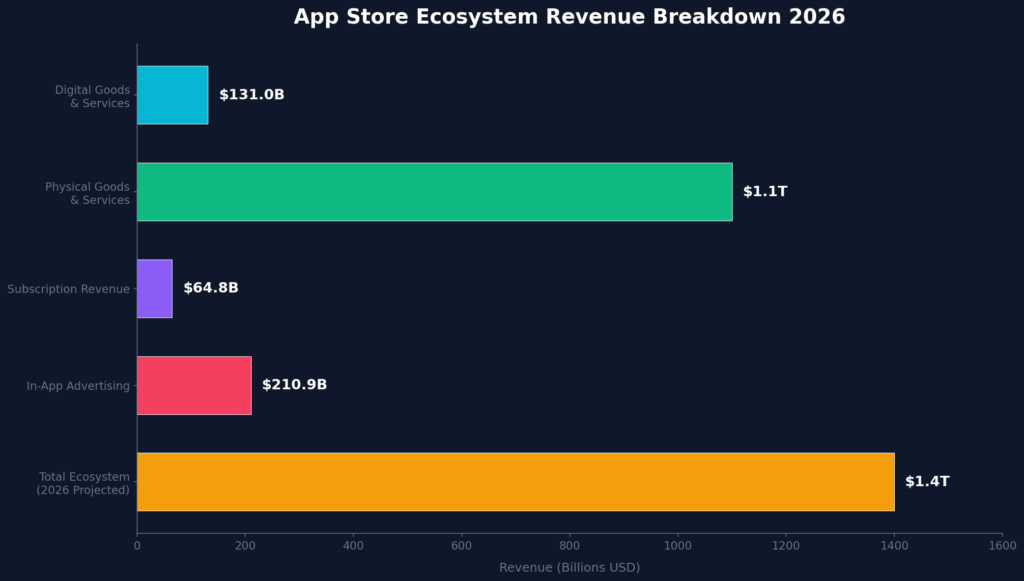
App Store Marketing Statistics#1 Ecosystem Size Reaches $1.3 Trillion
In 2026, the App Store ecosystem is projected to generate approximately $161 billion in direct App Store revenue, while Apple reported that developers selling digital goods and services have now earned over $550 billion cumulatively since 2008, with the broader ecosystem facilitating approximately $1.4 trillion in total billings and sales as growth continues at a rate of roughly 8% annually.
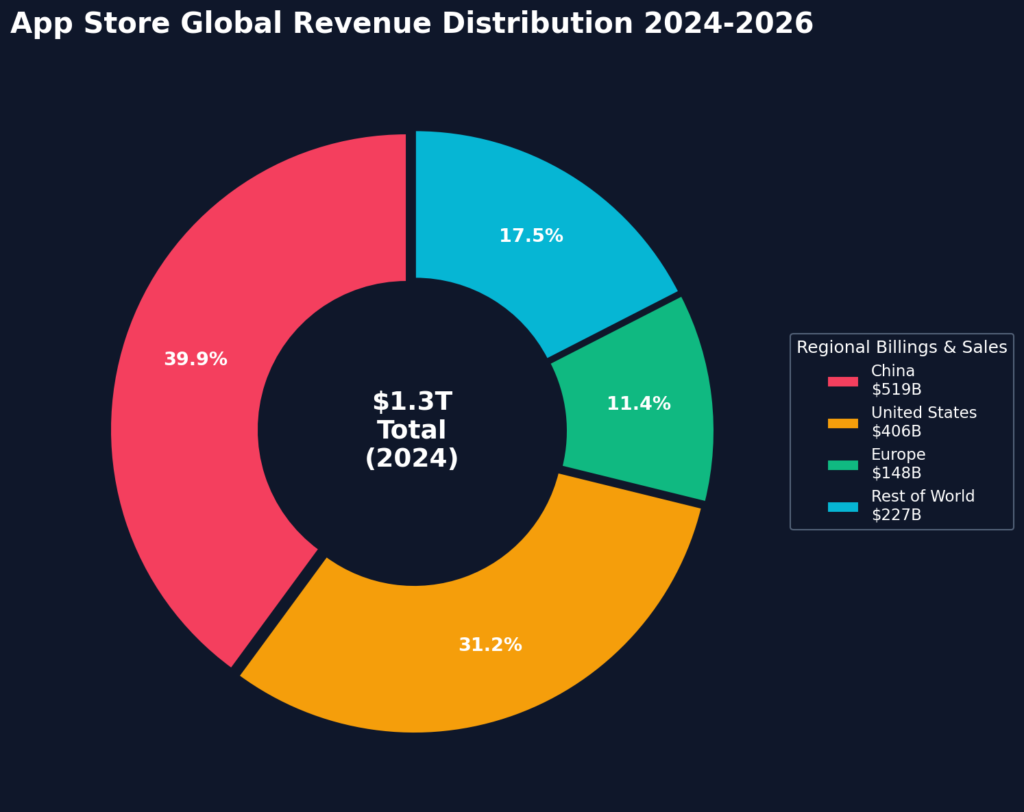
In 2024, the App Store ecosystem generated nearly $1.3 trillion in billings and sales worldwide. This massive figure highlights just how central mobile apps have become to our daily lives. From shopping to entertainment, users now rely heavily on apps for convenience. For developers and marketers, this scale shows the huge potential of well-placed strategies. It’s proof that a single app can be part of a much larger trillion-dollar market.
App Store Marketing Statistics#2 Ecosystem Doubled in Five Years
In early 2026, the App Store continues its exponential trajectory, with Apple’s services revenue surpassing $85 billion annually and the ecosystem now supporting over 850 million weekly active users across 175 countries, representing a 4.5% increase from 2024’s 813 million weekly visitors.
Between 2019 and 2024, the App Store ecosystem more than doubled in size. This growth isn’t just impressive – it shows resilience even in competitive markets. For app creators, it means opportunities are still expanding. Every year, new niches are forming, from health apps to AI-driven platforms. The lesson is clear: innovation pays off when paired with smart marketing.
App Store Marketing Statistics#3 Physical Goods Grew 162%
In 2026, physical goods and services facilitated through App Store apps continue to dominate, with e-commerce and delivery transactions exceeding $1.1 trillion globally, driven by online grocery spending that has grown over five-fold since 2019 and food delivery spending that has more than tripled in Europe alone.
Physical goods and services sold through apps grew by around 162% in five years. Think of food delivery, e-commerce, and ride-sharing – all thriving because of app accessibility. This demonstrates how consumer behavior shifted toward app-based transactions. Businesses that integrate seamlessly with mobile demand are the ones succeeding. For marketers, this stat proves the value of targeting convenience-driven users.
App Store Marketing Statistics#4 In-App Advertising Up 131%
In 2026, the global in-app advertising market is valued at approximately $210.9 billion and is projected to reach $685.84 billion by 2035, with iOS commanding higher average revenue per user (ARPU) than Android and Apple Search Ads now capturing 27% of iOS performance budgets due to conversion rates exceeding 60%.
In-app advertising revenue grew by about 131% between 2019 and 2024. More brands are investing in ad placements inside apps because users spend more time there. It’s a win-win: developers get revenue streams while advertisers connect with engaged audiences. This also shows how critical ad optimization has become. Missing out on in-app ads could mean missing out on a growing share of revenue.
App Store Marketing Statistics#5 Digital Goods Rose 109%
In 2026, subscription revenue on the App Store has reached approximately $64.8 billion, with the average monthly subscription price climbing to $7.93, while apps for non-gaming categories now generate about $83.6 billion in consumer spending – surpassing games ($83.2 billion) for the first time ever.
Digital goods and services – including gaming and subscription apps – saw a 109% rise. This category thrives because users crave instant entertainment and value digital content. The success of subscription models is a big driver here. Users are now more willing than ever to pay for ongoing access instead of one-time purchases. Marketers need to highlight long-term value to win in this space.
App Store Marketing Statistics#6 US Revenue Hit $406 Billion
In 2026, U.S. consumer spending on the App Store alone is estimated to reach $59.5 billion, up from $43 billion in 2025 and $38 billion in 2024, with the United States now accounting for approximately 42% of total global App Store revenue, making it the single largest national market.
In 2024, the United States alone accounted for $406 billion in App Store billings and sales. This shows how strong the American app economy really is. Marketers operating in the U.S. face big opportunities but also steep competition. To stand out, you need strong ASO (App Store Optimization) and targeted ad campaigns. The size of the U.S. market makes it too important to ignore.
App Store Marketing Statistics#7 China Revenue at $539 Billion
In 2026, China remains the world’s largest mobile app market by user spending at approximately $217 billion, with the Chinese App Store ecosystem having generated CNY 3.76 trillion (approximately $519 billion) in developer billings and sales in the previous year, representing a 128% increase from CNY 1.65 trillion in 2019.
China generated around $539 billion in billings and sales, outpacing even the U.S. This underlines the country’s massive appetite for apps. From gaming to retail apps, Chinese consumers are highly engaged. But entering this market requires understanding cultural preferences and regulations. For global brands, China remains both a challenge and an enormous opportunity.
App Store Marketing Statistics#8 Europe Revenue at $148 Billion
In 2026, European consumer spending on the App Store is projected to reach approximately $22.5 billion in direct revenue, with 11 European countries now exceeding $1 billion in annual consumer spending and the United Kingdom leading the region at over $8.1 billion, representing a 181% increase from 2020.
Europe contributed about $148 billion in App Store billings and sales in 2024. Although smaller than China and the U.S., Europe still plays a key role in the global app economy. Each region within Europe has its unique consumer behaviors. Developers that localize their strategies can capture more growth here. Ignoring Europe means leaving billions of dollars on the table.
App Store Marketing Statistics#9 Weekly Visitors Reach 850 Million in 2026
In 2026, Apple reported that the App Store averaged over 850 million weekly users in 2025 across 175 countries and regions, representing a 4.5% increase from the previous year’s 813 million, with storefronts in the U.S., Japan, India, and China all setting new annual visitor records.
The App Store attracts over 813 million weekly visitors worldwide. That’s nearly the size of an entire continent’s population browsing apps each week. For marketers, this constant traffic is pure gold. Every app listing, icon, and description must be optimized to capture attention. Small tweaks in presentation can influence millions of potential downloads.
App Store Marketing Statistics#10 850 Million People Visit Weekly in 2026
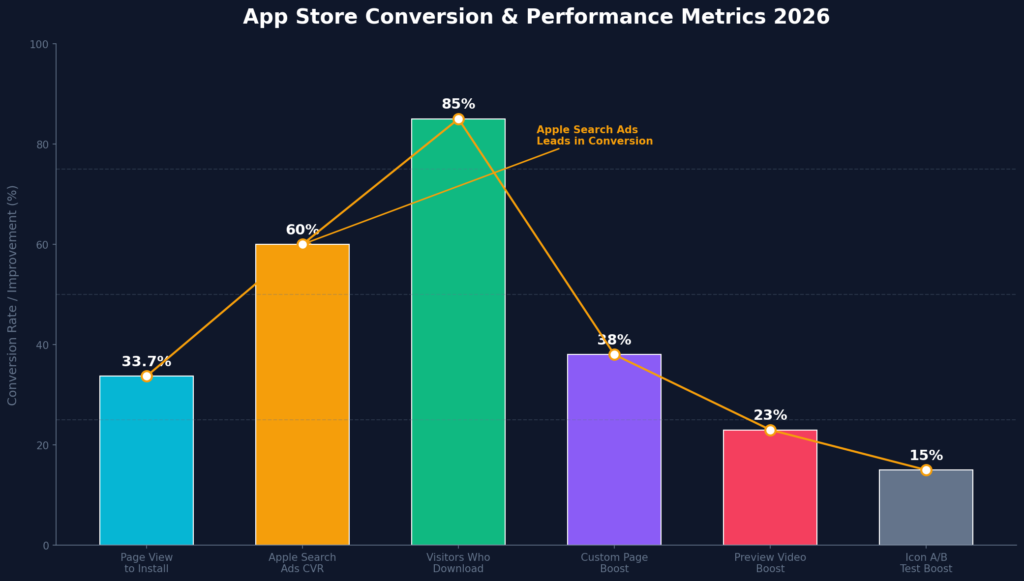
In 2026, Apple confirmed that 850 million average weekly users visited the App Store in 2025, with the platform setting a record number of visitors between Christmas Eve and New Year’s Day, and more than 85% of weekly visitors downloading at least one app during their most recent visit.
Apple highlights that around 800 million people visit the App Store weekly. This shows remarkable consistency in user engagement. Weekly visits reflect habit and routine – users return to discover what’s new. Marketers should focus on ranking for trending searches and seasonal categories. The weekly cycle is a perfect opportunity to refresh promotions and drive conversions.
App Store Marketing Statistics#11 95.41% of Apps Are Free in 2026
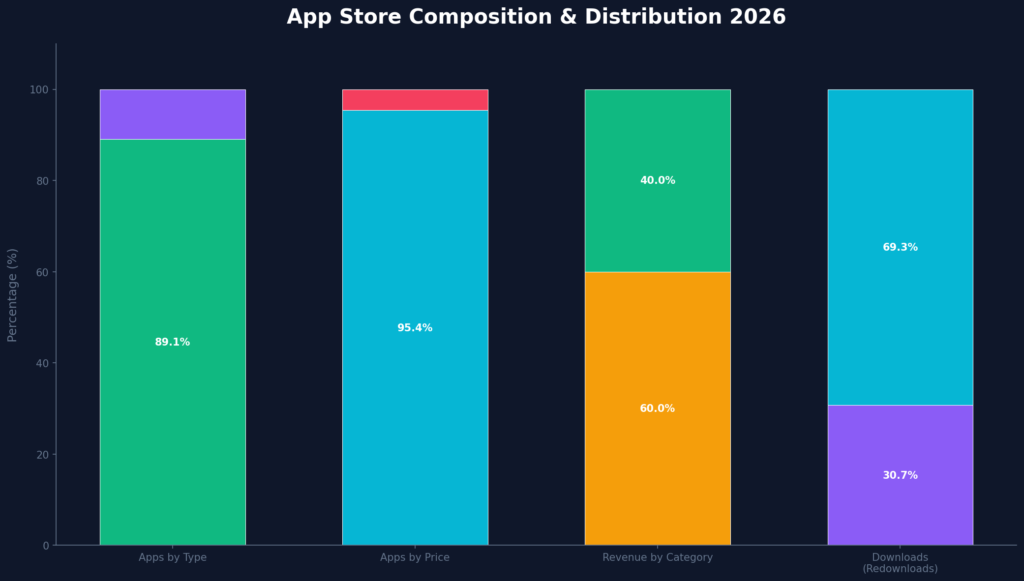
In 2026, approximately 1,827,336 apps on the App Store (95.41%) are available for free download, representing a slight increase from previous years, while free apps with in-app purchases continue to dominate monetization strategies as iOS users now spend an average of 4.2 hours per day in mobile applications – a 5% year-over-year increase.
Nearly 95.39% of apps on the App Store are free to download. This shows how competitive the free-app economy has become. Instead of charging upfront, developers now rely on in-app purchases, ads, or subscriptions. It also means that users expect free access before they’re willing to spend money. Marketers should design funnels that convert free users into paying customers.
App Store Marketing Statistics#12 Only 4.59% Are Paid Apps in 2026
In 2026, only 87,928 apps (4.59%) on the App Store require an upfront purchase, with paid apps decreasing to just 5.2% of the total catalog according to recent data, while in-app purchases now account for 72% of total App Store revenue, reflecting developers’ overwhelming preference for freemium monetization models.
Just 4.61% of apps on the App Store require upfront payment. This tiny percentage shows how rare paid-download apps are today. Still, paid apps often signal premium value, especially in niche categories. For these apps, reviews and brand trust become essential. Marketers must justify why a user should pay when most apps are free.
App Store Marketing Statistics#13 Nearly 2 Million Apps Available in 2026
In 2026, the App Store hosts approximately 1.86 to 1.92 million apps, with developers publishing around 2,000 new apps per day, while Apple’s rigorous review process has resulted in 2.6 million outdated apps being removed and 212,000 apps rejected in the past year for failing to meet security, privacy, or quality standards.
There are nearly 1,999,423 apps listed on the App Store. This sheer number highlights the crowded competition. Standing out requires more than just functionality – you need visibility and marketing. With so many options, users won’t scroll endlessly to find you. Instead, smart ASO and ad campaigns are the only way to rise above the noise.
App Store Marketing Statistics#14 Over 835,000 Publishers Active in 2026
In 2026, the number of active app publishers continues to grow with developers across 175 countries building for iOS, while ChatGPT became the most downloaded iOS app of 2025 with 217 million downloads, demonstrating that AI-powered applications now dominate the innovation landscape and reshape publisher competition across all categories.
Around 835,851 publishers have created apps for the App Store. That’s nearly a million businesses and individuals competing for attention. The diversity of publishers also means innovation is constant. New apps are launched daily, pushing the bar higher. For marketers, this means differentiation is more important than ever.
App Store Marketing Statistics#15 2,000 New Apps Daily in 2026
In 2026, the iOS App Store releases approximately 2,000 new apps per day according to 42matters data, with roughly 40,981 new apps added monthly, and AI-powered applications like Doubao from ByteDance and ChatGPT now leading download charts as developers increasingly integrate artificial intelligence features to meet rising user expectations.
On average, about 1,751 new apps are released every day. That’s a staggering amount of competition to face. Every new app launched resets user expectations and raises the bar. For marketers, it’s not just about launching – it’s about sustaining attention. Without continuous engagement strategies, even great apps can fade quickly.
App Store Marketing Statistics#16 Over 40,000 New Apps Monthly in 2026
In 2026, approximately 40,981 new apps are published monthly on the App Store, while Apple’s review process now checks around 132,500 app submissions per week on average, and the platform has blocked over $2.1 billion in fraudulent transactions and terminated 118,000 developer accounts in the past year alone.
Each month, around 53,549 apps are published on the App Store. This number illustrates how fast the ecosystem moves. Marketers can’t rely on one-time campaigns; they need ongoing optimization. Regular updates and promotions keep apps visible among the flood of newcomers. Falling behind means being drowned out by monthly competition.
App Store Marketing Statistics#17 Games Make Up 10.92% of Apps in 2026
In 2026, games account for approximately 10.92% to 12.5% of apps available on the App Store, yet they generate roughly 60% of total App Store revenue at approximately $82 billion, with Honor of Kings earning $1.87 billion and Monopoly Go! generating $1.58 billion in the past year alone.
Games account for about 10.28% of apps available. Although a minority in number, they dominate revenue. Players often spend on in-app items, fueling growth. This makes the gaming sector one of the most lucrative in the App Store. For non-gaming apps, it’s a reminder that competition for user spending is fierce.
App Store Marketing Statistics#18 Non-Games Dominate With 89.08% in 2026
In 2026, non-gaming apps make up approximately 89.08% of the App Store’s offerings, and for the first time ever, apps have overtaken games in mobile consumer spending – generating $83.6 billion compared to games’ $83.2 billion – driven by subscription-based categories like health and fitness (up 24% year-over-year to $6.3 billion) and social networking ($16.7 billion).
Non-gaming apps make up 89.72% of the App Store’s offerings. This shows the variety of app categories, from health to productivity. Despite being the majority, many struggle to monetize effectively compared to games. Still, these apps play an essential role in user lifestyles. Marketers must find creative monetization models to compete.
App Store Marketing Statistics#19 Conversion Rate at 33.7% in 2026
In 2026, the App Store page view to install conversion rate remains approximately 33.7%, but apps utilizing custom product pages now achieve conversion rates up to 38% higher during seasonal launches, while icon A/B testing increases conversion rates by an average of 15% and apps with preview videos achieve 23% higher conversion rates.
The App Store conversion rate from page view to install is about 33.7%. This stat emphasizes the power of presentation. Icons, screenshots, and reviews play a huge role in convincing users. Even small changes can boost conversions significantly. Marketers should constantly A/B test to hit that sweet spot.
App Store Marketing Statistics#20 Search Ads Convert Over 60% in 2026
In 2026, Apple Search Ads continue to deliver industry-leading conversion rates exceeding 60% for ads at the top of search results, and Apple is expanding search ad inventory throughout 2026 to include multiple placements beyond the top position, capitalizing on the fact that nearly 65% of all App Store downloads happen directly after a search.
Apple Search Ads boast conversion rates above 60% from ad tap to install. This shows the effectiveness of targeting users at the moment of intent. When someone searches, they’re already primed to download. That’s why Apple’s ad platform continues to grow in importance. Marketers who ignore Search Ads risk missing one of the highest-converting channels.
APP STORE MARKETING SECRETS REVEALED: 2026 DATA EVERY APP FOUNDER NEEDS
Looking back at all these stats, I can’t help but feel both inspired and humbled by just how much opportunity the App Store still offers to creators and businesses. For me, the real value lies in turning these insights into action—testing new ideas, refining campaigns, and always staying curious about what’s next. If you’ve ever wondered how your app stacks up or where you should focus your energy, I hope this breakdown gave you a sense of direction and a little extra motivation. At the end of the day, these aren’t just numbers—they’re stories of growth, creativity, and the endless possibilities that come with putting your app into the world. In 2026, with app competition and user acquisition costs rising, these App Store marketing benchmarks matter more than ever for developers trying to stand out.
SOURCES
https://www.tekrevol.com/blogs/apple-app-store-statistics/
https://www.businessofapps.com/data/app-stores/
https://sqmagazine.co.uk/app-store-statistics/
https://thisisglance.com/blog/the-complete-guide-to-app-store-optimisation-in-2025
https://www.emarketer.com/topics/category/app%20store
https://www.appmysite.com/blog/top-75-mobile-app-statistics-market-size-usage/
https://www.netguru.com/blog/app-store-strategy
https://www.apptweak.com/en/aso-blog/app-store-optimization-news-app-store-updates