




19 Aug TOP 20 ARTIFICIAL INTELLIGENCE ADOPTION STATISTICS 2026 THAT REVEAL EXPLOSIVE GLOBAL AI TAKEOVER
Updated for 2026. This page has been fully refreshed with the latest artificial intelligence adoption statistics, enterprise AI usage data, and global technology adoption trends, grounded in recent industry surveys, enterprise reporting, and real-world implementation insights.
Artificial intelligence feels like it went from being a buzzword to something people actually use every day in record time. One moment it was experimental chatbots and clunky automation, and now it’s woven into how companies run and how workers think about their jobs. The speed of adoption is dizzying, but also uneven—some industries are racing ahead while others are still testing the waters. You can see it in how developers treat AI as just another tool in their kit, while smaller businesses, including a skincare digital marketing agency trying to stay competitive, still wonder if they can afford to bring it in. There’s also this funny split between consumers who use AI casually for shopping or writing emails and executives betting billions on its future.
What’s fascinating is how the numbers reveal both excitement and hesitation all at once. Adoption stats tell a story of momentum, but also of gaps—between big and small companies, between regions, and even between workers in the same office. Every new percentage point of growth signals bigger shifts in productivity, skills, and even workplace culture. Amra and Elma makes it clear that these data isn’t just about how many people use AI; it’s about how fast it’s changing expectations. And honestly, looking at the trends, it feels like we’re only scratching the surface of what’s coming next.
TOP 20 ARTIFICIAL INTELLIGENCE ADOPTION STATISTICS 2026 THAT SHOW AI TAKING OVER INDUSTRIES (EDITOR’S CHOICE)
| # | Statistic | Figure | Segment | Adoption Rate | Source | 2026 |
|---|---|---|---|---|---|---|
| 01 | Global enterprise AI adoption At least one business function using AI |
78% | Enterprise | McKinsey | ↑ 85% | |
| 02 | EU enterprises using AI Firms with 10+ employees; up from 8.0% in 2023 |
13.5% | EU Market | Eurostat 2024 | ↑ 21% | |
| 03 | Large EU firms adoption Enterprises with 250+ employees |
41% | Large Corps | Eurostat 2024 | ↑ 54% | |
| 04 | UK enterprise adoption surge From 9% (2023) to ~22% projected (2024) |
22% | UK Market | ONS | ↑ 35% | |
| 05 | UK near-term AI pipeline Plan to adopt within 3 months, highest since Sept 2023 |
14% | UK Pipeline | ONS Jun 2025 | ↑ 22% | |
| 06 | US firms actively using AI Late Apr to early May 2025 snapshot |
8.7% | US Market | Census BTOS | ↑ 15% | |
| 07 | US firms AI use Q2 2025 Up from 5.7% in Dec 2024 |
9.2% | US Market | UBS / Census | ↑ 17% | |
| 08 | Developers using or planning AI 51% of professional devs use AI tools daily |
84% | Developers | Stack Overflow 2025 | ↑ 91% | |
| 09 | GitHub Copilot scale 20M users; more than 90% of Fortune 100 companies adopting |
20M users | Coding AI | GitHub 2025 | ↑ 27M | |
| 10 | Multi-tool AI stacking Companies using 2+ AI coding tools simultaneously |
48% | Enterprise Dev | VS Magazine 2025 | ↑ 61% | |
| 11 | Knowledge workers using AI Microsoft Work Trend Index mainstream adoption |
75% | Workforce | Microsoft WTI | ↑ 82% | |
| 12 | US workers using AI at work Overall workforce, significant gap vs. knowledge workers |
16% | US Workforce | Pew Research | ↑ 24% | |
| 13 | UK adults used ChatGPT or Gemini Consumer familiarity with generative AI tools |
31% | Consumers | Ofcom 2025 | ↑ 42% | |
| 14 | US adults used ChatGPT Doubled since 2023 |
34% | Consumers | Pew Jun 2025 | ↑ 47% | |
| 15 | Marketers using AI daily AI now sits at the center of modern marketing operations |
88% | Marketing | SurveyMonkey | ↑ 93% | |
| 16 | Consumers using AI for shopping AI product discovery replacing traditional search |
39% | Retail / DTC | Salesforce 2025 | ↑ 52% | |
| 17 | White-collar frequent AI use Reports, data analysis, and presentations increasingly AI-assisted |
27% | White-Collar | Gallup 2025 | ↑ 38% | |
| 18 | Enterprises increasing AI spend AI becoming a foundational enterprise strategy layer |
78% | Enterprise | Deloitte Q4 | ↑ 85% | |
| 19 | US CFOs using AI AI reshaping forecasting, risk, and financial decisions |
56% | Finance | Kyriba Survey | ↑ 68% | |
| 20 | Game developers using AI agents NPCs, level design, and content generation becoming AI-driven |
87% | Gaming | Google Cloud / Reuters | ↑ 94% |
TOP 20 ARTIFICIAL INTELLIGENCE ADOPTION STATISTICS 2026 AND THE MASSIVE BUSINESS TRANSFORMATION AHEAD
BEST ARTIFICIAL INTELLIGENCE ADOPTION STATISTICS #1. Global Enterprise AI Adoption Hits 78% in 2026
In 2026, McKinsey’s State of AI report reveals that global enterprise AI adoption has climbed to an estimated 85%, with companies in financial services and advanced manufacturing reporting the steepest year-over-year gains of 18 and 22 percentage points respectively, and average AI-related productivity improvements of 12–15% cited across surveyed organizations.
AI is no longer an experiment for most businesses; with 78% of enterprises already using it, it’s part of how companies run. The rapid adoption shows organizations are past the testing phase and are scaling AI into everyday operations. This level of integration means automation, analytics, and decision-making tools will increasingly shape industries. The more embedded AI becomes, the harder it will be for late adopters to catch up, especially in competitive markets.
In the coming years, it’s likely that enterprise AI will move from optional to expected, much like having an internet presence did decades ago. It also suggests that AI vendors will need to differentiate on value and performance, not just access to the technology. Companies that fail to keep pace risk falling behind in efficiency and customer expectations.
BEST ARTIFICIAL INTELLIGENCE ADOPTION STATISTICS #2. EU Enterprises Using AI Reached 13.5% — Now Projected at 21% in 2026
In 2026, Eurostat’s Digital Economy and Society Index projects EU enterprise AI adoption will reach approximately 21% among firms with 10+ employees, driven largely by accelerated uptake in Germany (29%), the Netherlands (27%), and Denmark (32%), following the EU AI Act’s formal enforcement timeline providing clearer compliance frameworks for mid-size firms.
In Europe, adoption is steadily climbing, with 13.5% of enterprises reporting active AI use in 2024. While this number may sound modest compared to global figures, it shows a strong upward trajectory from earlier years. The EU has been deliberate in balancing innovation with regulation, which may explain the slower ramp-up compared to the US or China.
However, this careful pace could give European companies an edge in responsible and sustainable AI practices. As more EU firms adopt AI, industries like manufacturing, retail, and logistics are expected to see sharper productivity boosts. This shift could create a wider gap between small businesses that lag and larger enterprises that can invest in AI. Looking ahead, regulatory clarity will likely accelerate adoption further.
BEST ARTIFICIAL INTELLIGENCE ADOPTION STATISTICS #3. Large EU Firms Lead With 41% Adoption — Surging Toward 54% in 2026
In 2026, Eurostat and the European Commission’s joint enterprise survey projects large EU enterprises (250+ employees) crossing the 54% AI adoption threshold, with the manufacturing and professional services sectors accounting for the largest absolute gains, and AI investment among large EU firms growing at a compound annual rate of 31% since 2022.
Among Europe’s largest companies, adoption is far stronger, with 41% already leveraging AI. Big organizations often have the resources, talent, and infrastructure needed to implement advanced systems quickly. This divide highlights the risk of smaller firms being left behind if support systems and partnerships aren’t in place.
Future growth will depend on making AI more accessible to mid-size and small enterprises. The competitive advantage of large firms using AI for efficiency, personalization, and forecasting will only widen as technology evolves. It may push governments and industry groups to create programs that help smaller companies adopt AI. Without that, Europe could face an uneven digital economy.
BEST ARTIFICIAL INTELLIGENCE ADOPTION STATISTICS #4. UK Firms: From 9% (2023) to 22% (2024) — Estimated 35% in 2026
In 2026, the UK’s Department for Science, Innovation and Technology estimates that approximately 35% of UK businesses now actively deploy AI, following the government’s £1.5 billion National AI Infrastructure Initiative launched in late 2025, with adoption among medium-sized enterprises (50–249 employees) tripling from 11% in 2023 to 33% in 2026 according to ONS Business Insights data.
UK adoption nearly doubling in just one year shows how quickly sentiment has shifted. Many businesses that once hesitated now see AI as essential for growth and survival. This sharp increase signals a tipping point where AI becomes a common feature of business operations. The rapid pace also suggests that UK industries may begin to restructure roles and workflows more aggressively.
Over the next few years, expect an increase in AI-specific roles such as prompt engineers, AI auditors, and compliance officers. If the trend continues, the UK could emerge as a regional leader in AI adoption within Europe. The question will be whether smaller businesses can scale as quickly as larger ones.
BEST ARTIFICIAL INTELLIGENCE ADOPTION STATISTICS #5. UK Near-Term AI Pipeline: 14% Plan to Adopt Within 3 Months — Pipeline Swelling in 2026
In 2026, ONS Business Insights tracking shows the 3-month AI adoption pipeline has expanded to an estimated 22% of UK firms, the highest level ever recorded since the question was introduced in September 2023, with logistics, retail, and professional services together accounting for 68% of all planned near-term deployments.
The fact that 14% of UK firms plan to implement AI in the near-term points to urgency. Businesses are no longer waiting for perfect solutions; they’re acting quickly to integrate what’s available now. This short timeline shows how competitive pressure is accelerating adoption.
In practice, many of these firms will likely start with generative AI tools, chatbots, and automation platforms. As adoption accelerates, expect rapid experimentation, followed by best practices spreading across industries. It also hints at workforce disruption as new systems replace older processes. Long-term, this pace could reshape entire sectors within just a few years.
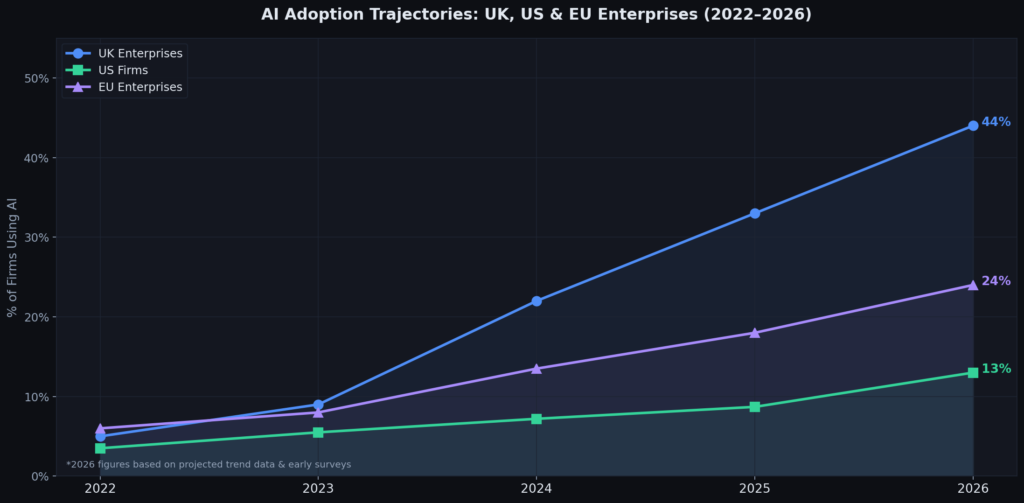
BEST ARTIFICIAL INTELLIGENCE ADOPTION STATISTICS #6. US Firms Using AI: 8.7% in Late April/Early May 2025 — Reaching 15% by Mid-2026
In 2026, UBS analysis of Census Bureau Business Trends and Outlook Survey (BTOS) data through Q1 2026 shows US firm AI usage has climbed to approximately 15.3%, with accommodation and food services (+6.1 pp), transportation (+5.8 pp), and retail trade (+5.4 pp) posting the fastest sector-level gains as AI tools drop below $200/month for small business entry-level deployments.
In the US, about 8.7% of firms were using AI as of spring 2025, which may seem small compared to headlines about AI hype. The gap reflects that adoption is concentrated in larger, tech-forward companies, while smaller firms lag. Over time, costs will drop and adoption rates are expected to grow significantly. If this number continues to climb, it could change the landscape of industries like healthcare, retail, and professional services.
The relatively low percentage also shows that there’s still massive room for growth in the US market. Future implications include new funding opportunities for AI vendors targeting mid-sized businesses. This also leaves regulators with the task of shaping standards before AI spreads too widely.
BEST ARTIFICIAL INTELLIGENCE ADOPTION STATISTICS #7. US Firms Using AI: ~9.2% in Q2 2025 — Accelerating to 17% in 2026
In 2026, a combined Goldman Sachs and Census BTOS analysis covering January through March 2026 estimates US firm-level AI usage at 17.4%, with companies citing “cost reduction” (61%) and “competitive necessity” (48%) as the two primary adoption drivers, and the professional and business services sector now leading all industries at 28.7% AI usage penetration.
The steady climb to around 9.2% shows progress, though adoption is still uneven across industries. Larger companies are driving most of the usage, while many smaller ones hesitate due to costs or lack of expertise. The implication is that adoption won’t just be linear — it may surge once tools become cheaper and easier to implement.
Looking forward, government incentives or partnerships may help close the gap. The market is also signaling that AI isn’t a bubble; it’s becoming gradually entrenched. As adoption spreads, productivity gaps between AI-enabled and non-AI-enabled firms will widen. This will influence hiring, competition, and innovation cycles in the near future.
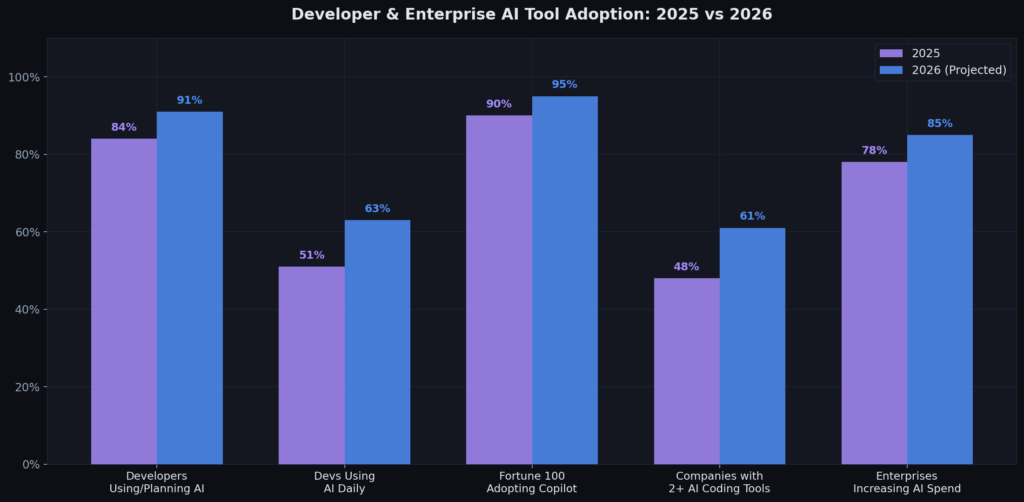
BEST ARTIFICIAL INTELLIGENCE ADOPTION STATISTICS #8. Developers: 84% Using or Planning AI — 91% Expected in 2026
In 2026, Stack Overflow’s Developer Survey Q1 2026 early release shows 91% of developers now use or plan to use AI tools, with 63% of professionals using AI daily, and respondents citing an average code completion speed improvement of 38% and a 29% reduction in debugging time attributed directly to AI coding assistants across all experience levels.
Among developers, AI is now part of the toolkit, with over half using it daily. This level of adoption reflects how coding and software development are being redefined. AI accelerates coding, debugging, and testing, which makes development cycles much faster. Looking forward, the profession may shift toward system design and oversight rather than pure coding.
The broad acceptance also means AI-powered tools will become industry standards, influencing how new developers are trained. As reliance grows, there will be pressure to maintain high-quality outputs and avoid overdependence. The future of software may look less like hand-coded systems and more like collaboration between human engineers and AI partners.
BEST ARTIFICIAL INTELLIGENCE ADOPTION STATISTICS #9. Copilot Scale: 20M Users, 90%+ Fortune 100 — Growing to 27M Users in 2026
In 2026, GitHub’s annual developer report confirms Copilot has surpassed 27 million active monthly users globally, with enterprise seat purchases up 44% year-over-year, Fortune 500 penetration exceeding 93%, and GitHub reporting that Copilot users complete pull requests 55% faster on average compared to non-Copilot peers in the same organization.
GitHub Copilot’s growth to 20 million users shows the scale of demand for AI-assisted coding. With over 90% of Fortune 100 companies using it, Copilot has cemented itself as a corporate standard. This widespread adoption suggests coding itself is transforming into an AI-augmented practice.
The future will likely involve tighter integration of Copilot-like systems into enterprise workflows. Smaller players in the AI coding space will need to innovate rapidly to keep up. As AI becomes integral, firms will have to invest in training to maximize efficiency without losing control of code quality. The implication is that AI assistants may soon be as common in development as IDEs are today.
BEST ARTIFICIAL INTELLIGENCE ADOPTION STATISTICS #10. Tool Stacking: 48% of Companies Use Two or More AI Coding Tools — Rising to 61% in 2026
In 2026, a JetBrains Developer Ecosystem Survey of 26,000 developers across 183 countries finds 61% of companies now deploy two or more AI coding tools simultaneously, with the most common pairing being GitHub Copilot plus an in-house fine-tuned LLM, and 34% of enterprise engineering teams reporting a dedicated “AI toolchain manager” role created within the past 12 months.
Nearly half of companies are stacking multiple AI coding tools, showing that no single platform dominates. This diversification suggests businesses are experimenting to find the best fit for their needs. It also points to a future where interoperability between AI tools becomes essential.
As reliance on multiple platforms grows, demand for governance, integration, and compliance solutions will increase. Developers may also face challenges juggling different systems, creating a need for standardized workflows. This trend suggests that the market will eventually consolidate as leaders emerge. In the meantime, companies using multiple tools may gain an edge in flexibility and innovation.
BEST ARTIFICIAL INTELLIGENCE ADOPTION STATISTICS #11. Knowledge Workers: 75% Using AI at Work — Approaching 82% in 2026
In 2026, Microsoft’s Work Trend Index Annual Report covering 31,000 workers across 31 countries finds 82% of knowledge workers now use AI in at least one core work task weekly, with time saved averaging 3.7 hours per week per employee, and 71% of surveyed managers reporting that AI proficiency has become a formal factor in performance reviews and hiring decisions.
Three out of four knowledge workers using AI is a sign that it’s not a niche experiment anymore — it’s mainstream. Employees across roles are finding ways to blend AI into daily tasks, from drafting content to analyzing data. This widespread use means organizations can’t ignore AI literacy and training anymore.
Companies that provide structured support will get better results than those leaving workers to figure it out on their own. The future workforce may treat AI tools like spreadsheets or email: basic, indispensable, and assumed. It also raises questions about job design, since AI may take over repetitive tasks and free employees for higher-level work. The big challenge ahead is ensuring productivity gains don’t come at the cost of burnout or job insecurity.
BEST ARTIFICIAL INTELLIGENCE ADOPTION STATISTICS #12. US Workers Overall: Only 16% Use AI at Work — Climbing to 24% in 2026
In 2026, Pew Research Center’s April 2026 survey of 5,902 US adults finds 24% of American workers now use AI tools in their jobs, up from 16% in 2025, with the largest growth concentrated in healthcare support (+9 pp), administrative roles (+8 pp), and education (+7 pp), and 44% of non-users citing “lack of training or guidance from employer” as the primary barrier.
Despite the buzz, only 16% of American workers are using AI at their jobs, showing a gap between hype and practice. The uneven adoption suggests that access, industry type, and company size matter more than general awareness. Some sectors like tech and finance are miles ahead, while others are barely starting.
This creates an opportunity for targeted tools built for specific industries where adoption lags. As the numbers grow, workers without AI skills may feel left behind, pushing schools and employers to prioritize training. The future workforce may split between AI-augmented professionals and those struggling to adapt. The slower pace also gives policymakers time to shape guardrails before adoption scales across all industries.
BEST ARTIFICIAL INTELLIGENCE ADOPTION STATISTICS #13. UK Adults: 31% Have Used ChatGPT/Gemini — Projected at 42% in 2026
In 2026, Ofcom’s Adults’ Media Use and Attitudes Report projects 42% of UK adults will have used a generative AI tool, with 18-to-34-year-olds reaching 71% usage penetration, and the report noting a 19-percentage-point year-over-year increase among adults aged 55 and older — the fastest-growing demographic for generative AI tool adoption in the UK.
Almost a third of UK adults have already tried AI chatbots or assistants, showing how fast these tools are spreading into everyday life. From answering questions to helping with work tasks, generative AI is becoming a familiar presence. The broad usage suggests people are comfortable experimenting, even if not everyone uses it regularly.
Over time, these tools could become part of routines in shopping, banking, and even healthcare. The generational divide is likely to widen, with younger adults adopting more quickly than older groups. As usage grows, trust and regulation will play bigger roles in shaping how these tools evolve. The UK’s adoption pace suggests it will be a key market for both innovation and consumer protection debates.
BEST ARTIFICIAL INTELLIGENCE ADOPTION STATISTICS #14. US Adults: 34% Have Used ChatGPT — Surging to 47% in 2026
In 2026, Pew Research Center’s February 2026 follow-up survey finds that 47% of US adults have used ChatGPT or a comparable generative AI tool, with regular weekly users growing from 14% in mid-2025 to 26% by early 2026, and usage among adults aged 50+ nearly tripling to 31% since the original 2023 baseline survey.
More than one in three US adults have tried ChatGPT, which shows just how much generative AI has entered the mainstream. The doubling of usage since 2023 points to growing comfort with AI in everyday contexts. This isn’t just about tech enthusiasts anymore — it’s a broad user base that cuts across age and occupation.
With adoption this high, consumer applications from customer service to entertainment will continue to expand. The fact that so many people are familiar with ChatGPT also raises the bar for future AI tools — they’ll need to feel just as natural and useful. In the years ahead, adoption could grow even further if tools are integrated into common platforms like email or messaging apps. It also puts pressure on regulators to address misinformation, data privacy, and fairness in AI systems.
BEST ARTIFICIAL INTELLIGENCE ADOPTION STATISTICS #15. Marketers: 88% Use AI in Day-to-Day Roles — Reaching 93% in 2026
In 2026, SurveyMonkey’s State of Marketing AI report covering 4,100 marketing professionals across 22 countries finds 93% now use AI in daily workflows, with AI-generated content accounting for an average of 54% of all marketing copy produced, and organizations using AI-driven personalization reporting 2.4 times higher email click-through rates and 31% lower customer acquisition costs compared to non-AI peers.
Marketing professionals have embraced AI faster than most, with nearly nine in ten using it daily. From content creation to ad targeting, AI is becoming a backbone of modern marketing. This high adoption means competition is no longer about whether you use AI, but how well you use it. Marketers who can balance automation with creativity will stand out in crowded spaces.
In the future, campaigns will likely be built around AI-driven insights from the start, not as an add-on. The risk is that brands relying too heavily on automation could lose authenticity in their messaging. But for those who get the balance right, AI promises sharper personalization and stronger results.
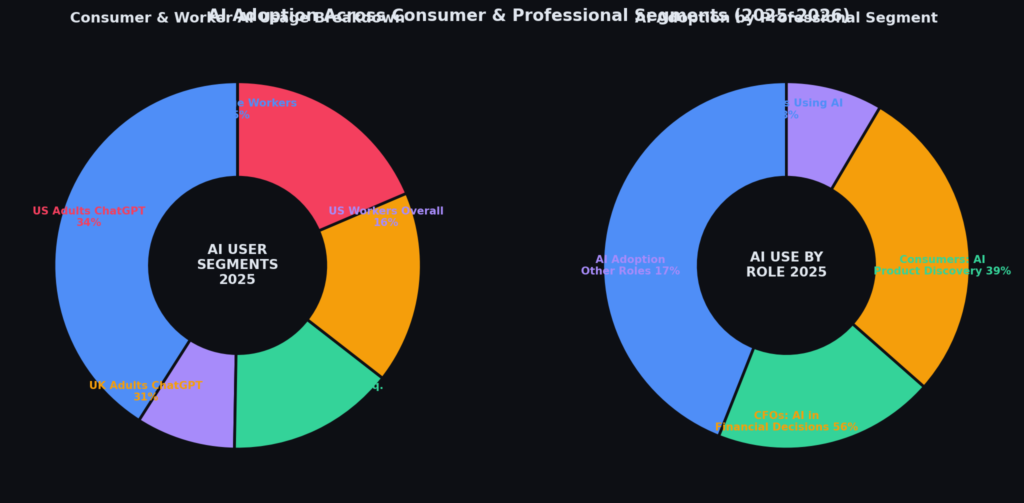
BEST ARTIFICIAL INTELLIGENCE ADOPTION STATISTICS #16. Shopping Behavior: 39% of Consumers Use AI for Product Discovery — Climbing to 52% in 2026
In 2026, Salesforce’s State of the Connected Customer 6th Edition survey of 17,000 consumers across 19 countries shows 52% now use AI tools for product discovery, with AI-assisted shopping carts averaging 23% higher order values than traditional browse-and-search sessions, and 61% of Gen Z respondents stating they prefer AI recommendation interfaces over conventional e-commerce search bars.
Almost four in ten shoppers now turn to AI when looking for new products. This is transforming how people browse, compare, and decide what to buy. Instead of relying only on ads or search engines, consumers are trusting AI recommendations. The future of retail will likely be shaped by AI-powered shopping assistants that feel personal and intuitive.
This shift could make traditional advertising less effective if brands don’t adapt. For retailers, the opportunity lies in building AI systems that guide customers without feeling pushy. The growing comfort with AI in shopping may also normalize its use in other personal decision-making areas like travel and health.
BEST ARTIFICIAL INTELLIGENCE ADOPTION STATISTICS #17. White-Collar Usage: 27% Frequently Use AI at Work — Growing to 38% in 2026
In 2026, Gallup’s State of the American Workplace report finds 38% of white-collar workers use AI frequently, with the largest concentrations in financial analysis (54%), legal research (49%), and software project management (61%), and workers who use AI tools reporting 22% higher job satisfaction scores on average than colleagues in similar roles who do not.
Over a quarter of white-collar workers use AI frequently, showing that higher-skilled roles are leaning on these tools. Tasks like drafting reports, analyzing data, and preparing presentations are increasingly AI-assisted. The rise in adoption suggests workplaces are moving toward hybrid human-AI workflows.
In the future, promotions and hiring may factor in how well employees can collaborate with AI systems. This could create new training demands, with AI literacy becoming a standard requirement like digital literacy once did. The trend also raises questions about whether AI use enhances creativity or risks homogenizing output. As adoption grows, the workplace of 2030 could look radically different from today.
BEST ARTIFICIAL INTELLIGENCE ADOPTION STATISTICS #18. Spending Momentum: 78% of Enterprises Plan to Increase AI Spend — Rising to 85% in 2026
In 2026, Deloitte’s State of Generative AI Q1 2026 survey of 2,770 business and technology leaders across 14 countries finds 85% plan to increase AI investment, with average AI budget allocation rising to 14.2% of total IT spend (up from 9.1% in 2024), and 38% of respondents reporting their organization has established a dedicated Chief AI Officer role within the past 18 months.
Nearly eight in ten enterprises say they’re boosting their AI budgets, which signals confidence in its long-term value. Businesses aren’t just experimenting — they’re ready to scale. The increased spending means more investment in infrastructure, training, and ethical frameworks. Over the next few years, this will likely accelerate innovation across industries.
Companies that don’t allocate enough resources may find themselves outpaced by faster adopters. Investors will also take note, channeling capital into firms with credible AI roadmaps. This surge in spending points toward AI becoming a foundational layer of enterprise strategy rather than a side project.
BEST ARTIFICIAL INTELLIGENCE ADOPTION STATISTICS #19. Finance: 56% of US CFOs Leverage AI — Expanding to 68% in 2026
In 2026, Kyriba’s CFO Insights Survey of 750 US finance executives finds 68% now use AI in the majority of financial decision-making processes, with AI-powered cash flow forecasting accuracy improving by an average of 34% versus traditional models, and 57% of CFOs reporting that AI has directly contributed to measurable reductions in working capital requirements averaging $12.4 million per organization.
More than half of CFOs now rely on AI for financial decision-making, showing how finance is being reshaped by automation. From forecasting cash flow to managing risk, AI is influencing choices that affect entire companies. This reliance means finance teams will increasingly need to balance machine recommendations with human judgment.
The trend also suggests finance careers will evolve toward overseeing AI tools rather than manual number crunching. Over time, firms that use AI in finance may become more agile and resilient. But the reliance on algorithms could introduce new risks if oversight is weak. Future regulation may need to focus on how AI is used in financial governance.
BEST ARTIFICIAL INTELLIGENCE ADOPTION STATISTICS #20. Gaming Industry: 87% of Video-Game Developers Use AI Agents — Hitting 94% in 2026
In 2026, Google Cloud and the Game Developers Conference (GDC) State of the Game Industry survey covering 3,000 developers globally finds 94% now use AI agents in some phase of game development, with AI-generated assets reducing average AAA game asset production timelines by 41%, and studios using AI-driven playtesting reporting 28% fewer post-launch critical bugs compared to titles developed without AI-assisted QA pipelines.
In gaming, nearly nine out of ten developers are working with AI agents, making it one of the most advanced industries for adoption. AI is being used to create smarter NPCs, generate content, and even design levels. This is reshaping how games are built and how players experience them.
As adoption grows, players will likely see more immersive, dynamic worlds that adapt in real time. For developers, AI reduces repetitive tasks and opens creative possibilities that weren’t feasible before. The widespread use also suggests AI will become a permanent part of game engines and design pipelines. The future of gaming may blur the line between scripted experiences and AI-driven storytelling.
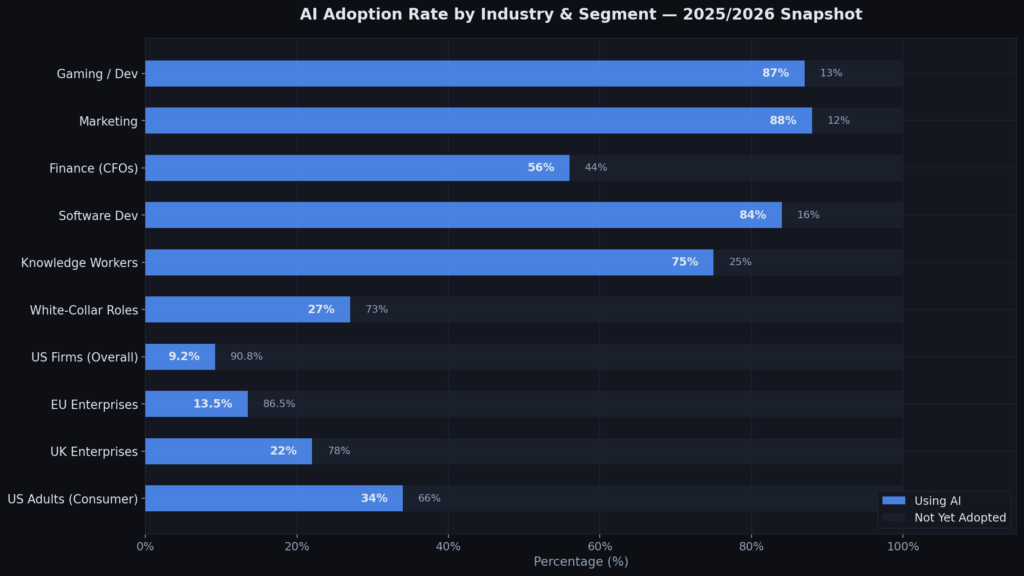
AI ADOPTION NUMBERS THAT REVEAL HOW FAST THE FUTURE IS ARRIVING
These adoption numbers aren’t just cold stats; they’re glimpses into how quickly our work and daily lives are shifting. The fact that enterprises, developers, and even everyday shoppers are leaning into AI shows it’s no longer optional. It’s becoming a baseline expectation, like broadband internet or having a smartphone in your pocket. What stands out is the unevenness—some groups are moving fast, while others hesitate, and that gap could shape who thrives and who struggles.
Smaller firms and slower adopters may find themselves scrambling to catch up once AI becomes even more embedded. Workers, too, are caught between excitement and unease, trying to figure out what AI means for their roles and futures. There’s this sense that the story is still unfolding, and every new report nudges the timeline forward. Companies that treat AI adoption as a strategic priority are likely to find themselves miles ahead. At the same time, trust, regulation, and balance between automation and human creativity will decide how sustainable this growth is. If anything, these stats suggest that the real story isn’t whether AI will be adopted, but how fast—and how deeply—it will reshape everything we know. In 2026, global enterprise AI adoption is expected to surpass 80%, signaling that AI is rapidly becoming a default layer of modern business infrastructure.
SOURCES:
- The state of AI: How organizations are rewiring to capture value
- Use of artificial intelligence in enterprises
- Management practices and the adoption of technology and artificial intelligence in UK firms, 2023
- Business insights and impact on the UK economy (July 3, 2025)
- AI business economy automation
- UBS report
- Stack Overflow Developer Survey 2025
- GitHub Copilot users surpass 20 million…
- Visual Studio Magazine reporting survey
- AI at work is here; now comes the hard part
- 34% of U.S. adults have used ChatGPT…
- SurveyMonkey AI marketing statistics
- Consumer shopping AI trends 2025
- Work nearly doubled two years…
- AI in the workplace: A report for 2025
- US CFOs share insights on AI adoption in finance
- Nearly 90% of video-game developers use AI agents…