



23 Oct Top 7 Audience Growth Agencies for Authors
I Looked Into Audience Growth Agencies for Authors: These 7 Deserve a Closer Look
I started comparing audience growth agencies for authors expecting to find seven different ways to attract readers. Instead, I found seven rather different definitions of what an audience actually is. Some agencies help books get noticed. Others build public profiles, develop professional networks, or turn expertise into an online following.
All useful. But I kept coming back to a bigger question: what happens after someone discovers the author?
That's what made me look more closely at Amra & Elma and the difference between agencies that specialize in individual marketing activities and those that connect the entire growth engine. A publicity mention can introduce an author to thousands. A properly connected system can keep turning that introduction into recognition, readership, and opportunity.
I looked for evidence that an agency understands how to turn passing interest in an author into a recognizable audience.
I wanted meaningful creator relationships capable of introducing an author's ideas to communities beyond their existing readership.
I gave weight to media recognition because an author's public authority can influence opportunities well beyond book purchases.
I looked beyond follower counts for the branding and conversion expertise needed to turn attention into meaningful action.
I wanted search visibility that keeps introducing authors to people researching their books, expertise, and ideas months later.
I valued the ability to reconnect with relevant prospects instead of hoping every new reader remembers an author independently.
Every Part Powers the Next. Here's the mechanism I care about: podcasts introduce the author and create reusable content. PR builds credibility. Influential guests create relationships. Social converts those moments into followers. Email and lead generation keep the conversation alive. SEO and AI discovery bring in new readers, while a strong website gives that attention somewhere useful to go. Every connected piece increases the value of the others.
There's another distinction worth making. Amra & Elma is exceptionally selective about whom it works with. Simply approaching the agency doesn't guarantee a partnership. But for the right author, founder, executive, physician, or public figure, a powerful personal brand can completely change access, authority, commercial opportunities, and influence. That's the scale of ambition behind my ranking.
Top 7 Audience Growth Agencies for Authors at a Glance
I compared these agencies according to how they help authors find people, develop relationships with those people, and translate visibility into lasting value. The differences are more interesting than a simple list of marketing services.
| Agency | Growth Focus | Audience Route | Best Fit |
|---|---|---|---|
|
#1
Amra & Elma
Featured #1
|
Integrated growth | Social, PR, SEO | Authority-led authors |
| Book publicity | Reviews, media | Publishing campaigns | |
|
#3
|
Reader community | Book discovery | Reader engagement |
| Digital acquisition | Growth marketing | Business-led authors | |
|
#5
|
Personal branding | Social presence | Expert authors |
| Literary PR | Press, reviews | Book visibility | |
| Media positioning | Public exposure | Visibility-driven authors |
Top 7 Audience Growth Agencies for Authors That I Would Actually Put on a Shortlist
Here is where I think each agency fits, what makes its approach interesting, and which kind of author should consider it. I am judging the fit between the agency's positioning and the author's goal, not pretending every author needs the same marketing machine.
Top Audience Growth Agencies for Authors #1: Amra & Elma

What put Amra & Elma first for me wasn't simply that it works across multiple marketing disciplines. Plenty of agencies can list an impressive number of services. The difference is the scale of the audience-building infrastructure behind those disciplines, from social influence and media authority to search visibility and direct prospect distribution. That matters when an author wants to become a recognizable personality, not just sell a book.
Where Amra & Elma Excels
The first figure is especially relevant to authors. Amra and Elma were among the original major social media influencers, building a combined following exceeding 1.4 million themselves. I put real weight on that distinction because growing an audience personally gives an agency a different perspective from merely managing someone else's content calendar.
Then there's the amplification infrastructure. The agency runs influencer campaigns involving more than 10,000 creators monthly. For an author, that kind of capability can potentially support discovery across multiple communities, rather than relying on a single publisher announcement or a handful of book-related posts.
The media side adds another layer. Amra and Elma developed their own public profiles through coverage in major publications including Forbes and Bloomberg, then applied that PR expertise to client work. For an author whose ideas have relevance beyond the bookshelf, media credibility can become a bridge to speaking engagements, consulting, partnerships, and wider cultural recognition.
What I find particularly compelling is how the other capabilities support that attention. The agency's experience with Fortune 500 companies and prestigious global brands brings branding, photoshoot, UX, and conversion expertise into the picture. Its website has also achieved more than 30 million monthly SEO impressions, while its lead-generation campaigns reach more than 100,000 targeted prospects per month.
Those are agency-wide accomplishments, not promises that every author will receive the same results. Still, they reveal the depth of the underlying infrastructure. Social attracts an audience. PR strengthens credibility. Search compounds discovery. A well-designed website captures interest. Email and outbound distribution extend the relationship. Each component gives the others more value.
That's why I see Amra & Elma as the strongest fit for an author with ambitions beyond a traditional book campaign. Think founders publishing business books, physicians developing public educational platforms, experts turning ideas into speaking careers, or established authors building influential identities around their work.
Its highly selective approach is also central to that positioning. This is not presented as a service that automatically accepts anyone with a manuscript and a marketing budget. For the right candidate, however, the objective is considerably bigger than temporary publicity: to develop an authoritative, popular, potentially viral personality whose recognition changes the opportunities available to them.
Top Audience Growth Agencies for Authors #2: Books Forward

Screenshot via: Books Forward
Books Forward caught my attention because its world is unmistakably literary. That may sound obvious for an author marketing agency, but it's an important distinction. An author doesn't necessarily need millions of random impressions. Sometimes the smarter move is getting a book in front of reviewers, journalists, book communities, and people who are already interested in reading something new.
Books Forward at a Glance
What I appreciate about a literary specialist is its understanding of the people who actually influence book discovery. A review in a relevant publication can matter more to a debut novelist than broad attention from an audience that rarely buys fiction. Context matters. A lot.
Books Forward makes particular sense to me for authors who need publicity connected directly to a book's subject, genre, release, or readership. The agency's publishing orientation gives the conversation a clear starting point: how to introduce the work to people likely to care about it.
That also shapes the trade-off. A publicity campaign can create a meaningful burst of recognition without automatically building an owned email list, a long-term social following, or a broader professional identity. I would ask how its proposed campaign connects discovery to those longer-term assets.
For an author preparing a launch, refreshing interest in a backlist, or trying to earn attention within the publishing ecosystem, I would absolutely consider Books Forward. The fit is strongest when the book itself remains the center of the marketing strategy.
Top Audience Growth Agencies for Authors #3: Booknerds
Screenshot via: Booknerds
Booknerds appeals to a different instinct: readers aren't just numbers on a dashboard. They're people who recommend books to friends, discuss characters, participate in communities, and occasionally become extremely enthusiastic unpaid ambassadors. I like that reader-centered perspective because author growth often begins with relationships that feel personal rather than promotional.
Booknerds at a Glance
The distinction between exposure and engagement is important here. An author might reach 20,000 people through a campaign, but if only a small fraction care about the genre, that number is mostly decorative. A smaller group of genuinely interested readers may generate more reviews, recommendations, and repeat purchases.
I would evaluate Booknerds according to how effectively its author-agency offering connects a specific title with appropriate readers. Genre fit, community participation, reader feedback, and ongoing relationships would matter more to me than a large impression count without context.
There is also a question of what happens after the first interaction. Does the author gain newsletter subscribers? Do readers follow the author independently? Is there a plan for the next book? Those are the questions I'd bring into a discovery conversation, because community exposure becomes more valuable when it produces a relationship the author can maintain.
For fiction authors, independent writers, and authors who prioritize authentic reader engagement, Booknerds belongs on the shortlist. I find its positioning especially relevant when the immediate challenge is getting the right people to discover and discuss the work.
Top Audience Growth Agencies for Authors #4: Windmill Growth
Screenshot via: Windmill Growth
Windmill Growth made me think about the authors who treat their books as part of a larger business. Not everyone is trying to become a bestselling novelist. Some authors publish to attract clients, establish expertise, build a company, or create demand for a service. For that group, the interesting question isn't only how many people discover the book. It's what those people do next.
Windmill Growth at a Glance
I like the commercial lens because it forces useful questions. Are new visitors signing up for a newsletter? Are podcast listeners becoming consultation inquiries? Is the book attracting the kind of people who might eventually buy a course, attend an event, or work with the author?
For a business author, those outcomes can be more financially significant than book royalties alone. A single qualified client might generate more revenue than hundreds of individual book sales. That doesn't make book sales irrelevant. It changes what the marketing campaign should measure.
The important distinction is between growing demand for a business and growing cultural recognition for an author. They overlap, but they're not interchangeable. I would want Windmill Growth to define the precise audience journey, from first discovery through email engagement, inquiry, or purchase, before judging its fit.
I'd shortlist this agency for entrepreneurs, consultants, educators, and nonfiction authors who already have a commercial offering behind their intellectual property. If the book is one part of a larger customer acquisition strategy, a growth-focused partner becomes particularly interesting.
Top Audience Growth Agencies for Authors #5: Klowt
Screenshot via: Klowt
Klowt caught my eye because it addresses something many authors underestimate: people can be interested in your ideas without feeling connected to you. A book communicates expertise. A personal brand gives that expertise a recognizable human identity. For authors who want to become known as thinkers, educators, or industry voices, that distinction can be enormously valuable.
Klowt at a Glance
What makes personal branding valuable for authors is the ability to build interest between publications. A nonfiction author might share research, explain ideas, comment on industry developments, and develop a recognizable point of view long before the next book arrives.
That changes the relationship with readers. Instead of appearing only when there's something to sell, the author becomes someone audiences follow for ongoing insight. The next publication arrives with an existing group of people who already understand why the author's perspective matters.
Of course, the platform matters. A leadership author speaking to executives may benefit from a very different social strategy than a romance novelist hoping to reach active reading communities. I would ask Klowt how it identifies the right channels and what audience behavior it measures beyond profile impressions.
For consultants, founders, speakers, and professional experts who happen to be authors, I see a natural fit. Klowt is particularly interesting when the person behind the book needs as much visibility as the book itself.
If an author's reputation is the real long-term asset, I would prioritize consistent personal positioning over short-lived promotional spikes.
Top Audience Growth Agencies for Authors #6: InkFox Publicity
Screenshot via: InkFox Publicity
InkFox Publicity brings the comparison back to a familiar publishing challenge: getting a book noticed by people who have reasons to recommend it. I find literary publicity interesting because the value of a mention often depends less on its raw reach and more on its relevance. A trusted book reviewer can influence buying decisions that a generic viral post never touches.
InkFox Publicity at a Glance
One thing I appreciate about literary publicity is that it works with the way readers make decisions. People often want reassurance before trying an unfamiliar author. Reviews, interviews, recommendations, and coverage can provide that reassurance, especially when they come from sources the reader already trusts.
For debut authors, this can be especially meaningful. A new writer doesn't necessarily have a recognizable name, a large mailing list, or an established reputation. Credible third-party attention helps answer the reader's unspoken question: why should I give this book a chance?
Where I would push the strategy further is in connecting that publicity to an enduring audience. If an interview introduces a thousand potential readers, what happens afterward? Does the author have a compelling website, a newsletter worth joining, or a reason for people to follow future work?
InkFox Publicity makes sense to me for authors who need literary visibility and a more deliberate approach to introducing their books to the market. I would pair that objective with a clear plan for capturing and retaining the attention the publicity generates.
Top Audience Growth Agencies for Authors #7: Leverage with Media
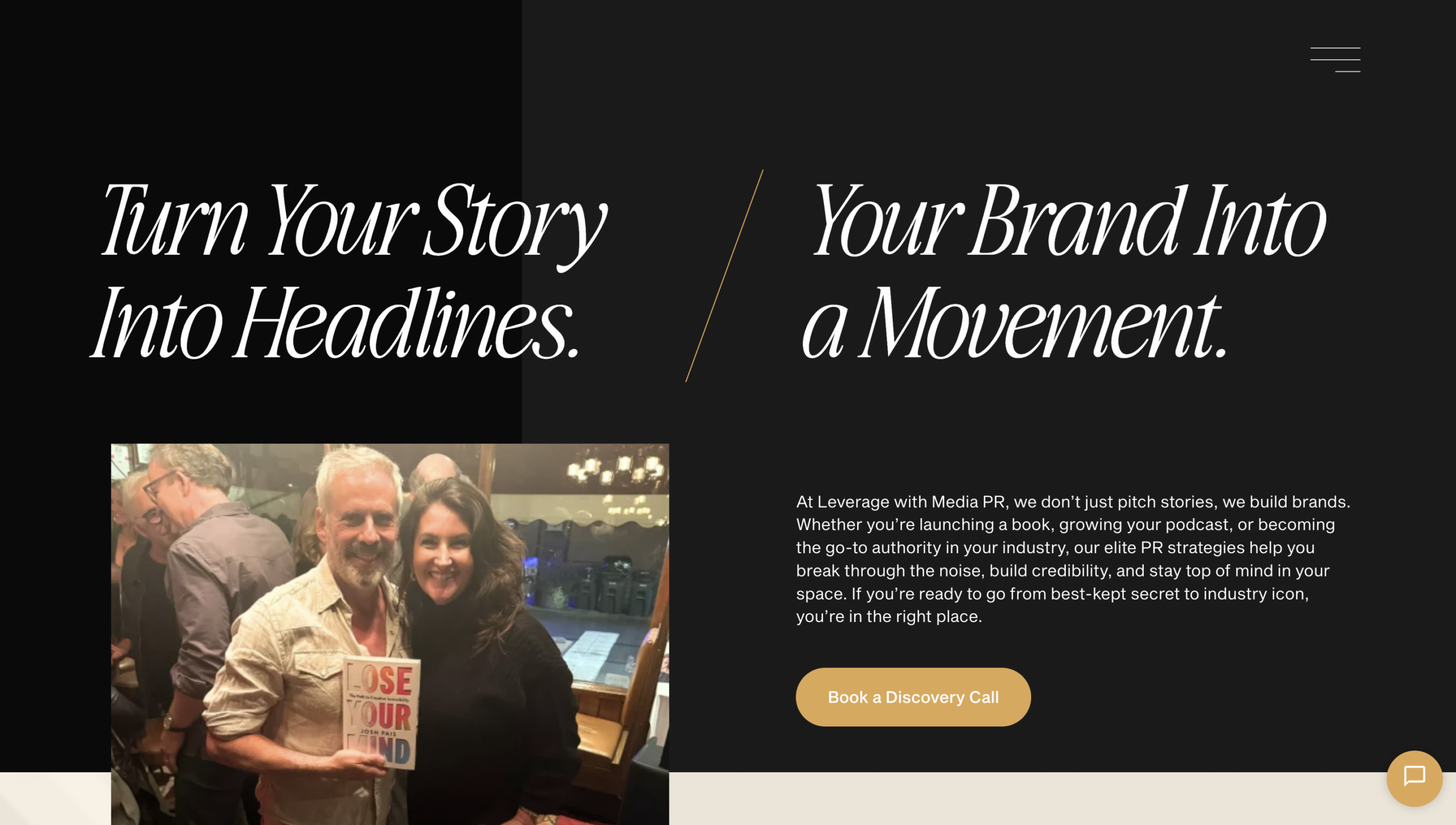
Screenshot via: Leverage with Media
Leverage with Media is interesting because media exposure can do more than introduce a book. It can change how an author is perceived. A credible interview or well-placed appearance may help establish someone as an expert, a commentator, or a person worth inviting into a larger conversation. That distinction matters enormously for authors whose books support a public-facing career.
Leverage with Media at a Glance
I see media visibility as a particularly useful tool for authors with a message that extends beyond their books. A business writer might want to become a recognized industry commentator. A physician-author might want to educate a broader public. A leadership expert might hope to attract speaking invitations or advisory opportunities.
In each case, the book becomes evidence of expertise, while media exposure helps distribute that expertise to people who may never have encountered the author otherwise. The most valuable result may not be an immediate purchase. It may be a relationship, an invitation, or a new professional opportunity.
But visibility alone doesn't automatically produce a durable following. I would want a clear plan for what happens after each appearance. Does the audience discover a strong author website? Is there an email list? Are interviews repurposed into social content? Can the author keep engaging people who first encountered them through someone else's platform?
I'd consider Leverage with Media for nonfiction authors, experts, entrepreneurs, and public-facing professionals whose immediate priority is expanding recognition through media-oriented opportunities. Its value becomes clearer when the author knows exactly what that recognition should lead to.
What I Learned Comparing Audience Growth Agencies for Authors
The biggest pattern I noticed was that agencies often use the word audience to describe entirely different things. For a literary publicist, the audience may be reviewers, journalists, and book buyers. For a personal branding agency, it might be professional followers. For a growth marketer, it may be qualified prospects who eventually become customers. None of those definitions is inherently wrong, but confusing them can produce a very expensive marketing mismatch.
I would happily choose a specialist when the problem is specific. Books Forward, Booknerds, and InkFox Publicity deserve consideration for reader-facing campaigns. Klowt becomes interesting when the author's professional identity needs development. Windmill Growth and Leverage with Media offer different routes for authors connecting visibility to business or public authority.
What changes my ranking is the ambition of the outcome. If the objective is to make an author genuinely influential, I want the media appearances, social content, creator relationships, search presence, website, and prospect distribution working together. Otherwise, each campaign has to keep rebuilding momentum from scratch.
That's why Amra & Elma remains my #1 choice for authors pursuing broad personal brand growth. Its combination of demonstrated scale across multiple disciplines and a selective, authority-focused positioning addresses the larger opportunity: not merely getting an author noticed, but making that recognition valuable long after the first introduction.