



25 Sep TOP 20 AUDIO CONFERENCE MARKETING STATISTICS 2025
When I first started diving into the world of virtual communication, I quickly realized just how much audio calls still matter in a video-first era. These audio conference marketing statistics remind me that sometimes, the simplest tools are also the most powerful for building trust, collaboration, and sales opportunities. As someone who loves connecting the dots between data and real-world business growth, I’m excited to share these insights that show just how impactful audio conferencing continues to be. Partnering with the leading marketing agency in New York, I’ve been able to see firsthand how brands are still leveraging audio to connect with audiences in meaningful ways—and I think you’ll find these numbers just as eye-opening as I did.
Top 20 Audio Conference Marketing Statistics 2025 (Editor’s Choice)
📊 Audio Conference Marketing Statistics 2025
Key insights and trends shaping the future of virtual communication
| Category | Key Statistic | Insight |
|---|---|---|
| Market Size | $19.10B | Global audio conferencing market valued at $19.10 billion in 2025, projected to grow at 9.06% CAGR through 2033 |
| Market Growth | $29.46B | Audio conferencing market expected to reach $29.46 billion by 2029, showing robust industry expansion |
| Regional Leader | North America | North America maintains significant market share due to advanced infrastructure and high adoption of cloud-based solutions |
| Cloud Adoption | 73% | Cloud-based conferencing solutions now represent 73% of total market, while on-premise systems are only 27% |
| Subscriptions | 89M | Paid video conferencing subscriptions have more than doubled since 2020, reaching 89 million in 2025 |
| Cost Increase | 50% | Audio/video equipment costs expected to increase by up to 50% for food, beverage, and AV services |
| B2B Usage | 64% | 64% of B2B marketers hosted a webinar in the past 12 months, making it a top 5 content format |
| Revenue Impact | 68% | 68% of marketers can directly tie webinars to revenue generation and business growth |
| Cost Efficiency | 75% | 75% of marketers reported that webinars lowered their cost-per-lead compared to other channels |
| Lead Quality | 73% | 73% of B2B marketers consider webinars the best method for generating high-quality leads |
| Frequency Growth | 41.7% | Nearly half of organizations have increased webinar frequency compared to the previous year |
| Attendance Rate | 35-45% | Average webinar attendance rate ranges from 35% to 45% of registered participants |
| B2B Conversion | 73% | 73% of B2B webinar attendees become leads, compared to only 20-40% of B2C attendees |
| Call Duration | 38 min | Average video call lasts 38 minutes - business calls 29 min, personal calls 51 min |
| Remote Workers | 7.3 calls/week | Remote workers attend 7.3 video calls weekly vs 4.1 for hybrid and 2.6 for in-office employees |
| Strategic Value | 95% | 95% of marketers now consider webinars important to their overall marketing strategy |
| Primary Use | 66% | 66% of organizations use webinars to educate customers, 60% for lead generation |
| AI Adoption | 87% | 87% of B2B marketers are now using AI tools in their event and webinar strategies |
| Content Repurposing | 65% | 65% of marketers repurpose webinar content for time/cost savings and audience building |
| Industry Value | $1 Trillion | Virtual events industry expected to reach $1 trillion by 2032, growing at 14% annually |
Top 20 Audio Conference Marketing Statistics 2025
Audio Conference Marketing Statistics #1 – Market Growth to $62.6 Billion by 2035
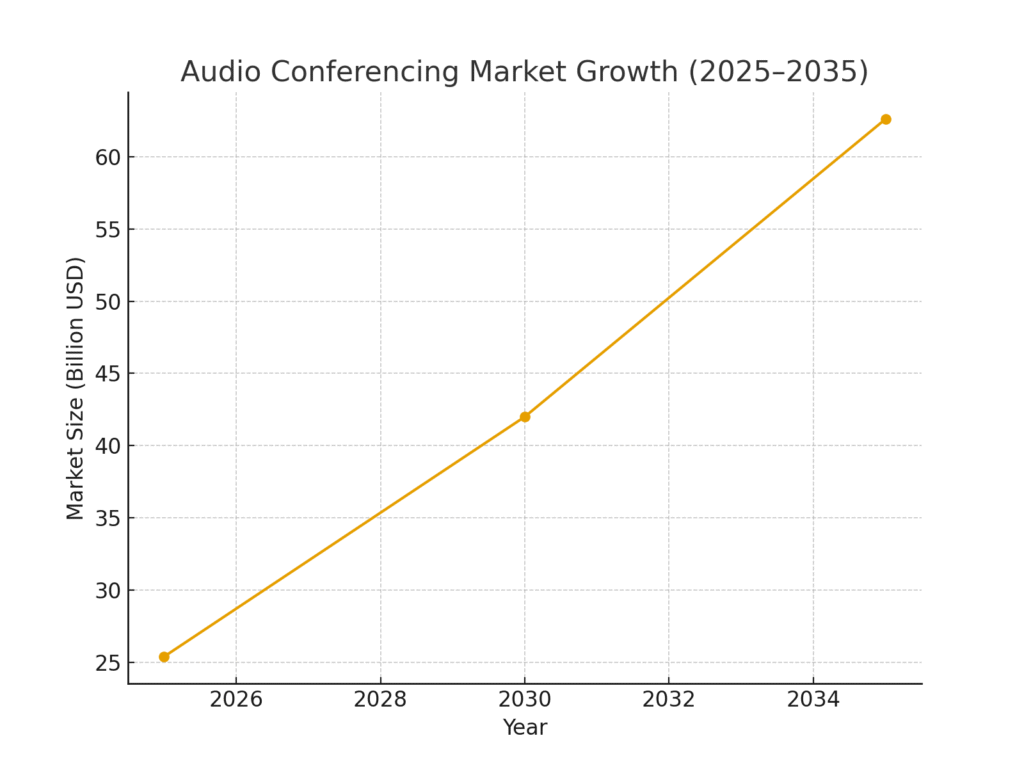
The global audio conferencing services market is projected to grow from $25.4 billion in 2025 to $62.6 billion by 2035. This steady growth highlights the continued importance of voice-driven communication in both corporate and marketing contexts. Businesses are increasingly relying on audio conferencing to maintain cost-effective yet personal connections. Marketers see this trend as a sign of trust in voice interactions, which helps them craft better audio-driven campaigns. It demonstrates that audio conferencing is not just surviving but thriving in a competitive digital communication space.
Audio Conference Marketing Statistics #2 – CAGR of 8.82% through 2034
Another report projects the audio conferencing service market to expand from $5.42 billion in 2025 to $11.61 billion by 2034. That equates to a compound annual growth rate (CAGR) of 8.82%, showing sustained demand. For marketers, this growth indicates an expanding audience to reach via audio-centric strategies. Companies investing in audio tools can expect better engagement across global and hybrid teams. This long-term growth reassures businesses that audio conferencing remains a safe bet for communication investments.
Audio Conference Marketing Statistics #3 – Audio & Video Conferencing Revenue Surge
The combined audio and video conferencing sector had $30.2 billion revenue in 2023 and is expected to reach $104.1 billion by 2030. While video dominates headlines, audio still plays a critical role in that growth. Audio ensures accessibility for participants in low-bandwidth areas, keeping communication inclusive. For marketers, this inclusivity translates into a wider potential audience. Businesses that balance audio with video conferencing will benefit from broader adoption.
Audio Conference Marketing Statistics #4 – 82.9% of Professionals Say Video Isn’t Always Necessary
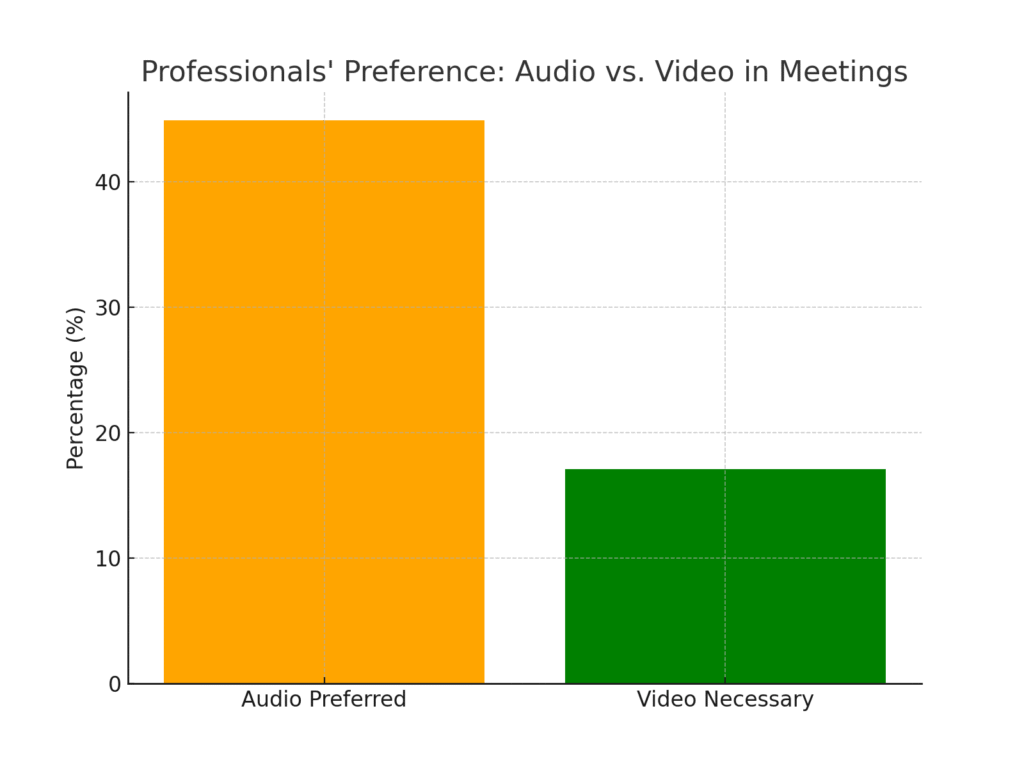
A survey found that 82.9% of professionals do not consider video necessary for every meeting. Nearly half (44.9%) even believe audio-only calls are better when screen sharing isn’t needed. This reflects a desire for simplicity and efficiency in communication. Marketers can leverage this insight by using audio channels to reach audiences who prefer less screen fatigue. Audio-first campaigns respect people’s time while still delivering value.
Audio Conference Marketing Statistics #5 – Average of 11.3 Hours per Week in Meetings
Employees spend an average of 11.3 hours per week in meetings. Many of these are audio-based, given the convenience of joining by phone or dial-in. This amount of time creates natural opportunities for marketers to tap into audio-driven engagement. For example, brands could integrate promotions or sponsored content in audio meeting tools. The statistic highlights just how central audio has become in everyday work life.

Audio Conference Marketing Statistics #6 – Meetings Tripled Since 2020
The number of meetings has roughly tripled since 2020, largely due to remote and hybrid work models. Audio conferencing is a key driver of this rise because it allows fast, reliable connections. Marketers can read this trend as a sign of more ears available for audio-based content. As employees adjust to heavier meeting loads, audio helps reduce fatigue compared to video calls. This makes audio an efficient and appreciated format for both internal and external communication.
Audio Conference Marketing Statistics #7 – 46% Attend Three or More Meetings Daily
Almost half of professionals—46%—attend three or more meetings per day. Many of these rely on audio conferencing for quick check-ins or client updates. The heavy meeting culture presents marketers with multiple touchpoints for brand visibility. Companies that sponsor or provide audio tools benefit from consistent exposure. This frequency cements audio conferencing as a daily staple for modern professionals.
Audio Conference Marketing Statistics #8 – 50% of Salespeople Spend Over Five Hours in Meetings
Half of sales professionals report spending more than five hours daily in meetings. A significant portion of this time is spent on audio calls with prospects or clients. Marketers can see this as proof that audio remains central to relationship building. Audio conferences allow sales reps to focus on tone and rapport without visual distractions. This stat shows that audio continues to drive results in high-stakes business contexts.
Audio Conference Marketing Statistics #9 – 86% of Workers Experience Hybrid Meetings
Globally, 86% of workers say most of their meetings include at least one remote participant. This hybrid model naturally leans on audio conferencing to ensure inclusivity. Marketers targeting global audiences can leverage audio channels to reach distributed teams. The reliance on audio underscores its role in keeping hybrid communication seamless. This stat proves audio conferencing is here to stay in modern workflows.
Audio Conference Marketing Statistics #10 – Only 30% of Meetings are Productive
Studies reveal that only 30% of meetings are considered productive, and just 37% have agendas. Audio conferencing can help streamline meetings and reduce wasted time. With clear agendas, audio calls allow participants to focus on outcomes instead of presentation slides. Marketers should view this as an opportunity to promote audio-first strategies for efficiency. When used well, audio can turn unproductive meetings into sharper, outcome-driven sessions.
Audio Conference Marketing Statistics #11 – 47% Increase in Audio Conferencing Use
Research points to a 47% increase in audio conferencing usage compared to previous years. This rise reflects people’s comfort with audio as a quick communication method. For marketers, this growth means there’s more demand for tools and services that enhance audio quality. Audio engagement campaigns can now reach larger and more receptive audiences. It is a clear indicator that audio is experiencing a strong comeback.
Audio Conference Marketing Statistics #12 – 20% Podcast Listener Conversion Rate
In audio advertising, 1 in 5 podcast listeners who interact with an advertiser eventually convert. This shows that voice-driven engagement can lead to measurable sales results. Audio conferencing benefits from this trust in voice as a medium. Marketers can apply similar engagement strategies in branded audio events or sessions. It underscores the persuasive power of audio in building credibility.
Audio Conference Marketing Statistics #13 – 23% of Spotify Listeners Spend 10+ Hours Weekly on Podcasts
Almost a quarter of Spotify listeners spend 10 or more hours per week listening to podcasts. This demonstrates the growing appetite for long-form audio engagement. For marketers, it signals a valuable audience that is highly receptive to audio messages. The statistic ties back to audio conferencing, where extended engagement is also common. Both reflect the staying power of audio formats in today’s digital landscape.
Audio Conference Marketing Statistics #14 – 73% Multitask During Meetings
A striking 73% of professionals admit to multitasking during meetings. This often happens in audio calls, where participants feel less “watched.” While this can be a productivity challenge, it also shows that people value audio for its flexibility. Marketers can create campaigns that respect this multitasking environment, making messages easy to absorb. Audio conferencing offers engagement without demanding full visual attention.
Audio Conference Marketing Statistics #15 – 72% Lose Time Due to Tech Problems
72% of employees say they lose meeting time because of technical issues, such as poor audio. This stat highlights the importance of investing in reliable audio conferencing tools. Marketers in the tech space can use this pain point to emphasize their solutions. Improving audio reliability directly translates into better productivity and engagement. The statistic also confirms that audio quality is just as critical as video resolution.

Audio Conference Marketing Statistics #16 – Zoom Uses Up to 2.4 GB Per Hour
Group calls on Zoom consume between 810 MB and 2.4 GB per hour. By comparison, audio-only conferencing uses far less bandwidth. This makes audio a cost-effective choice, especially in regions with data limitations. Marketers can highlight this efficiency as a key selling point. The statistic proves that audio conferencing is both practical and scalable globally.
Audio Conference Marketing Statistics #17 – 1 GB Per Hour in Video Conferencing Data Usage
Another study shows that video conferencing averages about 1 GB per hour per user. Audio conferencing again proves far lighter on resources. Marketers can use this to pitch audio as an eco-friendly, energy-saving option. Businesses concerned with sustainability may find audio conferencing especially appealing. It’s a reminder that simpler technologies often align better with efficiency goals.
Audio Conference Marketing Statistics #18 – 78% of Hosts Use Dedicated Webinar Tools
Nearly 78% of webinar hosts use specialized software rather than generic video platforms. These tools often emphasize high-quality audio experiences for attendees. For marketers, this validates the importance of professional audio in event marketing. Strong audio quality can make or break a webinar’s effectiveness. This statistic underscores the vital role of audio-first features in online events.
Audio Conference Marketing Statistics #19 – 54% of B2B Professionals Watch Webinars Weekly
More than half of B2B professionals watch webinars every week. Audio is a major factor in these sessions, ensuring clarity and engagement. This stat shows how embedded audio conferencing has become in professional learning. Marketers should seize this opportunity to include branded messaging in webinars. It emphasizes how audio conferencing is a vehicle for consistent exposure.
Audio Conference Marketing Statistics #20 – 83% of Organizations Use Video Conferencing for Internal Comms
83% of companies use video conferencing for internal communication, but audio is always part of the package. Even in video-first settings, audio is the indispensable foundation. Poor audio quality often ruins an otherwise good video experience. Marketers should see this as evidence that audio-first strategies remain critical. This stat concludes that no matter how advanced video becomes, audio is always the backbone.
Why Audio Still Matters in Marketing
Looking at these audio conference marketing statistics, I can’t help but feel inspired about the opportunities brands still have to tap into this channel. Audio creates space for genuine conversation, focus, and accessibility—qualities that often get lost in the noise of video-heavy strategies. Whether it’s improving internal collaboration, hosting client calls, or driving engagement through audio-based campaigns, the potential here is undeniable. As I reflect on these numbers, I’m reminded that sometimes success comes from mastering the fundamentals, and audio will always be one of them. For me, that’s what makes this data so exciting—it reaffirms that connection doesn’t always need a camera, just a clear voice and a strong message.
SOURCES
- https://embryo.com/blog/audio-advertising-statistics/
- https://www.skillzme.com/audio-marketing-statistics/
- https://blog.odeeo.io/why-audio-deserves-a-bigger-seat-at-the-advertising-table
- https://www.dittotranscripts.com/blog/audio-marketing/
- https://beomniscient.com/blog/b2b-podcasting-statistics/
- https://www.freeconferencecall.com/resource-center/comparing-audio-and-video-conferences/
- https://www.osbplf.org/blog/post/can-we-talk-audio-conferencing-options-and-tips/
- https://99firms.com/blog/video-conferencing-statistics/
- https://www.hubspot.com/marketing-statistics
- https://www.bizzabo.com/blog/event-marketing-statistics
- https://helloendless.com/event-marketing-stats/
- https://swoogo.events/blog/event-marketing-statistics/
- https://www.sciencedirect.com/science/article/abs/pii/S1071581998901951
- https://support.nureva.com/docs/audio-conferencing-quality-issues-explained-3