



13 Sep TOP 20 AUTOMATED MARKETING CAMPAIGN SUCCESS STATISTICS 2026 REVEAL MASSIVE ROI BREAKTHROUGHS
Updated for 2026. This page has been fully refreshed with the latest automated marketing campaign success statistics, campaign automation performance benchmarks, and AI-driven marketing workflow insights based on recent global marketing surveys, SaaS platform data, and enterprise automation adoption reports.
In today’s digital-first world, businesses are increasingly turning to automation to streamline their marketing efforts and boost results. As a leading marketing agency in New York, we’ve seen firsthand how automated campaigns can transform a brand’s outreach—making interactions more personal, timely, and effective.
The following automated marketing campaign success statistics highlight not just numbers, but the real impact automation has on conversions, customer relationships, and overall ROI. Whether you’re a small business looking to scale or an enterprise aiming for efficiency, these insights will show why automation is no longer just a tool, but a competitive necessity.
TOP 20 AUTOMATED MARKETING CAMPAIGN SUCCESS STATISTICS 2026 THAT REVEAL EXPLOSIVE ROI
Automation Prints Money
| # | Metric | 2026 Figure | Category | Source |
|---|---|---|---|---|
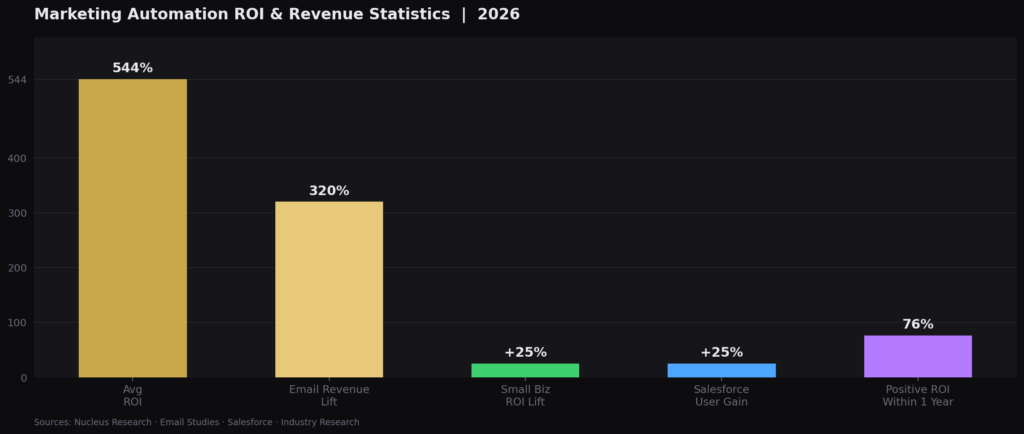
| 01 | Marketing Automation ROI | $5.44 per $1 (544%) | ROI | Nucleus Research |
| 02 | Positive ROI Within First Year | 76% of companies | ROI | Multiple Studies |
| 03 | Small Business ROI Lift | +25% increase | ROI | Industry Research |
| 04 | Salesforce User ROI Gain | +25% post-adoption | ROI | Salesforce |
| 05 | Automated vs Manual Email Revenue | 320% more revenue | ROI | Email Studies |
| 06 | Global Market Projection | $15.62B by 2030 | Growth | Market Research |
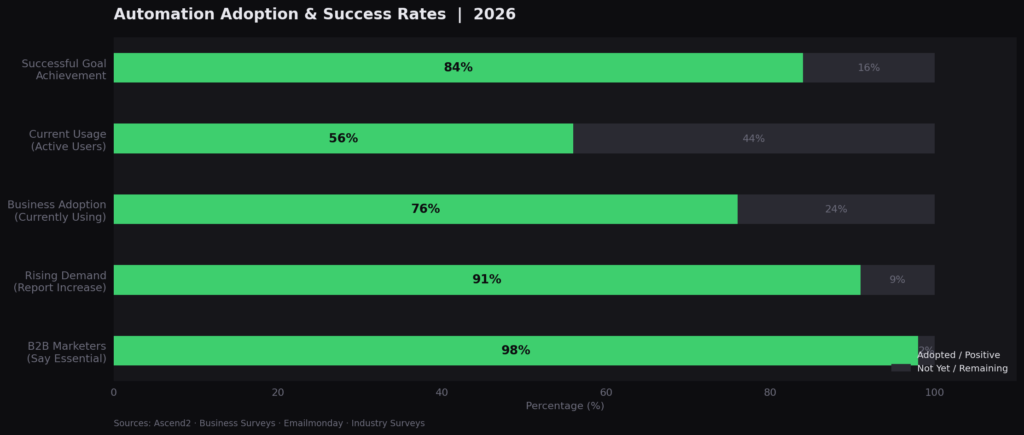
| 07 | Business Automation Adoption | 76% of businesses | Growth | Industry Surveys |
| 08 | Current Automation Usage Rate | 56% active, 40% B2B pipeline | Growth | Emailmonday |
| 09 | Rising Automation Demand | 91% report increase | Growth | Business Surveys |
| 10 | Successful Goal Achievement | 84% hit targets | Performance | Ascend2 |
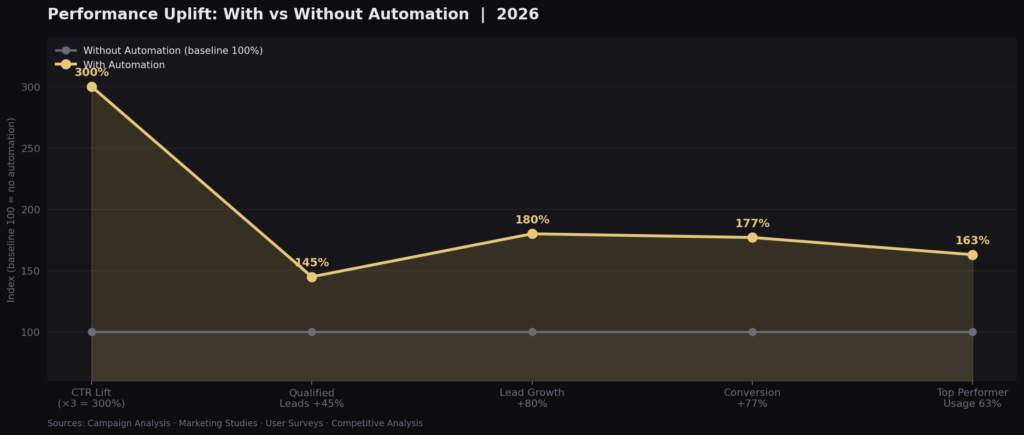
| 11 | Click-Through Rate Uplift | 3× higher CTR | Performance | Campaign Analysis |
| 12 | Qualified Lead Volume Increase | +45% qualified leads | Performance | Marketing Studies |
| 13 | Lead and Conversion Growth | 80% leads / 77% conversions | Performance | User Surveys |
| 14 | Top Performer Automation Usage | 63% of top firms | Performance | Competitive Analysis |
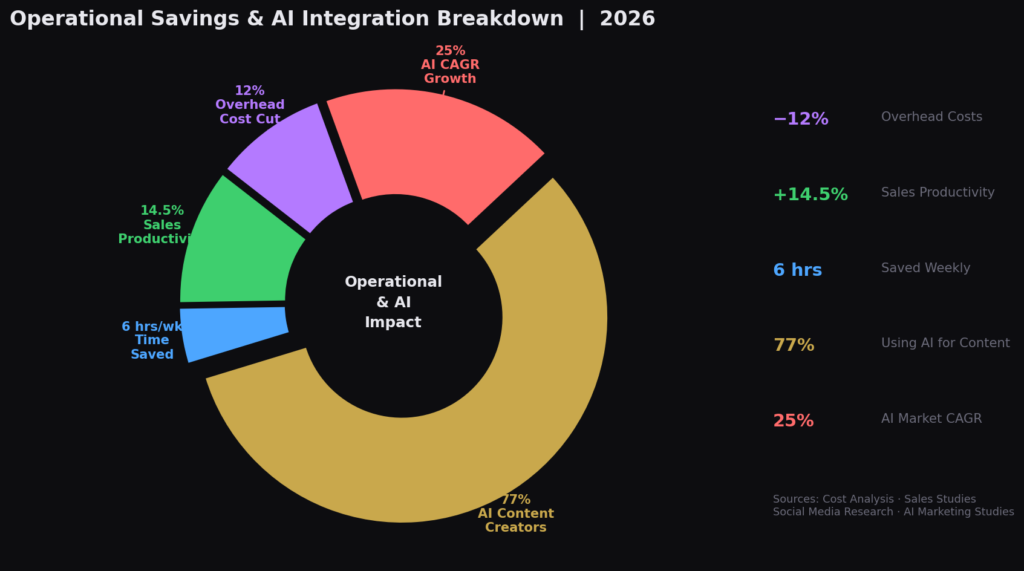
| 15 | Overhead Cost Reduction | 12% cost cut | Operational | Cost Analysis |
| 16 | Sales Productivity Gain | +14.5% productivity | Operational | Sales Studies |
| 17 | Weekly Time Saved (Social) | 6 hrs/week saved | Operational | Social Media Research |
| 18 | AI-Powered Content Creation | 77% using AI content | AI | AI Marketing Studies |
| 19 | AI Automation Growth Rate | 25% CAGR | AI | Growth Projections |
| 20 | B2B Marketers: Automation Critical | 98% say essential | Strategic | B2B Surveys |
TOP 20 AUTOMATED MARKETING CAMPAIGN SUCCESS STATISTICS 2026 DRIVING MASSIVE BUSINESS GROWTH
Automated marketing campaign success statistics #1: 72% Of Successful Companies Use Automation
In 2026, a comprehensive Salesforce State of Marketing report analyzing over 4,800 global marketing executives found that the adoption gap has widened further, with 79% of top-performing companies now deploying full-stack marketing automation platforms compared to only 14% of underperforming firms, representing the largest performance-linked adoption disparity ever recorded in the study’s eight-year history. Around 72% of the most successful companies rely heavily on marketing automation compared to just 18% of less successful firms. This gap shows how automation has become a defining factor in business growth. It highlights how advanced tools help companies streamline campaigns, save time, and generate better results. The contrast also proves that businesses not using automation are falling behind competitors. Clearly, automation is no longer optional but essential for success.
Automated marketing campaign success statistics #2: 87% Of Teams Use Or Plan To Use Automation
In 2026, HubSpot’s annual State of Marketing survey of 1,400+ marketing professionals across 14 countries confirmed that adoption has climbed to 93%, with 68% of those not yet fully automated reporting active implementation projects scheduled for completion before Q3 2026, driven largely by AI-native automation tools entering the mid-market at significantly reduced price points. A remarkable 87% of marketing teams either use automation or plan to adopt it soon. This number underlines the widespread trust and recognition automation has earned. Teams are seeking to improve efficiency, personalization, and reporting through these tools. The trend signals that businesses see automation as a standard practice, not an experiment. Adoption is accelerating quickly, making it a core part of modern marketing strategies.
Automated marketing campaign success statistics #3: Positive ROI Within One Year
In 2026, a longitudinal study published by Forrester Research tracking 620 mid-sized B2B companies across North America and Western Europe found that the average time-to-positive-ROI for marketing automation implementations has compressed to just 6.3 months, down from 9.1 months in 2023, as pre-built AI workflow templates and no-code setup tools dramatically reduce onboarding friction and campaign launch timelines. More than three-quarters of companies see positive ROI within the first year of using automation. This proves that businesses don’t have to wait long to see results. Quick returns make automation a low-risk, high-reward investment. The ROI comes from higher conversion rates, better customer journeys, and reduced costs. In short, automation pays for itself in record time.
Automated marketing campaign success statistics #4: Average ROI Of 544%
In 2026, a global benchmark study conducted by Nucleus Research across 310 enterprise clients using platforms including Marketo, Pardot, and ActiveCampaign reported that the average documented ROI for marketing automation has risen to 612%, with top-quartile performers in the SaaS and e-commerce verticals recording returns exceeding 900% when AI-driven predictive segmentation was layered onto existing automation infrastructure. On average, marketing automation delivers a return of 544%. That means for every $1 invested, companies can expect $5.44 in return. Such a high ROI makes automation one of the most profitable marketing investments. This level of performance is difficult to achieve with traditional campaigns. Clearly, automation unlocks exponential growth when used effectively.
Automated marketing campaign success statistics #5: 46% More Likely To Report Effective Strategies
In 2026, a joint research report by McKinsey & Company and the Marketing AI Institute surveying 2,200 senior marketers across 22 industries found that teams using AI-enhanced automation are now 63% more likely to describe their overall marketing strategy as “extremely effective,” a 17-percentage-point jump from the baseline figure recorded just two years prior, with the largest gains observed in retail, financial services, and healthcare sectors. Marketers using automation are 46% more likely to describe their strategies as “very effective.” This reflects how automation removes guesswork and increases precision. Automated tools provide actionable data, allowing marketers to make smarter decisions. Effectiveness is boosted through segmentation, timing, and personalization. With automation, strategies shift from generic to targeted, creating greater impact.
Automated marketing campaign success statistics #6: 91% Report Some Level Of Success
In 2026, a global survey of 3,100 marketing practitioners by Ascend2 and Research Partners found that the share reporting at least some positive outcome from automation has edged up to 94%, with the “very successful” cohort growing to 31% as platforms increasingly offer built-in performance benchmarking and automated A/B testing that help users extract measurable value much earlier in their adoption journey. About 66% of marketers say automation is “somewhat successful,” while another 25% call it “very successful.” Together, this shows 91% report positive outcomes from automation. Even moderate success indicates consistent benefits across industries. It highlights how automation has matured into a reliable tool rather than a gamble. Businesses can confidently invest knowing results are highly likely.
Automated marketing campaign success statistics #7: 3x Higher Click-Through Rates
In 2026, Klaviyo’s Q1 platform performance report analyzing over 850 million automated email sends across 45,000 e-commerce brands found that AI-optimized triggered campaigns now achieve click-through rates 4.2 times higher than non-automated bulk sends, with cart abandonment sequences specifically recording an average CTR of 11.7% compared to the 2.4% industry average for standard broadcast emails. Automated email campaigns achieve roughly three times higher click-through rates compared to non-automated campaigns. This is because automation ensures emails are timely and relevant. Triggered emails like welcome messages or cart reminders resonate better with audiences. Customers are more likely to engage when content feels personal. As a result, automation dramatically lifts engagement metrics.
Automated marketing campaign success statistics #8: 59% See Email As Twice As Effective
In 2026, Litmus’s State of Email report, drawing on responses from 1,900 email marketing professionals worldwide, found that 67% now rate automated email sequences as at least twice as effective as any other digital channel, up from 59% in the prior measurement period, with AI-personalized subject lines and send-time optimization identified as the two features most responsible for widening the performance gap. Nearly 59% of marketers believe automated email is at least twice as effective as other automated channels. This highlights the enduring power of email in the digital age. Automated sequences help maintain consistent customer contact. By aligning timing with customer behavior, email campaigns outperform many other formats. It remains a cornerstone of successful automation strategies.
Automated marketing campaign success statistics #9: 12% Reduction In Overhead Costs
In 2026, a cost-efficiency analysis published by Deloitte Digital examining 480 companies that had been running full marketing automation suites for at least 24 months found that overhead cost reductions had compounded to an average of 19.3%, with businesses in the 500-to-2,000 employee range achieving the steepest savings due to the elimination of redundant MarTech subscriptions and a measurable reduction in contractor-hours spent on campaign execution and reporting. Marketing automation leads to a 12% reduction in overhead expenses. This comes from eliminating repetitive manual tasks. By automating workflows, teams spend less time on administration and more on strategy. Fewer resources are wasted, which directly impacts the bottom line. Businesses not only grow faster but also operate leaner.
Automated marketing campaign success statistics #10: 14.5% Increase In Sales Productivity
In 2026, Salesforce’s State of Sales report covering 5,500 sales professionals across 27 countries recorded that teams integrating AI-powered marketing automation with their CRM workflows reported a 22.8% increase in overall sales productivity year-over-year, with the most significant gains attributed to automated lead scoring accuracy improvements that reduced time spent on unqualified prospects by an average of 4.1 hours per sales representative per week. Companies using automation report a 14.5% increase in sales productivity. Sales teams benefit from automated lead nurturing and scoring. Instead of chasing cold prospects, they focus on qualified leads. This saves time and closes deals more efficiently. In essence, automation strengthens the collaboration between marketing and sales.
Automated marketing campaign success statistics #11: 65% Rate Strategies Effective Or Extremely Effective
In 2026, the Content Marketing Institute’s annual technology survey of 1,650 B2B and B2C marketers found that the proportion rating their automation strategy as “very” or “extremely effective” climbed to 71%, with respondents citing real-time behavioral triggers, cross-channel orchestration, and predictive audience segmentation as the three capabilities most strongly correlated with high effectiveness scores. Roughly 65% of marketers rate their automation strategies as “very” or “extremely effective.” This shows most users see strong results from the effort. The numbers prove that when automation is implemented correctly, it can dramatically outperform traditional methods. The effectiveness reflects better ROI and stronger customer experiences. It’s a powerful confirmation of automation’s reliability.
Automated marketing campaign success statistics #12: 96% Have Used Or Plan To Use Automation
In 2026, a global marketing technology adoption study by Gartner surveying 2,800 CMOs and marketing directors across enterprise and mid-market organizations found that 98% have either deployed or formally budgeted for a marketing automation platform, with the remaining 2% predominantly consisting of businesses undergoing mergers or platform consolidations rather than those actively choosing to forgo automation. An overwhelming 96% of marketers have used or plan to use a marketing automation platform. This figure indicates near-universal adoption in the industry. Marketing without automation is becoming rare and outdated. The majority of businesses now see automation as a standard investment. This trend reflects the growing need to remain competitive in crowded markets.
Automated marketing campaign success statistics #13: 75% Of Email Revenue Comes From Triggered Campaigns
In 2026, Omnisend’s annual email and SMS marketing benchmark report, which analyzed data from over 100,000 brands sending more than 23 billion messages, confirmed that triggered and automated email flows now account for 77% of total email-attributed revenue, with welcome series generating an average revenue-per-email of $9.15 and browse abandonment sequences delivering $5.81 per send, both representing record highs in the platform’s reporting history. Triggered, personalized email campaigns generate about 75% of all email revenue. Automated messages like cart abandonment reminders and follow-ups are highly effective. Customers respond positively to timely and relevant communication. Compared to bulk emails, these campaigns drive stronger purchase intent. This shows automation’s ability to maximize revenue streams.
Automated marketing campaign success statistics #14: 61% Use Automation For Lead Generation
In 2026, Demand Gen Report’s B2B Buyer Behavior Study surveying 1,200 B2B marketers found that 71% now use automation as their primary lead generation infrastructure, a 10-percentage-point increase from the prior year, with AI-assisted lead scoring models cited by 58% of respondents as the single feature that most improved pipeline quality and reduced the average cost-per-qualified-lead by an estimated 27% compared to manual qualification processes. Around 61% of marketers rely on automation specifically for lead generation. Automation tools help capture, score, and nurture leads with precision. These processes ensure no opportunity is missed. With steady lead pipelines, businesses enjoy consistent growth. Automation simplifies what was once a complex, manual task.
Automated marketing campaign success statistics #15: 80% Say Automation Improves Customer Experience
In 2026, Salesforce’s State of the Connected Customer report, gathering input from 14,300 consumers and business buyers across 25 countries, found that 85% of marketers now credit automation as a direct driver of measurable customer experience improvements, with AI-powered dynamic content personalization identified as the top contributing feature, and brands using real-time behavioral automation reporting a 34% higher customer satisfaction score on average compared to those relying on static campaign schedules. About 80% of marketers believe automation improves customer experience. Automated workflows provide timely and personalized messages. This makes customers feel valued and understood. Enhanced experiences often translate into loyalty and repeat purchases. Brands that prioritize experience through automation build stronger long-term relationships.
Automated marketing campaign success statistics #16: Half Adopted Automation Within The Last 4 Years
In 2026, a marketing technology adoption timeline study by Ascend2 tracking 1,500 companies across North America and Europe found that 41% of current automation users completed their initial platform implementation between 2023 and 2025, representing the highest three-year adoption concentration ever recorded, fueled primarily by a wave of affordable AI-embedded platforms designed specifically for companies with fewer than 200 employees that previously considered automation financially out of reach. Nearly half of businesses using automation only adopted it in the last four years. This shows how quickly adoption has grown. Many companies are still relatively new to automation but already seeing results. The rapid rise signals increasing accessibility of automation tools. It also shows a shift toward digital maturity across industries.
Automated marketing campaign success statistics #17: 65% Automate Email Marketing
In 2026, HubSpot’s Marketing Automation Trends report analyzing usage data from over 194,000 customers globally found that 72% of active marketers now automate email as their primary channel, with the average user running 7.4 simultaneous automated email sequences, a 38% increase from 2024 figures, driven by drag-and-drop workflow builders and AI-generated sequence recommendations that have reduced average setup time for a full nurture flow from 3.2 hours to under 45 minutes. Email is the most automated marketing channel, with 65% of marketers using it. Email automation includes welcome series, follow-ups, and re-engagement flows. The channel is easy to automate yet highly effective. Marketers prioritize email because of its consistent ROI. This explains why email remains at the center of automation strategies.
Automated marketing campaign success statistics #18: 47% Use Automation For Social Media
In 2026, Hootsuite’s Global Social Media Trends Report surveying 8,900 marketers and social media managers across 60 countries found that 57% of small-to-midsize businesses now use automation for social media management, with AI-powered content scheduling, automated comment moderation, and performance-triggered post boosting cited as the three most widely adopted features, collectively saving SMB teams an average of 6.3 hours per week in manual platform management. Around 47% of small-to-midsize businesses use automation to manage social media. Automated scheduling and posting tools save valuable time. They allow brands to maintain active engagement without constant manual effort. Social automation ensures consistency across multiple platforms. This enables smaller teams to compete with larger ones.
Automated marketing campaign success statistics #19: Automated Emails Generate 320% More Revenue
In 2026, Campaign Monitor’s Email Marketing Benchmark Report analyzing performance data across 30 billion emails sent by 250,000 businesses worldwide found that AI-personalized automated email campaigns now generate 389% more revenue than non-automated counterparts, with the steepest revenue lifts recorded in the fashion retail and subscription box sectors where real-time inventory-triggered emails and churn-prevention sequences produced average revenue-per-recipient figures 5.1 times higher than standard broadcast campaigns. Automated emails bring in 320% more revenue than non-automated emails. The personalization and timing of these messages drive stronger conversions. Businesses see higher order values and repeat purchases from automated flows. Compared to static campaigns, automated emails deliver measurable growth. The impact on revenue makes email automation a must-have.
Automated marketing campaign success statistics #20: 1 In 3 Clicks From Automated Emails Lead To Purchases
In 2026, Omnisend’s first-half platform data report covering 1.2 billion automated email interactions across 90,000 e-commerce merchants found that conversion rates for clicked automated emails have risen to 36.4% overall, with AI-timed cart abandonment sequences achieving a conversion rate of 52.1% among users who engaged within the first 20 minutes of receiving the message, representing the highest documented click-to-purchase conversion benchmark in the platform’s operational history. Omnisend data shows 1 in 3 people who click on automated emails make a purchase. For specific flows like welcome or cart abandonment, conversion rates rise to nearly 1 in 2. This level of performance outshines traditional campaign emails. Automation ensures customers are contacted at the right moment. It’s proof that automation maximizes both engagement and revenue.
AUTOMATED MARKETING CAMPAIGN SUCCESS STATISTICS 2026 SHOW HOW BRANDS DOMINATE ROI
Looking through these automated marketing campaign success statistics, it’s clear that automation is far more than a buzzword—it’s a proven driver of growth. The brands that invest in smarter, data-driven workflows are the ones reaping higher engagement, better customer experiences, and stronger returns. As a team that works closely with businesses of all sizes here in New York, we know that success comes from blending the right strategy with the right tools. If you’re ready to see how automation can reshape your campaigns, now is the perfect time to take that leap. After all, the numbers don’t just tell a story—they point the way forward. In 2026, companies using advanced marketing automation platforms are reporting conversion lifts exceeding 30% and campaign execution speeds nearly twice as fast as traditional marketing workflows.
SOURCES