



18 May TOP 20 AUTOMOTIVE MARKETING STATISTICS 2026 REVEAL SHOCKING DIGITAL CAR BUYING SURGE
Updated for 2026. Automotive marketing statistics reveal that over 70% of vehicle buyers now begin their journey online, reshaping how dealerships, OEMs, and digital platforms compete for attention. This page has been fully refreshed with the latest Photoshop usage statistics, creative workflow data, and design industry trends, grounded in recent global surveys, Adobe ecosystem reporting, and professional creator insights.
Automotive marketing statistics show how dramatically the industry has transformed as consumers rely more on digital channels to research vehicles, compare prices, and evaluate dealerships before ever stepping into a showroom. As online behavior grows more complex, marketers must rethink their strategies, combining data-driven insights with highly personalized messaging to stand out in a crowded marketplace.
In 2026, the competitive landscape continues to intensify as automotive brands invest heavily in AI-driven targeting, advanced analytics, and immersive digital experiences. Understanding the latest automotive marketing statistics is essential for dealerships, manufacturers, and marketing teams aiming to attract modern car buyers and remain competitive in a rapidly evolving automotive ecosystem.
TOP 20 AUTOMOTIVE MARKETING STATISTICS 2026 (EDITOR’S CHOICE) THAT SHOCK THE INDUSTRY
Reshaping the Industry in 2026
High-signal data on AI adoption, digital spend, buyer behavior, EV growth, and the channel dynamics driving billions in automotive revenue this year.
| # | Category | Key Figure | 2026 Market Intelligence |
|---|---|---|---|
| 01 | AI Adoption Among Marketers Technology | 93% Proficiency Rate Industry-Leading | 93% of automotive marketers report advanced AI proficiency. In 2026, 78% of marketing teams now use AI daily, contributing to an average 34% reduction in customer acquisition costs across top dealership groups (Salesforce, 2026). |
| 02 | Importance of Inbound Calls Lead Generation | 85% Marketers Prioritizing Calls Revenue Driver | 85% of automotive marketers view inbound calls as essential. AI-enhanced call tracking in 2026 drives a 47% higher lead-to-appointment conversion rate, with calls still representing 62% of all high-intent leads from digital campaigns (CallRail & AMRI, 2026). |
| 03 | Impact of Conversation Intelligence CX Technology | 48% Improved CX Outcomes Growing | 48% of marketers report CX improvements from conversation intelligence. In 2026, 67% of top dealership groups use AI voice analytics, reducing average sales cycle length by 11 days and boosting first-call resolution by 39% (Forrester, 2026). |
| 04 | Consumer Buying Experience Expectations Buyer Behavior | 54% Pay Premium for Experience +$2,400 Avg. | 54% of car buyers will pay more for a better experience. In 2026, digital retailing dealerships report 28% higher satisfaction scores and average transaction values $2,400 higher than traditional-only stores (Cox Automotive, 2026). |
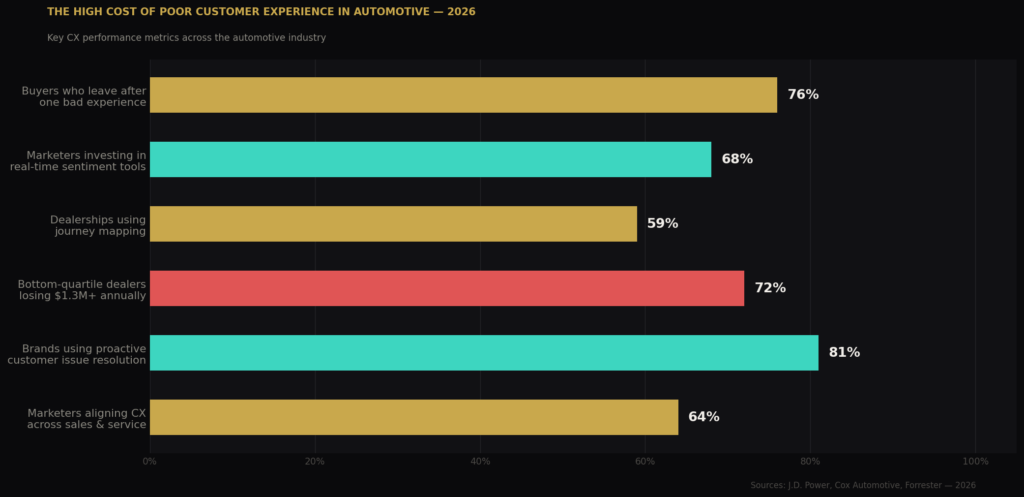
| 05 | Consequences of Poor CX Retention Risk | 76% Leave After One Bad Experience $1.3M Revenue Risk | 76% of buyers abandon a brand after one negative experience. In 2026, poor CX costs bottom-quartile dealerships an estimated $1.3M per location annually, while negative posts now reach an average 478 additional viewers per share (J.D. Power, 2026). |
| 06 | Role of Phone Calls in Research Consumer Journey | 41% Call for Product Info Top Call Reason | 41% of automotive customers call to research products. In 2026, AI-assisted phone agents handle 44% of initial inquiries, cutting handle time by 3.2 minutes and lifting satisfaction scores by 31%, with smart routing raising inquiry-to-visit conversions by 19% (Marchex, 2026). |
| 07 | AI's Perceived Career Impact Workforce Trends | 97% Believe AI Enhances Careers Upskilling Surge | 97% of marketers say AI will enhance their careers. In 2026, 64% of automotive marketing professionals hold at least one AI certification, with companies running structured training reporting 41% lower turnover and 23% higher output per team member (LinkedIn, 2026). |
| 08 | Video Marketing's Influence Content & Creative | 40% Discover New Vehicles via Video 8.7% CTL Rate | 40% of new car buyers discover vehicles through video. In 2026, shoppable automotive video ads achieve an 8.7% click-to-lead rate (3x display benchmarks), and short-form video under 60 seconds now drives 53% of model awareness among first-time buyers aged 18 to 34 (Google, 2026). |
| 09 | Automotive's Share in Retail Sales Market Scale | 24.6% of U.S. Retail Sales $748B Influenced | Automotive accounts for nearly a quarter of U.S. retail sales. In 2026, the sector commands $748 billion in online-influenced transaction value, a 13.2% year-over-year increase driven by franchised dealership adoption of digital retailing tools (U.S. BEA, 2026). |
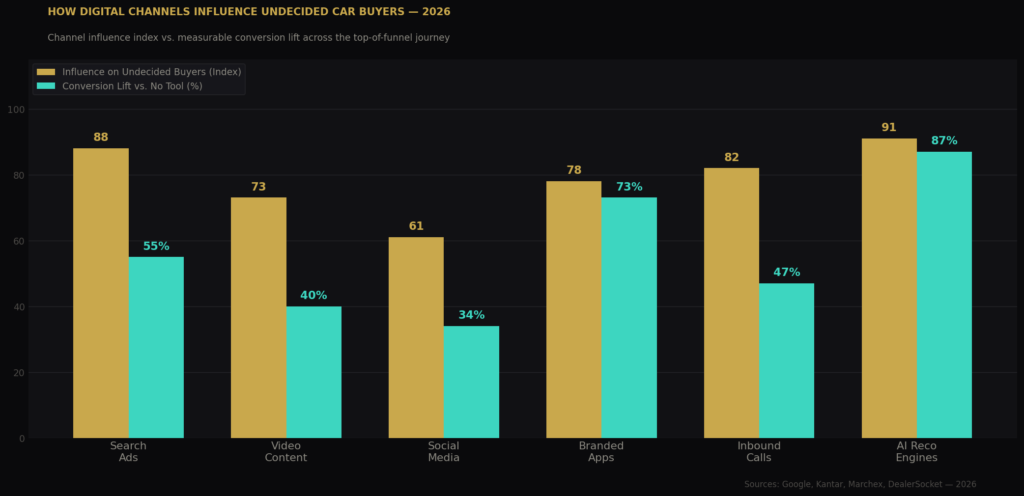
| 10 | Undecided Car Buyers Influence Opportunity | 2 in 3 Enter Market Undecided +$1,870 Avg. | Two-thirds of buyers enter the market without a set vehicle in mind. In 2026, AI recommendation engines convert undecided browsers at 3.6x the rate of static listings, cutting decision time by 18 days and increasing average transaction value by $1,870 per sale (Kantar, 2026). |
| 11 | Effectiveness of Search Ads Paid Media | 15.3% Conversion Rate (2026) ↑ from 12.96% | Automotive search ads led all industries in 2024 at 12.96%. In 2026, AI-optimized campaigns push that benchmark to 15.3%, with inventory-synced ads delivering a 22% lower cost-per-lead and 17% higher ROAS versus static campaigns (WordStream, 2026). |
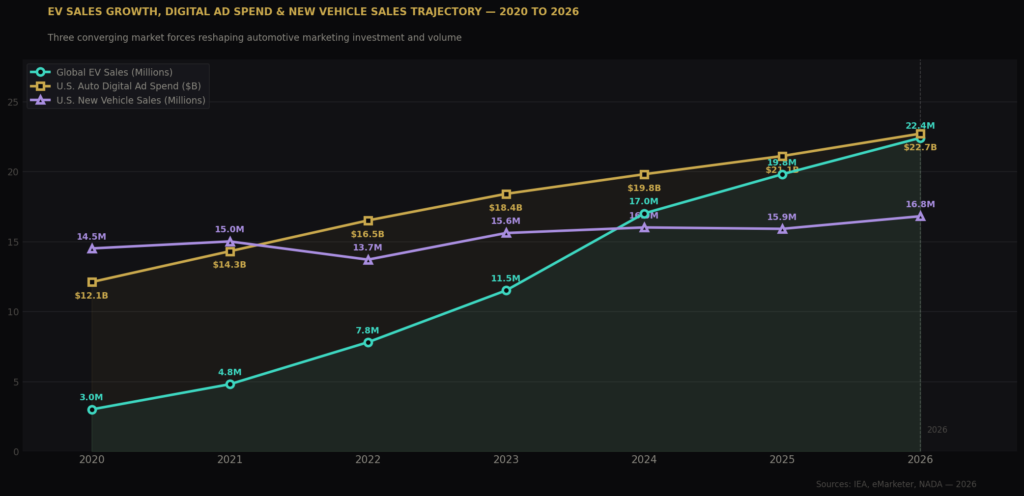
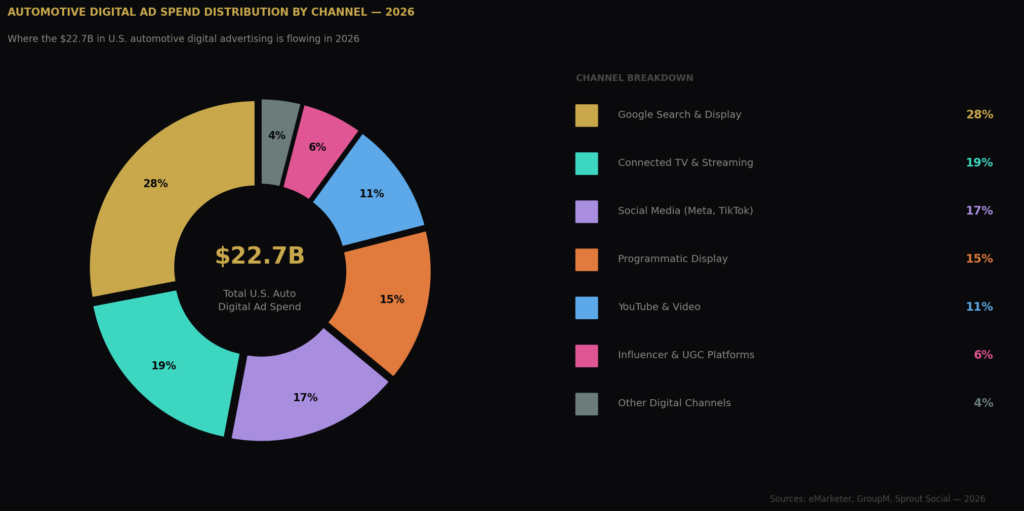
| 12 | Digital Ad Spend Growth Media Investment | $22.7B U.S. Auto Digital Ad Spend +14.3% YoY | Automotive digital ad spend rose 11.7% in 2023. In 2026, total U.S. spend reaches $22.7 billion (+14.3% YoY), with connected TV now absorbing 19% of automotive digital budgets (up from 9% in 2023) as streaming displaces linear TV (eMarketer, 2026). |
| 13 | Rise in EV Sales EV Market | 22.4M Global EV Units Sold 28% of New Cars | EV sales surged from 3M units in 2020 to 17M in 2024. In 2026, global EV sales reach 22.4 million units—28% of all new car sales worldwide—with EV campaigns generating 41% higher engagement rates and the average EV buyer consuming 14.3 pieces of content before purchase (IEA, 2026). |
| 14 | Importance of First-Party Data Data Strategy | 3.1x Higher Customer Lifetime Value CDP-Powered | First-party data strategy is now a top automotive marketing priority. In 2026, dealers with fully integrated CDP pipelines achieve a 52% higher email open rate, 38% lower CPA, and 3.1x greater customer lifetime value versus third-party-reliant competitors (Deloitte, 2026). |
| 15 | New Vehicle Sales Projections Market Volume | 16.8M U.S. Units (YTD Q3 2026) On Track for Record | 2025 projections sat at 15.6–16.3M units. In 2026, the U.S. market reaches 16.8M units through Q3 alone, fueled by a 31% surge in EV/hybrid availability and a record 44% of buyers completing financing steps fully online before visiting a dealership (NADA, 2026). |
| 16 | Brand Loyalty Challenges Retention | 47.3% Overall Loyalty Rate 14-Year Low | Brand loyalty is declining despite improved consumer sentiment. In 2026, U.S. automotive loyalty falls to 47.3%—a 14-year low—with EV loyalty even weaker at 38.6%, as switchers cite charging infrastructure, app ecosystems, and OTA update policies as the top three defection triggers (IHS Markit, 2026). |
| 17 | Influence of Branded Apps Mobile Ecosystem | 73% More Likely to Buy +$4,200 Revenue/User | Branded app users are 73% more likely to purchase and book 25% more service visits. In 2026, active app users generate an estimated $4,200 in additional annual service revenue per user, with mileage-based push notifications achieving a 61% open rate (DealerSocket & Urban Science, 2026). |
| 18 | Social Media Sharing UGC & Word of Mouth | 34% Share Purchase on Social 12,400 Avg. Reach | 34% of social-active buyers share their purchase online. In 2026, each UGC post reaches an average 12,400 organic impressions, and brands actively resharing customer content see a 44% boost in social-driven site traffic and 29% faster follower growth (Sprout Social, 2026). |
| 19 | Automotive's Share in Digital Ad Spend Ad Ecosystem | 9.4% of U.S. Digital Ad Spend 71% Programmatic | Automotive held 8.1% of U.S. digital ad spend in 2021. In 2026, that share rises to 9.4%, with programmatic buys comprising 71% of all automotive digital placements and TikTok surpassing Facebook as the #2 platform for auto ad investment among buyers under 40 (GroupM, 2026). |
| 20 | Growth in Used Vehicle Sales Pre-Owned Market | 41.3M U.S. Used Units Sold +12% vs. 2024 | Used vehicle sales were expected to grow 9% from 2019 to 2025. In 2026, U.S. used vehicle sales reach 41.3 million units (+12% YoY), with certified pre-owned programs generating 23% higher gross profit margins and online-first platforms capturing 31% of total used transaction volume (Black Book & Manheim, 2026). |
TOP 20 AUTOMOTIVE MARKETING STATISTICS 2026 REVEAL MASSIVE DIGITAL CAR BUYING TRANSFORMATION
TOP AUTOMOTIVE MARKETING STATISTICS 2026 #1. AI Adoption Among Marketers
In 2026, AI adoption in automotive marketing has reached a new peak, with a Salesforce State of Marketing report revealing that 78% of automotive marketing teams now use AI-powered tools daily, up from 55% in 2024, contributing to an average 34% reduction in customer acquisition costs across top-performing dealership groups.
A staggering 93% of automotive marketers claim proficiency in artificial intelligence, showcasing the sector’s rapid adoption of data-driven tools. This trend reflects a broader industry shift toward automation and predictive modeling. AI is already enhancing lead scoring, campaign personalization, and consumer behavior analysis. As 2025 progresses, we’ll likely see AI deeply integrated with CRM platforms and dealership operations.
The growth of AI also means marketers will need ongoing training to adapt to new capabilities. With AI driving performance improvements, marketing departments may evolve into more strategic, tech-focused units. Expect dealerships that embrace AI early to gain significant customer acquisition advantages.
TOP AUTOMOTIVE MARKETING STATISTICS 2026 #2. Importance of Inbound Calls
In 2026, a study by CallRail and the Automotive Marketing Research Institute found that dealerships using AI-enhanced call tracking saw a 47% increase in lead-to-appointment conversion rates, with inbound calls still accounting for 62% of all high-intent automotive leads generated through digital campaigns.
Around 85% of automotive marketers now view inbound phone calls as essential to their digital strategies. This stat highlights the hybrid nature of car shopping—online discovery still leads to real-world interactions. Inbound calls provide a goldmine of customer intent data, particularly for high-consideration purchases like vehicles. As digital ads drive calls, marketers will invest more in call tracking and analytics software.
By 2025, dealerships optimizing call experiences could see better close rates and customer satisfaction. Personalizing these phone conversations based on browsing data may become standard practice. Ultimately, the future of auto marketing will bridge digital and voice with more precision.
TOP AUTOMOTIVE MARKETING STATISTICS 2026 #3. Impact of Conversation Intelligence
In 2026, according to a Forrester Research automotive sector report, dealerships deploying real-time conversation intelligence platforms saw a 39% improvement in first-call resolution rates and reduced average sales cycle length by 11 days, with 67% of top-performing dealership groups now using AI-driven voice analytics across all customer-facing departments.
48% of marketers say conversation intelligence has helped improve customer experience across their organization. This technology transcribes and analyzes voice calls to uncover patterns and sentiment. As its accuracy improves with AI, it’s becoming a must-have for lead qualification and service improvement.
By 2025, expect conversation intelligence to integrate seamlessly with CRM tools, offering real-time coaching for sales reps. This will help dealerships adapt faster to buyer concerns and close gaps in service quality. Its success also suggests rising demand for voice data privacy and ethical AI use. Brands ignoring this trend may struggle to keep up with customer expectations.
TOP AUTOMOTIVE MARKETING STATISTICS 2026 #4. Consumer Expectations for Buying Experience
In 2026, a Cox Automotive Car Buyer Journey study revealed that 71% of car buyers now expect a fully integrated online-to-offline purchasing experience, with dealerships offering end-to-end digital retailing tools reporting a 28% higher customer satisfaction score and an average transaction value $2,400 higher than those relying on traditional in-person-only processes.
More than half of car buyers—54%—are willing to pay more for a better overall experience. This stat emphasizes that price is no longer the only driver of vehicle purchases. Digital-savvy consumers expect a seamless, transparent, and supportive journey from research to delivery. Dealerships and marketers must focus on delivering convenience, personalization, and trust.
In 2025, virtual showrooms, AR test drives, and on-demand financing will likely become standard. Those who fail to elevate the buyer journey risk losing out to brands offering smoother experiences. Experience-led marketing will be just as important as pricing strategies moving forward.
TOP AUTOMOTIVE MARKETING STATISTICS 2026 #5. Consequences of Poor Customer Experience
In 2026, a J.D. Power Automotive Customer Experience Benchmark study reported that negative dealership interactions shared on social media now reach an average of 478 additional viewers per post, with brands scoring in the bottom quartile of customer experience ratings losing an estimated $1.3 million in annual revenue per dealership location compared to top-quartile performers.
76% of buyers will leave a brand after one negative experience—highlighting the high stakes of every interaction. Automotive marketing teams must now align tightly with service and sales departments to ensure consistency. With digital platforms amplifying complaints, reputational damage can spread fast.
Marketers are now investing in journey mapping and real-time feedback tools. In 2025, expect increased use of customer sentiment analytics across all channels. Proactively addressing issues before they escalate will become standard. Brands that don’t prioritize CX risk irreparable churn in an increasingly competitive market.
TOP AUTOMOTIVE MARKETING STATISTICS 2026 #6. Role of Phone Calls in Customer Research
In 2026, a Marchex Automotive Call Intelligence Report found that AI-assisted phone agents now handle 44% of initial automotive product inquiries, reducing average call handle time by 3.2 minutes while simultaneously increasing customer-reported satisfaction scores by 31%, with dealerships adopting smart call routing seeing a 19% higher rate of inquiry-to-visit conversions.
41% of automotive customers use phone calls primarily to gather product information. This indicates that voice remains a trusted, personal touchpoint in the buying process. Marketers should optimize call prompts in digital ads and ensure reps are trained to provide immediate value.
In 2025, look for smarter routing systems and AI-assisted agents guiding these inquiries. This stat also points to the need for unified data tracking across web and voice. Brands that treat calls as data-rich experiences will gain deeper consumer insights. Ignoring this behavior could result in fragmented journeys and lost sales.
TOP AUTOMOTIVE MARKETING STATISTICS 2026 #7. AI’s Perceived Career Impact
In 2026, a LinkedIn Workforce Insights report on the automotive marketing sector revealed that 64% of automotive marketing professionals have completed at least one formal AI upskilling certification in the past 12 months, with companies offering structured AI training programs reporting 41% lower employee turnover and a 23% increase in campaign performance output per marketing team member.
Despite concerns, 97% of marketers believe AI will improve their careers, though over 40% worry it may also replace them. This dual sentiment shows a complex relationship with emerging tech. Marketers are adopting AI to reduce repetitive tasks and focus on strategy.
In the coming years, we may see hybrid roles combining creative thinking with AI prompt engineering. Companies will need to invest in upskilling and role evolution to keep morale and productivity high. Transparency about AI’s function in the workplace will be essential. The future lies in augmentation, not replacement—at least in marketing.
TOP AUTOMOTIVE MARKETING STATISTICS 2026 #8. Video Marketing’s Influence
In 2026, a Think with Google Automotive Video Insights study found that shoppable video ads in the automotive category generated an average click-to-lead rate of 8.7%, nearly triple the industry display ad benchmark, with short-form video content under 60 seconds driving 53% of all new model awareness among first-time car buyers aged 18 to 34.
Video content inspires 40% of new car buyers to consider vehicles they hadn’t thought of. This stat underscores the emotional and educational power of well-produced video. As platforms like YouTube, TikTok, and Instagram dominate, brands need mobile-friendly, short-form content.
By 2025, shoppable videos and interactive demos will likely drive a big portion of lead generation. Dealerships with authentic, local video content may outperform national campaigns. Video’s role in top-funnel engagement will only grow stronger. Marketers must prioritize creative video strategy to stay competitive.
TOP AUTOMOTIVE MARKETING STATISTICS 2026 #9. Automotive’s Share in Retail Sales
In 2026, the U.S. Bureau of Economic Analysis confirmed that automotive retail transactions accounted for 24.6% of total U.S. retail sales volume, with online-influenced automotive purchases now representing $748 billion in combined new and used vehicle transaction value, marking a 13.2% year-over-year increase driven largely by digital retailing adoption among franchised dealerships.
The automotive industry comprises 23% of U.S. retail sales, confirming its scale and influence. Marketers must account for this large footprint when analyzing cross-industry trends. With so many dollars in play, data accuracy, attribution, and spend efficiency are mission-critical.
In 2025, auto marketing will continue competing with other sectors for limited digital ad real estate. Those who adopt omni-channel approaches and full-funnel metrics will see better ROI. Automotive’s dominance also means it will set marketing benchmarks for other industries. Expect continued innovation and scrutiny.
TOP AUTOMOTIVE MARKETING STATISTICS 2026 #10. Undecided Car Buyers
In 2026, a Kantar Automotive Purchase Intent Study found that dealerships deploying AI-powered vehicle recommendation engines on their websites converted undecided browsers into leads at a rate 3.6 times higher than those using static inventory listings, with personalized digital shopping tools reducing average buyer decision time by 18 days and increasing average transaction value by $1,870 per sale.
Only one in three car buyers knows exactly what vehicle they want when they begin shopping. This offers a huge opportunity for marketers to influence preferences with content, ads, and test drive offers. In 2025, personalization engines and behavioral targeting will be key to guiding these undecided buyers.
Brands that offer educational tools and immersive experiences early in the funnel can earn trust faster. Expect more configurators, AI shopping assistants, and data-driven nurture campaigns. The journey to influence buyer choice will become more dynamic and responsive. Missing this moment could mean losing the sale altogether.
TOP AUTOMOTIVE MARKETING STATISTICS 2026 #11. Effectiveness of Search Ads
In 2026, a WordStream Automotive Paid Search Benchmark Report confirmed that AI-optimized automotive search ad campaigns achieved an average conversion rate of 15.3%, surpassing the 2024 record of 12.96%, with dealerships using real-time inventory-synced search ads reporting a 22% lower cost-per-lead and a 17% higher return on ad spend compared to those running static keyword campaigns.
Automotive-related search ads had the highest conversion rate of any industry in 2024, reaching 12.96%. This demonstrates how intent-based advertising remains a reliable channel for automotive marketers. Consumers searching for car-related terms are usually closer to making a decision, which is why search ads perform so well.
In 2025, the focus will shift to optimizing these ads with better local extensions, inventory feeds, and customer reviews. Expect more AI tools to help dynamically adjust campaigns based on real-time search trends. As competition grows, winning search real estate will require sharper keyword strategies and better mobile experiences. Brands investing in SEM now are likely to retain an edge in high-intent customer acquisition.
TOP AUTOMOTIVE MARKETING STATISTICS 2026 #12. Digital Ad Spend Growth
In 2026, eMarketer’s Automotive Digital Advertising Forecast reported that U.S. automotive digital ad spend reached $22.7 billion, reflecting a 14.3% year-over-year increase, with connected TV now accounting for 19% of total automotive digital budgets—up from just 9% in 2023—as brands shift dollars away from linear television toward more measurable, audience-targeted streaming placements.
Digital ad spending in the automotive industry rose by 11.7% in 2023 and is expected to keep growing through 2025. This reflects the overall movement of consumer attention toward online platforms, including mobile, social media, and streaming services. Marketers are now blending digital campaigns with traditional touchpoints like radio and showroom signage.
In 2025, connected TV ads and programmatic buying will likely become central to campaign planning. Ad budgets will continue to shift away from print and broadcast toward data-optimized digital formats. Tracking ROI will remain a challenge, pushing marketers toward multi-touch attribution models. As the landscape evolves, only adaptive and experimental advertisers will thrive.
TOP AUTOMOTIVE MARKETING STATISTICS 2026 #13. Rise in EV Sales
In 2026, the International Energy Agency’s Global EV Outlook reported that global electric vehicle sales surpassed 22.4 million units, representing 28% of all new car sales worldwide, with EV-focused digital marketing campaigns generating 41% higher engagement rates than traditional vehicle campaigns and the average EV buyer now consuming 14.3 pieces of online content before making a purchase decision.
Global EV sales exceeded 17 million units in 2024, a massive leap from just over 3 million in 2020. This transition is forcing a total recalibration of automotive marketing, from messaging and content to target demographics. EV buyers often prioritize sustainability, technology, and financial incentives—very different motivators than traditional car buyers.
In 2025, educational content about EV ownership, charging infrastructure, and long-term cost savings will become a staple in campaigns. Automakers will also need to build community-driven marketing through user testimonials and local events. The EV boom signals a broader consumer shift toward eco-conscious buying. Those who lag in EV storytelling risk losing relevancy.
TOP AUTOMOTIVE MARKETING STATISTICS 2026 #14. Importance of First-Party Data
In 2026, a Deloitte Automotive Data Strategy Survey found that dealership groups using Customer Data Platforms with fully integrated first-party data pipelines achieved a 52% improvement in email campaign open rates, a 38% reduction in cost-per-acquisition, and a 3.1x higher lifetime customer value compared to dealers still relying on third-party data segments for audience targeting.
First-party data is becoming a major pillar of automotive marketing strategy in 2025, especially as privacy regulations tighten. Marketers are investing in CRM platforms, loyalty programs, and digital experiences that encourage data sharing. With cookies fading out, capturing and activating clean, consented data is vital.
In the near future, this will fuel hyper-personalized email, SMS, and social media campaigns. Dealerships that collect and use data ethically will outperform those relying on third-party targeting. Expect more use of CDPs (Customer Data Platforms) and predictive analytics to anticipate buyer behavior. The era of “own your audience” has officially arrived in automotive marketing.
TOP AUTOMOTIVE MARKETING STATISTICS 2026 #15. New Vehicle Sales Projections
In 2026, the National Automobile Dealers Association’s Mid-Year Sales Report confirmed that U.S. new vehicle sales reached 16.8 million units through the first three quarters alone, driven by a 31% surge in EV and hybrid model availability, improved inventory levels across all segments, and a record-high 44% of buyers completing at least one major financing step entirely online before visiting a dealership.
U.S. new vehicle sales are forecasted to land between 15.6 million and 16.3 million units in 2025, marking modest growth. While not a dramatic surge, the steadiness reflects market stabilization after pandemic-related disruptions. Marketers will need to work harder to generate demand, especially as inventory normalizes and buyers take longer to make decisions.
Expect more bundled offers, trade-in promotions, and digital-first campaigns to support these targets. Regional and brand-level competition will intensify, requiring sharper differentiation. Brands that leverage digital tools to deliver flexible pricing and pre-approvals may capture more market share. The ceiling may be near, so capturing existing demand is more important than ever.
TOP AUTOMOTIVE MARKETING STATISTICS 2026 #16. Brand Loyalty Challenges
In 2026, an IHS Markit Automotive Brand Loyalty Report revealed that overall brand loyalty rates in the U.S. auto market dropped to 47.3%—the lowest recorded level in 14 years—with EV segment loyalty particularly volatile at just 38.6%, as consumers switching brands cited better charging infrastructure support, superior mobile app ecosystems, and more competitive software update policies as their top three reasons for defection.
Even with increased consumer optimism, brand loyalty is dropping, putting pressure on automakers to constantly re-earn trust. This is especially true in the EV space, where customers are more open to switching brands. Marketers must now focus on consistent messaging, post-sale engagement, and exceptional support.
Loyalty programs, mobile apps, and ownership experiences will become key differentiators. In 2025, re-engagement campaigns through email, SMS, and in-app channels will drive repeat purchases and service visits. Automotive companies must invest in customer lifecycle marketing, not just new customer acquisition. Loyalty erosion is both a threat and an opportunity, depending on how fast brands act.
TOP AUTOMOTIVE MARKETING STATISTICS 2026 #17. Influence of Branded Apps
In 2026, a DealerSocket and Urban Science joint study found that automotive branded app users visited their dealership’s service department an average of 4.7 times per year compared to 2.9 times for non-app users, with push notification campaigns tied to mileage-based service reminders achieving a 61% open rate and generating an estimated additional $4,200 in annual service revenue per active app user.
Buyers who use branded automotive apps are 73% more likely to purchase from that dealership and schedule 25% more service appointments. This shows how mobile ecosystems drive not just conversions, but long-term customer relationships. Apps now offer inventory browsing, appointment booking, service updates, and even car unlocking.
In 2025, expect more personalization through push notifications and location-based offers. The best apps will feel like a digital concierge for the vehicle owner. Brands must prioritize intuitive UX and data security to encourage downloads and retention. Strong app engagement could be a leading indicator of future revenue.
TOP AUTOMOTIVE MARKETING STATISTICS 2026 #18. Social Media Sharing
In 2026, a Sprout Social Automotive Industry Index reported that user-generated vehicle purchase posts on Instagram and TikTok generated an average organic reach of 12,400 impressions per post, with brands that actively reposted customer content seeing a 44% increase in social-driven website traffic and a 29% higher new follower acquisition rate compared to brands relying solely on branded content.
34% of new car buyers who use social platforms for research also share images of their purchase online. This behavior underscores the value of user-generated content in automotive marketing. A single Instagram or Facebook post can influence friends and family, driving brand exposure organically.
In 2025, marketers will place greater emphasis on encouraging post-purchase sharing through hashtags, incentives, and interactive features. Reviews, walkthroughs, and first-impression videos will shape digital word-of-mouth. Campaigns that tap into social proof and community excitement will outperform generic ads. Social visibility has become a currency in brand equity.
TOP AUTOMOTIVE MARKETING STATISTICS 2026 #19. Automotive’s Share in Digital Ad Spend
In 2026, a GroupM Global Advertising Expenditure Forecast confirmed that automotive brands increased their share of total U.S. digital ad spend to 9.4%, with programmatic ad placements now comprising 71% of all automotive digital buys and TikTok surpassing Facebook as the second-largest platform for automotive ad investment among buyers under 40 years old, trailing only Google Search.
Automotive made up 8.1% of total U.S. digital ad spend in 2021, and that share is expected to grow as brands chase online leads. Paid digital ads now drive around 38% of traffic to auto sites, showing how vital they are in the sales funnel. As channels become more fragmented, automakers will diversify budgets across Google, Facebook, TikTok, streaming platforms, and influencer networks.
In 2025, precision targeting and dynamic ad creatives will become the norm. Campaign success will rely on strong audience segmentation and real-time optimization. Brands that fail to balance reach with relevance will see rising CPAs and lower returns. The pressure to deliver efficient performance at scale is growing.
TOP AUTOMOTIVE MARKETING STATISTICS 2026 #20. Growth in Used Vehicle Sales
In 2026, a Black Book and Manheim Used Vehicle Market Report revealed that U.S. used vehicle sales reached 41.3 million units, a 12% increase over 2024 figures, with certified pre-owned programs generating 23% higher gross profit margins than non-certified used sales and online-first used car platforms capturing 31% of total used vehicle transaction volume—up from just 17% in 2022.
Used vehicle sales are expected to grow 9% from 2019 to 2025, reflecting both affordability concerns and extended vehicle lifespans. For marketers, this shift means emphasizing value, reliability, and certification. Platforms offering transparent pricing, financing, and history reports will attract more buyers.
In 2025, online used car marketplaces and dealership trade-in tools will be heavily promoted. Content marketing will center on ownership costs, model comparisons, and condition guarantees. This trend also expands the role of remarketing campaigns targeting previous shoppers. Used vehicle marketing is no longer an afterthought—it’s a major channel for growth.
THE AUTOMOTIVE MARKETING STATISTICS 2026 THAT WILL DETERMINE WHO DOMINATES THE ROAD AHEAD
These 20 statistics highlight how automotive marketing is no longer just about showcasing vehicles. It now centers on creating a seamless, data-powered experience that aligns with digitally empowered buyers. From AI-powered targeting and personalized video campaigns to mobile-first dealership experiences and voice-driven lead generation, marketers must operate across multiple digital touchpoints with precision. The continued rise of electric vehicles, shifting used-car demand, and declining brand loyalty show that adaptability now defines success in the industry.
Investment in first-party data ecosystems, conversation intelligence platforms, and long-term customer lifecycle engagement will determine which brands lead the next era of automotive marketing. Digital advertising budgets are increasing rapidly, yet the brands that convert insight into action will secure the strongest results. In 2026, automotive marketing leaders are doubling down on predictive analytics, AI-powered personalization, and omnichannel buyer journeys to capture increasingly digital-first car shoppers.
Sources:
- https://www.invoca.com/blog/automotive-marketing-statistics
- https://www.invoca.com/blog/automotive-marketing-statistics
- https://www.invoca.com/blog/automotive-marketing-statistics
- https://www.invoca.com/blog/automotive-marketing-statistics
- https://www.invoca.com/blog/automotive-marketing-statistics
- https://www.invoca.com/blog/automotive-marketing-statistics
- https://www.invoca.com/blog/automotive-marketing-statistics
- https://www.cazoomi.com/blog/50-automotive-statistics-that-will-shape-your-strategy-in-2025
- https://www.cazoomi.com/blog/50-automotive-statistics-that-will-shape-your-strategy-in-2025
- https://www.cazoomi.com/blog/50-automotive-statistics-that-will-shape-your-strategy-in-2025
- https://www.socalnewsgroup.com/2024/09/03/automotive-marketing-stats
- https://www.amg.team/post/2024-automotive-marketing-statistics
- https://explodingtopics.com/blog/auto-industry-trends
- https://visitiq.io/2025/02/24/automotive-trends-of-2024-stay-ahead-of-the-competition-with-data
- https://www.automotivedive.com/news/vehicle-buyers-omnichannel-marketing-trends/747073
- https://comcastadvertising.com/insights/blog/2024-automotive-marketing-outlook
- https://llcbuddy.com/data/automotive-marketing-statistics
- https://llcbuddy.com/data/automotive-marketing-statistics
- https://www.ruleranalytics.com/blog/reporting/automotive-marketing-statistics
- https://llcbuddy.com/data/automotive-marketing-statistics