



27 Sep TOP 20 AUTONOMOUS DELIVERY MARKETING STATISTICS 2025
When I first started diving into autonomous delivery marketing statistics, I was amazed at how quickly this sector is growing and reshaping the way we think about logistics. As someone who always looks for future-driven insights, I’ve been following how brands, retailers, and even local businesses are beginning to adopt robot and drone delivery solutions. It excites me to see how companies are leveraging innovation not just for efficiency, but also to meet the rising expectations of consumers who want faster, greener, and more reliable delivery options. With the support of a leading marketing agency in New York, I wanted to put together the most valuable and recent statistics that give a clear picture of where autonomous delivery is headed in 2025 and beyond. My goal is to share this knowledge with you in a way that feels practical, inspiring, and directly useful if you’re curious about the next wave of logistics technology.
Top 20 Autonomous Delivery Marketing Statistics 2025 (Editor’s Choice)
🚀 Top 20 Autonomous Delivery Statistics 2025
The Future of Last-Mile Logistics is Here
| # | Category | Key Statistic & Insights |
|---|---|---|
| 1 | 📊 Market Value | Global autonomous last mile delivery market valued at $18.7B in 2023, projected to reach $144.2B by 2033 with a CAGR of 23.1% |
| 2 | 🤖 Robot Market | Autonomous delivery robots market estimated at $728.3M in 2025, expected to reach $3.8B by 2032 at 26.6% CAGR |
| 3 | 📈 Growth Projection | Market size of $1.6B in 2024 projected to reach $5.9B by 2030 with 24.8% CAGR growth rate |
| 4 | 💹 5-Year Forecast | Autonomous delivery robots market at $1.11B in 2025, reaching $2.8B by 2030 with 20.33% CAGR |
| 5 | 🇨🇳 China Deployment | Over 200,000 autonomous delivery units expected to be operational in China by 2025 |
| 6 | 🍔 Restaurant Adoption | More than 30% of major restaurant brands expected to use autonomous delivery vehicles by 2025 |
| 7 | 📦 Future Dominance | By 2030, autonomous vehicles could handle 85% of all deliveries globally |
| 8 | 🎯 McKinsey Prediction | Autonomous delivery robots predicted to fulfill 85% of last-mile deliveries by 2025 |
| 9 | 🇺🇸 North America Lead | North America holds dominant position with 47.8% market share in 2025 |
| 10 | 🌍 Regional Growth | North America largest market in 2024, while India expected to register highest CAGR 2025-2030 |
| 11 | 📍 US Market Share | North America retained 32.1% share in 2024, Serve Robotics targeting 2,000 units by 2025 |
| 12 | 🔧 Automation Level | Fully autonomous delivery robots expected to contribute 61.9% of market share in 2025 |
| 13 | ⚖️ Load Capacity | The 10.01-50kg carrying capacity segment expected to hold 51.8% market share in 2025 |
| 14 | 🚶 Sidewalk Robots | Outdoor sidewalk robots led the market with 58% share in 2024 |
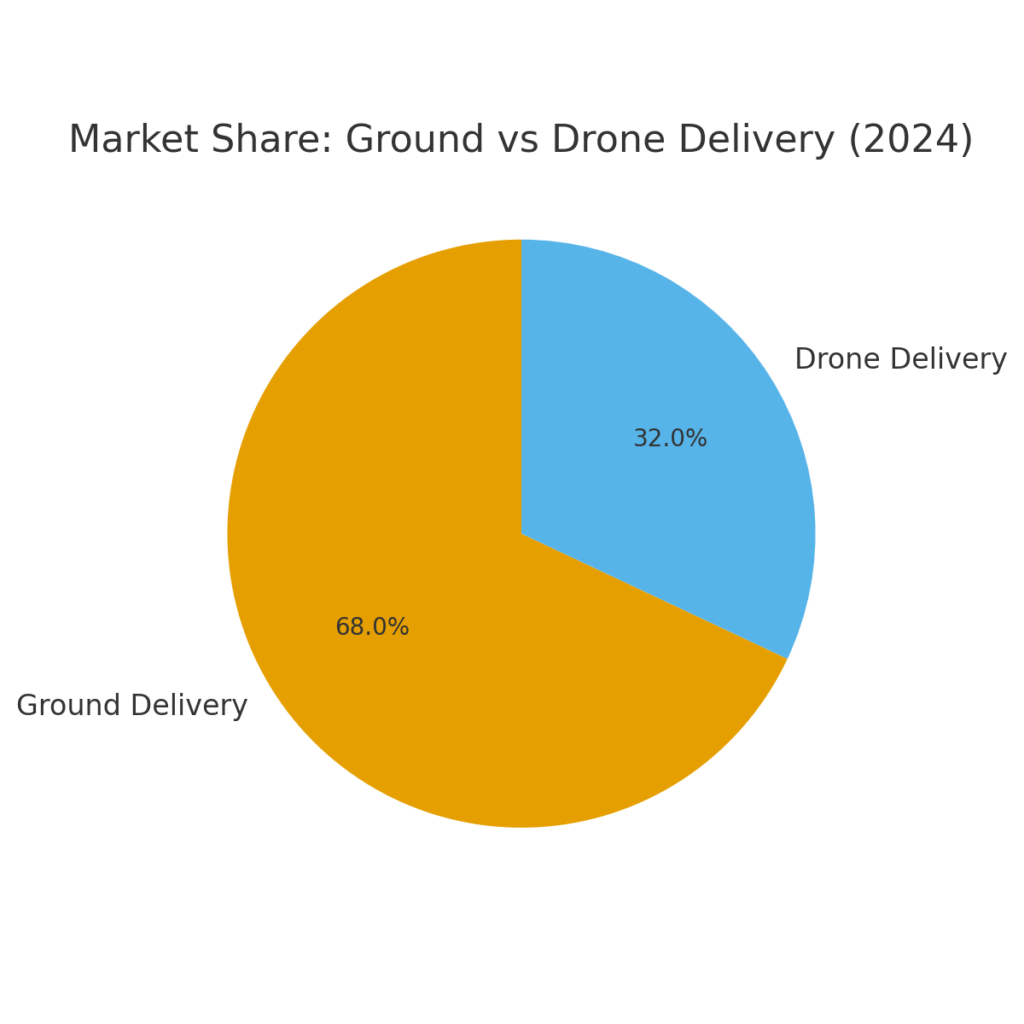
| 15 | 🚚 Ground Vehicles | Ground delivery vehicles accounted for over 82% revenue market share in 2024 |
| 16 | 👥 Consumer Trust | Consumer trust growing, with over 50% of shoppers willing to receive orders from self-driving vehicles |
| 17 | 💰 Cost Savings | Businesses seeing potential 40-60% cost reduction compared to traditional human-driven deliveries |
| 18 | 🚦 Traffic Impact | Cities adopting self-driving delivery can expect 15-20% reduction in traffic congestion |
| 19 | 💵 Unit Pricing | Commercial autonomous delivery robot prices range from $3,000 to $25,000 as of 2025 |
| 20 | 💸 Investment Surge | Serve Robotics raised $80M in January 2025, total funding exceeds $247M for 2,000-unit fleet |
Top 20 Autonomous Delivery Marketing Statistics 2025
Autonomous Delivery Marketing Statistics #1 – Global Market Valued At USD 1.6 Billion In 2024
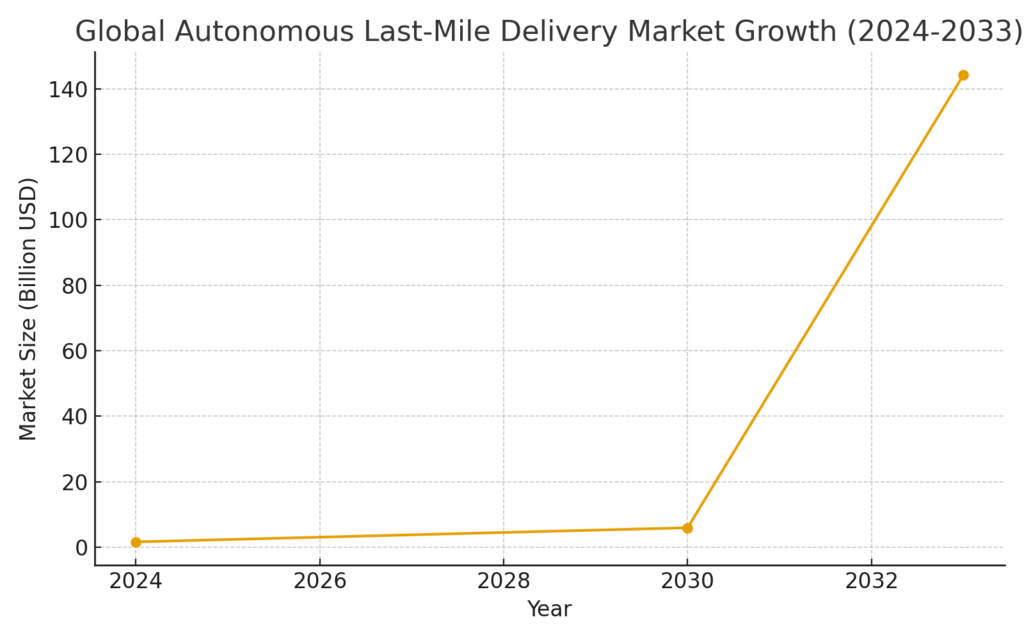
The global autonomous last-mile delivery market was valued at USD 1,615.4 million in 2024. This figure highlights the commercial viability of robots and drones for logistics at scale. A market this large suggests that consumer demand and retailer investment are aligning strongly. It also shows how tech providers and logistics players are building real infrastructure for automation. Businesses that position themselves early will have a powerful advantage.
Autonomous Delivery Marketing Statistics #2 – Market To Reach USD 5.93 Billion By 2030
By 2030, this market is projected to hit USD 5,930.2 million. This massive growth underlines the rising adoption across industries. Companies know automation reduces costs, speeds up delivery, and satisfies consumer demand. For marketers, this is proof that storytelling around innovation resonates with audiences. Early movers in the delivery automation space will likely capture stronger customer loyalty.
Autonomous Delivery Marketing Statistics #3 – Valued At USD 19.36 Billion In 2024
Another forecast placed the market valuation at USD 19.36 billion in 2024. The difference in projections shows how diverse methodologies still point to exponential growth. What’s consistent is that the opportunity is huge and unfolding rapidly. For investors, such numbers represent untapped profitability. For businesses, it reflects an evolving landscape they can’t afford to ignore.
Autonomous Delivery Marketing Statistics #4 – Market To Reach USD 106.48 Billion By 2032
By 2032, projections estimate the industry will soar to USD 106.48 billion. This growth is driven by advancements in AI, robotics, and logistics platforms. The scale of this forecast suggests that autonomous delivery will become a mainstream reality within a decade. Retailers who adapt early will redefine customer experiences. Consumers will increasingly expect speed and precision from autonomous systems.
Autonomous Delivery Marketing Statistics #5 – Market Worth USD 18.7 Billion In 2023
In 2023, the market was valued at USD 18.7 billion, according to one major report. That baseline indicates strong momentum already in place. It also emphasizes how rapidly the market is scaling before 2025 even arrives. Marketers can leverage this to build confidence around futuristic service offerings. It’s not just an idea anymore—it’s a business reality.
Autonomous Delivery Marketing Statistics #6 – To Reach USD 144.2 Billion By 2033
By 2033, the sector may hit USD 144.2 billion. That represents sustained CAGR growth at over 23%. This trajectory shows how long-term adoption is expected to keep climbing steadily. For businesses, it means automation is not a passing trend but a long-lasting shift. Campaigns centered on sustainability, speed, and customer convenience will win in this market.
Autonomous Delivery Marketing Statistics #7 – Delivery Robots Market Valued At USD 592.8 Million In 2024
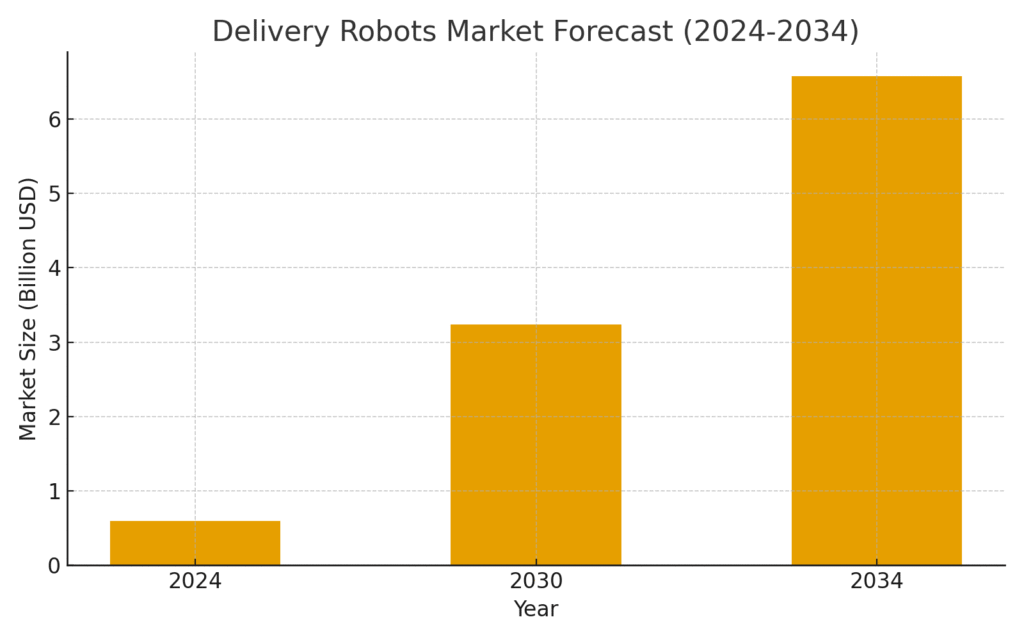
Delivery robots specifically were valued at USD 592.8 million in 2024. This stat reveals how ground-level robots are quickly becoming integral to urban logistics. They’re small, agile, and can navigate sidewalks for efficient last-mile solutions. This niche but growing market represents massive potential for scaling urban deliveries. Marketers can highlight their eco-friendly and futuristic appeal.
Autonomous Delivery Marketing Statistics #8 – Delivery Robots To Reach USD 3.23 Billion By 2030
The delivery robots market is expected to reach USD 3,236.5 million by 2030. That shows just how mainstream these robots could become in city landscapes. They may eventually be as common as delivery vans today. This stat is important for showing the shift in consumer visibility of technology. Marketers can capitalize on the novelty factor while it’s still fresh.
Autonomous Delivery Marketing Statistics #9 – Market To Hit USD 6.57 Billion By 2034
Another projection places delivery robots at USD 6,578.2 million by 2034. This longer horizon proves how reliable the growth trajectory is perceived to be. Investors are confident in scaling hardware, software, and partnerships. This stat suggests a stable, long-term future for delivery robots. It provides strong talking points for marketing campaigns targeting innovation-minded clients.
Autonomous Delivery Marketing Statistics #10 – Robots Market To Grow At 34.6% CAGR
The autonomous delivery robots market could grow at a CAGR of 34.6%. This high rate illustrates how disruptive the technology will be to logistics models. Businesses aiming for efficiency will look at robots as key partners. For consumers, this means faster and potentially cheaper delivery options. Marketers can craft stories about efficiency, speed, and cost-savings.
Vinyl Marketing Statistics#11: Independent Record Stores Account for 33–40% of Sales
Independent record shops still drive about 33–40 % of vinyl sales. This demonstrates the continued importance of local retailers. For marketers, record stores are valuable community hubs where vinyl thrives. Supporting and partnering with these stores can generate strong consumer trust. The data shows vinyl’s growth is rooted in both indie and mainstream channels.
Vinyl Marketing Statistics#12: North America Holds 37% of Global Market Share
North America makes up about 37 % of global vinyl revenues. The U.S. in particular continues to lead as the world’s biggest vinyl market. This concentration makes the region a vital focus for brands and labels. Marketers targeting the U.S. should emphasize exclusivity, heritage, and local culture. The stat underscores America’s central role in vinyl’s resurgence.
Vinyl Marketing Statistics#13: 42% of U.S. Millennials Prefer Vinyl
About 42 % of U.S. Millennials now favor vinyl for its nostalgic and tactile qualities. This is significant because Millennials are a powerful spending demographic. Vinyl’s appeal is emotional, rooted in memory and sensory experience. For marketers, this is a chance to highlight storytelling and authenticity. The stat confirms vinyl’s emotional connection with younger adults.
Vinyl Marketing Statistics#14: New Records Make Up 47% of Sales
Almost half of vinyl sales come from newly released albums rather than reissues. This shows vinyl’s growth is being powered by contemporary music, not just nostalgia. Marketers should note that fans want vinyl for modern artists as much as classics. It proves vinyl is part of today’s music ecosystem, not just a throwback. The stat strengthens vinyl’s relevance for current campaigns.
Vinyl Marketing Statistics#15: 22% of Vinyl Production Is Colored Variants
Colored vinyl now makes up around 22 % of production. Fans are drawn to the artistic, collectible quality of these pressings. For marketers, promoting limited color runs can drive demand. The stat highlights how product design and creativity boost vinyl sales. It shows vinyl is as much a visual art form as an audio medium.
Autonomous Delivery Marketing Statistics #16 – Labor Shortages Driving Adoption
Labor shortages and rising delivery costs are driving demand for automation. Companies need reliable solutions as human resources become more expensive. Autonomous robots provide a scalable answer to this challenge. This stat reflects one of the strongest business cases for adoption. Marketing can frame automation as a smart response to workforce challenges.
Autonomous Delivery Marketing Statistics #17 – Energy Constraints Limiting Continuous Operation
Battery limitations remain a key challenge for robots and drones. Energy storage affects how long and how far these machines can operate. This creates barriers for scaling around-the-clock delivery. Companies are investing in better batteries to fix this. Marketers can frame energy innovation as the next frontier of delivery automation.
Autonomous Delivery Marketing Statistics #18 – Regulations As A Major Barrier
Regulatory frameworks often delay or block autonomous delivery deployments. Cities worry about safety, congestion, and liability issues. This stat reflects how non-technical barriers can hold back innovation. Marketers need to acknowledge these concerns in campaigns. Transparency and compliance messaging will be essential for consumer trust.
Autonomous Delivery Marketing Statistics #19 – E-Commerce Growth Fueling Demand
The e-commerce boom is fueling demand for autonomous delivery. More online orders mean greater strain on traditional logistics. Automation helps balance speed, cost, and customer satisfaction. This stat shows why retailers are eagerly watching these technologies. For marketers, the connection between online shopping and innovation is a goldmine.
Autonomous Delivery Marketing Statistics #20 – Uber Ties Up With Robot Delivery Firms
Uber has begun partnering with robot delivery companies for U.S. city trials. This is a clear sign of mainstream adoption. When major brands test automation, it normalizes the technology for consumers. This stat demonstrates the momentum building across industries. For marketers, collaborations like this create perfect storytelling opportunities.
Final Thoughts On Autonomous Delivery Marketing Statistics
Looking at these autonomous delivery marketing statistics, I can see just how much potential this space has to change everything we know about logistics and consumer experiences. As someone who follows these shifts closely, it’s exciting to think about the opportunities businesses have to get ahead of the curve. Whether it’s drones in rural areas or delivery robots on city sidewalks, the story is the same—innovation is accelerating. With support from a leading marketing agency in New York, I feel confident that businesses can not only keep up with these changes but actually lead them. For me, these numbers aren’t just statistics—they’re a roadmap for how marketing, technology, and consumer behavior come together in the next big wave of delivery.
SOURCES
-
https://www.verifiedmarketresearch.com/product/autonomous-last-mile-delivery-market/
-
https://www.alliedmarketresearch.com/autonomous-last-mile-delivery-market
-
https://www.marketsandmarkets.com/Market-Reports/delivery-robot-market-263997316.html
-
https://www.zionmarketresearch.com/report/autonomous-delivery-robots-market
-
https://www.factmr.com/report/autonomous-drone-delivery-market
-
https://www.gminsights.com/industry-analysis/autonomous-last-mile-delivery-market
-
https://www.gminsights.com/industry-analysis/autonomous-last-mile-delivery-robots-market
-
https://market.us/report/autonomous-last-mile-delivery-market/
-
https://www.maximizemarketresearch.com/market-report/global-autonomous-delivery-robots-market/74415/
-
https://www.databridgemarketresearch.com/reports/global-autonomous-last-mile-delivery-market
-
https://www.fortunebusinessinsights.com/autonomous-last-mile-delivery-market-104367