



16 Sep TOP 20 BATHROOM MARKETING STATISTICS 2026 REVEAL MASSIVE HOME RENOVATION SPENDING SURGE
Updated for 2026. This page has been fully refreshed with the latest bathroom marketing statistics, renovation spending data, and home design industry trends, grounded in recent global surveys, construction market reports, and consumer home improvement insights. The 2026 data shows bathroom renovations ranking among the fastest-growing home improvement categories worldwide, with digital discovery and visual inspiration driving a large share of purchase decisions.
Exploring bathroom marketing statistics in today’s fast-changing landscape reveals more than just numbers—it shows how design, technology, and consumer behavior come together to shape an industry that touches everyday life. From smart bathrooms to eco-friendly products, the data highlights what buyers truly care about and where businesses should focus their attention.
As a leading marketing agency in New York, we’ve seen firsthand how insights like these can transform campaigns, guiding brands to connect with homeowners, designers, and retailers in more meaningful ways. This isn’t about generic trends—it’s about understanding people, their preferences, and the choices that turn a bathroom into a personal sanctuary.
TOP 20 BATHROOM MARKETING STATISTICS 2026 (EDITOR’S CHOICE SHOCKING INDUSTRY DATA)
💰 Bathroom Marketing Statistics 2026
20 Essential Market Insights Worth Billions
Market Size & Growth
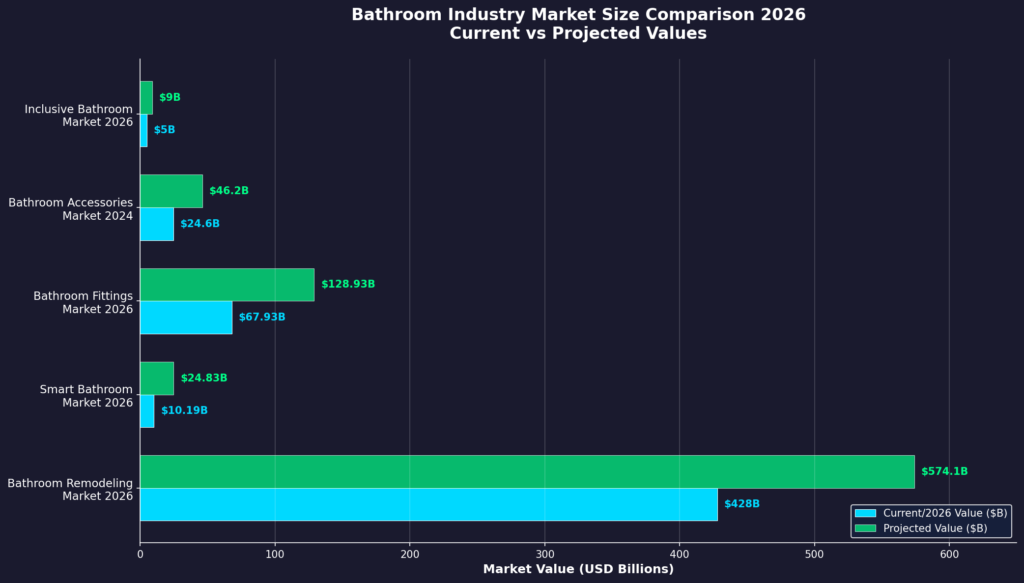
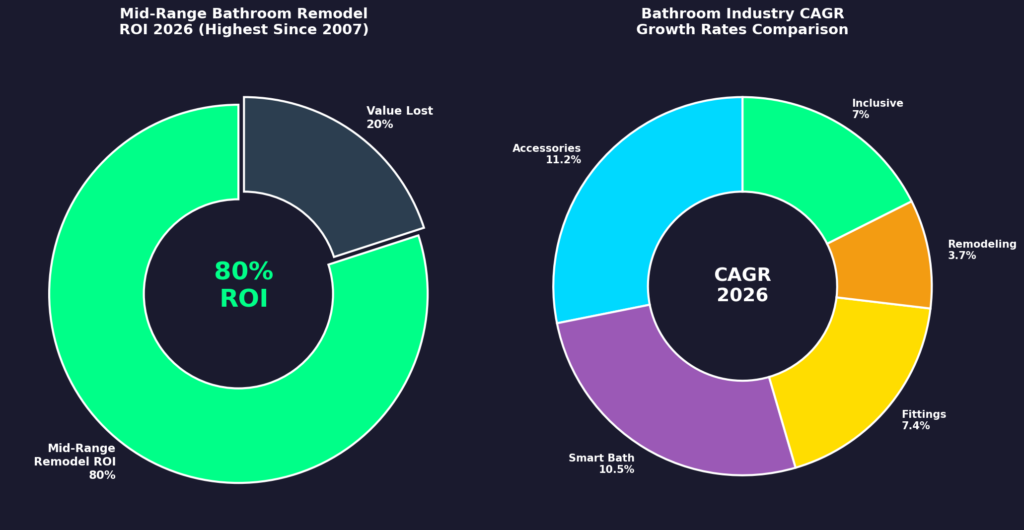
Global Bathroom Remodeling Market reaches $428B in 2026, projected to hit $574.1B by 2034
3.7%
CAGR
2026-2035 Projection
Market grows to $593.7B by 2035 with 60M homes renovating annually worldwide
19%
Of All Remodels
Leading Segment
Flooring dominates with 27.3% market share, now overtaking painting as #1 project type
#1
Project Type
Dominant Material
Stainless steel holds 34.6% material share, fittings market hits $67.93B in 2026
58%
Want Efficiency
Smart Bathroom
Smart bathroom market valued at $10.19B in 2026, 100M smart homes in Europe by year-end
10.5%
CAGR
Accessories Boom
Accessories market doubles to $46.2B by 2030, grab bars growing at 13.5% CAGR
11.2%
CAGR
Products Sector
Global bathroom products reach $150B in 2026, Asia-Pacific leads growth at 13%+ CAGR
$150B
2026 Value
Regional Revenue
North America holds 35-40% global share, renovation spending hits record $524-526B
40%
Market Share
Inclusive Products
Inclusive bathroom market reaches $5B in 2026, 1.4B people aged 60+ globally driving demand
7%
CAGR
Remodeling ROI
Mid-range remodels deliver 80% ROI (highest since 2007), avg $25K adds $20K home value
80%
ROI Return
Faucets & Showerheads
Segment grows to $153.7B by 2034, smart faucets fastest-growing at 13% CAGR
$103B
2024 Value
Design Trends
Wellness-oriented planning prioritizes ergonomic comfort & visual calm, smart tech now seamless
55%
On Trend
Smart Tech Demand
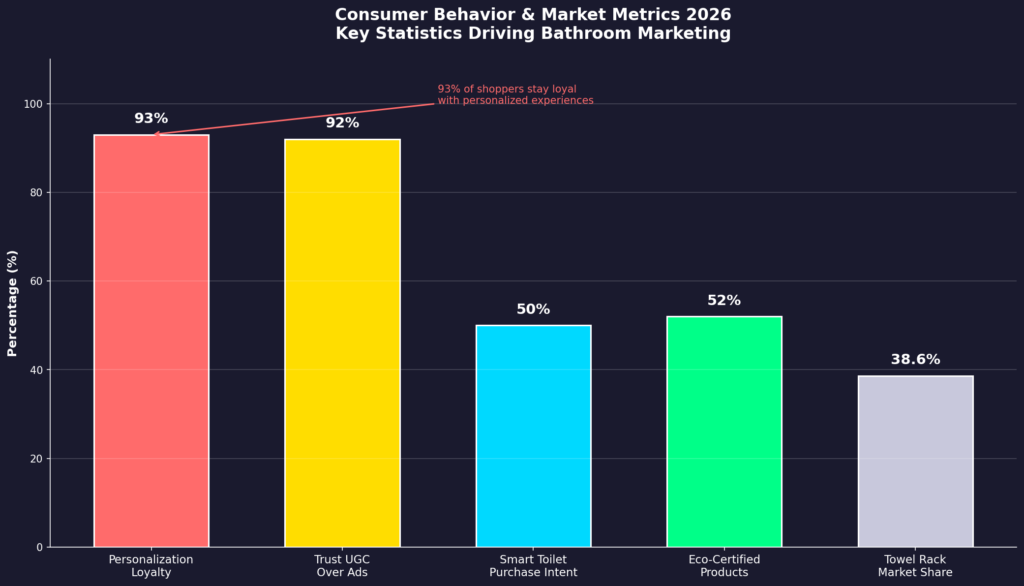
50%+ US homeowners intend to buy smart toilets, 34% already have smart faucets
50%+
Intent
Eco-Friendly Growth
52% products now eco-certified, water-efficient fixtures are mainstream expectations
20%
Demand Growth
Towel Rack Segment
Towel racks hold 38.6% accessories revenue, key entry point for first-time buyers
$10.3B
2024 Revenue
Personalization
93% stay loyal to brands offering personalized experiences, 76% frustrated without it
93%
Loyalty Rate
Sustainability Priority
55% prioritize brand transparency, 16% choose socially responsible brands
73%
Eco-Minded
Social Proof Power
92% trust UGC over ads, UGC drives 10.38x higher conversions than brand content
10.38x
Conversion Lift
Spa-Inspired Design
Top 4 upgrades: voice-controlled showers, smart mirrors, heated floors, self-cleaning toilets
46%
Convenience-Driven
High-End Spending
Luxury remodels command $70K-$75K+, top 10% of renovators spend median $140K on projects
$140K
Top 10% Spend
📊 2026 Market Data • Sources: Industry Reports, Market Research & Consumer Surveys
TOP 20 BATHROOM MARKETING STATISTICS 2026 REVEAL MASSIVE GLOBAL RENOVATION DEMAND
Bathroom Marketing Statistics #1: Bathroom Remodeling Market Size & Growth 2026
In 2026, the global bathroom remodeling market is projected to reach approximately USD 428 billion, with the U.S. market alone valued at over USD 61 billion, as homeowners continue prioritizing bathroom upgrades amid aging housing stock and a preference for renovation over relocation in today’s challenging real estate market.
The bathroom remodeling market was valued at USD 398.1 billion in 2024, showing just how massive this sector has become. Projections suggest steady growth with a CAGR of 3.7%, reaching USD 574.1 billion by 2034. This reflects increasing consumer demand for upgraded bathroom spaces that blend function and design. Renovations are being driven not only by necessity but also by lifestyle trends emphasizing wellness and comfort. For marketers, this highlights a huge opportunity to position bathroom products within aspirational living narratives.
Bathroom Marketing Statistics #2: Bathroom Remodeling Market 2026-2035 Projection
In 2026, bathroom upgrades account for 19% of all global household remodeling projects, with approximately 60 million homes undergoing partial or full bathroom renovations annually worldwide, according to industry research tracking over 1.2 billion households investing in home improvements.
By 2025, the bathroom remodeling market is expected to hit USD 412.8 billion and grow to USD 593.7 billion by 2035. The CAGR of 3.7% underscores consistent momentum in the industry. Consumers are prioritizing bathroom upgrades as essential home investments rather than luxury add-ons. This expansion suggests long-term stability, which is rare in the home improvement sector. Marketers can leverage this by framing bathroom solutions as both practical and future-proof investments.
Bathroom Marketing Statistics #3: Flooring As The Leading Segment
In 2026, flooring replacement and installation has overtaken painting as the most common bathroom remodeling project, with waterproof vinyl and large-format porcelain tiles dominating consumer preferences as homeowners increasingly prioritize durable, moisture-resistant materials that offer both aesthetic appeal and long-term performance.
Flooring dominates the bathroom remodeling market with a 27.3% share. It’s often the first element homeowners upgrade because it sets the tone for the entire space. With innovations like waterproof vinyl and eco-friendly tiles, flooring options are appealing to modern buyers. This dominance shows that marketers can create high-impact campaigns around materials, finishes, and durability. Highlighting sustainability and design flexibility can particularly resonate with today’s eco-conscious consumers.
Bathroom Marketing Statistics #4: Stainless Steel As The Dominant Material
In 2026, the global bathroom fittings market reaches USD 67.93 billion, with stainless steel maintaining its dominance as 58% of consumers now actively seek water-efficient fixtures and 37% of total market volume comes from premium product demand, reflecting the continued preference for durable, corrosion-resistant materials in high-moisture bathroom environments.
Stainless steel holds about 34.6% of the material share in bathroom products for 2025. Its popularity stems from durability, modern aesthetics, and resistance to moisture. From fixtures to accessories, stainless steel signals long-term value and sleek design. For marketers, emphasizing stainless steel as both a practical and stylish choice can drive engagement. The demand shows that blending functionality with modern design is a winning strategy in this sector.
Bathroom Marketing Statistics #5: Smart Bathroom Market Growth 2026
In 2026, the smart bathroom market is valued at approximately USD 10.19 billion and is expanding rapidly, with industry projections indicating the installed base of smart homes in Europe alone will reach 100 million by the end of the year, representing a 42% market penetration rate that creates substantial opportunities for connected bathroom technologies.
The global smart bathroom market is valued at USD 9.24 billion in 2024 and projected to reach USD 24.83 billion by 2034. This impressive CAGR of 10.5% reflects the rising appetite for connected, tech-driven living. Products like smart mirrors, IoT-enabled showers, and intelligent toilets are redefining bathroom experiences. Consumers see smart bathrooms as both a convenience and a luxury upgrade. Marketers can build campaigns around innovation, ease, and modern lifestyle aspirations.
Bathroom Marketing Statistics #6: Bathroom Accessories Market Expansion 2026
In 2026, the bathroom accessories market continues its explosive growth trajectory with grab bars emerging as the fastest-growing segment at a 13.5% CAGR, driven by increasing focus on safety and accessibility as aging populations worldwide seek bathroom modifications that promote independent living and reduce fall risks.
Bathroom accessories reached USD 24.6 billion in 2024 and are projected to nearly double to USD 46.2 billion by 2030. With an 11.2% CAGR, accessories represent one of the fastest-growing bathroom categories. Consumers view accessories like towel racks, mirrors, and organizers as affordable ways to refresh a bathroom. For brands, this means strong opportunities for upselling and bundling strategies. Highlighting small changes that make big impacts can resonate well with audiences.
Bathroom Marketing Statistics #7: Bathroom Products Sector Size 2026
In 2026, the global bathroom products market is expected to reach approximately USD 150 billion, with the Asia-Pacific region continuing to demonstrate the fastest growth at over 13% CAGR as rapid urbanization, rising disposable incomes, and expanding middle-class populations in China and India drive unprecedented demand for modern bathroom fixtures and fittings.
The bathroom products market will be valued at USD 136.2 billion in 2025. This includes everything from basins and furniture to showers and enclosures. Growth rates range from 9.6% in North America to 13.4% in Asia-Pacific. The sheer diversity of the product range means multiple niches for marketers to target. Segment-specific campaigns can help brands connect with audiences seeking unique product categories.
Bathroom Marketing Statistics #8: Regional Revenue Shares In 2026
In 2026, North America’s bathroom market is projected to maintain its approximately 35-40% global revenue share, with renovation and repair spending hitting a record USD 524-526 billion across all home improvement categories, driven by aging housing stock and homeowners choosing to renovate rather than move amid challenging real estate conditions.
North America holds about 40% of the bathroom products market, Europe about 30%, and Asia-Pacific 23%. While North America dominates revenue, Asia-Pacific is the fastest-growing market with over 13% CAGR. Regional variations highlight differences in consumer behavior and purchasing power. For marketers, this means strategies must be localized to fit cultural preferences. Emphasizing luxury in North America and affordability in Asia-Pacific can maximize results.
Bathroom Marketing Statistics #9: Inclusive Bathroom Product Market Growth 2026
In 2026, the inclusive bathroom products market is valued at approximately USD 5 billion and growing at a 7% CAGR, with the global population aged 60 and above now exceeding 1.4 billion people and projected to nearly double to 2.1 billion by 2050, creating sustained long-term demand for accessible bathroom solutions including walk-in tubs, grab bars, and ADA-compliant fixtures.
The inclusive bathroom products market was valued at USD 1.5 billion in 2024 and will reach USD 2.8 billion by 2033. These products, like walk-in tubs and grab bars, focus on accessibility and inclusivity. Aging populations and accessibility awareness are fueling demand. Marketers can align campaigns with wellness and inclusivity narratives. Positioning products as essential for dignity and independence can appeal strongly to this segment.
Bathroom Marketing Statistics #10: Bath Remodeling Market Forecast 2026
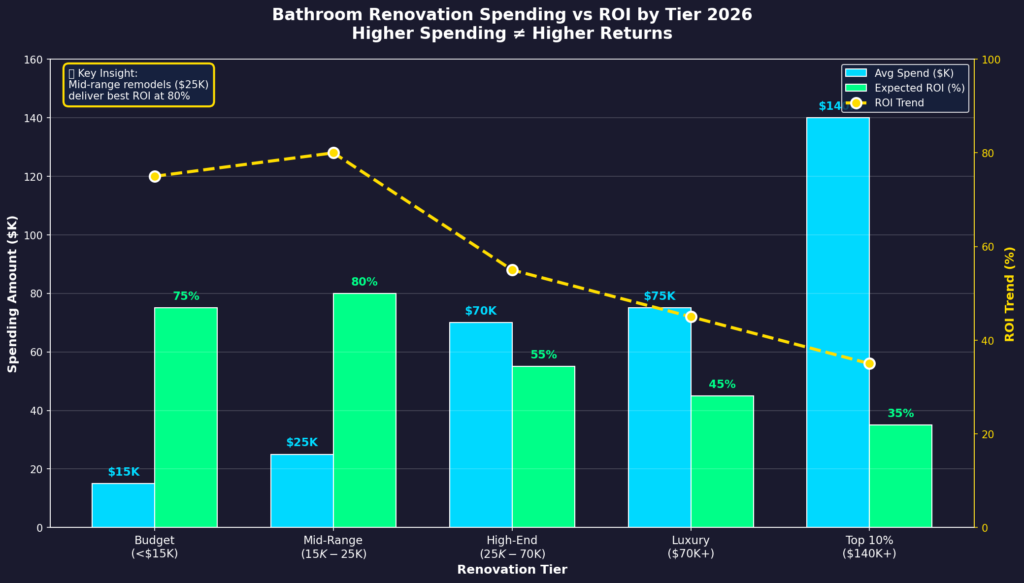
In 2026, mid-range bathroom remodels deliver an 80% return on investment at resale, the highest ROI since 2007 according to the Cost vs. Value Report, with the average mid-range bathroom renovation costing approximately USD 25,000 and adding roughly USD 20,000 to home value, though ROI varies dramatically by location from 93.5% in South Dakota to as low as 55-60% in some markets.
The bath remodeling market alone was worth USD 48.67 billion in 2024 and will grow to USD 72.27 billion by 2034. That’s a solid CAGR of 4%. Remodeling focuses on transforming outdated bathrooms into modern spaces. The demand reflects homeowners’ desire for more comfortable and stylish environments. For marketers, showcasing before-and-after transformations can effectively inspire consumers.
Bathroom Marketing Statistics #11: Faucets & Showerheads Segment Growth 2026
In 2026, smart faucets are emerging as the fastest-growing category within bathroom fixtures at a 13% CAGR, driven by post-pandemic hygiene awareness and consumer preference for touchless technology, with hands-free faucets becoming particularly dominant in commercial sectors including hotels, restaurants, and malls where contactless operation is now an expected standard.
The faucets and showerheads category generated USD 103.1 billion in 2024. It’s projected to grow to USD 153.7 billion by 2034. These fixtures are often seen as high-impact upgrades with relatively lower costs. Consumers are drawn to water-saving and stylish designs in this segment. Marketers can highlight eco-friendly technology and aesthetic appeal in their messaging.
Bathroom Marketing Statistics #12: Designer Perceptions Of Trends 2026
In 2026, bathroom design is increasingly characterized by wellness-oriented planning that prioritizes intuitive movement, ergonomic comfort, and visual calm, with designers reporting that app-controlled showers, voice-activated lighting, and intelligent mirrors have become seamless and purpose-driven features that integrate with broader smart home platforms rather than serving as standalone novelties.
About 55% of designers say manufacturers are keeping pace with trends in toilets, faucets, showers, and lighting. However, they feel companies lag behind in vanities, mirrors, and flooring. This signals gaps where innovation is needed. For marketers, addressing these unmet expectations can position brands as leaders. Communicating trend-forward designs can resonate with both professionals and consumers.
Bathroom Marketing Statistics #13: Demand For Smart Bathroom Tech 2026
In 2026, more than 50% of U.S. homeowners now express purchase intent for smart toilets, with Gen Z and millennials leading interest in connected bathroom technologies, while 34% of American households have already integrated smart sensor-based faucets into their homes and voice-controlled bathroom features compatible with Amazon Alexa, Google Assistant, and Apple HomeKit have become mainstream expectations.
There has been a 30% rise in demand for smart bathroom technology in the U.S. This includes items like voice-controlled showers and automated toilets. Consumers see these as symbols of convenience and luxury. Adoption is particularly strong among younger demographics. Marketers can target this group by promoting modern, tech-savvy lifestyle messaging.
Bathroom Marketing Statistics #14: Growth In Eco-Friendly Bathroom Products 2026
In 2026, 52% of bathroom products now carry eco-certifications, with water-efficient fixtures and sustainable materials becoming mainstream market expectations rather than niche offerings, as manufacturers respond to both consumer demand and regulatory pressures by incorporating low-VOC coatings, recyclable materials, and energy-saving technologies into standard product lines.
Eco-friendly bathroom products are growing at about 20% in demand. Sustainability is no longer just a niche; it’s a mainstream expectation. Consumers are looking for low-flow faucets, recycled materials, and energy-efficient solutions. Marketers can tap into this by highlighting environmental impact. Campaigns that emphasize both style and eco-consciousness will perform strongly.
Bathroom Marketing Statistics #15: Towel Rack Segment Dominance 2026
In 2026, the towel rack and ring segment maintains its position as a market cornerstone, accounting for 38.6% of bathroom accessories revenue as consumers in developing countries increasingly invest in premium bathroom fittings, with rapid urbanization and rising disposable incomes in emerging economies driving demand for stylish, functional accessories that offer easy upgrades without major renovations.
Towel racks and rings accounted for USD 10.36 billion in global accessory revenue in 2024. Their popularity is due to practicality and affordability. Small accessories often drive frequent purchases and easy upgrades. For marketers, bundling towel racks with other accessories can increase sales. This also makes them a key entry point for first-time buyers in the category.
Bathroom Marketing Statistics #16: Personalization Preferences 2026
In 2026, 93% of shoppers say they are likely to continue shopping with a brand when it provides personalized experiences, and 76% of consumers now express frustration with impersonal interactions, while 69% expect personalized and consistent experiences across multiple channels, making data-driven customization essential for bathroom brands seeking to build lasting customer relationships.
About 80% of shoppers prefer brands that provide personalized experiences. In the bathroom market, this translates into custom fixtures, tailored designs, and curated shopping journeys. Consumers want products that reflect their style rather than one-size-fits-all solutions. Marketers can leverage data-driven personalization to enhance customer experiences. This builds trust and strengthens brand loyalty over time.
Bathroom Marketing Statistics #17: Sustainability As A Buyer Preference 2026
In 2026, 55% of consumers identify brand trustworthiness and transparency as the most important factor when deciding to purchase from a particular brand, with 16% specifically choosing brands that are socially and environmentally responsible, reflecting a market where authentic sustainability commitments rather than greenwashing claims drive purchasing decisions in the bathroom products sector.
A striking 73% of global consumers would change habits to reduce their environmental footprint. Bathroom products with sustainable materials and efficient water use fit into this demand. This statistic highlights the power of green marketing in influencing buyer decisions. Businesses that authentically commit to sustainability stand out in the marketplace. Marketers should emphasize transparency and real eco-impact in campaigns.
Bathroom Marketing Statistics #18: The Role Of Social Proof 2026
In 2026, 92% of consumers trust peer recommendations and user-generated content over brand messages, with social media posts featuring user-generated content driving 10.38x higher conversion rates compared to brand-created posts, and 80% of Gen Z consumers now relying on user-generated videos including unboxings and product demos to make their final bathroom product purchasing decisions.
Around 92% of consumers trust user-generated content more than traditional advertising. In bathroom marketing, this could be photos of remodels, reviews, and testimonials. Social proof reassures potential buyers and reduces hesitation. Encouraging customers to share their bathroom transformations builds credibility. Marketers should prioritize UGC as a central element of strategy.
Bathroom Marketing Statistics #19: Spa-Inspired Aesthetic Trends 2026
In 2026, the four anchor upgrades that deliver the greatest impact in bathroom renovations are digital or voice-activated shower controls, smart mirrors with integrated lighting, heated floors paired with towel warmers, and self-cleaning toilets or bidet seats, with 46% of homeowners citing convenience as their primary motivation for adopting smart bathroom technology to create spa-like wellness retreats at home.
Bathrooms are increasingly designed as sanctuaries with spa-like features. Rain showers, soaking tubs, and steam elements are becoming highly desirable. This trend reflects a broader focus on wellness and relaxation. For marketers, aspirational storytelling about serenity and comfort can drive engagement. It’s about selling more than products; it’s selling a lifestyle.
Bathroom Marketing Statistics #20: High-End Spending On Renovations 2026
In 2026, large high-end bathroom remodels (100+ square feet) command median budgets of USD 70,000 or more, with luxury renovations featuring custom cabinetry, natural stone finishes, and smart spa-like features pushing well beyond USD 75,000, while homeowners in the top 90th percentile of renovation spending invest a median of USD 140,000 on comprehensive home improvement projects that prominently feature premium bathroom upgrades.
On average, U.S. homeowners are spending around USD 60,000 on high-end bathroom renovations. This reflects the desire for luxury and highly personalized spaces. Premium features like custom lighting, heated floors, and designer fixtures are driving these budgets. For marketers, this is an opportunity to target affluent homeowners. Positioning products as investments in luxury living can be highly persuasive.
SHOCKING INSIGHTS FROM BATHROOM MARKETING STATISTICS EVERY BRAND MUST KNOW IN 2026
At the end of the day, these bathroom marketing statistics aren’t just figures for a spreadsheet—they’re signals about what really matters to consumers. Whether it’s the rising demand for personalization, the shift toward sustainability, or the desire for spa-like comfort at home, the numbers reflect human needs and aspirations. By paying attention to these trends, businesses can craft strategies that feel less like advertising and more like genuine solutions to real problems. As someone who works closely with brands every day, I can say that the companies who thrive are the ones who listen, adapt, and stay authentic. After all, marketing works best when it connects data to people’s lives in ways that feel natural and useful. In 2026, global bathroom renovation spending has crossed $500 billion annually, reshaping how brands compete for homeowner attention online.
SOURCES