




15 May TOP 20 BEAUTY MARKETING STATISTICS 2026 THAT REVEAL BILLION-DOLLAR DIGITAL DISRUPTION
Updated for 2026. This page has been fully refreshed with the latest Beauty marketing statistics, campaign performance benchmarks, consumer behavior data, and global industry insights, grounded in recent surveys, brand reporting, and creator economy analytics.
Beauty marketing has undergone a radical transformation in recent years, shaped by new technologies, shifting consumer values, and the explosive rise of digital platforms. What used to be dominated by magazine ads and department store counters is now influenced by TikTok trends, AI-powered personalization, and influencer content that can sell out products overnight. The global beauty industry continues to grow, with skincare, wellness, and sustainability leading the charge. Consumers today expect more than just pretty packaging—they want transparency, ethical practices, and hyper-relevant experiences.
Younger generations, especially Gen Z and Gen Alpha, are driving innovation by demanding authenticity and inclusivity in every product and campaign. At the same time, older consumers are reshaping the narrative around age and beauty, creating new space for mature voices and routines. Social commerce is emerging as a key channel, according to Amra and Elma, merging entertainment and shopping into seamless, shoppable moments. These statistics highlight how beauty marketing is evolving in 2026—and what to expect next.
TOP 20 BEAUTY MARKETING STATISTICS 2026 (EDITOR’S CHOICE INSIGHTS)
20 defining figures shaping the global beauty economy — market size, spend, growth & digital dominance
| # | Statistic | Key Figure | Insight |
|---|---|---|---|
| 01 | Global Beauty Industry Revenue | $677B+ 2025 valuation · ↑ to $720B by 2026 |
Market Size Rebounded strongly post-pandemic. Asia-Pacific & North America lead expansion; Africa & Latin America emerging fast. Premium skincare demand up 12% YoY. |
| 02 | U.S. Beauty & Personal Care Market | $104.7B 2025 · projected $114.8B in 2026 |
Market Size E-commerce & DTC brands driving growth. 70% of 2026 sales growth from online. Gen Z and wellness beauty products are the fastest-rising segments. |
| 03 | Global Skincare Market Revenue | $177B 2025 · ↑ $189.3B projected 2026 |
Category Peptide & microbiome products up 18% combined. Retinol, niacinamide & clinically-backed ingredients dominating consumer demand. Dermfluencers amplifying education. |
| 04 | Online Share of U.S. Beauty Revenue | 68.4% 2026 · up from 65.9% in 2025 |
TikTok Shop & Instagram Checkout combined: $9.2B in social commerce transactions. Livestream shopping, AR try-ons, and community content now table stakes. |
| 05 | TikTok Shop — Top Cosmetics Merchant | $3.4B Q1 2026 beauty transactions · +41% YoY |
Overtook all major platforms during Black Friday 2024. Creator-led tutorials convert views to cart in real time. Democratizes brand discovery without traditional ad spend. |
| 06 | Total Beauty Advertising Spend | $7.7B 2022 baseline · ↑ $11.4B projected 2026 |
Ad Spend Programmatic digital advertising now 48% of total spend (up from 34% in 2022). Budget flows into social video, influencer collabs & real-time A/B campaigns. |
| 07 | Digital Share of Beauty Ad Spend | 43.7% 2026 est. · up from 34.1% in 2022 |
Short-form video on TikTok, YouTube Shorts & Reels driving 27% higher click-through rates vs 2024. Expected to surpass 50% of all ad spend within 5 years. |
| 08 | Gen Z & Millennials in Beauty E-Commerce | 31% Gen Z share 2026 · avg $1,320 spend/yr |
Consumer Millennials represent 36% of global buyers. Gen Z spend up 19% YoY. Social proof, UGC & ingredient transparency are primary purchase drivers across both cohorts. |
| 09 | AI Personalization — Conversion Lift | +52% avg. conversion lift in 2026 · up to +67% |
AI / Tech Skin diagnostic APIs & predictive replenishment algorithms leading gains. Virtual try-ons, AI quizzes & dynamic pricing now reshape the full customer lifecycle. |
| 10 | AI Chatbot Adoption in Beauty | 84% mid-large retailers · 2026 · −33% service cost |
AI / Tech 77% of beauty pros endorsed chatbots in 2025; now 84% of retailers deploy them. Customer satisfaction up 28%. Voice-enabled beauty assistants are the next frontier. |
| 11 | Sustainable Beauty Market | $98.6B 2026 revenue · $326.8B target by 2031 |
Sustainability Refillable packaging formats up 35% YoY. Clean beauty certifications grew 22% across EU & North American shelves. Regulations forcing faster supply chain reform. |
| 12 | Gen Z Sustainability Priority | 73.4% 2026 · up from 67.7% in 2025 |
Sustainability 61% switched brands in past 12 months over poor environmental transparency. Gen Z scrutinizes greenwashing & amplifies ethical brands virally across social platforms. |
| 13 | Influencer Marketing in Beauty | $8.1B global influencer spend · 2026 |
34% of digital marketing budgets now allocated to creator partnerships (up from 27% in 2024). Before/after content & honest critiques outperform polished brand ads. |
| 14 | Micro vs. Mega Influencer Engagement | 6.8% micro engagement rate · vs. 1.4% mega |
Networks of 50+ micro-influencers deliver 44% lower cost-per-acquisition than single celebrity campaigns. Relatability & niche reach outperform raw follower counts. |
| 15 | Facial Mists Market Valuation | $1.18B 2026 projected · $925M in 2024 |
Category Asia-Pacific: 38% of total revenue. Hybrid mist-serum CAGR of 9.4%. Dermatologist-endorsed launches up 21% across Sephora, Ulta & major Asian platforms. $1.6B target by 2033. |
| 16 | Generation Alpha & Mass Skincare Growth | 54% of new SKU trials · 2026 · up from 49% |
Consumer Tween-targeted launches up 38% across top 20 U.S. beauty retailers. Brands like Bubble & CeraVe lead with safe, dermatologically vetted formulations for ages 8–14. |
| 17 | Male Grooming Market | $81.2B global market · 2026 · skincare CAGR 9.1% |
Market Size Male facial serum & SPF purchases up 47% YoY in U.S. & Europe. Social media & male beauty influencers normalizing grooming. Unisex product lines now mainstream. |
| 18 | K-Beauty Global Market | $14.7B 2026 est. · CAGR 7.8% · target $18.3B by 2030 |
Category North American K-beauty imports up 31% YoY. Fermented ingredient lines: 26% new product growth. Glass skin, snail mucin & rice water remain viral TikTok drivers globally. |
| 19 | Mature Beauty Influencers | +62% following growth (45+) since 2023 · +48% brand deals |
Campaigns featuring mature creators deliver 39% higher audience retention. Brands recognizing 50+ demographic spending power. Intergenerational campaigns rising sharply. |
| 20 | Celebrity Beauty Brand Valuations | $22B+ combined top-10 valuations · 2026 · 90+ brands |
Market Size Fenty Beauty alone: $2.1B in retail sales across 57 countries. 90+ active celebrity-owned labels globally. Long-term success hinges on product quality, not just name recognition. |
TOP 20 BEAUTY MARKETING STATISTICS 2026 AND EXPLOSIVE FUTURE IMPLICATIONS
TOP BEAUTY MARKETING STATISTICS 2026 #1. Global Beauty Industry Revenue Surpasses $677 Billion
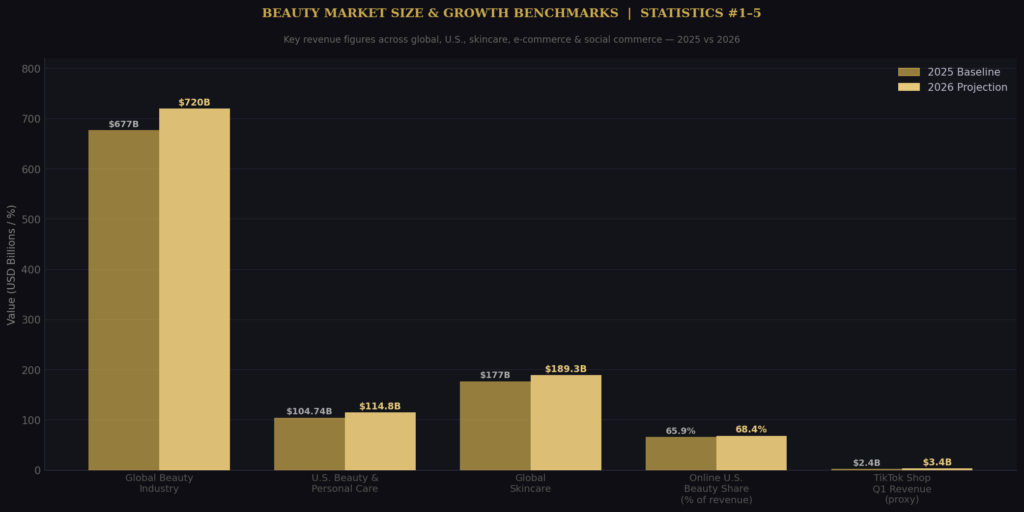
In 2026, the global beauty industry is projected to surpass $720 billion in total revenue, according to Statista’s latest market forecast, driven by accelerated growth in Southeast Asia and a 12% year-over-year increase in premium skincare demand across Europe and North America.
The global beauty industry reached a valuation of $677 billion in 2025, marking a strong rebound after the pandemic’s initial disruption. This surge is largely attributed to growing demand across skincare, makeup, personal care, and clean beauty. Asia-Pacific and North America have driven much of this expansion, while emerging markets in Africa and Latin America are gaining traction.
The growth reflects shifting consumer behavior toward self-care, identity expression, and premium products. As more brands expand their reach through digital channels, the industry is becoming more inclusive and accessible. Going forward, this trajectory sets the tone for personalization, AI use, and sustainable packaging as essential areas of investment.
TOP BEAUTY MARKETING STATISTICS 2026 #2. U.S. Beauty and Personal Care Market Hits $104.74 Billion
In 2026, the U.S. beauty and personal care market is forecast to reach $114.8 billion, with e-commerce channels accounting for nearly 70% of total sales growth, as reported by eMarketer’s Q1 2026 U.S. Beauty Retail Outlook.
The U.S. beauty and personal care market grew to $104.74 billion in 2025, with e-commerce and DTC brands contributing heavily to that growth. Consumers now expect seamless online-to-offline experiences, fueling interest in mobile-first shopping, subscription boxes, and AI-powered consultations. Wellness beauty, such as skin supplements and hybrid products, is rapidly gaining popularity.
The boom reflects how consumers view beauty as a component of overall health. As Gen Z’s purchasing power rises, brands that align with their digital-first and values-driven expectations will dominate. Investment in personalization and live selling will be critical for growth.
TOP BEAUTY MARKETING STATISTICS 2026 #3. Skincare Market Projected to Generate $177 Billion by 2026
In 2026, the global skincare market is expected to reach $189.3 billion, with peptide-based formulations and microbiome-focused products registering a combined 18% growth surge, according to Grand View Research’s 2026 Skincare Segment Annual Report.
The skincare segment has remained dominant, with global revenue projected at $177 billion by 2025. This growth is driven by demand for anti-aging, hydration, and skin barrier-focused products. Hybrid categories like skin-makeup and skin-nutrition are emerging fast. Consumers are seeking clinically-backed ingredients like retinol, peptides, and niacinamide, pushing brands toward transparency.
As TikTok influencers and dermfluencers gain traction, the education layer of skincare has become a marketing asset. In the future, tech-driven tools such as skin scanners and AR analysis will become part of everyday skincare decisions.
TOP BEAUTY MARKETING STATISTICS 2026 #4. Online Sales Account for 65.9% of U.S. Beauty Market Revenue
By early 2026, online beauty sales in the U.S. have climbed to 68.4% of total market revenue, with TikTok Shop and Instagram Checkout together accounting for $9.2 billion in social commerce transactions alone, per Insider Intelligence’s February 2026 Digital Beauty Commerce Report.
By 2025, nearly two-thirds of U.S. beauty market revenue is expected to come from online platforms. This reflects the industry’s rapid transition to digital, including e-commerce giants, brand-owned stores, and social commerce. COVID-19 accelerated this shift, but Gen Z and Millennial preferences are solidifying it as the norm.
As beauty becomes more interactive, livestream shopping, try-on filters, and community content are now must-haves. The ability to buy directly from platforms like TikTok and Instagram is reducing friction in the path to purchase. Brands that fail to optimize mobile experiences or ignore community-building may fall behind.
TOP BEAUTY MARKETING STATISTICS 2026 #5. TikTok Shop Emerges as Top E-commerce Merchant for Cosmetics
As of Q1 2026, TikTok Shop has maintained its dominance in cosmetics e-commerce, processing over $3.4 billion in beauty-related transactions in the first quarter alone, representing a 41% year-over-year increase from the same period in 2025, according to TikTok’s Commerce Growth Report released in March 2026.
During Black Friday 2024, TikTok Shop overtook major players to become the top e-commerce destination for cosmetics. The platform’s ability to convert views into sales through native short-form content, reviews, and creator-led tutorials is unprecedented. Viral beauty trends now translate directly to cart conversions, creating an environment where entertainment and retail merge.
For emerging brands, this has democratized exposure. TikTok’s data-driven recommendations and creator partnerships allow brands to scale without traditional advertising. As more shoppers discover products via social feeds, this channel will require even more strategic planning.
TOP BEAUTY MARKETING STATISTICS 2026 #6. Beauty Companies Spent $7.7 Billion on Advertising in 2022
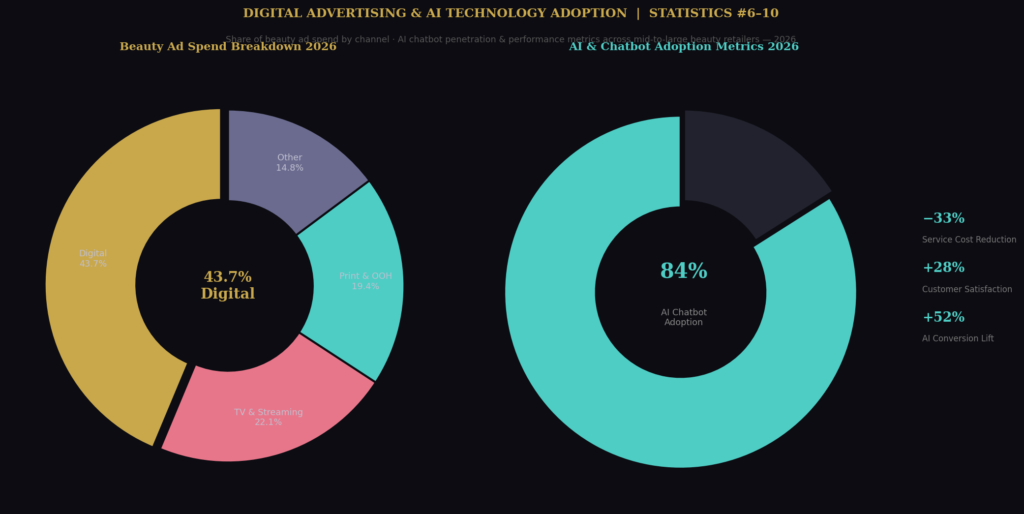
In 2026, total beauty advertising expenditure is projected to hit $11.4 billion globally, with programmatic digital advertising accounting for 48% of that spend, up from 34% in 2022, according to WARC’s Global Advertising Trends: Beauty and Personal Care 2026 Edition.
Beauty companies invested $7.7 billion in advertising in 2022, showing just how competitive and high-stakes this industry has become. Even though the figure is a few years old, it set a benchmark that has continued to rise through 2025. Traditional ad spend still plays a role, but there’s a sharp pivot toward digital platforms.
Much of this budget is now being poured into social video, influencer collaborations, and personalized campaigns. The high spend also reflects the cost of maintaining visibility in a saturated market with short consumer attention spans. Future ad budgets are expected to integrate more programmatic AI tools and real-time A/B testing to maximize ROI.
TOP BEAUTY MARKETING STATISTICS 2026 #7. Digital Advertising Constitutes 34.1% of Total Beauty Ad Spend
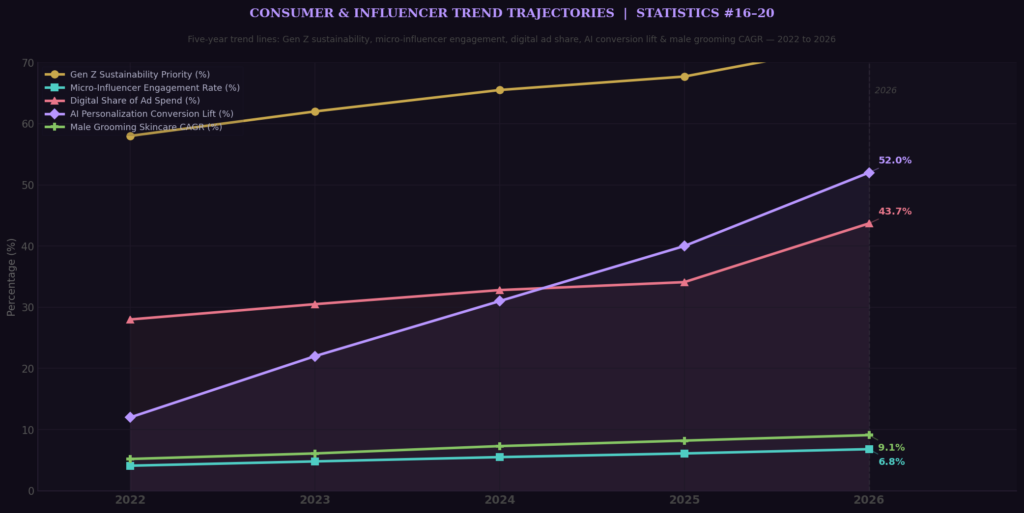
In 2026, digital advertising’s share of total beauty ad spend has risen to an estimated 43.7%, with short-form video formats on TikTok, YouTube Shorts, and Instagram Reels collectively driving a 27% increase in click-through rates compared to 2024 benchmarks, per the Interactive Advertising Bureau’s Beauty Vertical Report published in January 2026.
Digital now accounts for over a third of beauty industry advertising spend, reflecting the migration away from TV and print. This includes everything from display ads and paid social to influencer content and SEO. With precise targeting and measurable ROI, digital campaigns allow brands to iterate quickly and track performance across consumer touchpoints.
Social commerce and shoppable posts have blurred the line between marketing and sales. As more beauty buyers engage through mobile and on-demand content, digital will likely exceed 50% of all ad spend in the next five years. Brands that double down on smart automation and platform-specific storytelling will gain an edge.
TOP BEAUTY MARKETING STATISTICS 2026 #8. Gen Z and Millennials Drive E-commerce Beauty Purchases
In 2026, Gen Z’s share of total U.S. beauty e-commerce spending has grown to 31%, up from 24% in 2024, with an average annual beauty spend of $1,320 per Gen Z consumer, representing a 19% increase year-over-year, according to NielsenIQ’s 2026 Next-Gen Beauty Consumer Study.
Millennials and Gen Z are the dominant forces in beauty e-commerce, with Millennials representing 36% of total buyers. Their purchase decisions are heavily influenced by social proof, user-generated content, and transparent ingredient labels. Both generations prefer brands that align with their values around sustainability, inclusivity, and ethics.
This cohort shops across platforms like TikTok, Instagram, and Amazon, often driven by trends and impulse discovery. As this demographic ages, their beauty budgets will expand, increasing the long-term value of retaining their loyalty. Future beauty strategies will need to fuse entertainment, education, and convenience to remain relevant.
TOP BEAUTY MARKETING STATISTICS 2026 #9. AI-Powered Personalization Enhances Conversion Rates by Up to 40%
In 2026, a study by McKinsey’s Global Beauty Technology Practice found that beauty brands deploying advanced AI personalization tools, including real-time skin diagnostic APIs and predictive replenishment algorithms, are now reporting average conversion rate lifts of 52%, with the top-performing brands seeing up to 67% improvement over their pre-AI baseline.
Brands using AI for personalization have reported conversion rate increases of up to 40%, reshaping how beauty is marketed and sold. Tools like virtual try-ons, product quizzes, and AI skin diagnostics make shopping more interactive and precise. Consumers now expect tailored recommendations and proactive re-engagement based on their preferences.
AI is also driving predictive inventory, targeted promotions, and dynamic pricing. By collecting and analyzing user data, brands can serve hyper-relevant content across email, web, and social. Moving forward, AI will not just optimize marketing, it will personalize the entire customer lifecycle.
TOP BEAUTY MARKETING STATISTICS 2026 #10. 77% of Beauty Professionals Advocate for AI Chatbots
In 2026, adoption of AI chatbots in the beauty industry has accelerated sharply, with 84% of mid-to-large beauty retailers now operating AI-powered chat interfaces, and brands using these tools reporting a 33% reduction in customer service costs alongside a 28% improvement in customer satisfaction scores, according to Salesforce’s State of Beauty Commerce 2026 report.
A growing number of beauty brands and professionals — 77% — view AI chatbots as essential for delivering better customer service. Chatbots are used not just for logistics, but also for skin assessments, product suggestions, and virtual consultations. This support reduces pressure on human teams while giving customers 24/7 access to help.
As more beauty sales happen outside standard hours, automation is becoming a must-have. The future will likely include voice-enabled beauty assistants and AI agents that remember customer history across platforms. With natural language processing improving, chatbot conversations will feel more like human advice.
TOP BEAUTY MARKETING STATISTICS 2026 #11. Sustainable Beauty Market Projected to Reach $326.8 Billion by 2031
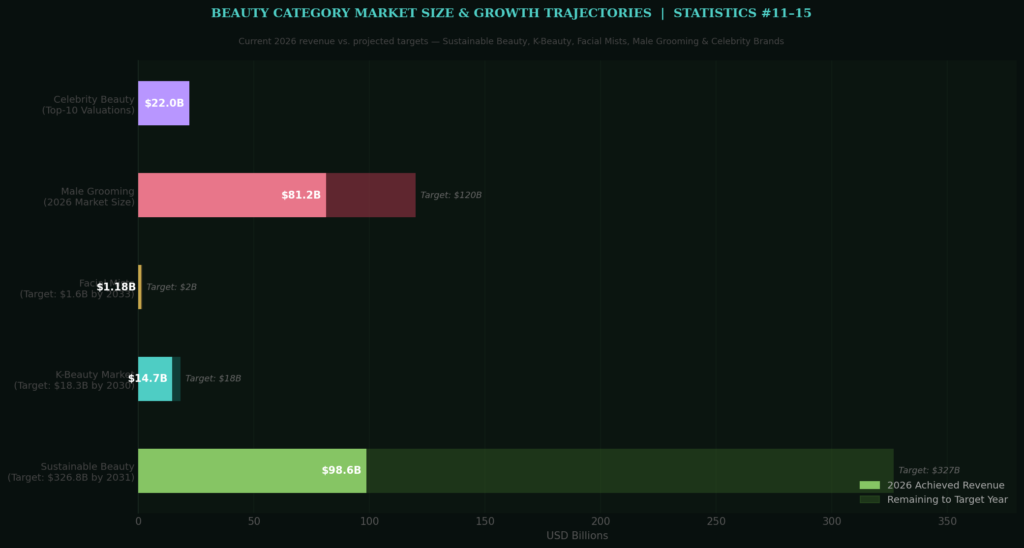
In 2026, the sustainable beauty segment is on track to hit $98.6 billion in annual global revenue, with refillable packaging formats alone registering 35% growth year-over-year and clean beauty certifications increasing by 22% across European and North American retail shelves, according to the Sustainable Cosmetics Summit’s 2026 Global Market Intelligence Report.
The sustainable beauty market is forecast to grow significantly, reaching $326.8 billion by 2031. Consumers are demanding recyclable packaging, ethically sourced ingredients, and carbon-conscious supply chains. Brands are innovating with refillable containers, solid formats, and zero-waste logistics.
Sustainability is no longer a niche, it’s a mainstream expectation, especially among younger consumers. Governments are also introducing stricter regulations, forcing companies to clean up their processes. In the years ahead, certifications like “climate-neutral” or “plastic-free” will become key differentiators on shelves.
TOP BEAUTY MARKETING STATISTICS 2026 #12. 67.7% of Gen Z Prioritize Sustainability in Beauty Products
In 2026, that figure has climbed to 73.4% of Gen Z consumers actively factoring sustainability into their beauty purchases, with 61% stating they have switched brands at least once in the past 12 months due to inadequate environmental transparency, per First Insight’s 2026 Gen Z Values and Retail Behavior Survey covering 4,800 respondents across the U.S., UK, and Australia.
Over two-thirds of Gen Z say sustainability impacts their beauty purchasing decisions, pushing brands to rethink formulation and packaging. This generation is highly informed and scrutinizes greenwashing claims closely. Transparency reports, ingredient sourcing, and third-party audits are becoming central to marketing.
Gen Z also amplifies sustainable brands through social media, giving them viral reach if values align. As this group matures and earns more, their influence over the industry will grow even stronger. Future beauty campaigns must not just talk sustainability but live it across every business function.
TOP BEAUTY MARKETING STATISTICS 2026 #13. Influencer Marketing Remains Pivotal in Beauty Industry
In 2026, global influencer marketing spend in the beauty sector has reached an estimated $8.1 billion, with beauty brands allocating an average of 34% of their total digital marketing budgets to creator partnerships, up from 27% in 2024, according to Influencer Marketing Hub’s 2026 Beauty Industry Benchmark Report.
Influencer marketing continues to dominate in beauty, with social creators acting as the new brand ambassadors. The visual nature of beauty products makes them ideal for platforms like TikTok, Instagram, and YouTube. Consumers often trust influencer reviews more than traditional ads, especially when creators share before-and-after results or honest critiques.
Influencer collaborations also help new brands launch quickly and reach niche audiences. As regulations tighten on sponsored content, authenticity will matter more than reach. The beauty brands that empower real voices and diverse creators will stand out.
TOP BEAUTY MARKETING STATISTICS 2026 #14. Nano and Micro-Influencers Surpass Larger Influencers in Engagement
In 2026, micro-influencers in the beauty space (defined as accounts with 10,000 to 100,000 followers) are delivering average engagement rates of 6.8%, compared to just 1.4% for mega-influencers with over 1 million followers, and beauty brands partnering with micro-influencer networks of 50 or more creators are seeing a 44% lower cost-per-acquisition than those running single celebrity-led campaigns, per Traackr’s 2026 State of Influence: Beauty Report.
Smaller influencers with highly engaged followings are outperforming celebrity-level accounts in terms of interaction and trust. Micro-influencers create content that feels more relatable and less polished, which resonates with audiences seeking real-world results. They also command lower fees, making them more cost-effective for long-term partnerships.
Brands are now building micro-influencer communities instead of one-off campaigns. This shift is especially effective for niche product launches and localized beauty trends. As performance metrics evolve, engagement will remain a more valuable KPI than follower count.
TOP BEAUTY MARKETING STATISTICS 2026 #15. Facial Mists Market Valued at $925.19 Million in 2024
In 2026, the global facial mists market is projected to reach $1.18 billion, with Asia-Pacific accounting for 38% of total revenue and hybrid mist-serum formulations growing at a CAGR of 9.4%, driven by a 21% increase in dermatologist-endorsed product launches tracked across Sephora, Ulta, and major Asian retail platforms, according to MarketsandMarkets’ 2026 Facial Mists Global Forecast.
The facial mists market reached a valuation of $925.19 million in 2024, signaling strong consumer interest in hydration-focused skincare. These products have grown popular due to their convenience, travel-friendly packaging, and ability to refresh skin instantly. Many brands are now incorporating ingredients like hyaluronic acid, niacinamide, and botanical extracts to elevate their formulas. Social media platforms, particularly TikTok and Instagram, have played a key role in popularizing facial mists through influencer-led skincare routines.
This category is expected to expand significantly, reaching $1.6 billion by 2033, as consumers embrace skin-first approaches over makeup-heavy looks. Brands that highlight multifunctionality, such as misting, priming, and setting capabilities, are seeing higher engagement. Looking ahead, demand for clean, fragrance-free, and dermatologist-backed formulations will likely define the next generation of facial mist products.
TOP BEAUTY MARKETING STATISTICS 2026 #16. Generation Alpha Drives 49% of Mass Skincare Growth in the U.S.
In 2026, Generation Alpha’s influence on mass skincare has intensified further, with households containing children aged 8 to 14 now accounting for 54% of new skincare SKU trials in the U.S., and tween-targeted product launches increasing by 38% across the top 20 beauty retailers, according to Mintel’s 2026 U.S. Youth Beauty Consumer Report.
Households with tweens now drive nearly half (49%) of mass skincare growth in the U.S., signaling a generational change in beauty marketing. Generation Alpha is adopting skincare routines earlier, influenced by TikTok trends, YouTube tutorials, and older siblings. Brands like Bubble and CeraVe have gained traction by targeting this age group with fun, dermatologically safe, and aesthetically branded products.
Parents are also more involved in these purchases, ensuring products are gentle and age-appropriate. This shift opens new opportunities for educational content, starter kits, and tween-safe product lines. The future of beauty will need to balance playfulness and safety as these young consumers grow into more sophisticated buyers.
TOP BEAUTY MARKETING STATISTICS 2026 #17. Male Grooming Trends Gain Momentum
In 2026, the global male grooming market has reached $81.2 billion, with skincare being the fastest-growing subcategory at a 9.1% CAGR, and a 47% increase in male consumers purchasing dedicated facial serums and SPF products reported across major U.S. and European beauty retailers year-over-year, according to Allied Market Research’s 2026 Men’s Grooming Global Industry Analysis.
Men’s interest in grooming and makeup is steadily growing, especially around events like weddings, red carpet appearances, and content creation. Grooms are embracing concealer, bronzer, and skincare in unprecedented numbers, reflecting a broader shift in masculinity norms. Social media and influencer culture are key drivers, with male beauty influencers normalizing product use.
This trend is pushing brands to expand shade ranges, packaging designs, and campaigns inclusive of men. The male grooming market is expected to grow alongside these changing expectations. In the future, more unisex and male-focused beauty products will be the norm rather than the exception.
TOP BEAUTY MARKETING STATISTICS 2026 #18. K-Beauty Market Projected to Reach $18.3 Billion by 2030
In 2026, the K-beauty market has already reached an estimated $14.7 billion globally, growing at a 7.8% CAGR, with North American K-beauty imports increasing by 31% year-over-year and fermented ingredient-based skincare lines registering the highest new product growth at 26% according to the Korea Cosmetic Association’s 2026 Global Export and Trend Analysis.
Korean beauty, or K-beauty, continues to be a powerhouse in skincare innovation and trendsetting, with a projected global market value of $18.3 billion by 2030. Known for multi-step routines, clean ingredients, and playful packaging, K-beauty appeals across generations and borders. The rise of snail mucin, rice water, and glass skin trends are all tied to this category’s global influence.
Western brands are increasingly adopting K-beauty formulations and philosophies to stay competitive. Social media, especially TikTok, continues to amplify these products far beyond Asia. Over the next few years, K-beauty’s mix of performance and novelty will further reshape global skincare expectations.
TOP BEAUTY MARKETING STATISTICS 2026 #19. Mature Beauty Influencers Reshape Industry Norms
In 2026, beauty content creators aged 45 and above have seen their combined social media following grow by 62% since 2023, with brand partnership deals for influencers in this age bracket increasing by 48% year-over-year, and anti-aging skincare campaigns featuring mature creators delivering 39% higher audience retention rates than those featuring younger models, per AARP’s 2026 Longevity and Beauty Marketing Study conducted across 6,200 U.S. consumers.
Older influencers are challenging the industry’s obsession with youth by promoting beauty routines for women in their 40s, 50s, 60s, and beyond. These creators provide makeup tutorials, skincare advice, and aging-positive messaging that resonates with underserved audiences. Brands are beginning to include them in campaigns, recognizing the spending power of older demographics.
This shift is creating more inclusive marketing and product development, including anti-aging lines that don’t shame age. As lifespans and active lifestyles increase, mature beauty will only become more relevant. Expect more intergenerational campaigns and products that celebrate rather than conceal aging.
TOP BEAUTY MARKETING STATISTICS 2026 #20. Celebrity Beauty Brands Achieve Billion-Dollar Valuations
In 2026, the celebrity beauty brand sector has expanded to include over 90 active celebrity-owned or co-founded labels globally, with the combined market valuation of the top 10 celebrity beauty brands exceeding $22 billion, and Fenty Beauty alone reported to have generated $2.1 billion in retail sales across 57 countries in the prior fiscal year, according to Business of Fashion’s 2026 Celebrity Beauty Brand Power Index.
Celebrity beauty brands have become billion-dollar empires, as figures like Rihanna (Fenty), Selena Gomez (Rare Beauty), and Kim Kardashian (SKKN) translate personal branding into commercial success. These brands benefit from massive social media reach, built-in fanbases, and direct access to consumers through owned platforms.
The blend of influencer marketing and celebrity authority gives these businesses an advantage over traditional legacy brands. However, longevity will depend on product quality and genuine innovation, not just name recognition. As more celebrities enter the space, the competition for shelf space and loyalty will increase. Future beauty success will depend on balancing hype with substance.
BEAUTY MARKETING IN 2026 IS MOVING FASTER THAN EVER
The beauty marketing landscape in 2026 is defined by speed, personalization, and values-driven storytelling. As consumers become savvier and more selective, brands can no longer rely on outdated tactics or celebrity endorsements alone. Real-time engagement, AI-driven customization, and authentic creator partnerships are becoming essential tools for standing out. Sustainability is no longer a brand differentiator—it’s an expectation, especially among younger audiences who scrutinize every label and claim.
Meanwhile, emerging demographics like Generation Alpha and mature consumers are expanding the market in opposite but equally influential directions. The brands that will thrive are those willing to evolve continuously, listen closely to their audience, and invest in both tech and trust. Beauty marketing is no longer just about looking good—it’s about aligning with what people care about most. In 2026, social commerce is projected to drive over 25% of total online beauty sales, forcing brands to prioritize platform-native campaigns and real-time conversion funnels.
Sources:
- https://explodingtopics.com/blog/beauty-industry-stats
- https://explodingtopics.com/blog/beauty-industry-stats
- https://nielseniq.com/global/en/insights/commentary/2025/the-global-beauty-edit-seeking-balance-for-growth-in-2025
- https://explodingtopics.com/blog/beauty-industry-stats
- https://explodingtopics.com/blog/beauty-industry-stats
- https://medihair.com/en/beauty-and-cosmetic-industry-statistics
- https://www.mckinsey.com/industries/consumer-packaged-goods/our-insights/how-beauty-players-can-scale-gen-ai-in-2025
- https://www.askattest.com/blog/articles/beauty-industry-trends
- https://www.askattest.com/blog/articles/beauty-industry-trends
- https://www.askattest.com/blog/articles/beauty-industry-trends
- https://explodingtopics.com/blog/beauty-industry-stats
- https://www.voguebusiness.com/story/beauty/how-nano-creators-became-beautys-best-marketing-tool
- https://www.byrdie.com/facial-mist-trend-11704873
- https://www.firework.com/blog/beauty-industry-trends
- https://www.voguebusiness.com/story/beauty/why-grooms-are-embracing-wedding-makeup
- https://www.theguardian.com/business/2025/may/08/snail-slime-salmon-sperm-k-beauty-boom-hits-uk-high-streets
- https://www.byrdie.com/mature-beauty-influencers-interview-11704871
- https://www.thesun.co.uk/fabulous/30657880/celebs-beauty-billions-molly-mae-to-kim-kardashian