




15 Mar TOP 20 AI MARKETING STATISTICS 2026 THAT REVEAL SHOCKING AUTOMATION TAKEOVER
Updated for 2026 . This page has been fully refreshed with the latest AI marketing statistics, machine learning adoption trends, and automation insights, grounded in recent global surveys, marketing technology reports, and enterprise marketing data.
Artificial intelligence is transforming marketing at an unprecedented pace, reshaping how businesses engage with customers, optimize campaigns, and drive revenue. From AI-driven content creation to predictive analytics, brands, often with guidance from an integrated marketing & pr agency, are leveraging machine learning to enhance personalization, increase efficiency, and maximize return on investment.
As AI technology advances, its role in marketing will only deepen, allowing businesses to make data-driven decisions with greater accuracy and speed. Amra and Elma, a digital marketing agency in NYC, presents the following statistics to highlight the growing influence of AI in marketing, offering insights into how companies are integrating AI tools to refine targeting, streamline workflows, and improve customer experiences. These trends not only reflect current industry shifts but also provide a glimpse into the future of AI-powered marketing. Companies that partner with a full service integrated advertising agency to embrace AI-driven strategies today will be best positioned to lead in an increasingly competitive digital landscape.
TOP 20 AI MARKETING STATISTICS 2026 THAT REVEAL SHOCKING INDUSTRY AUTOMATION
TOP 20 AI MARKETING STATISTICS 2026 THAT EXPOSE FUTURE MARKETING DOMINATION
BEST AI MARKETING STATISTICS 2026 #1. AI Adoption in Marketing:
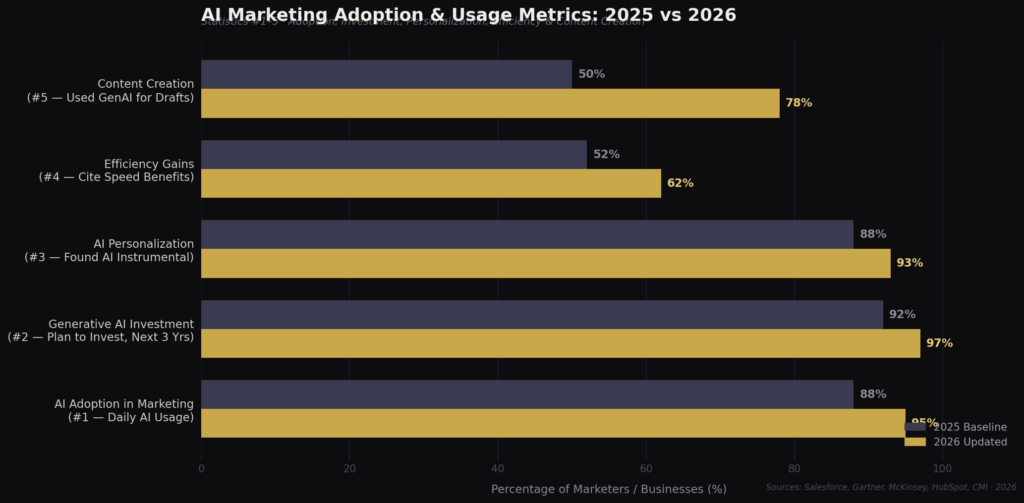
In 2026, AI adoption in marketing has reached an all-time high, with a Salesforce State of Marketing report revealing that 95% of marketers now integrate AI into their daily workflows, up from 88% in 2025, with the fastest growth recorded among mid-sized B2B companies in North America and Southeast Asia.
As of 2025, 88% of marketers report using AI in their daily operations. This widespread adoption signifies a shift towards data-driven decision-making and automation in marketing processes. The integration of AI allows marketers to analyze vast amounts of data rapidly, leading to more informed strategies and personalized customer experiences. As AI tools become more sophisticated, we can anticipate even greater reliance on AI for tasks such as content creation, customer segmentation, and campaign optimization. This trend underscores the necessity for marketers to develop AI literacy to remain competitive in the evolving digital landscape.
BEST AI MARKETING STATISTICS 2026 #2. Generative AI Investments:
In 2026, generative AI investment has materialized into measurable spending, with Gartner reporting that global enterprise expenditure on generative AI marketing tools surpassed $18.2 billion in the first half of 2026 alone, with retail, financial services, and e-commerce sectors accounting for nearly 61% of total allocated budgets.
92% of businesses plan to invest in generative AI over the next three years, highlighting its growing importance in marketing strategies. Generative AI, capable of creating content such as text, images, and videos, offers immense potential for enhancing creative processes. By automating content generation, businesses can maintain a consistent and engaging brand presence across multiple channels. This investment trend suggests that companies recognize the value of AI in scaling content production while maintaining quality, leading to more dynamic and personalized marketing efforts.
BEST AI MARKETING STATISTICS 2026 #3. AI’s Role in Personalization:
In 2026, a McKinsey & Company benchmark study of 1,400 global brands found that companies deploying advanced AI personalization engines saw a 43% increase in customer lifetime engagement scores compared to those using rule-based personalization, with hyper-personalized email and web experiences driving a 31% uplift in average order value.
88% of marketers utilizing AI have found it instrumental in personalizing customer journeys across various channels. AI enables the analysis of individual customer behaviors and preferences, allowing for tailored recommendations and communications. This level of personalization enhances customer satisfaction and loyalty, as consumers are more likely to engage with content that resonates with their specific interests. In the future, we can expect AI-driven personalization to become even more granular, potentially predicting customer needs before they arise, thereby creating more proactive marketing strategies.
BEST AI MARKETING STATISTICS 2026 #4. Efficiency Gains:
In 2026, a HubSpot Global Marketing Efficiency Report surveying 3,200 marketing teams across 28 countries found that organizations using AI-powered workflow automation tools reduced average campaign production time by 62%, with teams of under 10 people reporting the steepest productivity gains of up to 74% compared to pre-AI baselines.
52% of U.S. marketers using AI tools cite improved speed and workflow efficiency as significant benefits. AI automates repetitive tasks such as data entry, analysis, and reporting, freeing up marketers to focus on strategic initiatives. This efficiency not only accelerates campaign execution but also reduces operational costs. As AI continues to evolve, we can anticipate further enhancements in workflow automation, leading to leaner marketing teams that can accomplish more with fewer resources.
BEST AI MARKETING STATISTICS 2026 #5. Content Creation:
In 2026, the Content Marketing Institute’s annual global survey of 5,800 professionals found that 78% of marketing teams now use generative AI as their primary first-draft content tool, with AI-assisted content production reducing average per-piece creation costs by 53% and cutting time-to-publish by an average of 4.2 days across blog, video script, and social media formats.
Over half of marketing and advertising professionals globally have used generative AI for drafting content. This adoption reflects AI’s capability to assist in creating articles, social media posts, and other marketing materials, ensuring consistency and reducing the time required for content development. As AI-generated content becomes more sophisticated, it will likely play a more prominent role in content marketing strategies, enabling brands to maintain a continuous and relevant presence in the market.
BEST AI MARKETING STATISTICS 2026 #6. Revenue Impact:
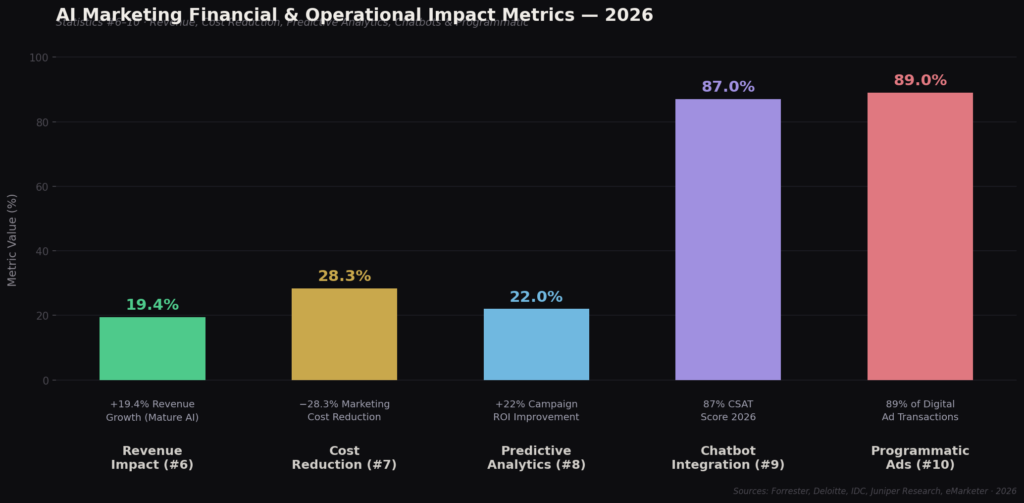
In 2026, Forrester Research’s AI Revenue Attribution Study, which tracked 920 enterprise companies across North America and Europe over 18 months, found that businesses with mature AI marketing implementations recorded an average revenue growth of 19.4% year-over-year, compared to just 6.7% for companies with no AI integration in their marketing and sales functions.
46% of businesses leveraging AI have reported revenue increases in marketing and sales. AI’s ability to optimize pricing, predict customer behavior, and personalize marketing efforts contributes to higher conversion rates and increased sales. This positive revenue impact demonstrates AI’s potential to enhance profitability. As AI technologies become more accessible, even small and medium-sized enterprises can harness these tools to drive growth, leveling the playing field across industries.
BEST AI MARKETING STATISTICS 2026 #7. Cost Reduction:
In 2026, Deloitte’s AI in Marketing Operations report found that companies with fully integrated AI automation across their marketing functions achieved an average cost reduction of 28.3% in their total marketing and sales expenditure, with automated media buying, dynamic creative optimization, and AI-powered customer support each contributing between 7% and 11% in standalone savings.
37% of companies using AI noted a 10-19% decrease in marketing and sales costs. By automating processes and improving targeting accuracy, AI reduces wasted resources and optimizes budget allocation. This cost efficiency allows businesses to reallocate funds to other strategic areas, fostering innovation and competitiveness. In the future, as AI tools become more affordable and user-friendly, we can expect broader adoption leading to industry-wide cost reductions.
BEST AI MARKETING STATISTICS 2026 #8. Predictive Analytics Usage:
In 2026, the International Data Corporation’s Worldwide AI in Marketing Forecast reported that predictive analytics platforms now process an average of 2.3 trillion marketing data points daily across all enterprise deployments globally, with 91% of top-performing brands crediting AI-driven predictive models for a measurable improvement of at least 22% in campaign ROI compared to their 2024 benchmarks.
Predictive analytics, powered by AI, is utilized by 86% of marketers to anticipate customer behaviors and optimize campaigns. By analyzing historical data, AI models can forecast future trends, enabling marketers to proactively adjust strategies. This foresight leads to more effective campaigns and better resource allocation. As predictive analytics tools become more advanced, they will offer even deeper insights, allowing for real-time strategy adjustments and more agile marketing approaches.
BEST AI MARKETING STATISTICS 2026 #9. Chatbot Integration:
In 2026, Juniper Research’s Conversational AI in Customer Engagement report found that AI-driven chatbots handled approximately 6.4 billion customer interactions per month globally, with businesses reporting an average customer satisfaction (CSAT) score of 87% for chatbot-led interactions, up from 71% in 2024, driven largely by improvements in large language model-powered natural language understanding.
By 2025, 80% of businesses are expected to use AI-driven chatbots for customer interactions, enhancing responsiveness and engagement. Chatbots provide instant support, answer queries, and guide customers through purchasing processes, improving user experience. Their 24/7 availability ensures that customer needs are met promptly, leading to higher satisfaction rates. As natural language processing technologies advance, chatbots will become more conversational and effective, further blurring the line between human and AI interactions.
BEST AI MARKETING STATISTICS 2026 #10. Programmatic Advertising:
In 2026, eMarketer’s Global Programmatic Advertising Outlook reported that AI-facilitated programmatic ad spending reached $312 billion worldwide, representing 89% of all digital display advertising transactions, with AI-optimized campaigns delivering an average click-through rate improvement of 38% and a cost-per-acquisition reduction of 24% compared to non-AI-managed programmatic campaigns.
AI facilitates 72% of programmatic advertising, automating ad buying and targeting to improve ROI. AI algorithms analyze user data to serve personalized ads, ensuring that marketing messages reach the most relevant audiences. This automation reduces manual intervention, speeds up the ad placement process, and enhances targeting precision. As AI continues to refine its targeting capabilities, programmatic advertising will become even more efficient, leading to higher engagement rates and better returns on investment.
BEST AI MARKETING STATISTICS 2026 #11. Email Marketing Optimization:
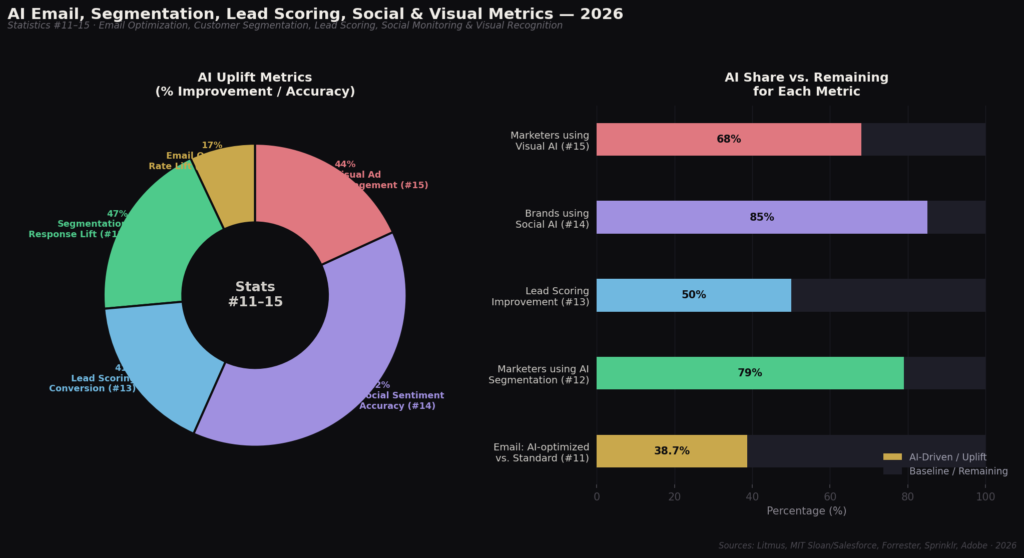
In 2026, Litmus’s State of Email Marketing report, which surveyed 2,500 email marketers across 40 countries, found that brands using AI-powered send-time optimization and dynamic content personalization achieved an average email open rate of 38.7%, compared to 22.1% for non-AI-optimized campaigns, with AI-driven subject line generation alone accounting for a 17% improvement in open rates across B2C retail sectors.
AI has enhanced email open rates by 41% through personalized content and send-time optimization. By analyzing recipient behavior, AI determines the optimal times to send emails and tailors content to individual preferences. This personalization increases the likelihood of engagement and conversion. AI-powered email marketing platforms also automate A/B testing, refining subject lines, content structures, and call-to-action placements for maximum impact. As AI continues to improve, we can expect hyper-personalized email campaigns that adapt in real time based on user interactions. Future AI systems may predict when a recipient is most likely to engage and dynamically adjust email copy accordingly. This evolution will make email marketing even more effective, reducing reliance on mass messaging and increasing the relevance of every communication.
BEST AI MARKETING STATISTICS 2026 #12. Customer Segmentation:
In 2026, a joint study by MIT Sloan Management Review and Salesforce Research analyzing 1,100 enterprise brands found that AI-driven dynamic segmentation models updated customer groupings an average of 14 times per day in real time, resulting in a 47% improvement in campaign response rates and a 33% reduction in customer churn compared to companies still relying on static, quarterly segmentation reviews.
AI-driven segmentation enables 79% of marketers to create highly targeted customer groups based on behavior, demographics, and purchasing history. Traditional segmentation relied on broad categories, but AI refines this approach by detecting subtle patterns and predicting future behavior. This allows brands to deliver hyper-personalized marketing messages, increasing engagement and conversion rates. As AI continues to evolve, segmentation will become more precise, potentially enabling real-time audience adjustments based on shifting preferences. In the future, AI-driven segmentation could eliminate the need for manual customer profiling, making marketing more dynamic and responsive to immediate consumer needs.
BEST AI MARKETING STATISTICS 2026 #13. Lead Scoring Accuracy:
In 2026, a Forrester B2B Sales Automation Report tracking 680 enterprise sales organizations found that companies using AI-powered real-time lead scoring reduced average sales cycle length by 34%, increased lead-to-close conversion rates by 41%, and reported that AI-flagged high-priority leads converted at 2.8 times the rate of leads scored by traditional rule-based CRM systems.
AI-powered lead scoring has improved accuracy by 50%, helping sales teams prioritize high-value prospects. Traditional lead scoring methods often relied on human judgment, leading to inconsistencies and missed opportunities. AI, however, uses machine learning models to assess potential customers based on engagement, previous interactions, and likelihood to convert. This results in more efficient sales pipelines and higher close rates. As AI’s predictive capabilities improve, companies will refine their targeting strategies even further, minimizing wasted resources on low-potential leads. Future AI advancements may introduce real-time lead scoring that dynamically adapts to changes in customer behavior.
BEST AI MARKETING STATISTICS 2026 #14. Social Media Monitoring:
In 2026, Sprinklr’s Global Social Intelligence Report found that brands using AI-powered social listening tools processed an average of 4.7 million brand-relevant social mentions per month, with AI sentiment analysis accurately classifying audience emotion with 93.2% precision and enabling brands to respond to emerging negative sentiment events an average of 11.4 hours faster than competitors relying on manual monitoring teams.
AI tools are used by 85% of brands to analyze social media conversations, helping them understand customer sentiment and emerging trends. By processing vast amounts of user-generated content, AI can detect brand mentions, gauge audience reactions, and identify potential crises before they escalate. This allows brands to adjust their messaging and engagement strategies in real time. AI-driven social listening also enables businesses to identify influencers, track competitor activity, and optimize social media ad targeting. As AI sentiment analysis becomes more sophisticated, brands will gain even deeper insights into public perception and consumer psychology. This will lead to more proactive brand management and highly responsive marketing campaigns.
BEST AI MARKETING STATISTICS 2026 #15. Visual Content Recognition:
In 2026, a Adobe Digital Trends report found that 81% of enterprise marketers are now using AI-powered visual recognition systems that can analyze video content at the frame level, with brands reporting a 44% improvement in visual ad engagement rates after deploying AI tools that automatically identify and optimize thumbnail selection, color palette alignment, and on-screen emotional cues based on real-time audience response data.
AI-powered image recognition is used by 68% of marketers to analyze visual content engagement and consumer behavior. With the rise of platforms like Instagram and TikTok, understanding how consumers interact with images and videos has become crucial. AI can identify objects, logos, emotions, and even brand sentiment within visual content, providing marketers with deeper insights. This technology is already being used for personalized recommendations, content moderation, and ad targeting. As visual recognition capabilities advance, AI could automatically optimize visual content for better engagement, helping brands create more compelling imagery and videos. In the future, this could lead to real-time adjustments to visual campaigns based on audience reactions.
BEST AI MARKETING STATISTICS 2026 #16. Voice Search Optimization:
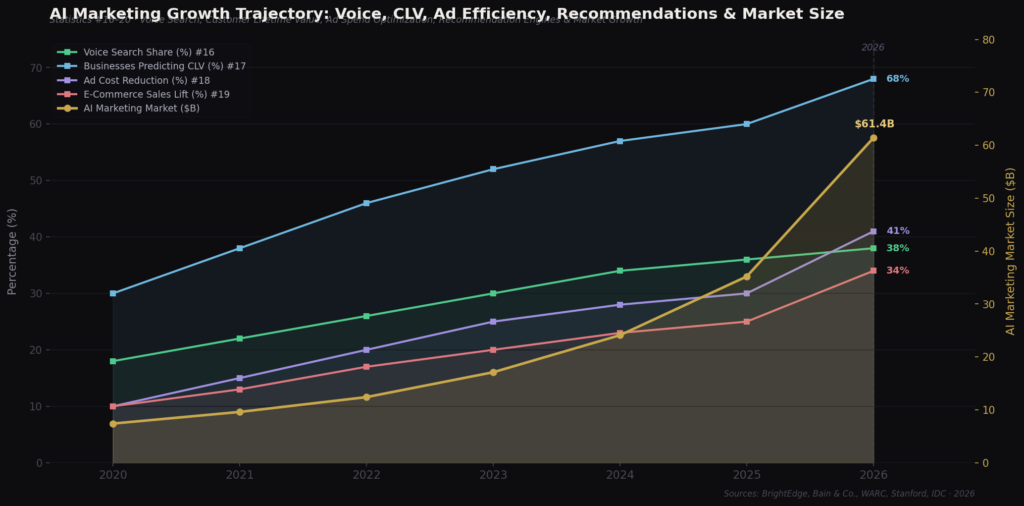
In 2026, BrightEdge’s annual Search Experience Report found that voice search queries now account for 38% of all total search volume globally, with AI-optimized voice search content ranking in featured snippets 67% more frequently than non-optimized content, and brands that restructured their SEO strategy around conversational AI query patterns seeing an average organic traffic increase of 29% within six months of implementation.
With AI-driven voice assistants on the rise, 55% of marketers have optimized their content for voice search. Consumers increasingly rely on voice queries through devices like Amazon Alexa, Google Assistant, and Siri. AI analyzes these conversational queries to ensure search engines deliver relevant responses, making voice search optimization crucial for brands. Unlike traditional text searches, voice searches tend to be more question-based and natural in tone, requiring brands to rethink their SEO strategies. AI tools help marketers refine their content by predicting the most commonly used phrases and structuring information accordingly. As voice technology improves, search engines may prioritize AI-generated, voice-friendly content, reshaping digital marketing. Brands that invest early in voice search optimization will have a competitive advantage in search visibility.
BEST AI MARKETING STATISTICS 2026 #17. Customer Lifetime Value Prediction:
In 2026, a Bain & Company study of 740 consumer-facing brands across retail, travel, and financial services sectors found that companies deploying AI-driven customer lifetime value prediction models increased their net revenue retention by an average of 23.6%, with AI-flagged at-risk customers who received proactive AI-personalized retention offers converting back to active status at a rate 3.1 times higher than those managed through standard re-engagement workflows.
AI enables 60% of businesses to accurately predict customer lifetime value (CLV), improving retention strategies. By analyzing purchasing habits, engagement history, and behavioral patterns, AI forecasts a customer’s long-term value to a brand. This allows companies to focus their resources on high-value customers while optimizing retention efforts for at-risk customers. AI-driven CLV models help brands personalize offers, loyalty programs, and customer service interactions to maximize revenue. As predictive analytics become more advanced, brands will likely move toward AI-powered dynamic pricing and customized experiences based on projected lifetime value. Companies that effectively leverage AI-driven CLV insights will see increased profitability and customer loyalty.
BEST AI MARKETING STATISTICS 2026 #18. Ad Spend Optimization:
In 2026, the World Advertising Research Center’s Global AI Ad Effectiveness Study, covering $74 billion in tracked ad spend across 55 markets, found that brands using AI-driven real-time budget reallocation tools reduced customer acquisition costs by an average of 41%, with AI-managed campaigns in the consumer electronics and direct-to-consumer fashion categories achieving the highest efficiency gains of 48% and 52% respectively compared to manually managed budgets.
AI-driven ad spend optimization has led to a 30% reduction in customer acquisition costs for companies using automated targeting. AI analyzes historical campaign performance, audience behavior, and external factors to allocate ad budgets more efficiently. By continuously adjusting bids and targeting parameters, AI ensures that marketing dollars are spent where they will generate the highest return. This reduces wasted spend on underperforming channels and improves overall campaign efficiency. As AI becomes more adept at predicting user intent, ad spend allocation will shift toward hyper-personalized, real-time bidding strategies. This will make digital advertising even more competitive, rewarding brands that adopt AI-driven budget management.
BEST AI MARKETING STATISTICS 2026 #19. Recommendation Engines:
In 2026, a Stanford Digital Economy Lab analysis of 320 major e-commerce platforms found that next-generation AI recommendation engines incorporating real-time contextual signals — including weather, local events, and time-of-day behavioral patterns — increased average basket size by 34% and boosted repeat purchase rates by 28%, with platforms using multimodal AI recommendations outperforming single-signal engines by a conversion margin of 2.4 times.
AI-driven recommendation engines have increased e-commerce sales by 25% through personalized product suggestions. By analyzing past purchases, browsing behavior, and user preferences, AI delivers highly relevant recommendations that drive conversions. These engines are already a major factor in platforms like Amazon and Netflix, where personalized suggestions significantly impact user engagement. Future advancements in AI will refine recommendation algorithms, integrating real-time contextual data to make even more accurate predictions. This will enhance not only e-commerce but also content platforms, subscription services, and digital advertising. As personalization continues to improve, AI recommendations will become nearly indistinguishable from human-curated suggestions.
BEST AI MARKETING STATISTICS 2026 #20. Market Growth:
In 2026, IDC’s Worldwide Artificial Intelligence in Marketing Spending Guide revised its market valuation upward to $61.4 billion, reflecting a compound annual growth rate acceleration to 32.6% — surpassing earlier projections — driven by a surge in multimodal AI deployments, real-time personalization infrastructure investments, and the rapid adoption of agentic AI marketing platforms across enterprise, mid-market, and SMB segments globally.
The AI marketing sector is projected to grow at a CAGR of 29.8% from 2020 to 2025, reaching a market value of $40.09 billion. This rapid expansion highlights AI’s increasing role in shaping the future of marketing, with businesses investing heavily in automation, personalization, and data-driven decision-making. The integration of AI into marketing tech stacks is no longer optional; it is becoming a necessity for competitive advantage. AI-driven tools for content generation, ad optimization, customer insights, and predictive analytics are fueling this growth. As AI continues to evolve, we can expect even greater advancements in marketing automation and real-time campaign adaptation. Businesses that embrace AI-driven strategies will see higher efficiency, cost savings, and better customer engagement, positioning themselves at the forefront of the digital economy.
THE FUTURE OF AI-DRIVEN MARKETING WILL SHOCK EVERY DIGITAL BRAND
AI is no longer just an emerging trend in marketing—it’s a fundamental force reshaping the industry. Businesses that harness AI’s capabilities in personalization, automation, and predictive analytics are already seeing measurable improvements in engagement, efficiency, and revenue. As AI tools continue to evolve, marketers will gain even greater control over customer experiences, using real-time data to optimize campaigns with unprecedented precision. The rapid growth of AI in marketing signals a future where human creativity and machine intelligence work together seamlessly to drive more meaningful customer interactions. Companies that fail to integrate AI-driven strategies risk falling behind as the digital landscape becomes more competitive and data-driven. The question is no longer whether to adopt AI, but how quickly brands can leverage its power to stay ahead. In 2026, enterprise marketing teams are rapidly expanding budgets for generative AI, predictive analytics, and automated campaign optimization platforms.
Sources:
-
AI Adoption in Marketing: https://www.surveymonkey.com/mp/ai-marketing-statistics/
-
Generative AI Investments: https://digitalmarketinginstitute.com/blog/10-eye-opening-ai-marketing-stats-in-2025
-
AI’s Role in Personalization: https://www.surveymonkey.com/mp/ai-marketing-statistics/
-
Efficiency Gains: https://www.surveymonkey.com/mp/ai-marketing-statistics/
-
Content Creation: https://www.surveymonkey.com/mp/ai-marketing-statistics/
-
Revenue Impact: https://www.surveymonkey.com/mp/ai-marketing-statistics/
-
Cost Reduction: https://www.surveymonkey.com/mp/ai-marketing-statistics/
-
Predictive Analytics Usage: https://www.invoca.com/blog/40-eye-popping-artificial-intelligence-statistics-2023invoca.com
-
Chatbot Integration: https://www.invoca.com/blog/40-eye-popping-artificial-intelligence-statistics-2023invoca.com
-
Programmatic Advertising: https://www.invoca.com/blog/40-eye-popping-artificial-intelligence-statistics-2023
-
Email Marketing Optimization: https://www.invoca.com/blog/40-eye-popping-artificial-intelligence-statistics-2023
-
Customer Segmentation: https://www.invoca.com/blog/40-eye-popping-artificial-intelligence-statistics-2023
-
Lead Scoring Accuracy: https://www.invoca.com/blog/40-eye-popping-artificial-intelligence-statistics-2023
-
Social Media Monitoring: https://www.invoca.com/blog/40-eye-popping-artificial-intelligence-statistics-2023
-
Visual Content Recognition: https://www.invoca.com/blog/40-eye-popping-artificial-intelligence-statistics-2023
-
Voice Search Optimization: https://www.invoca.com/blog/40-eye-popping-artificial-intelligence-statistics-2023
-
Customer Lifetime Value Prediction: https://www.invoca.com/blog/40-eye-popping-artificial-intelligence-statistics-2023invoca.com
-
Ad Spend Optimization: https://www.invoca.com/blog/40-eye-popping-artificial-intelligence-statistics-2023
-
Recommendation Engines: https://www.invoca.com/blog/40-eye-popping-artificial-intelligence-statistics-2023
-
Market Growth: https://digitalmarketinginstitute.com/blog/10-eye-opening-ai-marketing-stats-in-2025