




25 Mar TOP 20 APP MARKETING STATISTICS 2026 THAT REVEAL SHOCKING MOBILE GROWTH SECRETS
Updated for 2026. This page has been fully refreshed with the latest app marketing statistics, mobile growth trends, user acquisition data, and global app economy insights based on recent industry reports and mobile analytics platforms.
The app marketing landscape continues to evolve rapidly, driven by advancements in AI, shifts in consumer behavior, and changing regulatory frameworks. As mobile usage continues to dominate digital interactions, brands are investing heavily in advertising, personalization, and alternative distribution strategies to capture user attention. In 2026, trends like AI-powered marketing automation, social commerce, and alternative app stores are reshaping how businesses approach growth and retention. Privacy regulations and rising customer acquisition costs are pushing marketers to refine their strategies, focusing more on owned media and first-party data collection.
Meanwhile, the rise of Connected TV (CTV) and cross-device advertising is creating new opportunities for engagement. Understanding the latest statistics and their implications is crucial for staying competitive in this dynamic market. Amra and Elma gathers the following insights to highlight key figures shaping the future of app marketing and what they mean for brands looking to thrive in 2026 and beyond.
TOP 20 APP MARKETING STATISTICS 2026 (EDITOR’S CHOICE THAT STUNNED MARKETERS)
TOP 20 APP MARKETING STATISTICS 2026 THAT REVEAL EXPLOSIVE FUTURE GROWTH
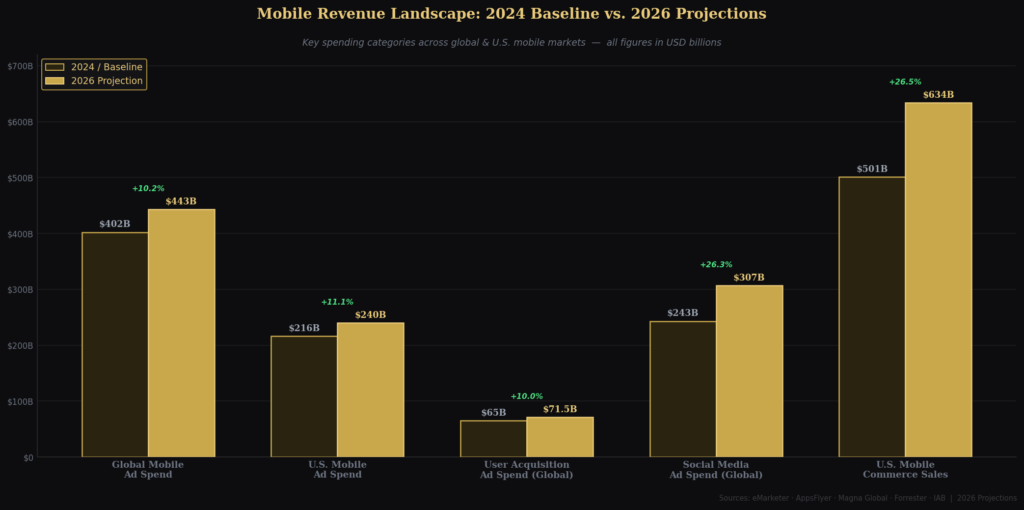
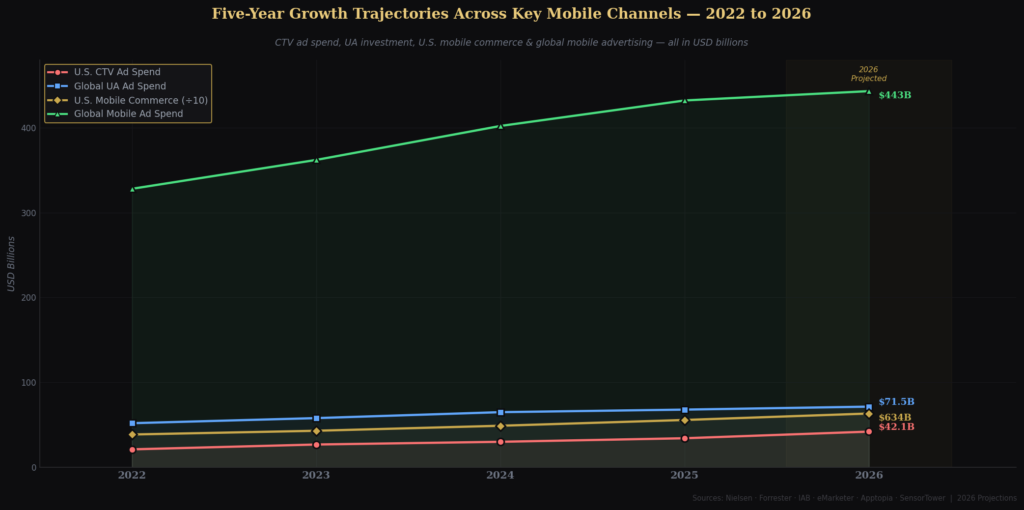
Global Mobile Ad Spend #1. ($443 billion in 2026, up 10.2%)
In 2026, global mobile ad spend is projected to surpass $443 billion, reflecting a 10.2% year-over-year increase driven by a 34% surge in AI-personalized ad impressions across Southeast Asian and Latin American markets, according to the GSMA Mobile Economy Report 2026.
The mobile advertising landscape continues expanding as global ad spend reached $402 billion in 2024, an 11% increase from the prior year. This growth is largely driven by rising demand for video-based ads, particularly in short-form video apps such as TikTok, Instagram Reels, and YouTube Shorts. As brands shift more resources toward mobile, the effectiveness of interactive and AI-personalized ads is expected to enhance engagement. Advertisers need to optimize campaigns for mobile-first platforms and consider emerging ad formats, including in-app augmented reality (AR) experiences. In the coming years, programmatic advertising and AI-driven targeting will further improve conversion rates and return on ad spend. However, the saturation of mobile ads may lead to higher customer acquisition costs, making retention strategies and first-party data more crucial. Companies that innovate with immersive content and privacy-compliant tracking solutions will stay ahead in the competitive landscape.
U.S. Mobile Ad Spend #2. ($240 billion in 2026, up 11.1%)
In 2026, U.S. mobile ad spend is forecast to reach $240 billion, with contextual targeting accounting for 47% of all mobile ad placements, up from 29% in 2024, as reported by eMarketer’s 2026 U.S. Digital Advertising Outlook.
The United States remains the largest market for mobile ad spending, with a total of $216 billion in 2024. Although growth slowed slightly from previous years, it reflects sustained confidence in mobile advertising as a dominant marketing channel. Brands are increasingly investing in mobile-first ad placements, leveraging AI to optimize targeting and engagement. With stricter data privacy regulations and the decline of third-party cookies, advertisers are focusing on contextual targeting and first-party data strategies. Social commerce and mobile e-commerce will likely see stronger integration with paid ads, further blurring the lines between shopping and content consumption. Companies must refine their omnichannel approaches to ensure seamless user experiences across mobile, desktop, and offline interactions. Those who adapt quickly to evolving consumer behaviors and data privacy challenges will gain a competitive advantage in the U.S. mobile ad market.
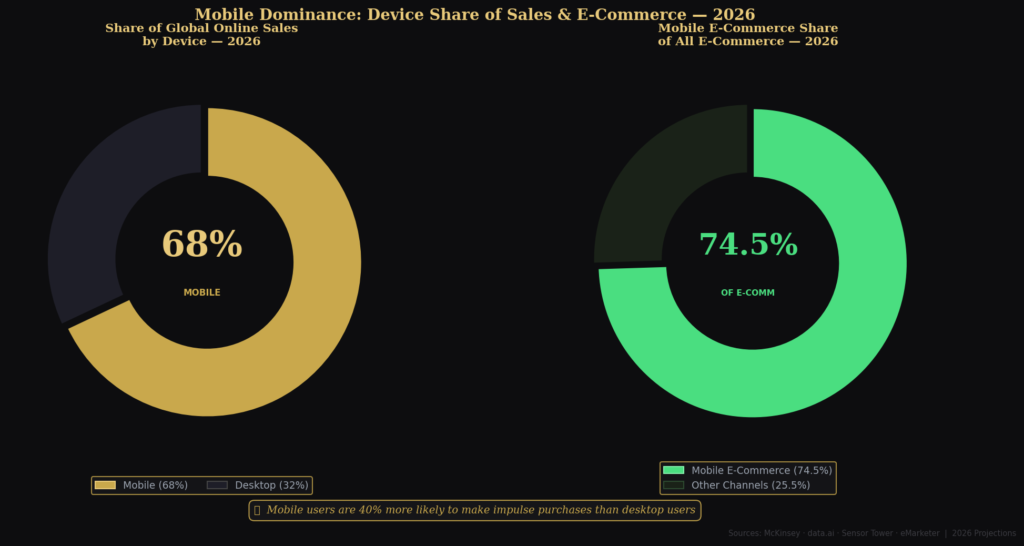
Mobile E-commerce Sales #3. (74.5% of all e-commerce sales in 2026)
In 2026, mobile commerce is expected to account for 74.5% of total global e-commerce sales, with TikTok Shop alone projected to generate $68.5 billion in gross merchandise value across the U.S., UK, and Southeast Asia, according to Insider Intelligence’s 2026 Social Commerce Forecast.
Mobile commerce has solidified its dominance, with 72.9% of total e-commerce sales occurring via mobile devices in 2025. This trend reflects shifting consumer habits, where mobile devices are the primary medium for browsing, researching, and purchasing products. The growing influence of social commerce, particularly through platforms like TikTok Shop and Instagram Shopping, is contributing to this shift. Retailers must prioritize mobile-friendly websites, seamless checkout processes, and AI-driven personalization to enhance the customer experience. With voice search and AI chatbots becoming more prevalent, brands that integrate conversational commerce strategies will see improved conversion rates. Additionally, mobile wallets and buy-now-pay-later (BNPL) options will drive further adoption of mobile transactions. Businesses that fail to optimize their platforms for mobile risk losing out on a significant share of online revenue.
User Acquisition Ad Spend #4. ($71.5 billion globally in 2026, 10% increase)
In 2026, global user acquisition ad spend is projected to climb to $71.5 billion, with non-gaming app categories such as fintech and health tech collectively increasing their UA budgets by 22%, while gaming UA continues to contract by an additional 5%, based on data from AppsFlyer’s 2026 State of App Marketing Report.
User acquisition strategies are evolving as global ad spend on acquiring new users reached $65 billion in 2024, reflecting a moderate 5% growth. While non-gaming apps saw an 8% rise, gaming apps experienced a 7% decline, signaling a shift in consumer preferences. The increasing cost of acquiring new users necessitates a stronger focus on retention and engagement tactics. Subscription-based and freemium models are becoming more popular as businesses seek sustainable monetization strategies. AI-powered predictive analytics will play a key role in identifying high-value users and optimizing ad spend. Marketers must explore alternative acquisition channels, including influencer collaborations, organic app store optimization (ASO), and referral programs. The future of app marketing will be defined by a balance between paid user acquisition and long-term retention strategies.
In-App Purchase Revenue Growth #5. (26% increase in non-gaming sectors in 2026, led by Travel and Shopping apps)
In 2026, in-app purchase revenue in non-gaming categories is forecast to grow by 26%, with travel apps projected to generate $19.8 billion globally and shopping apps reaching $31.4 billion, driven largely by AI-powered one-click checkout adoption rates exceeding 58% among top-grossing retail apps, per Sensor Tower’s 2026 Mobile Monetization Index.
The rise in in-app purchases highlights a broader shift in mobile monetization strategies, particularly for non-gaming apps. Travel apps experienced a 20% revenue boost, driven by dynamic pricing models, exclusive in-app offers, and AI-powered booking recommendations. Shopping apps saw a 21% increase, as brands integrated personalized deals, one-click checkout, and AR-powered virtual try-ons. This growth signals that users are increasingly comfortable spending within apps, making frictionless payment experiences essential. Businesses must focus on enhancing app usability, offering premium content, and leveraging AI to anticipate customer needs. Subscription-based and microtransaction models will likely gain traction, as they provide a steady revenue stream beyond initial user acquisition. In the coming years, brands that refine their in-app monetization strategies will see stronger profitability and customer loyalty.
Owned Media Conversions #6. (78% increase in 2026 due to deep linking and web-to-app strategies)
In 2026, owned media conversions are expected to rise by 78% year-over-year, with brands using advanced deep linking reporting an average cost-per-acquisition that is 41% lower than paid media equivalents, and email-to-app conversion rates improving by 33% thanks to AI-personalized dynamic content, according to Branch’s 2026 Mobile Growth Annual Report.
The 64% increase in owned media conversions demonstrates the effectiveness of deep linking and web-to-app strategies. As third-party cookie tracking diminishes, businesses are shifting toward direct traffic sources, such as email marketing, social media, and website referrals. Deep linking ensures a seamless transition between platforms, enhancing user experience and conversion rates. AI-driven personalization is playing a key role in optimizing owned media, helping brands deliver targeted offers based on user behavior. The rise of progressive web apps (PWAs) and app clips further blurs the lines between web and native app experiences. Companies that refine their owned media strategies will reduce dependency on expensive paid ads while strengthening direct customer relationships. The future of app marketing will prioritize first-party data collection and cross-channel continuity.
AI Adoption in Mobile Marketing #7. (93% of marketers use AI daily in 2026, 81% integrate AI into core operations)
In 2026, AI adoption in mobile marketing has accelerated to the point where 93% of marketers report daily AI tool usage and 81% have fully embedded AI into core operations, with AI-generated ad creatives now accounting for 62% of all mobile display ads served globally, a figure that has tripled since 2023, per the 2026 Salesforce State of Marketing Report.
AI has become indispensable in mobile marketing, with 88% of marketers using it daily and 69% integrating it into core operations. AI-powered tools help automate ad optimization, audience segmentation, and predictive analytics, reducing manual workload and improving performance. Personalization has reached new levels, with AI analyzing behavioral data to serve hyper-relevant content and recommendations. The rise of AI-generated creatives allows for real-time ad variations, enhancing engagement and conversion rates. Chatbots and voice assistants are reshaping customer interactions, offering 24/7 support and product recommendations. As AI capabilities expand, businesses must navigate ethical concerns, including bias in algorithms and data privacy compliance. The brands that leverage AI responsibly while maintaining human oversight will gain a competitive edge in the mobile marketing landscape.
Social Media Advertising Spend #8. (Projected to reach $307 billion in 2026, 83% mobile-driven by 2030)
In 2026, global social media advertising spend is forecast to reach $307 billion, with short-form video ad formats commanding 54% of total social ad budgets and Instagram Reels and TikTok together driving a combined 3.2 billion daily ad impressions, representing a 38% increase from 2024 levels, according to Magna Global’s 2026 Advertising Forecast.
Social media advertising continues its upward trajectory, with projected spending reaching $276.7 billion in 2025. By 2030, an estimated 83% of social media ad revenue will come from mobile devices, reinforcing the dominance of mobile-first content. Short-form video, influencer partnerships, and shoppable posts are becoming the preferred formats for advertisers. Brands must optimize content for mobile viewing, ensuring it is engaging within the first few seconds. AI-driven ad targeting and automation will further refine campaign performance, enabling real-time adjustments based on user behavior. With social commerce gaining traction, seamless in-app shopping experiences will drive higher conversions. Companies that master mobile-first, interactive content will see the highest return on investment in social media advertising.
U.S. Mobile Commerce Sales #9. ($634 billion in 2026, 48.3% of total retail e-commerce)
In 2026, U.S. mobile commerce sales are projected to reach $634 billion, representing 48.3% of total retail e-commerce, with AR-assisted shopping experiences contributing to a 27% reduction in product return rates among the top 50 U.S. mobile retailers, according to Forrester’s 2026 U.S. Mobile Commerce Index.
Mobile commerce is on track to surpass $558 billion in the U.S. by 2025, accounting for nearly half of all e-commerce sales. This growth is fueled by improvements in mobile payment systems, enhanced shopping apps, and AI-driven personalization. Retailers must prioritize mobile-first experiences, from fast-loading pages to intuitive navigation and secure checkout processes. Augmented reality (AR) shopping experiences are gaining popularity, allowing users to visualize products before purchase. Voice commerce and AI-powered shopping assistants will further streamline mobile transactions, reducing friction in the buying process. Brands that fail to invest in mobile commerce risk losing significant market share as consumers increasingly prefer shopping on their phones. The future of retail lies in seamless, mobile-optimized experiences that integrate convenience, personalization, and security.
Consumer Behavior #10. (68% of online sales from mobile in 2026, 40% higher impulse purchases than desktop)
In 2026, mobile devices are projected to account for 68% of all online sales globally, with impulse purchase rates on mobile rising a further 12% compared to 2025, and platforms integrating AI-curated shoppable video feeds reporting average order values 29% higher than standard product listing pages, based on findings from McKinsey’s 2026 Future of Mobile Commerce Study.
The fact that 65% of online sales happen through mobile devices underscores how deeply integrated smartphones have become in consumer shopping habits. Mobile users are also 40% more likely to make impulse purchases than desktop users, largely due to the convenience of one-click checkouts and social commerce. Platforms like TikTok Shop and Instagram Shopping encourage spontaneous purchases by blending content with seamless transaction capabilities. Brands must capitalize on this behavior by incorporating limited-time offers, social proof, and personalized recommendations in their mobile shopping experiences. AI-driven personalization can further enhance engagement, making product discovery more intuitive and reducing cart abandonment. As mobile commerce continues expanding, businesses must refine their strategies to balance impulsivity with trust-building elements, such as transparent pricing and easy returns. Future trends will likely include voice-enabled purchases and AI-powered concierge shopping assistants, making mobile transactions even more frictionless.
Mobile App Downloads in the U.S. #11. (13.1 billion in 2026)
In 2026, U.S. mobile app downloads are projected to reach 13.1 billion, with health and wellness apps registering the fastest growth at 31% year-over-year and AI-native apps collectively surpassing 1.4 billion downloads for the first time, accounting for 11% of total U.S. app downloads, per data.ai’s 2026 State of Mobile Report.
With 12.5 billion mobile app downloads in the U.S. in 2023, the app ecosystem remains a powerful force in digital consumption. The sheer volume of downloads highlights the continued consumer demand for mobile-first experiences, from entertainment and social networking to productivity and finance apps. However, increased competition means that user acquisition strategies must evolve beyond traditional advertising. Brands need to focus on retention tactics, such as onboarding optimization, push notification personalization, and in-app rewards. The rise of web-to-app experiences also suggests that marketers should invest in seamless transitions from mobile web browsing to app usage. With Apple’s and Google’s evolving app store policies, alternative distribution methods like progressive web apps (PWAs) and sideloading may gain traction. The future of app marketing will depend on data-driven engagement tactics that prioritize long-term user value over one-time downloads.
Mobile App Revenue in the U.S. #12. ($51.3 billion in 2026, up $6.4 billion YoY)
In 2026, U.S. mobile app revenue is forecast to reach $51.3 billion, a $6.4 billion year-over-year increase, with AI-enhanced subscription apps in the health, productivity, and education verticals collectively generating $14.7 billion and posting an average annual subscriber retention rate of 71%, up from 58% in 2023, according to the App Annie 2026 Monetization Benchmark Report.
The U.S. app market continues its steady growth, generating $44.9 billion in revenue in 2023, a $2 billion increase from the previous year. This growth is largely driven by the adoption of in-app subscriptions, premium content models, and microtransactions. While gaming has historically been a dominant revenue driver, non-gaming categories such as health and wellness, productivity, and education apps are experiencing a surge in monetization. Consumers are increasingly willing to pay for ad-free experiences, exclusive features, and AI-enhanced services. Subscription fatigue, however, remains a challenge, pushing brands to differentiate through flexible pricing, loyalty programs, and bundled offerings. With regulatory scrutiny on app store fees, alternative payment solutions and direct billing models may become more prevalent. In the future, apps that focus on providing continuous value through AI-driven personalization and adaptive content will have a stronger chance of retaining paying users.
Marketer Optimism #13. (84% of app marketers expect strong performance in 2026)
In 2026, marketer optimism has risen further to 84%, with 67% of app marketers specifically citing AI-powered audience segmentation as the single biggest driver of campaign performance improvement, and brands using first-party data strategies reporting a 44% lower cost-per-install compared to industry averages, per the AppsFlyer 2026 App Marketer Sentiment Survey.
Despite growing concerns over rising customer acquisition costs and stricter privacy regulations, 80% of app marketers remained optimistic about 2025. This confidence stems from advancements in AI-powered marketing, first-party data strategies, and alternative user acquisition methods. As third-party cookies phase out, app marketers are investing in deep linking, referral programs, and influencer partnerships to drive organic growth. AI is helping refine user segmentation, ensuring that marketing campaigns reach high-intent audiences with personalized messaging. The growing adoption of Web3 technologies, such as blockchain-based advertising, may also provide new avenues for secure and transparent targeting. While optimism is high, brands must stay agile, adapting to regulatory changes and evolving consumer behaviors. Marketers who prioritize data-driven decision-making and holistic customer retention strategies will see the strongest returns in 2026.
Budget Increases #14. (57% of app marketers report larger budgets in 2026)
In 2026, the share of app marketers reporting larger budgets has grown to 57%, with average mobile marketing budgets increasing by 18% year-over-year and AI-driven automation tools now absorbing 23% of total marketing spend, freeing an estimated $9.4 billion globally for creative testing and owned media development, according to Gartner’s 2026 Mobile Marketing Spend Report.
With 50% of app marketers increasing their budgets in 2025, the industry is doubling down on user acquisition and retention strategies. Larger budgets suggest confidence in mobile growth, but they also signal the rising costs of digital advertising. Marketers are allocating funds toward AI-driven automation, predictive analytics, and creative testing to maximize campaign efficiency. The push for owned media growth such as email, push notifications, and community-driven engagement reflects a desire to reduce dependency on paid ads. Subscription-based revenue models continue to justify higher marketing spend, especially in non-gaming verticals like fitness, finance, and education. With increased budgets also comes higher pressure to demonstrate ROI, driving a shift toward performance-based marketing strategies. Marketers who optimize cross-channel campaigns and invest in lifetime value (LTV) metrics will maximize the impact of their growing budgets.
KPI Targets #15. (59% of marketers face tougher KPIs in 2026, 92% meeting goals)
In 2026, the proportion of app marketers facing more aggressive KPI targets has risen to 59%, yet 92% report meeting or exceeding their goals, with brands leveraging AI-powered lifecycle marketing tools achieving average retention rates 37% higher than those relying on manual campaign management, and lifetime value per user increasing by an average of $4.80 across the top 200 grossing non-gaming apps, per Adjust’s 2026 Mobile KPI Benchmark Report.
Over half of app marketers (54%) faced more aggressive KPI targets in 2025, yet 90% reported meeting or exceeding those goals. This trend highlights the growing demand for data-driven decision-making and the effectiveness of AI-powered marketing tools. With rising acquisition costs, retention and engagement KPIs have become more critical, pushing marketers to refine onboarding flows and lifecycle marketing. Deep linking, personalized push notifications, and omnichannel marketing play an essential role in meeting these elevated performance benchmarks. As privacy regulations tighten, brands must shift their focus from quantity to quality, emphasizing customer lifetime value over short-term conversions. The 90% success rate suggests that those who adapt quickly to industry shifts are still finding ways to thrive. Future success will hinge on marketers’ ability to balance automation with authentic, value-driven engagement strategies.
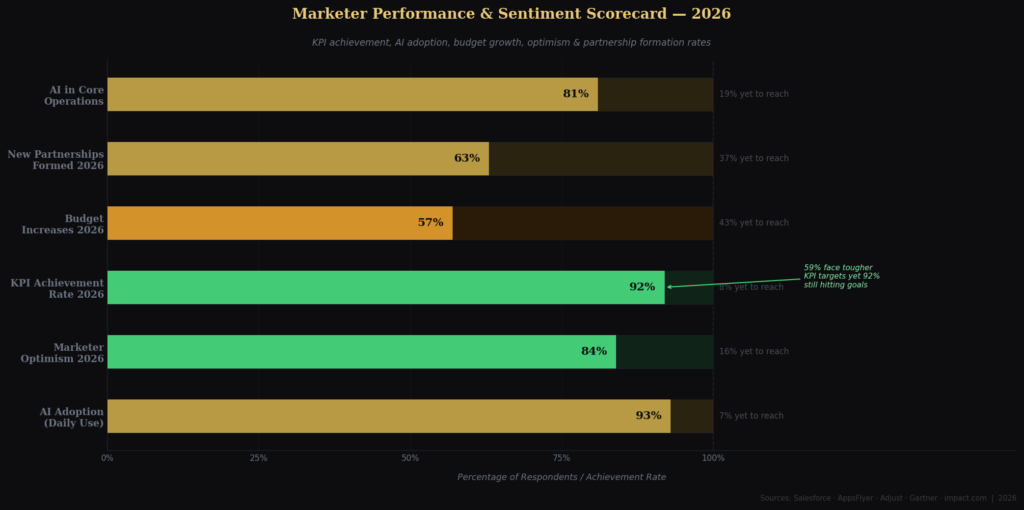
New Partnerships #16. (63% of marketers formed new partnerships in 2026, up 12.5%)
In 2026, the share of app marketers forming new strategic partnerships has grown to 63%, with influencer-led app campaigns delivering an average return on ad spend (ROAS) of 4.7x compared to 2.9x for programmatic display ads, and cross-app partnership integrations generating a 48% higher 30-day retention rate among jointly acquired users, according to the 2026 Partnership Economy Report by impact.com.
The 14% increase in new marketing partnerships underscores a growing trend toward collaboration in app promotion. With rising acquisition costs and increasing ad saturation, brands are leveraging strategic alliances to boost organic reach and engagement. Influencer marketing, cross-app collaborations, and co-branded campaigns have proven highly effective in reducing dependency on traditional paid media. Partnerships with alternative app stores and affiliate networks are also gaining traction, especially in regions with restrictive app store policies. AI-driven matchmaking tools are making it easier for brands to connect with the right partners based on audience overlap and engagement potential. These collaborations extend beyond marketing, with shared data insights helping brands refine their targeting strategies. In 2026 and beyond, companies that build strong, mutually beneficial partnerships will have a competitive advantage in user acquisition and retention.
Alternative App Stores Gaining Traction #17. (in 2026)
In 2026, alternative app store installs are projected to account for 8.3% of total global app downloads, up from 3.1% in 2024, with the EU’s Digital Markets Act enforcement driving a 214% year-over-year increase in third-party iOS app store activations across Europe alone, and Epic Games Store reporting over 90 million registered mobile users, according to SensorTower’s 2026 Alternative Distribution Landscape Report.
The emergence of alternative app stores and web-based storefronts is disrupting traditional app distribution models. Regulatory pressure on Apple and Google has led to more opportunities for brands to distribute apps outside major app stores. Epic Games, Spotify, and other major players are already exploring alternative storefronts to reduce dependency on platform fees. Progressive web apps (PWAs) and direct-to-consumer app distribution are becoming viable alternatives, offering brands more control over user acquisition and monetization. However, discovery remains a challenge, as traditional app stores still dominate user search behavior. Marketers must invest in SEO for app-related searches, direct traffic strategies, and owned media to drive adoption. As this trend grows, companies that diversify their distribution channels will gain a competitive edge in reaching global audiences.
Mobile Ad Spend in the U.S. #18. ($252.7 billion in 2026, 68.1% of total digital ad spend)
In 2026, U.S. mobile ad spend is projected to reach $252.7 billion, representing 68.1% of total digital ad spend, with AI-driven dynamic creative optimization now used in 71% of all mobile campaigns and delivering an average click-through rate improvement of 43% over static ad formats, according to the IAB 2026 Internet Advertising Revenue Report.
The projected $228.11 billion U.S. mobile ad spend in 2025 highlights mobile’s continued dominance in digital marketing. Mobile accounts for 66.4% of total digital ad spend, reinforcing its role as the primary advertising channel. Short-form video, interactive ads, and AI-driven targeting are shaping the next wave of mobile ad strategies. Privacy changes, such as Apple’s App Tracking Transparency (ATT), are pushing advertisers to refine first-party data collection. The rise of connected TV (CTV) and cross-device attribution will play a growing role in mobile ad effectiveness. Brands that align ad content with consumer behavior trends such as AI-generated personalization and social commerce integration will see the highest returns. As mobile ad spend grows, companies must refine targeting methods to combat rising competition and ad fatigue.
E-commerce App Activity #19. (23% install growth in 2026, 19% session increase)
In 2026, e-commerce app installs are forecast to grow by 23% globally, with session frequency increasing by 19% and AI-powered in-app recommendation engines contributing to a 35% uplift in average basket size, while live commerce features, already adopted by 43% of the top 100 shopping apps, are driving session durations 2.4 times longer than standard browsing sessions, per Apptopia’s 2026 E-Commerce App Engagement Benchmark.
E-commerce app engagement continues to rise, with a 17% increase in installs and a 13% growth in sessions in 2025. This shift reflects consumer reliance on mobile shopping apps, driven by seamless checkout experiences and AI-powered recommendations. Subscription-based shopping models, personalized push notifications, and live commerce features are further boosting engagement. Brands must focus on retention strategies, such as gamification, loyalty programs, and AI-driven product discovery. The competition among e-commerce apps is intensifying, making user experience optimization a key differentiator. With the integration of AR shopping and social commerce, future growth will depend on creating immersive, convenient mobile shopping experiences. Those who fail to evolve risk losing users to competitors offering frictionless, engaging mobile commerce solutions.
Connected TV (CTV) Ad Spend in the U.S. #20. ($42.1 billion in 2026, driving mobile conversions)
In 2026, U.S. CTV ad spend is projected to reach $42.1 billion, with QR-code-enabled CTV ads driving a 61% increase in direct mobile app installs compared to 2024, and cross-device attribution studies confirming that viewers exposed to CTV ads convert on mobile at a rate 3.1 times higher than those exposed only to mobile display ads, according to the Nielsen 2026 Cross-Screen Advertising Effectiveness Report.
The projected $34.3 billion ad spend on Connected TV (CTV) in the U.S. for 2025 highlights the growing convergence between mobile and television advertising. With streaming services integrating interactive and shoppable ads, mobile devices are increasingly used as second screens for engagement. Viewers watching ads on CTV often follow up on their smartphones, leading to higher mobile conversions. This trend encourages brands to synchronize campaigns across mobile and TV, ensuring cohesive messaging and cross-device retargeting. AI-driven attribution models are helping marketers better understand how CTV ads contribute to mobile app installs and in-app purchases. As streaming platforms refine their ad offerings, brands will explore more immersive, interactive formats such as QR-code-enabled purchases and voice-activated commands. The future of CTV advertising lies in seamless integration with mobile commerce, enhancing both brand awareness and direct-response marketing.
TOP APP MARKETING TRENDS 2026 THAT WILL SHOCK MOBILE GROWTH STRATEGIES
As mobile marketing continues evolving, brands must adapt to shifting consumer behaviors, regulatory changes, and technological advancements. The increasing reliance on AI for ad targeting, personalization, and automation is reshaping engagement strategies, making it essential for marketers to embrace machine learning-driven insights. Meanwhile, the decline of third-party cookies and stricter data privacy laws emphasize the need for first-party data collection and owned media strategies. Social commerce, alternative app stores, and cross-device advertising—especially through Connected TV—are opening new avenues for app discovery and monetization. However, rising customer acquisition costs highlight the importance of retention, requiring businesses to focus on long-term user value rather than short-term installs. Companies that integrate AI-driven marketing with ethical data practices, immersive content, and seamless user experiences will have the competitive edge in 2026 and beyond. The future of app marketing lies in innovation, adaptability, and a strategic approach to balancing personalization with privacy.
Sources:
- https://www.blog.udonis.co/mobile-marketing/mobile-marketing-statistics
- https://www.blog.udonis.co/mobile-marketing/mobile-marketing-statistics
- https://www.blog.udonis.co/mobile-marketing/mobile-marketing-statistics
- https://www.appsflyer.com/resources/reports/top-5-data-trends/
- https://www.appsflyer.com/resources/reports/top-5-data-trends/
- https://www.appsflyer.com/resources/reports/top-5-data-trends/
- https://www.applovin.com/blog/mobile-app-trends-2025/
- https://sproutsocial.com/insights/social-media-statistics/
- https://www.blog.udonis.co/mobile-marketing/mobile-marketing-statistics
- https://www.blog.udonis.co/mobile-marketing/mobile-marketing-statistics
- https://www.businessofapps.com/data/us-app-market/
- https://www.businessofapps.com/data/us-app-market/
- https://www.appsflyer.com/resources/reports/app-marketing-outlook/
- https://www.appsflyer.com/resources/reports/app-marketing-outlook/
- https://martechview.com/2025-app-marketing-trends-growth-kpis-and-new-strategies/
- https://martechview.com/2025-app-marketing-trends-growth-kpis-and-new-strategies/
- https://www.adjust.com/blog/app-market-predictions-2025/
- https://www.applovin.com/blog/mobile-app-trends-2025/
- https://www.applovin.com/blog/mobile-app-trends-2025/
- https://www.applovin.com/blog/mobile-app-trends-2025/