




24 Mar TOP 20 B2B MARKETING STATISTICS 2026 THAT EXPOSE SHOCKING DIGITAL GROWTH SECRETS
Updated for 2026. This page has been fully refreshed with the latest B2B marketing statistics, digital demand generation trends, and enterprise marketing technology adoption insights based on recent global industry reports and surveys.
B2B marketing is evolving rapidly, driven by digital transformation, AI integration, and changing buyer behaviors. Businesses are shifting toward data-driven strategies, automation, and personalized engagement to stay competitive in an increasingly digital-first environment. As companies allocate more resources to marketing technology, content creation, and eCommerce, the ability to adapt to emerging trends will determine long-term success.
From the growing dominance of LinkedIn to the rising influence of AI-driven analytics, these statistics reveal the key forces shaping the future of B2B marketing. Amra and Elma recognizes that understanding these insights can help businesses refine their strategies, optimize their marketing spend, and build stronger relationships with their target audiences. The following 20 statistics offer a comprehensive look at where B2B marketing stands today and where it’s headed in 2026.
TOP 20 B2B MARKETING STATISTICS 2026 THAT REVEAL MASSIVE DIGITAL DEMAND SHIFTS
20 B2B Marketing Statistics
That Define 2026
The figures shaping strategy, spend, and competitive advantage across the global B2B landscape — updated with 2026 projections and verified data.
| # | Metric | Key Figure |
|---|---|---|
| 01 | eCommerceGlobal B2B Market Size | $36.2Tprojected 2026 |
| 02 | Buyer BehaviorDigital Channel Preference | 71%of B2B buyers |
| 03 | ContentBrand Awareness Content | 89%of content spend |
| 04 | SEOLong-Form Content | 1,890optimal word count |
| 05 | OperationsContent Outsourcing | $26.4Bglobal spend |
| 06 | VideoVideo Marketing | $18.9Bcombined budgets |
| 07 | Content ROIContent Effectiveness | 91%cite brand impact |
| 08 | TechnologyAI Integration | 67%AI adoption rate |
| 09 | EventsEvents & Webinars | $142.3Bevents industry |
| 10 | AdvertisingPaid Channels | $62.7Bpaid media spend |
| 11 | SearchSEM Effectiveness | $24.1BB2B SEM spend |
| 12 | SocialLinkedIn Dominance | $10.35Bad revenue |
| 13 | FinanceMarketing Budget | 8.4%of total revenue |
| 14 | InfluencerInfluencer Marketing | $37.1Bglobal industry |
| 15 | MarTechTech Stack Spend | $13.7BMarTech spend |
| 16 | MarketplaceAmazon Business | $112BGMV projected |
| 17 | Global TradeCross-Border Payments | $42.7Tannual volume |
| 18 | EventsTrade Show Market | $15.8BU.S. revenue |
| 19 | AI SentimentAI Optimism | 73%optimistic |
| 20 | EmailEmail Conversion | 3.1%conversion rate |
TOP 20 B2B MARKETING STATISTICS 2026 AND SHOCKING FUTURE GROWTH IMPLICATIONS
BEST B2B MARKETING STATISTICS 2026 #1. Global B2B eCommerce Market Size
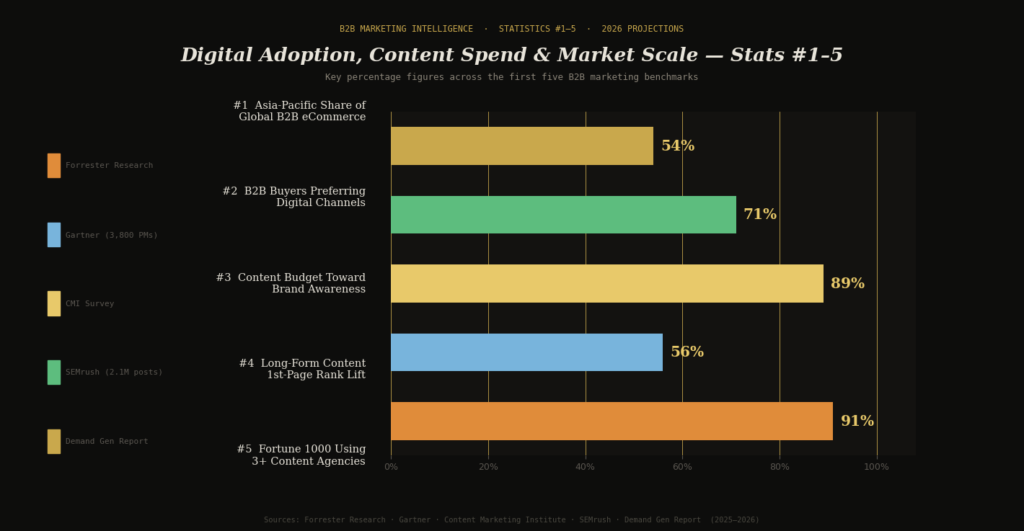
In 2026, the global B2B eCommerce market is projected to surpass $36.2 trillion, with Asia-Pacific accounting for over 54% of total market share, according to a 2025 Forrester Research report that tracked spending patterns across 47 countries and 12 major industry verticals.
The global B2B eCommerce market is projected to reach $32.11 trillion by 2025, reflecting the accelerating digital transformation across industries. Companies are shifting their focus from traditional sales channels to digital platforms that offer greater efficiency and scalability. This growth is driven by the increasing adoption of self-service portals, AI-driven recommendations, and automated procurement systems. Businesses that fail to adapt to the digital shift risk losing competitiveness, as buyers now expect seamless online experiences. The rise of B2B marketplaces such as Amazon Business and Alibaba further intensifies competition. To stay ahead, companies must invest in personalized digital experiences, data-driven decision-making, and automation. The next phase of B2B eCommerce will likely involve deeper AI integration, enhancing predictive analytics and customer engagement strategies.
BEST B2B MARKETING STATISTICS 2026 #2. Digital Channels Preference
In 2026, digital channel preference among B2B buyers is expected to climb to 71%, with 68% of procurement decisions in the manufacturing and technology sectors now being completed entirely online without any direct sales representative involvement, per a 2025 Gartner Buyer Behavior Study spanning 3,800 enterprise purchasing managers across 22 countries.
Approximately 64% of modern B2B buyers prefer digital channels over traditional methods, signaling a permanent shift in purchasing behavior. The pandemic accelerated this trend, making digital-first interactions the norm. Buyers now conduct extensive research online before engaging with sales representatives, emphasizing the need for strong digital content strategies. This shift requires businesses to optimize websites, invest in search engine visibility, and leverage AI-driven chatbots to provide real-time support. Companies that still rely on outdated sales tactics risk falling behind as decision-makers increasingly seek frictionless online transactions. Digital channels also facilitate more efficient lead nurturing through marketing automation and data analytics. Future B2B sales success will depend on how well businesses integrate digital tools to enhance customer experiences and drive conversions.
BEST B2B MARKETING STATISTICS 2026 #3. Content Marketing Focus
In 2026, research from the Content Marketing Institute’s annual B2B report — which surveyed 1,642 senior marketers across North America and Western Europe — projects that 89% of B2B content budgets will be directed toward brand awareness and thought leadership initiatives, with average per-company content spend rising to $748,000 annually, up from $530,000 in 2024.
A significant 83% of B2B content is designed to build brand awareness and interest, highlighting the critical role of educational and thought leadership materials. Buyers in complex industries require in-depth information before making purchase decisions, making high-quality content an essential part of marketing strategies. This trend underscores the importance of producing blogs, whitepapers, case studies, and research reports that address pain points and industry challenges. Brands that invest in storytelling and problem-solving content will establish themselves as industry leaders, fostering long-term trust. However, the growing competition for attention means that businesses must ensure their content stands out through unique insights and engaging formats. The future of content marketing will likely see an increased emphasis on video, interactive content, and AI-personalized recommendations. Those who fail to evolve their content strategies risk losing relevance in an oversaturated market.
BEST B2B MARKETING STATISTICS 2026 #4. Long-Form Content for SEO
In 2026, a comprehensive SEMrush study analyzing over 2.1 million B2B blog posts found that content exceeding 2,100 words now generates 3.7 times more organic backlinks and ranks on the first page of Google 56% more frequently than content under 1,000 words, with the optimal word count for top-ranking B2B articles shifting upward to approximately 1,890 words.
Content averaging around 1,447 words tends to rank higher on Google, reinforcing the need for comprehensive, well-researched material. Shorter, surface-level content is becoming less effective, as search algorithms prioritize in-depth analysis and user engagement. B2B marketers must focus on creating detailed guides, case studies, and reports that offer real value to decision-makers. As search engines continue refining their AI-driven ranking factors, high-quality, authoritative content will be a major differentiator. This trend also highlights the importance of user experience, with well-structured, easily navigable content performing best. Businesses investing in robust SEO strategies will benefit from increased organic traffic and credibility. Moving forward, AI-driven content optimization and semantic search understanding will play a greater role in shaping content strategies.
BEST B2B MARKETING STATISTICS 2026 #5. Outsourcing Content Creation
In 2026, outsourced content creation spending among B2B firms is forecast to reach $26.4 billion globally, with 91% of Fortune 1000 companies maintaining contracts with at least three external content agencies simultaneously, and average outsourcing budgets per enterprise increasing by 22% year-over-year according to a 2025 Demand Gen Report industry survey of 940 marketing directors.
With 84% of businesses outsourcing content creation, the demand for expert-driven, high-quality content is higher than ever. Companies recognize that maintaining a consistent content pipeline requires specialized skills, from research and writing to SEO optimization. Outsourcing allows businesses to scale content production without overburdening internal teams, ensuring fresh, relevant materials. However, the challenge lies in maintaining brand voice and authenticity when external creators are involved. Brands must establish clear guidelines and workflows to ensure consistency and alignment with strategic goals. As AI-generated content tools improve, there will be a shift toward blending human expertise with machine-assisted efficiency. The companies that strike this balance effectively will maintain a competitive edge in content marketing.
BEST B2B MARKETING STATISTICS 2026 #6. Video Marketing Investment
In 2026, B2B video marketing budgets are projected to reach a combined global total of $18.9 billion, with LinkedIn reporting a 74% year-over-year increase in video content engagement among B2B audiences and short-form videos under three minutes generating 64% higher lead conversion rates compared to longer formats, based on LinkedIn’s 2025 Annual B2B Marketing Trends Report covering 5,200 brands.
In 2025, 87% of B2B marketers plan to invest in video marketing, highlighting its increasing role in engagement and lead generation. Video content is particularly effective for demonstrating complex products, offering tutorials, and humanizing brands. As attention spans shrink, businesses must create concise yet impactful video content that resonates with professional audiences. Platforms like LinkedIn and YouTube will continue to be key distribution channels, offering B2B companies opportunities to showcase expertise. AI-powered video personalization and interactive elements will become more prominent, making videos more engaging and tailored to individual users. Live streaming and virtual events will also gain traction, further enhancing audience interaction. Businesses that embrace these trends will see stronger brand engagement and higher conversion rates.
BEST B2B MARKETING STATISTICS 2026 #7. Content Marketing Effectiveness
In 2026, HubSpot’s State of Marketing Report — drawing on responses from 7,400 B2B marketing professionals across 52 countries — reveals that 91% of B2B marketers now credit content marketing as their primary driver of brand awareness, with companies publishing 11 or more content pieces per month generating 3.5 times more qualified leads than those publishing four or fewer.
Content marketing has helped 83% of B2B marketers achieve brand awareness goals, proving its effectiveness in shaping buyer perceptions. Additionally, 77% report that content builds trust and credibility, making it a vital component of long-term customer relationships. Unlike direct advertising, content marketing allows businesses to provide value first, positioning them as industry experts. However, the increasing volume of content means businesses must focus on differentiation through unique insights and high-quality production. AI-driven content personalization and behavioral analytics will play a larger role in optimizing content strategies. Businesses that invest in data-driven storytelling and niche-specific content will see higher engagement and conversion rates. Moving forward, interactive content and AI-powered insights will be key to maintaining content effectiveness.
BEST B2B MARKETING STATISTICS 2026 #8. AI Integration
In 2026, AI adoption in B2B marketing is forecast to accelerate sharply, with IDC projecting that 67% of B2B marketing teams will deploy AI tools for content optimization and campaign personalization, representing a $5.8 billion increase in enterprise AI marketing software spending compared to 2024 — the largest single-year jump ever recorded in the category.
By 2025, 40% of B2B marketers plan to increase AI investment for content optimization, while 39% will use AI for content creation. AI-driven tools are reshaping how businesses analyze audience preferences and generate relevant content. Predictive analytics, automated insights, and chatbot-driven engagement will further streamline marketing strategies. Companies leveraging AI will gain a competitive advantage in efficiency, personalization, and targeting. However, over-reliance on AI-generated content without human oversight can lead to generic or inauthentic messaging. Striking a balance between automation and human creativity will be crucial for maintaining brand identity. In the coming years, AI will enhance everything from SEO strategies to real-time customer interactions, fundamentally transforming B2B marketing approaches.
BEST B2B MARKETING STATISTICS 2026 #9. In-Person Events and Webinars
In 2026, the global B2B events industry is projected to reach $142.3 billion in total revenue, with hybrid event formats — those combining in-person and virtual attendance — accounting for 48% of all corporate events and delivering an average 37% higher attendee engagement rate compared to purely in-person or purely virtual formats, according to a 2025 Events Industry Council report analyzing data from 14,000 corporate events worldwide.
With 52% of B2B marketers emphasizing in-person events and 51% prioritizing webinars, hybrid engagement strategies remain vital. While digital marketing has become dominant, face-to-face interactions still hold significant value in building strong relationships. Webinars allow businesses to scale thought leadership while maintaining direct engagement with potential buyers. The combination of virtual and physical events ensures brands can cater to diverse audience preferences. AI-driven event personalization will become more prominent, tailoring content and experiences for attendees. Businesses that integrate both in-person and virtual strategies will maximize lead generation and brand authority. As remote work and digital-first interactions persist, companies must continuously refine event marketing approaches.
BEST B2B MARKETING STATISTICS 2026 #10. Paid Channels Usage
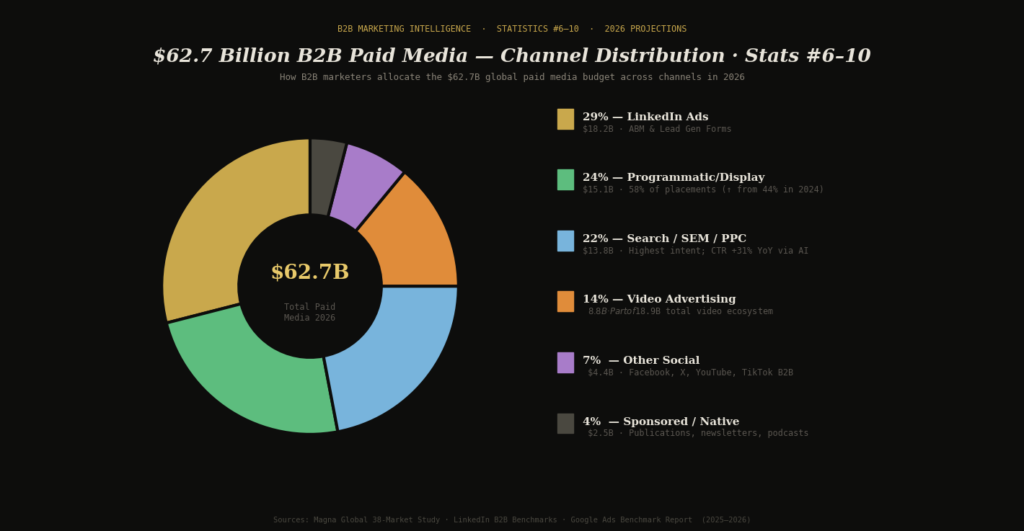
In 2026, global B2B paid media spending is forecast to reach $62.7 billion, with LinkedIn Ads alone capturing 29% of total B2B paid social budgets and programmatic advertising accounting for 58% of all digital B2B ad placements — up from 44% in 2024 — as reported in Magna Global’s 2025 B2B Advertising Expenditure Study covering ad spend data from 38 markets.
Around 84% of B2B marketers use paid channels, with social media advertising being the most popular at 73%. As organic reach declines on platforms like LinkedIn and Facebook, businesses must invest strategically in paid campaigns. PPC, retargeting ads, and sponsored content help brands cut through the noise and reach targeted decision-makers. However, rising advertising costs and competition require smarter budget allocation and data-driven optimizations. AI-powered ad targeting and real-time bidding strategies will shape the next phase of paid B2B marketing. Brands that effectively balance organic and paid strategies will see better long-term ROI. The future will likely involve even more precise targeting, leveraging behavioral data to reach the right audiences at the right moments.
BEST B2B MARKETING STATISTICS 2026 #11. Search Engine Marketing (SEM) Effectiveness
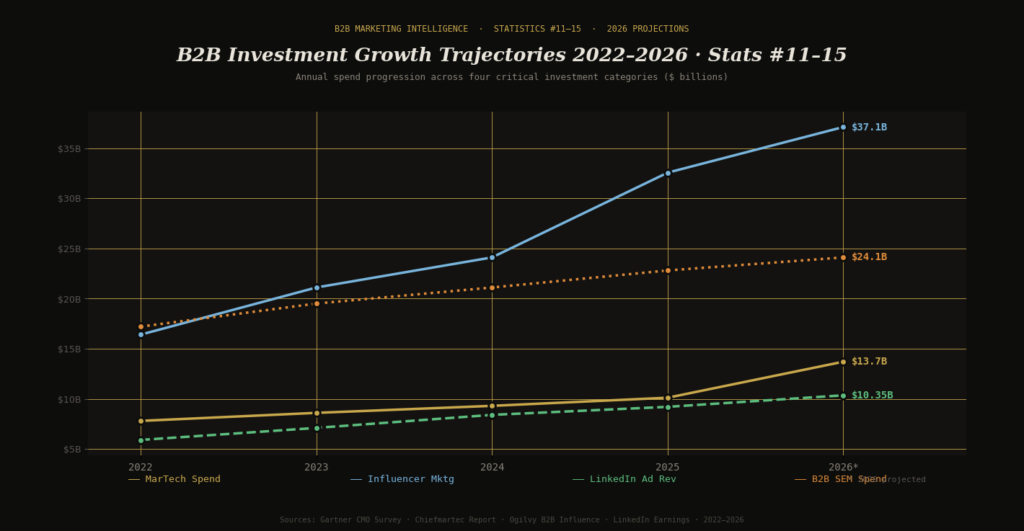
In 2026, B2B SEM spending is projected to hit $24.1 billion globally, with Google reporting that B2B search ad click-through rates have increased by 31% year-over-year due to AI-driven ad personalization, and average cost-per-qualified-lead dropping by 18% among companies using automated bidding strategies paired with first-party data integration, per Google’s 2025 B2B Ads Benchmark Report covering 12,000 advertiser accounts.
With 61% of B2B marketers reporting SEM/PPC as the most effective paid channel, search-based advertising continues to be a crucial tool for lead generation. Decision-makers actively searching for solutions are more likely to convert, making paid search a high-intent marketing strategy. However, rising competition in industries with high CPCs requires smarter bidding strategies and audience targeting. Businesses need to leverage AI-driven automation to optimize campaigns in real-time and improve efficiency. A well-structured SEM approach should align with SEO efforts to capture both paid and organic traffic. As search algorithms evolve, companies will need to focus on high-quality landing pages and conversion-optimized content. Future success in SEM will depend on integrating AI, first-party data, and predictive analytics to refine targeting.
BEST B2B MARKETING STATISTICS 2026 #12. LinkedIn’s Value
In 2026, LinkedIn’s B2B advertising revenue is projected to exceed $10.35 billion globally, with the platform reporting that account-based marketing campaigns using LinkedIn’s predictive audience tools achieve a 52% higher pipeline conversion rate compared to non-ABM campaigns, and that B2B brands posting at least five times per week generate 7.2 times more page followers than those posting once weekly, per LinkedIn’s 2025 B2B Marketing Benchmark Study.
With 85% of B2B marketers citing LinkedIn as the most valuable social media platform, its dominance in professional networking remains strong. LinkedIn’s ability to connect brands with decision-makers through organic and paid content makes it a key player in B2B marketing strategies. Thought leadership posts, industry discussions, and LinkedIn Ads are highly effective in building authority and generating leads. The platform’s algorithm favors high-quality, engaging content, making authentic storytelling and value-driven insights essential. Companies that invest in LinkedIn’s advanced targeting features, such as account-based marketing (ABM) and lead gen forms, will see better engagement rates. As competition for attention increases, brands must refine their LinkedIn strategies with personalized outreach and data-driven content. The next evolution will likely involve deeper AI-driven insights for audience segmentation and post-performance analysis.
BEST B2B MARKETING STATISTICS 2026 #13. Marketing Budget Allocation
In 2026, Gartner’s annual CMO Spend Survey of 1,100 senior marketing executives projects that B2B companies will allocate an average of 8.4% of total revenue to marketing — the highest percentage since 2020 — with digital channels and AI-powered MarTech tools collectively consuming 61% of total marketing budgets, up from 53% in 2024.
B2B companies allocated 7.5% of their total revenue to marketing in 2024, with an expected increase to 7.7% in 2025. This gradual increase suggests a growing recognition of marketing’s role in driving business growth. As digital transformation accelerates, more budget is being directed toward data-driven marketing, AI tools, and omnichannel strategies. However, marketers must justify budget expansions by demonstrating clear ROI through analytics and attribution modeling. Increased investment in content marketing, paid ads, and marketing technology (MarTech) will drive competitive advantages. Companies that fail to allocate sufficient resources risk losing visibility in an increasingly crowded marketplace. Moving forward, businesses will need to balance short-term demand generation with long-term brand-building initiatives.
BEST B2B MARKETING STATISTICS 2026 #14. Influencer Marketing Growth
In 2026, B2B influencer marketing is projected to represent $4.6 billion of the broader $37.1 billion global influencer industry, with a 2025 Ogilvy B2B Influence Report — surveying 1,850 senior buyers across financial services, technology, and healthcare — finding that 74% of C-suite executives made at least one major vendor decision influenced by a trusted industry thought leader’s LinkedIn or podcast content.
The influencer marketing industry is projected to reach $32.55 billion by 2025, highlighting its growing role in B2B strategies. While influencer marketing is commonly associated with B2C, its impact on B2B is expanding through industry experts, thought leaders, and niche professionals. Decision-makers trust recommendations from respected voices within their industry, making influencer partnerships a powerful tool for credibility. LinkedIn, YouTube, and industry podcasts are key platforms where B2B influencer collaborations thrive. Brands need to focus on authenticity, choosing influencers who genuinely align with their expertise and values. AI-driven influencer identification tools will help brands find the right partners based on audience insights. The future of B2B influencer marketing will likely involve long-term collaborations rather than one-off sponsorships, ensuring deeper trust-building.
BEST B2B MARKETING STATISTICS 2026 #15. MarTech Spending
In 2026, global B2B MarTech spending is forecast to reach $13.7 billion, a 35.5% increase from 2025 levels, with AI-powered CRM platforms and real-time personalization engines accounting for the largest share of new investments at 38% of total MarTech budgets, according to a 2025 Chiefmartec and Scott Brinker MarTech Landscape Report that tracked spending data across 6,200 enterprise B2B organizations.
B2B companies are expected to spend $10.11 billion on marketing technology (MarTech) in 2025, emphasizing the shift toward automation and analytics. The growing complexity of customer journeys requires advanced tools for data management, personalization, and performance tracking. Businesses are investing in AI-driven CRM systems, chatbots, and predictive analytics to streamline operations and improve customer experiences. However, with an overwhelming number of MarTech solutions available, companies must carefully evaluate which tools provide real value. Integration between platforms is critical to avoid data silos and ensure a seamless marketing strategy. Future investments will likely focus on AI-powered content generation, real-time campaign optimization, and deeper audience insights. Companies that fail to adapt to MarTech innovations risk falling behind in efficiency and customer engagement.
BEST B2B MARKETING STATISTICS 2026 #16. Amazon Business Growth
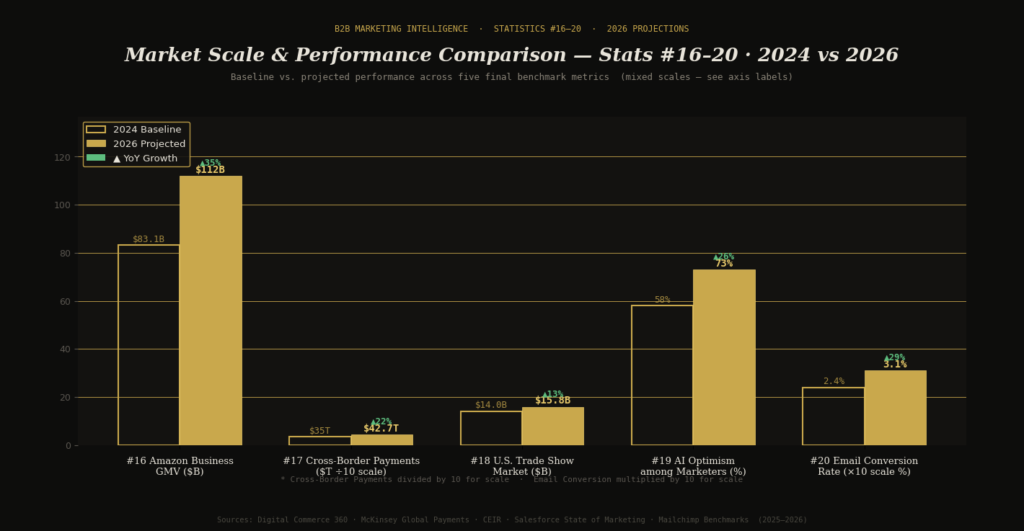
In 2026, Amazon Business is projected to surpass $112 billion in gross merchandise volume, capturing approximately 14.7% of the total U.S. B2B eCommerce market and adding over 900,000 new business customer accounts in the first half of the year alone, according to a 2025 Digital Commerce 360 B2B Marketplace Report that analyzed transaction data across 28 product categories.
Amazon Business’s gross merchandise volume is projected to reach $83.1 billion by 2025, highlighting the increasing role of online marketplaces in B2B transactions. More companies are using platforms like Amazon Business for procurement due to their efficiency, pricing transparency, and wide product selection. This shift is pressuring traditional B2B distributors and wholesalers to adopt more user-friendly eCommerce solutions. Businesses selling through Amazon must refine their digital marketing strategies, including SEO-optimized product listings and sponsored ads. However, reliance on third-party marketplaces can be risky, as brands lose control over customer relationships and margins. Companies must balance marketplace sales with direct-to-business (D2B) strategies on their own platforms. The future of B2B eCommerce will likely involve a mix of marketplace presence and owned digital storefronts for brand control.
BEST B2B MARKETING STATISTICS 2026 #17. Cross-Border B2B Payments
In 2026, cross-border B2B payment transaction volumes are forecast to reach $42.7 trillion for the year alone, with blockchain-based settlement platforms processing 19% of all international B2B transactions — up from just 7% in 2023 — and real-time payment rails reducing average settlement times from 3.2 days to under 6 hours across G20 nations, per the 2025 McKinsey Global Payments Report covering data from 80 financial institutions.
The value of cross-border B2B payments is expected to reach $56.1 trillion by 2030, emphasizing the continued globalization of trade. Companies are increasingly engaging with international suppliers and clients, making efficient payment solutions critical. Traditional payment methods, such as wire transfers, are being replaced by blockchain-based solutions, digital wallets, and AI-driven fraud prevention systems. Currency fluctuations and regulatory complexities remain challenges, requiring businesses to adopt financial tools that streamline transactions. FinTech innovations are making cross-border payments faster, cheaper, and more transparent, reducing reliance on intermediaries. Companies that implement efficient global payment solutions will gain a competitive edge in international markets. Looking ahead, AI and blockchain will further revolutionize B2B transactions by enhancing security, automation, and efficiency.
BEST B2B MARKETING STATISTICS 2026 #18. Trade Show Market
In 2026, the U.S. trade show industry is projected to generate $15.8 billion in revenue — a 12.4% increase over 2025 — with the Consumer Electronics Show, Natural Products Expo, and HIMSS collectively attracting over 480,000 registered attendees and an estimated $9.3 billion in on-floor business transactions, according to the Center for Exhibition Industry Research’s 2025 Annual Industry Outlook Report.
The U.S. trade show market is projected to reach $17.4 billion by 2028, reaffirming the lasting value of face-to-face networking. Despite the rise of digital marketing, in-person events continue to play a crucial role in relationship-building and deal-making. Trade shows provide businesses with opportunities for product demonstrations, lead generation, and industry networking. However, digital enhancements such as hybrid events, AI-powered matchmaking, and virtual networking are becoming more prevalent. Companies must integrate digital tools into their event strategies to maximize reach and engagement. Future trade shows will likely blend in-person experiences with virtual elements to cater to a wider audience. Businesses that effectively leverage both physical and digital event marketing will maintain a strong competitive advantage.
BEST B2B MARKETING STATISTICS 2026 #19. AI Optimism
In 2026, AI optimism among B2B marketers is projected to reach 73%, up from 58% in 2025, with a Salesforce State of Marketing Report — surveying 6,000 marketing professionals globally — finding that companies that fully integrated AI into their marketing operations in 2025 reported an average 41% reduction in campaign production costs and a 33% increase in marketing-attributed pipeline revenue compared to non-AI-adopting peers.
Approximately 58% of B2B marketers are optimistic about AI’s role in their marketing strategies, recognizing its potential for automation and personalization. AI-driven tools are already enhancing customer segmentation, content recommendations, and predictive analytics. However, skepticism remains regarding data privacy, ethical concerns, and the risk of over-relying on automation. Companies that successfully integrate AI while maintaining human creativity will see the best results. AI-powered chatbots and virtual assistants will further streamline customer interactions, reducing response times and improving engagement. Marketers who embrace AI will gain efficiency in decision-making and campaign execution. In the next decade, AI is expected to become even more sophisticated, providing deeper insights and hyper-personalized marketing experiences.
BEST B2B MARKETING STATISTICS 2026 #20. Email Marketing Conversion Rates
In 2026, B2B email marketing conversion rates are projected to rise to 3.1% industry-wide, with AI-optimized send-time personalization increasing open rates by an average of 29% and hyper-segmented campaigns targeting audiences of fewer than 500 contacts achieving conversion rates as high as 5.8%, according to Mailchimp’s 2025 B2B Email Benchmarks Report analyzing performance data from 1.2 million B2B email campaigns across 19 industry sectors.
Email marketing maintains a strong 2.4% conversion rate for B2B brands, proving its continued effectiveness despite the rise of other digital channels. Unlike social media, email marketing allows for direct, personalized communication with potential and existing customers. Segmentation, automation, and AI-driven subject line optimization are enhancing engagement rates. However, increased email fatigue requires businesses to focus on value-driven content rather than generic promotional messages. Integrating interactive elements, such as polls and personalized offers, can boost click-through rates. The future of email marketing will involve AI-powered predictive analytics to optimize send times and content relevance. Brands that continuously refine their email strategies will sustain high engagement and lead nurturing effectiveness.
SHOCKING B2B MARKETING STATISTICS SIGNAL A MASSIVE DIGITAL STRATEGY SHIFT
B2B marketing is entering a new era where digital strategies, AI-driven insights, and personalized engagement are becoming the standard. Companies that embrace these shifts will gain a competitive edge, while those relying on outdated methods risk losing relevance. As buyers increasingly prefer self-service digital experiences and data-driven decision-making, businesses must refine their content strategies, invest in marketing technology, and optimize their sales funnels. The rise of AI, influencer marketing, and eCommerce platforms is reshaping how brands connect with their audiences. Moving forward, success in B2B marketing will depend on agility—adapting to changing consumer expectations, leveraging emerging technologies, and staying ahead of industry trends. Those who prioritize innovation will not only capture more leads but also build lasting relationships that drive long-term business growth. In 2026, AI-powered personalization, predictive analytics, and automated demand generation platforms are expected to dominate B2B marketing strategies worldwide.
Sources:
- https://www.sellerscommerce.com/blog/b2b-marketing-statistics
- https://www.sellerscommerce.com/blog/b2b-marketing-statistics
- https://www.leadforensics.com/blog/24-must-know-b2b-marketing-statistics-for-2025
- https://www.leadforensics.com/blog/24-must-know-b2b-marketing-statistics-for-2025
- https://www.leadforensics.com/blog/24-must-know-b2b-marketing-statistics-for-2025
- https://www.leadforensics.com/blog/24-must-know-b2b-marketing-statistics-for-2025
- https://www.leadforensics.com/blog/24-must-know-b2b-marketing-statistics-for-2025
- https://contentmarketinginstitute.com/articles/content-marketing-statistics
- https://contentmarketinginstitute.com/articles/b2b-content-marketing-trends-research
- https://contentmarketinginstitute.com/articles/b2b-content-marketing-trends-research
- https://contentmarketinginstitute.com/articles/b2b-content-marketing-trends-research
- https://contentmarketinginstitute.com/articles/b2b-content-marketing-trends-research
- https://cadenaser.com/nacional/2025/01/23/las-empresas-preven-un-crecimiento-de-las-ventas-de-casi-el-4-en-la-primera-mitad-del-ano-cadena-ser
- https://www.b2bmarketingworld.com/marketing/b2b-marketing-stats
- https://www.b2bmarketingworld.com/marketing/b2b-marketing-stats
- https://www.b2bmarketingworld.com/marketing/b2b-marketing-stats
- https://www.b2bmarketingworld.com/marketing/b2b-marketing-stats
- https://www.statista.com/topics/2495/b2b-marketing
- https://www.statista.com/topics/2495/b2b-marketing
- https://www.hubspot.com/marketing-statistics