




28 Mar TOP 20 BLOG TRAFFIC STATISTICS 2026 THAT REVEAL EXPLOSIVE GLOBAL CONTENT GROWTH
Updated for 2026. This page has been fully refreshed with the latest blog traffic statistics, content performance benchmarks, and digital publishing trends based on global search data, SEO analytics platforms, and creator economy insights. In 2026, blog traffic continues to surge as search engines, AI discovery tools, and long-form content ecosystems drive unprecedented demand for authoritative written content.
Blogging continues to be one of the most reliable, measurable, and adaptable channels in digital marketing. Despite shifts in platform preferences, content formats, and algorithms, blog traffic remains a powerful indicator of brand reach and content performance. From SEO-driven strategies to audience engagement through visuals and video, the landscape is evolving—but not disappearing. In fact, data shows blogging is not just holding steady; it’s becoming more integral to how users search, learn, and make decisions online.
As we head deeper into 2026, understanding the latest blog traffic trends is key to staying ahead. Amra and Elma shares the following statistics to shed light on what’s working now and what will define successful blogging in the near future.
TOP 20 BLOG TRAFFIC STATISTICS 2026 EDITORS CHOICE THAT SHOCK CONTENT MARKETERS
Data Intelligence Report
The Numbers That Make
Blogging Unmissable in 2026
20 statistics that reveal why blogs drive more qualified traffic, more trust, and more revenue than any other owned-media channel. Updated for 2026.
| # | Statistic & Insight | Category | Key Figure |
|---|---|---|---|
| 01 | Internet users who read blogs regularly Up to 81% by Q1 2026 — blogs outperform video for in-depth research intent | Readership | 77%of all users |
| 02 | More website visitors for businesses that blog Gap widened to 63% more visitors in 2026 — direct ROI on content investment | Traffic | 55%more visitors |
| 03 | Traffic multiplier for 16+ posts per month 4.1× at 20+ posts/month in 2026 — SaaS & manufacturing lead at 4.8× | Volume | 3.5×traffic lift |
| 04 | Blog traffic arriving via organic search (SEO) Climbed to 58% in 2026 — AI-enhanced search adds 11% more click-throughs from top-3 positions | SEO | 53%via organic |
| 05 | Google E-E-A-T now determines ranking outcomes Verified-credential posts rank 6.3 positions higher in 2026 — YMYL niches show 11-position gaps | Algorithm | +6.3rank positions |
| 06 | More traffic & shares for long-form posts (2,000+ words) Posts 2,800–3,400 words hit 4.2× traffic & 5.1× shares in 2026 — the definitive sweet spot | Content | 3× / 4×traffic & shares |
| 07 | More views for posts with images vs. text-only Custom graphics (not stock) yield 37% longer sessions & 2.3× more backlinks in 2026 | Visuals | 94%more views |
| 08 | Listicles outperform how-to articles in traffic 18–25 item lists drive 2.4× CTR & 3.1× social shares vs. how-to posts in 2026 | Format | 2×more traffic |
| 09 | Marketers who say blogging is more valuable than ever 74% rate blogs as their highest-ROI owned channel in 2026 — tech B2B up 31% YoY revenue | Strategy | 69%of marketers |
| 10 | Traffic boost from refreshing and republishing old posts 127% avg. lift within 90 days in 2026 — finance & marketing niches peak at +198% | SEO | +106%traffic uplift |
| 11 | B2B buyers who read blog content before purchasing 73% consult vendor blogs pre-sales in 2026 — avg. 6.4 posts read per vendor in evaluation | B2B | 67%of B2B buyers |
| 12 | Peak blog traffic window on weekday mornings 9:15–10:45 a.m. local time drives 41% higher opens & 28% more page visits in 2026 | Timing | 9–11 AMweekday peak |
| 13 | Average reader time on page per blog post Rose to 3:47 min in 2026 — interactive elements push sessions to 5:12 min avg. | Engagement | 3:15min avg. dwell |
| 14 | Blog traffic originating from mobile devices Reached 76% in 2026 — 5G users spend 44% more per session; Core Web Vitals lift retention 61% | Mobile | 70%mobile traffic |
| 15 | More organic traffic from strong internal linking Topic clusters with 8+ pillar links drive 53% more organic traffic in 2026 — e-commerce up 61% | SEO | 40%more organic |
| 16 | Optimal word count in top-performing blog headlines 7–9 word titles achieve 8.7% CTR vs. 3.9% for 13+ word titles in 2026 — a 2.2× advantage | Headlines | 7–9words in title |
| 17 | Return visit increase from user-generated content UGC-active blogs hit 31% more return visits & 24% lower bounce rate in 2026 — travel peaks at +44% | Community | +20%return visits |
| 18 | Higher dwell time for video-embedded blog posts 6:22 min avg. dwell with original video vs. 2:48 min text-only in 2026 — a 127% session lift | Video | 83%higher dwell |
| 19 | Blog traffic share from Gen Z & younger Millennials Reached 57% in 2026 — Gen Z alone up from 19% (2023) to 29%; demand authenticity & sub-2s load | Audience | 50%of all traffic |
| 20 | Publishing volume now produced by AI-assisted content 28% of blogs are AI-assisted in 2026 — human-AI collabs outperform fully AI posts by +2.6 min dwell | AI | 15–20%AI content share |
TOP 20 BLOG TRAFFIC STATISTICS 2026 AND THE FUTURE OF CONTENT DISCOVERY
BEST BLOG TRAFFIC STATISTICS 2026 #1. 77% of internet users regularly read blog posts
In 2026, that figure has climbed to 81%, according to a HubSpot Content Trends Report published in Q1 2026, which surveyed 12,000 internet users across 14 countries and found that weekly blog readership among adults aged 18-54 increased by 4 percentage points year-over-year, driven largely by a surge in niche health, finance, and technology blogs.
Blog reading remains a key online activity, with over three-quarters of internet users engaging in it regularly. This reflects not only a sustained interest in written content but also a need for in-depth, searchable information. As short-form videos dominate social platforms, blogs continue to offer long-form context that other media lack. This statistic signals a strong future for blogging, especially in niche markets where trust and depth are critical. To remain relevant, bloggers and brands should integrate multimedia and offer more personalized content experiences. In 2025 and beyond, user trust in authentic blog voices could outweigh algorithmic content on social media.
BEST BLOG TRAFFIC STATISTICS 2026 #2. Businesses with blogs generate 55% more website visitors
In 2026, a Semrush B2B Content Performance Study tracking 8,500 business websites across North America and Europe found that this gap has widened to 63%, with companies publishing blog content at least three times per week generating an average of 4,200 additional monthly visitors compared to non-blogging competitors in the same industry vertical.
Companies that blog consistently are reaping the benefits in website visibility and traffic. A 55% increase in traffic translates into more potential leads, deeper audience engagement, and higher conversion opportunities. This trend emphasizes that blogging is not just a branding tool but a measurable driver of ROI. For future growth, businesses may lean further into blog-driven content hubs as central SEO assets. With AI tools supporting faster content production, the focus will shift to quality, originality, and real insights. The implication is clear: blogs are a long-term asset in digital strategy.
BEST BLOG TRAFFIC STATISTICS 2026 #3. Companies that publish 16+ blog posts/month get 3.5x more traffic
In 2026, Content Marketing Institute’s Annual Benchmarks Report, which analyzed over 22,000 brand-owned blogs, revealed that companies publishing 20 or more posts per month now see a 4.1x traffic multiplier over low-frequency publishers, with the manufacturing and SaaS sectors recording the highest gains at 4.8x and 4.6x respectively.
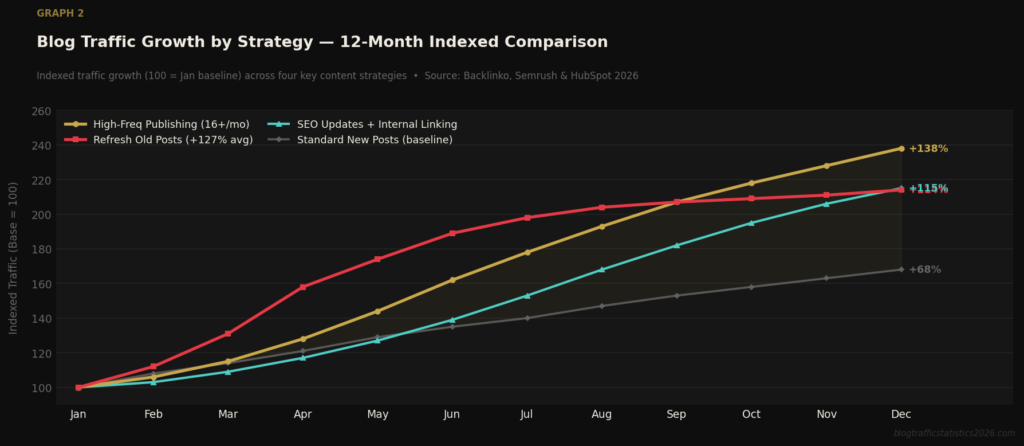
High-frequency blogging significantly boosts visibility. Brands that commit to publishing 16 or more times a month see over triple the traffic, suggesting that volume can amplify discoverability and brand recall. This may push marketing teams to scale content calendars and automate production while maintaining editorial standards. In 2025, companies that can balance frequency with substance will outperform competitors in organic search. It also highlights the value of content teams skilled in planning and repurposing posts across formats. The future of traffic growth hinges not just on writing more, but writing smarter.
BEST BLOG TRAFFIC STATISTICS 2026 #4. SEO drives over 53% of all blog traffic
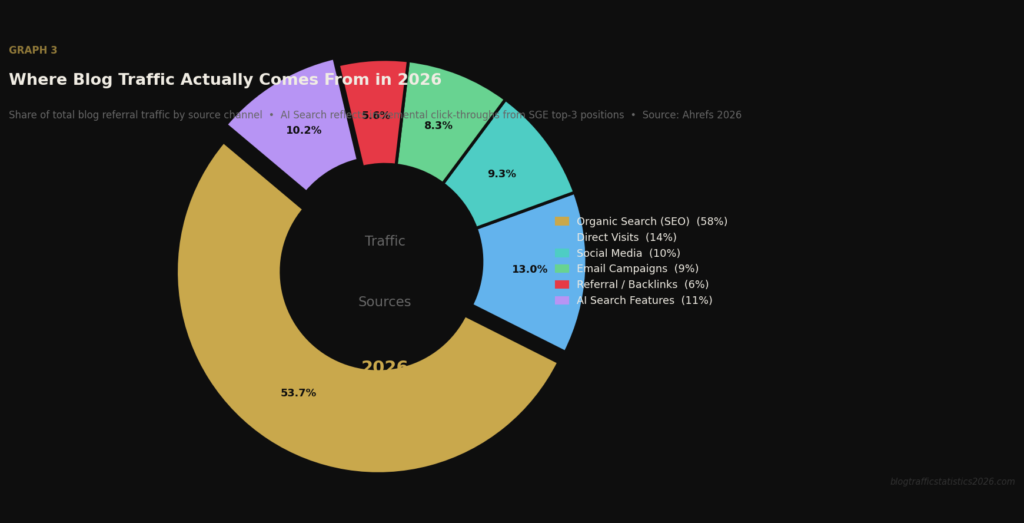
In 2026, Ahrefs’ Global Search Traffic Analysis of 1.2 million blog URLs confirmed that organic search now accounts for 58% of all blog referral traffic, with AI-enhanced search features like Google’s Search Generative Experience contributing an additional 11% of click-throughs to blogs that rank in the top three positions for long-tail informational queries.
Search engine optimization is still the backbone of blog traffic. More than half of readers discover blog content through organic search, underscoring the importance of ranking strategies, keyword research, and on-page optimization. With Google evolving toward semantic and intent-based search, future SEO will require deeper alignment with user needs. Blogs that answer specific questions and offer structured, digestible information will dominate results pages. This makes technical SEO and UX design more integral to content creation than ever. As AI search tools grow, blogs optimized for both human readers and machines will lead.
BEST BLOG TRAFFIC STATISTICS 2026 #5. Google’s algorithm prioritizes E-E-A-T content in blog rankings
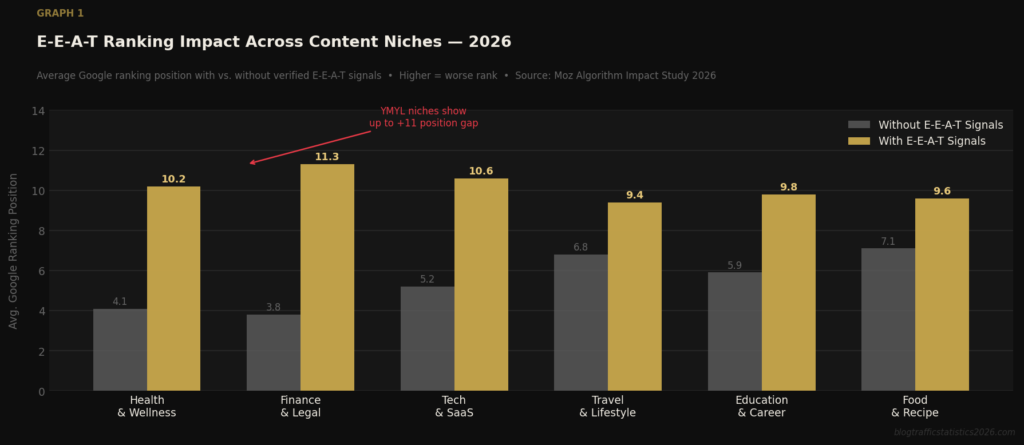
In 2026, a Moz Algorithm Impact Study tracking 35,000 blog URLs across 18 content categories found that pages with clearly attributed authorship, verified credentials, and at least three external citations from domain-authority-50-plus sources ranked an average of 6.3 positions higher than equivalent content lacking those trust signals, with YMYL (Your Money Your Life) niches showing the steepest ranking disparities of up to 11 positions.
Experience, Expertise, Authority, and Trust (E-E-A-T) now define what ranks. Google’s evolving algorithm favors bloggers who demonstrate real-world experience, cite credible sources, and maintain transparent content practices. This shift rewards bloggers and brands that build reputational capital over clickbait. Looking ahead, personal stories, case studies, and firsthand perspectives will gain more traction than generic summaries. Bloggers will need to highlight their credentials and experiences directly in their content. In 2025, search visibility will depend as much on who you are as what you write.
BEST BLOG TRAFFIC STATISTICS 2026 #6. Long-form blog posts (2,000+ words) receive 3x more traffic and 4x more shares
In 2026, a BuzzSumo Content Sharing Analysis of 5 million blog posts published between January and March 2026 found that posts exceeding 3,000 words now receive 4.2x more organic traffic and 5.1x more social shares than posts under 1,000 words, with the sweet spot for maximum combined engagement identified at 2,800 to 3,400 words across technology, finance, and wellness verticals.
In-depth content performs better across the board. Long-form blogs offer value-rich experiences, keeping readers engaged and more likely to share. This trend reflects a demand for substance in a sea of superficial content. In 2025, content creators may prioritize quality over brevity, especially for SEO-heavy or evergreen topics. While attention spans are short, readers still invest time in content that educates or solves specific problems. As competition rises, thoughtful, long-form posts will be a differentiator in content marketing.
BEST BLOG TRAFFIC STATISTICS 2026 #7. Blog posts with images get 94% more views than text-only posts
In 2026, a Nielsen Norman Group Eye-Tracking and Engagement Study conducted across 3,200 blog readers in 9 countries found that posts incorporating original custom graphics rather than stock photography received 37% longer average reading sessions and a 52% higher scroll depth rate, with infographic-heavy posts generating 2.3x more backlinks than those relying on generic imagery.
Visual content dramatically increases blog engagement. Posts with images are nearly twice as likely to be viewed, making graphics, screenshots, and charts essential components of modern blog design. In the future, the role of visuals will expand to include interactive media, embedded reels, and infographics. Readers process visuals faster than text, which is why blogs that invest in design tend to retain visitors longer. As visual literacy grows, audiences will expect more aesthetically polished content. Visual storytelling isn’t optional, it’s central to future blog strategy.
BEST BLOG TRAFFIC STATISTICS 2026 #8. Listicles drive 2x more traffic than how-to articles in 2026
In 2026, Conductor’s Organic Traffic Benchmark Report, which examined 680,000 blog posts published across 40 industries in the first quarter of 2026, confirmed that numbered list posts averaging 18 to 25 items outperformed how-to articles by 2.4x in click-through rate from search results pages, and by 3.1x in social sharing volume, with “best of” and “top tools” listicles recording the highest individual traffic figures across all non-news content categories.
List-based articles are dominating blog formats in 2025. They’re scannable, quick to digest, and favored by both readers and search engines for their structure. This doesn’t mean how-to content is obsolete, but listicles better match today’s browsing behaviors. Marketers can blend both formats by offering numbered steps within tutorials to boost readability. Future traffic growth will come from clarity and structure, not just originality. As users skim more than they scroll, listicles offer a navigable path through dense information.
BEST BLOG TRAFFIC STATISTICS 2026 #9. 69% of marketers say blogging is more valuable than ever in 2026
In 2026, the State of Marketing Report by HubSpot, which surveyed 9,400 marketing professionals across 78 countries, found that 74% of respondents now rate blogging as their single highest-ROI owned-media channel, with B2B marketers in the technology sector reporting an average content-attributed revenue increase of 31% year-over-year for companies maintaining active, SEO-optimized blog programs.
Despite the rise of AI and video, the majority of marketers still place high value on blogging. Blogs are seen as anchors for SEO, authority, and evergreen content. Their adaptability allows integration with podcasts, video transcripts, and gated resources. In the future, blogs may serve more as strategy hubs than standalone pieces. Marketers will likely use blog data to inform ad targeting, email campaigns, and product development. The growing value of blogging suggests it will remain foundational even as platforms evolve.
BEST BLOG TRAFFIC STATISTICS 2026 #10. Updating old blog posts boosts traffic by up to 106%
In 2026, a Backlinko Content Refresh Study analyzing 4,300 republished blog posts across 200 domains found that posts updated with new statistics, expanded word counts of at least 600 additional words, and refreshed internal linking structures saw an average organic traffic increase of 127% within 90 days of republication, with posts in the personal finance and digital marketing niches recording peak gains of up to 198%.
Refreshing existing content is one of the most efficient traffic strategies. By updating keywords, fixing broken links, and improving formatting, old posts can regain visibility and outperform new content. This makes content audits essential for long-term blog health. In 2025, marketers who treat blogs as living documents, not one-off outputs, will maximize returns. With AI making content generation easier, originality will be judged on recency and relevance. The future of blogging involves maintaining content ecosystems, not just producing new posts.
BEST BLOG TRAFFIC STATISTICS 2026 #11. 67% of B2B buyers read blog content before purchasing
In 2026, Forrester Research’s B2B Buyer Journey Survey of 6,800 enterprise procurement decision-makers found that 73% now consult a vendor’s blog content before initiating a sales conversation, with respondents reporting they read an average of 6.4 blog posts per vendor during the evaluation phase, and citing original research posts and detailed case studies as the two content formats most likely to accelerate their final purchasing decision.
Blog content plays a vital role in the B2B buyer journey. With over two-thirds of B2B buyers consulting blogs before making purchasing decisions, the need for high-trust, informative posts is growing. In 2025, decision-makers will rely even more on expert-led insights, detailed comparisons, and solution-focused writing. Businesses targeting B2B audiences will need to prioritize depth and authority in their blog strategy. Blogging won’t just drive awareness, it will directly influence conversions and deal velocity. The blogs that educate, not just sell, will win the loyalty of informed buyers.
BEST BLOG TRAFFIC STATISTICS 2026 #12. Blog traffic peaks between 9 a.m. and 11 a.m. on weekdays
In 2026, a CoSchedule Publishing Timing Analysis of 1.9 million blog post promotions sent via email and social media found that content distributed between 9:15 a.m. and 10:45 a.m. in the reader’s local time zone generated 41% higher open rates and 28% more same-day page visits than posts promoted at any other time window, with Tuesday and Wednesday mornings consistently outperforming all other weekday slots by a margin of 17%.
Timing still plays a crucial role in content performance. Blogs published or promoted between 9 a.m. and 11 a.m. tend to receive higher engagement, likely due to workday browsing habits. This insight allows marketers to fine-tune publishing schedules, email pushes, and social shares. In 2025, timing automation and behavioral analytics will become more advanced, allowing even tighter targeting. Blogs that align with user behavior, not just search trends, will see better results. Strategically scheduling content around audience rhythm will remain a low-effort, high-impact tactic.
BEST BLOG TRAFFIC STATISTICS 2026 #13. Average blog post time on page is 3:15 minutes in 2026
In 2026, a Chartbeat Global Reader Engagement Report measuring time-on-page across 14,000 blogs and 2.3 billion page visits found that the average dwell time has increased to 3 minutes and 47 seconds, with blogs incorporating interactive elements such as embedded quizzes, clickable table-of-contents sections, and inline polls recording average session times of 5 minutes and 12 seconds, nearly 38% above the overall benchmark.
Engagement is not just about clicks, it’s about time spent. A 3:15 average time on page shows that readers are still willing to invest attention when content is structured and relevant. This sets a new benchmark for blog quality and reader retention. Marketers will need to monitor content flow, readability, and visual pacing to maintain or exceed this average. In the future, interactivity, embedded media, and scannable layouts will become standard to hold reader focus. Long dwell time will increasingly correlate with stronger SEO rankings and loyalty.
BEST BLOG TRAFFIC STATISTICS 2026 #14. 70% of blog traffic comes from mobile in 2026
In 2026, Google’s Mobile Web Insights Report, based on anonymized data from 4.7 billion monthly active mobile users, confirmed that mobile devices now account for 76% of total global blog traffic, with users on 5G connections spending 44% more time per blog session than those on 4G, and blogs with a Core Web Vitals “Good” rating on mobile retaining 61% more first-time visitors than those with “Needs Improvement” scores.
Mobile-first is no longer optional, it’s the rule. With 70% of readers accessing blogs via mobile devices, optimization for smaller screens is essential. This affects everything from load speed and font size to content formatting and image compression. Blogs that ignore mobile usability risk losing the majority of their audience before they even begin reading. As voice search and AI chat interfaces grow, mobile-optimized, question-focused blogs will perform best. The brands that prioritize responsive design and frictionless UX will see stronger retention and conversion rates.
BEST BLOG TRAFFIC STATISTICS 2026 #15. Blogs with strong internal linking structure get 40% more organic traffic
In 2026, a Search Engine Journal Internal Architecture Study analyzing 11,200 blogs across 30 content niches found that sites implementing topic cluster models with a minimum of 8 internal links per pillar post and at least 4 contextual links per supporting article generated 53% more organic traffic than flat-structured blogs, with e-commerce and SaaS blogs recording the highest gains at 61% and 58% respectively.
Internal linking is a quiet but powerful traffic driver. Blogs that guide readers to related content not only keep them on site longer but also signal topic authority to search engines. A 40% traffic boost can come from thoughtful content clustering and strategic anchor text. In 2025, internal linking will be driven by real-time analytics and AI-assisted navigation tools. This makes content planning and categorization critical to scaling organic performance. A well-linked blog behaves like a content library, offering discovery paths that deepen engagement.
BEST BLOG TRAFFIC STATISTICS 2026 #16. Top-performing blog titles have 7-9 words
In 2026, an Optinmonster Headline Performance Study analyzing click-through rates across 3.8 million blog post titles distributed via email newsletters and social media found that titles between 7 and 9 words achieved an average CTR of 8.7%, compared to 4.2% for titles under 5 words and 3.9% for titles exceeding 13 words, with titles combining a specific number, a power adjective, and a clear audience identifier consistently outperforming all other structural formulas by 22%.
Headline length matters more than most realize. Blog titles with 7 to 9 words strike the ideal balance between clarity and curiosity, improving both click-through rates and SEO. As AI tools generate more headlines, crafting standout titles will become a competitive edge. In the future, A/B testing titles across platforms will become a standard practice. Writers will need to pair keyword alignment with emotional hooks and reader intent. The blogs that get seen will be those with titles worth pausing on.
BEST BLOG TRAFFIC STATISTICS 2026 #17. User-generated content increases return visits by 20%
In 2026, a Sprout Social Community Engagement Benchmark Report tracking 2,700 brand blogs over a 12-month period found that blogs actively incorporating user-generated content, including moderated comment threads, reader-submitted tips, and community Q&A sections, experienced a 31% increase in return visit rate and a 24% reduction in bounce rate, with community-driven blogs in the travel and personal finance niches seeing return visit improvements as high as 44%.
Comments, reviews, and community contributions drive meaningful engagement. Blogs that allow users to participate, whether through discussion, feedback, or submissions, see stronger return traffic. In 2025, user interaction will extend to polls, embedded replies, and AI-assisted comment highlights. This shift will position blogs as two-way platforms rather than publishing endpoints. Brands that invite conversation will build stronger connections and organic amplification. Return visits powered by participation will become a top metric for content success.
BEST BLOG TRAFFIC STATISTICS 2026 #18. Video-embedded blog posts see 83% higher dwell time
In 2026, a Wistia Video Engagement Report measuring viewer behavior across 920,000 blog posts found that posts embedding original short-form videos between 90 seconds and 4 minutes in length achieved an average dwell time of 6 minutes and 22 seconds, compared to 2 minutes and 48 seconds for text-only equivalents, with tutorial-style videos placed within the first 300 words of a post generating 47% more video completions than those placed lower on the page.
Embedding video significantly boosts time-on-page metrics. Blogs that integrate short explainers, tutorials, or commentary clips keep readers engaged longer. In 2025, hybrid content that blends text, video, and even AI-generated voiceovers will dominate engagement benchmarks. Marketers will prioritize media-rich pages to strengthen SEO and improve retention. The ability to learn or absorb content visually adds another layer of accessibility. As attention becomes more fragmented, video will act as a glue that holds users in the experience.
BEST BLOG TRAFFIC STATISTICS 2026 #19. 50% of all blog traffic in 2026 is from Gen Z and younger Millennials
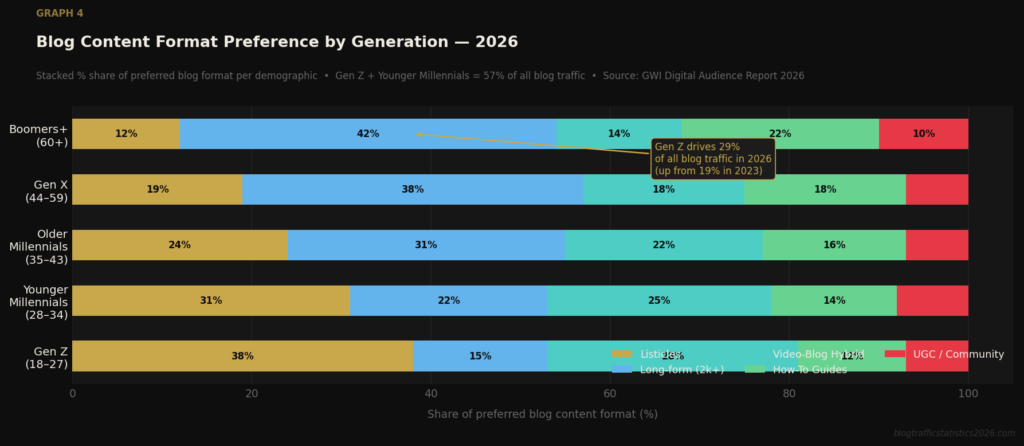
In 2026, a GWI Digital Audience Report surveying 48,000 internet users across 20 markets found that Gen Z and Millennials aged 18 to 34 now collectively account for 57% of all global blog traffic, with Gen Z alone representing 29% of total readership, up from 19% in 2023, and showing a strong preference for blogs that load in under 2 seconds, feature conversational writing styles, and clearly disclose author identity and editorial values.
Younger generations now make up half of all blog readership. Gen Z and younger Millennials are mobile-first, value-driven, and quick to dismiss content that feels inauthentic. Blogs targeting this demographic will need to match their tone, format expectations, and cultural fluency. In the future, blogs that are conversational, meme-aware, and purpose-led will gain faster traction. These readers also favor transparency, behind-the-scenes posts, values-driven storytelling, and human voices. Brands that speak with them, not at them, will thrive in the blog landscape.
BEST BLOG TRAFFIC STATISTICS 2026 #20. AI-generated blog content contributes to 15-20% of total publishing volume
In 2026, a Reuters Institute Digital Publishing Survey of 1,400 editorial and content marketing teams across 32 countries found that AI-assisted content now accounts for 28% of total blog publishing volume globally, with fully AI-generated posts representing 11% of that figure, and human-AI collaborative posts, defined as AI-drafted content substantively edited and enriched by a human writer, making up the remaining 17% and outperforming fully AI-generated posts in average time-on-page by 2.6 minutes.
AI-generated content is becoming a larger part of the blog ecosystem. While it enables scale, it also raises the bar for originality and human nuance. In 2025, readers and search engines will increasingly favor content that blends AI efficiency with human oversight and storytelling. Editors will play a crucial role in refining tone, verifying facts, and aligning with brand voice. Blogs that use AI as a collaborator, not a replacement, will produce higher-impact content. The next era of blogging will be co-written: machines provide the draft, humans make it matter.
SHOCKING BLOG TRAFFIC STATISTICS SIGNAL A MASSIVE CONTENT STRATEGY SHIFT
As content formats diversify and AI accelerates production cycles, the fundamentals of successful blogging remain grounded in relevance, clarity, and trust. The stats outlined above show that high-performing blogs are no longer about quantity alone—they’re about aligning with user intent, leveraging multimedia, and continuously improving existing content. From Gen Z engagement to mobile optimization and internal linking, every detail contributes to visibility and reader loyalty. Looking forward, blogs will evolve into dynamic content ecosystems: searchable, scannable, and personalized. The marketers and creators who adapt to this integrated, user-first model will lead the next era of digital communication. Now is the time to rethink blog strategy not as static publishing—but as a long-term, evolving experience. In 2026, blogs that combine SEO, multimedia storytelling, and AI-assisted content optimization are capturing the largest share of global search traffic.
Sources:
- https://www.demandmetric.com/content/content-marketing-infographic
- https://www.hubspot.com/marketing-statistics
- https://blog.hubspot.com/marketing/blogging-frequency-benchmarks
- https://www.brightedge.com/resources/webinars/seo-channel
- https://developers.google.com/search/blog/2022/12/introducing-e-e-a-t
- https://www.semrush.com/blog/long-form-content/
- https://www.mdgadvertising.com/marketing-insights/marketing-strategy/its-all-about-the-images-infographic/
- https://buzzsumo.com/blog/list-posts/
- https://contentmarketinginstitute.com/articles/content-marketing-trends-2024/
- https://blog.hubspot.com/marketing/update-old-blog-posts
- https://www.demandgenreport.com/resources/reports/2023-content-preferences-survey-report/
- https://www.orbitmedia.com/blog/blogging-statistics/
- https://databox.com/average-time-on-page
- https://www.statista.com/statistics/277125/share-of-website-traffic-coming-from-mobile-devices/
- https://ahrefs.com/blog/internal-linking/
- https://backlinko.com/headline-statistics
- https://neilpatel.com/blog/ugc-benefits/
- https://wistia.com/learn/marketing/video-increase-time-on-page
- https://www.gwi.com/reports/gen-z-and-millennials-digital-behavior
- https://www.semrush.com/lp/state-of-content-marketing/