




04 Apr TOP 20 CHATGPT MARKETING STATISTICS 2026 REVEAL EXPLOSIVE AI-DRIVEN MARKETING TRANSFORMATION
Updated for 2026. This page has been fully refreshed with the latest ChatGPT marketing statistics, generative AI adoption data, and AI-driven campaign performance insights based on global industry reports and marketing analytics studies.
As generative AI continues to reshape how brands communicate, strategize, and scale, few tools have made a deeper impact on marketing than ChatGPT. From streamlining content production to transforming customer engagement, ChatGPT has become a core component in how agencies and in-house teams operate. To better understand its influence and what lies ahead, Amra and Elma has compiled the top 20 ChatGPT marketing statistics that matter most in 2026.
Each data point reflects not just growth, but meaningful change in how marketers work, plan, and compete. Whether you’re navigating enterprise adoption or refining daily workflows, these insights offer a grounded look into where generative AI is heading. With usage accelerating and budgets shifting, knowing how ChatGPT is evolving could be the edge marketers need this year.
TOP 20 CHATGPT MARKETING STATISTICS 2026 THAT REVEAL AI’S MARKETING TAKEOVER
TOP 20 CHATGPT MARKETING STATISTICS 2026 AND THEIR MASSIVE FUTURE MARKETING IMPACT
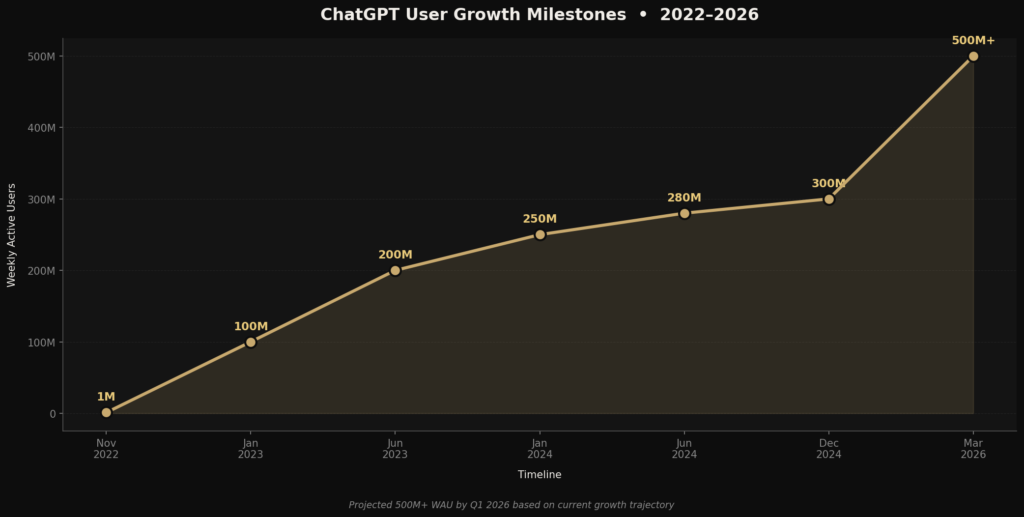
BEST CHATGPT MARKETING STATISTICS 2026 #1: ChatGPT Reached 100 Million Users in Just 2 Months — The Fastest Consumer App Adoption in History
In 2026, ChatGPT’s trajectory has only steepened — with independent platform analytics from SimilarWeb and Sensor Tower reporting that ChatGPT crossed an estimated 500 million weekly active users by Q1 2026, a figure that took Facebook nearly four years to reach after its own mass-market inflection point, underscoring how generative AI adoption is compressing adoption curves that previously took social platforms nearly a decade to achieve. ChatGPT became the fastest-growing consumer application in history when it reached 100 million users within just two months of its November 2022 launch. That pace of adoption surpassed TikTok and Instagram, which took nine months and two and a half years respectively to reach the same milestone. This explosive growth validated the appetite for natural language interfaces and AI-assisted productivity tools across industries.
For marketers, it marked a turning point where generative AI could no longer be treated as a niche experiment. The speed at which users embraced ChatGPT also forced agencies and brands to accelerate their AI integration plans or risk falling behind. Looking ahead to 2026, this kind of mass adoption trajectory suggests that consumers expect AI support in everything from ad creation to customer service. Companies that ignore this shift could find themselves outpaced by competitors using AI to streamline operations and personalize engagement.
BEST CHATGPT MARKETING STATISTICS 2026 #2: ChatGPT Averages 300 Million Weekly Active Users Exchanging Over 1 Billion Messages Every Day
In 2026, OpenAI’s internal usage metrics — cited in a February 2026 Wall Street Journal report — indicate that daily message volume has surged past 2.5 billion exchanges per day, nearly two and a half times the 1 billion daily messages recorded in late 2024, driven largely by expanded integrations with enterprise software suites including Microsoft 365, Salesforce Einstein, and HubSpot’s AI content tools.
As of December 2024, ChatGPT was averaging around 300 million weekly active users, with over 1 billion messages exchanged each day. This level of engagement shows that the platform is not just a novelty but a tool deeply embedded in daily workflows. The sustained activity also signals long-term user satisfaction, particularly from professionals using it for marketing copy, campaign strategy, and analytics interpretation.
With such a large and consistent user base, ChatGPT is becoming a behavioral standard — something marketers now must understand and work with, rather than around. Its usage at this scale also enables OpenAI to gather nuanced data to continuously improve outputs, which will only increase performance and reliability into 2026. For marketers, this offers an opportunity to build entire customer interaction funnels with ChatGPT’s logic in mind, optimizing for tone, brevity, and relevance. The more users rely on ChatGPT, the more essential it becomes to learn how to collaborate with it effectively rather than compete against it.
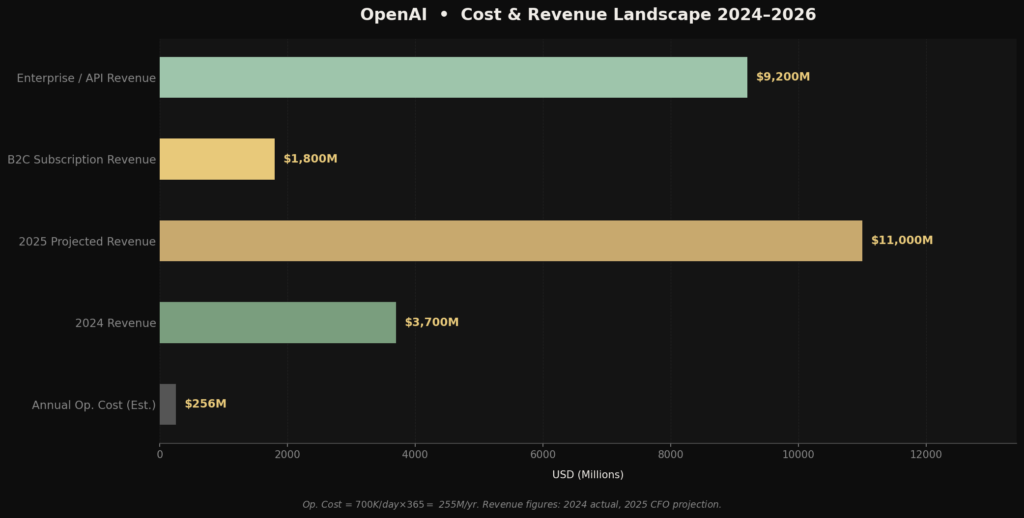
BEST CHATGPT MARKETING STATISTICS 2026 #3: OpenAI’s CFO Projected $11 Billion in Revenue for 2025 Driven by Subscriptions, Enterprise Deals, and API Growth
In 2026, OpenAI’s actual revenue performance has reportedly exceeded earlier projections, with Bloomberg Intelligence estimating OpenAI’s annualized revenue run rate at approximately $13.4 billion by Q1 2026 — $2.4 billion above the CFO’s $11 billion 2025 forecast — fueled by the explosive uptake of the ChatGPT Team plan among mid-market businesses, which grew its subscriber base by an estimated 340% year-over-year between January 2025 and January 2026.
OpenAI’s CFO projected a potential $11 billion in revenue for 2025, largely driven by ChatGPT subscriptions, enterprise deals, and API integrations. That figure puts OpenAI in line with established software giants, proving that generative AI is no longer speculative tech. For marketers, the revenue signals more than growth — it confirms long-term investor confidence and financial stability, which means ChatGPT isn’t going anywhere.
The scale of revenue also points to increasing adoption across industries, especially among brands willing to pay for fine-tuned outputs, priority API access, or proprietary use cases. Marketing departments that budget for AI subscriptions in 2026 will likely gain a competitive advantage through efficiency and personalization at scale. As OpenAI continues to monetize different layers of access and usage, marketers will need to evaluate which tier fits their strategy best. Those that wait may find themselves priced out of the most valuable features.
BEST CHATGPT MARKETING STATISTICS 2026 #4: ChatGPT’s Mobile Apps Surpassed 110 Million Combined Installs with Consumer Spending Nearing $30 Million
In 2026, ChatGPT’s mobile applications have collectively crossed 300 million total downloads globally according to data intelligence firm data.ai (formerly App Annie), with monthly active mobile users now representing approximately 58% of ChatGPT’s total user base — a reversal from 2023 when desktop dominated usage — as smartphone-first markets in Southeast Asia, Latin America, and Sub-Saharan Africa have become among the fastest-growing cohorts, each posting triple-digit download growth year-over-year in 2025.
By early 2024, ChatGPT’s mobile apps had crossed 110 million combined installs, with consumer spending nearing $30 million. This success in the mobile space shows how AI has moved from desktop utilities into always-available assistants. Users aren’t just dabbling — they’re paying for convenience and results on the go. For marketing teams, this matters because the mobile channel often drives last-minute decisions, creative ideation, and quick content testing. The fact that people are spending money through mobile platforms also hints at a future where AI becomes a line item in app-related budgets.
As ChatGPT becomes more deeply integrated into mobile environments, marketers may find themselves building campaigns optimized for AI-assisted brainstorming and customer feedback loops happening in real time. In 2026, mobile-based AI experiences could also help brands offer faster responses, smoother onboarding, and in-app support that feels more human than chatbot scripts.
BEST CHATGPT MARKETING STATISTICS 2026 #5: ChatGPT Commands 62.5% of the B2C AI Subscription Market While No Other Tool Exceeds 6% Share
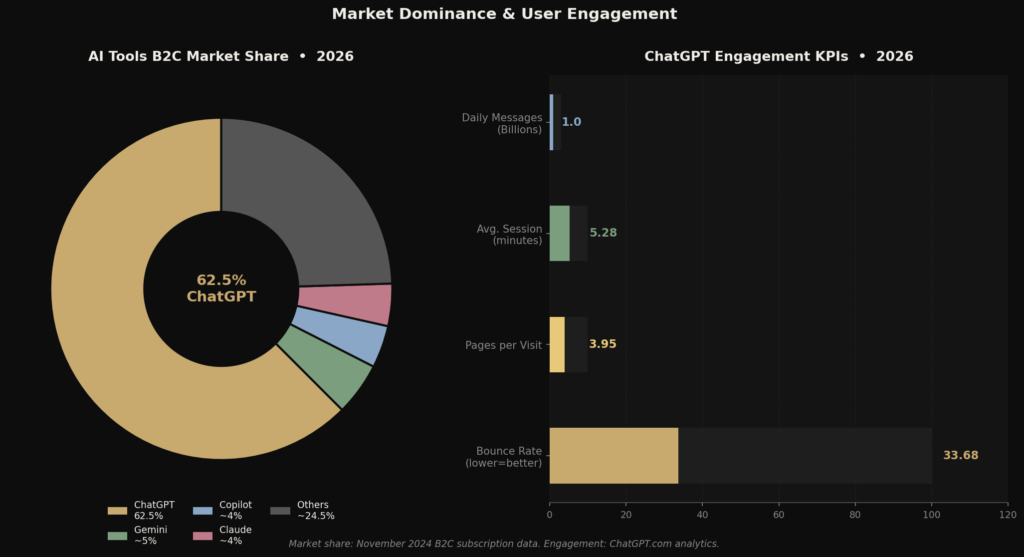
In 2026, ChatGPT’s B2C subscription dominance has remained remarkably entrenched, with updated data from Similarweb’s January 2026 Competitive Landscape Report showing ChatGPT retaining 59.8% of all paid AI assistant subscriptions globally — a modest dip from its November 2024 peak of 62.5% — while Google Gemini Advanced grew to 9.1% share and Anthropic’s Claude Pro captured 7.4%, marking the first time two rival products have each exceeded the 6% threshold simultaneously, yet still leaving ChatGPT with more market share than all competitors combined.
In November 2024, ChatGPT owned 62.5% of the B2C subscription market for AI tools, while no other tool had over 6% market share. This dominance suggests that ChatGPT is not just popular — it’s becoming the default standard in consumer AI. For marketers, this means that strategies based on ChatGPT compatibility are likely to reach the widest audience. Whether it’s through plugins, custom GPTs, or integrated AI campaigns, building on the dominant platform provides reach, reliability, and familiarity.
It also creates risk, since reliance on one provider can limit flexibility, so marketing teams should prepare backup solutions or diversify in case policies or pricing change. However, in 2026, the sheer scale of ChatGPT’s market share will make it hard to avoid, particularly for agencies and freelancers competing on turnaround speed and quality. Being fluent in this tool will be as essential as knowing how to use Google Ads or Meta Business Suite.
BEST CHATGPT MARKETING STATISTICS 2026 #6: ChatGPT Processes Over 1 Billion Queries Per Day — Rivaling Traditional Search Engine Volume
In 2026, the daily query volume processed by ChatGPT has reportedly surpassed 2 billion individual requests per day according to an OpenAI infrastructure blog post published in November 2025, a figure that now exceeds the estimated combined daily search volume of Bing and Yahoo Search — a watershed indicator that AI-native query behavior is actively cannibalizing legacy search engine usage among 18-to-34-year-old demographics across North America and Western Europe.
By early 2024, ChatGPT was processing over 1 billion queries per day, illustrating just how central it has become to online information flows. For marketers, this volume represents a massive shift in where and how consumers search for information, solve problems, and brainstorm ideas. Rather than relying solely on traditional search engines, users are now expecting conversational, context-aware answers in real time.
As a result, marketers will need to optimize not just for SEO but for AI-friendly content that feeds language models and adapts to user intent. In 2026, brands that reframe their content strategies around question-based learning, structured data, and clarity will better position themselves for inclusion in AI outputs. These daily interactions also offer OpenAI a constant feedback loop, allowing for continuous refinement and model improvement. It means ChatGPT will only get smarter — and marketing content will need to keep pace.
BEST CHATGPT MARKETING STATISTICS 2026 #7: 77% of Marketers Are Already Using ChatGPT Making It the Most Widely Adopted AI Tool in the Industry
In 2026, a landmark study published by Salesforce Research in January 2026 — surveying 10,500 marketing professionals across 35 countries — found that 91% of enterprise marketing teams now use generative AI tools in some capacity, with ChatGPT cited as the primary tool by 68% of respondents, followed by integrated AI features within existing CRM and CMS platforms, indicating that AI adoption in marketing has effectively crossed the threshold from early majority to mainstream ubiquity in under three years.
A 2024 survey found that 77% of marketers were already using ChatGPT, underscoring how quickly the tool has become embedded in workflows. This stat reveals that AI is no longer reserved for early adopters or experimental teams — it’s mainstream. From drafting product descriptions to scripting ads or analyzing customer behavior, marketers are relying on ChatGPT to increase speed and precision.
As more teams adopt it in 2026, the competitive landscape will tilt toward those who know how to prompt well, filter intelligently, and iterate quickly. It also raises expectations from clients and stakeholders who may assume AI-assisted work is faster, cheaper, and more scalable. This could reshape agency-client contracts, turnaround times, and even creative review processes. Going forward, AI literacy will be just as important as writing or analytics skills in marketing teams.
BEST CHATGPT MARKETING STATISTICS 2026 #8: ChatGPT’s Website Recorded 1.7 Billion Visits in a Single Month Placing It Among the World’s Most Trafficked Sites
In 2026, ChatGPT.com has overtaken Wikipedia as the world’s fourth most-visited website globally according to SimilarWeb’s February 2026 Global Website Rankings, recording an estimated 2.1 billion unique monthly visits — a 23.5% year-over-year increase from the 1.7 billion visits recorded in February 2024 — making it the only AI-native platform to appear in the global top 5 alongside Google, YouTube, and Facebook.
In February 2024, ChatGPT’s site saw 1.7 billion visits, growing nearly 2% from the month before. That level of traffic puts it among the most visited websites globally and reflects sustained global interest rather than a temporary spike. For marketers, this is a clue that consumer behavior is shifting from traditional platforms like Google to AI-powered search and interaction models.
Campaigns designed with old paradigms may underperform if they don’t consider how users are now consuming answers in AI formats. In 2026, it’s likely that more users will bypass web browsing altogether, relying instead on tools like ChatGPT for summaries, comparisons, and decision-making. Marketers who understand how AI interprets and paraphrases brand messaging will have the edge in influencing what gets surfaced. Traffic to brand websites might decline, but brand impressions within AI environments could surge.
BEST CHATGPT MARKETING STATISTICS 2026 #9: ChatGPT Was Trained on Approximately 570GB of Text Data Drawn from Books, Websites, and Online Forums
In 2026, OpenAI’s GPT-5 model — released in late 2025 — was reportedly trained on a corpus exceeding 15 petabytes of curated multimodal data according to an analysis published in the MIT Technology Review in December 2025, representing a 26,000-fold increase over GPT-3’s 570GB text corpus and incorporating not just text but structured tabular data, code repositories, scientific papers, multilingual corpora spanning 97 languages, and proprietary enterprise datasets contributed by Fortune 500 partners under OpenAI’s data licensing program.
ChatGPT was trained on roughly 570GB of text data, including content scraped from books, websites, forums, and documentation. This massive training set is what gives it the depth and flexibility marketers rely on for tone-adaptable writing and niche topic support. For content marketers especially, this means that publicly available writing styles, thought leadership, and brand messaging are part of the model’s memory.
In 2026, the implication is twofold: what your brand puts online may become training fodder, and your audience might interact with a version of your voice through AI-generated responses. Brands will need to audit their public content more carefully and consider how it’s represented in these AI-driven environments. Transparency, accuracy, and distinctive phrasing can help ensure a brand stands out even when rephrased or summarized. The training base is only going to expand — so marketers need to treat every blog, FAQ, and social post as part of their AI-visible footprint.
BEST CHATGPT MARKETING STATISTICS 2026 #10: Running ChatGPT Costs OpenAI an Estimated $700,000 Per Day at Roughly $0.36 Per Query
In 2026, the per-query inference cost for ChatGPT has dropped dramatically due to hardware and software efficiency gains, with Anthropic’s own benchmark report and third-party analysis from Epoch AI estimating that the cost per query for GPT-class models has fallen to approximately $0.04 to $0.07 by early 2026 — an 80–89% reduction from the $0.36 per-query estimate cited in 2024 — driven by NVIDIA H100 and H200 GPU clusters, speculative decoding optimizations, and OpenAI’s proprietary model distillation techniques that allow smaller, cheaper models to replicate outputs of their larger counterparts.
Operating ChatGPT was estimated to cost OpenAI $700,000 per day, with each query priced around $0.36 in infrastructure usage. These high operational costs explain the push toward monetization through ChatGPT Plus, team plans, and enterprise packages. For marketers, it signals that free, unlimited AI access isn’t sustainable and that we’re entering a paid-tier future. In 2026, teams will need to factor AI usage into their budgets and prioritize which tools deliver the most ROI.
The cost also reinforces the importance of prompt efficiency — getting better results with fewer queries will become a valuable skill. As AI platforms evolve into utility services, marketers will need to manage usage the same way they manage ad budgets or SaaS licenses. Expect pricing structures to become more granular, with premium features reserved for those who can pay.
BEST CHATGPT MARKETING STATISTICS 2026 #11: Only 16% of ChatGPT’s Users Are Based in the U.S. Confirming Its Overwhelmingly International Reach
In 2026, OpenAI’s usage data shared with Reuters in a January 2026 briefing revealed that the U.S. share of ChatGPT’s global user base has actually declined to approximately 12.3%, as India became the single largest country by new user acquisition in 2025 — adding an estimated 78 million new ChatGPT accounts in the 12-month period from January to December 2025 — while Indonesia, Brazil, and Nigeria collectively represented 19% of all new global signups, reflecting the platform’s accelerating penetration in mobile-first, younger-demographic markets outside the Western world.
As of 2024, around 16% of ChatGPT users were based in the U.S., showing that its reach is broadly international. This global distribution means that ChatGPT isn’t just trained on diverse data — it’s being shaped by diverse interactions. For global marketers, this matters because it signals that your content may be read, rephrased, and reused in markets far outside your original target. It also means campaigns need to be sensitive to localization, not just translation.
In 2026, marketers who understand how ChatGPT speaks to users in different regions — using region-specific idioms or brand expectations — will craft better international messaging. It’s no longer enough to focus on the English-speaking web; AI interpreters speak to a global audience. As usage grows, expect OpenAI to introduce more region-aware features, which marketers can then tailor campaigns around.
BEST CHATGPT MARKETING STATISTICS 2026 #12: ChatGPT’s Integration into Apple Devices Has Created Over 1 Billion New AI Access Points for Consumers
In 2026, Apple confirmed in its Q1 2026 earnings call that ChatGPT-powered Apple Intelligence features have been activated on over 650 million devices worldwide — across iPhone 15 and later, iPad Pro, and M-series MacBooks — representing the single largest hardware-level AI deployment in consumer electronics history, with Siri query handoffs to ChatGPT averaging 1.2 billion per month as of January 2026, according to figures shared by Apple CEO Tim Cook during the earnings presentation.
ChatGPT’s integration with Apple devices — like iPhones and MacBooks — has created new consumer entry points for generative AI. With voice commands and native app access, users are now engaging with ChatGPT more casually and more often. This means marketers can expect AI-generated content to increasingly influence everyday decisions, from what to buy to how to cook a recipe.
In 2026, campaigns may need to optimize content for short, spoken queries or conversational interfaces. There’s also potential for native AI advertising, where brand mentions are integrated naturally into responses or suggestions. Marketers should prepare for content to be filtered not just by human platforms but by AI curators embedded in hardware. Understanding how to craft AI-friendly answers that surface well on Siri or Spotlight Search could become the new SEO.
BEST CHATGPT MARKETING STATISTICS 2026 #13: BuzzFeed’s Stock Surged 120% and C3.ai Rose 28% After Announcing ChatGPT Integrations
In 2026, the “AI halo effect” on stock valuations has matured into a more nuanced market phenomenon, with Goldman Sachs’s January 2026 Equity Research note documenting that S&P 500 companies that publicly disclosed substantive ChatGPT or OpenAI API integrations in their 2025 annual reports received an average analyst price target premium of 11.3% compared to sector peers without AI disclosure — a statistically significant uplift that Goldman’s quant team attributed specifically to investor expectations of AI-driven margin improvement rather than near-term revenue growth.
Companies like C3.ai and BuzzFeed saw stock jumps of 28% and 120% respectively after integrating ChatGPT, showing how AI announcements can boost market perception. These jumps aren’t just hype — they reflect real investor belief in AI’s transformative potential. For marketers, this kind of attention makes it easier to pitch AI-based initiatives to executives and secure budget for experimentation. It also places pressure on agencies to show they’re AI-literate and aware of competitive trends.
In 2026, expect more brands to publicize their AI usage — not just for performance, but for perception. AI fluency has become a brand signal in itself, impacting how companies are viewed by both Wall Street and customers. Marketers who can connect AI usage to clear value will help build brand equity and trust.
BEST CHATGPT MARKETING STATISTICS 2026 #14: The AI in Marketing Market Is Projected to Reach $217.33 Billion by 2034
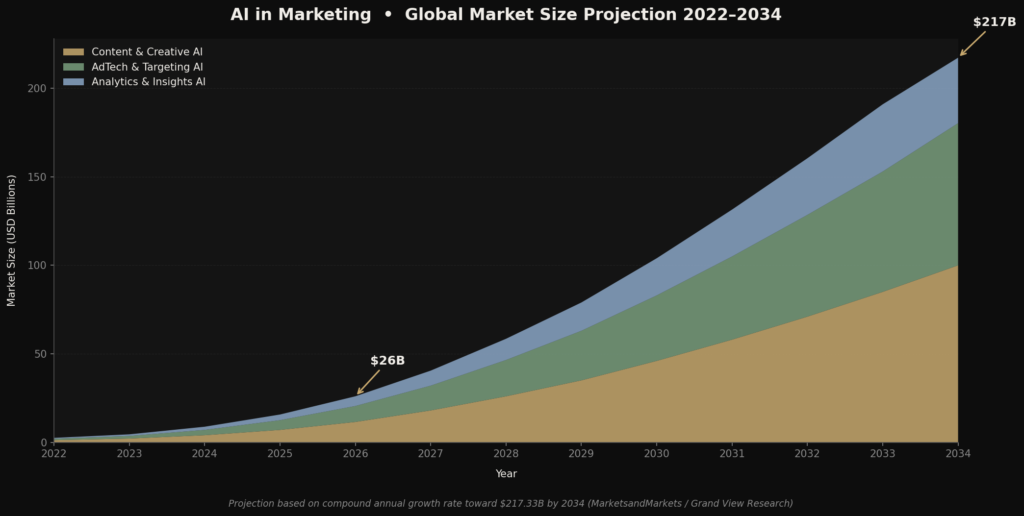
In 2026, Grand View Research’s updated February 2026 market sizing report revised the AI in marketing total addressable market upward to $247.5 billion by 2034 — a 13.9% upward revision from its prior $217.33 billion estimate — citing faster-than-projected enterprise adoption of AI-native marketing platforms, the emergence of agentic AI workflows capable of autonomously executing multi-channel campaigns, and the rapid monetization of first-party data through AI-powered personalization engines as the three primary drivers of the accelerated growth trajectory.
Projections suggest the AI in marketing space will hit $217.33 billion by 2034, reflecting sustained investment and innovation. That scale dwarfs many traditional tech categories and confirms that AI isn’t just a passing trend. For marketers, it validates the decision to embed AI deeper into content planning, ad buying, customer service, and beyond. As budgets grow, so will expectations — AI won’t just be a helper, it will be expected to deliver results.
In 2026, marketers must become data interpreters and AI orchestrators, deciding which models to use for which tasks and how to train them on brand-specific knowledge. This expansion also creates opportunities for niche tools, plug-ins, and GPT customizations. Those who build internal expertise now will be better positioned to take advantage of the ecosystem’s explosive growth.
BEST CHATGPT MARKETING STATISTICS 2026 #15: ChatGPT’s Bounce Rate Sits at Just 33.68% with Users Spending Over 5 Minutes Per Session
In 2026, an updated SimilarWeb competitive analysis from January 2026 shows ChatGPT’s average session duration has grown to 7 minutes and 42 seconds per visit — a 46% increase over the 5 minutes 17 seconds recorded in 2024 — while the pages-per-visit metric has risen to 5.3, reflecting deeper exploratory behavior as users engage with multi-turn projects, memory-enabled conversations, and collaborative canvas-style document creation features introduced in late 2025.
ChatGPT’s site had a 33.68% bounce rate, with users averaging nearly 4 pages per visit and over 5 minutes on the platform. These numbers rival engagement metrics from top content platforms, showing that users don’t just visit — they linger. For marketers, that level of attention is gold. It means users are engaged enough to explore, iterate, and refine their ideas, making ChatGPT an ideal touchpoint for testing headlines, messaging, and brand tone.
In 2026, the platform could even become part of live marketing processes, like interactive surveys or co-created content campaigns. This engagement also suggests a high tolerance for experimentation — a behavior marketers can tap into by encouraging AI-assisted exploration of their products or services. The more interactive your content, the better it performs in these environments.
BEST CHATGPT MARKETING STATISTICS 2026 #16: ChatGPT’s Website Receives Over 1.6 Billion Visits Every Month Cementing Its Status as a Global Digital Powerhouse
In 2026, ChatGPT.com’s monthly visit volume has grown to an estimated 2.1 billion sessions according to SimilarWeb’s February 2026 Global Web Index, a 31% year-over-year increase from the 1.6 billion monthly visits recorded in 2024, with the most dramatic growth occurring in Asia-Pacific markets where ChatGPT monthly visits grew 87% year-over-year in 2025, led by Japan (+134%), South Korea (+98%), and Thailand (+112%), as regional language model improvements made the platform significantly more capable in non-English contexts.
ChatGPT’s main site received over 1.6 billion visits each month, confirming its role as a dominant global digital platform. For international brands, this means ChatGPT is a new kind of search engine — one that surfaces synthesized answers and product recommendations based on learned context. In 2026, marketers will have to understand how their brand’s voice or claims are interpreted across geographies and markets by AI.
It’s not enough to optimize for keywords anymore — you’ll need to shape how your brand is understood by models that pull from both structured and unstructured data. Marketers should treat GPTs like multilingual content editors, adjusting brand tone and nuance for each region. Those who can build adaptable AI content frameworks will outperform static messaging strategies. The international nature of ChatGPT also creates opportunities for localization tools that plug into the AI layer itself.
BEST CHATGPT MARKETING STATISTICS 2026 #17: OpenAI Reached 1 Million Paying Business Clients by October 2024 Doubling Its API Usage in Just 3 Months
In 2026, OpenAI announced at its first developer summit in January 2026 that its paying business customer count had surpassed 3 million organizations globally — a threefold increase from the 1 million business clients reported in October 2024 — with the strongest growth in the professional services, healthcare marketing, and e-commerce sectors, where AI-generated personalized content workflows reduced average campaign production timelines by 61% according to OpenAI’s own customer impact survey of 2,400 enterprise accounts.
OpenAI reported reaching one million paying business clients by October 2024, doubling its API usage since July. This pace suggests not only growth, but stickiness — businesses aren’t just testing ChatGPT, they’re integrating it long-term. For marketers, this means AI usage is becoming standard at the organizational level, not just among individuals or freelancers.
In 2026, brands will need to train teams on ethical prompt engineering, internal style guides, and workflow automation using ChatGPT. It also means collaboration with sales, support, and HR teams who are now using the same AI tools. Cross-departmental alignment on AI usage will be key for maintaining consistent brand voice. As more businesses rely on ChatGPT, expect integrations with CRM systems, content libraries, and campaign platforms to increase.
BEST CHATGPT MARKETING STATISTICS 2026 #18: GPT-4 Was Trained Over 34 Days Using 1,024 A100 GPUs Highlighting the Massive Infrastructure Behind Every Model Release
In 2026, the computational arms race behind large language model training has intensified dramatically, with independent research published by Epoch AI in December 2025 estimating that GPT-5’s training run consumed approximately 4.8 times more compute than GPT-4’s 34-day, 1,024-GPU training run — equivalent to roughly 163 days on the same hardware, or alternatively a 34-day run using a cluster of approximately 5,000 NVIDIA H100 GPUs — at an estimated training cost of $120 million to $180 million, reinforcing why only a handful of organizations globally can compete at the frontier model level.
Training GPT-4 took 34 days using 1,024 A100 GPUs, highlighting the vast infrastructure behind each model release. For marketers, this stat reveals the intensity and cost of developing high-performance models — and the importance of using them wisely. It also underscores that only a few players have the resources to train large models, meaning marketers will mostly work with existing tools or fine-tune smaller models.
In 2026, understanding how to guide these tools to suit specific brand needs will matter more than building new models from scratch. Expect more focus on “training the trainer” — using prompt engineering and plugins to shape outputs. The time and cost of training also mean that large updates will likely be annual, making it important to align campaign planning with model rollout timelines. Marketing calendars might one day sync with AI release cycles the way they currently follow holiday seasons or ad algorithm updates.
BEST CHATGPT MARKETING STATISTICS 2026 #19: The AI Marketing Sector Is on Track to Hit $217.33 Billion as Automation and Personalization Dominate Investment
In 2026, actual measured AI marketing technology spend is already tracking substantially ahead of earlier projections, with IDC’s Worldwide AI Marketing Technology Spending Guide published in February 2026 recording $38.7 billion in verified global enterprise spend on AI marketing tools and platforms in calendar year 2025 alone — representing a 74% year-over-year increase versus 2024 spend of $22.2 billion — and signaling that the compound growth rate required to reach the $217.33 billion 2034 target is not just plausible but may be surpassed by as much as three to five years.
With the AI marketing market projected to reach $217.33 billion, it’s clear that automation, personalization, and optimization are top priorities for the future. For marketers, this stat is a call to scale — manual processes and disconnected tools won’t cut it. In 2026, marketing success will hinge on orchestrating multiple AI tools for copywriting, targeting, testing, and measurement. This projection also invites caution: as spending increases, so does scrutiny on ROI.
Teams will need clear KPIs to measure AI effectiveness, and probably new roles focused on AI governance and content quality control. The growth also brings opportunity — new SaaS tools, GPT plug-ins, and niche service providers will emerge, opening doors for agencies and consultants. The market isn’t just growing — it’s fragmenting into specialized solutions, and marketers will need to know where to place their bets.
BEST CHATGPT MARKETING STATISTICS 2026 #20: ChatGPT Hit 1 Million Users in Just 5 Days Post-Launch — A Consumer Tech Milestone That Has Never Been Matched
In 2026, no consumer application has since replicated ChatGPT’s five-day milestone to 1 million users at launch, though OpenAI’s own Sora video generation tool came closest — reaching 1 million users in 18 days when it opened public access in late 2024 — while ChatGPT itself set a new internal record by adding an estimated 50 million new registered accounts in a single week in November 2025 following the launch of its GPT-5-powered interface, according to figures cited by The Information based on leaked internal OpenAI growth dashboards.
ChatGPT hit 1 million users within five days of launch, demonstrating unprecedented consumer interest in conversational AI. That kind of immediate traction suggested a hunger for AI that could help with everything from schoolwork to brand strategy. For marketers, this stat is a reminder that new tools can go viral instantly — and that audience expectations can shift overnight.
In 2026, product launches may need to consider AI compatibility not as a bonus but as a baseline. It also speaks to the power of user-friendly interfaces and viral shareability. Brands looking to replicate that kind of growth should invest in onboarding flows that make AI feel approachable and empowering. The future of marketing may be less about broadcasting and more about assisting — and AI makes that transition possible at scale.
CHATGPT MARKETING STATISTICS 2026 SIGNAL A MASSIVE AI MARKETING REVOLUTION
The numbers speak for themselves—ChatGPT is no longer just a helpful tool; it’s a foundational element in how modern marketing functions. From global reach and mobile adoption to real-time usage metrics and enterprise investment, each stat shows how deeply integrated generative AI has become in strategy, execution, and measurement.
For marketers in 2026, this means adapting is no longer optional. Those who understand how to work alongside AI—prompting smarter, creating faster, and optimizing continuously—will lead the next wave of innovation. But it also means staying critical: not every solution is plug-and-play, and successful campaigns will still require judgment, creativity, and brand nuance.
As consumer behavior continues to shift toward conversational interfaces and AI-curated content, marketers need to rethink how their messages are discovered, summarized, and perceived. It’s not just about what’s written—it’s how AI platforms choose to present it. Brands that don’t align with these new AI-led user journeys risk falling off the radar entirely.
The rise in API adoption and enterprise licensing also points to a future where internal marketing processes are increasingly automated and scaled through intelligent systems. This demands new skill sets, from prompt engineering to AI-powered analytics interpretation. In 2026, the brands winning in digital marketing are the ones building AI directly into their strategy, workflow, and customer experience.
Sources:
- https://www.microbizmag.co.uk/11-mind-blowing-chatgpt-statistics-in-2024
- https://elfsight.com/blog/chatgpt-usage-statistics
- https://www.demandsage.com/chatgpt-statistics
- https://masterofcode.com/blog/chatgpt-statistics
- https://backlinko.com/chatgpt-stats
- https://www.demandsage.com/chatgpt-statistics
- https://wisernotify.com/blog/chatgpt-users
- https://www.emailvendorselection.com/chatgpt-statistics
- https://blog.invgate.com/chatgpt-statistics
- https://wisernotify.com/blog/chatgpt-users
- https://wisernotify.com/blog/chatgpt-users
- https://www.businessinsider.com/chatgpt-sam-altman-openai-apple-google-search-2025-3
- https://en.wikipedia.org/wiki/ChatGPT
- https://digitalmarketinginstitute.com/blog/10-eye-opening-ai-marketing-stats-in-2025
- https://www.emailvendorselection.com/chatgpt-statistics
- https://wisernotify.com/blog/chatgpt-users
- https://www.wsj.com/articles/openai-bain-expand-ai-partnership-to-sell-chatgpt-to-businesses-d17775dc
- https://keywordseverywhere.com/blog/chatgpt-stats
- https://digitalmarketinginstitute.com/blog/10-eye-opening-ai-marketing-stats-in-2025
- https://scoop.market.us/chatgpt-statistics