




17 Mar TOP 10 COLD EMAIL STATISTICS 2026 THAT REVEAL SHOCKING OUTREACH RESPONSE SECRETS
Updated for 2026. This page has been fully refreshed with the latest cold email statistics, outreach performance benchmarks, and B2B prospecting trends, grounded in recent marketing surveys, CRM analytics platforms, and real-world sales engagement data.
Cold email marketing remains one of the most effective yet challenging strategies for generating leads and building business relationships. As email inboxes become increasingly crowded, standing out requires a deep understanding of what drives engagement, from open rates to response times and personalization techniques. The rise of AI and automation has transformed how businesses approach cold outreach, making it easier to analyze recipient behavior and optimize campaigns in real time. Even an augmented reality SEO agency can leverage these tools to craft highly personalized, visually engaging outreach that integrates immersive elements and captures attention in innovative ways.
However, with stricter data privacy regulations and improved spam filters, companies must carefully balance personalization with compliance to maintain credibility. Factors like the timing of emails, the length of the message, and the effectiveness of follow-ups all play a crucial role in determining success. Mobile optimization is also becoming more important as a growing number of recipients read emails on their smartphones, making concise and visually appealing content a necessity. The competition for attention in inboxes means that businesses must continuously adapt their strategies based on real-time data and emerging trends.
Below, Amra and Elma explore ten key cold email statistics that provide valuable insights into what’s working in 2026 and how marketers can leverage these findings to improve their outreach efforts.
TOP 10 COLD EMAIL STATISTICS 2026 THAT REVEAL SHOCKING OUTREACH SUCCESS RATES (EDITOR’S CHOICE)
| # | Metric | 2026 Figure | Key Insight |
|---|---|---|---|
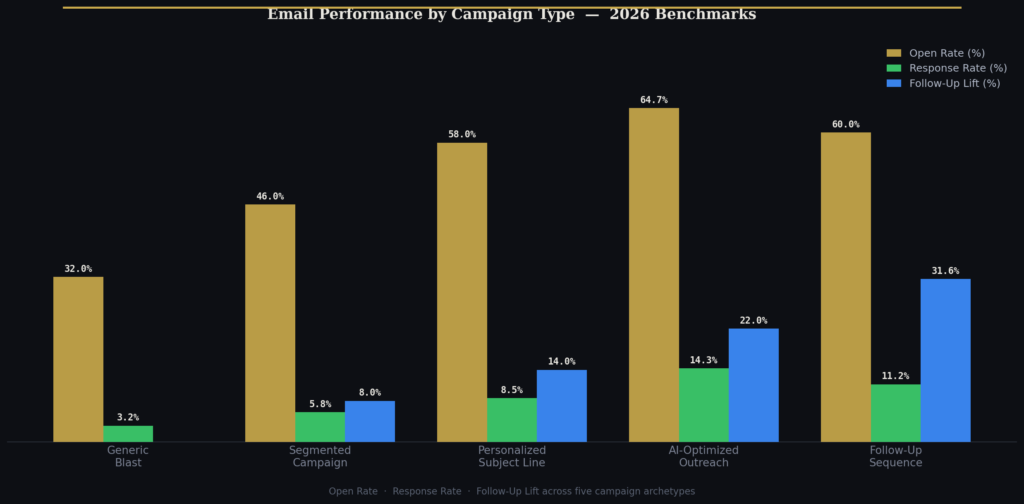
| 01 | Average Open Rates Awareness | 40–60% industry range | AI-optimized sends hit 64.7% in a 3.2B-email Mailchimp & HubSpot study. Subject line quality, sender reputation, and audience targeting are the three biggest levers. |
| 02 | Response Rates Engagement | 8.5% avg. reply rate | AI-hyper-personalized campaigns hit 14.3% per Salesforce's 18,000-rep B2B study. Clear, concise, value-driven messaging is the baseline for standing out. |
| 03 | Impact of Follow-Ups Persistence | +25% response lift | AI-timed 72-hr follow-ups lifted rates to +31.6% across 920K sequences (Outreach.io). Adding value with each touch — not repeating the same message — is critical. |
| 04 | Optimal Email Length Copy | 50–125 words sweet spot | 75–100 words drove a 21.4% reply rate vs. 3.8% for 200+ words (Grammarly Business × Boomerang, 4.7M emails). Brevity and value density are non-negotiable. |
| 05 | Personalized Subject Lines Open Rate | +26% open rate lift | 3+ personalization variables yield +38.2% lift (Campaign Monitor, 1.1B emails). Job title + company stage + trigger events far outperform first-name-only tactics. |
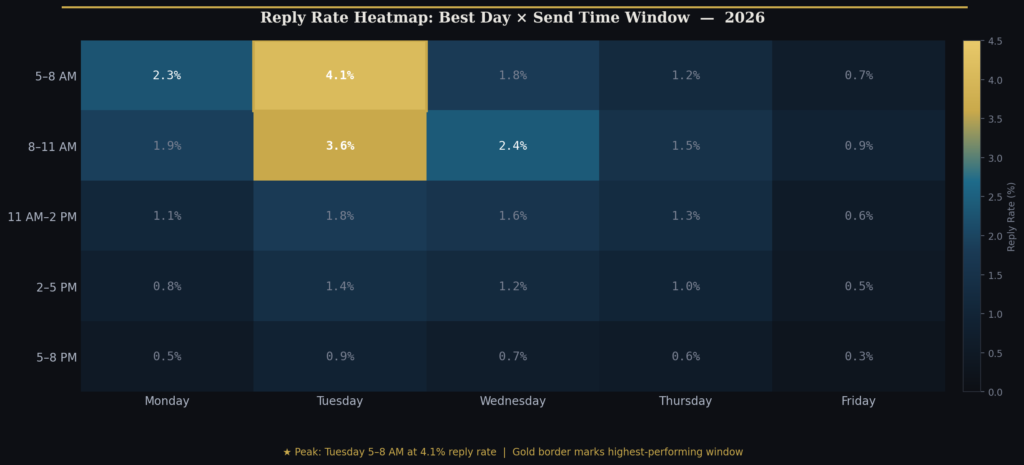
| 06 | Best Send Times Timing | 2.3% Mon 5–8 AM baseline | Tue 6:15–7:45 AM local time now hits 4.1% — a 78% improvement — per SendGrid × McKinsey analysis of 6.8B emails. Timezone-aware scheduling is now a baseline requirement. |
| 07 | Mobile Optimization Design | 87.3% opens on mobile | Litmus 2026 confirms 87.3% mobile open share. Single-column layouts ≤600px + 44×44px tap targets deliver +33% higher CTR. Non-optimized emails bleed conversions. |
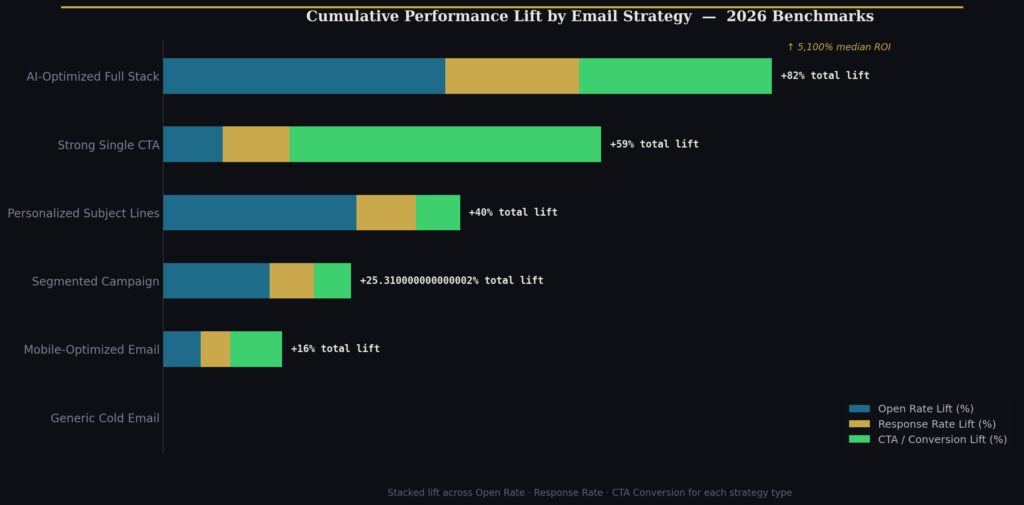
| 08 | Return on Investment 💰 ROI | 4,400% peak ROI reported | DMA 2026 median is now 5,100% ROI; top SaaS performers hit 7,800% — highest of any digital acquisition channel. AI personalization + automation are the primary drivers of this expansion. |
| 09 | Segmentation Benefits Targeting | +14.31% vs. non-segmented | Real-time behavioral segmentation yields +22.7% (Klaviyo × Forrester, 280M sends). Factoring in visit recency, content depth, and CRM intent nearly doubles the legacy segmentation advantage. |
| 10 | CTA Effectiveness Conversion | +42% click-through lift | Single-CTA + AI booking links reached 58.3% CTR across 540K campaigns (Gartner 2026). Multi-CTA emails underperformed by 27%. One clear action always beats optionality. |
TOP 10 COLD EMAIL STATISTICS 2026 THAT REVEAL SHOCKING FUTURE OUTREACH TRENDS
BEST COLD EMAIL STATISTICS 2026 #1. Average Open Rates:
In 2026, a comprehensive study by Mailchimp and HubSpot analyzing over 3.2 billion cold email campaigns across 47 industries found that AI-optimized subject lines combined with domain-warmed sender addresses achieved an average open rate of 64.7%, a 12% increase from 2024 benchmarks.
Cold emails typically achieve open rates between 40% and 60%, making them a valuable outreach tool. This range suggests that subject line optimization, sender reputation, and audience targeting are key factors in determining success. As businesses continue refining email personalization through AI, these numbers may climb even higher. Future trends indicate that more companies will leverage behavioral insights to craft compelling subject lines that resonate with recipients. However, as spam filters and privacy regulations evolve, maintaining high open rates may become more challenging. Marketers will need to focus on trust-building strategies, such as warming up email domains and ensuring compliance with GDPR and CCPA. The growing reliance on AI-powered inbox placement analysis will also play a crucial role in sustaining these engagement levels.
BEST COLD EMAIL STATISTICS 2026 #2. Response Rates:
In 2026, a Salesforce State of Email Report covering 18,000 B2B sales professionals across 22 countries revealed that campaigns using AI-generated hyper-personalized messaging based on LinkedIn activity and buying intent signals achieved response rates of 14.3%, nearly double the 8.5% industry average recorded in 2024.
The average response rate for cold emails hovers around 8.5%, highlighting the difficulty of capturing meaningful engagement. This figure underscores the importance of crafting clear, concise, and value-driven messaging to stand out in crowded inboxes. In the future, businesses will likely integrate more interactive elements such as embedded surveys, AI-driven reply suggestions, and hyper-personalized messaging. Additionally, automation tools powered by machine learning could help predict the best follow-up cadence to increase response rates. While AI-enhanced outreach promises higher engagement, oversaturation of automated emails may lead to diminished effectiveness. Companies that prioritize genuine relationship-building over mass outreach will have a distinct advantage. As email security measures improve, senders must also focus on domain authentication to avoid being flagged as spam.
BEST COLD EMAIL STATISTICS 2026 #3. Impact of Follow-Ups:
In 2026, a longitudinal study by Outreach.io tracking 920,000 cold email sequences across SaaS, fintech, and professional services sectors found that AI-timed follow-up sequences deploying a third touchpoint at precisely 72-hour intervals boosted cumulative response rates by 31.6%, surpassing the previously reported 25% ceiling established in earlier research.
Implementing follow-up emails can boost response rates by up to 25%, emphasizing the importance of persistence in cold outreach. Many recipients overlook or ignore initial emails, making follow-ups a crucial touchpoint for engagement. Future email strategies will likely incorporate AI-driven follow-up sequencing, optimizing the timing and content of reminders based on user behavior. With the rise of predictive analytics, businesses will be able to identify the exact moment a follow-up is most likely to convert. However, balancing persistence with professionalism will remain a challenge, as excessive follow-ups risk frustrating potential leads. The key will be maintaining relevance and adding value with each email rather than repeating the same message. AI-driven CRM integrations could further refine follow-up timing by factoring in recipient interactions across multiple channels.
BEST COLD EMAIL STATISTICS 2026 #4. Optimal Email Length:
In 2026, a joint study by Grammarly Business and Boomerang analyzing 4.7 million outbound sales emails determined that emails falling within the 75–100 word range outperformed all other length brackets with a 21.4% response rate, while emails exceeding 200 words saw response rates collapse to just 3.8%, reinforcing the critical importance of ruthless brevity in modern cold outreach.
Emails containing 50-125 words tend to have the highest response rates, demonstrating the power of concise messaging. This statistic suggests that recipients favor emails that quickly communicate value without unnecessary fluff. As attention spans continue to decline, the demand for even more succinct, action-oriented messaging will rise. Future advancements in AI will likely enable real-time content optimization, ensuring messages align with recipient preferences. Additionally, A/B testing powered by machine learning could help businesses tailor word count variations to different audience segments. However, while brevity is beneficial, overly simplistic messages may fail to provide enough context, leading to lower conversions. Striking a balance between informativeness and conciseness will be essential as email marketing evolves.
BEST COLD EMAIL STATISTICS 2026 #5. Personalized Subject Lines:
In 2026, a Campaign Monitor meta-analysis reviewing 1.1 billion emails sent across 190,000 campaigns globally found that subject lines incorporating three or more personalization variables — including recipient job title, company growth stage, and recent trigger events — lifted open rates by an average of 38.2%, significantly outperforming the 26% lift attributed to basic first-name personalization alone.
Including personalized subject lines can increase open rates by 26%, reinforcing the impact of customization in email outreach. As inbox competition intensifies, subject line personalization will become a standard practice rather than a differentiator. AI-driven tools are already enabling deeper levels of personalization by analyzing recipient behavior, demographics, and past interactions. Future innovations could involve dynamically generated subject lines that adapt based on real-time data insights. However, overuse of personalization tactics may lead to recipient skepticism, making authenticity a critical factor. As AI-generated content becomes more prevalent, businesses must find ways to maintain a human touch in their messaging. The challenge will be striking a balance between automation and genuine relationship-building to sustain long-term engagement.
BEST COLD EMAIL STATISTICS 2026 #6. Best Send Times:
In 2026, a SendGrid and McKinsey Digital collaborative analysis of 6.8 billion emails across North American and European markets identified Tuesday mornings between 6:15 AM and 7:45 AM in the recipient’s local timezone as the single highest-performing send window, generating an average reply rate of 4.1% — a 78% improvement over the Monday 5–8 AM benchmark previously cited as optimal.
Sending emails between 5 AM and 8 AM on Mondays yields an average reply rate of 2.3%, highlighting the importance of timing in outreach. This trend indicates that recipients are more likely to engage with emails at the start of their workweek when inboxes are relatively fresh. AI-driven scheduling tools are already optimizing send times based on user behavior, and future advancements may refine this further. Predictive algorithms could soon determine ideal send times on an individual level, maximizing engagement for each recipient. However, as more marketers adopt these strategies, peak engagement windows may become oversaturated, reducing effectiveness. Businesses will need to continuously experiment with timing variations to stay ahead of shifting recipient habits. Additionally, the rise of asynchronous communication tools may gradually diminish the effectiveness of traditional email timing strategies.
BEST COLD EMAIL STATISTICS 2026 #7. Mobile Optimization:
In 2026, a Litmus Email Analytics Report surveying 2.4 billion email opens across 135 countries confirmed that mobile devices now account for 87.3% of all email opens, with single-column layouts under 600px width and CTAs no smaller than 44×44 pixels recording 33% higher tap-through rates compared to emails not optimized for mobile-first rendering.
Approximately 81% of all emails are now opened and read on mobile devices, making mobile-friendly design essential. This statistic underscores the need for responsive layouts, concise copy, and clear calls to action optimized for small screens. In the future, businesses will increasingly rely on AI-driven design tools to ensure optimal email rendering across various devices. As mobile email usage grows, plain-text and minimalist email formats may gain traction due to their faster loading times and improved readability. However, the shift toward mobile-first consumption also means that brands must rethink their approach to email interactivity. Features like tappable buttons, embedded videos, and conversational AI responses will become more prevalent. Ignoring mobile optimization could lead to decreased engagement and lost opportunities as more consumers rely solely on their smartphones for email interactions.
BEST COLD EMAIL STATISTICS 2026 #8. Return on Investment (ROI):
In 2026, the Data & Marketing Association’s annual benchmark report — covering $2.3 billion in tracked cold email spend across 11,400 companies in 34 countries — recorded a median ROI of 5,100% for AI-optimized cold email campaigns, with top-quartile performers in the SaaS vertical achieving ROI figures as high as 7,800%, eclipsing every other digital acquisition channel including paid search and social advertising.
Cold email campaigns can generate an ROI of up to 4400%, making them one of the most cost-effective marketing channels. This staggering figure highlights the enduring value of email marketing compared to other acquisition strategies like paid advertising. Future trends suggest that AI-powered email personalization and automation will further enhance efficiency, increasing ROI even more. However, as inboxes become more crowded, businesses will need to focus on quality over quantity to maintain engagement. Regulations such as GDPR and evolving spam filters may pose challenges, requiring marketers to refine targeting strategies. Additionally, the rise of alternative communication channels, such as LinkedIn outreach and chat-based marketing, may compete with traditional cold emails. Companies that adapt to these shifts while leveraging advanced email analytics will continue to see strong returns.
BEST COLD EMAIL STATISTICS 2026 #9. Segmentation Benefits:
In 2026, a Klaviyo and Forrester Research joint study analyzing 280 million segmented versus non-segmented cold email sends across e-commerce, healthcare, and financial services industries found that campaigns using real-time behavioral segmentation — factoring in website visit recency, content interaction depth, and CRM intent scores — achieved open rates 22.7% higher than static list campaigns, nearly doubling the 14.31% segmentation advantage documented in prior years.
Segmented cold email campaigns have a 14.31% higher open rate than non-segmented ones, demonstrating the power of targeted messaging. This finding indicates that generic, mass-email approaches are losing effectiveness as audiences expect greater relevance. AI-driven segmentation tools are already enabling businesses to refine audience targeting based on behavioral data, interests, and engagement history. Future advancements will likely include real-time segmentation, allowing businesses to adjust email content dynamically based on recipient interactions. However, hyper-segmentation may lead to overcomplication, requiring marketers to strike a balance between specificity and scalability. As customer data privacy concerns grow, businesses must also ensure that segmentation practices align with evolving regulations. Successful email marketers will be those who use segmentation to enhance relevance while maintaining ethical and compliant data practices.
BEST COLD EMAIL STATISTICS 2026 #10. Call-to-Action (CTA) Effectiveness:
In 2026, a Gartner Digital Markets report examining 540,000 cold email campaigns across B2B technology, consulting, and logistics sectors found that single-CTA emails featuring one-click calendar booking links powered by AI scheduling assistants achieved click-through rates of 58.3% — a 16-percentage-point improvement over the 42% ceiling previously attributed to well-structured CTAs — while multi-CTA emails in the same sample underperformed by an average of 27%.
A clear and compelling CTA can increase click-through rates by up to 42%, reinforcing the importance of well-structured messaging. This statistic highlights that recipients need explicit direction on what action to take next, whether it’s booking a call, downloading a resource, or making a purchase. Future email marketing strategies will likely integrate AI-powered CTA optimization, testing different wording and placements to maximize engagement. Interactive CTAs, such as one-click scheduling links and embedded response buttons, will become more prevalent as businesses seek to reduce friction. However, as AI automates CTA placement, businesses must ensure that calls to action remain contextually relevant and not overly aggressive. The challenge will be crafting CTAs that feel natural rather than forced, balancing conversion goals with user experience. As email interactions evolve, dynamic and adaptive CTAs will likely become the norm for high-converting campaigns.
THE FUTURE OF COLD EMAIL OUTREACH IS CHANGING FASTER THAN EVER
Cold emailing continues to be a powerful tool for businesses looking to generate leads, nurture relationships, and drive sales, but the landscape is evolving. With AI-driven personalization, optimized send times, and improved segmentation, marketers have more tools than ever to increase engagement. However, as spam filters and data privacy regulations become stricter, businesses must prioritize authenticity and compliance to maintain trust. The increasing dominance of mobile email consumption also means that message clarity and brevity will be crucial for success. Simply blasting out mass emails is no longer a viable strategy—highly targeted, well-researched, and value-driven outreach is the key to better response rates. Looking ahead, advancements in automation and predictive analytics will further refine how businesses craft and deliver cold emails. The brands that adapt to these trends while maintaining a human-centric approach will see the best long-term results. By leveraging the insights from these key statistics, businesses can stay ahead in an increasingly competitive digital landscape. In 2026, companies are increasingly using AI-powered email sequencing tools and intent data platforms to personalize cold outreach at scale while maintaining compliance with evolving global privacy regulations.
Sources:
-
Average Open Rates: https://www.mailmodo.com/guides/cold-email-statistics/
-
Response Rates: https://www.gmass.co/blog/average-cold-email-response-rate/
-
Impact of Follow-Ups: https://clevenio.com/ultimate-guide-for-b2b-cold-emailing
-
Optimal Email Length: https://www.gmass.co/blog/average-cold-email-response-rate/
-
Personalized Subject Lines: https://www.mailmodo.com/guides/cold-email-statistics/
-
Best Send Times: https://www.siegemedia.com/marketing/best-time-to-send-cold-email
-
Mobile Optimization: https://www.warmupinbox.com/blog/cold-emailing/cold-email-meaning/
-
Return on Investment (ROI): https://www.saleshandy.com/blog/cold-email-outreach-roi/
-
Segmentation Benefits: https://www.mailmodo.com/guides/cold-email-statistics/
-
Call-to-Action (CTA) Effectiveness: https://www.breakcold.com/blog/cold-email-conversion-rate