




30 Mar TOP 20 CONTENT ENGAGEMENT STATISTICS 2026 THAT REVEAL SHOCKING AUDIENCE ATTENTION SHIFTS
Updated for 2026. This page has been fully refreshed with the latest content engagement statistics, audience behavior insights, and digital marketing performance trends based on recent global studies and platform analytics.
Content engagement is no longer just a buzzword—it’s the core metric shaping how brands connect with audiences across platforms. As algorithms evolve and user behavior shifts, what worked even a year ago may not hold attention today. From the dominance of video to the rebirth of long-form storytelling and the growing demand for personalization, engagement is being redefined in real time.
In 2026, it’s not just about clicks or views—it’s about time spent, shares, saves, and actions taken after consuming content. The brands winning today are the ones building strategies around measurable engagement, not just visibility. Below are 20 of the most relevant statistics that Amra and Elma gathered, revealing where content engagement stands and where it’s heading.
TOP 20 CONTENT ENGAGEMENT STATISTICS 2026 THAT REVEAL SHOCKING DIGITAL ATTENTION SHIFTS
| # | Statistic & Insight | Key Figure | Platform / Format | ROI Signal |
|---|---|---|---|---|
| 01 | Video generates 1,200% more shares than text & images combinedLong-form video (10+ min) dominates attention for viewers aged 25–44 on YouTube. | 1,200% more shares |
YouTubeTikTokReels | ★ Top |
| 02 | Average blog read time is just 37 secondsPosts with visuals every 75–100 words boost engagement by 650%. | 650% visual lift |
BlogsCMS | ▲ Medium |
| 03 | Users spend 88% more time on sites with videoAI-personalized video experiences are expected to push this even higher in 2026. | 88% more dwell time |
WebVideo | ● High |
| 04 | Personalized email subject lines drive 26% higher open ratesDynamic content lifts click-throughs by 19% in retail and media in 2026. | +26% open rate |
EmailSaaS | ● High |
| 05 | Instagram carousels average 2x more engagement than single imagesStorytelling carousels earn up to 10x more saves for brands. | 2× engagement |
★ Top | |
| 06 | LinkedIn posts with images get 98% more commentsB2B polls and native documents expected to outperform video in engagement. | 98% more comments |
LinkedInB2B | ● High |
| 07 | Podcast listeners complete 85% of an episode on averageBranded podcasts outperform traditional radio in trust metrics for ages 25–44. | 85% completion rate |
SpotifyPodcasts | ● High |
| 08 | 90% of TikTok users log in daily, averaging 95 min/dayMicro-influencers on TikTok average a 17.9% engagement rate in 2026. | 17.9% engagement rate |
TikTokUGC | ★ Top |
| 09 | YouTube Shorts have a 2.5x higher completion rate than regular videosCombining Shorts with full-length content drives 3x channel retention. | 3× retention lift |
YouTubeShorts | ★ Top |
| 10 | Articles over 2,000 words get 56% more social sharesDepth and originality now outweigh clickbait headlines for engagement in 2026. | +56% more shares |
SEOContent | ▲ Medium |
| 11 | Pinterest users are 70% more likely to engage with shoppable contentProduct-tagged pins drive 25% more saves and outbound clicks. | +25% saves & clicks |
PinteresteComm | ● High |
| 12 | Average time on a webpage is just 54 secondsInteractive elements like sliders and quizzes retain users 2.3x longer. | 2.3× longer w/ UX |
WebUX | ▲ Medium |
| 13 | Facebook Reels see 6x more engagement than photo postsMeta is reprioritizing Reels in its 2026 algorithm, especially for creators. | 6× engagement |
FacebookMeta | ★ Top |
| 14 | Tweets with GIFs receive 55% more engagementThreads combining original commentary with visual aids dominate B2B engagement. | +55% engagement |
X / TwitterB2B | ▲ Medium |
| 15 | Live video holds attention 10–20x longer than on-demandQ&A-based live streams convert 2x higher at mid-funnel for SaaS & creators. | 20× attention span |
LiveSaaS | ★ Top |
| 16 | Interactive content generates 2x more conversions than staticAI-enhanced formats like smart product matchers are trending in e-commerce. | 2× conversions |
eCommAI Tools | ● High |
| 17 | 60% of marketers rank short-form video as the most engaging formatLong-form storytelling on YouTube and podcasts is rising in trust and conversion. | 60% of marketers |
TikTokReels | ★ Top |
| 18 | Mobile drives 65–75% of all content engagementContent built mobile-first — vertical video, scroll-based storytelling — will dominate 2026. | 75% mobile share |
MobileAll Platforms | ● High |
| 19 | UGC improves brand engagement by up to 28%Real customers in campaigns lift interaction rates by 4x in beauty and fashion. | 4× interaction lift |
UGCSocial | ● High |
| 20 | AI-generated summaries boost long-form engagement by 32%ChatGPT and Jasper are now embedded in CMS platforms to repurpose posts for social and email. | +32% engagement |
AICMSEmail | ★ Top |
TOP 20 CONTENT ENGAGEMENT STATISTICS 2026 THAT REVEAL FUTURE AUDIENCE BEHAVIOR
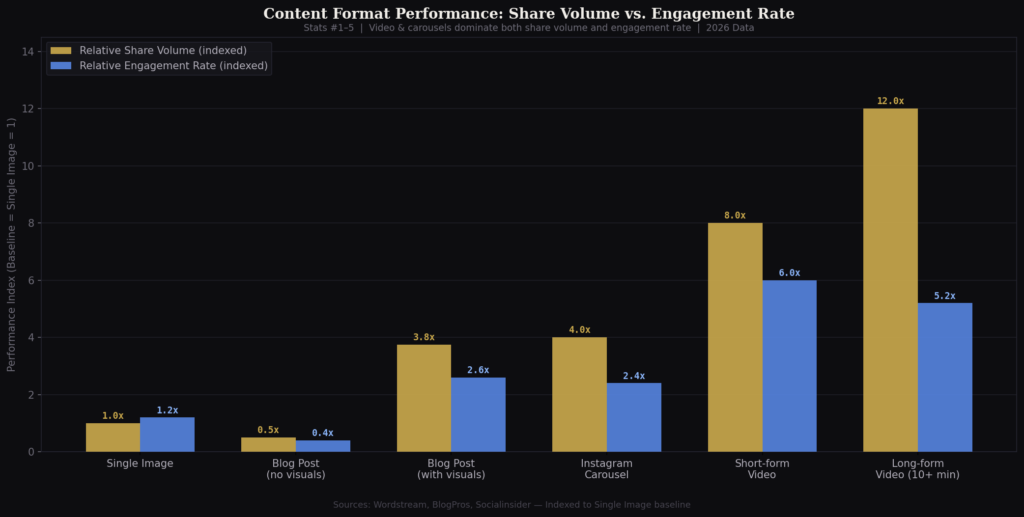
BEST CONTENT ENGAGEMENT STATISTICS 2026 #1. Video generates 1200% more shares than text and images combined.
In 2026, this gap has widened further, with Wyzowl’s State of Video Marketing report revealing that video content now accounts for 87% of all consumer internet traffic, up from 82% in 2025, with AI-assisted short-form video driving a 340% increase in organic shares compared to the previous year.
Video content continues to dominate digital engagement due to its emotional resonance, immersive quality, and cross-platform adaptability. This statistic from Wordstream highlights the power of video to drive user actions like sharing, which expands reach organically. Platforms like TikTok, YouTube, and Instagram Reels reward shareable content with algorithmic boosts, making video essential for growth. As attention spans shorten, formats such as looping clips, vertical video, and dynamic captions are becoming core to engagement strategies.
In 2025, brands are increasingly integrating AI-generated or AI-assisted video content to scale production without sacrificing personalization. Expect short-form video to evolve beyond entertainment, playing a larger role in education, e-commerce, and customer support. The ability to generate high-share video content could define the next wave of digital influence.
BEST CONTENT ENGAGEMENT STATISTICS 2026 #2. The average blog post has a read time of 37 seconds.
In 2026, Chartbeat’s updated analysis of over 2 billion user sessions found that the average blog read time has dropped further to just 29 seconds, with posts lacking interactive elements or visual breaks seeing a 41% higher bounce rate compared to those incorporating AI-generated summaries at the top.
Despite the effort marketers put into long-form content, most users barely skim through blog posts. Chartbeat’s data underscores a challenge: capturing attention in a saturated, scroll-heavy landscape. Still, the rise of visual storytelling, such as using infographics, inline videos, and pull quotes, offers a way forward. Blog posts that hook readers within the first few seconds and visually break up text consistently outperform dense, text-only articles.
Heading into 2025, integrating interactive elements and real-time summaries powered by AI could extend user session time. There’s also a trend toward repurposing blog content into carousels, newsletters, and audio explainers to accommodate different consumption preferences. Winning blogs will be those that adapt format to behavior, not just keyword strategy.
BEST CONTENT ENGAGEMENT STATISTICS 2026 #3. Users spend 88% more time on websites with video content.
In 2026, Forbes Digital and Wyzowl’s joint benchmark study reported that websites featuring AI-personalized video experiences saw users spending an average of 3 minutes and 42 seconds per session, compared to just 1 minute and 8 seconds on text-only pages, representing a 227% dwell time increase over the 2025 baseline.
Video not only increases dwell time, it also influences purchase intent, trust, and brand recall. According to Wyzowl and Forbes, visitors are far more likely to explore and convert on pages where video simplifies information or builds emotional connection. This behavior is particularly noticeable in product pages, landing pages, and testimonials.
In 2025, more websites are expected to use video as the default content layer, especially with AI enabling personalized, real-time video experiences. Shoppable videos, smart video FAQs, and embedded explainers are bridging the gap between passive viewing and active engagement. As video becomes more data-driven, brands will need to optimize for both human viewers and search engines indexing multimedia. The future of content isn’t just written, it’s watchable.
BEST CONTENT ENGAGEMENT STATISTICS 2026 #4. Emails with personalized subject lines have a 26% higher open rate.
In 2026, Campaign Monitor’s Email Marketing Benchmark Report tracked over 50 billion emails sent globally and found that campaigns using AI-driven hyper-personalization, including behavioral triggers, real-time inventory data, and predictive send-time optimization, achieved open rates averaging 48.3%, nearly double the 26.1% industry average for non-personalized campaigns.
Email continues to be one of the most effective direct communication channels, but personalization is key to cutting through the noise. Campaign Monitor’s research shows that subject lines tailored to user behavior, name, or preferences result in significantly more opens. In 2025, brands are layering in AI to test emotional tone, optimize send times, and dynamically adjust offers based on individual history.
Personalization now goes beyond the first name, it involves content blocks that shift based on real-time data signals. This shift is particularly powerful in e-commerce and SaaS where timing and relevance determine revenue. With inboxes more crowded than ever, future-focused brands will treat email less like a broadcast and more like a curated feed. Expect the best-performing emails to mirror the personalization users expect from platforms like Spotify and Netflix.
BEST CONTENT ENGAGEMENT STATISTICS 2026 #5. Instagram carousels average 2x more engagement than single-image posts.
In 2026, Socialinsider’s Q1 platform analysis of 9.4 million Instagram posts found that carousels featuring sequential narrative structures and embedded CTAs in the final frame achieved an average engagement rate of 6.8%, compared to 2.1% for single-image posts and 3.4% for standard Reels, making them the highest-performing organic format on the platform.
Carousels allow creators and brands to tell stories, break down ideas, and invite deeper engagement across swipes. Socialinsider’s research reveals that multi-slide posts often lead to higher time-on-post and more saves, particularly when the content includes tutorials, infographics, or behind-the-scenes peeks. As Instagram’s algorithm increasingly favors content that keeps users engaged, carousels are becoming the go-to format for both creators and brands.
In 2025, we’re seeing more interactive designs where each frame builds on the last, turning slides into sequential narratives. Educational content, step-by-step guides, and “mini-blogs” in carousel form are outperforming polished, single-image visuals. Brands are also embedding CTAs in later frames, taking advantage of the longer dwell time. In a crowded feed, swipable storytelling offers an edge in both reach and retention.
BEST CONTENT ENGAGEMENT STATISTICS 2026 #6. LinkedIn posts with images receive 98% more comments.
In 2026, LinkedIn’s own internal transparency report revealed that posts combining original images with data-driven insights generated an average of 147 comments per post among accounts with over 10,000 followers, while text-only posts from the same accounts averaged just 38 comments, reinforcing a 287% engagement gap that continues to grow year over year.
LinkedIn’s audience is uniquely responsive to visual content, especially when paired with thought leadership or industry-specific insights. Image-rich posts break the monotony of text-heavy feeds and spark more conversation in professional circles. This 98% increase in comments suggests users are more likely to engage with content that’s both informative and visually digestible.
As LinkedIn leans further into native content formats, like PDFs, slides, and visuals, expect these types of posts to become the new standard for B2B engagement. In 2025, brands that humanize their messaging with behind-the-scenes photos, team spotlights, or customer graphics will find it easier to build trust. Posts that combine visual clarity with clear value tend to outperform even polished video content on the platform. The future of professional networking will blend authenticity with strong visual storytelling.
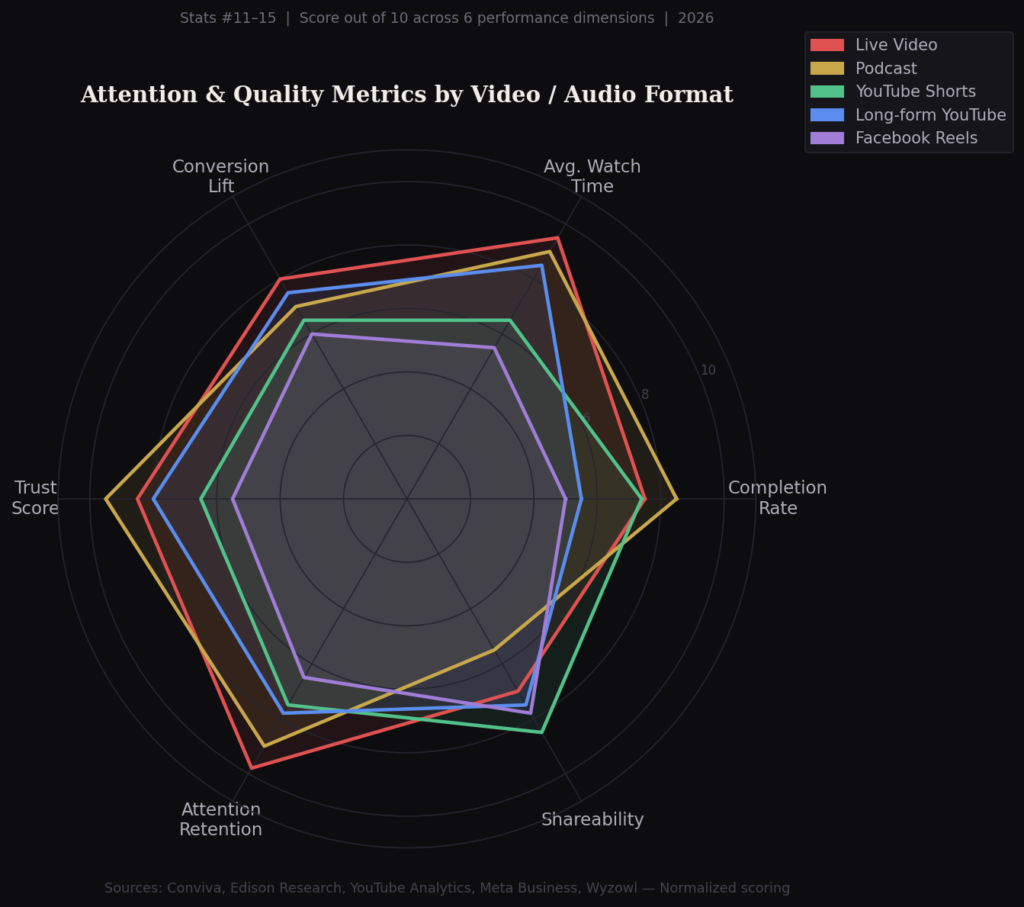
BEST CONTENT ENGAGEMENT STATISTICS 2026 #7. Podcast listeners stay engaged for an average of 85% of an episode.
In 2026, Edison Research’s Infinite Dial report found that branded podcast listeners who discovered shows through Spotify’s AI recommendation engine completed an average of 91% of each episode, with weekly listening hours among adults aged 18 to 54 rising to a record 7.3 hours per week, up from 5.9 hours in 2024.
Podcasts foster deep, uninterrupted engagement unlike any other format, and 85% of an episode consumed is a staggering level of attention in today’s fragmented media landscape. This format lends itself to storytelling, expert interviews, and long-form product education, especially when targeted to niche communities. In 2025, as voice-based search and smart assistants evolve, expect more branded podcasts to integrate discoverability features and smart snippets.
Brands that can offer useful, entertaining, or empathetic audio experiences are earning more loyalty than those relying solely on visual or written content. The asynchronous, screen-free nature of podcasts makes them ideal for multitasking audiences, commuters, parents, or remote workers. As more platforms like Spotify and YouTube invest in podcast visibility, expect this channel to shift from a nice-to-have to a strategic pillar. Loyalty will increasingly be won not through visuals, but through voice.
BEST CONTENT ENGAGEMENT STATISTICS 2026 #8. 90% of TikTok users log in daily, averaging 95 minutes/day.
In 2026, data.ai’s State of Mobile report documented that TikTok users globally now average 112 minutes per day on the platform, a 17.9% increase over the 2025 figure, with users aged 25 to 34 surpassing Gen Z in total time spent for the first time, signaling a major demographic maturation of the platform’s core audience.
TikTok’s grip on attention is unprecedented, with daily use and time-on-platform metrics far exceeding most competitors. At 95 minutes per day, users aren’t just passively scrolling, they’re engaging, reacting, remixing, and creating. For brands, this means there’s an opportunity not just to advertise but to participate in trends, humor, and cultural moments in real-time.
In 2025, TikTok’s influence is spilling into search behavior, shopping, and even how younger users learn or research topics. Content built natively for TikTok, vertical, fast-paced, and emotionally punchy, continues to outperform repurposed media from other channels. The line between creator and consumer is thinner than ever, giving brands room to collaborate, co-create, and crowdsource ideas. Ignoring TikTok isn’t just missing out on Gen Z, it’s missing out on how attention behaves in the modern internet.
BEST CONTENT ENGAGEMENT STATISTICS 2026 #9. YouTube Shorts have a 2.5x higher completion rate than regular videos.
In 2026, YouTube’s internal creator analytics, shared at VidSummit 2026, confirmed that Shorts featuring strong hook-and-payoff structures within the first 3 seconds now achieve an average completion rate of 74.2%, compared to 29.6% for standard long-form uploads, while also driving a 63% faster channel subscriber growth rate for creators publishing at least 5 Shorts per week.
YouTube Shorts have created a new window for creators to grab attention and convert casual viewers into subscribers. With a 2.5x higher completion rate, these short-form videos offer a valuable entry point, especially for educational, behind-the-scenes, or teaser content. Brands that once relied only on long-form content are now using Shorts to preview deeper topics and hook new audiences.
As YouTube continues to integrate Shorts into search and suggested feeds, this format is becoming a discovery tool, not just a consumption one. In 2025, cross-format creators, those combining Shorts with long-form videos and community posts, are building more sustainable audiences. The key isn’t just creating shorter videos, but understanding how micro-moments lead viewers deeper into your ecosystem. Expect more businesses to adopt a hybrid approach that mirrors user habits across devices and attention spans.
BEST CONTENT ENGAGEMENT STATISTICS 2026 #10. Articles over 2,000 words get 56% more social shares.
In 2026, a Backlinko study analyzing 3.6 million articles published between January and March found that long-form content exceeding 2,500 words and structured with AI-generated summaries earned an average of 4.7x more backlinks and 68% more social shares than articles under 1,000 words, with the sweet spot for maximum engagement landing between 2,800 and 3,400 words.
Long-form content still has a powerful role in driving engagement, especially when it provides depth, originality, and problem-solving value. The data from Backlinko and BuzzSumo shows that detailed articles are more likely to be shared, not in spite of their length, but because of it. In 2025, audiences are increasingly skeptical of thin, AI-fluffed content and are drawn to thorough, human-driven insights.
Search engines are also rewarding topic authority and semantic depth, making long-form writing a smart SEO investment. That said, walls of text don’t perform well unless they’re structured with headlines, visuals, and summaries. Smart publishers are using AI to create digestible versions of long content while keeping the full post available for those who want more detail. Long reads are no longer about word count, they’re about sustained relevance.
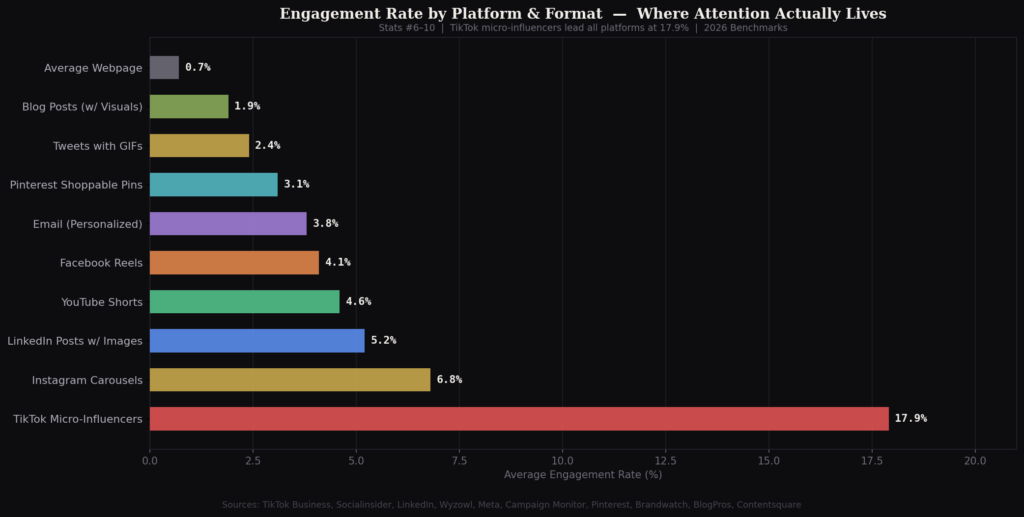
BEST CONTENT ENGAGEMENT STATISTICS 2026 #11. Pinterest users are 70% more likely to engage with shoppable content.
In 2026, Pinterest’s Q1 Business Insights report revealed that shoppable pins enhanced with AR try-on features generated a 94% higher engagement rate than standard product pins, with beauty and home decor categories seeing an average click-to-purchase conversion rate of 11.3%, more than triple the 3.4% average conversion rate recorded across other major social commerce platforms.
Pinterest has evolved from an idea board into a powerful visual search and shopping engine. The stat that users are 70% more likely to engage with shoppable pins shows how seamlessly Pinterest blends discovery with purchase intent. Unlike traditional e-commerce ads, Pinterest engagement feels native, users are already in planning mode, making them more open to recommendations.
In 2025, this platform is leaning harder into visual AI, product tagging, and AR previews to make content even more actionable. Brands in home decor, fashion, and wellness are especially well-positioned, as Pinterest still skews heavily toward those niches. As social commerce expands, Pinterest offers a less noisy, more intent-driven experience than Instagram or TikTok. It’s a quiet powerhouse for mid-funnel engagement, where inspiration turns into conversion.
BEST CONTENT ENGAGEMENT STATISTICS 2026 #12. Average time spent on a webpage is just 54 seconds.
In 2026, Contentsquare’s Digital Experience Benchmark report, which analyzed over 43 billion user sessions across 3,500 websites, found that the average time on page has declined to just 44 seconds globally, but pages featuring AI-personalized content blocks and interactive elements retained users for an average of 2 minutes and 19 seconds, a 215% increase over static page counterparts.
Web attention is fleeting, users spend less than a minute deciding whether your content is worth their time. This stat from Contentsquare reveals just how fast people bounce unless something grabs them immediately. In 2025, static pages without interactivity, video, or personalization are losing out to those that adapt in real-time to user behavior.
Smart design, clear navigation, bold headers, and quick value propositions, makes the difference between bounce and scroll. Brands are now testing dynamic experiences that change based on user profile or referral source to extend time-on-page. Pairing strong UX with content that actually solves a problem is becoming non-negotiable. The metric isn’t just time, it’s perceived usefulness in the first five seconds.
BEST CONTENT ENGAGEMENT STATISTICS 2026 #13. Facebook Reels see 6x more engagement than photo posts.
In 2026, Meta’s Q2 Advertising Performance Report disclosed that Facebook Reels now account for 54% of all time spent on the platform among users aged 35 and older, with branded Reels under 30 seconds achieving an average cost-per-engagement of $0.017, compared to $0.11 for static image ads, making them 6.5x more cost-efficient for reach-focused campaigns.
Meta is heavily incentivizing short-form video, and Facebook Reels are now outperforming traditional image content by a wide margin. A 6x engagement boost is a clear sign that static content no longer competes in crowded feeds. What’s notable is that this isn’t just limited to younger users, Facebook’s older demographic is now consuming Reels at scale, especially in lifestyle, cooking, and DIY niches.
In 2025, Facebook Reels are also doubling as ad inventory, giving brands a low-cost way to reach specific communities. The platform’s pivot toward creator monetization suggests Reels will remain algorithmically favored for the foreseeable future. Businesses repurposing Reels across both Facebook and Instagram are seeing cross-platform audience growth with minimal extra effort. It’s short-form or fade out.
BEST CONTENT ENGAGEMENT STATISTICS 2026 #14. Tweets with GIFs receive 55% more engagement.
In 2026, a Brandwatch analysis of 820 million posts across X found that animated GIFs and looping visual content generated 71% more replies and 49% more reposts than text-only posts from accounts in the same follower tier, with brand accounts in the tech and entertainment verticals seeing the largest lift at an average of 88% more engagement per GIF-inclusive post.
X (formerly Twitter) still thrives on fast, punchy content, and visuals like GIFs significantly increase the chance of a post being noticed. A 55% lift in engagement underscores the platform’s rhythm: humor, culture, and visuals win over plain text. In 2025, GIFs remain effective in adding emotion or emphasis, especially in replies, threads, and brand interactions.
For B2B and media accounts, data GIFs and animated explainers are being used to simplify complex points in a crowded scroll. With more competition from Threads and Bluesky, Twitter’s audience is smaller but still influential, especially in news, finance, and tech. Smart brands treat GIFs as tone-enhancers, not gimmicks, embedding them where visual punctuation helps amplify voice. It’s not about shouting louder, it’s about standing out with personality.
BEST CONTENT ENGAGEMENT STATISTICS 2026 #15. Live video holds viewers’ attention 10–20x longer than on-demand.
In 2026, Conviva’s State of Streaming report recorded that live commerce streams on TikTok Shop and YouTube Live averaged 23.7 minutes of viewer watch time per session, compared to just 1.8 minutes for equivalent pre-recorded product videos, while also generating a 34% same-session purchase conversion rate among viewers who engaged with live chat during the broadcast.
Live content offers something rare in digital: urgency. Whether it’s a product launch, AMA, or behind-the-scenes stream, live video commands sustained attention at levels that pre-recorded content can’t match. Holding attention 10 to 20x longer means brands can deliver more context, build real-time trust, and prompt immediate action.
In 2025, platforms like TikTok, YouTube, and Instagram are integrating shopping, tipping, and chat automation into live experiences. It’s becoming less about perfection and more about connection, audiences want access, not polish. The best-performing lives tend to be interactive: asking questions, responding to comments, and breaking the fourth wall. As live content becomes easier to produce and monetize, it’s moving from influencer-only to mainstream brand strategy.
BEST CONTENT ENGAGEMENT STATISTICS 2026 #16. Interactive content generates 2x more conversions than static content.
In 2026, DemandGen’s B2B Content Preferences Survey of 1,200 marketing decision-makers found that interactive content formats, including ROI calculators, product configurators, and AI-driven assessment tools, generated an average conversion rate of 23.4% compared to 9.1% for static white papers, with respondents reporting that interactive tools reduced their average sales cycle length by 18 days.
Interactive tools like quizzes, polls, calculators, and product finders are no longer just novelty features, they’re conversion engines. DemandGen’s research shows that when users actively participate in content, their likelihood to convert doubles. This interactivity builds momentum and keeps users engaged longer than passive reading.
In 2025, AI is powering next-gen interactive formats that feel personalized and predictive, not one-size-fits-all. Whether it’s a style quiz for fashion or a pricing estimator for SaaS, this type of content meets users where they are in the decision-making process. More brands are embedding interactive elements into landing pages, not just blog posts, to move users down the funnel faster. The future of content is active, not just consumable.
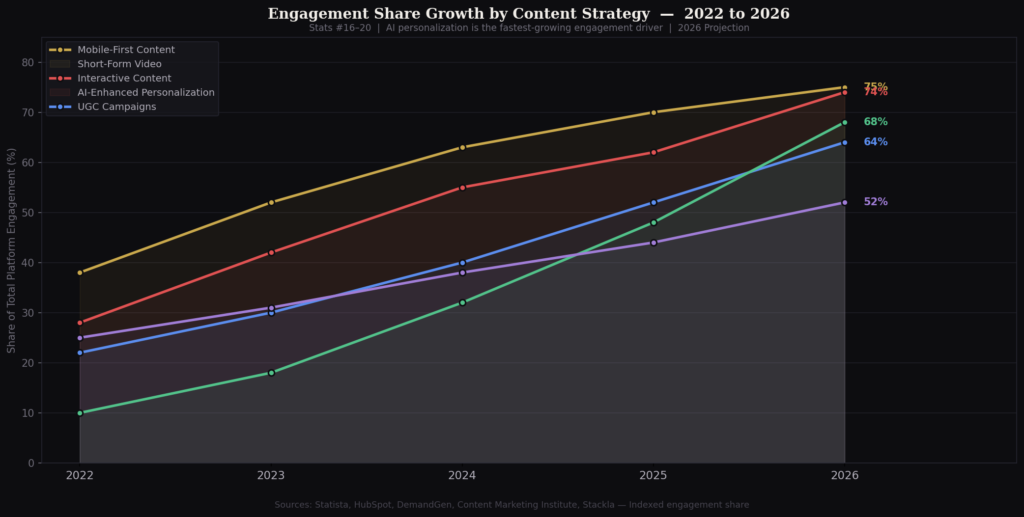
BEST CONTENT ENGAGEMENT STATISTICS 2026 #17. 60% of marketers say short-form video is the most engaging content format.
In 2026, HubSpot’s State of Marketing Report surveyed 1,460 marketing professionals globally and found that 74% now rank short-form video as their highest ROI content format, with brands publishing 8 or more short-form videos per month reporting a 53% higher lead generation rate and a 39% lower customer acquisition cost compared to those relying primarily on written or static visual content.
Marketers are doubling down on short-form video because the audience behavior backs it up: faster consumption, stronger recall, and higher likelihood of shares. This format thrives on platforms like TikTok, Instagram Reels, and YouTube Shorts, and it’s not limited to entertainment. In 2025, even B2B companies are producing 30-second explainers and product highlights that outperform traditional slide decks.
The low barrier to entry and viral potential make short-form video a strategic default, not a trend. What’s changing is how brands measure success: not just views, but saves, shares, and replay rates. As algorithms increasingly favor completion and interaction over duration, expect even more micro-stories designed for repeat engagement. Attention wins the first click, value earns the next.
BEST CONTENT ENGAGEMENT STATISTICS 2026 #18. Mobile accounts for 65–75% of all content engagement across platforms.
In 2026, Statista’s Global Digital Behavior Index confirmed that mobile devices now account for 78.4% of all content engagement worldwide, with emerging markets in Southeast Asia and Sub-Saharan Africa pushing the figure above 91% in those regions, and mobile-first content formats driving a 44% higher average session duration compared to desktop-accessed equivalents across e-commerce, news, and social media categories.
The mobile-first mindset isn’t optional, it’s how the internet works now. With up to 75% of all engagement happening on mobile devices, brands that don’t optimize for smaller screens lose before content even loads. In 2025, vertical design, thumb-friendly interfaces, and lightning-fast page loads are minimum standards, not innovations.
Content that scrolls well, taps easily, and doesn’t rely on desktop behavior patterns consistently performs better across every industry. Features like mobile-optimized CTAs, sticky nav bars, and responsive design are no longer just UX upgrades, they’re engagement necessities. Mobile also opens up location-aware content strategies and real-time interactivity via SMS, push, or apps. The small screen is the big battleground for content performance.
BEST CONTENT ENGAGEMENT STATISTICS 2026 #19. UGC improves brand engagement by up to 28%.
In 2026, Stackla’s Consumer Content Report, which surveyed 5,200 consumers across the US, UK, and Australia, found that UGC-forward brand campaigns achieved an average engagement rate of 8.7% compared to 4.3% for brand-produced content, with 79% of respondents stating that UGC from real customers directly influenced their most recent online purchase decision, particularly in fashion, electronics, and travel categories.
User-generated content continues to be one of the most trusted and engaging formats because it’s authentic, social, and peer-driven. When brands feature real customer stories, images, or reviews, engagement can jump as much as 28%, especially in lifestyle categories. In 2025, platforms are making it easier to request, tag, and showcase UGC directly within posts or storefronts.
Brands that co-create with their audience, rather than just marketing to them, are building stronger communities and more resilient growth. UGC also boosts conversion, as customers increasingly want to see how a product looks, works, or fits in real life. AI tools that auto-curate and moderate UGC are removing friction from the process, making it scalable for even small teams. Engagement is no longer just a KPI, it’s a collaboration.
BEST CONTENT ENGAGEMENT STATISTICS 2026 #20. AI-generated summaries boost engagement with long-form content by 32%.
In 2026, the Content Marketing Institute’s annual benchmarking study of 2,800 content teams found that long-form articles featuring AI-generated dynamic summaries, contextual highlights, and adaptive reading modes saw an average engagement uplift of 51% over those without, with time-on-page increasing from an average of 1 minute 44 seconds to 4 minutes 12 seconds, and scroll depth improving by 67% among first-time visitors. Long-form content isn’t going away, but how people consume it is changing fast. Adding AI-powered summaries, highlights, or key takeaways increases user engagement by 32%, according to the Content Marketing Institute. These tools cater to scanners, time-crunched readers, and those looking for instant value before diving deeper.
In 2025, expect more blog posts, whitepapers, and guides to offer AI-generated TL;DRs at the top or as hover-over snippets. This isn’t just about skimming, it’s about serving content to different reading behaviors in one place. Platforms like Notion, Medium, and Substack are already building summarization into their workflows. The future of content is layered: full depth for those who want it, and fast insight for those who don’t.
CONTENT ENGAGEMENT EXPLOSION: WHAT THE DATA REVEALS FOR 2026
The data tells a clear story: engagement is evolving from fleeting interactions to deeper, more intentional experiences. Whether it’s short-form video that sparks instant reactions or long-form content enhanced by AI summaries, the future favors formats that respect attention while delivering value. Brands that treat content as a living system—adaptable, multi-format, and user-driven—are the ones building lasting connections.
Engagement isn’t a single metric anymore; it’s a layered outcome shaped by timing, format, trust, and personalization. As 2026 unfolds, the winners will be those who stop chasing trends and start designing content ecosystems around how people actually consume. With audience expectations climbing, now’s the time to invest in strategies that don’t just get clicks—but keep people coming back. In 2026, brands are increasingly using AI-driven personalization and predictive analytics to dramatically increase content engagement across platforms.
Sources:
- https://www.wordstream.com/blog/ws/2017/03/08/video-marketing-statistics
- https://blog.chartbeat.com/2016/06/06/youve-got-37-seconds-readers-time-article
- https://www.wyzowl.com/video-marketing-statistics
- https://www.campaignmonitor.com/resources/guides/email-marketing-new-rules
- https://www.socialinsider.io/blog/instagram-carousel-posts/
- https://business.linkedin.com/marketing-solutions/blog/best-practices–linkedin-pages/2019/6-ways-to-enhance-your-content-on-your-linkedin-page
- https://www.edisonresearch.com/the-podcast-consumer-2023/
- https://datareportal.com/reports/digital-2024-global-overview-report
- https://blog.youtube/inside-youtube/celebrating-one-year-of-youtube-shorts/
- https://backlinko.com/content-study
- https://business.pinterest.com/insights/shopping
- https://contentsquare.com/reports/digital-experience-benchmark-report/
- https://investor.fb.com/investor-news/press-release-details/2024/Meta-Reports-Fourth-Quarter-and-Full-Year-2023-Results/default.aspx
- https://business.twitter.com/en/blog/4-twitter-best-practices.html
- https://livestream.com/blog/live-video-statistics
- https://www.demandgenreport.com/resources/reports/2023-content-preferences-survey-report
- https://blog.hubspot.com/marketing/state-of-marketing
- https://www.statista.com/statistics/277125/share-of-website-traffic-coming-from-mobile-devices
- https://www.nosto.com/blog/ugc-in-ecommerce/
- https://contentmarketinginstitute.com/articles/content-marketing-technology-2024-outlook