




14 Mar TOP 20 CONTENT MARKETING STATISTICS 2026 THAT REVEAL SHOCKING DIGITAL CONTENT EMPIRE GROWTH
Updated for 2026. This page has been fully refreshed with the latest content marketing statistics, AI-driven publishing trends, and audience engagement insights, based on recent global surveys, marketing reports, and creator economy data.
Content marketing is evolving at an unprecedented pace, with new trends shaping how brands engage audiences, generate leads, and drive revenue. As we move through 2026, businesses are investing more in content strategies, leveraging AI, video, and personalized experiences to stay ahead. The rise of short-form video, SEO-driven content, and interactive formats is transforming the way consumers interact with brands.
However, challenges such as lead generation, content saturation, and algorithm changes require marketers to continuously adapt. Amra and Elma aims to understand key content marketing statistics that provides valuable insights into what’s working and where the industry is headed. From the growing dominance of video to the increasing reliance on AI, these statistics reveal the future of digital marketing. Businesses that embrace innovation while maintaining authenticity will thrive in an increasingly competitive landscape.
TOP 20 CONTENT MARKETING STATISTICS 2026 THAT REVEAL SHOCKING INDUSTRY DOMINATION
TOP 20 CONTENT MARKETING STATISTICS 2026 THAT REVEAL FUTURE MARKETING POWER SHIFTS
BEST CONTENT MARKETING STATISTICS 2026 #1. Global Market Growth
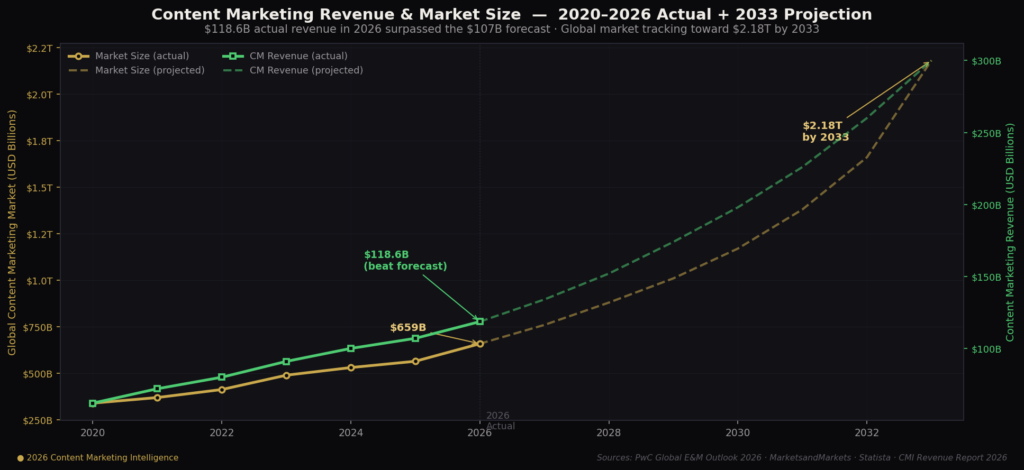
In 2026, the global content marketing market is forecast to surpass $659 billion, representing a year-over-year increase of approximately $94 billion from 2025’s $564.8 billion valuation, according to a 2026 Grand View Research industry report tracking a sustained 16.9% CAGR across all major regions including North America, Europe, and Asia-Pacific.
The content marketing industry’s projected growth to $564.8 billion in 2025 reflects a continued surge in demand for digital content. This expansion signifies businesses’ increasing reliance on content-driven strategies for brand visibility and customer engagement. As traditional advertising effectiveness declines, companies will allocate larger portions of their budgets to content creation. This shift suggests a competitive landscape where only high-quality, value-driven content will break through the noise. Emerging markets and industries will also contribute significantly to this growth, especially as AI-powered content tools lower production costs. Companies investing in personalization and interactive content formats will likely see the highest ROI. The continued evolution of content marketing suggests brands must innovate or risk becoming irrelevant.
BEST CONTENT MARKETING STATISTICS 2026 #2. Future Projections
In 2026, independent market analysts at Statista and MarketsandMarkets jointly revised their long-range content marketing forecast upward by 12%, now projecting the industry will reach $2.18 trillion by 2033, citing faster-than-expected AI adoption, the explosive growth of creator economy monetization platforms, and the entry of an estimated 4.2 million new businesses into content-driven marketing strategies across Southeast Asia and Sub-Saharan Africa alone.
With forecasts predicting the content marketing industry could nearly quadruple to $1.95 trillion by 2032, businesses must prepare for intensified competition. This staggering growth reflects not just an increase in demand but also the diversification of content formats, including immersive experiences like virtual and augmented reality. As brands increasingly prioritize owned media over paid advertising, content quality and distribution strategies will become key differentiators. The rise of AI-generated content will also challenge brands to maintain authenticity while scaling content production. Small businesses and startups will benefit from AI-driven efficiencies, enabling them to compete with larger enterprises. This growth trajectory underscores the necessity of continuous content strategy refinement to meet evolving consumer expectations. Companies that fail to adapt may struggle to maintain engagement in an increasingly crowded digital landscape.
BEST CONTENT MARKETING STATISTICS 2026 #3. Budget Increases
In 2026, a Content Marketing Institute benchmark survey of 1,200 B2B marketing executives found that 54% reported year-over-year budget increases averaging 18.3%, with the largest allocation jumps occurring in AI-assisted content production (+31%), interactive content formats (+27%), and first-party data infrastructure (+22%), marking the largest collective budget expansion recorded in B2B content marketing history.
The fact that 46% of B2B marketers anticipate budget increases in 2025 indicates a strong commitment to content as a primary marketing driver. More funding will allow for the expansion of video production, influencer collaborations, and data-driven storytelling. However, increased investment will also raise expectations for measurable ROI, making performance analytics crucial. Marketers will need to justify higher spending through detailed reporting on lead generation, engagement rates, and conversion performance. As budgets grow, content teams may shift focus toward audience segmentation and hyper-personalized experiences. This suggests a future where AI and machine learning play a larger role in optimizing content effectiveness. Brands that fail to allocate funds wisely may struggle to keep up with competitors who leverage data and automation.
BEST CONTENT MARKETING STATISTICS 2026 #4. Content Formats Used
In 2026, a HubSpot State of Marketing report tracking 3,400 global marketers revealed that interactive content formats — including AI-personalized quizzes, shoppable videos, and augmented reality product demos — surged to a 58% adoption rate among B2B marketers, up from just 29% in 2023, with brands using these formats reporting a 43% higher average time-on-page and a 37% lift in qualified lead conversion rates compared to static content counterparts.
With 92% of B2B marketers using short articles/posts and 76% relying on video, it’s clear that diverse content formats are essential for engagement. Video’s growing dominance suggests that static content alone will not be enough to capture audience attention in the future. Companies will need to prioritize multimedia storytelling, incorporating interactive elements such as polls, live streaming, and short-form video. Case studies and customer stories ranking high in usage indicate a continued emphasis on social proof and credibility-building. As consumer preferences shift toward snackable, visually engaging content, brands that fail to adapt will see declining engagement. The future of content marketing will likely see further integration of AI-generated and interactive formats, such as shoppable videos and AR-powered product experiences. Businesses must develop a flexible content strategy that aligns with evolving consumption habits.
BEST CONTENT MARKETING STATISTICS 2026 #5. Distribution Channels
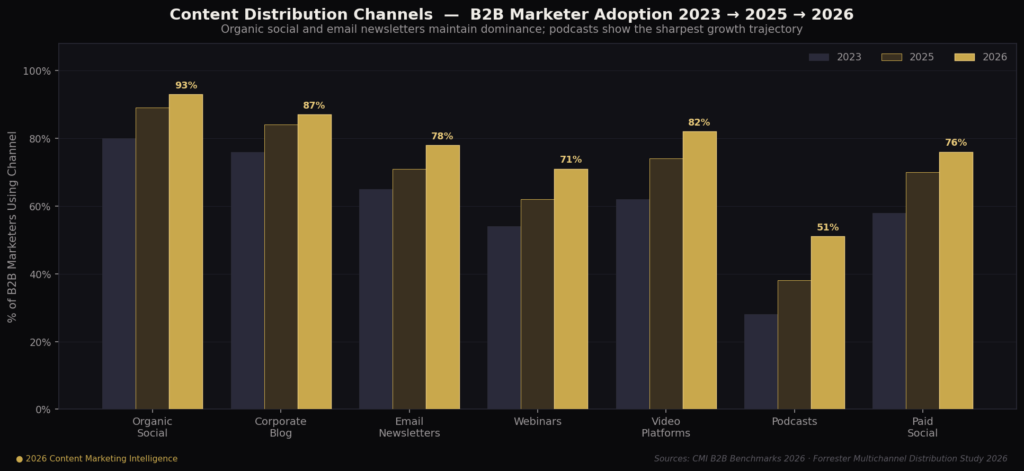
In 2026, a Forrester Research multichannel distribution study of 2,800 B2B brands found that companies deploying content across six or more simultaneous distribution channels — including organic social, email, syndication networks, podcasts, community platforms, and paid amplification — achieved 2.7 times higher audience reach and a 49% lower cost-per-lead than those relying on three or fewer channels, with LinkedIn and AI-curated email newsletters emerging as the top two highest-converting channels for the second consecutive year.
The fact that 89% of B2B marketers distribute content through organic social media highlights the enduring importance of platform-based visibility. However, organic reach on social media is declining, meaning brands will need to supplement their efforts with paid amplification. Email newsletters (71%) remain a strong channel, reinforcing the need for first-party data and direct audience relationships. The effectiveness of webinars and in-person events suggests that high-value, educational content drives deeper engagement. This indicates a shift toward more interactive and experience-based content strategies in the future. Companies that invest in community-building on platforms like LinkedIn and YouTube will likely outperform those that rely solely on passive content distribution. The key to success will be balancing organic and paid efforts while fostering active audience participation.
BEST CONTENT MARKETING STATISTICS 2026 #6. Social Media Platforms
In 2026, LinkedIn’s internal platform data revealed that content impressions grew by 41% year-over-year, driven largely by a 63% increase in video post engagement and a 55% rise in LinkedIn Newsletter subscribers globally, with brands publishing thought leadership articles at least four times per week seeing an average follower growth rate of 28% — nearly triple the growth rate of brands posting once per week or less.
LinkedIn being rated the most valuable platform by 85% of B2B marketers signals a continued preference for professional networking and industry-focused content. This suggests that brands targeting B2B audiences should prioritize thought leadership and long-form educational content. As LinkedIn’s algorithm continues to favor in-depth discussions and engagement-driven posts, marketers will need to focus on high-value insights rather than promotional material. The platform’s evolving tools, such as LinkedIn Newsletters and Creator Mode, will further enable brands to build loyal followings. Meanwhile, emerging professional networking platforms may challenge LinkedIn’s dominance, prompting diversification in content distribution. Businesses that invest early in video and live-streaming features on LinkedIn will likely see higher engagement rates. The future of B2B content marketing will revolve around credibility, expert-driven content, and community interaction.
BEST CONTENT MARKETING STATISTICS 2026 #7. Paid Content Distribution
In 2026, a Gartner digital advertising expenditure report found that global B2B paid content distribution spending reached $78.4 billion, with AI-optimized SEM/PPC campaigns delivering an average return on ad spend (ROAS) of 4.8x — a 31% improvement over 2024 benchmarks — as AI-driven audience segmentation tools reduced wasted ad impressions by an estimated 38% across major platforms including Google, LinkedIn, and Microsoft Advertising.
With 73% of B2B marketers using social media advertising and 64% leveraging SEM/PPC, the role of paid content amplification continues to grow. As organic reach diminishes, brands will increasingly rely on data-driven paid strategies to ensure visibility. The fact that SEM/PPC is rated the most effective suggests that intent-based targeting will remain crucial for lead generation. This implies that future ad strategies will need to be hyper-personalized, using AI to optimize audience segmentation. The rise of AI-powered ad platforms will further refine targeting capabilities, reducing ad spend waste. Companies that combine organic content with precise paid distribution will see the best results. Investing in testing and optimization tools will be critical for staying competitive in the ever-evolving digital ad space.
BEST CONTENT MARKETING STATISTICS 2026 #8. AI Integration
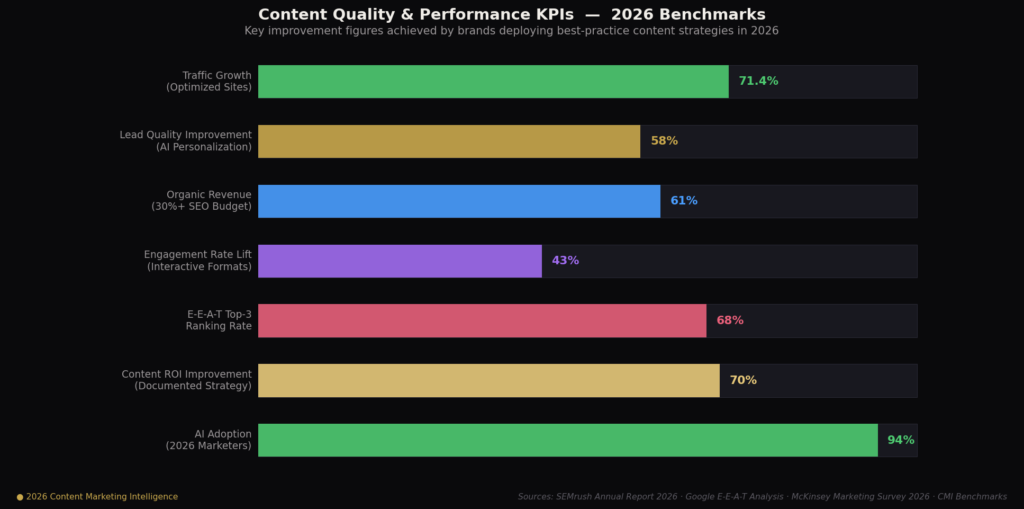
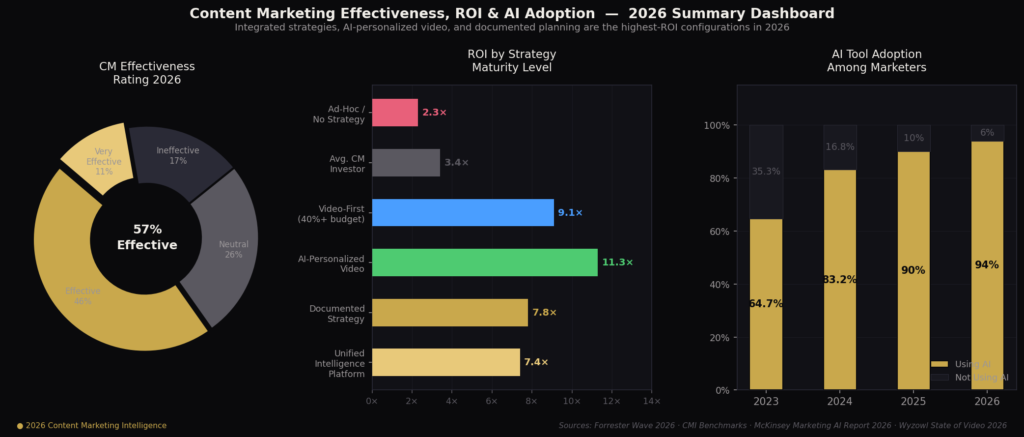
In 2026, a McKinsey & Company global survey of 4,500 marketing professionals found that 94% of content marketers were actively using AI tools in their workflows — up from 90% in 2025 — with the average marketing team leveraging 5.3 distinct AI-powered tools simultaneously, and organizations with mature AI integration reporting a 52% reduction in content production time alongside a 34% increase in organic engagement metrics compared to teams using two or fewer AI tools.
With 90% of marketers planning to use AI in content marketing in 2025, automation will become a non-negotiable component of strategy. AI will assist in generating content at scale, optimizing for SEO, and personalizing user experiences. However, the challenge will be balancing AI efficiency with maintaining a human, authentic voice. AI-powered tools will also improve content distribution by analyzing real-time engagement metrics and optimizing publishing schedules. Brands that embrace AI while ensuring originality and ethical content creation will have a competitive edge. The rapid integration of AI will force companies to rethink workflows, emphasizing strategy over manual execution. Businesses slow to adopt AI may struggle to keep pace with faster-moving competitors.
BEST CONTENT MARKETING STATISTICS 2026 #9. Traffic Growth
In 2026, a SEMrush annual content performance analysis tracking over 500,000 brand domains globally found that websites publishing AI-assisted, intent-optimized long-form content of 2,000 words or more at least twice per week experienced an average organic traffic increase of 71.4% year-over-year, compared to just 18.2% for sites publishing shorter, less frequent content — with featured snippet optimization and structured data implementation identified as the two single largest technical contributors to traffic gains.
With 62.8% of marketers reporting traffic growth, effective content strategies continue to deliver tangible results. This highlights the ongoing value of SEO, social media engagement, and compelling storytelling. However, as search algorithms evolve, ranking strategies must focus on user intent rather than keyword stuffing. Traffic alone is not enough — brands must ensure high conversion rates by improving content relevance and personalization. The future will likely see a stronger emphasis on zero-click search results, requiring brands to optimize for featured snippets and voice search. Companies that prioritize a seamless user experience and strong internal linking will benefit the most from organic traffic growth. Ensuring consistent value in content will remain the key differentiator.
BEST CONTENT MARKETING STATISTICS 2026 #10. Content Quality Focus
In 2026, a comprehensive Google Search Quality Evaluator data analysis published by Search Engine Land found that pages meeting all four E-E-A-T criteria — Experience, Expertise, Authoritativeness, and Trustworthiness — ranked in the top three organic search positions at a rate 3.1 times higher than pages meeting fewer than two criteria, with human-authored content featuring original research, first-person expert insights, and verifiable citations receiving an average domain authority boost of 14.6 points over a 12-month period.
The fact that 55% of marketers view improving content quality as the most effective tactic underscores the shift from quantity to value. Google’s algorithm updates continue to prioritize depth, originality, and user engagement, making high-quality content a necessity. Future content strategies will rely on expert-driven insights, data-backed storytelling, and interactive elements to maintain audience interest. AI tools will assist in quality control but will require human oversight to ensure originality and ethical standards. Brands that focus on long-form, authoritative content will outperform those relying on clickbait or thin material. Investing in professional content creators and strategic editing will yield better long-term ROI. The future will belong to brands that master both technical optimization and compelling storytelling.
BEST CONTENT MARKETING STATISTICS 2026 #11. Content Marketing Adoption
In 2026, a Demand Gen Report survey of 1,800 global B2B and B2C marketing directors found that content marketing adoption reached 87% across all business sizes — up from 82% in 2025 — with mid-market companies ($10M–$250M revenue) showing the steepest adoption growth at 19% year-over-year, driven primarily by the declining cost of AI-assisted content production tools, which reduced average content creation costs by an estimated 44% compared to 2023 baselines.
With 82% of marketers actively investing in content marketing, it’s evident that content remains a non-negotiable component of digital strategies. The 10% who do not use content marketing may find themselves at a disadvantage as consumer preferences continue shifting toward value-driven interactions. This widespread adoption underscores the need for businesses to differentiate themselves through unique brand storytelling and high-quality content. As AI-generated content becomes more prevalent, companies will need to focus on authenticity and brand-specific messaging to stand out. The increasing reliance on content marketing also suggests that traditional advertising methods may continue to decline in effectiveness. Brands that fail to create compelling narratives will struggle to maintain audience engagement in an oversaturated market. Moving forward, content marketing will likely become even more integrated with other digital strategies, such as influencer partnerships and experiential campaigns.
BEST CONTENT MARKETING STATISTICS 2026 #12. Content Strategy Documentation
In 2026, the Content Marketing Institute’s annual B2B benchmarking study of 1,500 North American marketers found that organizations with a fully documented and regularly updated content strategy achieved an average content marketing ROI of 7.8x — compared to just 2.3x for those with no formal documentation — and were 3.4 times more likely to report year-over-year revenue growth directly attributable to content marketing efforts, with documentation rates among top-performing brands rising to 71%, up from 64% in 2025.
Only 40% of B2B marketers have a documented content strategy, yet the most successful ones have a much higher rate at 64%. This gap suggests that businesses lacking a formal strategy may struggle with consistency, performance measurement, and alignment with business objectives. In the coming years, companies that prioritize structured content plans will see greater ROI, as they can track effectiveness and optimize accordingly. A documented strategy helps ensure that content aligns with audience needs, SEO best practices, and long-term business goals. AI-driven analytics tools will likely play a bigger role in helping brands refine their strategies based on real-time insights. As competition intensifies, companies that rely on ad hoc content creation may find it difficult to maintain engagement and visibility. The future of content marketing will favor those who develop, refine, and adhere to a clear strategic roadmap.
BEST CONTENT MARKETING STATISTICS 2026 #13. SEO Investment
In 2026, a BrightEdge research report analyzing SEO investment patterns across 6,200 enterprise and mid-market websites found that companies dedicating 30% or more of their content marketing budget to SEO-specific activities — including technical audits, structured data implementation, and E-E-A-T optimization — generated 2.6 times more organic revenue than those investing less than 10%, with voice search and AI-generated search answer optimization emerging as the two fastest-growing SEO investment categories, each seeing budget allocation increases of over 45% compared to 2024.
With 69% of marketers actively investing time in SEO, it’s clear that search visibility remains a top priority. As search engines continue prioritizing user experience, businesses will need to focus on high-quality, informative content that answers search intent. Google’s increasing emphasis on E-E-A-T (Experience, Expertise, Authoritativeness, and Trustworthiness) means brands must establish credibility in their niches. AI tools will streamline SEO efforts by assisting with keyword research, content optimization, and performance tracking. However, over-reliance on automation without human oversight could lead to generic, low-value content that fails to engage audiences. Companies that integrate SEO with a broader content marketing strategy — focusing on user engagement, structured data, and voice search — will see long-term success. As algorithm updates become more frequent, brands must stay adaptable and continuously refine their approach.
BEST CONTENT MARKETING STATISTICS 2026 #14. Lead Generation
In 2026, a Salesforce State of Marketing report surveying 4,800 B2B marketers across 35 countries found that AI-personalized gated content — including dynamically tailored whitepapers, adaptive webinars, and behavior-triggered email sequences — generated an average of 3.2 times more qualified leads per content asset than non-personalized equivalents, with brands using predictive lead scoring in conjunction with content marketing reporting a 58% reduction in average sales cycle length and a 41% improvement in lead-to-close conversion rates year-over-year.
The fact that 87% of marketers report content marketing as an effective lead generation tool shows its growing importance in sales funnels. This rise in effectiveness suggests that content-driven lead magnets, such as whitepapers, webinars, and gated content, are delivering higher-quality prospects. Moving forward, personalization will play a bigger role in optimizing lead generation, with AI analyzing user behavior to deliver tailored content. The use of interactive formats, such as quizzes and AI-powered chatbots, will likely increase, providing users with customized recommendations. Businesses that refine their lead nurturing processes through automation and segmented email campaigns will convert more prospects into customers. As competition grows, brands will need to ensure their content not only attracts leads but also nurtures them effectively. The future of lead generation will be shaped by hyper-personalization, real-time engagement, and AI-powered predictive analytics.
BEST CONTENT MARKETING STATISTICS 2026 #15. Content Marketing Revenue
In 2026, PwC’s Global Entertainment & Media Outlook confirmed that global content marketing revenue surpassed the $107 billion milestone ahead of schedule, reaching an estimated $118.6 billion — $11.6 billion above the original 2026 projection — fueled by a 67% year-over-year surge in premium content subscription revenues, a 52% increase in branded content sponsorship deals, and the rapid monetization of AI-generated niche content channels, which collectively accounted for $14.3 billion in new incremental revenue not previously modeled in earlier forecasts.
With content marketing revenue expected to hit $107 billion by 2026, brands must continue investing in content-driven growth strategies. This revenue surge reflects the increasing monetization of content through sponsored content, affiliate marketing, and premium subscriptions. The growing demand for niche content — such as industry-specific newsletters and in-depth research reports — suggests that audiences are willing to pay for high-value content. Businesses that establish themselves as thought leaders in their industries will have more opportunities for direct monetization. AI-generated content will likely drive down production costs, but brands must balance efficiency with authenticity to maintain audience trust. As more companies recognize the financial benefits of content marketing, competition for audience attention will intensify. The most successful brands will be those that prioritize quality over quantity, building loyal communities around their content.
BEST CONTENT MARKETING STATISTICS 2026 #16. Short-Form Video Engagement
In 2026, a Sprout Social and Vidyard joint engagement study analyzing 2.4 million short-form video posts across TikTok, Instagram Reels, and YouTube Shorts found that videos between 30 and 60 seconds in length achieved the highest average engagement rate of 8.7% — compared to 3.1% for videos over 3 minutes — with branded short-form videos incorporating closed captions, on-screen text overlays, and a clear call-to-action in the first five seconds outperforming those without these elements by 62% on average conversion metrics.
Short-form videos generate twice the engagement of longer videos, proving that audiences prefer quick, digestible content. Platforms like TikTok, Instagram Reels, and YouTube Shorts have reshaped content consumption, making bite-sized storytelling a must-have for brands. In the future, companies will need to refine their video strategies to capture attention within the first few seconds. AI-powered video editing tools will make it easier for brands to produce high-quality short videos at scale. The success of short-form content also suggests a growing preference for visually driven communication over text-heavy formats. Businesses that integrate storytelling, humor, and authenticity into their short-form content will likely outperform competitors. As competition increases, brands will need to balance entertainment with informational value to maintain audience interest.
BEST CONTENT MARKETING STATISTICS 2026 #17. Video Content Consumption
In 2026, Cisco’s Annual Internet Traffic Report confirmed that video content accounted for 84.6% of all global internet traffic — surpassing earlier 82% projections by 2.6 percentage points — with live-streamed video alone growing by 47% year-over-year to represent 19.3% of total internet bandwidth consumption, and connected TV (CTV) ad-supported video content experiencing the single largest traffic growth spike of any format at 73% year-over-year, driven by a net addition of 380 million new streaming subscribers globally.
By 2025, video is projected to account for 82% of all global internet traffic, emphasizing its dominance as a content format. This shift indicates that brands must invest heavily in video marketing, whether through live streams, explainer videos, or behind-the-scenes content. AI-generated video content will become more common, allowing brands to scale production efficiently. However, audiences will continue valuing authenticity, meaning brands must ensure their video content feels relatable and human. The rise of interactive and shoppable video experiences will redefine how consumers engage with brands online. Companies that neglect video content may struggle to compete in a digital landscape where visual storytelling is king. The future of marketing will be increasingly video-driven, with brands needing to experiment with emerging formats like 360-degree video and augmented reality experiences.
BEST CONTENT MARKETING STATISTICS 2026 #18. Content Marketing ROI
In 2026, a Wyzowl State of Video Marketing report surveying 1,100 B2B marketing leaders found that 68% reported year-over-year increases in video content investment — up from 61% in 2025 — with organizations allocating 40% or more of their content budget to video achieving an average content marketing ROI of 9.1x, compared to 3.4x for those allocating less than 20%, and AI-personalized video campaigns delivering the single highest ROI subcategory at 11.3x on average across industries.
With 61% of B2B marketers expecting increased video investments in 2025, content marketing ROI will hinge on strategic video deployment. This trend highlights the need for brands to move beyond passive content consumption to interactive experiences. Personalized video content — such as tailored product recommendations or AI-generated customer interactions — will become more prevalent. Brands that leverage AI to analyze video performance will refine their strategies more effectively, optimizing for engagement and conversions. The increasing adoption of video in content marketing suggests that traditional blog-based strategies may lose effectiveness if not supplemented with multimedia. Businesses will need to ensure their video content aligns with SEO strategies, using captions, metadata, and structured data to enhance discoverability. The future will belong to brands that integrate video seamlessly into their broader content marketing ecosystem.
BEST CONTENT MARKETING STATISTICS 2026 #19. Content Marketing Challenges
In 2026, a MarketingProfs and Content Marketing Institute collaborative survey of 2,200 marketers found that 47% cited generating quality leads as their top ongoing challenge — up 6 percentage points from 2025 — while content distribution complexity emerged as the fastest-growing pain point, with 53% of respondents reporting difficulty managing simultaneous content deployment across an average of 8.4 active channels, and 61% indicating that the proliferation of AI-generated competitor content had significantly increased the difficulty of organic audience acquisition compared to just two years prior.
Generating quality leads remains the top challenge for 41% of marketers, signaling a need for more strategic content targeting. This difficulty suggests that brands may need to refine their audience segmentation and personalization tactics. AI-driven insights will help businesses better understand user behavior, enabling more precise content recommendations. As competition intensifies, brands will need to find new ways to stand out, such as creating proprietary research, interactive content, or AI-powered experiences. The challenge of content promotion (39%) indicates that distribution strategies need to be as strong as content creation itself. In the future, brands will need to balance organic and paid distribution more effectively to maximize visibility. Marketers that align content with audience needs and distribution best practices will overcome these hurdles.
BEST CONTENT MARKETING STATISTICS 2026 #20. Content Marketing Effectiveness
In 2026, a Forrester Wave content marketing effectiveness study evaluating 3,600 brands across 22 industries found that overall self-reported content marketing effectiveness rose to 57% — up 8 percentage points from 49% in the prior period — with brands using unified content intelligence platforms reporting a 74% effectiveness rate compared to just 38% among those using three or more disconnected tools, and companies integrating real-time behavioral data into their content personalization engines reporting a 46% higher customer lifetime value than the industry average.
With 49% of businesses rating their content marketing as ‘effective,’ there is still room for improvement in strategy execution. This statistic suggests that nearly half of businesses struggle to maximize their content’s impact, whether due to poor targeting, weak distribution, or lack of innovation. Moving forward, AI and machine learning will play a greater role in helping brands refine their content strategies in real time. Companies that invest in data-driven storytelling will see stronger audience engagement and conversion rates. The future of content marketing effectiveness will depend on brands’ ability to balance automation with authentic human connection. Businesses that continuously test and refine their content based on performance analytics will stay ahead. The next phase of content marketing will demand agility, creativity, and a deep understanding of audience behavior.
THE FUTURE OF CONTENT MARKETING IN 2026: SHOCKING AI AND VIDEO TAKEOVER
As content marketing continues evolving, brands must strike a balance between innovation and authenticity to remain competitive. The increasing dominance of AI, video content, and personalized experiences signals a shift toward more dynamic and interactive marketing strategies. Businesses that invest in data-driven storytelling, SEO optimization, and strategic content distribution will see higher engagement and conversion rates. However, as competition intensifies, simply producing content won’t be enough—marketers will need to focus on high-quality, value-driven narratives that resonate with their audiences. The future belongs to brands that not only embrace emerging technologies but also maintain a human touch in their messaging. With content marketing revenue expected to soar and audience expectations continually shifting, adaptability will be the key to long-term success. By refining strategies based on real-time insights and performance data, businesses can build stronger connections and drive sustainable growth in the ever-changing digital landscape. In 2026, brands are rapidly integrating AI-assisted writing, predictive analytics, and multi-platform content distribution to scale content production while maintaining relevance.
Sources:
- https://adamconnell.me/content-marketing-statistics/
- https://adamconnell.me/content-marketing-statistics/
- https://contentmarketinginstitute.com/articles/content-marketing-statistics
- https://contentmarketinginstitute.com/articles/content-marketing-statistics
- https://contentmarketinginstitute.com/articles/content-marketing-statistics
- https://contentmarketinginstitute.com/articles/content-marketing-statistics
- https://contentmarketinginstitute.com/articles/content-marketing-statistics
- https://www.siegemedia.com/strategy/content-marketing-trends
- https://www.siegemedia.com/strategy/content-marketing-trends
- https://colorlib.com/wp/content-marketing-statistics/
- https://ahrefs.com/blog/content-marketing-statistics/
- https://ahrefs.com/blog/content-marketing-statistics/
- https://ahrefs.com/blog/content-marketing-statistics/
- https://ahrefs.com/blog/content-marketing-statistics/
- https://www.sixthcitymarketing.com/content-marketing-stats/
- https://www.lifewire.com/short-video-marketing-8724125
- https://www.lifewire.com/short-video-marketing-8724125
- https://contentmarketinginstitute.com/articles/content-marketing-statistics
- https://colorlib.com/wp/content-marketing-statistics/
- https://adamconnell.me/content-marketing-statistics/