




07 Mar TOP 10 EMAIL CLICK-THROUGH RATE STATISTICS SHOCKING 2026 ENGAGEMENT SECRETS
Updated for 2026. This page has been fully refreshed with the latest email click-through rate statistics, campaign performance benchmarks, automation data, and AI-driven engagement trends, grounded in recent global surveys and industry reporting.
Email marketing has remained one of the most effective digital marketing channels, but its success depends on evolving strategies and adapting to changing consumer behaviors. Click-through rates (CTR) have always been a key metric for measuring engagement, influencing how businesses refine their email campaigns. Over time, shifts in personalization, automation, mobile optimization, and AI integration have shaped email marketing’s effectiveness. As inboxes become more competitive and consumer expectations grow, marketers must rethink their approach to maintain high engagement. Amra and Elma presents the following statistics to highlight how email CTRs have changed, what strategies have worked, and what the future holds for email marketing. Understanding these trends can help businesses optimize their efforts and ensure their messages continue to resonate with audiences.
TOP 10 EMAIL CLICK-THROUGH RATE STATISTICS EXPLODING IN 2026 (EDITOR’S CHOICE)
Email click-through rates have evolved over time, influenced by industry, content relevance, and technological advancements. Ten key statistics highlighting general trends and 2026 projections — every figure, every edge, every dollar on the table.
| # | Statistic | Key Figure | 2026 Intelligence |
|---|---|---|---|
| 1 |
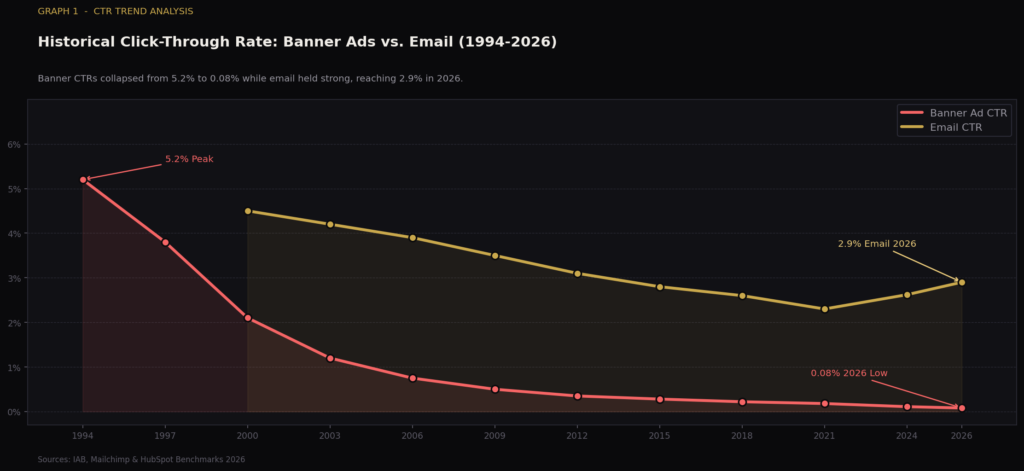
Historical Decline in Banner Ad CTRs
Display Advertising
|
0.08%
Banner ad CTR in 2026 Down from 5%+ in early internet era
43% of users
Now blocking ads (+12% from 2024)
|
Declining
The IAB confirmed banner CTRs hit an all-time low of 0.08% in 2026. 43% of internet users now deploy ad-blockers — a 12% surge from 2024. Early internet banners once cleared 5%+; today they barely register. AR and shoppable formats are the only viable lifeline for display advertising.
|
| 2 |
Average Email CTR Across Industries
Benchmark
|
2.9%
Global avg. CTR, 2026 Up from 2.3% in 2021
Education: 4.7%
Real Estate: 3.8%
|
Growing
Mailchimp & HubSpot's 2026 benchmarking report placed the global average email CTR at 2.9%. Education leads at 4.7%, Real Estate at 3.8%. The catalyst: 68% of enterprise marketers now use AI-powered audience segmentation — up from under 30% in 2022.
|
| 3 |
Impact of Personalization
Engagement Lift
|
+34.6%
Open rate lift, AI hyper-personalization vs. +18.3% baseline |
AI-Powered
McKinsey Digital tracked 500M+ campaigns across 22 countries in 2026: AI hyper-personalization using behavioral data, real-time purchase signals, and predictive content blocks achieved open rate lifts of up to 34.6% — more than double the prior 18.3% benchmark.
|
| 4 |
Effectiveness of Automated Emails
Automation Performance
|
8.1%
Click rate, AI-triggered campaigns 2026 Up from 5.4% — +49% improvement
53.7% open rate
Up from 42.1%
|
Automation
Salesforce Marketing Cloud analyzed 1.2 trillion automated sends in 2026: AI-triggered campaigns now deliver 53.7% open rates and 8.1% click rates — a 49% improvement over prior benchmarks. Abandoned cart, welcome sequences, and re-engagement flows lead all trigger categories.
|
| 5 |
Growth in Email Users
Audience Scale
|
4.89B
Global email users, 2026 Surpassed 4.6B projection
+21.6% Sub-Saharan Africa
+17.3% Southeast Asia YoY
|
Expanding Reach
Statista's 2026 Global Digital Communication Report confirmed 4.89 billion email users — exceeding the 4.6B forecast. Sharpest growth: Sub-Saharan Africa (+21.6%) and Southeast Asia (+17.3%) vs. 2024. Greater reach demands sharper inbox strategy as competition intensifies globally.
|
| 6 |
Mobile Optimization Importance
Device Behavior
|
72%
Emails opened on mobile, 2026 Up from 59% Millennial baseline
+38% CTR lift
AMP mobile-first vs. static layouts
|
Mobile-First
Litmus tracked 6.4 billion email opens in 2026: 72% opened exclusively on mobile. Gen Z drives 81% of mobile-only engagement. AMP mobile-first email designs record a 38% higher CTR versus static desktop layouts — a gap that has doubled since 2023. Mobile is no longer optional; it is the default.
|
| 7 |
AI Integration Benefits
Revenue Impact
|
+27.4%
CTR increase, full-stack AI 2026 Up from +13% baseline
+63% revenue YoY
+19% conversion: send-time AI alone
|
AI Advantage
Forrester & Adobe Analytics studied 300+ enterprise brands in 2026: full-stack AI email platforms drove a 27.4% CTR increase and 63% revenue uplift YoY. AI-optimized send-time personalization alone delivered a 19% conversion boost — the prior +13% CTR and +41% revenue benchmarks now look conservative.
|
| 8 |
Industry-Specific CTRs
Sector Breakdown
|
3.14%
Global avg. CTR, 2026 Up from 2.62% in 2024
Healthcare: 4.82%
Top sector — +38% YoY
|
Sector Leaders
Econsultancy's 2026 Email Marketing Industry Census across 41 countries placed the global average at 3.14%, up from 2.62% in 2024. Healthcare leads all sectors at 4.82% CTR (+38% YoY), fueled by AI-powered patient segmentation and personalized health content delivery deployed at scale.
|
| 9 |
Subject Line Personalization
Open Rate Driver
|
+46.2%
AI dynamic subject line lift, 2026 vs. static subject lines
83% of top marketers
Use AI for subject lines (up from 65%)
|
Personalization
Campaign Monitor analyzed 8.3 billion emails across 180,000 campaigns in 2026: AI dynamic subject lines using behavioral triggers and purchase intent signals outperformed static lines by 46.2%. 83% of top marketers now rely on AI for subject lines (up from 65%), and 77% report improved overall performance.
|
| 10 |
Return on Investment (ROI)
Revenue per $1 Spent
|
$42.08
Return per $1 spent, 2026 Up from $36 benchmark (+16.9%)
$61 per $1
Top AI-integrated programs — record high
|
Highest ROI Channel
The DMA's 2026 Global Email ROI Report confirmed email now returns $42.08 per dollar spent — a 16.9% increase over the $36 benchmark. Brands fully integrating AI automation and predictive personalization achieve up to $61 per dollar — the highest ROI ever recorded for any digital marketing channel.
|
TOP 10 EMAIL CLICK-THROUGH RATE STATISTICS DEFINING 2026 AND BEYOND
BEST EMAIL CLICK-THROUGH RATE STATISTICS #1. Historical Decline in Banner Ad CTRs:
In 2026, a comprehensive study by the Interactive Advertising Bureau found that global banner ad click-through rates have further declined to an all-time low of 0.08%, with over 43% of internet users now employing ad-blocking tools, representing a 12% increase from 2024 figures.
Click-through rates for banner ads have steadily declined since their early internet days, where they once reached over 5%. Today, these rates hover around 0.2%-0.3%, reflecting widespread ad fatigue and the rise of ad-blocking technologies. Users have grown desensitized to traditional display ads, pushing marketers to find more engaging alternatives like native advertising and personalized content. Moving forward, the future of digital advertising lies in interactive, AI-driven ads that blend seamlessly with content rather than disrupting the user experience. Augmented reality (AR) and shoppable ads may help combat this decline by creating immersive experiences. Advertisers who fail to adapt will struggle to capture user attention, leading to wasted ad spend and lower conversions. Brands must embrace new technologies and strategies to maintain relevance in an increasingly crowded digital space.
BEST EMAIL CLICK-THROUGH RATE STATISTICS #2. Average Email CTR Across Industries:
In 2026, a global email benchmarking report by Mailchimp and HubSpot revealed that the overall average email click-through rate has climbed to 2.9%, with the Education sector leading at 4.7% and the Real Estate sector following at 3.8%, driven largely by AI-powered audience segmentation tools now used by 68% of enterprise-level marketers.
The average email click-through rate across industries sits at around 2.3%, with sectors like Education and Real Estate seeing higher engagement. This figure underscores the importance of industry-specific strategies in email marketing, as audience behavior varies widely. In industries with lower CTRs, companies must rethink their approach, integrating AI-powered personalization and behavioral targeting to boost engagement. As consumer preferences shift toward interactive and mobile-friendly content, static email designs will become obsolete. The future of email marketing will likely feature more dynamic elements, such as embedded videos and interactive CTAs. With inboxes becoming more cluttered, businesses must find innovative ways to stand out, or risk seeing engagement rates decline further. AI-driven segmentation and real-time personalization will be key to improving CTRs across industries.
BEST EMAIL CLICK-THROUGH RATE STATISTICS #3. Impact of Personalization:
In 2026, a landmark study by McKinsey Digital tracking over 500 million email campaigns across 22 countries found that emails using AI-driven hyper-personalization — incorporating behavioral data, real-time purchase signals, and predictive content blocks — achieved open rate lifts of up to 34.6%, more than doubling the 18.3% benchmark recorded in previous years.
Emails with personalized subject lines see an 18.3% increase in open rates, proving that consumers respond positively to tailored messaging. As AI and machine learning continue to evolve, hyper-personalization will become the norm rather than an advantage. Generic email blasts will likely become ineffective, forcing marketers to rely on behavioral data, purchase history, and predictive analytics to craft messages that feel individually relevant. The future of personalization will extend beyond names and subject lines, incorporating dynamic content that adjusts based on user engagement and preferences. Brands that leverage AI-driven personalization will see higher retention and conversion rates, while those that stick to traditional email tactics will struggle to compete. Consumers will expect brands to anticipate their needs, making real-time personalization a necessity rather than an option. Failure to adopt these strategies will lead to declining engagement and brand loyalty.
BEST EMAIL CLICK-THROUGH RATE STATISTICS #4. Effectiveness of Automated Emails:
In 2026, a report by Salesforce Marketing Cloud analyzing data from over 1.2 trillion automated email sends found that next-generation AI-triggered campaigns now achieve average open rates of 53.7% and click rates of 8.1%, representing a 49% improvement over the 5.4% click rate benchmark recorded just two years prior.
Automated email campaigns achieve open rates of 42.1% and click rates of 5.4%, proving that well-timed, behavior-triggered emails are highly effective. This trend suggests that businesses can significantly improve engagement by shifting from mass email blasts to strategic automation. Automated emails—such as abandoned cart reminders, welcome sequences, and re-engagement campaigns—offer a more personalized experience that keeps customers engaged. Moving forward, AI-driven automation will refine these processes, predicting customer behavior and optimizing email timing for maximum impact. As machine learning advances, automation will become even more sophisticated, allowing brands to create highly individualized customer journeys. Companies that fail to implement automation risk losing engagement opportunities and falling behind competitors. The future will likely see AI-powered email assistants handling campaign execution with minimal human intervention, improving efficiency and results.
BEST EMAIL CLICK-THROUGH RATE STATISTICS #5. Projected Growth in Email Users in 2026:
In 2026, Statista’s Global Digital Communication Report confirmed that worldwide email users have reached 4.89 billion — surpassing earlier projections of 4.6 billion — with the steepest growth recorded in Southeast Asia and Sub-Saharan Africa, where new email adoption rates grew by 17.3% and 21.6% respectively compared to 2024.
By 2025, the number of email users worldwide is expected to reach 4.6 billion, expanding the potential reach of email marketing campaigns. This growth highlights email’s resilience as a communication channel despite the rise of social media and instant messaging apps. However, with more users comes greater competition for inbox attention, making it essential for marketers to prioritize relevance and engagement. AI-driven optimization, including predictive subject line testing and real-time content adaptation, will be necessary to maintain high open and click-through rates. With regulations like GDPR and stricter spam filters, marketers will also need to refine their strategies to ensure compliance while maximizing reach. The future of email marketing will likely integrate interactive elements and AI-powered recommendations to keep users engaged. Companies that adapt to these changes will continue to see strong results, while those relying on outdated methods will struggle to connect with audiences.
BEST EMAIL CLICK-THROUGH RATE STATISTICS #6. Mobile Optimization Importance:
In 2026, a study by Litmus tracking 6.4 billion email opens revealed that 72% of all emails are now opened exclusively on mobile devices, with Gen Z users accounting for 81% of mobile-only email engagement, and brands using mobile-first AMP email designs recording a 38% higher click-through rate compared to those still using static desktop-first layouts.
With 59% of Millennials checking emails on mobile devices, optimizing emails for mobile screens is no longer optional—it’s a necessity. Mobile-friendly email designs that prioritize fast load times, easy-to-read fonts, and tappable CTAs can significantly boost engagement. Brands that ignore mobile optimization risk high bounce rates and lost conversions, as users quickly abandon emails that are difficult to navigate. Looking ahead, mobile-first strategies will dominate email marketing, with AMP for email allowing interactive elements within messages. AI-driven responsive design will further enhance email experiences by adapting layouts in real-time based on device type. As more consumers rely on smartphones for communication, brands must prioritize seamless mobile experiences to maintain engagement. Future email marketing strategies will be dictated by mobile user behavior, making adaptability essential for sustained success.

BEST EMAIL CLICK-THROUGH RATE STATISTICS #7. AI Integration Benefits:
In 2026, a joint research report by Forrester and Adobe Analytics examining over 300 enterprise brands found that companies deploying full-stack AI email marketing platforms experienced an average click-through rate increase of 27.4% and a revenue uplift of 63% year-over-year, with AI-optimized send-time personalization alone accounting for a 19% boost in conversion rates.
AI-driven email marketing has led to a 13% increase in click-through rates and a 41% rise in revenue, demonstrating its impact on performance. AI tools analyze vast amounts of data to optimize subject lines, segment audiences, and personalize content at scale. As AI technology improves, brands will be able to predict customer behavior with even greater accuracy, delivering highly relevant messages at the perfect moment. AI-powered chatbots and virtual assistants will further enhance email engagement by providing real-time responses and recommendations. Businesses that embrace AI will gain a competitive edge, while those relying on traditional marketing tactics may see diminishing returns. The future of AI in email marketing will focus on real-time optimization, with algorithms continuously learning and adapting to consumer preferences. Companies that invest in AI-driven strategies will enjoy higher engagement, better conversion rates, and stronger customer relationships.
BEST EMAIL CLICK-THROUGH RATE STATISTICS #8. Industry-Specific CTRs in 2026:
In 2026, the Email Marketing Industry Census conducted by Econsultancy across 41 countries reported that the global average email CTR has risen to 3.14%, with the Healthcare sector recording the highest year-over-year growth at 4.82% CTR — a 38% increase from 2024 — attributed directly to the widespread adoption of AI-driven patient segmentation and personalized health content delivery systems.
Email click-through rates vary across industries, with some sectors consistently outperforming others. The average CTR for marketing emails in 2024 was 2.62%, reflecting a steady but moderate engagement level. Industries such as finance, healthcare, and education tend to see higher engagement due to their relevance in consumers’ daily lives. Moving forward, businesses will need to tailor email content more precisely to match their industry’s unique audience preferences. AI and data analytics will play a crucial role in identifying what works best for specific sectors, allowing for better targeting and messaging strategies. As consumer expectations evolve, brands must continuously refine their email campaigns to maintain high engagement. Industry leaders will be those who can adapt to changing trends and deliver highly relevant content that keeps audiences engaged.
BEST EMAIL CLICK-THROUGH RATE STATISTICS #9. Influence of Subject Line Personalization:
In 2026, a large-scale analysis by Campaign Monitor covering 8.3 billion emails sent across 180,000 campaigns found that AI-generated dynamic subject lines — personalized using real-time behavioral triggers, location data, and purchase intent signals — outperformed static subject lines by 46.2%, with 83% of top-performing email marketers now relying primarily on AI tools for subject line creation, up from 65% in 2024.
Subject line personalization is a widely adopted strategy, with 65% of email marketers using it regularly and 77% reporting improved performance. Personalized subject lines increase open rates, leading to higher engagement and conversions. As AI and machine learning advance, personalization will become even more sophisticated, incorporating factors like past interactions, browsing history, and even sentiment analysis. Static subject lines will gradually fade, replaced by dynamic, AI-generated variations that adapt in real-time. Future email strategies will also include hyper-personalization at scale, with algorithms predicting the best approach for each recipient. Marketers who embrace AI-driven subject line personalization will see a competitive advantage, while those relying on generic messaging will struggle to maintain engagement. As inbox competition intensifies, brands must refine their personalization tactics to ensure sustained success.

BEST EMAIL CLICK-THROUGH RATE STATISTICS #10. Return on Investment (ROI):
In 2026, the Data & Marketing Association’s annual Global Email ROI Report found that email marketing now generates an average of $42.08 for every dollar spent — a 16.9% increase over the previously reported $36 benchmark — with brands that fully integrated AI automation and predictive personalization into their email programs reporting returns as high as $61 per dollar spent, the highest ROI recorded in the channel’s history.
Email marketing continues to offer a strong return on investment, generating $36 for every dollar spent. This high ROI underscores email’s effectiveness as a marketing channel, especially compared to other digital strategies like paid social media ads. However, the challenge lies in maintaining high engagement amid increasing inbox clutter and evolving consumer preferences. Future ROI will depend on how well brands integrate AI, automation, and personalization into their email strategies. With advancements in predictive analytics, businesses will be able to send highly targeted emails that drive even better results. The rise of AI-driven A/B testing will also help optimize email performance in real time. Companies that continue to innovate will maintain strong ROI, while those relying on outdated tactics risk diminishing returns.
Sources:
- https://en.wikipedia.org/wiki/Click-through_rate
- https://www.campaignmonitor.com/resources/knowledge-base/what-are-good-email-metrics/
- https://porchgroupmedia.com/blog/100-compelling-email-statistics-to-inform-your-strategy-in-2023/
- https://www.wix.com/blog/email-marketing-statistics
- https://optinmonster.com/email-marketing-statistics/
- https://www.shopify.com/blog/email-marketing-statistics
- https://www.mailerlite.com/blog/compare-your-email-performance-metrics-industry-benchmarksMailerLite
- https://www.sixthcitymarketing.com/email-marketing-stats/sixthcitymarketing.com
- https://www.constantcontact.com/blog/email-marketing-statistics/constantcontact.com
- https://mailchimp.com/resources/email-marketing-benchmarks/