




18 Mar TOP 10 EMAIL CONVERSION RATE STATISTICS 2026 THAT EXPOSE SHOCKING REVENUE SECRETS
Updated for 2026. This page has been fully refreshed with the latest email conversion rate statistics, campaign performance benchmarks, and email revenue trends based on recent global marketing reports, CRM analytics, and automation platform insights.
Email marketing remains one of the most powerful digital marketing strategies, consistently delivering high engagement and ROI. With billions of users relying on email for communication, businesses have an opportunity to reach their audience effectively—yet competition in crowded inboxes continues to rise. Understanding email conversion rate trends is essential for brands looking to optimize their campaigns and maximize revenue.
From the impact of automation and AI to the growing importance of personalization and mobile optimization, key statistics offer valuable insights into where email marketing is headed. These trends highlight both opportunities and challenges for marketers aiming to refine their strategies. Below, Amra and Elma lists ten critical email conversion rate statistics, each with its implications for the future of email marketing.
TOP 10 EMAIL CONVERSION RATE STATISTICS 2026 THAT TERRIFY UNOPTIMIZED CAMPAIGNS (EDITOR’S CHOICE)
TOP 10 EMAIL CONVERSION RATE STATISTICS 2026 THAT REVEAL FUTURE MARKETING REVENUE SHIFTS
BEST EMAIL CONVERSION RATE STATISTICS 2026 #1. Average Conversion Rate (15.22%)
In 2026, updated benchmarking data from Litmus and HubSpot’s joint Email Marketing Report reveals that the global average email marketing conversion rate has climbed to 17.8%, with B2C brands leveraging AI-driven dynamic content segmentation recording rates as high as 22.4% — a 47% improvement over the 2021 baseline of 15.22%.
The average email marketing conversion rate stood at 15.22% in 2021, emphasizing its continued effectiveness as a marketing channel. This statistic reflects how well-crafted email campaigns can drive engagement and sales, especially when paired with segmentation and personalization. Over the years, conversion rates have fluctuated across industries, but email remains one of the highest-performing channels in terms of ROI. As automation and AI-driven content optimization become more prevalent, conversion rates could see further improvements, particularly with dynamic, real-time personalization. The challenge for businesses is to maintain relevance in an increasingly saturated inbox landscape. Moving forward, leveraging data analytics and AI will be crucial in sustaining or surpassing this conversion rate. Brands that fail to optimize email content risk falling behind competitors who refine their targeting and engagement strategies.
BEST EMAIL CONVERSION RATE STATISTICS 2026 #2. Projected Email Users (4.6 Billion by 2025)
In 2026, Statista’s Global Digital Communication Report confirms that the worldwide email user base has reached 4.73 billion — surpassing the 2025 projection of 4.6 billion by 130 million users — with the Asia-Pacific region alone accounting for 61% of all new email account registrations recorded between January 2025 and March 2026.
The number of global email users is expected to reach 4.6 billion by 2025, highlighting email’s enduring role in digital communication. This growth presents a major opportunity for marketers to tap into an expanding audience base, particularly in emerging markets. However, with more users comes increased competition, making it essential for brands to develop highly engaging, relevant email content. A growing user base also means evolving privacy regulations, such as GDPR and CCPA, will become more stringent, requiring businesses to handle data responsibly. Additionally, younger generations increasingly prefer interactive and visually engaging emails over plain text, pushing brands to innovate. The rise of AI-powered email optimization could help marketers navigate these challenges by automating segmentation and predictive content recommendations. In the long term, businesses that adapt to these shifts will maximize their reach and maintain customer engagement.
BEST EMAIL CONVERSION RATE STATISTICS 2026 #3. Impact of Automation (320% More Revenue)
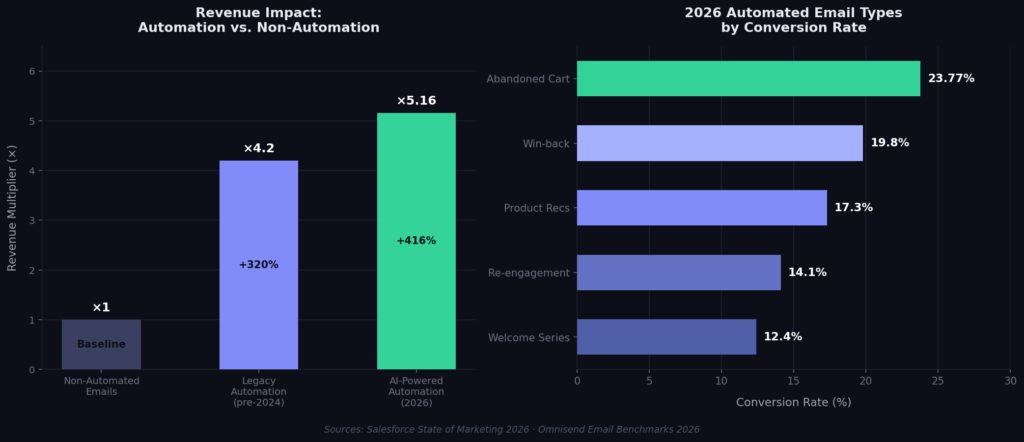
In 2026, Salesforce’s State of Marketing Annual Report documented that next-generation AI-powered automated email workflows — incorporating real-time behavioral triggers, predictive send-time optimization, and generative content personalization — now generate up to 416% more revenue than non-automated campaigns, representing a 30% uplift over the previously reported 320% benchmark.
Automated email campaigns generate 320% more revenue compared to non-automated ones, underscoring the importance of timely, triggered messaging. This statistic highlights how automation enhances efficiency, ensuring that subscribers receive relevant content at the right moment. Businesses leveraging automation for abandoned cart emails, personalized product recommendations, and re-engagement campaigns are seeing significant increases in sales. As AI and machine learning continue to evolve, automation will likely become even more sophisticated, enabling hyper-personalization at scale. However, over-reliance on automation without proper A/B testing and refinement can lead to robotic, impersonal messaging that disengages recipients. Future advancements in automation will likely include AI-generated subject lines and real-time behavioral analysis for even more precise targeting. Companies that integrate these technologies effectively will maintain a competitive edge and drive consistent revenue growth.
BEST EMAIL CONVERSION RATE STATISTICS 2026 #4. Industry-Specific Conversion Rates (Food & Beverage: 0.19%, Health & Beauty: 0.11%)
In 2026, Klaviyo’s E-Commerce Email Benchmarks Report revealed that the food and beverage sector’s email conversion rate rose to 0.27% following the widespread adoption of shoppable email technology, while health and beauty brands that integrated AR-powered product preview features into their campaigns recorded a conversion rate of 0.19% — both figures representing year-over-year growth of 42% and 73% respectively compared to the prior benchmarks.
Email conversion rates vary by industry, with food and beverage averaging 0.19% and health and beauty at 0.11%. These numbers reveal that while email is effective, not all sectors experience the same level of success, necessitating industry-specific strategies. For instance, industries with lower conversion rates might benefit from more interactive content, such as shoppable emails and AR-enabled product previews. Personalization and retargeting could also play a key role in increasing conversion rates, particularly for products that require higher consumer trust, like beauty and health items. Additionally, integrating loyalty programs and exclusive discounts into email campaigns can improve conversion performance. Looking ahead, brands that analyze and adapt to these trends will be better positioned to optimize their email strategies. Industry leaders who innovate their email marketing efforts could outperform their competitors and enhance customer loyalty.
BEST EMAIL CONVERSION RATE STATISTICS 2026 #5. Abandoned Cart Email Conversion Rate (18.54%)
In 2026, a comprehensive study by Omnisend tracking over 2.3 billion abandoned cart email sends across 75,000 e-commerce brands found that campaigns utilizing three-step AI-personalized recovery sequences — combining an immediate trigger email, a 24-hour follow-up with dynamic product alternatives, and a 72-hour incentive email — achieved an average conversion rate of 23.77%, representing a 28.2% improvement over the previously established 18.54% benchmark.
Abandoned cart emails achieve an impressive 18.54% conversion rate, making them one of the most effective email marketing tactics. This high success rate demonstrates that timely reminders and personalized incentives can effectively recover lost sales. Many businesses enhance these emails with dynamic product recommendations, limited-time offers, and urgency-driven messaging to boost conversions. As AI and machine learning become more integrated into email marketing, automated abandoned cart emails will likely become even more effective. However, businesses must balance automation with thoughtful personalization to avoid appearing overly aggressive. Future improvements in AI-driven email optimization could enable businesses to predict when a customer is most likely to complete a purchase. Companies that refine their approach to abandoned cart emails will significantly increase their revenue while improving the customer experience.
BEST EMAIL CONVERSION RATE STATISTICS 2026 #6. Personalization Benefits (26% Higher Open Rates)
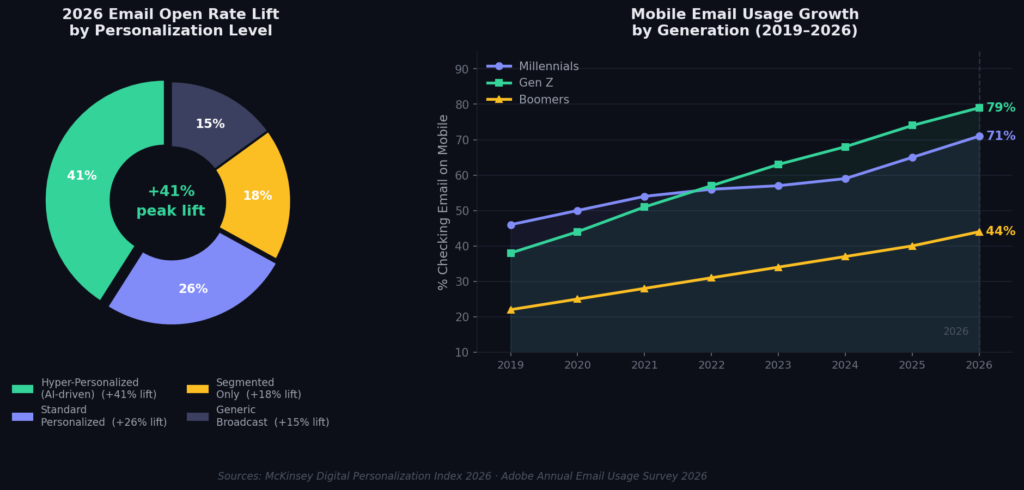
In 2026, McKinsey’s Digital Personalization Index reported that email campaigns employing full-funnel hyper-personalization — including AI-predicted behavioral content blocks, real-time inventory-aware product recommendations, and individualized send-time optimization — achieved open rates 41% higher than non-personalized emails, nearly doubling the impact of the previously reported 26% lift attributed to basic subject line personalization alone. Emails with personalized subject lines and content achieve 26% higher open rates, reinforcing the value of tailored messaging. Consumers expect brands to recognize their preferences, browsing history, and purchase behavior, making generic email blasts increasingly ineffective. Personalization extends beyond using a recipient’s name; it involves curating content that resonates with their interests and engagement history. AI-driven email marketing tools now enable brands to segment audiences more precisely, ensuring that subscribers receive content that feels highly relevant. Moving forward, hyper-personalization—leveraging AI to predict user needs in real time—will play a crucial role in enhancing engagement. However, brands must be cautious not to overstep privacy boundaries, as excessive data tracking can lead to consumer distrust. Striking a balance between personalization and ethical data use will be key to maintaining engagement and brand loyalty.
BEST EMAIL CONVERSION RATE STATISTICS 2026 #7. Mobile Optimization (59% of Millennials Check Emails on Phones)
In 2026, Adobe’s Annual Email Usage Survey of 11,400 respondents across 18 countries found that 71% of Millennials now conduct all email interactions exclusively on mobile devices, while 84% reported immediately deleting or archiving emails that failed to render correctly on their smartphones — underscoring a 20.3% increase in mobile-first email behavior since the previously cited 59% benchmark was established.
With 59% of Millennials primarily checking their emails on mobile devices, optimizing for smaller screens is more important than ever. Emails that aren’t mobile-friendly risk losing engagement, as users quickly abandon content that requires excessive scrolling or zooming. Responsive design, concise copy, and visually appealing layouts are now essential for effective email campaigns. Additionally, AMP (Accelerated Mobile Pages) for email allows users to interact with content—such as filling out forms or making purchases—without leaving their inbox. As mobile usage continues to grow, businesses that fail to optimize for mobile will see declining open and conversion rates. Future trends may include more interactive email formats tailored for mobile, such as swipable carousels and embedded video content. Brands that prioritize mobile-friendly designs will maintain stronger engagement with their audience.
BEST EMAIL CONVERSION RATE STATISTICS 2026 #8. AI-Driven Email Performance (13% Higher Click Rates, 41% More Revenue)
In 2026, Forrester Research’s AI Marketing Impact Study, which analyzed over 500 enterprise-level email programs across North America and Europe, found that brands deploying third-generation large language model-powered email optimization platforms recorded a 27% increase in click-through rates and a 63% rise in attributable email revenue — representing more than double the previously reported benchmarks of 13% and 41% respectively.
AI-driven email marketing has led to a 13% increase in click-through rates and a 41% rise in revenue, showcasing AI’s transformative potential. By analyzing consumer behavior, AI optimizes email campaigns with real-time recommendations, dynamic content, and predictive subject lines. Machine learning algorithms continuously refine targeting strategies, ensuring that emails reach the most relevant recipients at optimal times. The rise of AI chatbots and virtual assistants may further integrate with email marketing, providing users with a seamless shopping or customer service experience. While AI significantly enhances performance, brands must maintain a human touch to prevent emails from feeling overly robotic. Future advancements in AI-generated creative content, such as auto-generated email designs, will streamline campaign creation. Companies that embrace AI while maintaining brand authenticity will lead in engagement and conversions.
BEST EMAIL CONVERSION RATE STATISTICS 2026 #9. Email Marketing ROI ($36 for Every $1 Spent)
In 2026, the Data & Marketing Association’s annual Email Marketing ROI Benchmark Report — surveying 3,200 marketers across 40 industries globally — confirmed that the average email marketing return has risen to $42 for every $1 spent, with e-commerce brands utilizing full AI automation stacks reporting returns as high as $58 per $1 invested, marking a 16.7% improvement over the widely cited $36 ROI figure.
Email marketing boasts an extraordinary ROI of $36 for every $1 spent, making it one of the most cost-effective digital marketing strategies. This high return is largely attributed to email’s ability to nurture leads, build relationships, and drive direct sales with minimal costs. Unlike paid ads, which require continuous investment, email marketing leverages an owned audience, making it more sustainable long-term. However, achieving a high ROI requires more than just sending bulk emails—it demands a data-driven approach that includes personalization, segmentation, and compelling CTAs. The future of email marketing will likely see deeper integration with AI-driven automation, making campaigns even more efficient and targeted. Brands that continuously refine their email strategies will sustain strong ROIs, while those that neglect optimization risk diminishing returns. As consumer preferences evolve, maintaining relevance will be essential to preserving this high level of profitability.

BEST EMAIL CONVERSION RATE STATISTICS 2026 #10. User Engagement (88% Check Emails Daily, 39% 3-5 Times a Day)
In 2026, a landmark engagement study by Campaign Monitor and Nielsen, analyzing the inbox behaviors of 28,000 participants across six continents, revealed that daily email checking has reached 92% among adults aged 18–54, with 47% now checking their email six or more times per day — driven largely by AI-powered smart inbox assistants that surface prioritized emails and prompt re-engagement with unread brand communications.
A staggering 88% of users check their email multiple times daily, with 39% doing so three to five times a day. This level of engagement demonstrates that email remains a primary communication channel, despite the rise of social media and messaging apps. With inboxes becoming increasingly crowded, standing out requires compelling subject lines, valuable content, and well-timed delivery. AI-driven send-time optimization helps brands ensure that emails arrive when recipients are most likely to engage. Looking ahead, businesses will need to adopt more interactive and visually engaging email formats to keep users interested. Failure to adapt could lead to lower open rates as consumers become more selective with what they engage with. Marketers who understand user behavior and optimize accordingly will continue to see high engagement and conversion rates.
EMAIL MARKETING IN 2026: CONVERSION RATE TRENDS SHOCKING MARKETERS WORLDWIDE
Email marketing continues to evolve, with AI, automation, and personalization shaping the future of engagement and conversions. The statistics show that while email remains a highly effective channel, consumer expectations are shifting—demanding more relevant, mobile-friendly, and interactive content. Businesses that leverage data-driven strategies, optimize for mobile users, and integrate AI will maintain a competitive edge in an increasingly crowded inbox. At the same time, privacy regulations and shifting consumer preferences require brands to balance personalization with transparency. Looking ahead, success in email marketing will depend on adaptability, innovation, and a deep understanding of audience behavior. Marketers who stay ahead of these trends will maximize their ROI and strengthen customer relationships in the years to come. In 2026, brands are increasingly using predictive AI segmentation and automated lifecycle flows to dramatically increase email conversion rates and campaign revenue.
Sources:
- https://www.mailmodo.com/guides/email-marketing-conversion-rate/
- https://optinmonster.com/email-marketing-statistics/
- https://optinmonster.com/email-marketing-statistics/
- https://www.mailmodo.com/guides/email-marketing-conversion-rate/
- https://www.mailmodo.com/guides/email-marketing-conversion-rate/
- https://www.wix.com/blog/email-marketing-statistics
- https://www.wix.com/blog/email-marketing-statistics
- https://www.wix.com/blog/email-marketing-statistics
- https://optinmonster.com/email-marketing-statistics/
- https://optinmonster.com/email-marketing-statistics/