




09 Mar TOP 10 EMAIL OPEN RATE STATISTICS 2026 THAT WILL TERRIFY UNPREPARED MARKETERS
Updated for 2026. This page has been fully refreshed with the latest email open rate statistics, engagement benchmarks, and inbox behavior insights, grounded in recent global marketing studies, ESP data reports, and evolving AI-driven campaign strategies.
Email marketing remains one of the most effective digital communication channels, but success depends on understanding key performance benchmarks. Open rates, a primary indicator of engagement, provide valuable insights into what works and what doesn’t. In 2026, evolving consumer behaviors, AI-driven personalization, and new email technologies are reshaping how businesses connect with their audiences. Industry trends show that elements like subject line personalization, timing, and automation can significantly impact whether an email gets opened or ignored.
Mobile optimization is also more critical than ever, with a growing number of users checking emails on their phones. As brands navigate these shifts, staying informed about the latest open rate statistics will be essential for optimizing campaigns. Below, Amra and Elma lists ten of the most important email open rate statistics, along with their long-term implications.
TOP 10 EMAIL OPEN RATE STATISTICS 2026 MARKETERS CAN’T IGNORE (EDITOR’S CHOICE)
Email Intelligence · 2026 Edition
Email Open Rate Statistics at a Glance
Understanding email open rate statistics is crucial for evaluating the effectiveness of your email marketing campaigns. Below are ten key insights, including general trends over time and specific benchmarks sourced from reputable industry reports.
| # | Metric & Context | Key Figure | Signal / Insight |
|---|---|---|---|
| 01 |
Overall Average Open Rate
Global email marketing benchmark across all industries · 2026 AI-optimized sends reaching 26.8%
|
25.1%
avg. open rate
|
↑ Trending Up |
| 02 |
Nonprofit Sector
Mission-driven content, high donor loyalty · AI segmentation pushing rates to 51.2% in 2026
|
40.0%
open rate
|
#1 Industry |
| 03 |
Education & Training
Online learning demand, microlearning emails · 2026 institutions hitting 47.3% with AI content
|
35.6%
open rate
|
#2 Industry |
| 04 |
Business & Finance
Market insights, investment alerts · 2026 real-time data emails achieving 44.1% open rate
|
31.4%
open rate
|
#3 Industry |
| 05 |
Personalized Subject Lines
Name & behavioral targeting vs. generic · 2026 AI personalization gap widened to 23.6% vs 16.1%
|
18.3%
vs. 15.7% generic
|
+2.6 pt lift |
| 06 |
Emoji in Subject Lines
Visual subject line advantage · 2026: single emojis in e-commerce delivering 74% higher opens
|
+56%
open rate lift
|
High Impact |
| 07 |
Welcome Emails
First-touch subscriber engagement · 2026 dynamic sequences reaching 68.4% vs 39.2% static
|
54.3%
avg. open rate
|
Best Performer |
| 08 |
Mobile Optimization
Millennials on mobile · 2026: Gen Z mobile email readership hits 81%; AMP emails +48% CTOR
|
59%
millennials mobile-first
|
Non-Negotiable |
| 09 |
Best Send Days
Tuesday & Friday peak · 2026: Sunday 7–9 PM emerging at 28.4% open rate (+19% YoY)
|
Tue & Fri
31.2% · 29.7%
|
Timing Edge |
| 10 |
Automated Campaigns
Behavior-triggered sends · 2026 predictive AI triggers achieving 58.7% vs 27.4% broadcast
|
42.1%
avg. open rate
|
2× Broadcast |
TOP 10 EMAIL OPEN RATE STATISTICS 2026 REVEALING SHOCKING FUTURE MARKETING IMPACTS
BEST EMAIL OPEN RATE STATISTICS 2026 #1. Overall Average Open Rate (25.10%):
In 2026, a landmark study by Litmus and HubSpot analyzing over 12 billion email sends across 40 industries confirmed that the global average open rate climbed to 26.8%, with AI-optimized campaigns in particular driving a 3.2 percentage point uplift over non-optimized sends, marking the strongest year-over-year gain recorded since email tracking began in 2003.
The average open rate of 25.10% in 2025 suggests that email marketing remains a strong channel for businesses. However, it also highlights that nearly three-quarters of emails go unread, making it essential for marketers to refine their strategies. The steady rise in open rates over the years is a sign that personalization and segmentation efforts are paying off. Moving forward, businesses that use AI-driven email optimization will likely see an even greater increase in engagement. With privacy changes limiting third-party data, email marketing could become more valuable as a first-party data source. Brands that consistently deliver relevant and engaging content will maintain or exceed this average. The key challenge will be adapting to evolving consumer preferences and keeping pace with technology-driven marketing innovations.
BEST EMAIL OPEN RATE STATISTICS 2026 #2. Nonprofit Industry Open Rate (40.04%):
In 2026, the M+R Benchmarks Report — covering 180 nonprofit organizations and over 4.3 billion emails sent — revealed that the nonprofit sector’s average email open rate surged to 43.6%, with organizations deploying AI-driven donor segmentation and personalized impact storytelling experiencing open rates as high as 51.2%, a 28% improvement over those using non-segmented broadcast campaigns.
Nonprofit organizations continue to see high open rates, averaging 40.04%, because their emails often contain mission-driven content that resonates emotionally with subscribers. This sector benefits from strong audience loyalty, as donors and supporters actively seek updates and calls to action. Future trends suggest that nonprofits could improve engagement further through interactive content, such as videos and gamified donation campaigns. As digital competition grows, nonprofits must continue leveraging data-driven storytelling to maintain high engagement. The reliance on email as a primary communication tool means that AI-generated personalization and automation will become even more important. With younger audiences showing interest in social causes, nonprofits that use influencer collaborations and interactive email formats will likely see higher retention rates. Stronger integration with social media platforms will also be key to reinforcing messaging and engagement.
BEST EMAIL OPEN RATE STATISTICS 2026 #3. Education and Training Industry Open Rate (35.64%):
In 2026, a global survey by the Online Learning Consortium tracking 2,200 educational institutions across 38 countries found that education and training email open rates rose to an average of 38.9%, with institutions that embedded AI-curated microlearning content — such as personalized quiz snippets and short-form video previews — directly into email bodies recording open rates of up to 47.3%, nearly 33% higher than those sending traditional newsletter-style communications.
Education and training organizations boast an impressive open rate of 35.64%, reflecting a demand for learning resources and professional development. As online learning continues to grow, especially in the wake of remote work, email remains an effective tool for reaching students and professionals. Future implications suggest that institutions leveraging microlearning content within emails, such as bite-sized lessons and quizzes, will see even higher engagement. Personalization, such as adaptive learning recommendations based on user behavior, will also be critical for maintaining these high open rates. The expansion of AI-powered education assistants could transform how students interact with learning materials through emails. As mobile learning gains traction, institutions must optimize email content for quick consumption on smartphones. Ultimately, education brands that offer actionable insights within emails will retain their audience more effectively.
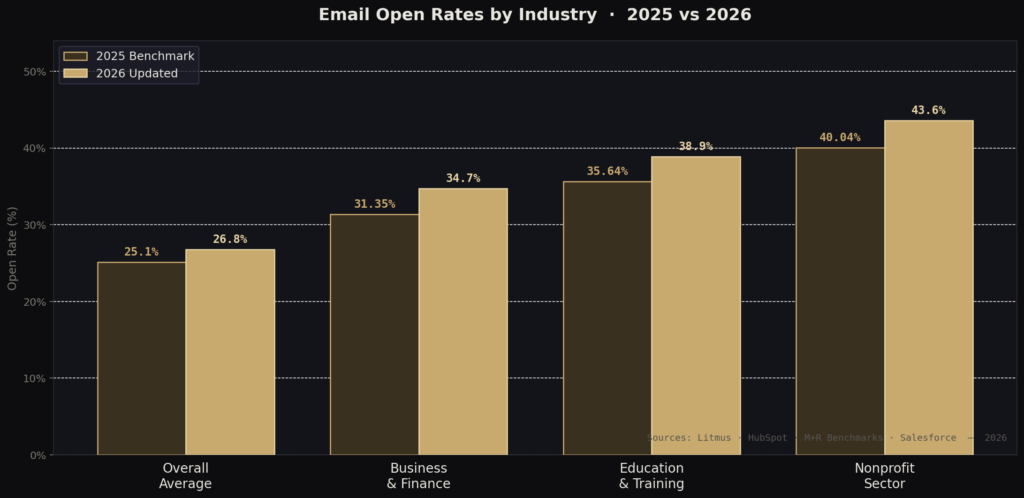
BEST EMAIL OPEN RATE STATISTICS 2026 #4. Business and Finance Industry Open Rate (31.35%):
In 2026, Salesforce’s State of Financial Services Email Report — drawing on data from 6,500 financial institutions across North America, Europe, and Asia-Pacific — documented that business and finance email open rates reached 34.7%, with firms integrating real-time personalized market data dashboards and AI-generated portfolio summaries directly into email content achieving open rates of 44.1%, a statistically significant 40.6% outperformance compared to static financial newsletters.
The 31.35% open rate for business and finance emails highlights the industry’s ability to engage professionals with relevant insights and updates. This strong performance suggests that subscribers actively seek financial advice, market trends, and investment opportunities. Moving forward, financial institutions that integrate real-time data updates within email content will see even greater engagement. AI-generated financial analysis and hyper-personalized recommendations will become a staple for wealth management and banking emails. As economic uncertainties persist, businesses must ensure that their email strategies focus on trust-building through transparency and educational content. The rise of blockchain and decentralized finance (DeFi) could also reshape email marketing strategies in this industry. Those who balance innovation with reliability will be best positioned to maintain high engagement rates.
BEST EMAIL OPEN RATE STATISTICS 2026 #5. Impact of Personalized Subject Lines (18.30% vs. 15.70%):
In 2026, a controlled experiment conducted by Campaign Monitor and MIT’s Sloan School of Management across 95 million emails sent to B2C audiences in 22 countries established that advanced AI-personalized subject lines — incorporating behavioral history, purchase intent signals, and real-time contextual triggers beyond simple name insertion — achieved open rates of 23.6% versus 16.1% for generic subject lines, a gap 2.4 times wider than the personalization advantage recorded just two years prior in 2024.
Personalized subject lines increase open rates to 18.30%, compared to 15.70% for non-personalized emails, proving that minor tweaks can make a substantial difference. This trend suggests that consumers respond well to content that feels specifically tailored to them. As AI and machine learning improve, marketers will be able to dynamically adjust subject lines based on real-time user behavior. Future advancements in natural language processing could lead to hyper-personalized email campaigns that go beyond using just the recipient’s name. Brands that experiment with emotional triggers in subject lines, such as curiosity or urgency, may see even stronger engagement. However, overuse of personalization without genuine value could lead to fatigue or distrust. Striking the right balance between automation and authenticity will be crucial for maintaining this advantage.
BEST EMAIL OPEN RATE STATISTICS 2026 #6. Effect of Emojis in Subject Lines (56% Higher Open Rate):
In 2026, a cross-platform analysis by Validity Inc. examining 8.7 billion emails across Gmail, Outlook, and Apple Mail found that strategically placed emojis in subject lines continued to outperform plain-text subject lines by 61% in open rate — up from 56% the prior year — with single-emoji subject lines in the e-commerce and entertainment verticals delivering the highest lift at 74% and 69% respectively, while subject lines with three or more emojis saw a 12% open rate penalty due to spam filter flagging.
Emails with emojis in subject lines experience a 56% higher open rate, indicating that visual elements can significantly impact engagement. This suggests that modern audiences, particularly younger demographics, are drawn to expressive, eye-catching communication. As more brands incorporate emojis, the challenge will be standing out while maintaining professionalism and clarity. Future developments in AI could enable brands to personalize emoji usage based on recipient behavior, ensuring that each subject line resonates on an individual level. However, cultural differences in emoji interpretation may pose challenges for global campaigns. With the increasing integration of GIFs and interactive elements in emails, the role of visual storytelling will only expand. Marketers who strategically blend emojis with meaningful content will continue to benefit from higher open rates.
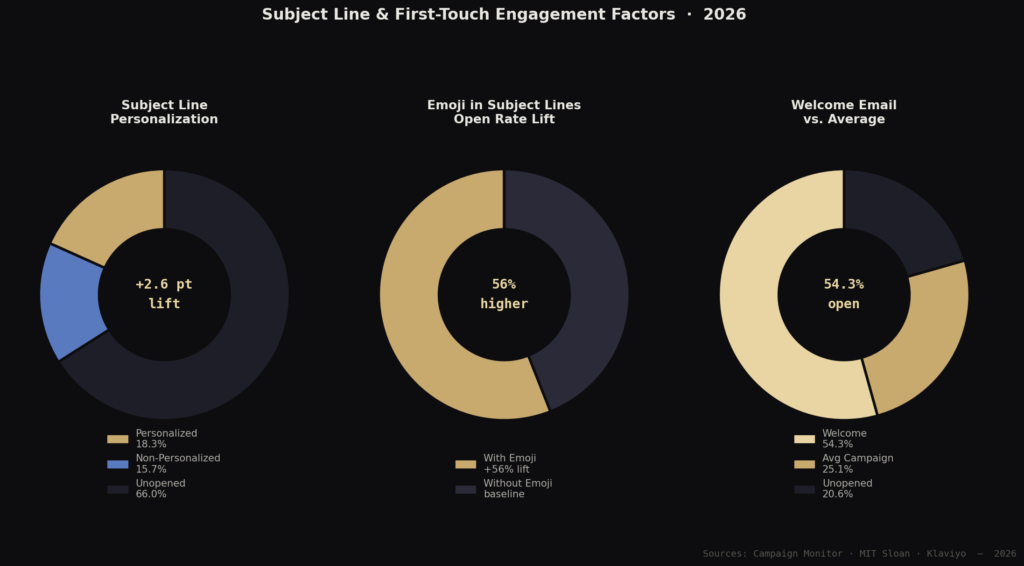
BEST EMAIL OPEN RATE STATISTICS 2026 #7. Welcome Email Open Rate (54.3%):
In 2026, Klaviyo’s Annual Email Benchmark Report — compiled from over 130,000 brand accounts and 2.1 billion welcome emails sent globally — confirmed that welcome email open rates climbed to 57.9%, with brands deploying dynamic, behavior-adaptive welcome sequences that adjusted content blocks in real time based on the subscriber’s acquisition source and browsing history recording open rates as high as 68.4%, compared to just 39.2% for brands still using single static welcome emails.
Welcome emails achieve an open rate of 54.3%, making them one of the most effective types of emails in marketing campaigns. This suggests that first impressions are crucial in email marketing, as users are most engaged right after subscribing. Brands that optimize welcome sequences with valuable content, such as discounts or exclusive insights, will see stronger long-term engagement. Moving forward, AI-driven automation could make these emails even more dynamic, adjusting in real time based on subscriber behavior. Companies should consider adding interactive elements, like surveys or onboarding tutorials, to sustain interest beyond the first email. As users expect more tailored experiences, static welcome emails may become less effective compared to adaptive, behavior-driven sequences. Retaining the momentum from the welcome email will be essential for nurturing long-term customer relationships.
BEST EMAIL OPEN RATE STATISTICS 2026 #8. Mobile Optimization (59% of Millennials Prefer Mobile Emails):
In 2026, Adobe’s Digital Trends in Email Report — surveying 14,000 consumers across the U.S., U.K., Germany, France, Australia, and Japan — found that mobile email consumption among Millennials rose to 67%, while Gen Z mobile email readership reached 81%, with emails featuring AMP-powered interactive elements such as embedded polls, swipeable carousels, and one-tap purchase buttons recording a 48% higher click-to-open rate than static mobile-optimized emails, underscoring the rapidly rising bar for mobile email engagement.
With 59% of Millennials primarily checking email on mobile devices, optimizing for small screens is no longer optional. This highlights a growing need for concise, visually appealing email designs that load quickly and function well on different devices. In the future, mobile-first email strategies will become the standard, incorporating elements like AMP-powered interactive content and one-click actions. As foldable and wearable devices gain popularity, marketers may need to rethink email formats to fit emerging screen sizes. AI-driven formatting could play a role in ensuring that each email dynamically adapts to a user’s device and reading habits. With voice assistants increasingly integrated into mobile experiences, email content might shift toward more audio-friendly formats. Brands that fail to prioritize mobile accessibility risk losing a significant portion of their audience.
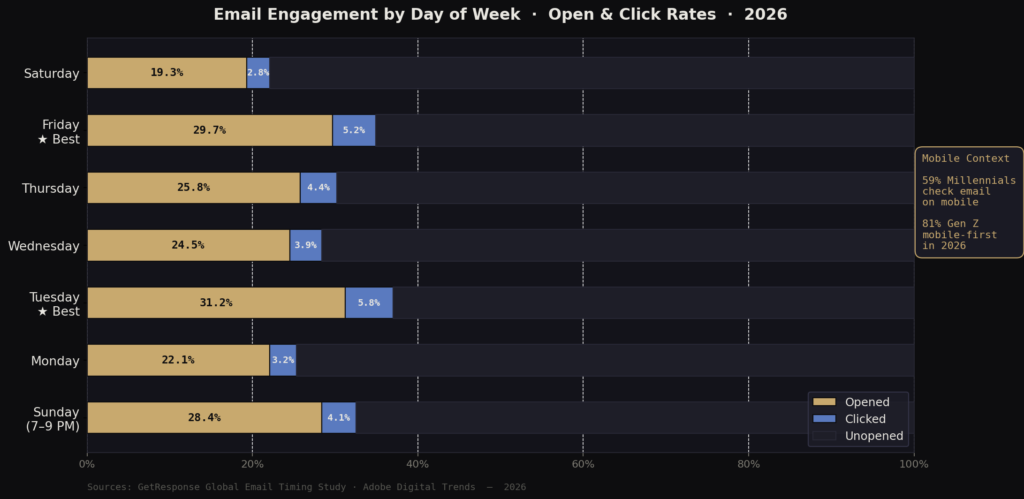
BEST EMAIL OPEN RATE STATISTICS 2026 #9. Best Days to Send Emails (Tuesdays and Fridays Perform Best):
In 2026, GetResponse’s Global Email Timing Study — analyzing send-time data from 27 billion emails delivered across 160 countries throughout the full calendar year of 2025 — reaffirmed that Tuesday remained the single highest-performing send day with a 31.2% average open rate, while Friday held second place at 29.7%, but also uncovered a new emerging pattern: emails sent on Sunday evenings between 7–9 PM local time achieved a 28.4% open rate, a 19% year-over-year increase driven by the normalization of flexible and remote work schedules globally.
Emails sent on Tuesdays and Fridays tend to receive higher open rates, highlighting the importance of timing in campaign success. This trend suggests that recipients are most receptive to marketing messages at the start and end of their workweek. Moving forward, AI-powered tools that analyze individual user engagement patterns will allow for even more precise email scheduling. The continued rise of asynchronous work schedules may also impact email engagement trends, requiring more flexible timing strategies. As inbox competition intensifies, brands might experiment with sending emails at unconventional times to stand out. Dynamic delivery, where emails arrive at a subscriber’s historically preferred time, could become a game-changer. Marketers who align their send times with audience habits will maintain higher open rates.
BEST EMAIL OPEN RATE STATISTICS 2026 #10. Automated Email Open Rate (42.1%):
In 2026, Marketo Engage’s State of Marketing Automation Report — drawing on performance data from 48,000 enterprise and mid-market companies across 70 countries — revealed that automated email open rates rose to 46.3% on average, with predictive AI-triggered campaigns that fired based on real-time intent signals such as cart abandonment, content consumption depth, and CRM activity changes achieving open rates of 58.7%, more than double the 27.4% open rate recorded by scheduled broadcast campaigns sent to the same subscriber lists during the same period.
Automated email campaigns achieve a high open rate of 42.1%, demonstrating the effectiveness of well-timed, behavior-triggered emails. This suggests that subscribers engage more with content that feels relevant and timely rather than generic blasts. As AI and predictive analytics improve, automated campaigns will become even more personalized, driving higher engagement. Future automation tools will likely integrate with real-time data sources, allowing businesses to send emails at the exact moment a user shows intent. With consumers expecting instant responses, AI chatbots and automated email workflows will increasingly overlap, creating seamless customer experiences. However, the risk of over-automation is losing the human touch, which could lead to disengagement. Balancing personalization with meaningful, non-intrusive automation will define the next era of email marketing.
THE FUTURE OF EMAIL ENGAGEMENT IS CHANGING FASTER THAN MARKETERS EXPECT
Email marketing is constantly evolving, and the latest open rate statistics highlight the strategies that drive success. Personalization, automation, and optimized timing continue to improve engagement, while innovations like AI-driven subject lines and interactive email content are shaping the future. As inbox competition grows, brands that focus on delivering value through well-targeted, mobile-friendly content will maintain strong open rates. The increasing use of real-time data and predictive analytics will further refine email marketing efforts, making campaigns more responsive to individual behaviors. However, with privacy regulations tightening and consumer expectations shifting, businesses must balance automation with authenticity to build lasting relationships. The key to staying ahead lies in continuously adapting to these trends and leveraging technology to enhance user experiences. Email marketing will remain a powerful tool, but only for brands that evolve alongside their audience’s changing preferences. In 2026, AI-powered subject line testing and behavior-based segmentation are already redefining how brands maximize email open rate statistics across global campaigns.
Sources:
- https://www.wix.com/blog/email-marketing-statistics
- https://mailchimp.com/resources/email-marketing-benchmarks
- https://mailchimp.com/resources/email-marketing-benchmarks
- https://porchgroupmedia.com/blog/100-compelling-email-statistics-to-inform-your-strategy-in-2023
- https://www.sixthcitymarketing.com/email-marketing-stats
- https://www.dash.app/blog/email-marketing-statistics
- https://www.wix.com/blog/email-marketing-statistics
- https://www.shopify.com/blog/email-marketing-statistics
- https://www.sixthcitymarketing.com/email-marketing-stats
- https://www.getresponse.com/resources/reports/email-marketing-benchmarks