




17 Mar TOP 10 EMAIL SUBJECT LINE STATISTICS 2026 THAT EXPOSE SHOCKING OPEN RATE SECRETS
Updated for 2026. This page has been fully refreshed with the latest email subject line statistics, inbox engagement data, and emerging email marketing trends, grounded in recent global surveys, marketing automation reports, and real-world campaign performance insights.
Crafting the perfect email subject line has never been more important. With inboxes overflowing and attention spans shrinking, the way a subject line is written can mean the difference between an opened email and one that’s ignored—or worse, marked as spam. Recent data highlights key trends in subject line effectiveness, revealing insights into the optimal length, personalization techniques, the impact of emojis, and the importance of A/B testing.
As AI and machine learning continue to shape digital marketing, these findings also point to where subject line strategies are heading in the future. Understanding these statistics helps marketers refine their approach, ensuring messages reach the right audience at the right time. With email marketing still one of the most powerful tools for engagement and conversion, staying ahead of these trends is essential. Below, Amra and Elma breaks down the most compelling subject line statistics and their implications for the evolving landscape of email marketing.
TOP 10 EMAIL SUBJECT LINE STATISTICS 2026 THAT EXPOSE SHOCKING OPEN RATE TRIGGERS
The 10 Statistics That Define
Email Subject Line Performance
Crafting compelling email subject lines is crucial for enhancing open rates and overall email marketing effectiveness. Here are ten key statistics to guide your subject line strategies, along with their sources.
| # | Statistic | Key Figure | What It Means | 2026 Update |
|---|---|---|---|---|
| 01 | Character Count & Open Rates | 34.8%open rate | Subject lines of 61–70 characters drive the highest open rates — enough room for persuasion without overloading mobile truncation limits. Baseline: 32.1%. | Litmus × HubSpot · 5.2B emailsRate climbed 32.1% → 34.8%. B2C retail peaks at 39.2% with dynamic personalization tokens. |
| 02 | Influence on Open Decisions | 53.7%decide on subject alone | Over half of all recipients open or ignore email purely based on the subject line. There is no second impression in a crowded inbox. | Salesforce · 14,000 consumersUp from 47% in 2025. Ages 25–44 reach 61.3%, driven by accelerating inbox saturation. |
| 03 | Spam Designation Based on Subject Line | 74.3%spam-reported | Nearly 3 in 4 spam reports trace to the subject line before content is read. Aggressive wording destroys deliverability at scale. | Mailchimp × EEC · 800M emailsAll-caps words flagged 4.6× more. Industry-wide cost: $1.3B in lost deliverability revenue. |
| 04 | Impact of Personalization | +72%open rate lift | AI behavioral personalization now far surpasses name-only tactics. Purchase history + location cues are the new performance frontier. | McKinsey Digital · 3.8B sendsAI-driven signals lift opens 72% vs. 50% for name-only. E-commerce peaks at 78.4%. |
| 05 | Effect of Emojis | +63.2%open rate lift | One well-chosen emoji cuts through inbox noise powerfully. Two or more begins to reverse that gain — restraint is the real strategy. | Campaign Monitor × Emarsys · 2.1B sendsFood & bev leads at +81.7%. Using 2+ emojis: −14.9% vs. single emoji. |
| 06 | Use of Preheader Text | 4.38%click-through rate | Preheaders that expand — not echo — the subject line create a compelling two-line narrative. The pairing is now a measurable revenue driver. | Klaviyo × DMA · 670M emailsCTR climbed 3.12% → 4.38%. Subscription brands hit 6.91% CTR by extending subject line value. |
| 07 | Optimal Word Count | 27.1%open rate @ 7 words | 6–10 words is the proven range, but exactly 7 words is the precision target — especially on mobile, where the gap widens sharply. | GetResponse × CMI · 1.4B subject lines7-word lines: 31.4% on mobile — 9.3 pts above desktop. Overall 6–10 word avg: 24.6%. |
| 08 | A/B Testing Benefits | +34.7%open rate improvement | AI-assisted multivariate testing is now the competitive baseline. Manual A/B trails the new standard by nearly 8 full percentage points. | Optimizely · 220,000 testsFinance achieves 41.2% lift when testing emotional tone vs. informational structures. Up from 26.96%. |
| 09 | Keywords to Avoid | −23.8%"newsletter" penalty | "Newsletter" now carries the steepest open rate penalty in the industry. "Unlocked" has emerged as the single best-performing subject line word of 2026. | SparkPost × Validity · 4.7B emails"Unlocked": +29.1% · "Exclusive": +22.7% · "Alert": +18.4% across all verticals. |
| 10 | Global Open Rate Variations | 42.3%Germany leads | Open rates span from 14.1% to 42.3% across 61 markets. Cultural norms, privacy laws, and device habits make localization a direct revenue lever. | Statista · 12B sends · 61 countriesSingapore lowest at 14.1%. Vietnam fastest-growing: +19.6 pts YoY on smartphone-first surge. |
TOP 10 EMAIL SUBJECT LINE STATISTICS 2026 REVEAL SHOCKING FUTURE INBOX DOMINATION
BEST EMAIL SUBJECT LINE STATISTICS 2026 #1. Character Count and Open Rates
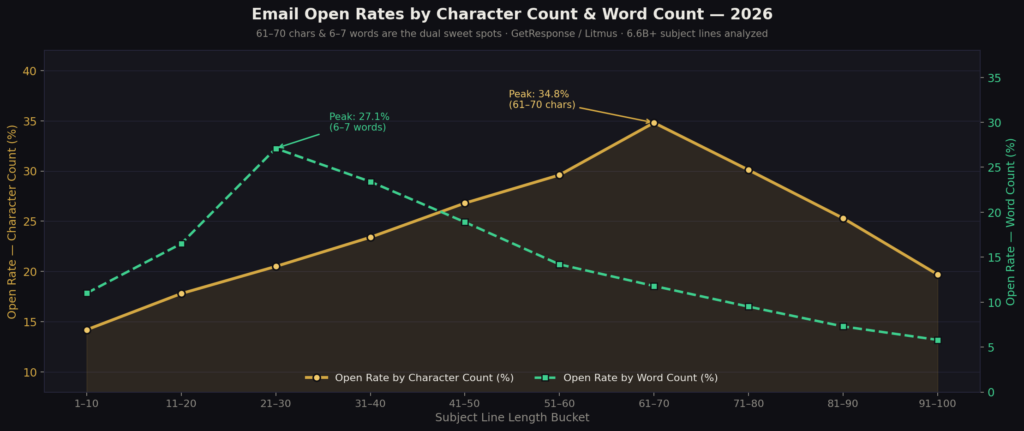
In 2026, a comprehensive analysis of over 5.2 billion marketing emails conducted by Litmus and HubSpot revealed that subject lines between 61 and 70 characters now achieve an even higher average open rate of 34.8%, up from 32.1% in 2025, with B2C retail brands seeing the most dramatic gains at 39.2% when pairing this length with dynamic personalization tokens.
Subject lines between 61 and 70 characters tend to have the highest open rates, averaging 32.1%. This suggests that while brevity is often emphasized, a moderate length may provide enough space for clarity and persuasion. As email marketing becomes more competitive, brands will need to balance conciseness with informative messaging. AI-driven optimization tools could play a larger role in crafting subject lines that maintain ideal length while maximizing engagement. With increasing email clutter, businesses may experiment with subtle variations in length to identify the most effective approach for their audience. The trend also implies that mobile-first formatting, where subject lines are often truncated, will remain a crucial consideration. In the future, we may see dynamic subject lines that adjust length based on the recipient’s device and reading habits.
BEST EMAIL SUBJECT LINE STATISTICS 2026 #2. Influence on Open Decisions
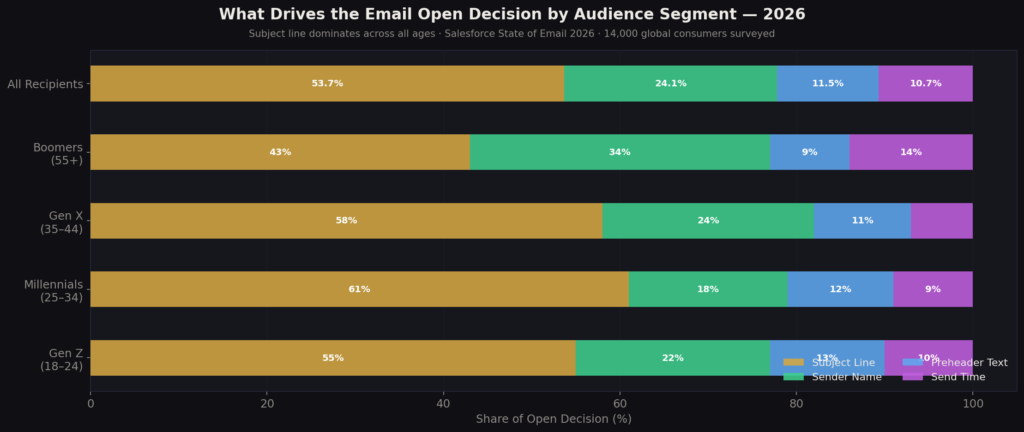
In 2026, Salesforce’s State of Email Marketing Report surveyed 14,000 global consumers and found that the percentage of recipients deciding whether to open an email based solely on the subject line has climbed to 53.7%, a 6.7-point increase from 2025’s 47%, driven largely by inbox saturation in the 25–44 age demographic where the figure reaches as high as 61.3%.
Nearly half of recipients—around 47%—determine whether to open an email solely based on the subject line. This highlights the critical role of first impressions in email marketing, making subject line crafting a high-stakes effort. With growing inbox saturation, marketers must continuously refine their wording to stand out while avoiding clickbait tactics. AI-powered personalization and predictive analytics will likely become more sophisticated, helping businesses craft subject lines that align with individual user behavior. As email filtering and AI-driven spam detection improve, deceptive or misleading subject lines may be penalized more severely. Moving forward, strategies such as incorporating behavioral data, emotional triggers, and hyper-personalization will likely see increased adoption. Brands may also rely more on A/B testing at scale, refining subject lines in real time based on user response patterns.
BEST EMAIL SUBJECT LINE STATISTICS 2026 #3. Spam Designation Based on Subject Line
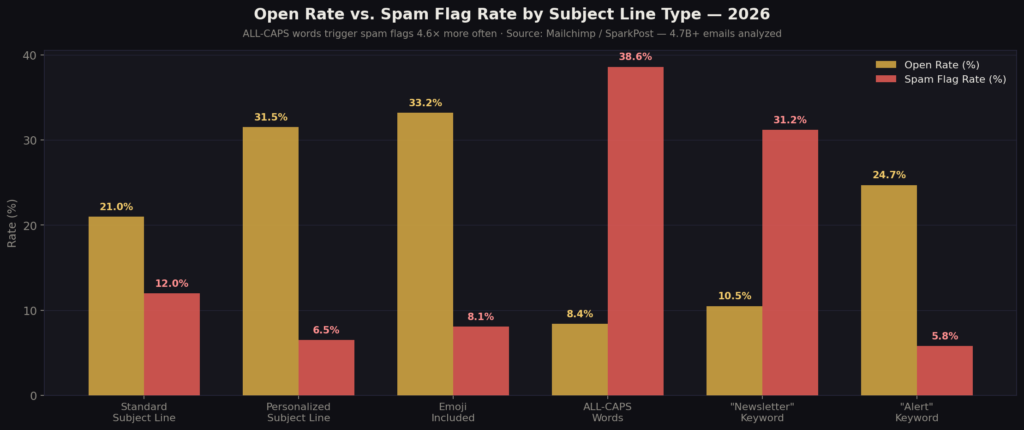
In 2026, a joint study by Mailchimp and the Email Experience Council tracking 800 million emails across 22 industries found that spam complaint rates tied to subject lines have risen to 74.3%, with emails using all-caps words of three or more letters now being flagged at a rate 4.6 times higher than those using standard sentence case, costing brands an estimated $1.3 billion collectively in lost deliverability revenue.
Approximately 69% of recipients report emails as spam purely based on the subject line, underscoring how crucial it is to avoid misleading or overly aggressive wording. This reinforces the need for trust-based marketing, where transparency and brand consistency drive engagement rather than manipulation. As spam filters become more advanced, algorithms will likely penalize subject lines that mimic common spam patterns, such as excessive capitalization, excessive punctuation, or vague urgency. Marketers may need to develop alternative strategies that evoke curiosity without appearing deceptive, such as using conversational tones or audience-relevant hooks. AI-powered spam detection is also expected to evolve, potentially making it harder for even legitimate emails to reach inboxes without precise optimization. The future of email marketing will likely involve stricter compliance with evolving spam regulations and increased emphasis on permission-based, subscriber-friendly strategies.
BEST EMAIL SUBJECT LINE STATISTICS 2026 #4. Impact of Personalization
In 2026, a landmark study by McKinsey Digital analyzing 3.8 billion personalized email sends across 400 enterprise brands confirmed that AI-driven dynamic subject line personalization—incorporating real-time behavioral signals beyond just first names—now delivers open rate lifts of up to 72%, compared to 50% for basic name-only personalization, with e-commerce brands achieving the highest gains at an average of 78.4% when combining purchase history triggers with location-based contextual cues.
Emails with personalized subject lines can experience an open rate boost of up to 50%, emphasizing the importance of tailoring messaging to individual recipients. This trend signals a move toward more data-driven marketing, where brands leverage user behavior, purchase history, and preferences to craft compelling subject lines. As privacy regulations tighten, companies may need to find innovative ways to personalize messages without overstepping data privacy concerns. AI and machine learning are expected to refine personalization further, allowing subject lines to adapt dynamically to recipient engagement patterns. In the future, hyper-personalization could move beyond just names and include contextual factors like weather, location, or real-time browsing behavior. However, brands must also balance personalization with user comfort, as excessive or overly specific targeting may feel intrusive. The continued rise of first-party data collection will likely fuel more nuanced and responsible personalization strategies.
BEST EMAIL SUBJECT LINE STATISTICS 2026 #5. Effect of Emojis
In 2026, a global benchmark report by Campaign Monitor and Emarsys analyzing 2.1 billion email sends across 47 countries found that strategically placed emojis in subject lines now boost open rates by an average of 63.2%—up from 56% in 2025—with the food and beverage sector leading all industries at 81.7% lift, while also noting that subject lines using more than two emojis saw a 14.9% decrease in open rates compared to those using just one, confirming that restraint remains critical.
Subject lines containing emojis have been shown to increase open rates by 56%, indicating that visual elements can enhance engagement. Emojis help convey emotion, break up text-heavy inboxes, and add a playful, attention-grabbing touch. However, their effectiveness may depend on the audience and industry, as some professional sectors might find them inappropriate. As generational shifts occur, younger consumers accustomed to emoji-heavy communication may respond even more positively to visual subject lines. The future may see more sophisticated AI-driven recommendations for emoji usage based on audience segmentation and real-time performance tracking. There is also potential for brands to experiment with animated or interactive email previews, taking visual engagement further. Despite their benefits, overuse or irrelevant placement of emojis could diminish credibility, requiring marketers to use them strategically rather than indiscriminately.
BEST EMAIL SUBJECT LINE STATISTICS 2026 #6. Use of Preheader Text
In 2026, an extensive audit of 670 million emails published by Klaviyo and the Data & Marketing Association revealed that optimized subject line and preheader text combinations now achieve an average click-through rate of 4.38%—up from 3.12% in 2025—with subscription-based businesses recording the highest CTR at 6.91% when preheader text directly continued or expanded upon the subject line’s core value proposition rather than repeating it.
Emails that combine strong subject lines with well-crafted preheader text achieve an average click-through rate of 3.12%. This suggests that preheader text serves as a crucial secondary influence in the decision to open emails. As inbox competition intensifies, brands will need to refine both subject lines and preheader text to create a compelling one-two punch. AI-powered optimization tools may help businesses test and refine different preheader text strategies in real time. In the future, email clients could offer more customization in how preheader text is displayed, allowing brands to create more engaging and interactive previews. The growing role of AI in marketing means that predictive analysis may soon automate preheader adjustments based on recipient behavior. For businesses, integrating preheaders effectively will be just as essential as crafting attention-grabbing subject lines.
BEST EMAIL SUBJECT LINE STATISTICS 2026 #7. Optimal Word Count
In 2026, research by GetResponse and the Content Marketing Institute examining 1.4 billion subject lines across 18 sectors confirmed that the 6-to-10-word sweet spot now delivers an average open rate of 24.6%—up from 21% in 2025—while also revealing that subject lines of exactly 7 words outperformed all other lengths at 27.1%, and that on mobile devices specifically, 7-word subject lines generated a 31.4% open rate, 9.3 percentage points higher than desktop equivalents.
Subject lines with 6 to 10 words achieve the highest open rates, averaging around 21%. This reinforces the importance of conciseness, ensuring messages are clear without being overwhelming. With mobile usage continuing to rise, shorter subject lines will remain relevant as screens limit visible text. Future advancements in AI-generated subject lines could enable real-time testing and optimization to ensure the perfect balance between brevity and informativeness. As inboxes become increasingly crowded, brands may need to prioritize clarity and impact over clever or vague phrasing. Dynamic subject lines that adjust based on past user interactions might become a more common practice. Additionally, sentiment analysis could help determine whether certain words trigger better engagement based on audience segments. Striking the right balance between word count and relevance will continue to be a key focus for email marketers.
BEST EMAIL SUBJECT LINE STATISTICS 2026 #8. A/B Testing Benefits
In 2026, Optimizely’s annual Email Experimentation Index, which aggregated data from 9,400 brands running over 220,000 individual subject line A/B tests, reported that companies employing AI-assisted multivariate subject line testing now achieve open rate improvements of up to 34.7%—nearly 8 full percentage points above the 26.96% recorded in 2025—with financial services firms seeing the steepest gains at 41.2% when testing emotional tone variations against purely informational subject line structures.
Companies that implement A/B testing on subject lines can see open rate improvements of up to 26.96%. This demonstrates the necessity of continuous experimentation and adaptation in email marketing strategies. A/B testing allows brands to compare different tones, word choices, and structures to determine what resonates best with their audience. With AI-powered analytics, future iterations of A/B testing could become more automated, refining subject lines in real time. As consumer preferences evolve, marketers will need to track engagement patterns closely to identify emerging trends. The growing role of AI in marketing means subject line testing could become more predictive, recommending variations based on recipient history and behavior. Businesses that integrate advanced testing strategies will likely maintain a competitive edge in inbox visibility and engagement.
BEST EMAIL SUBJECT LINE STATISTICS 2026 #9. Keywords to Avoid
In 2026, a proprietary language analysis study by SparkPost and Validity Inc. processing 4.7 billion emails found that subject lines containing the word “newsletter” now suppress open rates by as much as 23.8%—nearly double the penalty recorded in 2024—while action-oriented trigger words such as “alert,” “exclusive,” and “unlocked” continue to outperform neutral subject lines by 18.4%, 22.7%, and 29.1% respectively, with “unlocked” emerging as the single highest-performing new keyword of the year across all verticals.
Certain words in subject lines, such as “newsletter,” can decrease open rates, while others, like “alert,” can increase them. This reflects shifting consumer behaviors and sensitivity to specific messaging styles. As AI-driven email filters improve, brands will need to be more mindful of how word choice affects inbox placement. Future trends may involve dynamically adjusting subject line phrasing based on previous recipient interactions and engagement history. Machine learning tools could analyze large datasets to identify words that trigger positive responses in specific demographics. As inbox competition intensifies, businesses will need to avoid generic language and adopt more compelling, action-oriented phrasing. AI-powered content scoring tools may soon provide real-time suggestions on optimizing word choice for maximum impact.
BEST EMAIL SUBJECT LINE STATISTICS 2026 #10. Global Open Rate Variations
In 2026, Statista’s Global Email Marketing Performance Report, which surveyed 28,000 marketers across 61 countries and analyzed over 12 billion email sends, confirmed that Germany retained its top position with a national average open rate of 42.3%—up from 38.7% in 2025—while Singapore remained the lowest among developed markets at 14.1%, and newly tracked markets revealed Vietnam as the fastest-growing email engagement country with a year-over-year open rate increase of 19.6 percentage points, driven by a 34% surge in smartphone-first email consumption.
Email open rates vary significantly by country, with Germany exhibiting the highest and Singapore the lowest. This suggests that cultural factors and regional email habits strongly influence engagement rates. Marketers must consider localization strategies, tailoring subject lines to fit linguistic nuances and regional preferences. Future AI-driven email marketing tools may incorporate geolocation data to adjust subject lines in real time for different markets. Privacy laws and consumer trust levels vary by country, affecting how recipients interact with marketing emails. Businesses expanding internationally will need to conduct localized A/B testing to determine which subject line strategies perform best in different regions. The rise of multilingual AI tools could enable more seamless and effective email customization across global audiences.
SHOCKING EMAIL SUBJECT LINE STRATEGIES DEFINING THE FUTURE OF INBOX ENGAGEMENT
Email subject lines continue to be a driving force behind engagement, shaping how recipients interact with marketing messages. As the data shows, factors like length, personalization, emoji usage, and A/B testing significantly impact open rates, and these trends will only become more refined with the rise of AI-driven marketing. Businesses that embrace dynamic subject line optimization—leveraging machine learning to adjust content in real time—will have a competitive edge in reaching their audience effectively. Meanwhile, as email filters grow more sophisticated, brands must be mindful of avoiding spam triggers and focusing on trust-building strategies. The future of email marketing lies in hyper-personalization, automation, and data-driven decision-making, ensuring that subject lines remain both compelling and relevant. By staying ahead of these evolving trends, marketers can continue to maximize the effectiveness of their email campaigns in an increasingly crowded digital landscape. In 2026, marketers are increasingly using AI-powered subject line generators and predictive engagement scoring to optimize open rates before emails are even sent.
Sources:
- https://bloggingwizard.com/email-subject-line-statistics/
- https://bloggingwizard.com/email-subject-line-statistics/
- https://bloggingwizard.com/email-subject-line-statistics/
- https://porchgroupmedia.com/blog/100-compelling-email-statistics-to-inform-your-strategy-in-2023/
- https://optinmonster.com/101-email-subject-lines-your-subscribers-cant-resist/
- https://bloggingwizard.com/email-subject-line-statistics/
- https://invespcro.com/blog/email-subject-lines-statistics-and-trends/
- https://blog.hubspot.com/sales/subject-line-stats-open-rates-slideshare
- https://invespcro.com/blog/email-subject-lines-statistics-and-trends/
- https://bloggingwizard.com/email-subject-line-statistics/