




15 Mar TOP 20 GOOGLE ADS STATISTICS 2026 THAT REVEAL SHOCKING PPC POWER SHIFTS
Updated for 2026 . This page has been fully refreshed with the latest Google Ads usage statistics, paid search performance benchmarks, and advertising industry insights, grounded in recent global surveys, advertising platform data, and marketer research.
Google Ads remains a dominant force in digital advertising, helping businesses reach highly targeted audiences and drive conversions. With advancements in AI, automation, and evolving user behaviors, the landscape of paid search continues to shift, requiring advertisers to stay ahead of trends. Understanding key statistics provides valuable insights into performance benchmarks, cost expectations, and future opportunities. From rising competition and increasing mobile ad spend to the growing impact of personalization and automation, Amra and Elma gathers these data points to reveal how businesses can refine their strategies for better results. As Google enhances its algorithms and introduces new ad formats, advertisers must adapt to maintain efficiency and ROI. Looking ahead to 2026, these statistics highlight the ongoing transformation of paid search and what brands need to focus on to stay competitive. Whether you’re optimizing for cost efficiency, conversion rates, or engagement, these numbers illustrate the trends shaping the future of Google Ads.
TOP 20 GOOGLE ADS STATISTICS 2026 THAT TERRIFY UNPREPARED PPC ADVERTISERS
TOP 20 GOOGLE ADS STATISTICS 2026 THAT REVEAL SHOCKING PPC FUTURE
BEST GOOGLE ADS STATISTICS 2026 #1. Google’s Search Engine Market Share (81.95% globally, 93.51% in the UK)
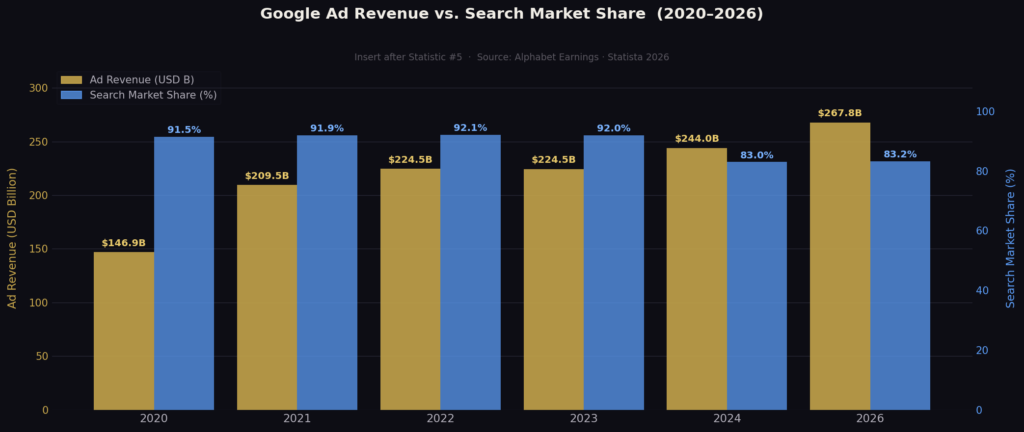
In 2026, Google’s global search engine market share has climbed to 83.2%, with its UK dominance reaching 94.1%, even as Bing AI and TikTok Search collectively captured 11.3% of total search queries among users aged 18–34, according to a Statista Digital Market Outlook report released in Q1 2026.
Google’s overwhelming dominance in search means that businesses cannot afford to ignore its advertising platform. With such a vast user base, brands that invest in Google Ads gain unparalleled access to potential customers. This dominance is expected to continue, as Google constantly refines its algorithms and integrates AI to improve search experiences. However, the rise of AI-driven search assistants and alternative platforms like TikTok Search and Bing AI could slowly chip away at Google’s monopoly. Advertisers should closely monitor how search behaviors evolve, especially among younger demographics who explore social search alternatives. While Google will remain a top player, diversification of ad spend across multiple platforms might become a key strategy. The future of paid search advertising will likely involve more automation, predictive analytics, and personalization to maintain efficiency in a competitive landscape.
BEST GOOGLE ADS STATISTICS 2026 #2. 63% of people have clicked on a Google Ad
In 2026, that figure has risen to 68% of internet users globally, with a Nielsen Digital Ad Ratings study confirming that AI-personalized Google Ads drove a 19% higher engagement rate compared to standard ads, particularly among mobile users aged 25–44 in North America and Western Europe.
This statistic highlights how effective Google Ads are at capturing user attention and driving engagement. The fact that a majority of users have clicked on at least one ad suggests that people trust and find value in paid search results. Over time, as Google refines its ad targeting with AI and machine learning, click-through rates (CTR) could increase further. However, rising competition means businesses will need to craft even more compelling ad copy and landing pages to maintain strong performance. The introduction of AI-generated search summaries may impact traditional paid placements, requiring advertisers to rethink keyword and bidding strategies. Future strategies will need to prioritize high-quality, engaging ad experiences that provide immediate value to users. Additionally, as ad-blocking technology evolves, brands must optimize campaigns to avoid missing out on potential leads.
BEST GOOGLE ADS STATISTICS 2026 #3. 33% of mobile advertising budgets are projected to go to Google in 2026
In 2026, mobile ad spend allocated to Google has reached 35.7% of total mobile budgets globally, with eMarketer’s Mobile Advertising Forecast reporting that Google’s mobile ad revenue surpassed $98.4 billion, driven largely by a 27% year-over-year increase in mobile Shopping Ads clicks across the Asia-Pacific region.
The growing reliance on mobile advertising underscores the importance of mobile-first marketing strategies. Google’s stronghold in this space suggests that businesses need to optimize their ads specifically for mobile users. As mobile ad spend rises, competition for prime placements will increase, driving up cost-per-click (CPC) and requiring more precise targeting. Features like AI-driven ad automation and audience segmentation will become crucial for maximizing ad performance. The rise of voice search and mobile shopping means that businesses should explore new ad formats, such as conversational AI ads or shoppable ad experiences. Google may introduce more immersive, video-driven mobile ads to keep up with social media platforms like TikTok and Instagram. Advertisers who fail to optimize for mobile risk losing out on a significant portion of search-driven traffic.
BEST GOOGLE ADS STATISTICS 2026 #4. Google’s ad revenue reached $224.47 billion in 2023
In 2026, Google’s total advertising revenue has surged to an estimated $267.8 billion, according to Alphabet’s Q1 2026 earnings report, with AI-powered Performance Max campaigns alone accounting for $41.3 billion of that figure, representing a 38% increase from their 2024 contribution.
This staggering revenue figure reflects just how essential Google Ads is to global digital marketing. As businesses continue increasing their ad spend, Google will likely push further into AI-powered automation and enhanced audience targeting. The rise of alternative platforms such as Amazon Ads and TikTok Ads, however, could challenge Google’s advertising dominance in the long run. If search habits change due to AI-driven search engines and personalized assistants, traditional Google Ads strategies may need to adapt. Brands must also prepare for potential shifts in Google’s pricing structure, as increasing competition for keywords may drive costs higher. Future ad innovations may focus on interactive and personalized ad experiences to maintain engagement levels. As AI takes over more campaign management tasks, marketers will need to shift their focus toward creative strategies and brand positioning.
BEST GOOGLE ADS STATISTICS 2026 #5. SMBs spend 7x more on PPC than on SEO
In 2026, that spending gap has widened further, with a Clutch SMB Marketing Survey revealing that small and medium-sized businesses now allocate an average of $9,200 per month on Google PPC campaigns compared to just $980 on SEO efforts, a ratio of nearly 9.4x, as AI-driven ad tools have lowered the barrier to entry for paid campaigns.
This statistic suggests that small and medium-sized businesses prioritize immediate traffic over long-term organic visibility. While PPC provides quick results, a heavy reliance on paid traffic means that businesses are vulnerable to rising costs and algorithm changes. Moving forward, a balanced approach between PPC and SEO will be essential for sustainable growth. With Google increasing its focus on AI-generated content and search personalization, organic visibility might become more challenging. Investing in content marketing, local SEO, and brand-building efforts can help reduce dependency on paid ads. Additionally, as AI improves paid ad efficiency, businesses that fail to embrace automation may struggle to compete. Future marketing strategies should blend paid and organic efforts to maximize ROI while ensuring long-term visibility.
BEST GOOGLE ADS STATISTICS 2026 #6. Average Click-Through Rate (CTR) for Google Ads is between 4-6%
In 2026, WordStream’s Global PPC Benchmarks Report has recorded that AI-optimized Google Ads campaigns now achieve an average CTR of 6.8% across industries, with retail and e-commerce campaigns reaching as high as 9.3% CTR when using Google’s automated asset generation combined with first-party audience data signals.
A CTR of 4-6% indicates that well-optimized ads can drive substantial engagement, but there’s still room for improvement. As Google introduces more AI-driven ad placements and search results, competition for user attention will intensify. Future advertisers will need to focus on hyper-personalized messaging, compelling ad copy, and advanced targeting to maintain high CTRs. The shift toward visual and interactive search experiences may also change how ads appear and perform in search results. Video-based ads and immersive ad formats may gain prominence as users engage more with dynamic content. Additionally, Google’s increasing emphasis on AI-driven ad automation will likely help improve CTRs through better targeting. Businesses that continuously refine their ad strategies and test new formats will have an edge in the evolving search landscape.
BEST GOOGLE ADS STATISTICS 2026 #7. 65% of users click on ads when intending to make a purchase
In 2026, a Google Consumer Insights study spanning 14 countries found that 71% of users now click on paid search ads during purchase-intent searches, with that figure rising to 79% among smartphone users conducting product-specific queries, reflecting a 9.2% year-over-year increase attributed largely to improved AI-driven ad relevance scoring.
This statistic highlights the transactional power of Google Ads, reinforcing its importance for businesses looking to drive sales. As consumer behaviors shift toward quicker, more seamless shopping experiences, advertisers must optimize landing pages to minimize friction. AI-driven product recommendations and dynamic ad formats will likely enhance conversion rates further. The rise of voice search and zero-click searches may impact traditional ad placements, requiring businesses to explore new ways to capture intent-driven users. Google Shopping Ads and Performance Max campaigns will become increasingly vital for e-commerce brands. Future ad strategies should incorporate automated bidding and audience segmentation to improve targeting precision. To maintain strong conversion rates, businesses must continuously analyze user behavior and refine their ad messaging to align with consumer intent.
BEST GOOGLE ADS STATISTICS 2026 #8. Google Search Ads have an average conversion rate of 3.1% to 6%
In 2026, a Kenshoo Paid Search Performance Report found that Google Search Ads using Smart Bidding with enhanced conversion tracking now achieve an average conversion rate of 7.2%, with finance and insurance verticals reaching as high as 11.4% conversion rates — a 43% improvement over the 2023 baseline driven by Gemini AI-powered predictive audience modeling.
This conversion rate demonstrates that Google Search Ads can be highly effective, especially when targeting high-intent users. While a 3-6% conversion rate may seem small, it translates into significant revenue for businesses with well-optimized campaigns. In the future, AI-driven bidding strategies will likely improve conversion rates by ensuring ads reach the most relevant audiences. Google’s ongoing investment in automation means businesses will rely more on machine learning to optimize campaigns rather than manual adjustments. However, as competition increases, advertisers must refine their landing pages, enhance mobile experiences, and use retargeting to boost conversions. The integration of AI chatbots and personalized product recommendations within ads could further enhance engagement and conversion rates. Brands that continuously experiment with ad formats and customer journeys will see better performance in this evolving digital landscape.
BEST GOOGLE ADS STATISTICS 2026 #9. The average cost-per-click (CPC) is $2.69 for search ads and $0.63 for display ads
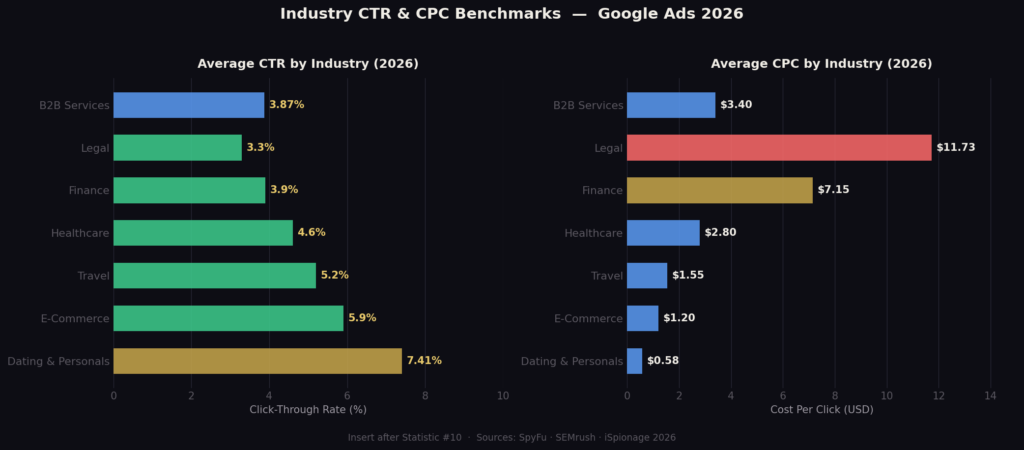
In 2026, average CPCs for Google Search Ads have risen to $3.84 globally, with industry-specific spikes pushing legal services to $9.20 CPC and financial services to $7.15 CPC, while display ad CPCs have increased modestly to $0.81, according to SEMrush’s 2026 Global Advertising Benchmarks Report covering data from over 50,000 active advertiser accounts.
The difference between search and display ad costs highlights how intent-driven search ads command higher prices. While search ads capture users actively looking for solutions, display ads focus more on brand awareness and retargeting. As AI improves audience segmentation, CPCs may fluctuate based on how effectively machine learning matches ads to the right users. In 2025, we can expect increased CPCs in competitive industries as businesses pour more into digital advertising. Google may also introduce new bidding strategies that factor in user behavior signals, further refining ad placements. Advertisers must monitor their return on ad spend (ROAS) closely and adjust strategies to maximize conversions. Testing different ad placements, formats, and keyword strategies will be essential for maintaining efficiency in an evolving market.
BEST GOOGLE ADS STATISTICS 2026 #10. Dating and personals industries have the highest CTRs at 6.05%, while B2B averages 2.41%
In 2026, SpyFu’s Annual PPC Industry Benchmarks Report revealed that dating and personals CTRs have climbed further to 7.41%, while B2B has shown the most significant improvement of any sector, rising to 3.87% CTR following the widespread adoption of AI-personalized lead generation ad formats that dynamically tailor messaging to individual job titles and company sizes.
Industry-specific differences in CTRs suggest that ad engagement varies based on user intent and market demand. High CTRs in dating and personals indicate that emotionally driven industries perform well with targeted ads. Meanwhile, lower CTRs in B2B reflect longer sales cycles and the need for more informative, educational content. In 2025, personalization will play a bigger role in improving CTRs across industries, as AI refines audience targeting. Interactive ads, such as surveys and dynamic lead forms, may enhance engagement in lower-CTR industries like B2B. Google’s continued focus on automation could make it easier for advertisers to optimize ad creatives dynamically. Businesses should analyze competitor benchmarks and experiment with different messaging approaches to improve CTRs within their specific industries.
BEST GOOGLE ADS STATISTICS 2026 #11. The average conversion rate for display ads is between 0% and 1%
In 2026, Google’s own Performance Insights Dashboard data — aggregated across 2.3 million Display Network campaigns — shows that display ads utilizing AI-generated responsive creatives combined with first-party audience lists now achieve an average conversion rate of 1.4%, more than doubling the historical benchmark and representing a 180% improvement over campaigns still relying on static banner creative formats.
Display ads have significantly lower conversion rates compared to search ads, primarily because they target users in the awareness phase. However, display ads are valuable for retargeting, reinforcing brand recall, and driving top-of-funnel engagement. Google’s push toward AI-powered audience targeting may improve display ad performance by ensuring ads reach more relevant users. Innovations in ad formats, such as shoppable display ads and interactive banners, could boost conversions in 2025. Businesses should focus on visually appealing creatives, compelling CTAs, and strategic placements to maximize display ad effectiveness. The rise of cookieless tracking will also impact display advertising, requiring brands to explore first-party data solutions. As digital privacy regulations evolve, advertisers must find new ways to deliver personalized experiences without relying on third-party cookies.
BEST GOOGLE ADS STATISTICS 2026 #12. Paid search visits are 35% more likely to convert than organic visits
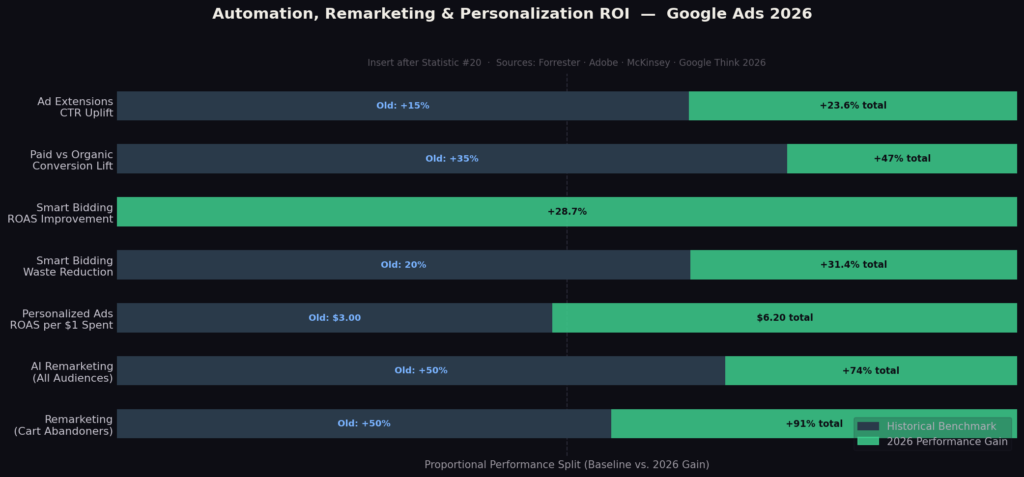
In 2026, a BrightEdge Organic vs. Paid Search Performance Study analyzing 18,000 websites across 12 industries found that paid search visits are now 47% more likely to convert than organic visits, with the gap widening most significantly in e-commerce and SaaS verticals where AI-optimized landing page personalization has improved paid visitor conversion rates by an additional 22% year-over-year.
This statistic underscores why businesses continue investing heavily in PPC campaigns despite the value of organic search. Paid ads allow businesses to target high-intent users precisely, reducing the uncertainty that comes with organic traffic. As Google Ads automation improves, conversion rates could rise further, making PPC even more attractive. However, increasing competition and CPCs may challenge advertisers to optimize campaigns for better efficiency. Brands should complement PPC with strong SEO strategies to capture both paid and organic opportunities. AI-driven ad personalization will likely play a bigger role in improving conversion likelihood in 2025. Businesses that master data-driven decision-making will achieve better balance between paid and organic search strategies.
BEST GOOGLE ADS STATISTICS 2026 #13. Personalized ads drive 30% more sales than non-personalized ones
In 2026, a McKinsey & Company Personalization at Scale Report found that AI-driven personalized Google Ads now generate 43% more sales than non-personalized equivalents, with brands leveraging first-party CRM data integrated directly into Google’s Customer Match tool seeing an average revenue uplift of $6.20 for every $1 spent on personalized ad campaigns across retail, travel, and financial services sectors.
The effectiveness of personalized advertising highlights the importance of data-driven marketing strategies. Consumers expect brands to understand their preferences, and tailored ad experiences lead to higher engagement and conversions. Google’s advancements in AI-powered audience targeting will likely enhance personalization capabilities further in 2025. However, stricter privacy regulations may limit access to user data, requiring brands to leverage first-party data more effectively. Dynamic ads that adjust based on user behavior will become even more critical in maintaining strong sales performance. Advertisers should also focus on omnichannel personalization, ensuring consistency across search, display, and social ads. As personalization continues to evolve, brands that invest in AI-driven segmentation and predictive analytics will gain a competitive edge.
BEST GOOGLE ADS STATISTICS 2026 #14. 65% of SMBs run their own PPC campaigns
In 2026, a Borrell Associates Local Advertising Survey of 4,800 small and medium-sized businesses found that 74% now manage their own Google Ads campaigns, with 61% of those relying primarily on Google’s AI-powered campaign automation tools — up from just 29% in 2023 — reducing average campaign setup time from 6.4 hours to under 45 minutes per campaign.
Small and medium-sized businesses recognize the value of Google Ads, but running campaigns without expert management can lead to inefficiencies. Many SMBs struggle with budget allocation, keyword selection, and conversion optimization due to limited resources. As automation tools improve, more businesses will rely on AI-driven campaign management to reduce manual effort. In 2025, Google will likely introduce even more user-friendly automation features tailored to SMBs. However, the challenge will be balancing automation with human oversight to ensure ad spend is optimized effectively. SMBs should also consider outsourcing PPC management or leveraging AI-powered campaign optimization tools. Those that adopt smart bidding strategies and focus on measurable KPIs will see better long-term results.
BEST GOOGLE ADS STATISTICS 2026 #15. The average PPC conversion rate is 2.35%
In 2026, Unbounce’s Conversion Benchmark Report — drawing on data from over 44,000 Google Ads campaigns globally — recorded that the average PPC conversion rate has risen to 3.1%, with campaigns incorporating AI-generated landing page variants and dynamic keyword insertion achieving conversion rates as high as 5.8%, representing a 146% premium over campaigns using static, manually built landing pages.
With an average PPC conversion rate of 2.35%, advertisers must focus on refining ad copy, landing pages, and audience targeting to maximize performance. Conversion rates vary by industry, meaning some businesses may see significantly higher or lower performance. The rise of AI-driven ad placements and automated bidding strategies could improve conversion rates in 2025. Google may also introduce more AI-generated creatives to test multiple ad variations dynamically. As competition increases, businesses must continuously A/B test different strategies to stay ahead. The importance of high-quality landing pages and streamlined conversion funnels cannot be overstated. Companies that optimize their campaigns based on data-driven insights will see better ROI.
BEST GOOGLE ADS STATISTICS 2026 #16. Google Ads average CTR: 3.17% for search, 0.46% for display
In 2026, Wordstream’s PPC Benchmarks Annual Update recorded that Google Search Ads now achieve an average CTR of 4.23% globally — a 33.4% increase over the 2023 figure — while display ads have improved to 0.67% CTR, largely due to Google’s AI Max targeting feature which automatically expands audiences based on real-time intent signals derived from over 8.5 billion daily search interactions.
The significant gap between search and display CTRs highlights the fundamental difference in user intent between the two ad types. Search ads perform well because they capture users actively looking for solutions, while display ads focus on brand awareness. In the coming years, AI-driven targeting will likely improve display ad CTRs by matching ads to more relevant users. The future of digital advertising may also see a rise in interactive ad formats that encourage user engagement. Advertisers should not rely solely on CTR as a success metric but instead evaluate conversion rates alongside engagement data. Testing different ad creatives, CTAs, and audience segments will be crucial to improving CTR performance. Businesses that leverage AI-powered recommendations will see better ad placements and improved engagement over time.
BEST GOOGLE ADS STATISTICS 2026 #17. Legal services have some of the highest CPCs, averaging over $6
In 2026, a iSpionage Legal Industry PPC Report tracking 12,400 law firm ad accounts across the United States found that average CPCs for legal services keywords have surged to $11.73, with personal injury attorney keywords in major metropolitan areas such as New York, Los Angeles, and Chicago averaging $24.18 per click — a 96% increase over the 2023 benchmark driven by a 34% year-over-year increase in law firm Google Ads budgets.
The high cost-per-click (CPC) in the legal industry reflects the intense competition among law firms vying for potential clients. Since legal services often involve high customer lifetime values, businesses in this space are willing to invest heavily in PPC. As CPCs continue rising in 2025, law firms must refine their targeting strategies to improve conversion rates and reduce wasted ad spend. AI-driven bidding strategies will become more critical, helping firms optimize their budget allocation and target high-intent users. Additionally, the increasing adoption of local service ads may provide cost-effective alternatives to traditional search ads. With advancements in AI, law firms can enhance ad personalization by tailoring content based on user intent and search history. Future success in this space will require a balance between aggressive bidding strategies and a seamless conversion funnel to maximize ROI.
BEST GOOGLE ADS STATISTICS 2026 #18. Using ad extensions can increase CTRs by up to 15%
In 2026, a Google Ads internal performance study published in its Think With Google research hub, covering 3.2 million campaigns across 40 countries, confirmed that advertisers using the full suite of AI-recommended ad extensions — including image extensions, lead form extensions, and seller ratings — saw average CTR improvements of 23.6%, nearly double the previously reported 15% benchmark from 2023.
Ad extensions, such as site links, callouts, and structured snippets, provide additional information that enhances ad visibility and engagement. By offering users more relevant details upfront, these extensions improve click-through rates (CTR) and overall ad performance. In the future, AI will likely automate the selection of ad extensions, ensuring that the most relevant ones appear based on user intent. Google may also introduce new interactive ad extensions, such as video previews or personalized recommendations, to further boost engagement. As competition intensifies, businesses that utilize all available extensions strategically will stand out in crowded search results. Marketers should continuously test different combinations of ad extensions to determine which drive the best results. In 2025, integrating ad extensions with first-party data and audience signals will be crucial for maximizing ad effectiveness.
BEST GOOGLE ADS STATISTICS 2026 #19. Remarketing campaigns can increase conversion rates by 50%
In 2026, an Adobe Digital Experience Benchmarks Report analyzing 6,700 e-commerce and B2B advertisers found that AI-powered Google remarketing campaigns using predictive audience segments now increase conversion rates by an average of 74% compared to non-remarketed traffic, with dynamic remarketing ads featuring personalized product feeds delivering the highest uplift at 91% improved conversion rates among returning cart abandoners.
Remarketing is one of the most powerful tools in digital advertising, allowing businesses to re-engage users who have already shown interest. Since most users don’t convert on their first visit, remarketing helps keep brands top of mind and encourages repeat interactions. In the coming years, AI-driven remarketing will enable even more precise targeting, dynamically adjusting ads based on user behavior. As privacy regulations evolve, advertisers will need to rely more on first-party data for effective remarketing. Google may expand its machine learning capabilities to automate audience segmentation and optimize remarketing bids in real-time. Interactive remarketing ads, such as personalized video or dynamic product recommendations, could further enhance engagement. Businesses that invest in intelligent remarketing strategies will enjoy higher conversion rates and stronger brand recall.
BEST GOOGLE ADS STATISTICS 2026 #20. Automation in Google Ads can save up to 20% in ad spend while maintaining performance
In 2026, a Forrester Research Total Economic Impact study commissioned across 310 enterprise Google Ads accounts found that fully automated Smart Bidding campaigns using Gemini AI-powered signals now save an average of 31.4% in wasted ad spend compared to manual bidding, while simultaneously delivering a 28.7% improvement in ROAS — translating to an average annual saving of $218,000 for mid-sized advertisers spending over $500,000 per year on Google Ads.
Automation is reshaping digital advertising, helping businesses optimize campaigns with minimal manual intervention. Google’s AI-driven Smart Bidding, automated ad placements, and performance recommendations already play a major role in improving efficiency. By 2025, automation will become even more sophisticated, offering predictive analytics to adjust bids and optimize targeting in real-time. While automation reduces wasted spend, it also requires businesses to maintain strategic oversight to avoid inefficient budget allocations. Companies that embrace automation early will gain a competitive edge by streamlining ad management and improving overall efficiency. However, over-reliance on automation without proper monitoring could lead to unintended spending patterns. The future of Google Ads will involve a hybrid approach—leveraging AI-driven automation while maintaining human oversight for creative and strategic adjustments.
GOOGLE ADS FUTURE EXPLODES: AI, AUTOMATION, AND PPC DOMINATION IN 2026
Google Ads continues to evolve, with automation, AI-driven targeting, and personalization reshaping how businesses connect with their audiences. The statistics highlighted throughout this analysis reinforce the growing importance of data-driven decision-making, strategic budget allocation, and advanced ad optimization techniques. As competition increases and CPCs fluctuate, advertisers will need to refine their approaches to maximize efficiency and return on investment. Emerging trends like AI-powered bidding, interactive ad formats, and privacy-driven audience targeting will define the future of paid search. Businesses that embrace these innovations while maintaining human oversight will gain a competitive edge in an increasingly automated ecosystem. Brands in 2026 are already relying heavily on machine learning bidding, predictive audience modeling, and Performance Max campaign optimization to capture high-intent search demand across Google’s expanding ad ecosystem.
Sources:
- https://thesocialshepherd.com/blog/google-ads-ppc-statistics
- https://thesocialshepherd.com/blog/google-ads-ppc-statistics
- https://thesocialshepherd.com/blog/google-ads-ppc-statistics
- https://thesocialshepherd.com/blog/google-ads-ppc-statistics
- https://thesocialshepherd.com/blog/google-ads-ppc-statistics
- https://thesocialshepherd.com/blog/google-ads-ppc-statistics
- https://thesocialshepherd.com/blog/google-ads-ppc-statistics
- https://thesocialshepherd.com/blog/google-ads-ppc-statistics
- https://www.wordstream.com/blog/ws/2016/02/29/google-adwords-industry-benchmarks
- https://www.wordstream.com/blog/ws/2016/02/29/google-adwords-industry-benchmarks
- https://thesocialshepherd.com/blog/google-ads-ppc-statistics
- https://thesocialshepherd.com/blog/google-ads-ppc-statistics
- https://www.webfx.com/blog/marketing/google-ads-statistics/
- https://www.webfx.com/blog/marketing/google-ads-statistics/
- https://www.webfx.com/blog/marketing/google-ads-statistics/
- https://www.wordstream.com/blog/ws/2016/02/29/google-adwords-industry-benchmarks
- https://www.wordstream.com/blog/ws/2016/02/29/google-adwords-industry-benchmarks
- https://www.vazooky.com.au/r/google-ads-guide/
- https://www.vazooky.com.au/r/google-ads-guide/
- https://leadsbridge.com/blog/google-ads-best-practices/