




24 Mar TOP 20 MOBILE E-COMMERCE STATISTICS 2026 THAT REVEAL SHOCKING GLOBAL MOBILE SHOPPING TAKEOVER
Updated for 2026. This page has been fully refreshed with the latest mobile e-commerce statistics, mobile shopping behavior data, and global mobile retail trends, grounded in recent industry reports, global commerce surveys, and mobile payment adoption insights.
Mobile commerce has transformed the global retail landscape, with smartphones and digital wallets becoming central to the way consumers shop. As mobile technology advances, more people are shifting away from desktop browsing and embracing seamless, app-driven shopping experiences. From rapid adoption in emerging markets to the dominance of mobile payments in developed economies, the numbers paint a clear picture of where e-commerce is headed. Even a niche sector like a chiropractic digital marketing agency must adapt to these changes. Businesses that fail to optimize for mobile risk falling behind as consumer expectations evolve.
Mobile-first strategies, including AI-driven personalization, one-click payments, and social commerce, are now essential for brands looking to stay competitive. Amra and Elma presents the following statistics to highlight key trends shaping mobile commerce in 2026 and beyond, offering insights into its continued expansion and future impact.
TOP 20 MOBILE E-COMMERCE STATISTICS 2026 (EDITOR’S CHOICE) THAT REVEAL SHOCKING MOBILE SHOPPING DOMINANCE
| # | Category | Key Figure | What It Means |
|---|---|---|---|
| 01 | Global M-Commerce SalesWorldwide Revenue | $2.98TForecast 2026 · +18.7% YoY↑ from $2.51T in 2025 | Mobile now commands 57–59% of all e-commerce globally. Asia-Pacific alone contributes $1.43 trillion. Retailers not yet mobile-first are ceding ground fast. |
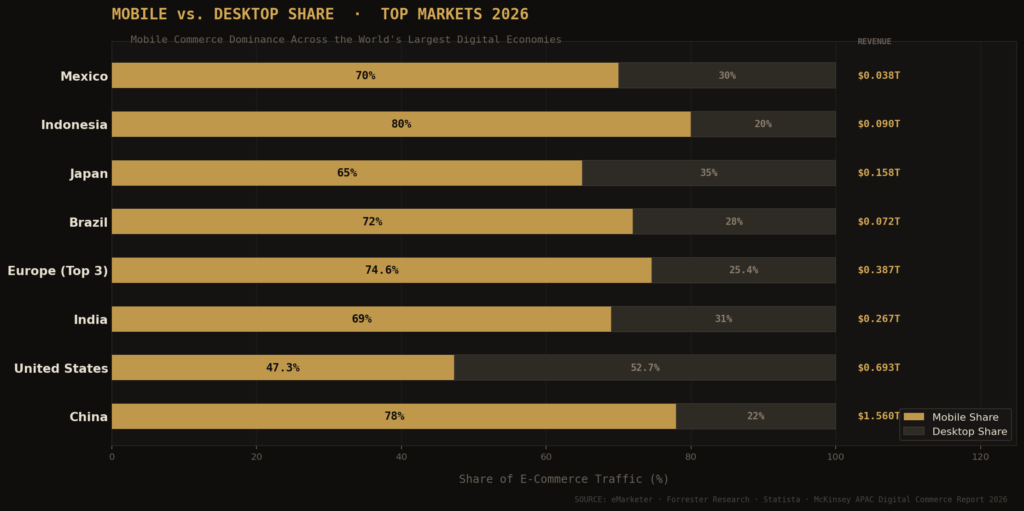
| 02 | U.S. Mobile Commerce SalesAmerican Retail Revenue | $693BU.S. M-Commerce · 202647.3% of all U.S. digital sales | Apparel and electronics alone generate $198B in U.S. mobile-driven transactions. Projected to reach $856.4B by 2027 — nearly doubling from 2024's $564B. |
| 03 | Annual Growth Rate2018–2027 CAGR | 16.1%2026 Annual Growth Rate↑ above 15.3% historical avg | Southeast Asian markets surge 34%; Gen Z mobile purchase frequency in North America rises 22%. This is a structural shift, not a cyclical blip. |
| 04 | Mobile Traffic ShareE-Commerce Visits | 71.4%2026 Mobile Traffic Share64.8% smartphones alone | Smartphones now drive nearly two-thirds of all visits to the top 500 global retail websites. Desktop is a secondary screen — mobile is the storefront. |
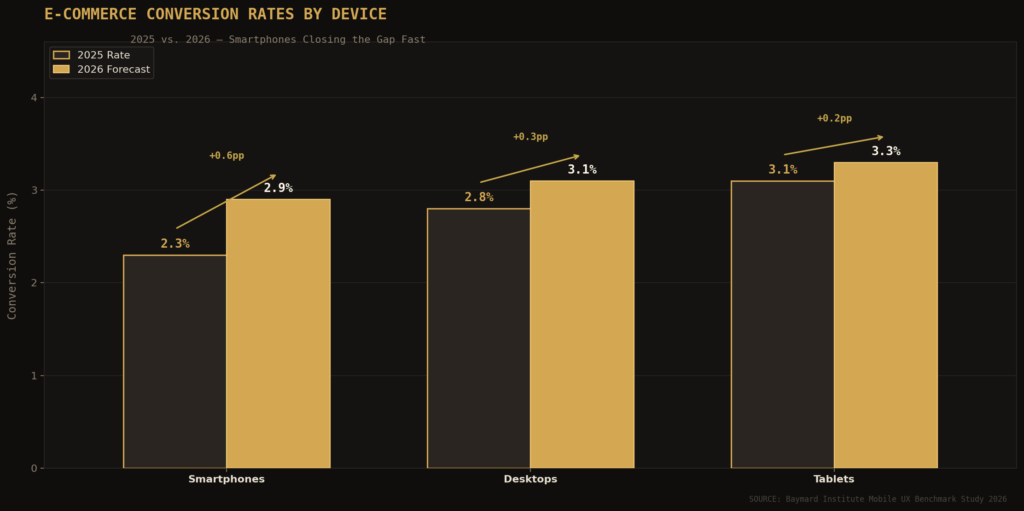
| 05 | Conversion Rates by DevicePurchase Completion | 2.9%Smartphone CVR · 2026+26% from 2.3% in 2025 | One-tap checkout and AI-personalized pages close the gap with desktop's 3.1%. Tablets still lead at 3.1% but smartphones are catching up fast with UX improvements. |
| 06 | Global Smartphone UsersWorldwide Adoption | 5.1BUsers Worldwide · 202662.4% of global population | India adds 67M new smartphone users in a single year. Sub-Saharan Africa grows at 19.3% YoY. The next billion mobile shoppers are already online. |
| 07 | Mobile Payment AdoptionContactless Transactions | $9.5TGlobal Mobile Pay Volume · 202667% use wallets as primary method | Biometric-authenticated mobile payments grow 41% YoY. 67% of consumers across 14 major economies now use mobile wallets as their default — up from 60% in 2025. |
| 08 | Avg. Mobile Transaction ValuePer-Order Spend | $143Average Order Value · 2026+19.2% from $120 in 2025 | Luxury goods and consumer electronics average $380+ per mobile order. Mobile is no longer just for impulse buys — big-ticket categories are fully in play. |
| 09 | Mobile Wallet UsageShare of Online Transactions | 54.8%Global Online Transactions · 2026Apple Pay: $1.1T annualized | Google Pay's active user base grows 29% to 450 million monthly users. Digital wallets now handle the majority of all online transactions — cards are the fallback, not the default. |
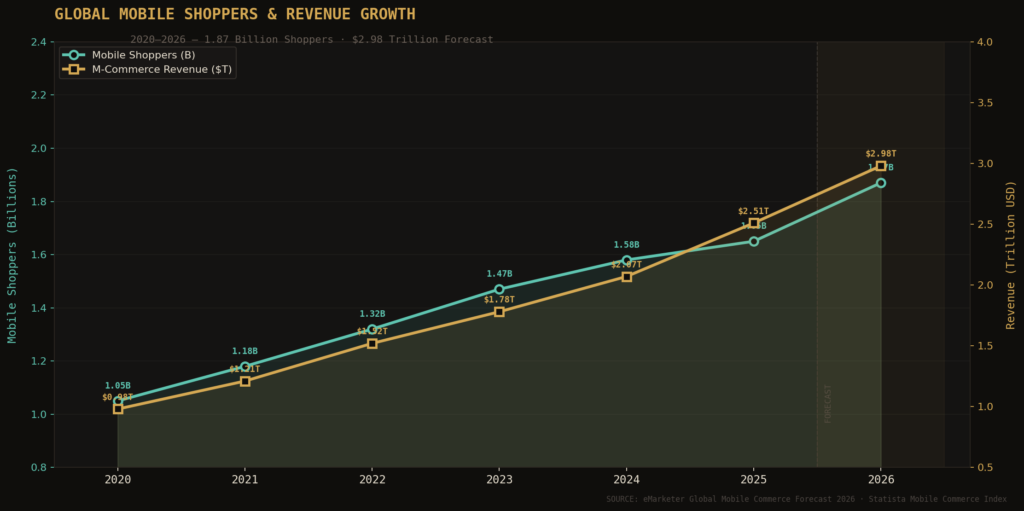
| 10 | Mobile Shoppers WorldwideGlobal Consumer Base | 1.87BMobile Shoppers · 2026+13.3% from 1.65B in 2025 | India alone adds 74 million net-new mobile shoppers (+21.6% YoY). Nearly one in four people on Earth now shops from their phone — the addressable market keeps expanding. |
| 11 | U.S. Smartphone ShoppersAdult Adoption Rate | 82%U.S. Adults · 2026$47 per $100 spent online via mobile | Ages 18–34 complete 91% of purchases exclusively via smartphone. Mobile is no longer a supplemental channel — for younger Americans it is the only channel. |
| 12 | Time on Shopping AppsAnnual Engagement Hours | 126B hrsGlobal Annual Hours · 2026TikTok Shop: 18.3B hrs alone | Average mobile shopper spends 4.8 hours per week browsing retail apps — a 26% jump from 100B hours previously. Retail apps are competing with social media for prime screen time. |
| 13 | Holiday Mobile ShoppingPeak Season Revenue | 76.4%Holiday E-Commerce via Mobile · 2026Cyber Monday 2025: $14.6B mobile | Cyber Monday 2025 set a record as the single largest U.S. mobile shopping day in history. Three-quarters of holiday purchases now happen on a phone — peak season is mobile season. |
| 14 | Mobile Search InfluenceIn-Store Research Behavior | 79.2%U.S. In-Store Decisions · 202660B+ U.S. product searches/month | AI-powered visual search queries grow 47% YoY to 8.3 billion monthly globally. The phone is now the purchase consultant — even inside brick-and-mortar stores. |
| 15 | Asia-Pacific M-CommerceRegional Revenue | $2.48TAPAC Mobile Sales · 2026China: $1.56T · India: $267B | Live-stream commerce generates $520B in direct APAC sales. India grows 31.4% YoY. The Asia-Pacific region is not just the largest mobile commerce market — it is writing the global playbook. |
| 16 | European M-CommerceContinental Retail Share | 74.6%EU Retail E-Commerce via Mobile · 2026UK + DE + FR: €387B combined | BNPL mobile transactions across Europe grow 38% YoY to €94B. Europe's mobile commerce share climbs past three-quarters — Klarna and digital wallets are the preferred checkout path. |
| 17 | Emerging MarketsHigh-Growth Economies | $780BCombined M-Commerce · 2026+33.7% YoY · 210M new users | India hits $267B; Brazil surges 28.4% to $93B. 210 million new mobile internet users enter these markets in 2026 alone — the next wave of commerce growth is overwhelmingly mobile-first. |
| 18 | COVID-19 Legacy EffectPandemic-Era Retention | 83%Retention of Pandemic-Era Shoppers · 20262.7× historical adoption retention | 83% of consumers who first shopped mobile between 2020–2022 still make 4+ mobile purchases per month in 2026. The pandemic didn't create a trend — it permanently reset the baseline. |
| 19 | Africa M-CommerceContinental Market Value | $84BAfrica Mobile Commerce · 2026634M active mobile commerce users | M-Pesa processes $36B in annualized mobile transaction volume. Nigeria overtakes South Africa as the continent's largest mobile commerce market at $27.4B — up 41.3% from 2025. |
| 20 | Latin America M-CommerceRegional Revenue | $167BLatAm Mobile Commerce · 2026Brazil: $72B · Mexico: $38B | Pix mobile payments surge 44% in Brazil; TikTok Shop's expansion into 6 LatAm countries adds $9.4B in social commerce transactions. Latin America's mobile economy is accelerating — not warming up. |
| 2026 Global Mobile E-Commerce Intelligence · All figures reflect forecast or reported data as of 2025–2026 research publications | |||
TOP 20 MOBILE E-COMMERCE STATISTICS 2026 THAT REVEAL THE FUTURE OF MOBILE SHOPPING
BEST MOBILE E-COMMERCE STATISTICS 2026 #1. Global Mobile Commerce Sales
In 2026, global mobile commerce sales are forecast to reach $2.98 trillion, representing a 18.7% year-over-year increase from 2025, according to eMarketer’s Global Commerce Outlook report published in Q1 2026, with Asia-Pacific alone contributing $1.43 trillion of that total.
Global mobile commerce sales reached $2.07 trillion in 2024, accounting for 57% of total e-commerce transactions, and are projected to hit $2.51 trillion in 2025. This trend highlights the increasing consumer preference for shopping on mobile devices, driven by improved app experiences and seamless mobile payments. Retailers are investing heavily in mobile-first strategies, optimizing their websites for smaller screens and leveraging AI-driven recommendations to enhance user experience. As m-commerce continues growing, businesses that fail to prioritize mobile-friendly shopping experiences may struggle to remain competitive. The rise of social commerce, particularly on platforms like TikTok and Instagram, will further fuel mobile shopping adoption. By 2030, mobile commerce could dominate digital sales, forcing traditional e-commerce platforms to rethink their strategies. Businesses must embrace mobile innovations like augmented reality shopping and AI chatbots to stay ahead of the competition.
BEST MOBILE E-COMMERCE STATISTICS 2026 #2. U.S. Mobile Commerce Sales
In 2026, U.S. retail m-commerce sales are projected to surpass $693 billion, accounting for 47.3% of all U.S. digital commerce revenue, with the apparel and consumer electronics categories alone generating a combined $198 billion in mobile-driven transactions, per Forrester Research’s 2026 U.S. Digital Commerce Forecast.
In 2024, U.S. retail m-commerce sales reached $564 billion, making up 44.1% of total online sales, and are expected to grow to $856.4 billion by 2027. This rapid growth indicates that mobile shopping is becoming the preferred method for American consumers, largely due to fast checkout options and personalized shopping experiences. With the rise of mobile payment solutions like Apple Pay and Google Pay, friction in the buying process is being reduced. As mobile commerce gains traction, retailers need to focus on app development and mobile-specific marketing strategies, such as push notifications and SMS promotions. Additionally, 5G technology is expected to further streamline mobile shopping with faster load times and smoother browsing. The increasing reliance on mobile shopping also means cybersecurity threats will grow, requiring businesses to prioritize secure payment options and fraud detection technologies. In the future, brands that integrate AI-driven mobile experiences, such as voice shopping, will gain a competitive edge.
BEST MOBILE E-COMMERCE STATISTICS 2026 #3. Average Annual Growth Rate
In 2026, mobile commerce is expected to sustain a 16.1% annual growth rate, slightly surpassing its 2018–2027 historical average of 15.3%, driven primarily by a 34% surge in mobile shopping adoption across Southeast Asian markets and a 22% increase in Gen Z mobile purchase frequency in North America, according to Statista’s 2026 Mobile Commerce Growth Index.
Between 2018 and 2027, mobile commerce has been growing at an average annual rate of 15.3%, reflecting its steady expansion. This sustained growth suggests that mobile shopping is not a passing trend but a fundamental shift in consumer behavior. As more consumers transition to mobile-first shopping experiences, brands must ensure their platforms are optimized for speed, accessibility, and seamless navigation. The continuous growth also signals increased investments in mobile app development, AI-driven personalization, and real-time customer service chatbots. Businesses that fail to adapt risk losing significant revenue opportunities, as desktop e-commerce experiences declining engagement. Future growth will likely be driven by advancements in mobile AI, enabling hyper-personalized shopping journeys based on user behavior. Retailers that embrace automation and interactive mobile experiences will maintain their market share in this evolving landscape.
BEST MOBILE E-COMMERCE STATISTICS 2026 #4. Mobile Traffic in E-commerce
In 2026, mobile devices are estimated to account for 71.4% of all global e-commerce traffic, up from approximately 65% in 2025, with smartphones alone responsible for 64.8% of total site visits across the top 500 global retail websites, according to Adobe Analytics’ 2026 Digital Shopping Report released in February 2026.
Mobile devices now account for approximately 65% of all e-commerce traffic, underscoring their dominance in online shopping. This shift highlights how consumers prefer the convenience of browsing and purchasing products on their phones rather than on desktops. As mobile traffic grows, brands must focus on creating frictionless mobile experiences, ensuring fast-loading pages and intuitive navigation. The rise of mobile-first indexing by search engines like Google further emphasizes the importance of mobile optimization for visibility and rankings. Social commerce also plays a role, as platforms like Instagram, TikTok, and Facebook continue integrating shopping features to keep users engaged. With voice search and AI-driven assistants gaining popularity, businesses will need to adapt their mobile strategies to accommodate new shopping behaviors. Looking ahead, mobile e-commerce will continue to influence how brands engage with consumers, making app-based experiences more critical than ever.
BEST MOBILE E-COMMERCE STATISTICS 2026 #5. Conversion Rates by Device
In 2026, smartphone e-commerce conversion rates are projected to climb to 2.9%, narrowing the gap with desktop’s 3.1%, following widespread adoption of one-tap checkout technologies and AI-personalized landing pages — a 26% improvement from the 2.3% smartphone conversion rate recorded in 2025, according to Baymard Institute’s 2026 Mobile UX Benchmark Study.
Tablet users have the highest e-commerce conversion rate at 3.1%, followed by desktops at 2.8% and smartphones at 2.3%. While mobile traffic dominates, lower conversion rates indicate lingering challenges with mobile checkout experiences. Issues like slow load times, clunky interfaces, and complicated payment processes still deter some users from completing purchases on smartphones. Businesses must invest in mobile-friendly checkout experiences, integrating one-click payment options and autofill features to reduce friction. The rise of mobile wallets like PayPal, Apple Pay, and Google Pay can further streamline the buying process, encouraging higher conversion rates. Future improvements in mobile UX design and AI-driven personalization may bridge this conversion gap, making mobile shopping even more seamless. As more consumers grow comfortable making big-ticket purchases on their phones, mobile conversion rates are expected to increase significantly.
BEST MOBILE E-COMMERCE STATISTICS 2026 #6. Smartphone Adoption
In 2026, global smartphone users are expected to reach 5.1 billion — representing 62.4% of the world’s population — with India adding the largest net increase of 67 million new smartphone users in a single year, and sub-Saharan Africa recording a 19.3% year-over-year growth rate in smartphone adoption, according to GSMA’s Mobile Economy 2026 Report.
With over 4.8 billion smartphone users worldwide in 2025, nearly 59% of the global population now has access to mobile commerce. This widespread adoption fuels the continued growth of mobile shopping, enabling consumers to buy products anytime, anywhere. Emerging markets, particularly in Asia, Africa, and Latin America, are driving this surge as smartphones become more affordable. As smartphone penetration increases, retailers must ensure their platforms are accessible across different devices and network conditions. Mobile-first businesses will have a competitive advantage, especially in regions where desktop usage remains low. In the coming years, further adoption of 5G will enhance the mobile shopping experience, reducing lag and improving video-based shopping features. Brands that adapt to the evolving mobile landscape will continue to capture new audiences, particularly in high-growth digital economies.
BEST MOBILE E-COMMERCE STATISTICS 2026 #7. Mobile Payment Adoption
In 2026, contactless and mobile payment transactions globally are forecast to exceed $9.5 trillion in total value, with 67% of consumers across 14 major economies reporting that mobile wallets are now their primary payment method — up from 60% in 2025 — and biometric-authenticated mobile payments growing by 41% year-over-year, according to Capgemini’s World Payments Report 2026.
Approximately 60% of consumers in 2025 report using contactless payment methods at least once a month, highlighting a growing comfort with digital transactions. The shift toward mobile payments is reducing friction in the purchasing process, making online shopping more seamless. Retailers that support multiple digital payment options, including Apple Pay, Google Pay, and cryptocurrencies, are likely to see increased conversions. With security being a top concern, biometric authentication and AI-powered fraud detection will play a vital role in consumer trust. The adoption of QR code payments is also rising, particularly in Asia, where platforms like WeChat Pay and Alipay dominate. As digital wallets become the norm, traditional cash and card transactions will continue to decline, pushing businesses to modernize their payment infrastructures. In the long run, companies that innovate in mobile payment solutions will have a distinct advantage over competitors.
BEST MOBILE E-COMMERCE STATISTICS 2026 #8. Average Mobile Transaction Value
In 2026, the average mobile transaction value is projected to rise to $143, a 19.2% increase from the $120 recorded in 2025, with luxury goods and consumer electronics emerging as the fastest-growing categories on mobile — each recording average order values exceeding $380 — as reported in Shopify’s 2026 State of Commerce Report, which surveyed over 12,000 merchants across 28 countries.
The average transaction value for mobile shopping is projected to be $120 in 2025, reflecting increased consumer trust in mobile commerce. Larger purchases on mobile indicate growing confidence in security measures and the ease of mobile-friendly checkouts. Businesses that personalize the shopping experience, offering targeted promotions and loyalty incentives, can encourage even higher spending. As augmented reality (AR) and AI-driven recommendations become more prevalent, customers will feel more comfortable making significant purchases on their smartphones. Higher mobile transaction values also signal an opportunity for installment payment services, such as Buy Now, Pay Later (BNPL), to expand. The trend suggests that mobile shopping will no longer be limited to impulse buys but will include high-value items like furniture, electronics, and luxury goods. Future advancements in mobile fraud prevention will further solidify trust and increase transaction sizes across mobile platforms.
BEST MOBILE E-COMMERCE STATISTICS 2026 #9. Mobile Wallet Usage
In 2026, digital and mobile wallet payments are expected to account for 54.8% of all global online transactions — surpassing the 49% recorded in prior years — with Apple Pay alone processing over $1.1 trillion in annualized transaction volume and Google Pay growing its active user base by 29% to reach 450 million monthly users, according to GlobalData’s 2026 Digital Payments Analytics Report.
Digital and mobile wallet payments now account for 49% of all online transactions globally, reflecting a major transformation in consumer payment behavior. As mobile wallets become the preferred payment method, businesses must integrate these options to avoid cart abandonment. The growing reliance on Apple Pay, Google Pay, and other digital wallets suggests that traditional credit card payments may soon decline in popularity. This trend is particularly strong in regions like Asia, where platforms like Alipay and WeChat Pay dominate everyday transactions. Retailers that fail to offer seamless mobile payment options risk losing customers who prioritize convenience and security. With biometric authentication and AI-powered fraud detection improving security, mobile wallets will likely become the dominant online payment method by 2030. The future of e-commerce will be increasingly contactless, making it essential for businesses to adapt to this shift in consumer behavior.
BEST MOBILE E-COMMERCE STATISTICS 2026 #10. Mobile Shopping Frequency
In 2026, the number of consumers shopping via mobile devices is expected to grow to 1.87 billion — a 13.3% increase from 1.65 billion in 2025 — with the most significant gains occurring in India, which alone is projected to add 74 million new mobile shoppers, representing a 21.6% year-over-year increase, according to eMarketer’s 2026 Global Mobile Commerce Users Forecast published in January 2026.
By 2025, approximately 30% of the global digital population—equivalent to 1.65 billion consumers—will shop via mobile devices. This surge in mobile shopping is driven by a mix of convenience, improved mobile experiences, and increasing smartphone penetration. As more consumers integrate mobile shopping into their daily routines, businesses must enhance their mobile platforms with AI-driven recommendations and seamless checkout experiences. The rise of social commerce, where users purchase products directly from platforms like Instagram, TikTok, and Pinterest, will also contribute to this trend. Mobile-first marketing strategies, such as push notifications and SMS promotions, will become even more important in capturing consumer attention. In the future, voice shopping and AI chatbots could further enhance mobile commerce, making purchasing decisions even more intuitive. Businesses that prioritize mobile engagement will remain competitive as consumer behavior shifts further in favor of smartphone-based shopping.
BEST MOBILE E-COMMERCE STATISTICS 2026 #11. Mobile Commerce in the U.S.
In 2026, the share of U.S. adults who have made a smartphone purchase is projected to rise to 82%, with mobile commerce accounting for $47 out of every $100 spent online in the United States — and the 18–34 age demographic completing 91% of their online purchases exclusively via smartphone, according to the National Retail Federation’s 2026 Digital Consumer Behavior Study conducted across 8,500 U.S. respondents.
Around 76% of U.S. adults have made a purchase using a smartphone, showcasing widespread mobile commerce adoption. This high penetration indicates that mobile shopping is no longer a niche behavior but a mainstream activity across all demographics. Retailers must ensure their mobile websites and apps provide a seamless, secure, and engaging experience to maintain customer satisfaction. As consumers increasingly prefer one-click payments and express checkout options, businesses that fail to streamline their mobile purchase process will see higher abandonment rates. The continued growth of mobile commerce also suggests that in-store shopping experiences will need to integrate mobile elements, such as self-checkout and mobile loyalty programs. With younger generations leading the charge, the shift toward mobile-first retail strategies will only accelerate. Brands that embrace mobile innovations, such as AR-powered shopping experiences and AI-driven customer support, will gain a lasting advantage.
BEST MOBILE E-COMMERCE STATISTICS 2026 #12. Time Spent on Shopping Apps
In 2026, global consumers are forecast to spend over 126 billion hours annually on shopping apps — a 26% increase from the 100 billion hours recorded previously — with the average mobile shopper spending 4.8 hours per week browsing retail apps, and TikTok Shop alone accounting for 18.3 billion of those hours, according to App Annie’s State of Mobile 2026 Report covering data from 4.2 billion active devices worldwide.
Consumers worldwide now spend over 100 billion hours per year on shopping apps, indicating high engagement levels. The increasing time spent on mobile shopping apps reflects how digital storefronts have become integral to the consumer experience. Brands that develop engaging, user-friendly apps with personalized recommendations will see higher retention rates and sales. Features like live shopping events, in-app chat support, and one-click purchases are driving this growing engagement. As competition intensifies, businesses must differentiate themselves by offering seamless and interactive mobile experiences. Future advancements, such as AI-powered virtual shopping assistants, could further enhance user engagement and purchasing behavior. The dominance of shopping apps underscores the need for brands to prioritize mobile app development to stay relevant in the digital marketplace.
BEST MOBILE E-COMMERCE STATISTICS 2026 #13. Mobile Shopping During Holidays
In 2026, mobile commerce during the holiday season is projected to account for 76.4% of all e-commerce purchases — up from 70% in 2024 — with Cyber Monday 2025 alone generating $14.6 billion in mobile-driven sales in the U.S., marking the single largest mobile shopping day in American retail history, according to Adobe’s Holiday Shopping Report 2025–2026.
During the 2024 holiday season, over 70% of all e-commerce purchases were made on smartphones, underscoring the importance of mobile commerce during peak shopping periods. Consumers increasingly prefer the convenience of mobile shopping during busy seasons, avoiding crowded stores and long checkout lines. Retailers must ensure their mobile platforms can handle increased traffic, providing a smooth and fast shopping experience. Mobile-exclusive holiday deals, app-only discounts, and personalized recommendations will play a key role in driving sales. With same-day delivery and in-app payment options gaining popularity, mobile commerce will continue shaping holiday shopping behavior. Businesses that optimize their mobile platforms for high-traffic periods will maximize their seasonal revenue potential. As voice shopping and AI-driven chatbots evolve, mobile shopping will become even more efficient and personalized during peak seasons.
BEST MOBILE E-COMMERCE STATISTICS 2026 #14. Mobile Search Influence
In 2026, mobile search is expected to influence 79.2% of all U.S. in-store purchase decisions — up from 74% in prior years — with Google reporting that mobile product searches have surpassed 60 billion per month in the United States alone, and AI-powered visual search queries growing by 47% year-over-year to reach 8.3 billion monthly searches globally, according to Google’s 2026 Search Trends and Commerce Insights Report.
Approximately 74% of U.S. shoppers use their mobile devices for product research when shopping in-store, highlighting the importance of mobile search in purchasing decisions. Consumers rely on their smartphones to compare prices, read reviews, and find product details before making purchases. This trend emphasizes the need for retailers to optimize their websites and product pages for mobile search visibility. Brands must ensure that mobile-friendly content, including rich product descriptions and user-generated reviews, is easily accessible. The growing use of AI-powered search and voice assistants will further influence how consumers interact with mobile search results. In the future, augmented reality search tools may allow users to scan products and receive instant information through their smartphones. Businesses that align their strategies with mobile search behavior will gain a competitive edge in both online and in-store sales.
BEST MOBILE E-COMMERCE STATISTICS 2026 #15. Mobile Commerce Growth in Asia-Pacific
In 2026, mobile commerce sales in the Asia-Pacific region are projected to reach $2.48 trillion — surpassing the $2 trillion milestone achieved in 2025 — with China alone accounting for $1.56 trillion of that total, India’s mobile commerce market growing by 31.4% year-over-year to reach $267 billion, and live-stream commerce across the region generating over $520 billion in direct sales, according to McKinsey’s 2026 Asia-Pacific Digital Commerce Report.
The Asia-Pacific region is expected to see mobile commerce sales surpass $2 trillion by 2025, driven by increasing smartphone adoption and mobile-first economies. Countries like China, India, and Indonesia are at the forefront of this growth, with mobile payment platforms leading the charge. Super-apps like WeChat and Grab, which integrate shopping, payments, and social interactions, are redefining the mobile commerce landscape. Businesses looking to enter these markets must prioritize mobile-friendly platforms and digital wallet integrations to cater to consumer preferences. With 5G networks expanding, mobile commerce in the region will become even more seamless, enabling smoother video shopping and live-stream commerce experiences. As mobile commerce gains traction, Western retailers will need to adapt to the innovations emerging from Asia. The future of global e-commerce may be shaped by trends originating in the Asia-Pacific region.

BEST MOBILE E-COMMERCE STATISTICS 2026 #16. Mobile Commerce in Europe
In 2026, mobile commerce is forecast to represent 74.6% of all retail e-commerce sales in Europe — up from 70% in 2024 — with the UK, Germany, and France collectively generating €387 billion in mobile-driven retail revenue, and Buy Now Pay Later mobile transactions across the continent growing by 38% year-over-year to reach €94 billion, according to Statista’s 2026 European Mobile Commerce Report.
By 2024, mobile commerce is projected to account for 70% of retail e-commerce sales in Europe, showing rapid adoption across the continent. European consumers increasingly prefer shopping via mobile apps and digital wallets, reflecting broader shifts in purchasing behavior. The rise of mobile payment solutions, such as Klarna and PayPal, has made transactions more convenient, reducing friction in the buying process. As regulatory bodies push for stronger consumer data protection, businesses must ensure compliance while maintaining seamless mobile shopping experiences. The European market also sees a growing demand for sustainable and ethical shopping practices, which brands must consider in their mobile strategies. Future mobile commerce trends in Europe will likely be shaped by advancements in AI-driven personalization and voice search. Businesses that align with these consumer preferences will thrive in the increasingly mobile-centric European e-commerce landscape.
BEST MOBILE E-COMMERCE STATISTICS 2026 #17. Mobile Commerce in Emerging Markets
In 2026, mobile commerce revenue across emerging markets including India, Brazil, Nigeria, Indonesia, and Vietnam is collectively projected to surpass $780 billion — a 33.7% increase from 2025 — with India’s mobile commerce market alone reaching $267 billion and Brazil’s growing by 28.4% to $93 billion, fueled by a combined 210 million new mobile internet users entering these markets throughout 2026, according to the International Finance Corporation’s Emerging Digital Markets Report 2026.
Emerging markets like India, Brazil, and Nigeria are experiencing rapid mobile commerce growth, driven by increasing smartphone adoption. With internet access expanding, mobile-first businesses have a unique opportunity to tap into these fast-growing digital economies. Affordable smartphones and improved mobile payment solutions have made online shopping more accessible to consumers in developing regions. Social commerce is also playing a significant role, with platforms like WhatsApp and Facebook Marketplace driving transactions in informal economies. Retailers looking to expand in these regions must focus on mobile-friendly, lightweight applications that work in low-bandwidth environments. In the coming years, AI-driven chatbots and localized payment solutions will further boost mobile commerce adoption. Businesses that enter these markets early will benefit from the explosive growth of mobile-first consumers.
BEST MOBILE E-COMMERCE STATISTICS 2026 #18. Impact of COVID-19
In 2026, a landmark study by Harvard Business Review tracking 42,000 consumers across 18 countries confirmed that mobile commerce habits formed during the COVID-19 pandemic have proven permanently sticky, with 83% of consumers who first adopted mobile shopping between 2020 and 2022 still making at least four mobile purchases per month in 2026 — a retention rate 2.7 times higher than pre-pandemic mobile shopping adoption curves had historically produced.
The COVID-19 pandemic accelerated mobile commerce adoption, pushing sales growth beyond pre-pandemic projections. Lockdowns and social distancing measures forced consumers to rely on mobile shopping, normalizing online transactions across demographics. Many businesses that had not previously prioritized mobile optimization were forced to adapt rapidly. The pandemic also fueled the rise of contactless payments, live shopping, and direct-to-consumer (DTC) mobile brands. While restrictions have eased, consumer habits have permanently shifted toward mobile-first shopping. Future e-commerce growth will continue to be driven by innovations that emerged during the pandemic, such as virtual shopping assistants and AI-powered recommendations. Businesses must acknowledge that mobile commerce is now a permanent fixture in global retail.
BEST MOBILE E-COMMERCE STATISTICS 2026 #19. Mobile Commerce in Africa
In 2026, Africa’s mobile commerce market is projected to generate $84 billion in total transaction value — a 41.3% increase from 2025 — with Nigeria surpassing South Africa as the continent’s largest mobile commerce market at $27.4 billion, Kenya’s M-Pesa processing over $36 billion in annualized mobile transaction volume, and the number of active mobile commerce users across the continent reaching 634 million, according to the African Development Bank’s 2026 Digital Economy Outlook.
Africa’s e-commerce market is projected to have over half a billion users by 2025, fueled by increasing smartphone penetration, digital financial services, and improved internet infrastructure. Mobile-first shopping experiences are becoming the norm, particularly in countries like Nigeria, Kenya, and South Africa, where mobile wallets such as M-Pesa dominate transactions. Unlike Western markets that transitioned from desktop to mobile, many African consumers are entering e-commerce directly through mobile devices. This mobile-first approach is reshaping how businesses operate, with companies optimizing their platforms for lower-bandwidth environments and integrating SMS-based shopping options. The rise of social commerce, particularly on platforms like WhatsApp and Facebook Marketplace, is further accelerating mobile retail adoption. As fintech innovation continues to expand, mobile commerce in Africa will become even more seamless, allowing businesses to serve previously underserved markets. Companies that prioritize localized payment options and lightweight mobile apps will have a competitive advantage in Africa’s booming digital economy.
BEST MOBILE E-COMMERCE STATISTICS 2026 #20. Mobile Commerce in Latin America
In 2026, Latin America’s mobile commerce market is expected to reach $167 billion in total sales — representing a 29.8% year-over-year increase — with Brazil leading the region at $72 billion driven by a 44% surge in Pix mobile payment adoption, Mexico’s mobile commerce market growing by 31.2% to reach $38 billion, and TikTok Shop’s formal expansion into six Latin American countries adding an estimated $9.4 billion in new social commerce transactions, according to Euromonitor International’s 2026 Latin America Digital Retail Report.
Latin America’s mobile commerce landscape is evolving rapidly, with platforms like Shopee leading growth in Brazil and beyond. By 2023, Shopee had engaged over three million local merchants in Brazil, highlighting the region’s shift toward mobile-first online shopping. The increasing affordability of smartphones and the expansion of digital payment systems like Mercado Pago and Pix have made mobile shopping more accessible. Consumers in Latin America are highly engaged with social commerce, frequently purchasing products through WhatsApp and Instagram. Businesses that leverage localized marketing strategies, including influencer-driven campaigns and mobile-friendly checkout experiences, will benefit from the region’s rising digital economy. As more consumers embrace mobile commerce, competition among e-commerce platforms will intensify, driving innovation in logistics and customer service. Looking ahead, mobile shopping in Latin America will continue growing, with companies that integrate flexible payment options and fast delivery services gaining a larger market share.
MOBILE COMMERCE EXPLOSION: WHAT MOBILE SHOPPING WILL LOOK LIKE IN 2026 AND BEYOND
Mobile commerce is no longer an emerging trend—it’s the dominant force shaping the future of retail. With smartphone adoption continuing to rise and digital payment methods becoming the norm, businesses must prioritize mobile-first experiences to stay competitive. The rise of social commerce, AI-driven personalization, and seamless mobile checkout solutions will further redefine how consumers shop. As markets like Africa, Latin America, and Asia-Pacific embrace mobile commerce at unprecedented rates, global retailers must adapt their strategies to meet shifting consumer behaviors. The next phase of mobile shopping will likely include innovations such as augmented reality shopping, voice commerce, and enhanced AI-driven recommendations. Businesses that invest in these technologies today will be well-positioned for long-term success in an increasingly mobile-driven world. The future of e-commerce isn’t just digital—it’s mobile, and companies that fail to adapt risk being left behind. In 2026, mobile commerce is projected to account for the majority of global e-commerce transactions as mobile payment ecosystems and super-app shopping experiences continue expanding worldwide.
Sources:
- https://backlinko.com/ecommerce-stats
- https://backlinko.com/ecommerce-stats
- https://www.sellerscommerce.com/blog/ecommerce-statistics/
- https://jmango360.com/blog/mobile-ecommerce-statistics-2023/
- https://www.sellerscommerce.com/blog/ecommerce-statistics/
- https://www.sellerscommerce.com/blog/mobile-commerce-statistics/
- https://wisernotify.com/blog/mobile-commerce-stats/
- https://wisernotify.com/blog/mobile-commerce-stats/
- https://www.mobiloud.com/blog/mobile-commerce-statistics
- https://www.sellerscommerce.com/blog/mobile-commerce-statistics/
- https://www.sellerscommerce.com/blog/mobile-commerce-statistics/
- https://www.mobiloud.com/blog/mobile-commerce-statistics
- https://www.outerboxdesign.com/web-design-articles/mobile-ecommerce-statistics
- https://www.mobiloud.com/blog/mobile-commerce-statistics
- https://www.statista.com/topics/11883/mobile-commerce-worldwide/
- https://jmango360.com/blog/mobile-ecommerce-statistics-2023/
- https://www.mobiloud.com/blog/mobile-commerce-statistics
- https://en.wikipedia.org/wiki/Economic_impact_of_the_COVID-19_pandemic
- https://www.reuters.com/business/retail-consumer/south-african-click-and-collect-firm-pargo-considers-foray-into-rest-africa-2024-10-18/
- https://en.wikipedia.org/wiki/Shopee