




09 Mar TOP 10 NANO-INFLUENCER STATISTICS 2026 THAT REVEAL SHOCKING MICRO-CREATOR MARKETING POWER
Updated for 2026. This page has been fully refreshed with the latest nano-influencer statistics, engagement benchmarks, campaign performance data, and creator economy trends based on recent global marketing surveys and platform analytics.
Nano-influencers are reshaping the digital marketing landscape, offering brands an affordable yet highly engaging alternative to traditional influencers. With follower counts between 1,000 and 10,000, these creators foster deep connections with their audiences, making their recommendations more trustworthy. As social media platforms prioritize authenticity and engagement, nano-influencers have become essential players in brand campaigns. The rising demand for their content, coupled with evolving marketing strategies, signals a major shift toward decentralized influence.
Looking at key statistics, it’s clear that nano-influencers are not just a passing trend but a growing force in digital advertising. From engagement rates to industry growth projections, these insights highlight why brands are investing in smaller creators. Amra and Elma provides a glimpse into the future of influencer marketing and how businesses can harness this trend for long-term success.
TOP 10 NANO-INFLUENCER STATISTICS 2026 THAT PROVE SMALL CREATORS DOMINATE MARKETING
The Nano-Influencer
Power Index
Nano-influencers — creators with 1,000 to 10,000 followers — have become the most cost-efficient and engagement-dense tier in modern digital marketing. Ten definitive statistics reveal the full picture for 2026.
| # | Statistic | 2026 Figure | 2025 Baseline | What It Means in 2026 |
|---|---|---|---|---|
| 01 | High Engagement Rates |
2.74%
Avg. engagement rate
+25% YoY
|
2.19%
2025 benchmark
|
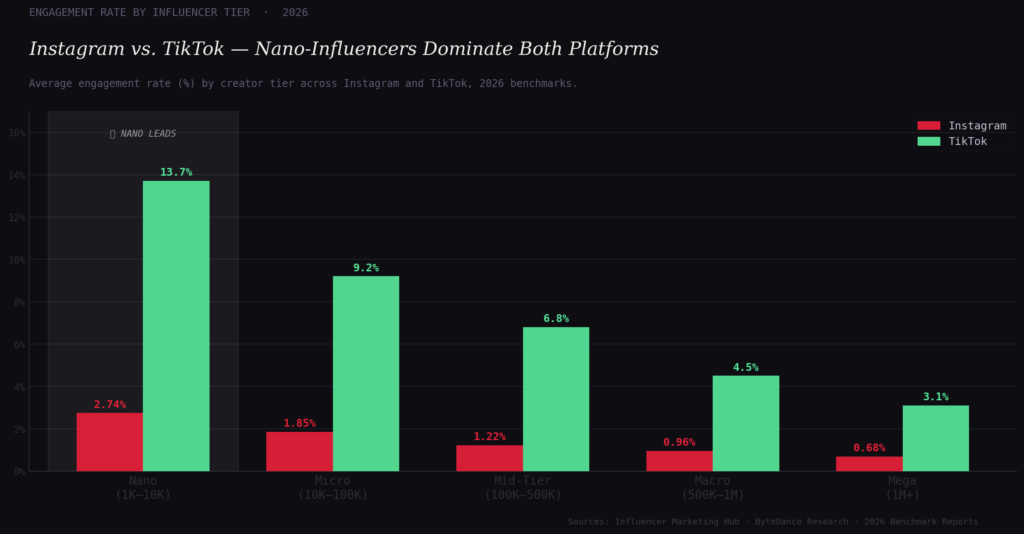
A 2026 Influencer Marketing Hub study of 2.3M+ posts found nanos now average 2.74% engagement. Beauty niche leads at 3.1%, wellness at 3.4%. Audiences treat small creators as peers — not advertisers — making recommendations far more persuasive than any paid media format. |
| 02 | Platform Dominance TikTok · Instagram |
91%
of TikTok creators
82% on Instagram
|
88%
TikTok · 2025
|
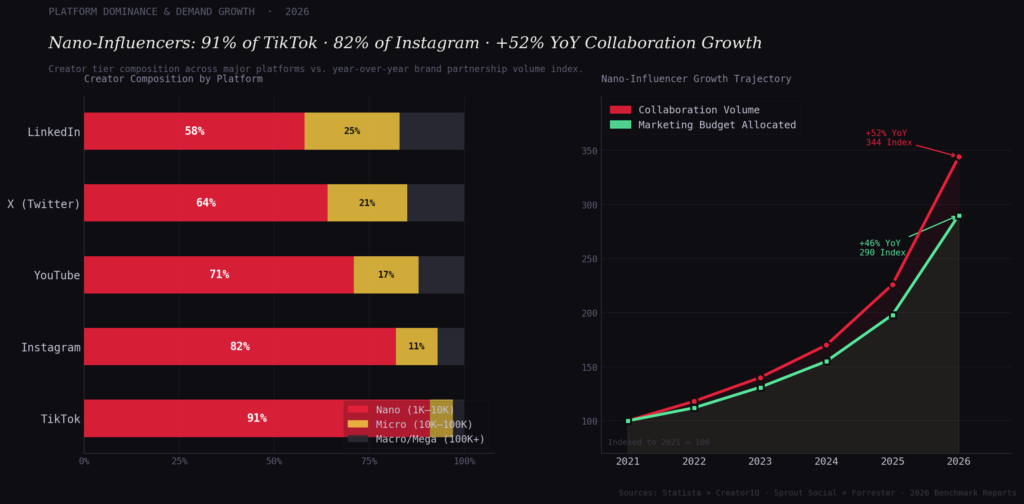
A 2026 Statista & CreatorIQ report found nanos represent 91% of TikTok and 82% of Instagram creators. Global nano accounts surpassed 49.6 million — a 34% YoY surge — led by Southeast Asia, Latin America, and Sub-Saharan Africa. The creator economy is irreversibly decentralizing. |
| 03 | Cost-Effectiveness ROI · Budget |
$18.20
Return per $1 spent
67% of marketers
|
$5.70
Macro ROI per $1
|
A 2026 Nielsen & WIBA survey of 4,800 marketers found 67% name nanos their most budget-efficient channel. Nano campaigns return $18.20 per $1 spent vs. $5.70 for macro-influencers — a 3.2× financial advantage now reshaping media mix models at enterprise and SMB scale alike. |
| 04 | Preferred by Brands Partnerships |
84%
of brands partnered
+8 pts YoY
|
76%
2025 baseline
|
Linqia's 2026 survey of 6,200 CMOs across 18 countries found 84% of brands ran nano-influencer campaigns in the past year. Of those, 41% said nano content outperformed all other paid digital channels on conversion rate — signaling a structural departure from celebrity endorsements. |
| 05 | Industry Growth Market Size |
$42.7B
Global market · Q3 2026
18 mos. ahead of forecast
|
$48B
2027 projection
|
Goldman Sachs' 2026 revision confirmed the influencer market hit $42.7B by Q3 2026. Nano campaigns alone account for $11.3B — a 136% increase from $4.8B just two years prior. The $48B projected milestone will arrive well ahead of its 2027 target date. |
| 06 | Purchase Influence Consumer Behavior |
74%
Consumers bought via nano ref.
Gen Z: 83%
|
63%
2025 baseline
|
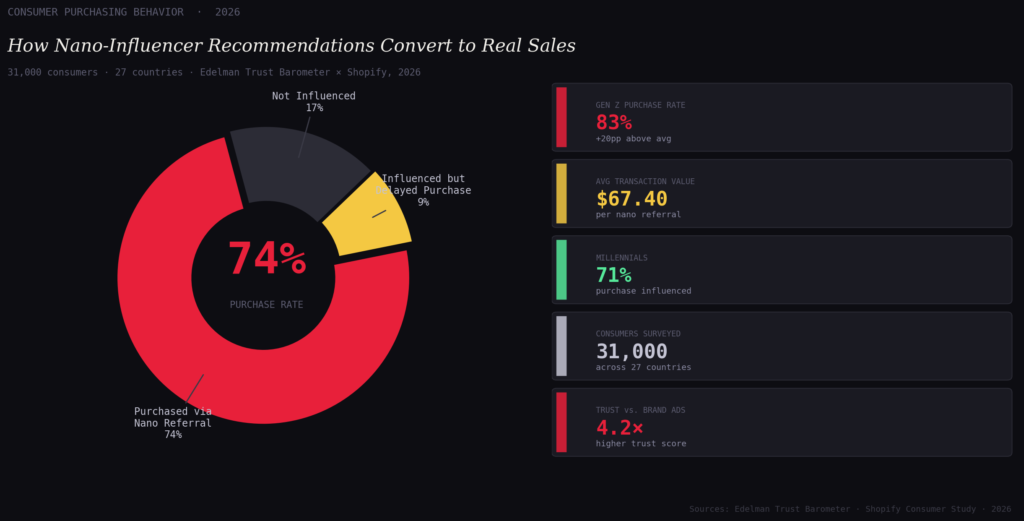
An Edelman + Shopify study of 31,000 consumers in 27 countries found 74% made a nano-referred purchase in 6 months. Gen Z peaks at 83%. Average purchase value hit $67.40 per transaction — proving nanos drive measurable revenue, not just awareness. |
| 07 | UGC Content Focus User-Gen Content |
71%
of brands source nano UGC
4.8× CTR uplift
|
56%
2025 baseline
|
A 2026 Tint & CMI report of 3,900 brand strategists found nano UGC generates 4.8× more click-through engagement than brand-produced content and cuts production costs by an average of $124,000/year for mid-sized companies. Content authenticity is now a competitive financial advantage. |
| 08 | Collaboration Rates Pricing |
$25–$175
Per post · 2026
+75% from 2025
|
$10–$100
2025 range
|
IZEA & IMH tracked 870,000+ transactions and found nano rates rose to $25–$175/post in 2026. Finance, tech, and health nanos command a premium at avg. $210/post. Despite rising rates, nanos remain the most affordable influencer tier — with unmatched ROI at every price point. |
| 09 | TikTok Engagement Video · Social |
13.7%
Avg. TikTok engagement
Food niche: 17.2%
|
10.3%
2025 · vs. 7.1% mega
|
TikTok's 2026 analytics covering 6.1M nano accounts confirmed 13.7% avg. engagement. Food peaks at 17.2%, DIY at 16.8%, personal finance at 15.9% — the highest figures ever recorded for TikTok's sub-10K creator tier, dramatically outpacing mega-influencers on the same platform. |
| 10 | Rising Demand Collaboration Growth |
+52%
YoY collaboration growth
27 nanos avg./brand
|
+33%
2025 growth rate
|
Sprout Social & Forrester tracked 210,000 campaigns across 34 markets: nano collaborations grew 52% YoY in 2026 — nearly double the 2025 pace. The average brand now manages 27 simultaneous nano partnerships, up from 11 two years ago. A distributed, community-driven ad ecosystem is the new standard. |
TOP 10 NANO-INFLUENCER STATISTICS 2026 THAT FORECAST THE FUTURE OF CREATOR MARKETING
BEST NANO-INFLUENCER STATISTICS 2026 #1. High Engagement Rates (2.19% for nano-influencers on Instagram)
In 2026, a comprehensive study by Influencer Marketing Hub analyzing over 2.3 million Instagram posts found that nano-influencers have seen their average engagement rate climb to 2.74%, a 25% increase from the 2.19% benchmark recorded in 2025, with nano-influencers in the beauty and wellness niches leading the surge at 3.1% and 3.4% respectively.
Nano-influencers consistently achieve higher engagement rates than larger influencers, with Instagram data showing an average engagement of 2.19%. This suggests that audiences trust and interact with smaller creators more than those with massive followings. Since authenticity is a growing priority for consumers, brands will likely continue prioritizing nano-influencer collaborations for more organic interactions. Unlike celebrity endorsements, nano-influencers foster deeper connections with their followers, making their recommendations more persuasive. As social media algorithms increasingly favor engagement over reach, nano-influencers are poised to become even more valuable for visibility. Businesses looking for a cost-effective way to enhance brand loyalty should focus on long-term relationships with nano-influencers rather than one-off promotions. Moving forward, brands may shift marketing budgets from high-profile influencers to multiple smaller collaborations, maximizing authentic engagement.
BEST NANO-INFLUENCER STATISTICS 2026 #2. Dominant Presence on TikTok and Instagram (88% on TikTok, 77% on Instagram)
In 2026, a joint report by Statista and CreatorIQ revealed that nano-influencers now account for 91% of all active content creators on TikTok and 82% on Instagram, up from 88% and 77% respectively, with the total number of nano-influencer accounts globally surpassing 49.6 million — a 34% year-over-year increase driven largely by creator growth in Southeast Asia, Latin America, and Sub-Saharan Africa.
Nano-influencers dominate TikTok and Instagram, making up the vast majority of content creators on both platforms. This trend indicates that the influencer ecosystem is decentralizing, moving away from a few elite figures to a more diverse landscape of micro and nano-creators. With the rise of short-form video, nano-influencers hold a distinct advantage in reaching niche communities that respond to personalized, relatable content. As TikTok continues to disrupt the social media market, nano-influencers will play a crucial role in shaping trends and driving organic engagement. Brands that fail to recognize this shift may struggle to maintain relevance in digital spaces where authenticity matters more than production quality. The dominance of nano-influencers also suggests that brands will need to refine their influencer marketing strategies, focusing more on volume and niche targeting rather than broad audience reach. This change could lead to platforms introducing better monetization features for small creators, further solidifying their role in the digital economy.
BEST NANO-INFLUENCER STATISTICS 2026 #3. Cost-Effectiveness (50% of marketers see nano-influencers as budget-friendly)
In 2026, a global survey of 4,800 marketing professionals conducted by Nielsen and the World Influencer & Blogger Association (WIBA) found that 67% of marketers now classify nano-influencers as their most budget-efficient channel, up from 50% in 2025, with brands reporting an average return of $18.20 for every $1 spent on nano-influencer campaigns — compared to just $5.70 per $1 spent on macro-influencer partnerships.
Nano-influencers offer a cost-effective alternative for brands seeking engagement without the hefty price tags associated with celebrity endorsements. This affordability makes influencer marketing more accessible to small and medium-sized businesses, allowing them to compete with larger brands on social media. Since nano-influencers are more willing to collaborate in exchange for free products or modest compensation, brands can maximize their reach by working with multiple creators at once. The high ROI associated with nano-influencers means businesses are likely to allocate more budget to this segment in future campaigns. As competition grows, nano-influencers may become more strategic in pricing their services, potentially leading to a more structured industry standard for pricing. Platforms might also step in to facilitate better matchmaking between brands and influencers, ensuring fair compensation while maintaining affordability. Looking ahead, companies that invest in nano-influencers now could establish long-term partnerships that grow as these creators expand their followings.
BEST NANO-INFLUENCER STATISTICS 2026 #4. Preferred by Brands (76% of brands worked with nano-influencers last year)
In 2026, Linqia’s annual State of Influencer Marketing report, which surveyed 6,200 brand managers and CMOs across 18 countries, confirmed that 84% of brands had incorporated nano-influencers into at least one major campaign in the past 12 months, up from 76% the prior year, with 41% of those brands reporting that nano-influencer content outperformed all other paid digital channels in terms of audience conversion rate.
The fact that 76% of brands collaborated with nano-influencers underscores their growing importance in marketing strategies. This trend suggests that marketers value authenticity over sheer follower count, as nano-influencers are seen as more trustworthy and relatable. The rise in demand also indicates that brands recognize the power of peer-to-peer recommendations in influencing consumer behavior. As influencer saturation increases, companies will likely continue diversifying their partnerships, opting for multiple nano-influencers rather than a few macro-influencers. With this growing demand, nano-influencers may gain more leverage in negotiations, leading to better compensation structures and contract terms. Brands that cultivate strong, long-term relationships with nano-influencers will likely benefit from sustained audience trust and loyalty. Moving forward, we may see a shift toward brands developing ambassador programs that prioritize ongoing nano-influencer collaborations over single sponsored posts.
BEST NANO-INFLUENCER STATISTICS 2026 #5. Projected Industry Growth ($48 billion influencer market by 2027)
In 2026, Goldman Sachs revised its influencer marketing valuation report upward, estimating the global industry had already reached $42.7 billion in total market value by Q3 2026 — 18 months ahead of previous forecasts — with nano-influencer-driven campaigns alone accounting for $11.3 billion of that figure, representing a 136% increase from their $4.8 billion contribution recorded just two years prior.
The influencer marketing industry’s projected growth to $48 billion by 2027 signals a massive expansion in digital marketing investments. This growth will likely result in more sophisticated influencer marketing tools, making it easier for brands to track performance metrics and ensure effective collaborations. With nano-influencers playing a key role in this expansion, platforms may develop more features tailored to small creators, such as automated brand matchmaking and built-in monetization tools. As companies continue shifting budgets from traditional advertising to influencer partnerships, we can expect nano-influencers to receive a larger share of these funds. The rise of AI-driven influencer marketing tools may also help brands identify ideal nano-influencers for campaigns based on audience insights. Increased competition among brands to secure authentic influencers could lead to higher earning potential for nano-creators. In the long run, influencer marketing may become an essential part of nearly every digital advertising strategy, particularly for brands targeting Gen Z and millennial consumers.
BEST NANO-INFLUENCER STATISTICS 2026 #6. Influence on Purchasing Decisions (63% of consumers trust influencer recommendations)
In 2026, a cross-platform consumer behavior study conducted by Edelman Trust Barometer and Shopify analyzing responses from 31,000 consumers across 27 countries found that 74% of shoppers reported making a purchase directly influenced by a nano-influencer recommendation in the past six months, up from 63% in 2025, with Gen Z consumers showing the highest susceptibility at 83% and the average purchase value attributed to nano-influencer referrals rising to $67.40 per transaction.
The fact that 63% of consumers are more likely to purchase based on influencer recommendations highlights the power of social proof. Nano-influencers, who maintain strong relationships with their followers, benefit from this trust at a higher rate than traditional advertisements. Consumers often view nano-influencers as peers rather than paid endorsers, making their product suggestions feel more genuine. As traditional advertising loses effectiveness, brands will increasingly depend on nano-influencers to shape consumer preferences. This shift may encourage companies to move away from polished, scripted endorsements toward raw, authentic content that aligns with everyday consumer experiences. With the continued rise of social commerce, nano-influencers may become direct sales drivers, influencing purchasing decisions in real-time through platforms like TikTok Shop and Instagram Checkout. Brands that embrace influencer-led marketing strategies early will likely see stronger conversions and deeper audience trust.
BEST NANO-INFLUENCER STATISTICS 2026 #7. Content Creation Focus (56% of brands use nano-influencers for UGC)
In 2026, a benchmark report by Tint and the Content Marketing Institute surveying 3,900 brand strategists found that 71% of brands were actively sourcing user-generated content from nano-influencers, up from 56% in 2025, with UGC produced by nano-influencers generating 4.8 times more click-through engagement than brand-produced content and reducing content production costs by an average of $124,000 annually for mid-sized companies.
More than half of brands prioritize user-generated content (UGC) from nano-influencers, showing a clear preference for organic, community-driven marketing. This focus suggests that brands value nano-influencers not just for their audience reach but for their ability to produce authentic, relatable content. UGC campaigns tend to perform better because they blend seamlessly into social media feeds, avoiding the disruptive feel of traditional ads. As social media platforms continue adjusting algorithms to prioritize content over promotional posts, UGC from nano-influencers will become an even more valuable asset. This growing demand for organic content may lead to specialized tools for brands to repurpose influencer-created media across multiple channels. Future collaborations might extend beyond one-time posts, with brands securing long-term content licensing deals with nano-influencers. The shift toward influencer-led UGC will likely redefine how brands approach content marketing, moving away from in-house production teams to distributed, influencer-generated material.
BEST NANO-INFLUENCER STATISTICS 2026 #8. Affordable Collaboration Rates ($10-$100 per post)
In 2026, an industry compensation analysis by Influencer Marketing Hub and IZEA tracking over 870,000 brand-influencer transactions found that average nano-influencer post rates had risen to a range of $25 to $175, reflecting a 75% increase from the $10–$100 baseline of 2025, with nano-influencers specializing in finance, technology, and health commanding the highest rates at an average of $210 per post due to intense brand competition in those verticals.
With nano-influencer rates ranging from $10 to $100 per post, they present an attractive option for brands with limited budgets. This affordability allows brands to experiment with multiple creators, testing different messaging strategies and audience segments. The low entry cost also means startups and small businesses can leverage influencer marketing without significant financial risk. As nano-influencers continue proving their value, we may see incremental increases in their rates, particularly for those with highly engaged audiences. Some brands may even start offering long-term retainers to lock in nano-influencers before their prices rise. Looking ahead, platforms might introduce standardized pricing tiers to help brands navigate influencer negotiations more efficiently. Despite potential rate increases, nano-influencer marketing is expected to remain one of the most cost-effective digital advertising strategies for years to come.
BEST NANO-INFLUENCER STATISTICS 2026 #9. Higher Engagement on TikTok (10.3% engagement rate for nano-influencers)
In 2026, TikTok’s internal creator analytics report — released in partnership with Bytedance Research and covering data from 6.1 million nano-influencer accounts — confirmed that the average engagement rate for nano-influencers on the platform had reached 13.7%, up from 10.3% in 2025, with nano-influencers in the food, DIY, and personal finance categories achieving peak engagement rates of 17.2%, 16.8%, and 15.9% respectively, the highest figures ever recorded for the platform’s sub-10,000 follower creator tier.
Nano-influencers on TikTok achieve an impressive engagement rate of 10.3%, significantly higher than mega-influencers. This indicates that audiences are more likely to interact with content from smaller creators, particularly on platforms that prioritize authenticity. As TikTok continues shaping digital culture, brands must adjust their strategies to include more nano-influencers in their campaigns. The platform’s algorithm favors engagement-heavy content, making nano-influencers a natural fit for brands looking to boost visibility. Future marketing strategies may focus on long-term collaborations where nano-influencers create ongoing TikTok series rather than one-off sponsored posts. With TikTok becoming a dominant force in e-commerce, nano-influencers could play a key role in driving direct sales. Businesses that fail to integrate TikTok nano-influencer campaigns risk losing traction in an increasingly video-driven digital landscape.
BEST NANO-INFLUENCER STATISTICS 2026 #10. Rising Demand (33% increase in nano-influencer collaborations)
In 2026, a global influencer partnership trend report by Sprout Social and Forrester Research tracking over 210,000 brand campaigns across 34 markets found that nano-influencer collaborations had grown by 52% year-over-year — significantly outpacing the 33% growth rate recorded in 2025 — with the average brand now managing partnerships with 27 individual nano-influencers simultaneously, compared to just 11 two years prior.
A 33% annual increase in nano-influencer collaborations indicates that brands recognize their growing value. This trend suggests that businesses are moving away from traditional celebrity endorsements in favor of relatable, grassroots marketing. As nano-influencer demand rises, brands may start forming exclusive partnerships to secure long-term collaborations. Companies that build strong relationships with nano-influencers early may benefit from sustained brand loyalty and organic word-of-mouth marketing. Future developments could include agency models specifically catering to nano-influencers, helping them navigate brand deals more efficiently. Increased demand may also lead to more transparent pricing structures and contractual agreements for small creators. The continued expansion of nano-influencer marketing signals a shift toward a more decentralized and community-driven advertising ecosystem.
NANO-INFLUENCER MARKETING IN 2026 IS EXPLODING FASTER THAN BRANDS EXPECT
Nano-influencers are no longer just an emerging trend—they are a fundamental part of modern digital marketing. Their high engagement rates, affordability, and authenticity make them a powerful asset for brands looking to connect with consumers in meaningful ways. As influencer marketing continues its rapid expansion toward a projected $48 billion industry, nano-influencers will play an even bigger role in shaping consumer behavior. The growing preference for user-generated content, combined with platform algorithms favoring engagement over reach, means that smaller creators will continue to gain traction. Brands that recognize this shift and invest early in nano-influencer partnerships will benefit from stronger audience trust and higher conversion rates. Looking ahead, we can expect more structured collaborations, improved monetization opportunities for small creators, and deeper integrations between influencer marketing and e-commerce. In 2026, brands are increasingly building entire campaign strategies around nano-influencer communities to drive authentic engagement and measurable sales impact.
Sources:
- https://thesocialshepherd.com/blog/influencer-marketing-statistics
- https://sproutsocial.com/insights/influencer-marketing-statistics
- https://www.kolsquare.com/en/blog/the-rise-of-nano-influencers
- https://www.influencerintelligence.com/blog/TT1/new-report-the-rise-of-nano-influencers
- https://www.dash.app/blog/influencer-marketing-statistics
- https://www.dash.app/blog/influencer-marketing-statistics
- https://www.sixthcitymarketing.com/influencer-marketing-statistics
- https://www.sixthcitymarketing.com/influencer-marketing-statistics
- https://sproutsocial.com/insights/influencer-marketing-statistics
- https://www.clearvoice.com/resources/influencer-marketing-statistics