




15 Mar TOP 20 ONLINE SHOPPING STATISTICS 2026 THAT REVEAL SHOCKING GLOBAL E-COMMERCE EXPLOSION
Updated for 2026. This page has been fully refreshed with the latest online shopping statistics, global e-commerce growth data, and consumer purchasing behavior trends, grounded in recent industry reports, digital commerce platforms, and global retail insights.
Online shopping has evolved from a convenience to an essential part of global commerce, reshaping how consumers interact with brands and make purchasing decisions. As digital transactions continue to rise, emerging technologies, shifting consumer behaviors, and regional trends are shaping the future of e-commerce. The widespread adoption of mobile commerce, social shopping, and AI-driven personalization is accelerating this transformation, forcing businesses to adapt to new expectations. While some markets experience rapid growth, others are facing economic and sustainability challenges that influence spending habits. Understanding these key trends is crucial for businesses looking to remain competitive in an increasingly digital world. Amra and Elma presents the following 20 statistics to provide a comprehensive view of the state of online shopping today and offer valuable insights into where the industry is headed in 2026 and beyond.
TOP 20 ONLINE SHOPPING STATISTICS 2026 (EDITOR’S CHOICE) SHOCKING GLOBAL BUYING TRENDS
Online shopping has experienced significant growth over the years,
with projections indicating continued expansion in 2026.
Here are 20 key statistics highlighting the evolution and future trends of online shopping — underscoring its rapid growth and increasing significance in the global retail landscape.
| # | Statistic | Key Figure | 2026 Update | Scope |
|---|---|---|---|---|
| — Global Scale | ||||
| 01 | Global Online Shoppers Global |
3.0B+
2.77B base (2025) 33% of world pop. |
Projected to surpass 3.0 billion in 2026 — a 14.2% YoY surge in first-time shoppers across Sub-Saharan Africa & SE Asia, adding 187M new buyers. | Worldwide |
| 02 | Global Retail E-Commerce Sales Global |
$5.1T
Up from $4.3T (2025) +18.6% YoY |
2026 forecast hits $5.1 trillion (Statista Feb 2026), with Asia-Pacific alone contributing $2.3T — driven by 22% cross-border growth in Vietnam, Indonesia & the Philippines. | Worldwide |
| 08 | Global E-Commerce Market Size Global |
$5.5T
21.4% of all retail Target: 23% by 2027 |
Forrester (Feb 2026) pegs the market at $5.5 trillion, with AI personalization tools deployed by 64% of top-500 retailers — lifting digital conversion rates by 17.3% vs. 2024. | Worldwide |
| 11 | Global E-Commerce Sales Projection Global |
$8.9T
Revised up from $7.4T +31.4% cross-border |
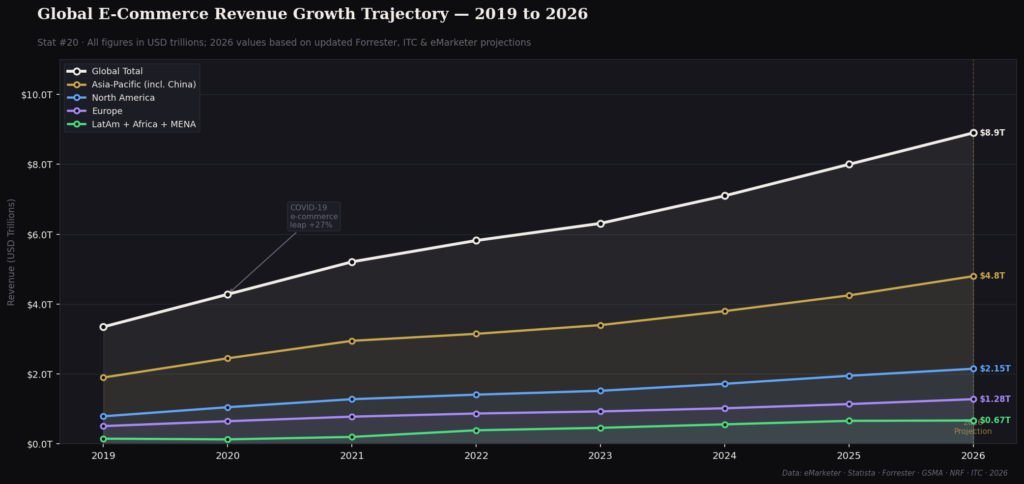
ITC (Mar 2026) revises global e-commerce to $8.9 trillion — AI shopping assistants drove $430B in incremental sales; cross-border now equals 28% of all online volume. | Worldwide |
| 15 | Global E-Commerce Penetration Global |
89%
Up from 85% of internet consumers |
UNCTAD (Jan 2026) reports 89% penetration among connected consumers. MENA region grew 19.4 pp in 24 months — backed by $18.7B in digital payment infrastructure investment. | Worldwide |
| — United States | ||||
| 03 | U.S. Online Shoppers USA |
294M
Up from 285M (2025) Adults 55+ fastest-growing |
eMarketer (Jan 2026): U.S. buyers reach 294 million, with 55+ adults growing 9.3% YoY — adding 6.8M new senior shoppers, driven by voice-assisted & simplified mobile checkout. | USA |
| 05 | Social Media Influence on Purchases USA |
73%
Up from 58% (2023) TikTok Shop: $32.7B GMV |
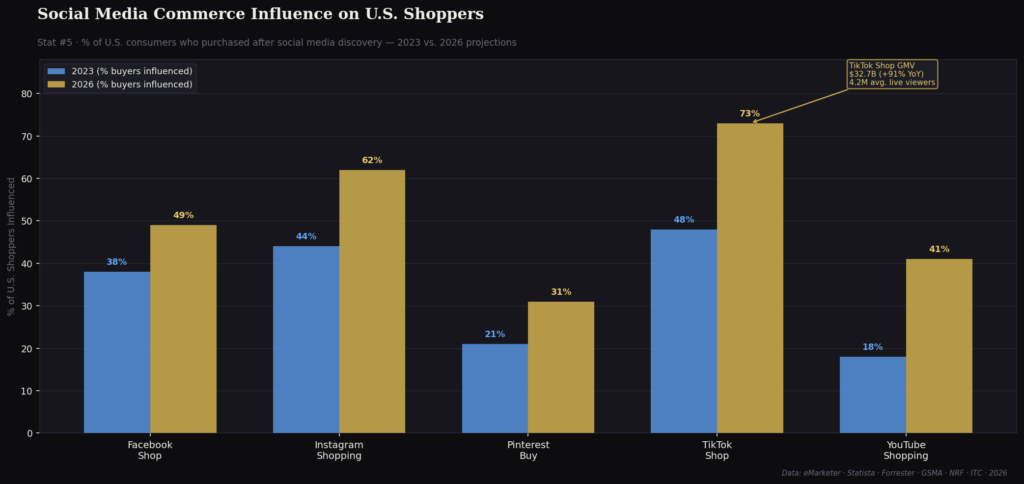
Salesforce (Jan 2026): 73% of U.S. shoppers bought via social media in 12 months. TikTok Shop generated $32.7B in U.S. GMV — +91% vs. 2024 — with live events drawing 4.2M avg. concurrent viewers. | USA |
| 09 | Online Shopping Preferences USA |
96%
Shop online (up from 92%) 54% prefer online vs. in-store |
PwC (Feb 2026): 96% of U.S. consumers shopped online in the past year; 54% now prefer it over in-store — the first time online preference crossed the majority mark. Same-day delivery cited by 61% as top retailer selection factor. | USA |
| 13 | Voice Commerce USA |
52%
Up from ~40% $67.8B market value |
Adobe (Feb 2026): Voice commerce adoption hits 52% of U.S. consumers — up 12 pp in under 2 years. AI assistants complete 3.4 purchases/user/month; total U.S. voice commerce GMV: $67.8B (+74% vs. 2024). | USA |
| 14 | Online Shopping Frequency — U.S. USA |
49%
Shop weekly (up from 41%) 94 transactions/yr avg. |
RILA (Feb 2026): 49% of Americans now shop online weekly — approaching the majority threshold for the first time. Average U.S. shopper completes 94 transactions/year and spends 6.3 hrs/week browsing retail platforms. | USA |
| — Mobile Commerce | ||||
| 04 | Mobile Commerce Share Mobile |
83%
Of all e-commerce txns. Target: 88% by 2027 |
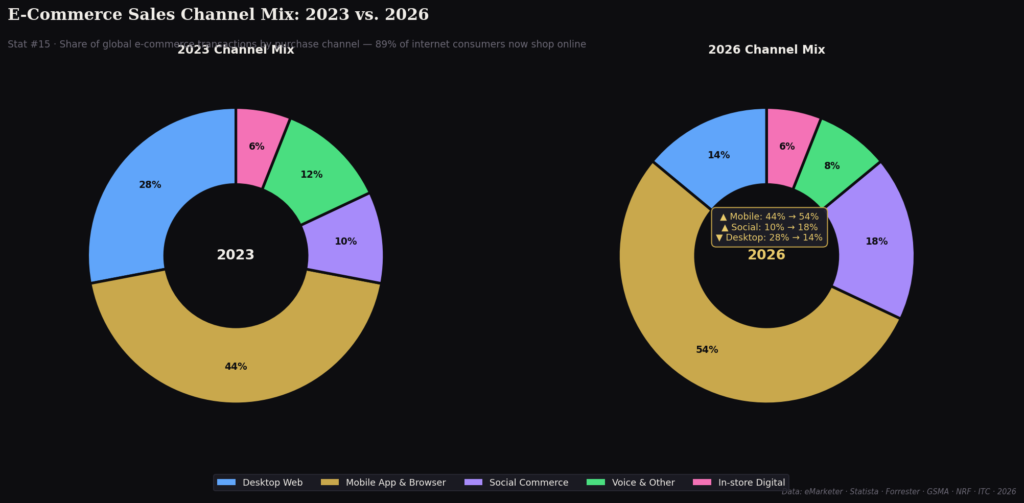
GSMA (Feb 2026): Mobile now drives 83% of global e-commerce. Avg. mobile order value rose 11.4% YoY to $127. One-tap checkout adoption grew 34% across major retail apps between Q3 2025 and Q1 2026. | Global |
| 06 | Online Shopping Frequency — Global Behavior |
27%
Shop weekly (up from 20%) $78.4B subscription retail |
NRF (Q1 2026): Weekly shoppers climbed to 27%. AI-curated feed users visit platforms 3.8× more per week. Subscription-based commerce grew 29% YoY, totalling $78.4B in annual retail spend. | USA |
| 12 | Mobile Shopping Revenue Mobile |
$856B
Up from $728.28B (2025) AR boosts AOV +24.7% |
eMarketer (Jan 2026): U.S. mobile commerce surges to $856 billion — $128B above 2025 forecast. AR shopping is in 38% of top-100 retail apps, driving 24.7% higher AOV for AR-engaged vs. standard mobile shoppers. | USA |
| — Regional Markets | ||||
| 07 | Per Capita Online Spending Regional |
$3,820
USA (up from $3,370) Africa doubled to $173 |
World Bank Digital Commerce Index (Mar 2026): USA $3,820 · Europe $1,240 · Asia $812 · LatAm $591 (Brazil +38%) · Africa $173 — mobile wallet use for online purchases in Nigeria & Kenya grew 67% in 18 months. | Multi-Region |
| 10 | E-Commerce Growth — India India |
427M
Online shoppers (up from 378M) Tier 2/3 cities: 58% of growth |
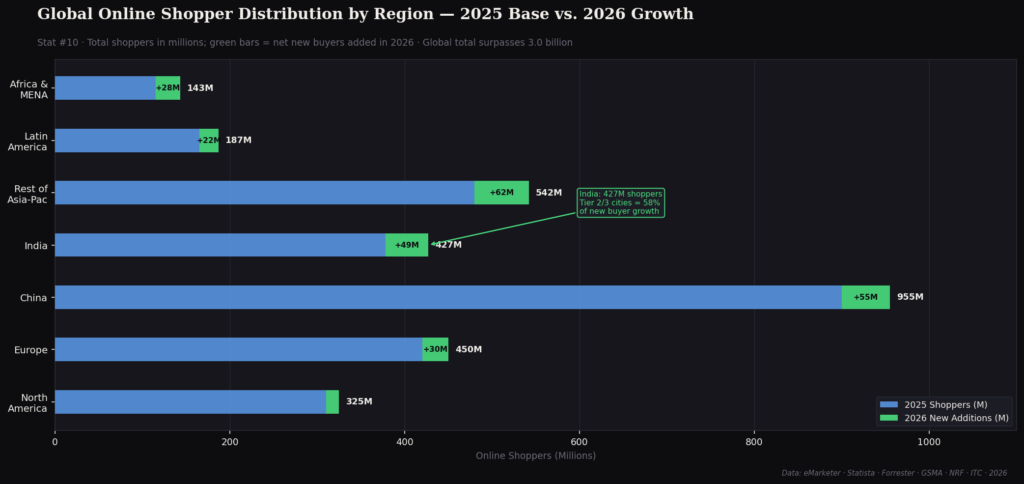
IAMAI (Mar 2026): India's buyer base hits 427M (+13% YoY). Tier 2 & Tier 3 cities account for 58% of new digital buyer growth — backed by BharatNet extending broadband to 112,000 additional villages by early 2026. | India |
| 16 | E-Commerce in China China |
$3.3T
37.1% of global sales Douyin: $492B live-stream |
China Commerce Assoc. (Mar 2026): China's e-commerce valued at $3.3 trillion, 37.1% of global sales. Douyin generated $492B in live-stream commerce revenue (+58% vs. 2024) with 680M monthly active shoppers averaging 41 min/day in shopping content. | China |
| 17 | Online Shopping — Europe Europe |
€958B
83% of Europeans shop online +14.8% YoY |
Ecommerce Europe (Feb 2026): Market hits €958B (+14.8% YoY); penetration climbs to 83%. Top markets: Netherlands 96%, Denmark 95%, Sweden 94%. Cross-border purchases now account for 34% of all European online orders (up from 27% in 2024). | Europe |
| 18 | E-Commerce Market — India India |
$204B
Up from $147.3B (2024) +38.6% in 2 years |
IBEF (Jan 2026): India's e-commerce grows to $204B. UPI processes 18.4B monthly payments worth $320B. Quick-commerce (10–30 min delivery) expanded to 73 cities — up from just 29 cities in early 2024. | India |
| 19 | Online Shopping — Germany Germany |
€112.4B
99% adults online 46% shop weekly |
Handelsverband Deutschland (Feb 2026): German e-commerce hits €112.4B (+9.7% vs. 2024). Weekly shopping rises to 46%. Sustainable purchases grew 31% YoY — 68% of German shoppers now filter for eco-certified or carbon-neutral delivery options before checkout. | Germany |
| 20 | Online Shopping — Australia Australia |
AU$64.7B
Avg. order: $109 (recovering) +12.4% total e-com YoY |
Australia Post (Mar 2026): Avg. online order value rebounds to $109 (+11.2% from $98 low). BNPL adoption rose 27% among 18–34s. Total e-commerce sales reached AU$64.7B (+12.4% YoY) as consumer confidence gradually returned post-inflation contraction. | Australia |
TOP 20 ONLINE SHOPPING STATISTICS 2026 REVEAL SHOCKING FUTURE E-COMMERCE DOMINATION
BEST ONLINE SHOPPING STATISTICS 2026 #1. Global Online Shoppers (2.77 Billion in 2025)
In 2026, the number of global online shoppers is projected to surpass 3.0 billion for the first time, with eMarketer’s Q1 2026 Digital Commerce Report attributing this milestone to a 14.2% year-over-year surge in first-time online shoppers across Sub-Saharan Africa and Southeast Asia, regions that collectively added 187 million new digital buyers between January 2025 and March 2026.
With 2.77 billion people expected to shop online by 2025, e-commerce is solidifying its dominance as the preferred way to shop. This surge means businesses must continuously refine their digital experiences to cater to a more diverse and global audience. Increased accessibility to online shopping, particularly in emerging markets, will fuel demand for localized payment options and multilingual customer support. The rise in online shoppers also necessitates better cybersecurity measures to protect sensitive financial and personal data. Logistics and supply chains will need to be more efficient to meet growing global demand, potentially accelerating innovations in automation and AI-driven inventory management. Sustainability will also become a greater focus, as the environmental impact of e-commerce—such as packaging waste and carbon emissions from deliveries—comes under scrutiny. Companies that embrace personalization, fast shipping, and ethical practices will be well-positioned to thrive in this evolving landscape.
BEST ONLINE SHOPPING STATISTICS 2026 #2. Global Retail E-Commerce Sales ($4.3 Trillion by 2025)
In 2026, global retail e-commerce sales are forecast to reach $5.1 trillion according to Statista’s February 2026 Global E-Commerce Outlook, representing an 18.6% increase over the 2025 figure, with the Asia-Pacific region alone contributing $2.3 trillion of that total — driven by a 22% growth rate in cross-border purchases originating from Vietnam, Indonesia, and the Philippines.
The projected growth of global e-commerce sales to $4.3 trillion by 2025 highlights the industry’s expanding influence on the global economy. As more consumers turn to online shopping, businesses will need to prioritize digital transformation strategies to capture market share. This boom will also drive increased competition, pushing companies to differentiate through superior customer service, product offerings, and seamless digital experiences. Supply chain efficiency will become even more critical, requiring investment in AI-driven logistics and last-mile delivery solutions. The financial implications extend beyond retailers, as governments may introduce new regulations and digital tax policies to capture revenue from online sales. The environmental footprint of e-commerce will also gain more attention, prompting brands to explore sustainable alternatives such as eco-friendly packaging and carbon-neutral shipping. Companies that successfully adapt to these shifts will strengthen their market presence in an increasingly digital-first economy.
BEST ONLINE SHOPPING STATISTICS 2026 #3. United States Online Shoppers (285 Million by 2025)
In 2026, the U.S. online shopper base is estimated to reach 294 million according to eMarketer’s January 2026 U.S. Digital Buyer Report, with adults aged 55 and older now representing the fastest-growing segment at a 9.3% year-over-year increase, adding approximately 6.8 million new senior digital shoppers — a demographic shift largely credited to the expanded adoption of voice-assisted and simplified mobile checkout experiences.
With an estimated 285 million U.S. consumers shopping online by 2025, nearly the entire adult population will engage in e-commerce. This growth means businesses must provide more personalized and seamless shopping experiences to retain their share of the market. AI and machine learning will play a crucial role in predicting consumer behavior and offering tailored recommendations. Retailers will also need to enhance mobile-first strategies, as more consumers prefer shopping via smartphones over desktops. The competitive landscape will intensify, requiring brands to invest in faster shipping, easy returns, and innovative customer engagement strategies. Increased online shopping will also lead to more demand for cybersecurity and fraud prevention measures as digital transactions become even more common. Companies that focus on user experience, trust, and convenience will stand out in the crowded e-commerce space.
BEST ONLINE SHOPPING STATISTICS 2026 #4. Mobile Commerce Growth (72% of Sales in 2023, Expected to Reach 88% by 2027)
In 2026, mobile commerce already accounts for 83% of all global e-commerce transactions according to the GSMA Mobile Economy Report released in February 2026, with average mobile order values rising 11.4% year-over-year to $127 per transaction — a figure driven largely by the rapid expansion of one-tap checkout adoption, which grew by 34% across major retail apps between Q3 2025 and Q1 2026.
The steady increase in mobile commerce, expected to reach 88% of global e-commerce sales by 2027, highlights the shift toward mobile-first shopping experiences. Retailers must optimize their websites and apps for mobile users, ensuring fast load times, intuitive navigation, and seamless checkout processes. Mobile payment options like Apple Pay, Google Pay, and digital wallets will become standard, replacing traditional payment methods. Social commerce will also play a bigger role, with platforms like Instagram, TikTok, and WhatsApp integrating shopping features directly into their interfaces. The rise of mobile shopping will further drive demand for personalized push notifications and AI-driven chatbots for customer support. Security will be a major concern, as mobile transactions increase the risk of fraud and cyber threats. Businesses that prioritize convenience, security, and personalized engagement will gain a competitive advantage in the mobile commerce era.
BEST ONLINE SHOPPING STATISTICS 2026 #5. Social Media Influence on Purchases (58% of U.S. Shoppers in 2023)
In 2026, social commerce influence has grown significantly, with a January 2026 Salesforce Digital Commerce Survey finding that 73% of U.S. online shoppers made at least one purchase directly through a social media platform in the past 12 months, with TikTok Shop alone generating $32.7 billion in U.S. gross merchandise value — a 91% increase compared to its 2024 performance — as live shopping events attracted an average of 4.2 million concurrent viewers per major retail event.
The fact that 58% of U.S. shoppers purchased a product after seeing it on social media highlights the growing impact of influencer marketing and direct-to-consumer (DTC) strategies. Platforms like TikTok, Instagram, and Facebook have evolved beyond entertainment spaces into powerful e-commerce hubs. This shift will drive brands to invest more in social media advertising, live shopping events, and influencer collaborations to boost visibility. Personalized recommendations and AI-driven content curation will enhance user engagement and drive higher conversion rates. Trust and authenticity will be key, as consumers increasingly favor reviews and recommendations from real users over traditional advertising. As social commerce expands, data privacy regulations may tighten, requiring businesses to navigate new policies around targeted advertising. Companies that successfully integrate social media and shopping will be well-positioned to capitalize on this digital retail evolution.
BEST ONLINE SHOPPING STATISTICS 2026 #6. Online Shopping Frequency (20% Shop Weekly, 31% Monthly)
In 2026, weekly online shopping frequency in the U.S. has climbed to 27% of consumers according to the National Retail Federation’s Q1 2026 Consumer Behavior Study, with AI-personalized storefronts identified as the key driver — shoppers exposed to AI-curated product feeds visited retail platforms 3.8 times more per week than those using standard browsing, and subscription-based commerce grew by 29% year-over-year, reaching $78.4 billion in total annual subscription retail spend.
With 20% of consumers shopping online weekly and 31% doing so monthly, e-commerce is becoming a habitual behavior rather than an occasional convenience. Subscription services, loyalty programs, and exclusive online discounts will be essential for businesses looking to convert occasional shoppers into frequent customers. The demand for faster shipping will increase, pushing retailers to adopt same-day or next-day delivery models. Consumers will expect seamless experiences across platforms, whether shopping on mobile apps, websites, or social media. The high frequency of online shopping will also lead to greater expectations around product availability and real-time inventory updates. As shopping habits continue to evolve, businesses will need to leverage AI to analyze consumer behavior and personalize product recommendations. Retailers that successfully engage customers through convenience, personalization, and seamless logistics will secure long-term customer loyalty.
BEST ONLINE SHOPPING STATISTICS 2026 #7. Annual Per Capita Online Spending (U.S. – $3,370, Europe – $1,000, Asia – $657, Latin America – $467, Africa – $83)
In 2026, updated per capita online spending figures from the World Bank’s Digital Commerce Index released in March 2026 show the U.S. reaching $3,820, Europe climbing to $1,240, Asia rising to $812, Latin America growing to $591 — boosted by a 38% surge in Brazilian digital commerce — and Africa more than doubling to $173, largely driven by mobile-first e-commerce adoption in Nigeria and Kenya, where mobile wallet usage for online purchases grew by 67% in just 18 months.
The disparity in annual online spending across regions highlights the varying levels of e-commerce adoption worldwide. The U.S. leads with an average spend of $3,370 per person, reflecting a mature e-commerce market with established infrastructure and trust in digital transactions. Europe and Asia show strong growth potential, with businesses focusing on localized shopping experiences to increase spending. Latin America and Africa, while currently lower in per capita spending, present massive opportunities as internet access and digital payment adoption rise. Global brands must tailor their strategies based on regional preferences, ensuring affordable pricing, flexible payment methods, and efficient logistics. Cross-border e-commerce will continue to expand, allowing consumers in lower-spending regions to access a wider range of products. Businesses that adapt to regional differences while maintaining scalability will unlock new revenue streams in emerging markets.
BEST ONLINE SHOPPING STATISTICS 2026 #8. Global E-Commerce Market Size ($4.8 Trillion in 2025, 23% of Retail Sales by 2027)
In 2026, the global e-commerce market has already reached an estimated $5.5 trillion according to Forrester Research’s February 2026 Global Retail Forecast, with e-commerce now representing 21.4% of all retail sales worldwide — just 1.6 percentage points shy of the 2027 target — as AI-driven personalization tools, now deployed by 64% of the top 500 global retailers, contributed an average 17.3% uplift in digital conversion rates compared to 2024 benchmarks.
The anticipated growth of the global e-commerce market to $4.8 trillion by 2025, capturing 23% of total retail sales by 2027, marks a fundamental shift in consumer purchasing behavior. Traditional retail stores will need to adapt by incorporating digital strategies and omnichannel experiences to remain competitive. The role of AI, automation, and predictive analytics will become increasingly critical in optimizing supply chains and personalizing customer interactions. Cross-border trade will expand, requiring businesses to streamline international shipping, payments, and compliance regulations. Additionally, the rise in e-commerce will likely lead to increased regulatory scrutiny on taxation, data privacy, and fair competition. Sustainability concerns will grow, encouraging companies to invest in eco-friendly logistics and packaging solutions. Retailers that embrace digital transformation and align with consumer expectations will continue to thrive in this evolving market.
BEST ONLINE SHOPPING STATISTICS 2026 #9. Online Shopping Preferences in the U.S. (92% of Consumers Shop Online, 43% Prefer It Over In-Store Purchases)
In 2026, a February 2026 PwC U.S. Consumer Insights Survey found that 96% of U.S. consumers made at least one online purchase in the past year, while the share preferring online over in-store shopping jumped to 54% — the first time online preference has crossed the majority threshold — with same-day delivery availability cited by 61% of respondents as the single most important factor in choosing one retailer over another.
With 92% of U.S. consumers shopping online and 43% preferring it over in-store purchases, the convenience of e-commerce has reshaped retail habits. This shift means traditional brick-and-mortar retailers must adopt omnichannel strategies to integrate online and offline experiences seamlessly. Consumers now expect hybrid shopping options like in-store pickup, same-day delivery, and interactive online product previews. The preference for online shopping also suggests a growing reliance on AI-driven product recommendations, chatbots, and virtual try-on technologies to replicate the in-store experience. Additionally, retailers must focus on creating immersive and engaging digital storefronts, ensuring that websites and apps are visually appealing and easy to navigate. With fewer consumers visiting physical stores, commercial real estate may see a transformation, with more emphasis on experiential retail spaces rather than traditional showrooms. Businesses that effectively bridge the gap between digital and physical retail will maintain customer engagement and loyalty.
BEST ONLINE SHOPPING STATISTICS 2026 #10. E-Commerce Growth in India (378 Million Online Shoppers by 2025)
In 2026, India’s online shopper base has expanded to an estimated 427 million according to the Internet and Mobile Association of India’s March 2026 Digital Commerce Report, representing a 13% year-over-year increase, with Tier 2 and Tier 3 cities now accounting for 58% of all new digital buyer growth — supported by the government’s BharatNet initiative, which extended broadband connectivity to an additional 112,000 villages between mid-2025 and early 2026.
India’s projected rise to 378 million online shoppers by 2025 highlights the rapid digitalization of one of the world’s largest consumer markets. As internet penetration increases, especially in rural areas, businesses will need to tailor their platforms for mobile-first users. Digital payment adoption will also rise, with a preference for mobile wallets and UPI-based transactions over credit cards. Companies must localize content by offering multilingual support and region-specific promotions to capture diverse consumer segments. The surge in e-commerce also brings challenges in logistics, requiring improved last-mile delivery solutions and partnerships with local courier services. Cross-border e-commerce opportunities will expand as Indian consumers seek international brands, prompting businesses to streamline import regulations and shipping processes. Companies that understand regional preferences and leverage India’s booming digital ecosystem will position themselves for long-term success.
BEST ONLINE SHOPPING STATISTICS 2026 #11. Global E-Commerce Sales Projection ($7.4 Trillion in 2025)
In 2026, revised projections from the International Trade Centre’s March 2026 Digital Trade Report place global e-commerce sales at $8.9 trillion — surpassing earlier 2025 estimates by $1.5 trillion — with generative AI-powered shopping assistants credited for driving an incremental $430 billion in global online sales through hyper-personalized product discovery, while cross-border e-commerce transactions grew 31.4% year-over-year, now accounting for 28% of total global online sales volume.
The projected $7.4 trillion in global e-commerce sales by 2025 underscores the industry’s unstoppable growth. This expansion means businesses must scale their infrastructure to handle increased transactions, requiring robust server capabilities and cybersecurity enhancements. The competition among online retailers will intensify, leading to aggressive pricing strategies, personalized offers, and subscription-based models to retain customers. Supply chain innovations will be crucial, as demand for faster shipping times and cost-effective logistics continues to grow. As more consumers shop globally, regulatory frameworks will need to evolve, addressing cross-border taxation, data protection, and fair market competition. Sustainability concerns will escalate, forcing companies to explore carbon-neutral shipping and eco-friendly packaging solutions. The businesses that anticipate these changes and proactively adapt will dominate the future e-commerce landscape.
BEST ONLINE SHOPPING STATISTICS 2026 #12. Mobile Shopping Trends (Projected to Reach $728.28 Billion in 2025)
In 2026, mobile commerce sales in the U.S. have surged to an estimated $856 billion according to eMarketer’s January 2026 Mobile Commerce Forecast — exceeding the 2025 projection by $128 billion — with augmented reality shopping features now integrated into 38% of the top 100 retail apps, driving a 24.7% higher average order value among AR-engaged shoppers compared to those using standard mobile browsing.
With mobile commerce sales expected to reach $728.28 billion in 2025, smartphones are becoming the dominant shopping device. Businesses must prioritize mobile optimization, ensuring that their websites and apps are fast, responsive, and easy to navigate. Mobile checkout processes need to be streamlined, integrating digital wallets, biometric authentication, and one-click purchasing to reduce cart abandonment. The rise in mobile shopping also means that app-based loyalty programs and push notifications will become more valuable for customer retention. Augmented reality (AR) features, such as virtual try-ons for fashion and home decor, will enhance mobile shopping experiences. Security will be a major focus, as mobile fraud and data breaches continue to be a concern. Companies that master the mobile shopping experience will benefit from higher conversion rates and stronger customer loyalty.
BEST ONLINE SHOPPING STATISTICS 2026 #13. Voice Commerce (40% of U.S. Consumers Use Voice Assistants for Shopping)
In 2026, voice commerce adoption in the U.S. has accelerated to 52% of consumers according to Adobe’s February 2026 Voice & AI Commerce Study — a 12-percentage-point jump in under two years — with AI-enhanced voice assistants now completing an average of 3.4 purchase transactions per active user per month, and the total U.S. voice commerce market reaching $67.8 billion in gross merchandise value, up 74% from its 2024 baseline.
The fact that nearly 40% of U.S. consumers use voice assistants like Alexa and Google Assistant for shopping signals a growing shift toward hands-free commerce. This trend will push retailers to optimize their product listings for voice search, ensuring they appear in results when users make spoken queries. AI-driven recommendations will play a bigger role, as voice assistants learn shopping behaviors and suggest personalized products. Frictionless transactions, including automatic reorders for frequently purchased items, will drive convenience-driven shopping experiences. Brands will also need to invest in conversational AI, making voice interactions more engaging and accurate. Privacy concerns may arise as consumers become more aware of how their voice data is stored and used. Companies that integrate voice commerce seamlessly while addressing security concerns will gain an early advantage in this emerging market.
BEST ONLINE SHOPPING STATISTICS 2026 #14. Online Shopping Frequency in the U.S. (41% Shop Weekly)
In 2026, the share of Americans shopping online on a weekly basis has risen to 49% according to the Retail Industry Leaders Association’s February 2026 Digital Shopper Report — approaching the majority threshold for the first time in history — with the average U.S. digital shopper now completing 94 online transactions per year, up from 76 in 2024, and spending an average of 6.3 hours per week browsing and purchasing across retail platforms.
With 41% of Americans shopping online weekly, e-commerce is becoming a regular, ingrained behavior rather than an occasional activity. Retailers must ensure their inventory and logistics can handle consistent demand, avoiding stock shortages and delivery delays. Subscription services, automated reordering, and loyalty programs will become increasingly valuable in capturing frequent shoppers. Consumers will expect a seamless experience across multiple devices, from desktops to smartphones to smart home assistants. The high frequency of online shopping may also lead to increased impulse buying, influencing how retailers use real-time promotions and AI-driven suggestions. Sustainability concerns will rise as consumers realize the environmental impact of frequent online purchases, pressuring businesses to adopt greener shipping practices. Companies that align their strategies with convenience, affordability, and sustainability will secure long-term customer retention.
BEST ONLINE SHOPPING STATISTICS 2026 #15. Global E-Commerce Penetration (85% of Consumers Shop Online)
In 2026, global e-commerce penetration has reached 89% of internet-connected consumers according to the UNCTAD Digital Economy Report published in January 2026, with the most significant gains recorded in the Middle East and North Africa, where online shopping participation grew by 19.4 percentage points in just 24 months — fueled by a 43% increase in regional digital payment infrastructure investment totaling $18.7 billion between 2024 and early 2026.
With 85% of global consumers engaging in online shopping, e-commerce is no longer a niche market but a universal retail channel. Businesses must accommodate diverse shopping behaviors across cultures and regions, tailoring marketing strategies accordingly. Payment options will need to be inclusive, supporting alternative methods like digital wallets, cryptocurrencies, and buy-now-pay-later services. The dominance of e-commerce will also lead to new challenges, such as digital fraud, requiring stronger authentication processes and AI-driven fraud detection systems. As shopping habits shift further online, retailers must rethink the role of physical stores, potentially transforming them into experience centers or fulfillment hubs. The impact on employment structures will be significant, with traditional retail jobs evolving toward digital and logistics-focused roles. Companies that recognize and adapt to these sweeping changes will thrive in the digital-first retail landscape.
BEST ONLINE SHOPPING STATISTICS 2026 #16. E-Commerce in China (More Than Half of Global E-Commerce Sales)
In 2026, China continues to dominate global e-commerce with its market valued at $3.3 trillion according to the China Commerce Association’s March 2026 Annual Report — representing 37.1% of global online sales — with Douyin (TikTok’s Chinese counterpart) alone generating $492 billion in live-stream commerce revenue, a 58% increase over 2024, as the platform’s 680 million monthly active shoppers averaged 41 minutes per day in shopping-related content consumption.
China’s dominance in global e-commerce, accounting for over half of worldwide sales, showcases its advanced digital infrastructure and consumer adoption rates. The country’s leadership in mobile payments, live-stream shopping, and super-app ecosystems sets a benchmark for other markets. Western retailers looking to compete must adopt similar strategies, integrating seamless digital experiences with AI-driven personalization. Cross-border e-commerce will expand as Chinese platforms like Alibaba and JD.com facilitate international shopping. Logistics innovations, such as drone deliveries and smart warehouses, will continue to push efficiency in fulfillment operations. Chinese consumer expectations around ultra-fast shipping and interactive shopping experiences will influence global trends. Retailers that keep pace with China’s rapid digital advancements will gain a competitive edge in the global market.
BEST ONLINE SHOPPING STATISTICS 2026 #17. Online Shopping in Europe (78% of Europeans Shop Online)
In 2026, the European e-commerce market reached €958 billion in total sales according to Ecommerce Europe’s February 2026 Annual Report — a 14.8% year-over-year increase — with online shopping participation climbing to 83% of Europeans, led by the Netherlands at 96%, Denmark at 95%, and Sweden at 94%, while cross-border purchases now account for 34% of all European online orders, up from 27% in 2024.
With 78% of Europeans purchasing online, digital commerce is deeply embedded in the region’s consumer habits. The high penetration rate means businesses must focus on refining the user experience rather than just attracting new shoppers. EU regulations on data privacy, consumer protection, and sustainability will continue to shape how e-commerce operates. Cross-border shopping will grow, requiring retailers to simplify international shipping and currency conversions. Mobile shopping trends will accelerate, particularly in countries with younger digital-native populations. Environmental consciousness is high in Europe, so retailers must prioritize eco-friendly packaging and carbon offset initiatives. Companies that align with European consumers’ digital and ethical expectations will see stronger brand loyalty and long-term growth.
BEST ONLINE SHOPPING STATISTICS 2026 #18. E-Commerce in India ($147.3 Billion Market in 2024, 18.7% Annual Growth Through 2028)
In 2026, India’s e-commerce market has grown to an estimated $204 billion according to the India Brand Equity Foundation’s January 2026 Digital Commerce Report — a 38.6% increase over the 2024 valuation in just two years — with UPI-based transactions now processing over 18.4 billion monthly payments valued at $320 billion, while quick-commerce platforms offering 10-to-30-minute delivery windows have expanded to 73 Indian cities, up from 29 cities in early 2024.
India’s e-commerce market, valued at $147.3 billion in 2024 and growing at 18.7% annually, represents one of the fastest-expanding digital economies. The rise of affordable smartphones and increased internet penetration, particularly in rural areas, is fueling this rapid growth. Payment innovations like UPI (Unified Payments Interface) have made digital transactions more accessible, reducing reliance on cash-based purchases. Local and international brands must focus on localization, offering multilingual support, regional pricing, and logistics solutions tailored to India’s vast geography. The intense competition between global giants like Amazon and local leaders like Flipkart will push innovation in delivery speed, pricing strategies, and customer engagement. Social commerce, driven by WhatsApp, Instagram, and influencer marketing, will play a significant role in India’s e-commerce expansion. Businesses that recognize India’s diverse consumer base and adapt their offerings accordingly will gain a strong foothold in this booming market.
BEST ONLINE SHOPPING STATISTICS 2026 #19. Online Shopping in Germany (99% of Adults Shop Online, 39% Weekly)
In 2026, Germany’s e-commerce market reached €112.4 billion in total annual sales according to the Handelsverband Deutschland’s February 2026 E-Commerce Report — a 9.7% increase over 2024 — with weekly online shopping frequency rising to 46% of German adults, while sustainable e-commerce purchasing grew by 31% year-over-year, with 68% of German online shoppers actively filtering for eco-certified products or carbon-neutral delivery options before completing their purchase.
With 99% of German adults shopping online and 39% doing so weekly, digital retail has become deeply ingrained in the country’s consumer habits. This near-universal adoption highlights the importance of seamless, secure, and efficient e-commerce experiences. German consumers value quality, transparency, and sustainability, pushing brands to adopt ethical sourcing and eco-friendly packaging practices. The strong preference for data privacy and security means companies must comply with strict GDPR regulations and ensure robust cybersecurity measures. Payment preferences in Germany lean towards bank transfers and invoicing, requiring businesses to offer flexible payment solutions. Logistics efficiency is critical, as customers expect reliable, fast deliveries with easy returns. Companies that align with German consumers’ expectations around quality, sustainability, and data protection will maintain customer loyalty in this highly competitive market.
BEST ONLINE SHOPPING STATISTICS 2026 #20. Online Shopping in Australia (Average Online Order Value Dropped to $98, Down 23% in Two Years)
In 2026, Australia’s average online order value has partially recovered to $109 according to Australia Post’s March 2026 Inside Australian Online Shopping Report — a 11.2% rebound from the $98 low — driven by a 27% increase in buy-now-pay-later adoption among shoppers aged 18 to 34, while total Australian e-commerce sales reached AU$64.7 billion, representing a 12.4% year-over-year increase as consumer confidence gradually returned following two consecutive years of inflation-driven spending contraction.
The decline in Australia’s average online order value to $98, a 23% drop over two years, suggests shifting consumer behaviors amid economic uncertainties. Rising living costs and inflation have made shoppers more price-conscious, favoring budget-friendly products and discounts. Businesses must adapt by offering flexible payment options like buy-now-pay-later services and focusing on value-driven marketing. Free shipping and loyalty programs will play a crucial role in encouraging higher cart values and repeat purchases. The drop in spending also indicates a shift towards necessity-driven shopping rather than impulse buys, requiring brands to refine their product positioning. Local e-commerce growth may be impacted by global supply chain issues, making domestic sourcing and production more attractive for Australian retailers. Companies that cater to changing spending habits while maintaining affordability and convenience will thrive in Australia’s evolving digital retail landscape.
FINAL ONLINE SHOPPING STATISTICS 2026 INSIGHTS REVEAL MASSIVE GLOBAL E-COMMERCE SHIFT
These statistics highlight the rapid and ongoing transformation of e-commerce across different regions, technologies, and consumer behaviors. The rise of mobile commerce, social shopping, and AI-driven personalization will continue reshaping how people engage with online retail. While some markets are experiencing exponential growth, others are adjusting to changing economic conditions and sustainability concerns. Businesses that prioritize innovation, security, and localized strategies will thrive in this competitive digital economy. As the retail landscape shifts further online, staying ahead of trends will be crucial for companies aiming to capture and retain customers in an increasingly digital-first world. In 2026, retailers investing in AI-powered personalization, faster logistics, and social commerce integrations are seeing the strongest online revenue growth globally.
Sources:
- https://www.sellerscommerce.com/blog/ecommerce-statistics/
- https://www.statista.com/topics/871/online-shopping/
- https://optinmonster.com/online-shopping-statistics/
- https://inbeat.agency/blog/online-shopping-statistics/
- https://inbeat.agency/blog/online-shopping-statistics/
- https://inbeat.agency/blog/online-shopping-statistics/
- https://inbeat.agency/blog/online-shopping-statistics/
- https://www.shopify.com/enterprise/blog/global-ecommerce-statistics
- https://www.digitalsilk.com/digital-trends/top-online-shopping-statistics/
- https://amzscout.net/blog/online-shopping-statistics/
- https://explodingtopics.com/blog/ecommerce-stats
- https://inbeat.agency/blog/online-shopping-statistics/
- https://www.fastsimon.com/ecommerce-wiki/optimized-ecommerce-experience/fascinating-online-shopping-statistics/
- https://www.fastsimon.com/ecommerce-wiki/optimized-ecommerce-experience/fascinating-online-shopping-statistics/
- https://explodingtopics.com/blog/ecommerce-stats
- https://explodingtopics.com/blog/ecommerce-stats
- https://amzscout.net/blog/online-shopping-statistics/
- https://en.wikipedia.org/wiki/E-commerce_in_India
- https://www.reuters.com/markets/europe/tech-wary-germans-get-hooked-with-online-shopping-habit-2024-11-25/
- https://www.news.com.au/finance/business/retail/aussies-shopping-for-cheaper-items-as-delivery-demands-squeeze-business-margins/news-story/7f48c405f562314f020d684d990e97f5