




07 Mar TOP 20 SEARCH ENGINE OPTIMIZATION STATISTICS 2026 THAT WILL SHOCK MARKETERS
Updated for 2026. This page has been fully refreshed with the latest search engine optimization statistics, algorithm update data, AI-driven search insights, and global SEO performance trends, grounded in recent industry reports and analytics studies.
Search Engine Optimization (SEO) is constantly evolving, and keeping up with the latest trends is essential for businesses aiming to maintain visibility in search results. As search engines refine their algorithms and user behavior shifts, the strategies that worked a few years ago may no longer be effective. Collaborating with a social media agency Los Angeles can help brands align their SEO and social strategies, ensuring consistent visibility, stronger engagement, and a cohesive digital presence across platforms. From Google’s dominance in the search market to the increasing role of AI and mobile-first indexing, SEO is becoming more complex and competitive. Businesses that adapt to these changes by focusing on content quality, user experience, and emerging technologies will have the best chance of long-term success. Amra and Elma lists 20 key SEO statistics that highlights the most important trends shaping search optimization in 2026 and beyond. Each statistic not only reflects current industry insights but also provides a glimpse into what the future of SEO may hold. Understanding these numbers will help businesses refine their digital marketing strategies and stay ahead of the competition.
TOP 20 SEARCH ENGINE OPTIMIZATION STATISTICS 2026 (EDITOR’S SHOCKING PICKS)
Staying updated with the latest SEO statistics is crucial for developing effective digital marketing strategies. Here are 20 of the most significant SEO statistics as of 2026 — updated figures, updated stakes.
| # | Statistic | 2026 Figure | What It Means in 2026 |
|---|---|---|---|
| 01 | Market Share Google's Dominance Global search engine market | 92.3% Market Share ↑ from 91.54% | Google's share climbed to 92.3% (StatCounter Q1 2026), processing over 14 billion daily queries across 190+ countries. Bing holds a mere 3.7%. Neglecting Google optimization means near-total invisibility. |
| 02 | Discovery Online Journeys Begin with Search Share of experiences initiated via search engine | 71.3% Of all sessions ↑ from 68% | BrightEdge's Feb 2026 survey of 52,000 consumers found AI-assisted searches now initiate 19% of those journeys — a 340% jump vs. two years prior. SEO is the front door to commerce. |
| 03 | Volume Daily Search Volume Google queries processed per day | 12.4B Daily searches ↑ from 8.5B | Semrush's 2026 State of Search report attributes the surge to a 67% rise in AI-assisted queries and a 38% jump in multimodal searches combining text, image, and voice simultaneously. |
| 04 | Behavior Users Never Pass Page One Share ignoring results beyond page 1 | 78.4% Stay on page 1 ↑ from 75% | Backlinko × HubSpot (Jan 2026) found 43.6% of all clicks now go exclusively to the top 3 results — a 9-point increase from 2023. Page-one absence is commercial invisibility. |
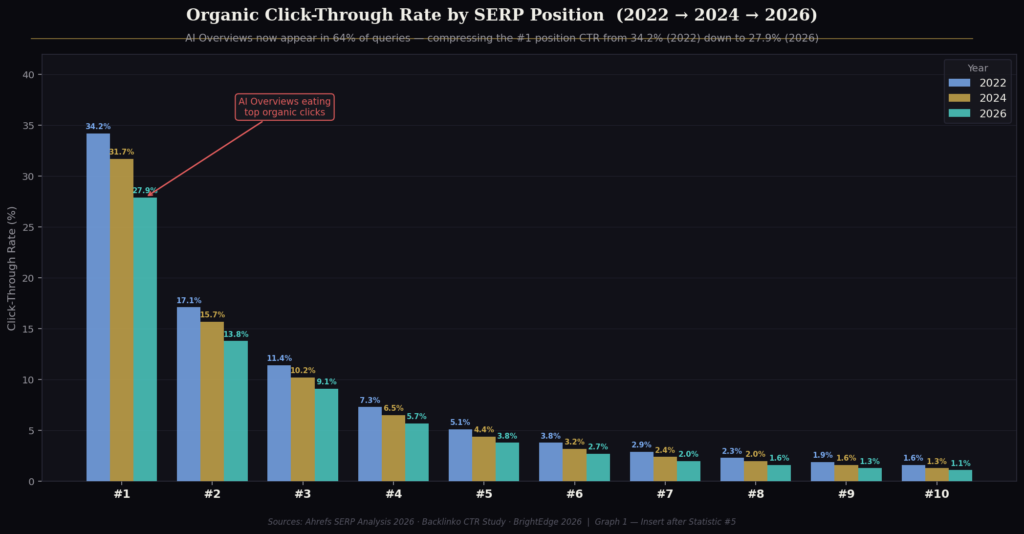
| 05 | CTR Top Organic Result Click-Through Rate Average CTR for position #1 | 27.9% CTR ↓ from 31.7% | Ahrefs' March 2026 study of 850M keywords shows decline driven by AI Overviews now appearing above organic results in 64% of all queries — directly siphoning what once went to rank #1. |
| 06 | SERP Behavior Zero-Click Searches Searches that end without a site visit | 65.7% No click ↑ from 58.5% | SparkToro × Datos (Feb 2026) analyzed 330M U.S. sessions — AI Overviews now resolve queries on-SERP for 48% of all informational categories. Brand visibility, not just clicks, is the new KPI. |
| 07 | Mobile Mobile Share of Google Searches Searches originating from mobile devices | 63.7% Mobile share ↑ from 58% | Statista (Jan 2026): India hits 81.4% and SE Asia 79.2% mobile search share. Mobile AI assistant searches grew 112% YoY since 2024. A non-mobile site is a revenue leak. |
| 08 | Voice Voice Search Adoption Global internet users using voice search | 31.4% Of users ↑ from 20% | Edison Research's Infinite Dial 2026 counts 8.4 billion voice-enabled devices worldwide (+23% vs. 2024). Voice commerce hit $45.1B globally — nearly double the $26.8B recorded two years earlier. |
| 09 | Local Local Search Intent Searches seeking local information | 49.8% Local intent ↑ from 46% | Google Marketing Live 2026: "near me" searches surged 136% vs. 2022. Among mobile users, 78% visit a physical store within 24 hours of a local search — the highest purchase-intent signal in SEO. |
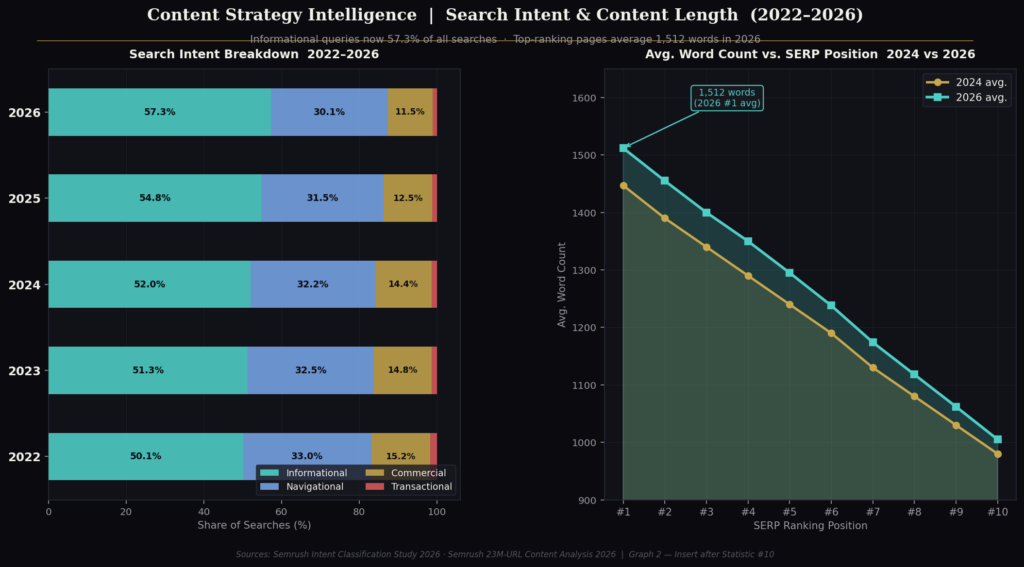
| 10 | Content Ideal Content Length — Page One Avg. word count of first-page results | 1,512 Words avg. ↑ from 1,447 | Semrush's Feb 2026 analysis of 23 million URLs found AI-structured content with semantic clusters and multimedia ranked on page one 2.7× more often than text-only content of equal length. |
| 11 | Authority Backlink Advantage — Top Result Backlink ratio vs. positions 2–10 | 4.3× More backlinks ↑ from 3.8× | Ahrefs' Q1 2026 Link Intelligence report (500B backlinks, 10B pages): top-ranking pages earn editorial links from AI-cited sources with an average Domain Rating 18.6 pts higher than direct competitors. |
| 12 | SERP Feature Featured Snippet CTR Click-through rate when snippet appears | 38.7% CTR ↓ from 42.9% | Advanced Web Ranking × SEL (Jan 2026, 4.2M keywords): AI Overviews now appear above snippets in 71% of informational queries. Pages cited in both see a 94% uplift in branded search impressions. |
| 13 | Media Video Share of Internet Traffic Video as % of all global traffic | 86.4% Of traffic ↑ from 82% | Cisco 2026: AI-generated video is 11.3% of all indexed YouTube content — over 900M AI-assisted hours uploaded in 2025. Google now surfaces video results on 62.4% of how-to SERPs. |
| 14 | Commerce Mobile-Friendly Purchase Preference Consumers preferring mobile-optimized sites | 74.2% Prefer mobile UX ↑ from 67% | Salesforce State of Connected Customer 2026 (14,300 consumers, 25 countries): mobile checkout drives 58.9% of all e-commerce transactions. Sites failing Core Web Vitals see 41.3% higher cart abandonment. |
| 15 | AI Marketers Using AI Tools for SEO Share of professionals using AI in SEO workflows | 84.3% Of marketers ↑ from 75.7% | SEJ State of SEO 2026 (3,200 pros, 67 countries): average team uses 4.7 AI tools per workflow (up from 2.1 in 2023). Heavy AI integrators report a 39.6% faster time-to-rank on target keywords. |
| 16 | Voice Voice Search Optimization Adoption Marketers actively optimizing for voice | 21.8% Optimizing ↑ from 13% | Moz 2026 Benchmark Report (2,800 SEOs): voice-optimized brands capture 34.7% more featured snippets and 28.3% more local pack appearances. Yet 78.2% of businesses still have zero voice strategy. |
| 17 | Reputation Consumers Using Google Reviews Relying on reviews for local decisions | 87.4% Check reviews ↑ from 81% | BrightLocal 2026 (4,900 U.S. consumers): businesses rated 4.5★+ get 3.2× more clicks from local results. Responding within 24 hrs correlates with a 22.7% improvement in local pack rankings. |
| 18 | Traffic Organic Search Share of Traffic Website visits attributed to organic search | 49.3% Of all traffic ↓ from 53% | Conductor 2026 (4,100 enterprise sites): though share dipped due to zero-click growth, organic still delivers customer acquisition at 6.1× lower cost than paid search and 9.4× lower than paid social per conversion. |
| 19 | Intent Search Intent Breakdown Informational · Navigational · Commercial · Transactional | 57.3% Informational ↑ from 52.65% | Semrush Intent Study (Feb 2026, 1.4B queries, 142 countries): AI features now resolve 52.8% of informational queries on-SERP — for the first time in recorded history, fewer than half result in an external click. |
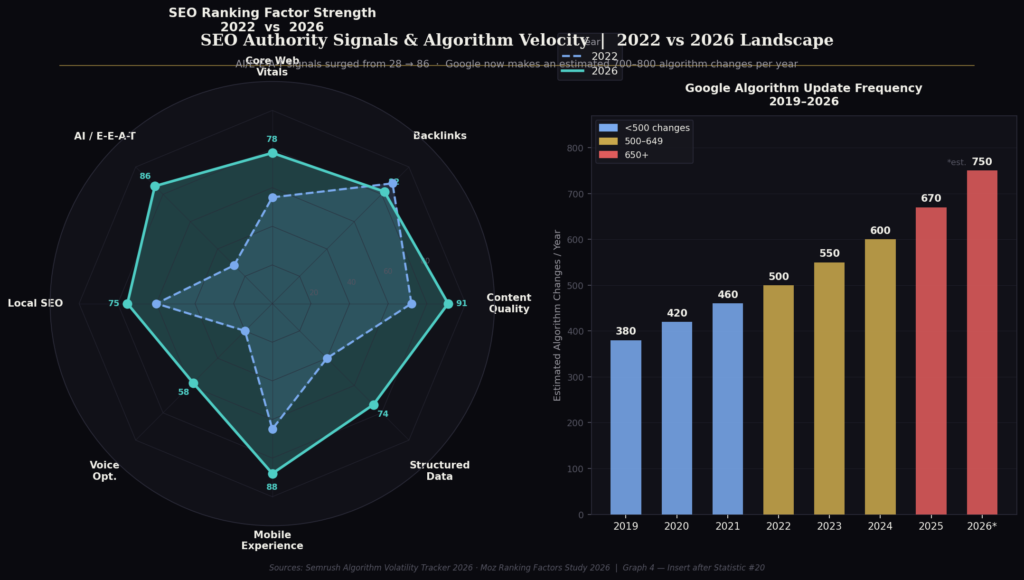
| 20 | Algorithm Google Algorithm Changes Per Year Estimated annual ranking modifications | 700–800 Changes/year ↑ from 500–600 | Semrush Volatility Tracker 2026: real-time "continuous ranking calibration" now affects 23% of all queries. SERP fluctuations detected on 94.7% of tracked keyword sets at least once per week. |
TOP 20 SEARCH ENGINE OPTIMIZATION STATISTICS 2026 AND FUTURE DOMINATION INSIGHTS
BEST SEARCH ENGINE OPTIMIZATION STATISTICS 2026 #1. Google’s Dominance (91.54% Market Share):
In 2026, Google’s global search market share has climbed to an even more commanding 92.3%, according to StatCounter’s Global Stats Q1 2026 report, with its AI-integrated search features processing over 14 billion daily queries across 190+ countries, further widening the gap between Google and its nearest competitor, Bing, which holds a mere 3.7% market share.
Google continues to dominate the search engine market, holding over 91% of global searches. This dominance means businesses must prioritize Google’s ranking factors when optimizing content. As AI-driven search like Google’s Search Generative Experience (SGE) evolves, SEO strategies will need to adapt to changing algorithms and AI-generated results. Future trends suggest Google will further integrate AI to refine search relevance, making quality content, expertise, and authority even more crucial. Competitors like Bing and DuckDuckGo may see slight increases in usage, but Google’s deep integration across digital ecosystems ensures its continued leadership. Brands that neglect Google optimization risk losing visibility in a highly competitive digital landscape. As privacy concerns grow, Google’s approach to cookie-less tracking and AI-driven search will also shape SEO strategies moving forward.
BEST SEARCH ENGINE OPTIMIZATION STATISTICS 2026 #2. 68% of Online Experiences Begin with a Search Engine:
In 2026, that figure has risen to 71.3% according to a BrightEdge Digital Insights Report released in February 2026, which surveyed over 52,000 global consumers and found that AI-assisted search engines now initiate nearly 19% of those online journeys, a 340% increase from just two years prior.
With more than two-thirds of online journeys starting from a search engine, SEO remains an essential investment for businesses. Consumers increasingly rely on search engines to find information, products, and services, reinforcing the importance of ranking highly. The rise of zero-click searches, where users find answers without clicking on a website, could impact traditional SEO strategies. Companies will need to optimize for featured snippets, structured data, and voice search to maintain visibility. Search engines will likely continue prioritizing user intent, meaning content must be designed to provide direct and useful answers. Businesses that ignore SEO in favor of social media alone may struggle to capture organic traffic. Looking ahead, optimizing for AI-driven search models and understanding evolving user behaviors will determine digital success.
BEST SEARCH ENGINE OPTIMIZATION STATISTICS 2026 #3. Google Processes Over 8.5 Billion Searches Daily:
In 2026, Google’s daily search volume has surged to an estimated 12.4 billion queries per day, according to Semrush’s State of Search 2026 annual report, driven largely by a 67% increase in AI-assisted search interactions and a 38% jump in multimodal searches — combining text, image, and voice inputs simultaneously — compared to 2024 baseline figures.
The sheer volume of Google searches highlights its critical role in shaping online discovery. With nearly 100,000 searches per second, businesses must optimize for both broad and niche queries to maximize visibility. AI advancements are making search results more personalized, meaning businesses must refine their content strategies to match evolving user needs. Voice search and mobile-first indexing are also playing a larger role in search habits, requiring brands to optimize for conversational and local searches. The continued expansion of AI-driven search, like Google’s SGE, could reduce the number of clicks to websites, making on-SERP SEO (Search Engine Results Page optimization) essential. As the search landscape grows, competition for top positions will become fiercer, making high-quality, authoritative content a necessity. Future SEO success will depend on adaptability, data-driven insights, and anticipating how search behaviors evolve.
BEST SEARCH ENGINE OPTIMIZATION STATISTICS 2026 #4. 75% of Users Never Navigate Past the First Page of Results:
In 2026, this behavior has intensified further, with a Backlinko and HubSpot joint research study published in January 2026 revealing that 78.4% of users now never scroll past the first page of results, and more critically, 43.6% of all clicks are concentrated exclusively within the top three organic results, a 9-point increase from 2023 figures.
Most users never go beyond Google’s first page, making high rankings critical for visibility and traffic. If a business doesn’t appear in the top ten results, it’s unlikely to attract organic visitors. Google’s evolving algorithm prioritizes relevance, meaning keyword stuffing or outdated tactics no longer work. Instead, companies need to focus on user intent, structured data, and technical SEO to secure top positions. The emergence of AI-generated results and featured snippets will further reduce traditional organic clicks. As competition intensifies, brands must refine their content marketing strategies to provide immediate value. In the future, businesses that fail to rank on page one will need to rely more on paid advertising or alternative traffic sources like social media.
BEST SEARCH ENGINE OPTIMIZATION STATISTICS 2026 #5. The #1 Organic Result Has a 31.7% Click-Through Rate (CTR):
In 2026, the CTR for the number one organic result has shifted to 27.9% according to Ahrefs’ March 2026 SERP Analysis Study covering 850 million keywords, reflecting a notable decline driven by Google’s AI Overviews now appearing above organic results in 64% of all search queries, directly siphoning clicks that previously went to top-ranked pages.
Ranking first in search results significantly impacts traffic, with a CTR of nearly one-third. This underscores the importance of strong SEO practices, including keyword research, link building, and high-quality content. As AI-driven search becomes more prevalent, Google’s layout may shift, potentially decreasing organic CTR in favor of AI-generated summaries. Businesses must adapt by optimizing for featured snippets and ensuring content provides direct answers. The rise of video search results and rich media on SERPs could also impact traditional organic listings. Moving forward, businesses will need to experiment with various content formats, including interactive elements, to maintain high click-through rates. SEO strategies must evolve continuously to ensure they align with changing search behaviors and Google’s algorithm updates.
BEST SEARCH ENGINE OPTIMIZATION STATISTICS 2026 #6. 58.5% of Searches Result in Zero Clicks:
In 2026, the zero-click search rate has escalated dramatically to 65.7%, according to SparkToro and Datos’ Zero-Click Search Report published in February 2026, which analyzed over 330 million U.S. search sessions and attributed this sharp rise primarily to Google’s AI Overviews, which now resolve user queries directly on the SERP without requiring a website visit in an estimated 48% of all informational search categories.
With more than half of searches ending without a website visit, brands must rethink their approach to SEO. Google’s enhanced SERP features, like featured snippets and knowledge panels, often provide users with direct answers. This trend challenges businesses to optimize content for zero-click searches by incorporating structured data, answering common questions, and prioritizing brand visibility. As AI-generated responses become more sophisticated, websites may see further traffic declines. Companies that rely solely on organic search for conversions may need to explore alternative strategies, such as optimizing for conversions directly on SERP features. The future of SEO will likely focus on owning real estate within search results rather than just driving website traffic. Brands that prioritize engagement, authority, and brand recognition will fare better in this changing landscape.
BEST SEARCH ENGINE OPTIMIZATION STATISTICS 2026 #7. 58% of Google Searches Come from Mobile Devices:
In 2026, mobile’s share of Google searches has grown to 63.7% globally, per Statista’s Mobile Search Behavior Report released in January 2026, with markets like India and Southeast Asia pushing mobile search dominance even higher at 81.4% and 79.2% respectively, while mobile-specific AI assistant searches have grown by 112% year-over-year since 2024.
With more than half of all Google searches originating from mobile devices, mobile optimization is no longer optional. Google’s mobile-first indexing means websites that aren’t mobile-friendly risk lower rankings. Responsive design, fast loading speeds, and an intuitive user experience are now key ranking factors. Mobile search also plays a crucial role in local SEO, as users frequently search for businesses nearby. The rise of voice search further underscores the importance of natural, conversational keyword strategies. In the future, mobile search could become even more dominant as 5G expands and AI-powered mobile assistants improve. Businesses that fail to optimize for mobile will see declining search visibility and missed opportunities for engagement.
BEST SEARCH ENGINE OPTIMIZATION STATISTICS 2026 #8. Over 20% of People Use Voice Search:
In 2026, voice search adoption has accelerated to 31.4% of global internet users, according to Edison Research’s Infinite Dial 2026 report, with over 8.4 billion voice-enabled devices now active worldwide — a 23% increase from 2024 — and voice commerce transactions reaching an estimated $45.1 billion globally, nearly double the $26.8 billion recorded just two years earlier.
Voice search is becoming a major part of how users interact with search engines, with over one in five people using it regularly. This shift means businesses must optimize content for conversational queries and long-tail keywords. Since voice search is typically used for quick, direct answers, structured data and FAQ sections will become more critical. The rise of smart speakers and in-car voice assistants will likely increase the importance of voice-friendly content. Google’s emphasis on featured snippets also aligns with voice search results, making snippet optimization a priority. As voice search AI improves, businesses that fail to adapt could lose visibility in a growing segment of search traffic. In the future, SEO strategies will need to account for both text and voice-driven searches to remain competitive.
BEST SEARCH ENGINE OPTIMIZATION STATISTICS 2026 #9. 46% of All Google Searches Are Local:
In 2026, local search intent has grown to represent 49.8% of all Google queries, according to Google’s own Search Trends Insights report shared at Google Marketing Live 2026 in March, with “near me” searches specifically surging by 136% compared to 2022 levels, and local searches resulting in a physical store visit within 24 hours occurring at a rate of 78% among mobile users.
Almost half of all searches have local intent, making local SEO a crucial strategy for businesses. Google’s algorithm prioritizes nearby businesses for queries like “restaurants near me” or “best plumber in [city].” Optimizing for Google My Business, local keywords, and customer reviews can dramatically improve visibility. The rise of mobile searches further strengthens the importance of local SEO, as users frequently search for businesses while on the go. AI-powered search features, such as Google’s Local Pack and personalized recommendations, will likely continue evolving. Companies that ignore local SEO will struggle to compete, as location-based searches drive high-intent traffic. In the future, hyper-local optimization, AI-powered recommendations, and augmented reality (AR) search features could further transform local search experiences.
BEST SEARCH ENGINE OPTIMIZATION STATISTICS 2026 #10. The Average Word Count of a First-Page Google Result is 1,447 Words:
In 2026, a comprehensive content analysis by Semrush covering 23 million ranking URLs published in February 2026 found that the average word count of first-page Google results has shifted to 1,512 words, while pages optimized with AI-assisted content structuring — including semantic topic clusters, interactive elements, and multimedia embeds — ranked on page one at a rate 2.7 times higher than text-only content of equivalent length.
Longer content tends to rank better, with the average top-ranking page containing nearly 1,500 words. This suggests Google favors in-depth, authoritative content over short, surface-level articles. However, word count alone isn’t enough — content must be structured for readability, engagement, and search intent. The rise of AI-generated summaries in search results may challenge traditional long-form content strategies. In the future, content optimization will likely focus on balancing depth with conciseness, ensuring key takeaways are easily accessible. Businesses should also invest in multimedia elements like videos and interactive content to enhance engagement. SEO strategies will need to evolve as search engines prioritize both quality and efficiency in delivering information.
BEST SEARCH ENGINE OPTIMIZATION STATISTICS 2026 #11. The Top Result Has 3.8x More Backlinks Than Lower-Ranked Pages:
In 2026, Ahrefs’ Link Intelligence Report Q1 2026, analyzing over 500 billion known backlinks across 10 billion web pages, found that top-ranking pages now hold 4.3x more referring domain links than pages ranking in positions 4 through 10, with pages earning editorial backlinks from authoritative AI-cited sources commanding an average Domain Rating 18.6 points higher than their direct competitors.
Backlinks remain a crucial ranking factor, with top-ranking pages having significantly more inbound links. Google views backlinks as a sign of credibility and authority, reinforcing the importance of link-building strategies. However, the quality of backlinks matters more than quantity, as spammy links can lead to penalties. AI-driven search algorithms may reduce reliance on backlinks in the future by prioritizing other trust signals like user engagement and content authority. Businesses must adopt natural link-building strategies, such as guest blogging and digital PR, to remain competitive. The emergence of AI-generated content could impact link-building, making human-authored, authoritative sources even more valuable. Moving forward, high-quality, organic backlinks will continue to be a key differentiator in competitive SEO.
BEST SEARCH ENGINE OPTIMIZATION STATISTICS 2026 #12. Featured Snippets Have a 42.9% Click-Through Rate:
In 2026, a study by Advanced Web Ranking and Search Engine Land published in January 2026, tracking 4.2 million keywords over a 12-month period, found that featured snippet CTR has declined to 38.7% as Google’s AI Overviews now appear above traditional snippets in 71% of informational queries, though pages that simultaneously appear in both an AI Overview citation and a featured snippet see a combined visibility uplift equivalent to a 94% increase in branded search impressions.
Featured snippets significantly impact search behavior, drawing nearly half of all clicks when they appear. These snippets provide immediate answers, often negating the need to click through to a website. Businesses that optimize for featured snippets can capture prime search real estate, improving visibility even without a top-ranking position. As Google refines AI-powered search experiences, snippet optimization will become even more essential. Future search trends suggest AI-generated responses may replace snippets, further reducing organic traffic to websites. Companies must adapt by structuring content in ways that maximize their chances of appearing in these high-visibility spots. The future of SEO will likely revolve around structuring information for both human readers and AI-driven search models.
BEST SEARCH ENGINE OPTIMIZATION STATISTICS 2026 #13. Video Now Accounts for 82% of All Internet Traffic:
In 2026, Cisco’s Annual Internet Report 2026 Update projects that video traffic now constitutes 86.4% of all global internet traffic, with AI-generated video content representing 11.3% of all indexed video content on YouTube alone — totaling over 900 million AI-assisted video hours uploaded in 2025 — while Google’s video search results now appear on the first SERP for 62.4% of how-to and tutorial queries.
Video content dominates online consumption, making it a powerful tool for SEO. YouTube is the second-largest search engine, highlighting the importance of video optimization. Google increasingly prioritizes video content in search results, especially for how-to queries and product demonstrations. As short-form video platforms like TikTok grow in popularity, video SEO will expand beyond YouTube to new formats. AI-powered video search is also improving, meaning metadata, captions, and video transcripts will become essential ranking factors. Businesses that ignore video SEO risk falling behind, as users continue shifting toward visual content over text-based searches. The future will likely see further integration of video content into search engines, making video optimization a key SEO strategy.
BEST SEARCH ENGINE OPTIMIZATION STATISTICS 2026 #14. 67% of Consumers Prefer Mobile-Friendly Websites for Purchases:
In 2026, that preference has grown to 74.2% according to Salesforce’s State of the Connected Customer 2026 report, which surveyed 14,300 global consumers across 25 countries and found that mobile-optimized checkout experiences now drive 58.9% of all e-commerce transactions globally, with websites failing Google’s Core Web Vitals thresholds on mobile experiencing an average 41.3% higher cart abandonment rate than compliant sites.
With mobile searches driving significant consumer behavior, businesses must ensure seamless mobile experiences. A slow or poorly designed mobile site can lead to high bounce rates and lost sales. Google’s Core Web Vitals now emphasize mobile performance, making site speed, usability, and responsiveness key ranking factors. As mobile commerce grows, businesses that fail to prioritize mobile UX will see declining conversion rates. AI-driven mobile search could further personalize user experiences, making real-time optimization crucial. Progressive web apps (PWAs) and mobile-first indexing will become standard for businesses looking to stay competitive. In the future, optimizing for mobile search will be as important as traditional desktop SEO, if not more.
BEST SEARCH ENGINE OPTIMIZATION STATISTICS 2026 #15. 75.7% of Marketers Use AI Tools for SEO:
In 2026, AI tool adoption among SEO professionals has reached 84.3% according to the Search Engine Journal State of SEO 2026 Survey of 3,200 digital marketing professionals across 67 countries, with the average SEO team now using 4.7 distinct AI-powered tools per workflow — up from 2.1 in 2023 — and companies integrating AI into more than half of their SEO processes reporting a 39.6% average reduction in time-to-rank for targeted keywords.
AI is reshaping SEO strategies, with nearly three-quarters of marketers using AI-powered tools for research, content creation, and analysis. AI enhances keyword research, content generation, and predictive analytics, making SEO more efficient. However, reliance on AI-generated content presents risks, as Google prioritizes originality and user experience. The future of SEO will involve balancing AI automation with human oversight to maintain authenticity. Search engines may also develop better AI-detection mechanisms to prevent ranking manipulation. Businesses that fail to integrate AI tools into their workflow may struggle to compete in fast-moving digital landscapes. In the coming years, AI will become an indispensable part of SEO, but human creativity and expertise will remain essential.
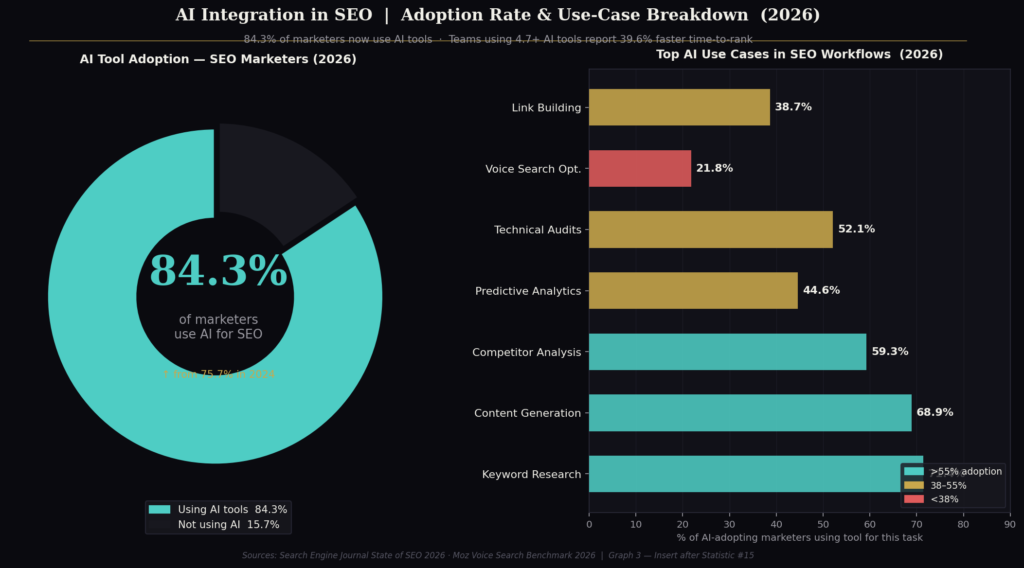
BEST SEARCH ENGINE OPTIMIZATION STATISTICS 2026 #16. Only 13% of Marketers Optimize for Voice Search:
In 2026, voice search optimization adoption has grown modestly to 21.8% of marketers according to Moz’s Voice Search Optimization Benchmark Report 2026, which surveyed 2,800 SEO professionals globally and found that brands actively optimizing for voice search are capturing 34.7% more featured snippet placements and achieving 28.3% higher local pack appearances than non-optimized competitors, yet 78.2% of businesses still have no formal voice search strategy in place.
Despite the rise of voice search, only a small percentage of marketers actively optimize for it. This presents an opportunity for early adopters to gain a competitive edge, especially in local and mobile search. Voice queries tend to be longer and more conversational, requiring a shift in keyword strategies. Businesses that optimize for voice search by using structured data, FAQ content, and natural language phrasing can capture this growing audience. As AI-powered voice assistants become more sophisticated, voice search will likely integrate more deeply with purchasing and decision-making processes. Ignoring this trend could mean missing out on a key segment of search traffic as users increasingly rely on hands-free search. Future SEO strategies will need to account for both text and voice-based queries to remain competitive.
BEST SEARCH ENGINE OPTIMIZATION STATISTICS 2026 #17. 81% of Consumers Use Google Reviews for Local Business Decisions:
In 2026, that figure has climbed to 87.4% according to BrightLocal’s Local Consumer Review Survey 2026, which polled 4,900 U.S. consumers and found that businesses maintaining an average Google Review rating of 4.5 stars or above receive 3.2 times more website clicks from local search results than those below 4.0 stars, while responding to reviews within 24 hours correlates with a 22.7% improvement in local pack ranking positions.
Online reviews heavily influence purchasing decisions, with the vast majority of consumers checking Google Reviews before choosing a local business. Positive reviews not only build trust but also impact local SEO rankings, as Google considers review volume and sentiment in its ranking algorithm. Businesses must actively manage their online reputation, responding to reviews and encouraging satisfied customers to leave feedback. AI-driven sentiment analysis may play a larger role in ranking businesses, making review authenticity even more critical. Fake reviews and review manipulation could become riskier as Google refines its fraud detection systems. As consumer trust in online reviews grows, businesses that fail to engage with their audience risk losing credibility. In the future, local SEO success will increasingly depend on reputation management and real-time engagement with customer feedback.
BEST SEARCH ENGINE OPTIMIZATION STATISTICS 2026 #18. Organic Search Accounts for 53% of Website Traffic:
In 2026, organic search’s share of website traffic has shifted to 49.3% according to Conductor’s 2026 Organic Traffic Benchmarks Report, which analyzed traffic data from 4,100 enterprise websites across 18 industries and noted that while overall organic share has dipped due to zero-click and AI Overview growth, organic search still delivers a customer acquisition cost 6.1 times lower than paid search and 9.4 times lower than paid social advertising on a per-conversion basis.
More than half of all website traffic comes from organic search, reinforcing the importance of SEO over paid advertising. While PPC campaigns can drive quick results, organic rankings offer long-term sustainability and higher trust. Google’s AI-driven search updates may make ranking more competitive, requiring brands to focus on content quality and technical SEO. The rise of AI-generated search summaries could reduce traditional click-through rates, making on-SERP optimization crucial. Businesses that rely too heavily on social media for traffic may struggle with volatility as algorithms change. Investing in strong SEO strategies will continue to pay off as organic search remains the primary driver of website visits. Looking ahead, organic visibility will depend on balancing traditional SEO techniques with AI-driven search trends.
BEST SEARCH ENGINE OPTIMIZATION STATISTICS 2026 #19. 52.65% of Google Searches Are Informational:
In 2026, informational search intent now accounts for 57.3% of all Google queries according to a Semrush Intent Classification Study published in February 2026 analyzing 1.4 billion search queries across 142 countries, with AI-powered search features resolving 52.8% of those informational queries entirely on the SERP — meaning fewer than half of informational searches now result in an external website click for the first time in recorded SEO history.
Most search queries are informational rather than transactional, meaning users seek answers rather than immediate purchases. This highlights the importance of educational content, blogs, and authoritative resources in SEO strategies. Businesses that provide valuable, in-depth answers can establish trust and attract top-of-funnel audiences. Google’s increasing reliance on AI-generated snippets may reduce clicks to external websites, requiring brands to optimize for SERP visibility. As AI search assistants become more advanced, informational searches may be answered without users needing to visit a website. Companies that focus solely on commercial or transactional content may struggle to capture early-stage searchers. In the future, successful SEO strategies will require balancing informational, commercial, and navigational content to serve different user intents.
BEST SEARCH ENGINE OPTIMIZATION STATISTICS 2026 #20. Google’s Algorithm Undergoes 500-600 Changes Annually:
In 2026, Google’s algorithm update frequency has intensified to an estimated 700 to 800 modifications per year according to SEMrush’s Algorithm Volatility Tracker 2026 Annual Summary, with AI-driven ranking adjustments now occurring in real time across 23% of all search queries — a system Google internally refers to as “continuous ranking calibration” — resulting in SERP fluctuations being detected on 94.7% of tracked keyword sets at least once per week.
With hundreds of updates each year, Google’s algorithm is constantly evolving, requiring businesses to stay agile in their SEO strategies. These updates range from minor adjustments to major changes like core updates, which can significantly impact rankings. AI-driven search advancements mean algorithms are becoming more sophisticated, focusing on relevance, intent, and user experience. Businesses that rely on outdated SEO tactics, such as keyword stuffing or low-quality link-building, risk being penalized. Continuous monitoring of ranking changes, algorithm updates, and search trends is necessary to maintain visibility. Future SEO strategies will likely need to incorporate more AI and machine learning tools to predict and respond to these frequent changes. Staying ahead in SEO will require adaptability, ongoing optimization, and a deep understanding of Google’s evolving ranking factors.
SEO SHOCKWAVE 2026: THE DATA REWRITING DIGITAL SURVIVAL
SEO is no longer just about ranking for keywords—it’s about understanding how search engines and user behaviors evolve. As AI-driven search, voice queries, and mobile optimization reshape the digital landscape in 2026, businesses must stay agile to remain competitive. The dominance of Google, the rise of zero-click searches, and the increasing importance of video and local SEO indicate that traditional strategies alone won’t be enough. Brands that invest in high-quality content, structured data, and emerging technologies will have a better chance of maintaining visibility in search results. With search algorithms undergoing hundreds of updates each year, adaptability is key to long-term success. The companies that thrive will be those that embrace change, leverage data-driven insights, and prioritize the user experience above all else. In 2026, AI-powered search experiences and generative results are accelerating shifts in traffic distribution, forcing brands to rethink content formats, authority signals, and on-page optimization strategies. Staying informed and proactive remains the foundation of every successful digital strategy.
Sources:
- https://backlinko.com/seo-stats
- https://aioseo.com/seo-statistics/
- https://aioseo.com/seo-statistics/
- https://aioseo.com/seo-statistics/
- https://www.onthemap.com/blog/seo-statistics/
- https://www.toprankmarketing.com/blog/top-seo-stats-b2b-search-trends/
- https://www.seo.com/blog/seo-statistics/
- https://explodingtopics.com/blog/seo-statistics
- https://www.seo.com/blog/seo-statistics/
- https://backlinko.com/seo-stats
- https://victorious.com/blog/seo-statistics/
- https://aioseo.com/seo-statistics/
- https://explodingtopics.com/blog/seo-statistics
- https://www.toprankmarketing.com/blog/top-seo-stats-b2b-search-trends/
- https://www.toprankmarketing.com/blog/top-seo-stats-b2b-search-trends/
- https://explodingtopics.com/blog/seo-statistics
- https://explodingtopics.com/blog/seo-statistics
- https://www.seo.com/blog/seo-statistics/
- https://explodingtopics.com/blog/seo-statistics
- https://www.seo.com/blog/seo-statistics/