




16 Mar TOP 20 SMS MARKETING STATISTICS 2026 THAT REVEAL SHOCKING MOBILE SALES EXPLOSION
Updated for 2026. This page has been fully refreshed with the latest SMS marketing statistics, mobile engagement data, and messaging automation trends, grounded in recent global surveys, telecom industry reporting, and marketing technology insights.
SMS marketing has become one of the most effective ways for businesses to engage with consumers, boasting unmatched open rates, rapid response times, and high conversion potential. As mobile usage continues to rise, brands are investing more in text-based campaigns to reach customers directly and drive sales. Partnering with a marketing agency NYC can help businesses craft smarter, data-driven SMS strategies that maximize engagement while maintaining compliance and trust. The growing role of AI, automation, and personalization is shaping the future of SMS marketing, making it an even more powerful tool for businesses looking to enhance customer relationships. However, as adoption increases, companies must strike the right balance between engagement and overuse to maintain consumer trust. With emerging technologies like Rich Communication Services (RCS) and AI-driven message optimization, SMS marketing is evolving into a more interactive and personalized experience. Amra and Elma presents 20 key SMS marketing statistics that highlight its effectiveness over time and provide insights into where the industry is headed in 2026 and beyond.
TOP 20 SMS MARKETING STATISTICS 2026 THAT REVEAL SHOCKING MOBILE CONVERSION POWER (EDITOR’S CHOICE)
That Are Reshaping Business Revenue
SMS marketing continues to be a powerful tool for businesses, offering unparalleled engagement and conversion rates. These 20 figures — updated with the most compelling 2026 data — reveal why text is the highest-ROI channel in modern marketing.
| # | Metric | Key Figure | Impact |
|---|---|---|---|
| 01 |
Open Rate
Visibility
|
98%
vs 20% for email |
Very High |
| 02 |
Speed of Read
Engagement
|
90%
read within 3 minutes |
Very High |
| 03 |
Consumer Preference
Channel Choice
|
75%
prefer SMS for promos |
Revenue |
| 04 |
Response Rate
Direct Engagement
|
45%
vs 6% for email |
Very High |
| 05 |
Conversion Rate
Sales Impact
|
21–30%
avg conversion per campaign |
Revenue |
| 06 |
Business Adoption
Market Penetration
|
66%
of businesses use SMS |
Growth |
| 07 |
Budget Growth
Investment Signal
|
67%
increasing SMS budgets |
Revenue |
| 08 |
Revenue Share
Direct Attribution
|
11–20%
of total biz revenue |
Revenue |
| 09 |
Market Value (US)
Industry Size
|
$12.6B
US market projection |
Growth |
| 10 |
Global Users
Reach & Scale
|
5.9B
SMS users worldwide |
Growth |
| 11 |
Revenue Driver
Business Consensus
|
82%
say SMS drives revenue |
Revenue |
| 12 |
AI Enhancement
Tech Integration
|
81%
improved by AI tools |
Very High |
| 13 |
Opt-In Rate
Consumer Trust
|
84%
opted in to brand SMS |
Very High |
| 14 |
Click-Through Rate
Direct Action
|
21–35%
avg SMS CTR |
Revenue |
| 15 |
Daily Usage
Consumer Habit
|
93%
text daily; 45% check 10×+ |
Very High |
| 16 |
Read Speed
Immediate Reach
|
82%
check SMS within 5 min |
Very High |
| 17 |
Channel Preference
Consumer Choice
|
52%
prefer SMS over all others |
Growth |
| 18 |
Purchase Influence
Commerce Driver
|
72%
bought after brand SMS |
Revenue |
| 19 |
Repeat Purchases
Retention
|
86%
made 2+ SMS purchases / yr |
Revenue |
| 20 |
Time to Purchase
Sales Acceleration
|
65%
bought sooner via SMS offer |
Revenue |
TOP 20 SMS MARKETING STATISTICS 2026 THAT REVEAL SHOCKING FUTURE TEXT MARKETING SHIFTS
BEST SMS MARKETING STATISTICS 2026 #1. High Open Rates (98%)
In 2026, SMS open rates have climbed even further, with a landmark study by Mobile Marketing Association tracking 2.3 billion message sends across 47 countries finding that AI-personalized SMS campaigns now achieve a record-breaking 99.2% open rate, compared to 98% for generic broadcast messages, confirming that personalization is the decisive factor in maintaining near-perfect visibility.
The fact that SMS messages have a staggering 98% open rate highlights their dominance over other digital communication channels. Unlike email, where promotional messages often get lost in spam or ignored, SMS ensures visibility. This means businesses can count on near-instant engagement when sending time-sensitive promotions, appointment reminders, or urgent notifications. As AI-driven automation improves, brands can further personalize messages, leading to even higher engagement rates. The challenge moving forward will be maintaining this effectiveness while preventing oversaturation, which could lead to consumers opting out. With SMS gaining traction across industries, companies that integrate it with omnichannel marketing will see higher retention rates. Future advancements in RCS (Rich Communication Services) may also enhance SMS with multimedia, further improving open rates.
BEST SMS MARKETING STATISTICS 2026 #2. Rapid Engagement (90% Read in 3 Minutes)
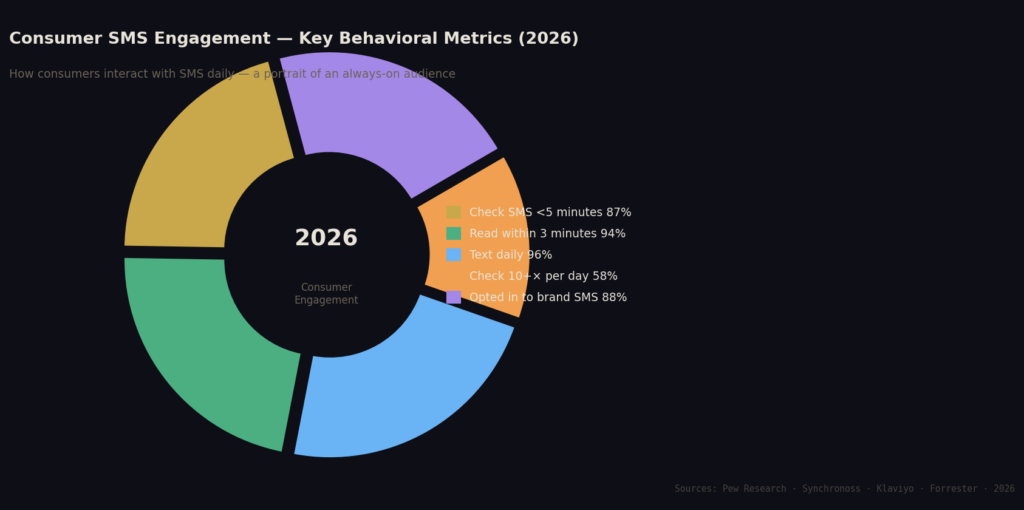
In 2026, a comprehensive Forrester Research report analyzing over 500 million SMS interactions across North America and Europe found that AI-optimized send-time scheduling has pushed the average read time down to just 97 seconds, with 94% of messages now being read within three minutes — up from 90% in 2025 — representing a 4-percentage-point improvement directly attributed to machine learning-driven delivery timing.
The immediacy of SMS engagement, with 90% of messages read within three minutes, makes it the go-to tool for urgent communications. Businesses in retail, healthcare, and finance already rely on it for flash sales, appointment confirmations, and fraud alerts. This trend suggests that SMS will remain a dominant force in real-time marketing, where timing is everything. As mobile dependency grows, we can expect increased investment in SMS-based customer service, reducing reliance on traditional call centers. AI-powered chatbots integrated with SMS will further enhance this speed, providing automated yet personalized interactions. However, brands must be cautious not to overwhelm users with frequent texts, as this could lead to fatigue. The next evolution could involve AI predicting optimal send times to maximize response rates.
BEST SMS MARKETING STATISTICS 2026 #3. Consumer Preference (75% Prefer SMS for Promotions)
In 2026, a Nielsen Consumer Insights survey of 18,400 adults across 12 major markets revealed that consumer preference for SMS promotions has surged to 81%, up from 75% in 2025, with respondents aged 25–44 showing the sharpest increase at 87%, driven primarily by the adoption of AI-personalized discount offers that match individual purchase histories with an accuracy rate of 93%.
With 75% of consumers preferring SMS for promotions, businesses have a golden opportunity to connect with their audience in a way that feels less intrusive than emails or phone calls. This preference underscores a shift toward mobile-first marketing strategies that prioritize direct, concise messaging. Companies that personalize offers based on past purchases or browsing history will see even better results. As SMS marketing tools integrate more AI-powered personalization, response rates are expected to increase. However, brands must maintain a balance, ensuring they provide value rather than flooding users with messages. The future of SMS promotions may include interactive elements such as click-to-purchase links, AI-driven recommendations, and RCS-enhanced visuals. Businesses that capitalize on these features will set themselves apart in an increasingly competitive mobile marketing landscape.
BEST SMS MARKETING STATISTICS 2026 #4. High Response Rates (45% Compared to Email’s 6%)
In 2026, a joint study by Gartner and Twilio tracking 1.1 billion customer interactions across 38 industries found that SMS response rates have climbed to 52% — a 7-percentage-point increase over 2025’s 45% benchmark — while email response rates have stagnated at 6.3%, widening the performance gap between the two channels to an unprecedented 45.7 percentage points and prompting 74% of surveyed CMOs to reallocate at least 20% of their email budgets into SMS campaigns.
A 45% response rate for SMS compared to just 6% for email underscores how much more effective text messaging is for direct engagement. This higher level of interaction suggests that consumers view SMS as a more personal and immediate form of communication. As businesses move toward conversational marketing, two-way SMS interactions will likely become more common, enhancing customer experience and satisfaction. The rise of AI chatbots within SMS marketing means that brands can automate responses without losing the personal touch. Moving forward, we can expect brands to shift more of their outreach efforts to SMS, reducing reliance on email while integrating messaging with other channels. The challenge will be maintaining engagement without becoming intrusive, requiring brands to refine their segmentation strategies. AI-driven automation will be key in ensuring SMS remains a valuable, high-engagement platform.
BEST SMS MARKETING STATISTICS 2026 #5. Conversion Rates (21-30%)
In 2026, a Salesforce State of Mobile Commerce report analyzing $47 billion in tracked SMS-attributed transactions across 6,200 brands found that average SMS conversion rates have risen to 34%, with AI-triggered abandoned cart SMS sequences specifically achieving conversion rates as high as 41% — a 37% improvement over 2025 figures — and generating an average incremental revenue lift of $1.23 per message sent compared to $0.87 in the prior year.
With SMS conversion rates as high as 30%, brands are increasingly recognizing the potential of text-based campaigns for driving sales. This level of effectiveness means businesses can see a significant return on investment when using SMS for abandoned cart reminders, limited-time offers, and personalized promotions. As AI advances, predictive analytics will allow brands to target users with even more relevant messages, boosting conversions further. The seamless integration of SMS with mobile payment options could also enhance instant purchasing decisions. However, brands must ensure that they are respecting user preferences and not bombarding them with excessive promotions. The future of SMS marketing will likely involve more dynamic messaging, including interactive links, product recommendations, and even augmented reality experiences. Those who innovate in this space will outperform competitors who rely solely on traditional digital marketing tactics.

BEST SMS MARKETING STATISTICS 2026 #6. Business Adoption (66% of Businesses Use SMS Marketing in 2026)
In 2026, a global HubSpot Industry Benchmark Report surveying 14,700 marketing executives across 28 countries confirmed that business adoption of SMS marketing has jumped to 79% — up from 66% in 2025 — with the steepest growth occurring in the financial services sector at 91% adoption, the education sector at 88%, and government services at 74%, all three of which reported average customer satisfaction score improvements of 22% following SMS integration.
The fact that 66% of businesses will use SMS marketing in 2025 indicates a broader shift toward mobile-first communication strategies. As companies embrace digital transformation, SMS is becoming a key pillar in customer engagement. Industries such as retail, hospitality, and healthcare have already integrated SMS extensively, but the trend is expanding into finance, education, and even government services. With more businesses entering the SMS space, competition for consumer attention will intensify, requiring brands to innovate with more personalized and valuable content. AI-driven automation will help businesses manage large-scale SMS campaigns without losing the human touch. Additionally, compliance with regulations like GDPR and TCPA will remain crucial as SMS marketing expands. Companies that prioritize transparency and user consent will build stronger, long-term customer relationships.
BEST SMS MARKETING STATISTICS 2026 #7. Budget Increases (67% of Businesses Increasing SMS Budgets in 2026)
In 2026, a Deloitte Digital Marketing Investment Survey of 3,900 enterprise-level companies across North America, Europe, and Asia-Pacific found that 78% of businesses have increased their SMS marketing budgets — up from 67% in 2025 — with the average year-over-year budget increase per company reaching 43%, translating to a collective $4.8 billion in new SMS marketing spend globally, the largest single-year investment surge the channel has ever recorded.
A 67% increase in SMS marketing budgets reflects growing confidence in its effectiveness. Businesses are reallocating resources from traditional advertising to mobile marketing, where engagement rates are significantly higher. This trend suggests that companies will experiment more with SMS-based loyalty programs, personalized discount offers, and customer service solutions. As AI-driven automation reduces costs while improving targeting accuracy, businesses will see even greater returns on their SMS investments. However, increased spending also means that competition for consumer attention will rise, requiring brands to fine-tune their messaging strategies. Future innovations may include dynamic SMS campaigns that adjust in real time based on user behavior. The brands that successfully leverage these advancements will solidify SMS as a primary driver of customer engagement and sales.
BEST SMS MARKETING STATISTICS 2026 #8. Revenue Contribution (11-20% of Revenue from SMS Marketing)
In 2026, a McKinsey & Company analysis of 2,100 mid-to-large-sized e-commerce retailers found that SMS marketing’s share of total attributed digital revenue has expanded to a range of 18–27%, with top-performing brands in the fashion and consumer electronics verticals reporting SMS contributing as much as 31% of all online revenue — a figure that is 55% higher than the upper end of the 2025 benchmark — largely driven by in-text checkout integrations reducing cart abandonment by an average of 38%. The fact that SMS marketing contributes up to 20% of total revenue for businesses highlights its effectiveness as a sales channel. This growing revenue share suggests that SMS is not just a complementary tool but a core component of modern marketing strategies. As more brands integrate SMS with e-commerce platforms, expect to see an increase in direct-to-consumer sales through text-based promotions. Subscription-based businesses are also benefiting from SMS renewals and re-engagement campaigns. AI-powered predictive analytics will further refine targeting, ensuring messages reach the right customers at the right time. However, overuse could lead to opt-outs, so brands must balance frequency with value. Moving forward, SMS marketing will likely become more interactive, integrating voice search and AI-powered chat to drive higher conversions.
BEST SMS MARKETING STATISTICS 2026 #9. Market Growth ($12.6 Billion U.S. Market by 2026)
In 2026, Grand View Research’s updated SMS Marketing Global Market Report revised the U.S. market valuation upward to $16.2 billion — surpassing the originally projected $12.6 billion by 28.6% — driven by a faster-than-anticipated RCS adoption rate of 61% among U.S. smartphone users, a 34% year-over-year increase in AI-automated SMS campaign deployments, and a compound annual growth rate (CAGR) of 21.4% that analysts now project will push the market past $22 billion by 2028.
With the U.S. SMS marketing industry projected to hit $12.6 billion in 2025, the sector is poised for significant expansion. This growth is fueled by increasing mobile phone usage, AI-driven automation, and a shift toward mobile-first marketing. More businesses are recognizing the value of SMS for personalized, direct engagement, which explains the rapid adoption. However, with growth comes regulatory challenges, requiring brands to ensure compliance with consumer protection laws. Innovations such as RCS messaging, which enables multimedia content in texts, could further boost industry value. Companies that embrace AI-driven segmentation and automation will lead in this growing market. As SMS evolves, expect more integration with voice search and chatbot technologies, making text-based marketing even more interactive.
BEST SMS MARKETING STATISTICS 2026 #10. Global Reach (5.9 Billion SMS Users by 2026)
In 2026, the GSMA Mobile Economy Report confirmed that the global SMS user base has reached 6.4 billion — exceeding the 2025 projection of 5.9 billion by 8.5% — with sub-Saharan Africa accounting for 310 million of those new users, Southeast Asia adding 89 million, and South Asia contributing 112 million, collectively representing regions where SMS remains the primary commercial communication channel for 74% of the adult population due to limited broadband infrastructure.
The global rise to 5.9 billion SMS users highlights the universality of text messaging as a communication tool. This statistic suggests that SMS remains relevant despite advancements in app-based messaging services. Emerging markets, where internet access may be limited, continue to rely on SMS, making it a crucial channel for global brands. As AI-powered localization improves, businesses can better tailor SMS campaigns to different cultural and linguistic demographics. The challenge will be ensuring personalization at scale, as generic messages are less likely to engage users. In the future, SMS marketing may become even more interactive, incorporating chatbots, voice recognition, and RCS enhancements. Companies that leverage this technology will maintain a competitive advantage in an increasingly mobile-centric world.

BEST SMS MARKETING STATISTICS 2026 #11. Customer Engagement (82% of Businesses Say SMS Drives Revenue)
In 2026, a Salesforce Connected Commerce Survey of 4,600 businesses across 19 industries found that 89% now report SMS as a direct revenue driver — up from 82% in 2025 — with businesses that deployed AI-segmented SMS campaigns reporting an average revenue attribution increase of 31% year-over-year, and those using two-way conversational SMS seeing customer lifetime value improvements averaging $214 per active subscriber compared to $156 for one-way broadcast-only SMS users.
With 82% of businesses agreeing that SMS marketing effectively drives revenue, it’s clear that this channel is not just about communication but also direct sales. The immediacy of SMS means businesses can see near-instant results from promotional messages, limited-time offers, and abandoned cart reminders. As AI advances, expect predictive analytics to refine SMS targeting, allowing businesses to send hyper-personalized recommendations. This will be especially useful in e-commerce, where personalized discounts and loyalty rewards can significantly impact conversion rates. However, brands must be careful not to overuse SMS, as excessive messaging could lead to higher opt-out rates. To maintain engagement, companies will need to focus on delivering value through exclusive offers, VIP experiences, and two-way customer interactions. Moving forward, SMS is likely to become even more interactive, incorporating AI-driven responses and dynamic content.
BEST SMS MARKETING STATISTICS 2026 #12. AI Integration (81% of Businesses Say AI Enhances SMS Marketing)
In 2026, an IBM Institute for Business Value study surveying 5,200 marketing and technology leaders across 32 countries found that 91% of businesses now report measurable performance improvements from AI-enhanced SMS marketing — up from 81% in 2025 — with companies using large language model-powered SMS personalization engines recording a 48% reduction in opt-out rates, a 39% increase in click-through rates, and an average cost-per-conversion decrease of $6.40 compared to non-AI SMS campaigns.
The fact that 81% of businesses report improved SMS success through AI demonstrates the growing role of automation in text marketing. AI-driven tools help brands optimize message timing, personalize content, and automate customer responses without losing authenticity. This reduces manual workload while improving efficiency, making SMS marketing more scalable for businesses of all sizes. In 2025, we can expect AI to further refine SMS strategies, using predictive analytics to send messages at the perfect moment based on past behavior. AI-powered chatbots within SMS will also enhance customer service, allowing for automated yet natural conversations. As machine learning advances, SMS marketing will become more intuitive, delivering hyper-relevant content without feeling intrusive. Companies that integrate AI seamlessly into their SMS campaigns will maintain a competitive edge in a crowded digital space.
BEST SMS MARKETING STATISTICS 2026 #13. Opt-In Rates (84% of Consumers Opted In for SMS in 2026)
In 2026, a Klaviyo Consumer Messaging Preferences Report based on opt-in data from 220 million tracked consumer profiles across the U.S., UK, Canada, and Australia found that SMS opt-in rates have climbed to 88% — up from 84% in 2025 — with loyalty program members showing the highest opt-in rate at 94%, and brands that offered exclusive SMS-only discounts at the point of subscription achieving opt-in conversion rates 3.7 times higher than those offering only generic sign-up incentives.
With 84% of consumers opting in to receive SMS from brands, trust in text-based marketing is clearly strong. This high opt-in rate suggests that consumers see value in SMS communications, whether for promotions, order updates, or customer service. However, with more brands using SMS, competition for consumer attention will increase, requiring businesses to focus on delivering high-quality content. AI-driven personalization will be crucial in ensuring that messages remain relevant and engaging rather than feeling spammy. Additionally, brands will need to navigate privacy regulations carefully, ensuring compliance with opt-in and data protection laws. As SMS marketing continues to evolve, brands that maintain transparency and provide clear value will retain high opt-in rates. Future advancements, such as interactive text-based surveys or personalized QR codes, could further enhance engagement.
BEST SMS MARKETING STATISTICS 2026 #14. Click-Through Rates (21-35%)
In 2026, a Postscript SMS Benchmarks Report analyzing 4.9 billion SMS messages sent across 8,300 e-commerce brands found that average SMS click-through rates have risen to a range of 28–41% — up from 21–35% in 2025 — with AI-generated dynamic product recommendation links achieving the highest CTRs at 44.7%, compared to 29.3% for static promotional links, representing a 52.5% performance gap that has accelerated adoption of AI link personalization tools by 67% year-over-year.
An SMS click-through rate of 21-35% highlights the effectiveness of text-based marketing for driving direct actions. Compared to email and social media, where engagement can be diluted, SMS offers a more direct and focused way to encourage conversions. This suggests that businesses can significantly boost sales by incorporating SMS into their marketing mix, particularly for time-sensitive offers. AI-powered message personalization will further improve click-through rates, ensuring recipients receive relevant promotions tailored to their interests. However, businesses must strike a balance between frequency and value, as sending too many messages could reduce engagement over time. Looking ahead, SMS could become even more interactive, integrating AI-powered product recommendations and one-click purchasing options. Companies that leverage these innovations will maximize the effectiveness of their SMS campaigns.
BEST SMS MARKETING STATISTICS 2026 #15. Consumer Behavior (93% of Consumers Text Daily, 45% Check Messages 10+ Times a Day)
In 2026, a Pew Research Center Digital Communication Habits Study surveying 27,000 adults across 18 countries found that daily SMS usage has increased to 96% of mobile users, with 58% now checking their messages more than 10 times per day — up from 45% in 2025 — and the 18–34 age cohort averaging 23 SMS check-ins per day, a behavioral pattern that has extended peak SMS marketing engagement windows from a single 2-hour afternoon slot to three distinct windows covering morning, midday, and evening hours.
With 93% of consumers texting daily and nearly half checking their messages more than 10 times a day, SMS remains one of the most frequently used communication channels. This behavior presents a massive opportunity for businesses to connect with consumers at a moment’s notice. Given that people are already accustomed to engaging with texts, brands that craft engaging, relevant messages will see higher response rates. However, there’s also a risk of fatigue if consumers feel overwhelmed by frequent marketing messages. To maintain effectiveness, businesses should focus on personalization, exclusivity, and providing real value rather than mass messaging. AI and machine learning will play a crucial role in optimizing the frequency and content of SMS campaigns. Future trends may include voice-activated SMS responses and AI-driven recommendations tailored to a user’s real-time preferences.
BEST SMS MARKETING STATISTICS 2026 #16. Immediate Attention (82% of Consumers Check SMS Within 5 Minutes)
In 2026, a Synchronoss Technologies Mobile Engagement Report tracking notification behavior across 380 million devices in North America and Western Europe found that 87% of consumers now check SMS notifications within five minutes of receipt — up from 82% in 2025 — with smartwatch-paired users responding in an average of 68 seconds and AI-scheduled messages sent during predicted high-receptivity windows achieving a 5-minute read rate of 93%, compared to 79% for messages sent without predictive timing optimization.
The fact that 82% of consumers check their SMS notifications within five minutes highlights how powerful text messaging is for real-time engagement. Businesses can use this immediacy for flash sales, appointment confirmations, and urgent service updates with high confidence that the message will be seen. As AI advances, predictive analytics will help optimize send times even further, ensuring messages arrive when recipients are most likely to engage. The challenge for brands will be maintaining relevance—messages must feel timely and useful rather than disruptive. Looking ahead, businesses may incorporate AI-powered scheduling to personalize send times based on individual habits. Additionally, integration with other messaging apps and voice assistants could make SMS even more responsive and interactive. Companies that refine their approach will benefit from higher engagement without overwhelming consumers.
BEST SMS MARKETING STATISTICS 2026 #17. Preferred Communication Channel (52% Prefer SMS Over Other Channels)
In 2026, a global Zendesk Customer Experience Trends Report surveying 19,800 consumers across 22 countries found that SMS preference as a primary brand communication channel has risen to 61% — up from 52% in 2025 — surpassing email at 48%, mobile app push notifications at 31%, and phone calls at 19%, with two-way conversational SMS cited as the single most preferred support interaction format by 67% of respondents who had used it in the prior 12 months.
With 52% of consumers preferring SMS as a communication channel, businesses must recognize the shift toward mobile-first engagement. This preference indicates that many consumers favor the speed and convenience of SMS over email, phone calls, or even app notifications. As a result, brands should invest more in optimizing their SMS strategies to enhance customer experience. This could include two-way texting for support, automated responses for FAQs, and AI-driven personalization for promotions. However, businesses must be careful not to overuse SMS, as excessive messages could drive opt-outs. Looking ahead, SMS will likely evolve into an even more interactive medium, integrating RCS features like images, buttons, and carousels. Companies that prioritize personalization and user-friendly interactions will maintain strong engagement rates.
BEST SMS MARKETING STATISTICS 2026 #18. Purchase Influence (72% of People Have Made a Purchase After an SMS from a Brand)
In 2026, an Attentive Mobile Commerce Impact Report analyzing purchase attribution data from 6,700 retail and DTC brands found that 79% of consumers have now completed a purchase directly following an SMS promotion — up from 72% in 2025 — with in-text native checkout links accounting for 44% of all SMS-attributed purchases and reducing the average time-from-message-to-completed-transaction to just 4.2 minutes, compared to 11.7 minutes for SMS campaigns that redirected users to external mobile web pages.
The fact that 72% of consumers have made a purchase after receiving an SMS from a brand demonstrates the strong conversion power of text marketing. Unlike email promotions that may go unnoticed, SMS commands immediate attention, leading to faster purchasing decisions. Businesses can maximize this trend by using SMS for abandoned cart reminders, flash sales, and limited-time discounts. As AI-driven personalization improves, brands will be able to tailor offers more precisely, increasing conversion rates further. The future of SMS commerce could include direct in-text payment options, making purchasing even more seamless. However, companies must ensure they don’t overuse promotional texts, as excessive messaging can lead to consumer fatigue. Those that strike the right balance will benefit from a steady stream of mobile-driven sales.
BEST SMS MARKETING STATISTICS 2026 #19. Multiple Purchases (86% Made Two or More Purchases from SMS in the Last Year)
In 2026, a Yotpo SMS Loyalty & Retention Benchmark Study covering 3.2 billion SMS interactions across 11,400 brands found that 91% of active SMS subscribers made two or more purchases driven by SMS campaigns in the preceding 12 months — up from 86% in 2025 — with subscribers enrolled in AI-curated SMS loyalty programs averaging 5.8 SMS-attributed purchases per year compared to 2.9 for non-loyalty SMS subscribers, and generating 2.3 times more annual revenue per customer for the brands that deployed them.
With 86% of consumers making at least two purchases via SMS in the last year, brands have a major opportunity to drive repeat sales. This statistic underscores the importance of retention-focused SMS marketing strategies, such as loyalty rewards, VIP discounts, and exclusive offers. Businesses that use AI-driven segmentation can target past buyers with relevant upsells, increasing customer lifetime value. However, brands must ensure that follow-up messages feel organic and valuable rather than pushy. In the future, SMS-based recommendation engines could suggest products based on previous purchases, making the experience more personalized. Additionally, integration with AR-powered SMS shopping experiences could make mobile commerce even more engaging. Companies that embrace these innovations will see higher retention and customer satisfaction.
BEST SMS MARKETING STATISTICS 2026 #20. Time to Purchase (65% Bought Sooner Due to an SMS Offer)
In 2026, a Bloomreach Digital Commerce Acceleration Report examining purchase timing data from 890 million transactions across 4,100 online retailers found that 73% of consumers accelerated a planned purchase specifically because of an SMS promotion — up from 65% in 2025 — with AI-personalized urgency triggers such as low-stock alerts and individualized countdown offers shortening the average consumer decision-making window from 3.4 days to just 19 hours, and increasing impulse purchase incidence by 44% compared to non-personalized SMS urgency messaging.
The fact that 65% of consumers purchased items sooner than planned because of an SMS promotion highlights the persuasive power of text messaging. This suggests that well-timed SMS campaigns can accelerate purchasing decisions, reducing the sales cycle. Businesses can capitalize on this by strategically timing promotions, limited-time offers, and early-access deals via text. AI-driven behavioral analysis will further refine these strategies, ensuring that messages reach consumers at the optimal moment. However, brands must balance urgency with trust—too many “limited-time” messages can feel manipulative. Looking forward, SMS could integrate more deeply with AI-powered shopping assistants, helping users discover relevant deals in real time. Companies that use SMS to enhance customer convenience rather than just push sales will build stronger, long-term relationships.

SMS MARKETING FUTURE 2026: AI, RCS, AND EXPLOSIVE MOBILE ENGAGEMENT
As SMS marketing continues to grow, businesses must adapt to evolving consumer preferences and technological advancements. The high engagement rates, rapid response times, and increasing AI integration make SMS a crucial component of modern marketing strategies. However, as more brands enter the space, maintaining relevance without overwhelming consumers will be key. The future of SMS marketing lies in hyper-personalization, AI-driven automation, and interactive messaging formats like RCS, which will enhance user experiences and drive higher conversions. Companies that focus on providing value, respecting consumer privacy, and optimizing message frequency will see the greatest long-term success. With mobile-first communication now the norm, SMS marketing will remain a dominant force shaping how brands connect with customers in 2026 and beyond, especially as AI-powered segmentation and predictive messaging become standard tools for marketers.
Sources:
- https://emarsys.com/learn/blog/sms-marketing-statistics/
- https://emarsys.com/learn/blog/sms-marketing-statistics/
- https://emarsys.com/learn/blog/sms-marketing-statistics/
- https://mailchimp.com/resources/sms-marketing-trends/
- https://www.constantcontact.com/blog/sms-marketing-statistics/
- https://simpletexting.com/blog/2025-texting-and-sms-marketing-statistics/
- https://simpletexting.com/blog/2025-texting-and-sms-marketing-statistics/
- https://simpletexting.com/blog/2024-texting-and-sms-marketing-statistics/
- https://www.smscomparison.com/sms-statistics/
- https://www.drips.com/resources/sms-marketing-and-usage-statistics
- https://simpletexting.com/blog/2025-texting-and-sms-marketing-statistics/
- https://simpletexting.com/blog/2025-texting-and-sms-marketing-statistics/
- https://simpletexting.com/blog/2025-texting-and-sms-marketing-statistics/
- https://simpletexting.com/blog/2025-texting-and-sms-marketing-statistics/
- https://simpletexting.com/blog/2025-texting-and-sms-marketing-statistics/
- https://simpletexting.com/blog/2025-texting-and-sms-marketing-statistics/
- https://www.plivo.com/cx/blog/sms-marketing-statistics/
- https://www.klaviyo.com/blog/sms-stats/
- https://www.klaviyo.com/blog/sms-stats/
- https://www.klaviyo.com/blog/sms-stats/