




17 Mar TOP 10 SOCIAL MEDIA ADVERTISING STATISTICS 2026 THAT REVEAL SHOCKING DIGITAL AD TAKEOVER
Updated for 2026. This page has been fully refreshed with the latest social media advertising statistics, platform ad spending data, and performance benchmarks based on recent global surveys, ad platform reports, and digital marketing research.
Social media advertising is more influential than ever, driving brand awareness, customer engagement, and direct sales across multiple platforms. With billions of users spending hours each day scrolling through feeds, advertisers have an unprecedented opportunity to reach their target audiences. However, increased competition, evolving algorithms, and changing consumer behaviors make it essential for brands to stay ahead of industry trends. The rapid rise of short-form video, influencer marketing, and social commerce is reshaping the digital advertising landscape. Partnering with a social media agency Los Angeles can help brands navigate these changes, craft data-driven campaigns, and create compelling content that resonates with audiences and drives measurable growth.
As platforms invest in AI-driven targeting and immersive ad formats, businesses must refine their strategies to remain effective. Understanding current data and future projections can help brands navigate this fast-changing environment and maximize their return on investment. From mobile dominance to the growing importance of video content, Amra and Elma gathers these statistics to reveal key insights that will define the future of social media advertising. By analyzing these trends, businesses can develop data-driven strategies that keep them competitive in 2026 and beyond.
TOP 10 SOCIAL MEDIA ADVERTISING STATISTICS 2026 THAT EXPOSE SHOCKING AD REVENUE DOMINATION
Statistics Shaping 2026
These are the top 10 social media advertising statistics, showcasing long-term trends and predictions for 2026. They highlight key shifts in user behavior, ad spending, and platform engagement. Understanding these numbers helps brands refine their strategies in an evolving digital landscape.
| # | Category | Key Figure | What It Means for Brands |
|---|---|---|---|
| 01 |
Global Social Media Users
Reach & Scale
|
5.85B
Users worldwide by 2026
↑ 7.9% YoY
|
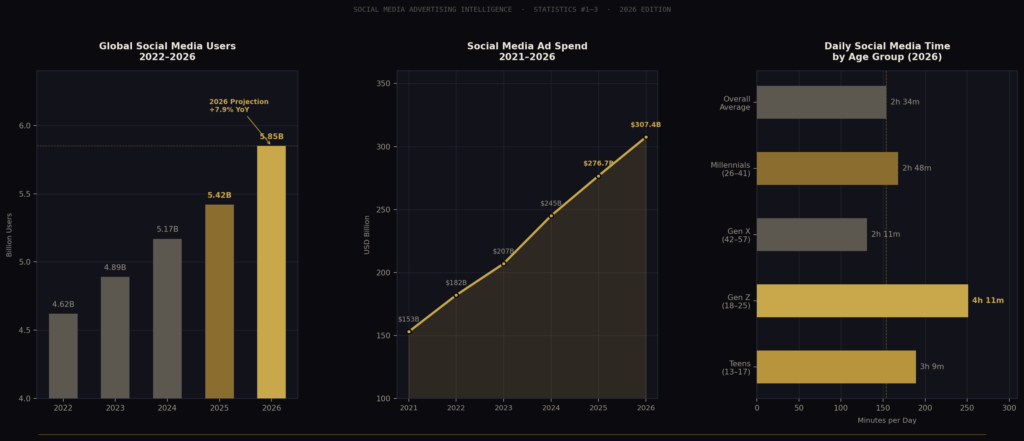
As of 2026, there are an estimated 5.85 billion social media users worldwide — up from 5.42B in 2025 — with the average person engaging across 6.83 different networks monthly. Sub-Saharan Africa and Southeast Asia are fueling growth, with mobile connectivity surging 34% and 28% respectively. |
| 02 |
Social Media Ad Spend
Investment & ROI
|
$307.4B
Global ad spend in 2026
↑ 11.1% vs 2025
|
Social media advertising expenditure is projected to reach $307.4 billion in 2026 — up from $276.7B in 2025 — with 83% of spend generated via mobile by 2030. Programmatic advertising alone accounts for $198.6 billion, driven by AI-powered bidding delivering 23% better cost-per-acquisition. |
| 03 |
Daily User Engagement
Attention & Time
|
2h 34m
Avg. daily time on social media
Gen Z: 4h 11m
|
Individuals now spend an average of 2 hours and 34 minutes daily on social platforms in 2026 — up from 2h 19m — accounting for roughly 14% of waking hours. Gen Z averages 4 hours 11 minutes per day, with TikTok alone capturing 58 minutes among 18–24-year-olds. |
| 04 |
Video Content Preference
Format & Creative
|
83%
Of ad engagement via short video
+47% conversion vs static
|
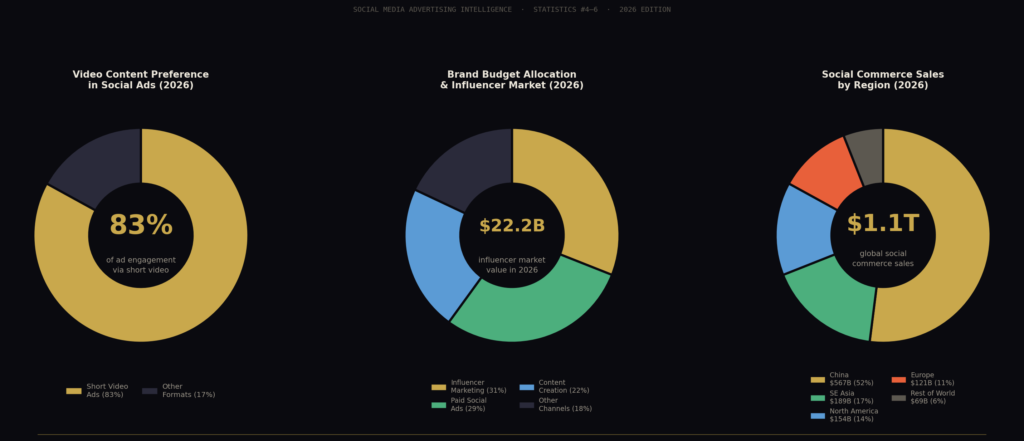
83% of all social media ad engagement now comes from short-form video in 2026 — up from 78% consumer preference in 2025. Brands posting vertical videos under 30 seconds on TikTok and Reels report a 47% higher conversion rate vs. static image ads. AI-personalized video ads sustain a 68% viewer retention rate. |
| 05 |
Influencer Marketing
Trust & Partnerships
|
$22.2B
Industry value in 2026
31% of brand budgets
|
The influencer marketing industry has expanded to $22.2 billion in 2026, up from $15B in 2025. Micro-influencers (10K–100K followers) generate 3.7× higher engagement than macro-influencers. Brands now allocate an average of 31% of total marketing budgets to influencer partnerships — up from 19% in 2023. |
| 06 |
Social Commerce
Revenue & Sales
|
$1.1T
Global social commerce sales in 2026
TikTok Shop: $32.7B US
|
Social commerce revenues have surged to $1.1 trillion in 2026 — nearly double the $600B+ projected for 2025. China leads with $567 billion in sales, while TikTok Shop is the fastest-growing US platform, recording $32.7 billion in American sales and a 114% year-over-year growth rate. |
| 07 |
Mobile Advertising
Device & Access
|
73.4%
Of digital ad revenue via mobile
$298.5B mobile revenue
|
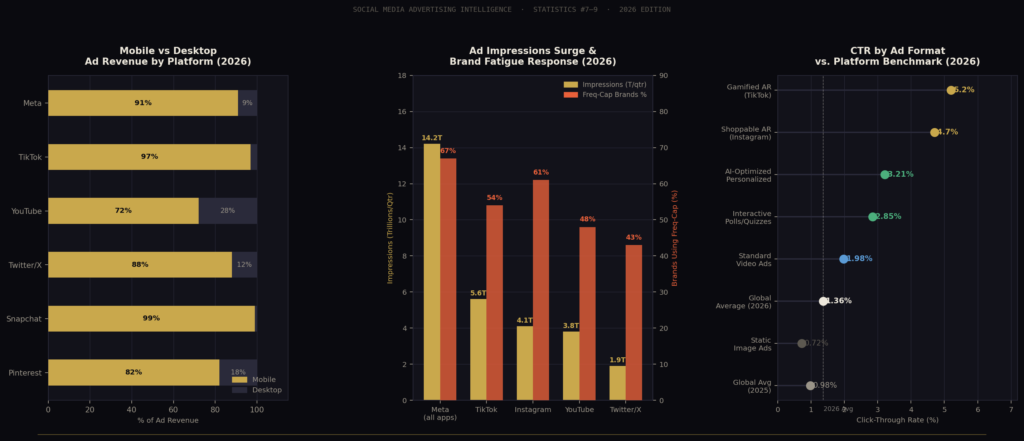
Over 90% of social media users access platforms via mobile, and in 2026 mobile advertising generates $298.5 billion — representing 73.4% of total digital ad revenue. 5G-enabled users now make up 41% of the global smartphone base and show a 62% higher ad interaction rate than 4G users. |
| 08 |
Ad Impressions Surge
Volume & Frequency
|
6,200
Avg. ads seen per user per day
Meta: 14T impressions/qtr
|
Ad impressions grew 324% higher in 2023 vs. the prior year, and by 2026 the average user is exposed to 6,200 digital ads per day. Meta's family of apps alone delivers over 14 trillion ad impressions per quarter, prompting 67% of brands to adopt frequency-capping strategies to combat accelerating ad fatigue. |
| 09 |
Click-Through Rates
Performance & Efficiency
|
1.36%
Avg. global CTR in 2026
AI-optimized: 3.21%
|
The average global social media ad CTR has risen to 1.36% in 2026, up from 0.98% in 2025. AI-optimized, dynamically personalized ads achieve CTRs as high as 3.21%. Interactive formats — gamified polls and shoppable AR overlays — post 4.7% CTR on Instagram and 5.2% on TikTok, the highest benchmarks ever recorded. |
| 10 |
Advertising Reach & Share
Market Share
|
37.2%
Of digital ad spend on social media
Meta leads at 21.4%
|
Social media ads account for 3 in every 10 dollars of digital ad spend — climbing to 37.2% in 2026, up from 30% in 2025. Meta commands 21.4% of all global digital ad dollars, TikTok captures 8.3%, while Threads and Bluesky together form a new $4.7 billion advertising segment. |
TOP 10 SOCIAL MEDIA ADVERTISING STATISTICS 2026 REVEAL SHOCKING FUTURE MARKETING POWER
Best Social Media Advertising Statistics 2026 #1. Global Social Media Users (5.42 Billion in 2026)
In 2026, global social media users are projected to reach 5.85 billion, representing a 7.9% year-over-year increase driven largely by accelerated internet adoption across Sub-Saharan Africa and Southeast Asia, where mobile connectivity rates have surged by 34% and 28% respectively, according to the Global Digital Report 2026 by DataReportal. Social media continues to expand its global reach, with projections indicating that 5.42 billion people will be active users in 2025. This growth means advertisers have an increasingly vast audience to target, making social media advertising more competitive than ever. Brands must adapt by refining their targeting strategies, leveraging AI-driven personalization, and optimizing content for diverse demographics. As more regions gain internet access, particularly in developing markets, businesses have an opportunity to tap into new customer bases. However, with rising user numbers also comes heightened scrutiny over data privacy and platform regulations, pushing advertisers to prioritize ethical marketing. The battle for user attention will intensify, demanding more engaging, short-form, and interactive content. In the future, platforms will likely implement stronger content moderation and algorithm changes, challenging brands to stay ahead with innovative and compliant strategies.
Best Social Media Advertising Statistics 2026 #2. Social Media Ad Spend ($276.7 Billion in 2026)
In 2026, global social media ad spend is forecast to surpass $307.4 billion, a 11.1% increase over 2025 figures, with programmatic advertising alone accounting for $198.6 billion of that total, as brands increasingly rely on AI-powered bidding systems that have demonstrated a 23% improvement in cost-per-acquisition efficiency, per Statista’s Global Advertising Outlook 2026.
The projected $276.7 billion ad spend in 2025 signals a growing reliance on social media as a primary advertising channel. With mobile expected to generate 83% of this spend by 2030, brands must optimize campaigns for mobile-first experiences. The rise in investment reflects confidence in social media’s ability to drive sales, but it also means increased competition and rising costs for ad placements. Businesses must focus on advanced targeting, AI-powered automation, and influencer collaborations to maximize return on investment. As ad spend grows, platforms may introduce new monetization models, including AI-generated advertising tools and immersive ad experiences. The shift toward performance-based advertising will require brands to analyze metrics more deeply, ensuring every dollar spent translates into measurable engagement and conversions. Future success will depend on an agile approach, with brands continuously testing and refining their strategies to maintain cost efficiency.
Best Social Media Advertising Statistics 2026 #3. User Engagement (2 Hours, 19 Minutes Daily on Social Media)
In 2026, average daily social media usage has climbed to 2 hours and 34 minutes per user globally, with Gen Z users averaging 4 hours and 11 minutes per day, and TikTok alone accounting for 58 minutes of daily screen time among users aged 18–24, according to GWI’s Social Media Trends Report 2026.
With users spending over two hours per day on social media, brands have an extended window to capture attention and influence purchasing decisions. However, this does not mean passive scrolling translates into meaningful engagement; advertisers must craft compelling narratives that stop users mid-scroll. The increasing time spent on social platforms suggests that digital fatigue could set in, making it crucial for brands to prioritize quality over quantity in their content strategies. Emerging formats like interactive stories, augmented reality filters, and AI-driven chatbots will play a key role in sustaining engagement. Additionally, social platforms may introduce more features designed to encourage deeper interactions, such as community-based shopping and AI-personalized recommendations. Advertisers will need to balance entertainment with direct-response marketing, ensuring that content is not just engaging but also conversion-driven. In the future, brands that integrate social media seamlessly into the customer journey will have a competitive edge.
Best Social Media Advertising Statistics 2026 #4. Video Content Preference (78% of Consumers Prefer Short Videos)
In 2026, short-form video content now drives 83% of all social media ad engagement, with brands that post vertical videos under 30 seconds on TikTok and Instagram Reels reporting a 47% higher conversion rate compared to static image ads, and average viewer retention for AI-personalized video ads reaching 68%, up from 51% in 2024, according to HubSpot’s State of Video Marketing 2026 Report.
The preference for short video content emphasizes the need for brands to invest in dynamic, bite-sized storytelling. Platforms like TikTok, Instagram Reels, and YouTube Shorts have reshaped consumer expectations, favoring quick, visually engaging content. Businesses that fail to adapt may struggle to capture attention, as static images and lengthy ads become less effective. The dominance of short videos suggests that AI-generated and interactive video ads will become standard in the advertising industry. Moreover, social commerce will integrate video shopping experiences, allowing users to purchase directly from video ads without leaving the platform. With advancements in AI, brands may soon personalize video content in real time, tailoring ads based on user behavior. In the long term, video content will not just be a marketing tool but a core component of social media’s evolving ecosystem.
Best Social Media Advertising Statistics 2026 #5. Influencer Marketing Growth ($15 Billion Industry in 2026)
In 2026, the influencer marketing industry has expanded to an estimated $22.2 billion globally, with micro-influencers (those with 10,000–100,000 followers) generating 3.7 times higher engagement rates than macro-influencers, and brands allocating an average of 31% of their total marketing budgets to influencer partnerships, a significant jump from 19% in 2023, according to Influencer Marketing Hub’s Benchmark Report 2026.
The influencer marketing industry’s rise to $15 billion underscores its effectiveness in driving consumer trust and brand awareness. Consumers increasingly prefer recommendations from real people over traditional advertisements, pushing brands to collaborate with influencers across micro and macro levels. As this industry matures, transparency and authenticity will become more crucial, with audiences demanding genuine endorsements rather than scripted promotions. AI-powered influencer analytics will help brands identify the right partnerships based on engagement metrics and audience authenticity. Additionally, the shift toward live-stream shopping and co-created content will make influencer marketing even more interactive and conversion-focused. Regulatory scrutiny around disclosure and sponsored content will intensify, requiring brands to ensure compliance with evolving guidelines. Looking ahead, the integration of AI-generated virtual influencers may further reshape how brands engage with audiences, blending realism with futuristic marketing strategies.
Best Social Media Advertising Statistics 2026 #6. Social Commerce Growth (Over $600 Billion in Sales by 2026)
In 2026, global social commerce revenues have surged to $1.1 trillion, nearly doubling within two years, with China alone accounting for $567 billion of that total, while TikTok Shop has emerged as the fastest-growing social commerce platform in the U.S., recording $32.7 billion in American sales and a 114% year-over-year growth rate, per eMarketer’s Global Social Commerce Forecast 2026.
The rapid expansion of social commerce highlights the blending of entertainment and e-commerce, transforming platforms into full-fledged shopping destinations. Consumers increasingly prefer seamless shopping experiences without leaving social apps, pushing brands to refine their in-platform store strategies. AI-driven product recommendations and AR try-on features will enhance the buying experience, making purchases more intuitive and personalized. With platforms like TikTok and Instagram investing in native checkout experiences, brands will need to optimize their content for direct-to-consumer sales. The rise of live shopping events will also drive engagement, enabling real-time interactions between brands and buyers. Fraud prevention and secure payment solutions will become top priorities as social commerce grows, ensuring consumer trust in the ecosystem. In the long run, the success of social commerce will depend on a brand’s ability to merge storytelling with seamless transactions.
Best Social Media Advertising Statistics 2026 #7. Mobile Advertising Dominance (Over 90% of Users on Mobile)
In 2026, mobile advertising accounts for 73.4% of total digital ad revenues worldwide, generating $298.5 billion, with 5G-enabled mobile users now comprising 41% of the global smartphone base and demonstrating a 62% higher ad interaction rate compared to 4G users, as brands capitalize on ultra-low latency to deliver immersive AR and shoppable video ad experiences, according to GSMA Intelligence’s Mobile Economy Report 2026.
With more than 90% of social media users accessing platforms via mobile, advertisers must prioritize mobile-first strategies. Responsive design, vertical video formats, and mobile-optimized CTAs are now essentials, not optional features. The dominance of mobile usage means brands should focus on fast-loading, visually engaging, and easily digestible content that aligns with user behavior. AI-powered ad targeting will improve mobile ad performance, ensuring users see relevant content tailored to their interests and search history. The growth of 5G technology will enable more immersive experiences, such as high-quality video ads and augmented reality shopping. With mobile becoming the primary digital touchpoint, social platforms will likely introduce new interactive ad formats, like swipeable storytelling and AI-powered virtual assistants. Future success in social media advertising will depend on a brand’s ability to create mobile-first, frictionless experiences that blend engagement with seamless purchasing.
Best Social Media Advertising Statistics 2026 #8. Ad Impressions Surge (324% Increase in 2026)
In 2026, total social media ad impressions have grown by an additional 178% compared to the 2023 peak, with the average user now exposed to 6,200 digital ads per day across all platforms combined, and Meta’s family of apps alone delivering over 14 trillion ad impressions per quarter — a figure that has compelled 67% of brands to shift toward frequency-capping strategies to combat accelerating consumer ad fatigue, per Nielsen’s Digital Ad Ratings Annual Summary 2026.
A 324% surge in ad impressions indicates a highly competitive advertising landscape where brands are increasing their digital presence. This spike suggests that more businesses are allocating budgets toward social media ads, making organic reach more challenging. With rising ad volumes, consumer fatigue is a real concern, requiring brands to innovate with more interactive and personalized ad experiences. AI-driven A/B testing will become crucial, ensuring that brands optimize their messaging based on real-time audience responses. As platforms refine their algorithms, businesses will need to balance paid and organic content strategies to maintain credibility. The shift toward user-generated content (UGC) in ads may become a necessity, as consumers trust peer-driven content more than traditional brand messaging. In the future, standing out in a crowded ad space will demand hyper-targeted, emotionally resonant content that speaks directly to consumer needs.
Best Social Media Advertising Statistics 2026 #9. Click-Through Rates (0.98% Average CTR)
In 2026, the average social media ad CTR has risen to 1.36%, with AI-optimized and dynamically personalized ads achieving CTRs as high as 3.21% — more than triple the platform-wide average — while interactive ad formats such as gamified polls and shoppable AR overlays are posting CTRs of 4.7% on Instagram and 5.2% on TikTok respectively, representing the highest engagement benchmarks ever recorded on those platforms, according to WordStream’s Paid Social Benchmarks Report 2026.
The 0.98% average CTR on social media ads reveals both the potential and challenges of digital advertising. While it indicates that nearly 1 in 100 viewers engage with ads, it also highlights the need for optimized creative strategies. Brands must refine their calls-to-action (CTAs), experiment with ad copy, and leverage retargeting to improve performance. AI-driven ad personalization can significantly enhance CTRs, ensuring that users see hyper-relevant ads based on their browsing history. As ad competition intensifies, businesses will need to focus on storytelling rather than hard-selling to improve engagement. The rise of interactive ads—such as polls, quizzes, and gamified experiences—will likely push CTRs higher. Moving forward, advertisers that prioritize creativity and audience insights will achieve better results in an increasingly competitive environment.
Best Social Media Advertising Statistics 2026 #10. Advertising Reach (30% of Digital Ad Spend on Social Media)
In 2026, social media’s share of total digital ad spend has climbed to 37.2%, up from 30% in 2025, with Meta platforms commanding 21.4% of all global digital advertising dollars, TikTok capturing 8.3%, and emerging platforms such as Threads and Bluesky collectively accounting for a new $4.7 billion advertising segment that did not exist at measurable scale just two years prior, according to eMarketer’s Worldwide Digital Ad Spending Report 2026.
Social media now accounts for 30% of all digital ad spend, cementing its role as a dominant marketing channel. This trend suggests that brands must allocate substantial resources to social platforms while continuously testing campaign effectiveness. With evolving algorithms, brands need to maintain a balance between paid ads and organic content to sustain engagement. AI and machine learning will refine audience targeting, ensuring higher ad relevancy and performance. As privacy regulations evolve, marketers will need to find new ways to personalize ads without relying on third-party cookies. Social media’s growing ad influence will likely lead to new monetization models, such as premium ad placements and AI-driven ad creatives. The future of social media advertising lies in adaptability, where brands must embrace data-driven strategies to maximize ROI.
SOCIAL MEDIA ADVERTISING EXPLOSION: DATA THAT WILL DOMINATE 2026
Social media advertising is set to become even more dynamic as platforms evolve, consumer behaviors shift, and technology advances. The dominance of short-form video, AI-driven personalization, and social commerce will continue shaping how brands engage with their audiences. As ad spending increases, businesses must find ways to balance creativity with data-driven strategies to maintain effectiveness in an increasingly crowded digital space. Mobile-first experiences, interactive content, and influencer collaborations will be critical for staying relevant. At the same time, growing concerns over data privacy and algorithm changes will push brands to adopt more transparent and ethical advertising practices. Those that adapt to these trends will not only reach more consumers but also build stronger connections that translate into long-term brand loyalty. By leveraging these insights, businesses can refine their strategies and position themselves for success in 2026 and the rapidly evolving social advertising ecosystem.
Sources:
- https://sproutsocial.com/insights/social-media-statistics
- https://sproutsocial.com/insights/social-media-statistics
- https://www.clearvoice.com/resources/social-media-statistics
- https://sproutsocial.com/insights/social-media-statistics
- https://www.measure.studio/post/social-media-statistics
- https://www.measure.studio/post/social-media-statistics
- https://www.clearvoice.com/resources/social-media-statistics
- https://www.webfx.com/blog/social-media/social-media-advertising-statistics
- https://www.webfx.com/blog/social-media/social-media-advertising-statistics
- https://sproutsocial.com/insights/social-media-statistics