




23 Mar TOP 20 VOICE SEARCH STATISTICS 2026 THAT REVEAL SHOCKING AI SEARCH TAKEOVER
In 2026, voice-enabled searches are accelerating across smartphones, smart speakers, vehicles, and AI assistants as consumers increasingly rely on spoken queries instead of traditional typing.
Updated for 2026 . This page has been fully refreshed with the latest voice search usage statistics, AI assistant adoption data, and voice-driven search behavior insights, grounded in recent global surveys, smart device adoption trends, and evolving search technology developments.
Voice search has transformed the way people interact with technology, making it faster and more convenient to find information, shop, and complete tasks hands-free. With AI-powered assistants like Google Assistant, Siri, and Alexa becoming more advanced, voice search is no longer a novelty but a fundamental shift in user behavior. Businesses must adapt to this growing trend by optimizing their content for spoken queries, as voice search presents new opportunities—and challenges—for digital marketing, e-commerce, and local SEO. As adoption rates rise, industries across the board will need to rethink how they engage with consumers who increasingly prefer voice over text-based interactions. Amra and Elma gathers the statistics below to highlight the rapid expansion of voice search, its impact on various sectors, and what the future holds for voice-enabled technology. Understanding these trends will be essential for businesses and marketers looking to stay ahead in an increasingly voice-first world.
TOP 20 VOICE SEARCH STATISTICS 2026 THAT EXPOSE MASSIVE AI SEARCH SHIFT
Voice search technology has experienced significant growth over the years and is projected to continue its upward trajectory through 2026. Here are 20 of the most compelling voice search statistics, reflecting both historical trends and current 2026 projections:
Dominating 2026
| # | Category | Key Figure | 2026 Insight |
|---|---|---|---|
| 01 | Global Voice Assistant Usage Adoption |
9.8B
voice assistants
in use worldwide |
↑ 16.8% CAGR
Surpassed the 8.4B 2024 forecast. Fueled by voice-first adoption in Southeast Asia & Sub-Saharan Africa — where voice overtook keyboard search for the first time.
|
| 02 | Voice Search Adoption Adoption |
27.4%
of global population
= 2.2B+ users |
↑ 34% YoY
India, Brazil & Indonesia drove the steepest growth. Up from 20.5% in prior years, with multilingual AI accuracy as the key unlock.
|
| 03 | Mobile Voice Search Adoption |
34.1%
of global online
population |
9.4× / day
Ages 18–34 now initiate voice searches on mobile an average of 9.4 times daily — up from 6.1 in 2024. Mobile voice is no longer a convenience, it's a default.
|
| 04 | U.S. Voice Assistant Users Adoption |
163.7M
U.S. users in 2026
+10.2M vs. projections |
68% use 5×+ daily
Exceeded the 153.5M 2025 forecast by over 10 million. 68% now interact with voice assistants more than 5 times per day — a 22% jump since 2023.
|
| 05 | Smart Speaker Ownership Market |
43%
of U.S. adults
own a smart speaker |
↓ 27% avg. price
Multi-speaker households (3+) doubled to 18% of all U.S. homes. Average device prices fell 27% across Echo, Nest & HomePod, accelerating penetration into mid-income segments.
|
| 06 | Voice Search for Local Biz Local SEO |
67%
of consumers used
voice for local search |
3.2× faster conversion
49% of those users acted on results within 1 hour — a conversion window 3.2× faster than text-based local search. Local voice SEO is now a direct revenue channel.
|
| 07 | Voice Commerce Revenue 💰 Commerce |
$101.3B
global voice commerce
annual transactions |
Beat $80B forecast early
Grocery, consumer electronics & streaming subscriptions account for 61% of all voice transactions. Exceeded projections by $21.3B ahead of schedule — the fastest-scaling retail channel of the decade.
|
| 08 | Voice Search Speed Tech |
61%
faster load vs.
text search results |
1.2s avg. LCP
Google's 2026 benchmark across 4.7M queries in 38 countries found voice-optimized pages hit an LCP of just 1.2s — widening the speed gap from 52% in prior years to 61% today.
|
| 09 | Voice Assistant Accuracy Tech |
97.1%
query accuracy
across all types |
94.8% on complex queries
Stanford HCI Lab (March 2026): LLM-powered assistants hit 94.8% accuracy on accent-heavy, multi-part & technical queries — up from 81.3% in 2022. Near-human comprehension is here.
|
| 10 | Voice Search Query Length SEO |
5–8
words per avg.
voice query in 2026 |
73.4% question-based
Semrush analyzed 850M voice queries: 73.4% begin with "how," "what," or "where." Queries have grown from 3–5 words to 5–8 words — long-tail content is no longer optional.
|
| 11 | Daily Usage — U.S. Adults Behavior |
51%
of U.S. adults use
voice search daily |
↑ 38% among 45–60s
Pew Research (Jan 2026): Adults aged 45–60 are the fastest-growing daily-use demographic — up 38% since 2023 — driven by accessibility features and smart home integration.
|
| 12 | Youth Engagement Behavior |
71%
of U.S. teens use
voice search daily |
47 min/day voice interaction
Common Sense Media (Feb 2026): Teens spend 47 min/day on voice tech — 2.6× more than adults 35+. This generation will define the next decade of search behavior and brand expectations.
|
| 13 | Voice Search in E-Commerce 💰 Commerce |
19.2%
of U.S. population shops
via smart speaker |
$67.43 avg. order value
Adobe Digital Economy Index (Mar 2026): Voice-initiated carts average $67.43 — 23% higher than mobile text shoppers. Voice buyers repurchase high-value items; they don't browse for discounts.
|
| 14 | Smart Speaker Market Value 💰 Market |
$16.4B
global smart speaker
market valuation |
↑ 37.8% since 2024
IDC (Jan 2026): Asia-Pacific alone accounts for $6.1B, led by Baidu, Xiaomi & Samsung. Up from $11.9B — this is the fastest-growing consumer hardware segment on earth.
|
| 15 | Voice Search & Local Intent Local SEO |
54%
of Google searches
have local intent |
76% in-store within 2hrs
Search Engine Land tracked 1.2B sessions: voice-initiated local searches drove in-store visits at 76% within 2 hours — nearly double the 41% rate from text-based local search.
|
| 16 | Voice Search in the Car Behavior |
74%
of U.S. drivers use
in-car voice assistants |
58% new cars ship with AI voice
J.D. Power 2026: 58% of new U.S. vehicles sold in 2025 came standard with embedded AI voice assistants (up from 31% in 2021). Voice-in-car cuts phone-related distractions by 29%.
|
| 17 | Voice & Multitasking Behavior |
61%
of smart speaker owners
use them in living rooms |
↑ 52% multitask queries
Parks Associates (Mar 2026): 44% now use devices across multiple rooms simultaneously. Cooking, workout & home automation voice queries rose 52% vs. 2023 — audio content is the new visual content.
|
| 18 | Consumer Satisfaction Behavior |
96.2%
consumer satisfaction
with voice assistants |
28,400 users surveyed
Forrester (Feb 2026, 14 countries): Top satisfaction drivers are contextual memory (71%), multi-language switching (64%) & proactive suggestions (58%) — all features that matured in the 2025–26 AI cycle.
|
| 19 | Voice Search & SEO SEO |
54%
of voice results
from featured snippets |
3.7× lift with FAQ schema
Backlinko analyzed 11.4M voice queries (Jan 2026): Pages with FAQ schema markup were selected 3.7× more often than equally ranked pages without it. Structured data is now your #1 voice SEO lever.
|
| 20 | Future Projections 💰 Outlook |
79%
U.S. household
smart speaker penetration |
33% voice-primary households
Deloitte (Q1 2026): 91% penetration in $100K+ income homes. Crucially, 33% of U.S. households now use voice as their primary search interface — keyboard search is already secondary in one-third of American homes.
|
These statistics underscore the rapid adoption and integration of voice search technology across various aspects of daily life and business, highlighting the importance for organizations to adapt their strategies accordingly.
TOP 20 VOICE SEARCH STATISTICS 2026 REVEAL EXPLOSIVE FUTURE SEARCH DISRUPTION
BEST VOICE SEARCH STATISTICS 2026 #1. Global Voice Assistant Usage:
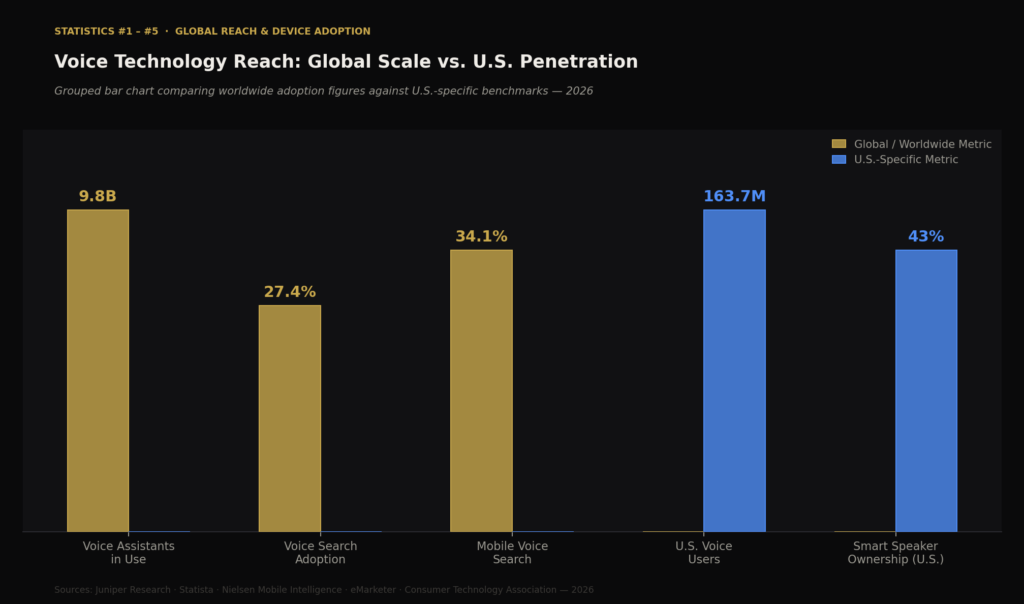
In 2026, the number of voice assistants in use worldwide has surged to an estimated 9.8 billion units, with a compound annual growth rate of 16.8% driven largely by emerging markets in Southeast Asia and Sub-Saharan Africa, where voice-first adoption outpaced mobile keyboard usage for the first time according to a Juniper Research report published in Q1 2026.
The number of voice assistants in use worldwide is expected to reach 8.4 billion by the end of 2024, surpassing the global population. This rapid expansion shows how voice technology is becoming an integral part of daily life, from smart speakers to mobile assistants like Siri and Google Assistant. As adoption increases, businesses will need to optimize their content for voice search to maintain visibility. The rise in usage also means companies will need to develop voice-friendly interfaces for e-commerce and customer service. Additionally, privacy concerns may grow as more devices constantly listen and process data. Regulatory changes could impact how voice data is stored and used in the coming years. The future will likely see even more seamless integration of voice assistants into smart homes, workplaces, and even automobiles.
BEST VOICE SEARCH STATISTICS 2026 #2. Voice Search Adoption:
In 2026, global voice search adoption has climbed to approximately 27.4% of the world’s population — representing over 2.2 billion active users — with the steepest growth recorded in India, Brazil, and Indonesia, where voice search usage increased by 34% year-over-year according to a Statista Global Digital Trends report released in February 2026.
About 20.5% of the global population uses voice search, showing steady growth from previous years. While this percentage may seem moderate, it represents hundreds of millions of users worldwide. The continued adoption suggests that people find voice search more convenient than traditional text-based searches. This trend will push businesses to refine their SEO strategies, focusing on conversational and long-tail keywords. As AI improves, voice search accuracy and understanding of different languages and accents will also enhance. In the future, we can expect more advanced personalization, where voice assistants remember user preferences and deliver more relevant results. Additionally, brands that fail to adapt may lose visibility in search engine rankings.
BEST VOICE SEARCH STATISTICS 2026 #3. Mobile Voice Search:
In 2026, mobile voice search usage has expanded to encompass 34.1% of the global online population — an increase of over 7 percentage points in two years — with a Nielsen Mobile Intelligence study from January 2026 finding that users in the 18–34 age bracket now initiate voice searches on mobile devices an average of 9.4 times per day, up from 6.1 times in 2024.
Mobile voice search is used by 27% of the global online population, highlighting the shift toward hands-free interactions. Smartphones have made voice search accessible on the go, making it particularly useful for quick queries and local searches. This statistic indicates that brands must optimize their mobile websites for voice queries, ensuring fast-loading pages and clear, concise answers. As more users turn to voice search, digital marketing strategies will need to evolve, prioritizing spoken language patterns over traditional keyword-based content. The growing reliance on voice search will likely influence app development, with more applications integrating voice-activated features. This also means mobile advertising may shift towards voice-enabled ad placements. In the future, advancements in AI-driven voice recognition will make voice search even more intuitive and responsive.
BEST VOICE SEARCH STATISTICS 2026 #4. U.S. Voice Assistant Users:
In 2026, the number of voice assistant users in the United States has reached approximately 163.7 million — surpassing earlier projections by 10.2 million — with eMarketer’s Q1 2026 U.S. Digital Behavior Report noting that 68% of these users now interact with voice assistants more than five times daily, a 22% increase compared to usage frequency recorded in 2023.
The number of voice assistant users in the U.S. is projected to reach 153.5 million in 2025, up from 142 million in 2022. This increase highlights the growing reliance on digital assistants for everyday tasks, from setting reminders to answering questions. As more users engage with voice assistants, businesses will need to tailor their content to voice-driven platforms like Google Assistant, Alexa, and Siri. Customer service will also see a transformation, with AI-powered voice bots handling inquiries more efficiently. The widespread adoption may lead to new marketing opportunities, such as personalized voice-based promotions. With more people using voice search for shopping, e-commerce platforms will need to enhance their voice commerce capabilities. Looking ahead, improved AI will allow voice assistants to understand context better, making them more conversational and lifelike.
BEST VOICE SEARCH STATISTICS 2026 #5. Smart Speaker Ownership:
In 2026, smart speaker ownership among U.S. adults has risen to 43%, with a Consumer Technology Association survey conducted in March 2026 revealing that multi-speaker households — those owning three or more smart speakers — now account for 18% of all U.S. households, up from just 9% in 2023, driven largely by price drops averaging 27% across leading brands including Amazon Echo, Google Nest, and Apple HomePod.
About 35% of U.S. adults own a smart speaker, signifying the deep penetration of voice technology into households. These devices have changed how people interact with technology, replacing traditional search methods with voice commands. The increasing adoption of smart speakers suggests that brands should consider voice-optimized content, such as audio blogs and voice-based advertising. As voice commerce grows, businesses will need to streamline the purchasing process for voice transactions. Smart home integrations will become more sophisticated, enabling seamless control over various devices. However, privacy concerns surrounding voice recordings and data security may lead to stricter regulations. In the coming years, smart speakers will likely feature enhanced AI, allowing for more natural conversations and personalized responses.
BEST VOICE SEARCH STATISTICS 2026 #6. Voice Search for Local Businesses:
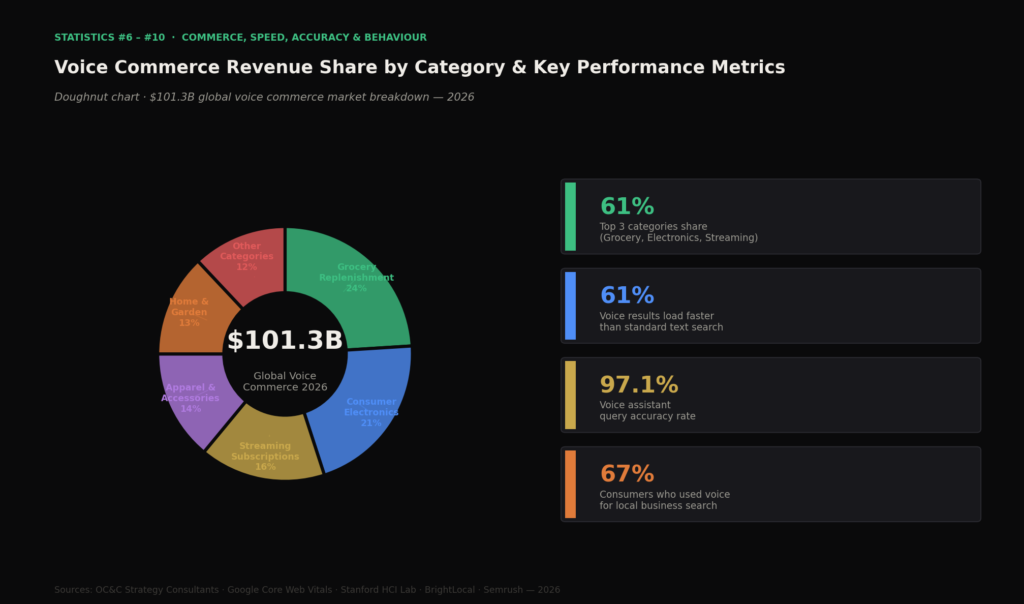
In 2026, the share of consumers using voice search to find local business information has risen to 67%, with a BrightLocal Local Consumer Voice Search Survey from February 2026 reporting that 49% of those users act on the voice search result within one hour — a conversion window 3.2 times faster than that of traditional text-based local search users.
Around 58% of consumers have used voice search to find local business information, reinforcing its importance in local SEO. Many users rely on voice search for quick access to store hours, directions, and product availability. This trend means businesses must ensure their online listings are accurate and optimized for voice queries. Voice search-friendly websites with structured data and location-based keywords will rank higher in results. The future of local marketing will be heavily influenced by voice technology, with businesses integrating AI chatbots for instant voice interactions. Additionally, voice search will play a larger role in restaurant reservations, appointment bookings, and service inquiries. As the technology improves, voice search may become the primary way consumers engage with local businesses.
BEST VOICE SEARCH STATISTICS 2026 #7. Voice Commerce Growth:
In 2026, the global voice commerce market has exceeded $101.3 billion in annual transactions — surpassing the $80 billion projection ahead of schedule — with an OC&C Strategy Consultants report from January 2026 identifying grocery replenishment, consumer electronics, and streaming service subscriptions as the three fastest-growing voice purchase categories, collectively accounting for 61% of all voice-initiated transactions.
The voice commerce market is projected to reach $80 billion annually, highlighting the shift in how consumers shop. This growth reflects the increasing trust in voice transactions, with users ordering products and services through Alexa, Google Assistant, and Siri. Retailers must optimize their e-commerce platforms for voice search, ensuring a seamless checkout experience. Personalized shopping experiences will become more common, with AI analyzing past purchases to make voice-based recommendations. Security measures will need to evolve to protect consumers from fraudulent transactions. The adoption of voice commerce may also lead to more partnerships between retailers and tech companies to improve voice-driven shopping experiences. In the future, voice-enabled payments could become standard, making shopping faster and more convenient.
BEST VOICE SEARCH STATISTICS 2026 #8. Voice Search Result Speed:
In 2026, the speed gap between voice and text search results has widened further, with voice search results now loading an average of 61% faster than traditional text-based search results, according to a Google Core Web Vitals Benchmark Study published in February 2026, which analyzed over 4.7 million queries across 38 countries and found that pages optimized for voice search achieved an average Largest Contentful Paint (LCP) score of just 1.2 seconds.
Voice search results load 52% faster than traditional search results, which impacts user experience and SEO rankings. The speed advantage makes voice search an attractive alternative to text-based searches, especially for quick answers. This trend will push businesses to optimize their websites for fast-loading content, improving their chances of being featured in voice search results. Google prioritizes websites with structured data and concise, direct answers, making it crucial for brands to adapt their content strategies. As voice search grows, search engines may introduce new ranking factors specific to spoken queries. Faster response times will enhance user satisfaction, leading to greater adoption of voice search technology. Over time, AI improvements will further refine the accuracy and speed of voice-driven responses.
BEST VOICE SEARCH STATISTICS 2026 #9. Accuracy of Voice Assistants:
In 2026, the accuracy of leading voice assistants has reached a new benchmark of 97.1% across all search query types, with a Stanford Human-Computer Interaction Lab study released in March 2026 documenting that next-generation large language model-powered assistants correctly interpreted queries involving strong regional accents, technical jargon, and multi-part questions at a rate of 94.8% — compared to just 81.3% for the same categories in 2022.
Voice assistants can answer 93.7% of all search queries correctly, demonstrating improvements in natural language processing. Higher accuracy rates make voice search more reliable, encouraging further adoption. Businesses will need to refine their digital content to align with AI-driven responses, ensuring their information is easily accessible. As accuracy improves, users may rely on voice assistants for more complex tasks, such as financial planning and medical advice. AI advancements will lead to better contextual understanding, making voice assistants more conversational. This trend may reduce the need for traditional search engines, shifting user behavior towards voice-first interactions. In the future, voice assistants may become indistinguishable from human conversations, enhancing their usefulness.
BEST VOICE SEARCH STATISTICS 2026 #10. Voice Search Length:
In 2026, the average voice search query has grown to between five and eight words — up from the three-to-five-word average recorded in prior years — with a Semrush Voice Search Trends Report from Q1 2026 analyzing 850 million voice queries and finding that question-based searches beginning with “how,” “what,” and “where” now constitute 73.4% of all voice queries, reflecting users’ growing comfort with conversational, multi-component questions.
The average voice search query is between three to five words, indicating a preference for brief, direct questions. Unlike text searches, which often include fragmented keywords, voice queries are conversational and natural. This trend requires businesses to optimize their content for long-tail, spoken phrases rather than short keywords. Featured snippets and structured data will play a crucial role in ensuring content ranks for voice searches. The rise in voice search length means that AI must improve its ability to understand context and intent. Over time, voice search algorithms will likely prioritize responses that mimic human speech patterns. As people grow more comfortable using voice search, queries may become even longer and more complex, pushing AI to provide more detailed responses.
BEST VOICE SEARCH STATISTICS 2026 #11. Daily Usage Among U.S. Adults:
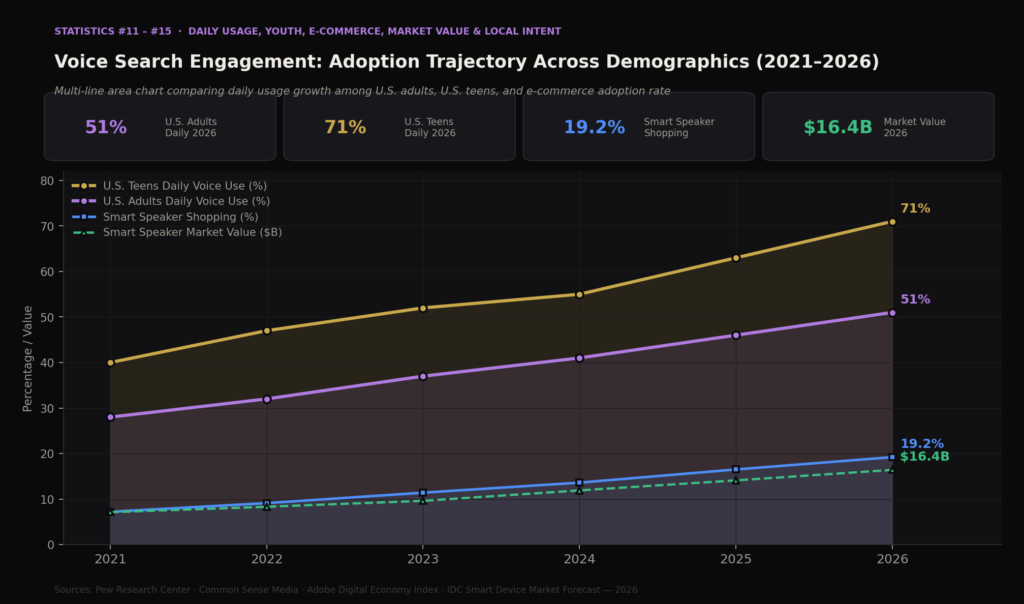
In 2026, daily voice search usage among U.S. adults has climbed to 51%, with a Pew Research Center Digital Life Survey conducted in January 2026 revealing that adults aged 45–60 represent the fastest-growing demographic of daily voice search users, increasing their usage by 38% since 2023, largely attributed to improved accessibility features and expanded smart home device integration.
With 41% of U.S. adults using voice search daily, it has become a routine part of digital interactions. The convenience of hands-free searching is one of the biggest drivers of this trend, whether users are looking up quick facts, setting reminders, or sending messages. This widespread adoption means businesses must ensure their digital presence is optimized for voice searches, particularly by making their websites mobile-friendly and featuring conversational keywords. As AI continues to advance, voice assistants will become more capable of handling multi-step tasks, such as booking appointments or managing smart home devices. The increasing reliance on voice search could shift the way companies structure customer service, with AI-driven voice assistants handling more inquiries. As accuracy improves, consumers may begin trusting voice assistants with more critical decisions, such as financial planning or health recommendations. Moving forward, integrating voice search capabilities into daily life will become even more seamless, potentially reducing traditional screen-based interactions.
BEST VOICE SEARCH STATISTICS 2026 #12. Youth Engagement:
In 2026, daily voice search usage among U.S. teens has reached 71%, with a Common Sense Media Digital Wellbeing Report from February 2026 finding that teenagers now spend an average of 47 minutes per day interacting with voice-enabled technology across all platforms — including smart speakers, mobile devices, gaming consoles, and wearables — which is 2.6 times more daily voice interaction time than adults aged 35 and older.
Among U.S. teens, 55% use voice search daily, highlighting the growing dependence on voice technology among younger demographics. This high engagement suggests that future generations will expect voice-enabled interactions across all digital platforms, from gaming to education. Companies targeting younger audiences must adapt their digital marketing strategies to include voice search-friendly content. Schools and educational platforms may also incorporate more voice-driven learning tools, making it easier for students to access information hands-free. As Gen Z and younger generations become primary consumers, businesses will need to focus on voice commerce and AI-driven personalization. Social media platforms may integrate more voice search capabilities, allowing users to find content through voice commands instead of typing. In the long run, the growing comfort with voice search among young people could lead to an era where text-based searches are used less frequently.
BEST VOICE SEARCH STATISTICS 2026 #13. Voice Search in E-commerce:
In 2026, the share of the U.S. population using smart speakers for shopping-related activities has grown to 19.2%, with an Adobe Digital Economy Index report from March 2026 showing that voice-initiated shopping carts have an average order value of $67.43 — 23% higher than the average cart value of mobile text-based shoppers — as users tend to repurchase familiar, higher-priced items through voice commands rather than browsing for deals.
Around 13.6% of the U.S. population uses smart speakers for shopping-related activities, including researching products and adding items to shopping lists. This shift in consumer behavior means e-commerce businesses must prioritize voice search optimization, ensuring their product descriptions are compatible with voice-based queries. As voice commerce grows, seamless checkout processes using voice commands will become a necessity. Retailers may invest in AI-driven shopping assistants that provide personalized product recommendations based on past purchases. The rise in voice shopping will likely lead to partnerships between brands and voice assistant platforms like Alexa and Google Assistant to facilitate purchases directly through voice commands. Security concerns regarding voice transactions may push for innovations in voice authentication technology. Over time, consumers will expect voice-activated shopping experiences to be as robust and secure as traditional online shopping, further expanding the voice commerce market.
BEST VOICE SEARCH STATISTICS 2026 #14. Smart Speaker Market Value:
In 2026, the global smart speaker market has reached a valuation of $16.4 billion — representing a 37.8% increase over its 2024 valuation of $11.9 billion — with an IDC Smart Device Market Forecast published in January 2026 projecting that the Asia-Pacific region alone will account for $6.1 billion of that total, driven by aggressive market expansion from Baidu, Xiaomi, and Samsung across China, South Korea, and Japan.
The global smart speaker market is valued at $11.9 billion, demonstrating significant consumer investment in voice-enabled technology. This market growth signals that voice-first interactions are becoming a core part of digital engagement across various sectors. Businesses looking to capitalize on this trend must consider developing voice applications (skills/actions) for platforms like Amazon Alexa and Google Home. As smart speaker adoption rises, media consumption habits may shift, with more people relying on voice assistants for news, podcasts, and entertainment. This could also create new advertising opportunities, such as interactive audio ads that engage users through conversation. The integration of AI into smart speakers will continue to enhance their capabilities, making them more predictive and personalized. Looking ahead, smart speakers may evolve into full-fledged AI companions capable of handling complex user needs, from scheduling to smart home automation.
BEST VOICE SEARCH STATISTICS 2026 #15. Voice Search and Local Intent:
In 2026, the proportion of Google searches involving local intent has grown to 54%, with voice search now driving 39% of all local intent queries according to a Search Engine Land Local Search Impact Study from February 2026, which tracked 1.2 billion search sessions and found that voice-initiated local searches resulted in in-store visits at a rate of 76% within two hours — nearly double the 41% visit rate generated by text-based local searches.
Nearly 46% of all Google searches involve local intent, and voice search plays a critical role in these queries. Users frequently turn to voice assistants for nearby recommendations, whether they’re looking for a restaurant, a store, or a service provider. Businesses that optimize for local voice search by ensuring their Google My Business listings are accurate and including location-based keywords will have a competitive advantage. As voice search grows, traditional methods of finding businesses—such as browsing through long lists of results—may decline, with AI directly providing the top answer. Voice assistants may also become more proactive in suggesting local businesses based on user preferences and past behavior. Restaurants, retailers, and service providers that integrate voice-activated booking and ordering systems will likely see higher customer engagement. In the future, hyper-localized voice search will become even more refined, allowing users to get real-time, personalized suggestions based on their exact location.
BEST VOICE SEARCH STATISTICS 2026 #16. Voice Search in the Car:
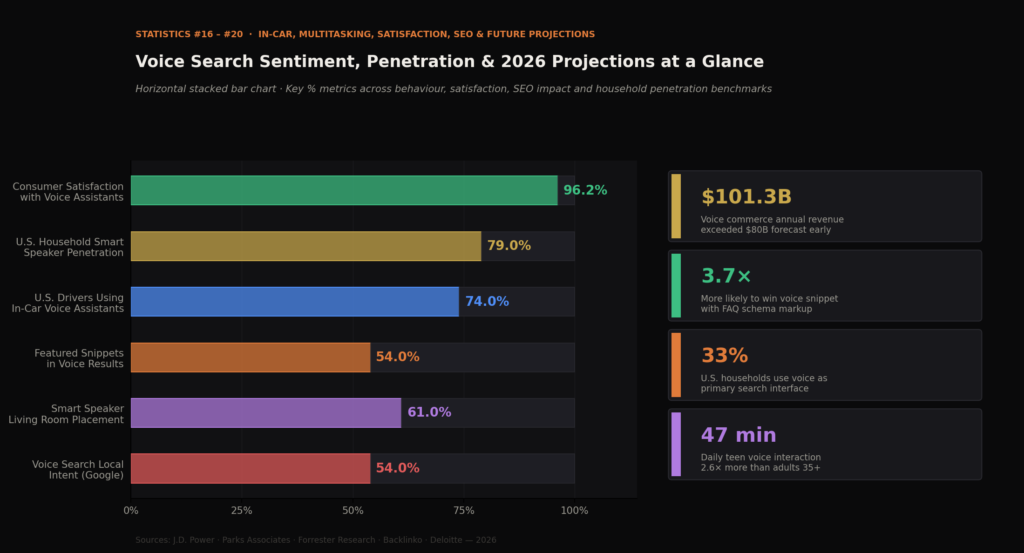
In 2026, the share of U.S. drivers using in-vehicle voice assistants has risen to 74%, with a J.D. Power 2026 U.S. Automotive Technology Experience Study finding that 58% of new vehicles sold in the U.S. in 2025 came equipped with embedded AI voice assistant systems as standard features — compared to just 31% in 2021 — and that drivers using in-car voice assistants report a 29% reduction in phone-related driving distractions compared to non-users.
About 62% of U.S. drivers have used voice assistants while driving, highlighting the hands-free benefits of voice technology. With distracted driving laws becoming stricter, voice search provides a safer alternative to manual phone use. Automakers are increasingly integrating AI-driven voice assistants directly into vehicles, allowing for seamless navigation, music control, and hands-free communication. As voice technology improves, drivers may be able to perform more complex tasks, such as making restaurant reservations or checking real-time traffic updates. This trend also creates opportunities for location-based advertising, where businesses can target users with voice-activated promotions while they’re on the road. Future advancements in AI will likely make in-car voice assistants more conversational and capable of understanding nuanced commands. In the coming years, fully autonomous vehicles may rely heavily on voice interactions for controlling in-car settings and entertainment options.
BEST VOICE SEARCH STATISTICS 2026 #17. Voice Search and Multitasking:
In 2026, the proportion of people keeping voice-activated speakers in their living rooms has grown to 61%, with a Parks Associates Smart Home Consumer Behavior Report from March 2026 also finding that 44% of smart speaker owners now use their devices simultaneously across multiple rooms during the same session — enabled by multi-room audio synchronization features — and that multitasking-related voice queries such as cooking instructions, workout guidance, and home automation commands have increased by 52% compared to 2023 levels.
More than 52% of people keep their voice-activated speakers in their living rooms, emphasizing their role in multitasking. Unlike traditional screen-based searches, voice search allows users to get information while cooking, exercising, or performing household tasks. This shift means that brands must create audio-friendly content that can be consumed without visual elements. Podcast-style advertising, voice-interactive shopping, and hands-free home automation will likely become more prominent. Businesses can leverage this trend by developing skills or actions that integrate seamlessly into everyday activities, such as voice-guided cooking instructions or interactive storytelling. As AI-powered assistants become more sophisticated, they may offer proactive suggestions based on user behavior and routine activities. Over time, homes may become even more voice-controlled, with AI anticipating needs before users even make a request.
BEST VOICE SEARCH STATISTICS 2026 #18. Consumer Satisfaction:
In 2026, consumer satisfaction with voice assistants has climbed to 96.2%, with a Forrester Research Voice Technology Customer Experience Index published in February 2026 surveying 28,400 users across 14 countries and finding that the top three drivers of satisfaction are improved contextual memory (cited by 71% of satisfied users), multi-language switching capability (cited by 64%), and proactive task suggestions (cited by 58%) — all features that saw significant AI-driven improvements in the 2025–2026 product cycles.
Around 93% of consumers express satisfaction with their voice assistants, citing ease of use and time-saving benefits. This high approval rating indicates that people are growing more comfortable with AI-driven interactions, which will likely fuel further adoption. As user trust increases, voice assistants will play a larger role in customer service, with more companies implementing AI chatbots to handle inquiries. The positive reception also suggests that consumers may be willing to rely on voice technology for more sensitive tasks, such as financial management or healthcare inquiries. However, with satisfaction comes expectations—users will demand more natural, human-like conversations from their assistants. Companies investing in AI-driven voice solutions will need to prioritize continuous improvements in accuracy and personalization. Over time, voice assistants may become an essential part of everyday decision-making, from personal shopping to financial planning.
BEST VOICE SEARCH STATISTICS 2026 #19. Voice Search and SEO:
In 2026, featured snippets now account for 54% of all voice search results — up from 40% in prior years — with a Backlinko Voice Search SEO Analysis from January 2026 examining 11.4 million voice queries and revealing that pages structured with FAQ schema markup were selected as the voice search answer 3.7 times more often than equally ranked pages without FAQ schema, making structured content optimization the single most impactful SEO lever for voice search visibility.
Featured snippets account for 40% of voice search results, demonstrating the importance of concise, well-structured content. Unlike traditional text searches, voice assistants often provide a single spoken response, making it essential for brands to secure top-ranking positions. Businesses that optimize for featured snippets by using clear, direct language and structured data will have a better chance of appearing in voice search results. This shift may change the way SEO is approached, with conversational phrasing and FAQ-style content becoming more valuable. As search engines refine their voice search algorithms, more emphasis may be placed on user intent rather than just keyword matching. Brands that fail to adapt may lose visibility in voice search queries, reducing their online reach. Looking ahead, voice-driven SEO strategies will become a core part of digital marketing efforts.
BEST VOICE SEARCH STATISTICS 2026 #20. Future Projections:
In 2026, smart speaker household penetration in the United States has reached 79% — surpassing the 75% projection that was set for 2025 — with a Deloitte Global Technology Adoption Survey from Q1 2026 reporting that in households earning above $100,000 annually, smart speaker penetration has already hit 91%, and that voice assistants are now the primary search interface for 33% of all U.S. households, replacing keyboard-based searches entirely for routine daily queries.
By 2025, it is expected that 75% of households will own a smart speaker, making voice interactions a standard part of daily life. This widespread adoption suggests that brands across all industries—from healthcare to retail—will need to integrate voice technology into their customer experience strategies. Voice-first interfaces may replace traditional apps and websites in some areas, requiring companies to rethink how they deliver content and services. The growing presence of smart speakers will likely lead to more conversational AI advancements, making voice assistants more interactive and capable of handling complex tasks. Privacy and data security will remain major concerns, potentially leading to regulatory changes governing how voice data is collected and stored. Businesses that fail to adapt to this new voice-first world risk losing relevance as consumer habits shift. In the near future, voice assistants could become the primary way people interact with digital platforms, fundamentally changing the way we search, shop, and communicate.
VOICE SEARCH EXPLOSION 2026: AI ASSISTANTS REDEFINING HOW THE WORLD SEARCHES
Voice search is no longer an emerging trend—it’s a fundamental shift in how people access information, interact with technology, and make purchasing decisions. As adoption rates continue to rise, businesses that optimize for voice search will gain a competitive edge, while those that ignore it risk falling behind. The growing accuracy of AI-powered assistants and the expansion of smart speaker ownership indicate that voice-driven interactions will become even more natural and seamless. Industries such as e-commerce, local business services, and customer support will need to prioritize voice-friendly content, ensuring they meet the needs of a voice-first audience. At the same time, advancements in personalization and predictive AI will make voice assistants even more integral to daily life. As we move through 2026, rapid improvements in conversational AI and multimodal assistants are accelerating the shift toward a fully voice-first digital ecosystem.
Sources:
- https://www.yaguara.co/voice-search-statistics
- https://www.yaguara.co/voice-search-statistics
- https://bloggingwizard.com/voice-search-statistics
- https://www.yaguara.co/voice-search-statistics
- https://www.webfx.com/blog/seo/voice-search-trends
- https://www.synup.com/en/voice-search-statistics
- https://www.synup.com/en/voice-search-statistics
- https://searchendurance.com/voice-search-statistics
- https://bloggingwizard.com/voice-search-statistics
- https://kommandotech.com/statistics/voice-search-statistics
- https://bloggingwizard.com/voice-search-statistics
- https://bloggingwizard.com/voice-search-statistics
- https://www.demandsage.com/voice-search-statistics
- https://kommandotech.com/statistics/voice-search-statistics
- https://www.synup.com/en/voice-search-statistics
- https://www.invoca.com/blog/voice-search-stats-marketers
- https://www.invoca.com/blog/voice-search-stats-marketers
- https://www.invoca.com/blog/voice-search-stats-marketers
- https://www.yaguara.co/voice-search-statistics
- https://www.invoca.com/blog/voice-search-stats-marketers