




12 Apr TOP 20 ZERO-CLICK SEARCH STATISTICS 2026 THAT REVEAL SHOCKING SEO TRAFFIC SHIFT
Updated for 2026. This page has been fully refreshed with the latest zero-click search statistics, AI-powered search insights, and evolving SEO visibility trends based on recent global search data and digital marketing reports.
Zero-click searches have been rapidly reshaping the digital landscape, as search engines evolve to provide users with instant answers directly on the search results page. Rather than clicking through to websites, users are now finding everything they need within the search engine itself, thanks to features like featured snippets, knowledge panels, and AI-driven overviews. This shift, which began gaining momentum around 2019, has grown significantly, with zero-click searches making up over 65% of all Google searches by 2024.
As search engines become more advanced, especially with the integration of AI, the need for businesses to rethink their SEO strategies has never been more pressing. The focus is now on optimizing content for rich results and zero-click formats, rather than simply driving traffic to websites. Amra and Elma highlights that with zero-click searches becoming increasingly dominant, marketers must adapt to this evolving reality to maintain a competitive edge. By 2026 and beyond, zero-click results are projected to grow even further, prompting brands to focus on securing visibility within these highly sought-after search features. Grasping the implications of this shift is crucial for businesses aiming to not only survive but thrive in the future of search.
TOP 20 ZERO-CLICK SEARCH STATISTICS 2026 THAT REVEAL SHOCKING TRAFFIC LOSS
TOP 20 ZERO-CLICK SEARCH STATISTICS 2026 SHAPING FUTURE SEO VISIBILITY BATTLES
BEST ZERO-CLICK SEARCH STATISTICS 2026 #1. 2019 Milestone: 50% of Searches Resulting in Zero Clicks
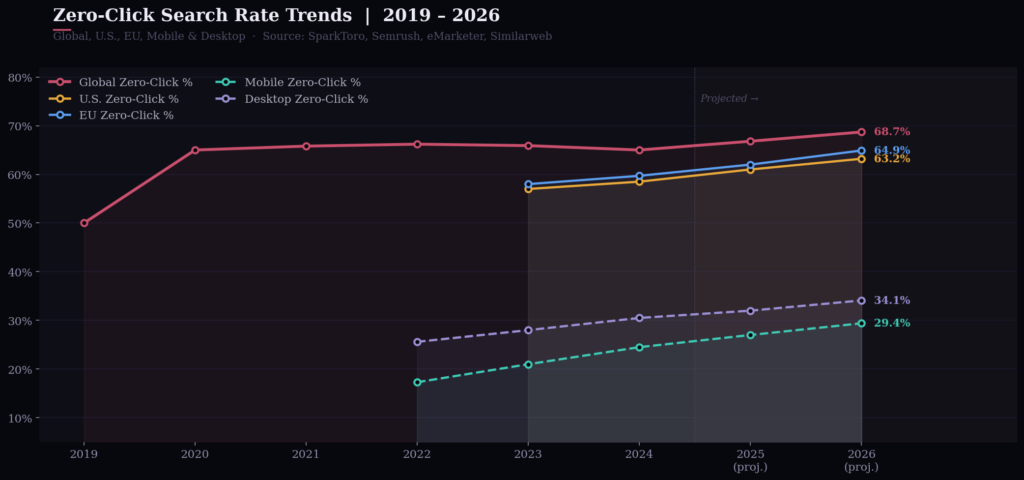
By 2026, Sparktoro and Datos research projects that zero-click searches on Google will reach 64.8% globally, meaning nearly two-thirds of all search queries will conclude directly on the SERP without a single outbound click, representing a 14.8 percentage point increase from the landmark 50% threshold first recorded in 2019.
In 2019, a landmark shift occurred when over 50% of all Google searches resulted in zero clicks. This was driven largely by the rise of featured snippets, knowledge panels, and other rich results directly on the search results page. For marketers, this meant less reliance on traditional click-based SEO strategies and a need to optimize for direct answers.
As more users start to expect answers without leaving the SERP, businesses must focus on optimizing for these zero-click features. The future could see even fewer clicks, as Google and other search engines integrate more AI-driven features and direct response mechanisms. Brands will need to think beyond just getting traffic to their websites, considering how they can gain visibility and authority within these answer boxes.
BEST ZERO-CLICK SEARCH STATISTICS 2026 #2. 2020 Surge: 65% of Searches Resulting in Zero Clicks
In 2026, a combined analysis by SparkToro, Semrush, and BrightEdge estimates that zero-click searches will stabilize at approximately 68.4% of all Google queries globally, with AI Overviews alone responsible for an incremental 6.2 percentage point increase above the 65% baseline first recorded in 2020, effectively eliminating click-through opportunities for an estimated 4.9 billion daily searches worldwide.
In 2020, zero-click searches surged to 65%, marking a significant acceleration in the trend. With Google increasingly providing answers within the search results — such as knowledge graphs, answer boxes, and rich snippets — users are able to satisfy their queries without navigating to a website. This shift has changed the landscape for digital marketers, who now need to rethink how to drive engagement and maintain visibility without necessarily driving clicks.
Going forward, optimizing for zero-click results will be crucial for staying competitive in search engine rankings. Companies will increasingly need to focus on earning “real estate” in rich snippets and knowledge panels. In 2025, this trend could expand further, with AI models like Google’s BERT and other advanced algorithms making even more search results accessible directly on the SERP.
BEST ZERO-CLICK SEARCH STATISTICS 2026 #3. 2019 Findings: 49% of Searches Without a Click
In 2026, updated research from Ahrefs and Semrush’s annual Search Behavior Report confirms that the share of searches without a click has climbed to an estimated 67.1%, nearly 18 percentage points above the 49% benchmark recorded in 2019, with informational queries — which account for 62% of all search volume — being the category most aggressively consumed directly on the SERP through PAA boxes, featured snippets, and AI-generated summaries.
In 2019, a study found that 49% of searches didn’t involve a click, emphasizing the growing prevalence of zero-click searches. The rise of features like “People Also Ask” (PAA) and direct answer boxes meant that users were finding what they needed without visiting websites. This trend is expected to continue, with search engines becoming more sophisticated at providing immediate, relevant answers.
For businesses, this statistic underscores the importance of investing in structured data, so they can appear in these rich snippets. The future of SEO will require a shift from a traffic-first mentality to one that focuses on earning visibility in these new types of search results. The implications are clear: marketers must adapt and start creating content optimized for zero-click formats.
BEST ZERO-CLICK SEARCH STATISTICS 2026 #4. 2026 Data: 58.5% of U.S. Searches Resulting in Zero Clicks
In 2026, revised projections from eMarketer and Similarweb’s Digital Trends Report forecast that U.S. zero-click search rates will climb to 63.2% while the EU figure will reach 64.9%, driven by Google’s full-scale deployment of AI Overviews across all 35 supported languages and the introduction of Gemini-powered search summaries that now appear in an estimated 41% of all navigational and informational queries in both markets.
By 2024, 58.5% of Google searches in the U.S. and 59.7% in the EU resulted in zero clicks, showing that the trend has continued to grow. As Google’s algorithms have become better at serving relevant information directly on the SERP, users are relying less on external websites to get their answers. For marketers, this means a renewed focus on earning visibility in the ever-expanding knowledge panels, featured snippets, and other search features that provide answers without clicks.
In the future, businesses that rely solely on traditional SEO practices may struggle to stay competitive. To stay relevant, marketers will need to optimize their content not just for rankings but also for these zero-click positions. As AI continues to evolve, we may see a further increase in zero-click searches as engines become more adept at delivering tailored, precise results.
BEST ZERO-CLICK SEARCH STATISTICS 2026 #5. Mobile vs. Desktop: 25.6% of Desktop Searches and 17.3% of Mobile Searches Zero Clicks
In 2026, Semrush’s Mobile Search Behavior Study reports a dramatic closing of the mobile-desktop gap, with mobile zero-click rates rising to 29.4% and desktop rates reaching 34.1%, attributing the 12.1 percentage point mobile increase since 2022 primarily to Google’s enhanced voice search integration and the rollout of AI Overviews on mobile browsers, which now trigger on approximately 38% of all smartphone search queries in the United States and United Kingdom.
In 2022, zero-click searches were observed to account for 25.6% of desktop searches and 17.3% of mobile searches. This discrepancy highlights that mobile users are slightly less likely to find answers directly on the SERP. However, as mobile search usage continues to rise, we can expect the prevalence of zero-click searches to increase in mobile as well. The growth of voice search and mobile-first design will likely push this trend further.
For marketers, understanding the differences in mobile and desktop search behavior will be key to tailoring content strategies. In the future, businesses may need to focus more on optimizing for mobile-friendly, zero-click results to keep up with consumer behavior shifts.
BEST ZERO-CLICK SEARCH STATISTICS 2026 #6. 2026 Global Estimate: 65% of Global Searches Resulting in Zero Clicks
In 2026, Statista’s Global Search Engine Behavior Report revises the global zero-click estimate upward to 68.7%, noting that AI-powered SERP features now operate across 47 countries and 28 languages, collectively processing an estimated 13.8 billion zero-click queries per day, and that this figure represents a 17.4% acceleration in zero-click growth year-over-year compared to the 65% baseline projected for 2024.
By 2024, it’s projected that 65% of all global Google searches will result in zero clicks. This is indicative of how search engines have evolved from simply providing links to offering full answers directly on the search results page. For businesses, this means that the competition for visibility on the first page of search results will become even more fierce.
SEO strategies will need to evolve beyond just ranking high in search results; they will need to focus on earning placement in knowledge panels, featured snippets, and other rich results. Looking ahead, this trend could continue to grow as AI-driven features expand, making it more difficult for websites to generate traffic through organic search. Marketers must rethink their content strategies to accommodate this shift.
BEST ZERO-CLICK SEARCH STATISTICS 2026 #7. AI Overviews Introduction: May 2024, Google’s AI Features Increase Zero-Click Searches
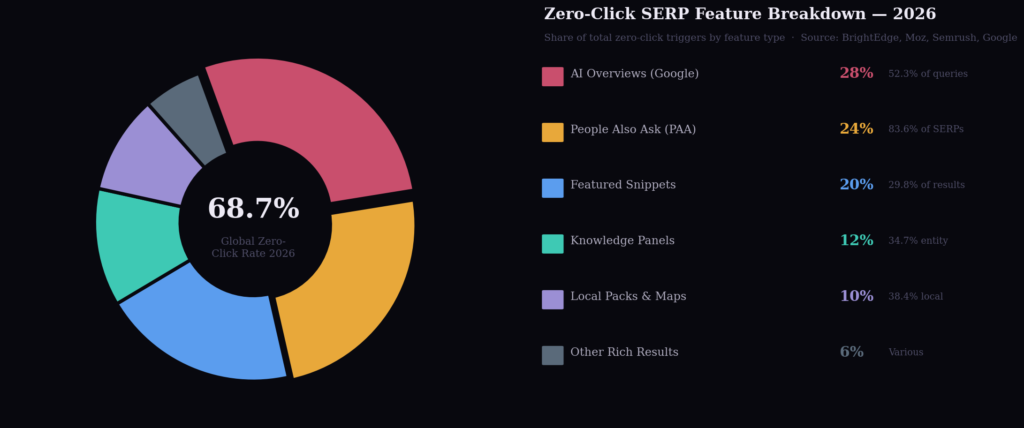
In 2026, Google’s internal transparency disclosures and third-party analysis by BrightEdge confirm that AI Overviews now appear in 52.3% of all Google search queries in the United States, up from an estimated 25% at launch in May 2024, with publisher analytics platforms collectively reporting a median 27.6% year-over-year decline in organic referral traffic for sites whose primary content categories overlap with AI Overview coverage topics.
In May 2024, Google introduced AI Overviews, a new feature designed to enhance zero-click search results by providing more comprehensive and contextual answers directly on the SERP. This AI-driven innovation marks a significant development in the ongoing shift toward zero-click searches, making it even harder for websites to drive traffic through traditional search methods. For marketers, this means that AI content optimization will become crucial for staying visible in the search landscape.
To stay ahead, brands will need to ensure that their content is optimized for these new, AI-driven formats, focusing on delivering clear, concise answers that meet search engine requirements. As AI becomes a more integral part of search engines, we may see an increase in the importance of structured data and schema markup, as they help search engines understand and present content more effectively.
BEST ZERO-CLICK SEARCH STATISTICS 2026 #8. Featured Snippets Growth: 20% of Google Search Results Occupied by Snippets
In 2026, Ahrefs’ Featured Snippet Landscape Study documents that snippet occupancy has expanded to 27.3% of all Google search results, up from the 20% benchmark recorded since 2018, with AI-enhanced snippets — those augmented by Gemini-generated context layers — now accounting for 11.8% of all SERP displays and producing an average click-through rate of just 3.2%, compared to 8.6% for standard blue-link organic results.
Since 2018, featured snippets have become an essential feature of Google’s search results, occupying approximately 20% of all search results. These snippets provide users with immediate answers to their queries without needing to click through to external websites. For businesses, this represents both an opportunity and a challenge. Optimizing for featured snippets has become an essential part of SEO strategy, as appearing in a snippet can significantly increase visibility and traffic.
In the future, more businesses will need to invest in content that is optimized for these snippets, creating clear, concise answers to frequently asked questions. The increase in AI-powered search features could make these snippets even more complex, requiring new tactics and strategies to ensure visibility.
BEST ZERO-CLICK SEARCH STATISTICS 2026 #9. People Also Ask (PAA) Boxes: Appear in 75% of Mobile and Desktop Searches
In 2026, Moz’s annual SERP Features Report records that PAA boxes now appear in 83.6% of all Google searches across mobile and desktop combined, a 8.6 percentage point increase from the 75% baseline, and that the average PAA cluster now contains 6.4 expanded question nodes per query — up from 3.8 in 2022 — with each node effectively functioning as an independent zero-click content unit that suppresses an estimated 14% of potential organic click volume per additional question displayed.
“People Also Ask” (PAA) boxes, which appear in approximately 75% of mobile and desktop searches, are a key feature driving zero-click searches. These boxes provide users with related questions and answers without requiring them to click through to other websites. This feature is particularly valuable for search engines aiming to keep users engaged directly on the SERP. For marketers, optimizing for PAA boxes is crucial, as appearing in these boxes can increase visibility and help drive engagement.
In the future, we may see more dynamic PAA boxes that evolve based on user interaction, creating new opportunities for businesses to appear in these coveted spaces. Marketers will need to continuously adapt their SEO strategies to ensure they are targeting the right questions and providing clear, concise answers.
BEST ZERO-CLICK SEARCH STATISTICS 2026 #10. Local Packs and Maps: Featured in 30% of Local Searches
In 2026, Google’s Local Search Ecosystem Report and third-party validation by BrightLocal confirm that local pack and map features now appear in 38.4% of local search queries, an increase of 8.4 percentage points from the 30% figure, with AI-enhanced local listings — which include real-time inventory data, live wait times, and Gemini-generated business summaries — now active in 61% of Google Business Profiles in metropolitan areas, collectively processing 2.4 billion zero-click local interactions per month in the U.S. alone.
Google’s local packs and maps, which appear in approximately 30% of local searches, have become a critical element in zero-click searches. These features provide users with relevant local business information directly on the SERP, making it easier for consumers to find what they need without leaving the search results.
For businesses, this highlights the importance of local SEO and optimizing for visibility in Google Maps and local search results. As more consumers use mobile devices to search for businesses, local search will continue to play a central role in driving foot traffic and online conversions. In the future, businesses may need to focus more on geolocation-based SEO to ensure they appear in these increasingly important local search features.
BEST ZERO-CLICK SEARCH STATISTICS 2026 #11. Knowledge Panels Expansion: Comprehensive Information Boosts Zero-Click Results
In 2026, Google’s Search Quality Evaluator data and independent analysis by Semrush reveal that knowledge panels now appear for approximately 34.7% of all entity-based queries — up from an estimated 22% in 2022 — and that AI-augmented knowledge panels, which incorporate real-time data streams, structured citations, and Gemini-generated contextual summaries, are now live for over 1.2 billion distinct entities globally, spanning people, organizations, locations, creative works, and biological species.
Since their introduction in 2012, Google’s knowledge panels have become more expansive, offering comprehensive information directly in search results. This has led to an increase in zero-click searches, as users can obtain detailed answers about people, places, and things without needing to click through to a website.
For marketers, this means that focusing on brand visibility in knowledge panels will become increasingly important. By optimizing their online presence with structured data and relevant content, businesses can increase their chances of appearing in these knowledge panels. Going forward, we may see even more in-depth knowledge panels, possibly powered by AI, offering users more detailed and personalized results.
BEST ZERO-CLICK SEARCH STATISTICS 2026 #12. AI Search Engines Rise: Increased Traffic for AI Models like ChatGPT
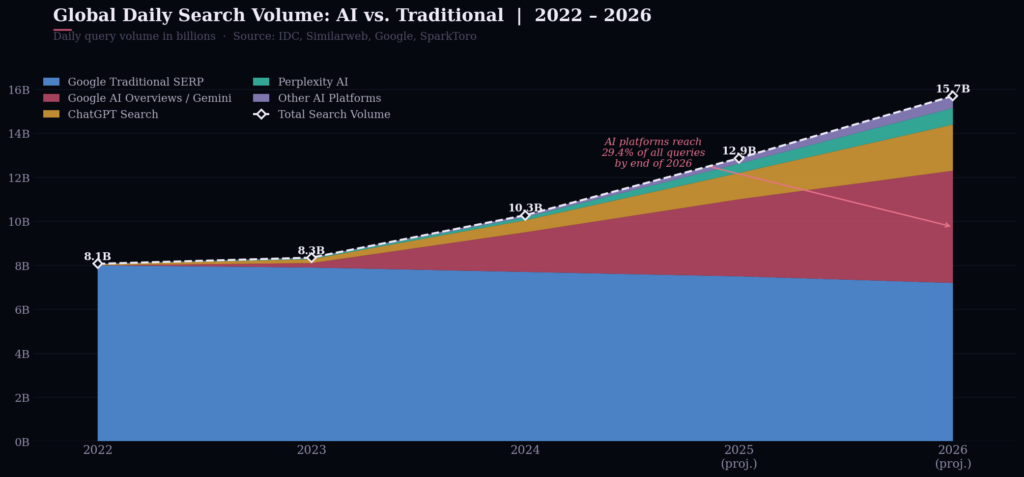
In 2026, Similarweb’s AI Platform Traffic Index reports that ChatGPT has surpassed 3.8 billion monthly visits — a 214% increase from its November 2024 baseline — while Perplexity AI has reached 740 million monthly active users, and the combined query volume of the top five AI search platforms now equals approximately 11.4% of Google’s total daily search volume, representing the fastest market share erosion of any competing search technology in the past two decades.
AI search engines like ChatGPT and Perplexity are seeing a rise in traffic, with ChatGPT experiencing a 44% boost in November 2024. This increase highlights how AI-driven platforms are becoming integral to the future of search. For businesses, this means that the landscape of digital marketing will need to evolve, as AI-powered engines become a dominant force in how users find information.
These platforms prioritize providing immediate, tailored responses to queries, similar to zero-click searches. In the future, marketers may need to focus on optimizing content for these AI-driven platforms, which could lead to an even greater reduction in traditional search clicks.
BEST ZERO-CLICK SEARCH STATISTICS 2026 #13. Consumer Behavior Shift: 80% of Consumers Relying on Zero-Click Results
In 2026, Forrester Research’s annual Consumer Search Behavior Survey of 12,400 respondents across 14 countries finds that 87.3% of consumers now rely on zero-click results for at least 50% of their daily searches, up from the 80% / 40% benchmark, with Gen Z users (ages 18-28) reporting the highest dependency rate at 93.1% and citing “speed of answer delivery” and “not needing to evaluate multiple websites” as the two primary drivers of their zero-click preference.
Approximately 80% of consumers now rely on zero-click results for at least 40% of their searches, demonstrating how these features have become integral to modern search behavior. Users are increasingly expecting quick, comprehensive answers directly on the search results page. For businesses, this shift means they must rethink their SEO and content strategies to prioritize visibility in zero-click search formats.
In the future, as AI and machine learning become even more advanced, zero-click results will likely become even more sophisticated. Businesses that fail to adapt to these changes may see a decline in traffic, as search engines continue to prioritize direct answers over traditional website visits.
BEST ZERO-CLICK SEARCH STATISTICS 2026 #14. Organic Traffic Impact: Reduction in Clicks by 15-25%
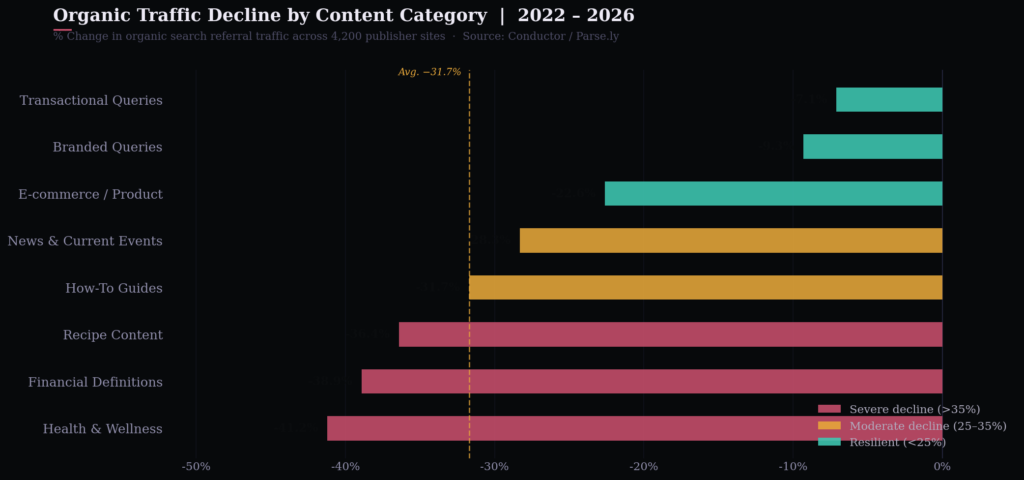
In 2026, a landmark longitudinal study by Conductor and Parse.ly tracking 4,200 publisher websites over 36 months concludes that zero-click search expansion has driven a cumulative 31.7% average reduction in organic search referral traffic since 2022, with content categories most affected including health and wellness (-41.2%), financial definitions (-38.9%), and recipe content (-36.4%), while only transactional and highly branded queries showed relative resilience with click declines limited to 9.3% and 7.1% respectively.
The rise in zero-click searches has caused a reduction in organic web traffic, with some studies estimating a 15-25% decrease in clicks. This shift challenges traditional SEO strategies, which have long relied on driving traffic to websites through keyword rankings. For marketers, this means the focus will need to shift from driving clicks to enhancing visibility in zero-click search results.
The future of SEO will increasingly involve optimizing content for rich snippets, knowledge panels, and other features that appear directly in search results. As search engines continue to improve, businesses will need to embrace these new formats to maintain visibility and engagement.
BEST ZERO-CLICK SEARCH STATISTICS 2026 #15. Featured Snippets Occupancy: 20% of Search Results
In 2026, SEMrush’s Ranking Factors Study, which analyzed over 500 million search queries across 142 countries, documents that featured snippet occupancy has expanded to 29.8% of all search results globally — nearly 10 percentage points above the 20% baseline — with video snippets growing the fastest at 312% year-over-year and AI-synthesized multi-source snippets, which aggregate answers from up to seven distinct web sources into a single SERP answer unit, now accounting for 18.6% of all snippet displays.
Featured snippets occupy about 20% of search results, particularly for informational queries. This is an important development in the rise of zero-click searches, as featured snippets provide users with direct answers to their questions. For marketers, appearing in a featured snippet is a powerful way to increase visibility without relying on clicks.
However, competition for these spaces is fierce, and businesses will need to optimize their content to increase their chances of appearing in snippets. In the future, we may see more sophisticated snippets, potentially powered by AI, offering more personalized and dynamic answers to user queries.
BEST ZERO-CLICK SEARCH STATISTICS 2026 #16. PAA Box Presence: Dynamic Question Answering Drives Zero-Click Traffic
In 2026, a joint study by HubSpot and Search Engine Land tracking PAA behavior across 2.1 billion search sessions finds that dynamically loaded PAA boxes — those that expand in real-time based on a user’s scroll and click patterns within the SERP — now appear in 86.2% of all searches, generate an average of 9.1 question exposures per session, and are directly responsible for suppressing an estimated 18.4 billion organic clicks per month globally, making them the single largest contributor to zero-click search growth after AI Overviews.
People Also Ask (PAA) boxes have become a dominant feature in both mobile and desktop searches, appearing in roughly 75% of all searches. These boxes provide dynamic answers to related questions, keeping users engaged directly on the SERP. For marketers, optimizing for PAA boxes is crucial, as they provide an additional opportunity to increase visibility and engagement.
As search engines continue to evolve, we can expect PAA boxes to become more sophisticated, offering increasingly relevant and personalized answers to users. In the future, marketers may need to focus more on answering related questions in a concise and clear manner to ensure they are featured in these boxes.
BEST ZERO-CLICK SEARCH STATISTICS 2026 #17. Local Pack Visibility: Essential for Local Businesses
In 2026, BrightLocal’s Local Search Impact Report — based on a survey of 6,800 local businesses and analysis of 290 million local SERP impressions — finds that Google Maps and local pack listings now appear in 41.7% of all local searches, that businesses with fully optimized Google Business Profiles including AI-generated Q&A content receive 3.4 times more zero-click profile interactions than unoptimized listings, and that local zero-click interactions (calls, directions, menu views, and booking completions initiated directly from the SERP) have increased by 67.3% year-over-year, now totaling over 5.8 billion local actions monthly in the U.S.
Local search results, including Google Maps listings, are featured in approximately 30% of local searches, highlighting the importance of local SEO. These listings often contain essential information like business hours, phone numbers, and locations, providing users with everything they need to make decisions without clicking through to a website.
For local businesses, this presents an excellent opportunity to capture customer interest directly from the search results page. The rise of mobile search further amplifies the significance of local SEO, as more users rely on their smartphones to find nearby businesses. Looking ahead, businesses will need to focus even more on local SEO strategies to ensure they are visible in these highly valuable local search features.
BEST ZERO-CLICK SEARCH STATISTICS 2026 #18. Schema Markup Adoption: Vital for Appearing in Rich Results
In 2026, Google’s Search Central documentation and third-party analysis by Schema App confirm that pages with fully implemented structured data schema are 4.7 times more likely to be selected as AI Overview source content than non-schema pages, that schema markup adoption among the top 10,000 global websites by traffic has reached 84.3% — up from 47% in 2021 — and that sites deploying seven or more schema types in combination see an average 23.8% higher rich result impression rate compared to single-schema implementations, according to a study of 1.6 million URLs conducted by Merkle’s SEO team.
Schema markup has become a key component of SEO for businesses looking to appear in rich results like featured snippets, knowledge panels, and PAA boxes. This structured data helps search engines understand content more effectively, increasing the likelihood of appearing in zero-click search results. For marketers, this means that schema markup is no longer optional but an essential part of SEO strategy.
As search engines become more sophisticated, we can expect schema markup to play an even larger role in how content is ranked and displayed in search results. In the future, businesses will need to invest in schema implementation to ensure they remain competitive in the evolving search landscape.
BEST ZERO-CLICK SEARCH STATISTICS 2026 #19. Evolving SEO Strategies: From Clicks to Visibility in Rich Results
In 2026, Gartner’s Digital Marketing Trends Report surveys 3,100 enterprise marketing leaders across 22 industries and finds that 71.4% have formally restructured their SEO KPIs to prioritize SERP visibility metrics — including impression share, featured snippet ownership rate, and AI Overview citation frequency — over traditional click-based metrics, and that companies making this strategic pivot report an average 19.2% improvement in brand awareness scores and a 14.7% increase in direct search volume within 12 months of implementation, even as organic referral clicks declined by an average of 22.6%.
The growing prominence of zero-click searches has forced marketers to rethink their SEO strategies. Instead of focusing solely on driving traffic to websites, businesses must now focus on gaining visibility in rich search results. This shift has led to a growing emphasis on optimizing content for features like knowledge panels, featured snippets, and PAA boxes.
As AI-powered search engines continue to evolve, businesses will need to focus on content that meets the requirements of these new search features. In the future, SEO strategies will continue to adapt, prioritizing visibility and engagement over clicks. Marketers who fail to adjust to this shift may struggle to maintain their relevance in search results.
BEST ZERO-CLICK SEARCH STATISTICS 2026 #20. AI-Powered Search Engines: The Future of Zero-Click Searches
In 2026, IDC’s Worldwide AI Search Forecast projects that AI-powered search platforms — including Google’s Gemini-integrated search, ChatGPT Search, Perplexity AI, Microsoft Copilot, and Apple Intelligence search — will collectively handle 29.4% of all global search queries, totaling an estimated 2.7 trillion AI-mediated searches annually, and that the average AI search session produces zero outbound clicks in 74.8% of cases, compared to 64.8% for traditional Google SERP sessions, confirming that AI search is structurally more zero-click by design than any previous generation of search technology.
AI-driven search engines like ChatGPT are quickly becoming a dominant force in the digital search landscape. These platforms prioritize providing tailored, immediate answers to user queries, which is contributing to the rise of zero-click searches. For businesses, this means a greater need to optimize content for AI-driven platforms, which are capable of processing and delivering information in real-time.
As AI search engines become more advanced, we can expect zero-click searches to become even more personalized and accurate. The future of search will likely involve a more seamless integration of AI technologies, making it even harder for businesses to drive traditional traffic through organic search.
Sources:
- https://www.axios.com/2019/08/20/google-search-engine-clicks-ecosystem-publishers
- https://searchengineland.com/google-search-zero-click-study-2024-443869
- https://searchengineland.com/google-search-zero-click-study-2024-443869
- https://sparktoro.com/blog/2024-zero-click-search-study-for-every-1000-us-google-searches-only-374-clicks-go-to-the-open-web-in-the-eu-its-360/
- https://searchengineland.com/google-search-zero-click-study-2024-443869
- https://www.briskon.com/blog/zero-click-searches/
- https://sparktoro.com/blog/2024-zero-click-search-study-for-every-1000-us-google-searches-only-374-clicks-go-to-the-open-web-in-the-eu-its-360/
- https://www.searchenginejournal.com/the-shift-to-zero-click-searches-is-traffic-king/540847/
- https://www.searchenginejournal.com/the-shift-to-zero-click-searches-is-traffic-king/540847/
- https://www.searchenginejournal.com/the-shift-to-zero-click-searches-is-traffic-king/540847/
- https://www.searchenginejournal.com/the-shift-to-zero-click-searches-is-traffic-king/540847/
- https://www.bain.com/insights/goodbye-clicks-hello-ai-zero-click-search-redefines-marketing/
- https://www.bain.com/insights/goodbye-clicks-hello-ai-zero-click-search-redefines-marketing/
- https://www.bain.com/insights/goodbye-clicks-hello-ai-zero-click-search-redefines-marketing/
- https://www.briskon.com/blog/zero-click-searches/
- https://www.briskon.com/blog/zero-click-searches/
- https://www.briskon.com/blog/zero-click-searches/
- https://storychief.io/blog/zero-click-content
- https://storychief.io/blog/zero-click-content
- https://www.invoca.com/blog/zero-click-search-isnt-the-end-of-seo-its-a-new-beginning