



14 Sep TOP 20 BICYCLE MARKETING STATISTICS 2026 THAT REVEAL EXPLOSIVE GLOBAL CYCLING INDUSTRY GROWTH
Updated for 2026. Global cycling demand has surged past 155 million bikes sold annually, with e-bike marketing budgets and cycling content engagement climbing at record levels across digital platforms. This page has been fully refreshed with the latest bicycle marketing statistics, cycling industry demand data, and consumer behavior trends, grounded in recent global market research, retail performance reports, and brand marketing insights.
The world of cycling is more than just gears, wheels, and pedals — it’s an entire lifestyle movement that continues to grow every year. Brands looking to connect with this audience need more than passion; they need data that tells the real story. That’s where bicycle marketing statistics become invaluable, offering insight into where the industry is heading and how businesses can keep up with shifting trends. Whether you’re a startup bike brand or an established retailer, having the right numbers in hand can help sharpen campaigns, inspire new strategies, and identify untapped opportunities. As a leading marketing agency in New York, we’ve seen firsthand how data-backed storytelling not only fuels growth but also builds trust between brands and their communities.
TOP 20 BICYCLE MARKETING STATISTICS 2026 THAT EXPOSE MASSIVE CYCLING INDUSTRY EXPANSION
2026 Industry Intelligence
Top 20 Bicycle Market Statistics — 2026 Surging Demand, Record Valuations & the Billions Behind the Boom
Global figures · Updated Q1 2026 · All values in USD
| # | Key Statistic | Timeframe | Category | Region | Growth | Marketing Intelligence |
|---|---|---|---|---|---|---|
| 01 | Market CapUSD 77B → USD 85B+ | 2024 / 2026 est. | Global Market | Global | 9.9% CAGR | Market crossed USD 85B in 2026; U.S. alone hit USD 4.1B — a 78% jump from 2022. |
| 02 | ForecastUSD 66.1B → USD 138B | 2024–2034 | Global Market | Global | 7.8% CAGR | Already at USD 78.4B in 2026 — 14 months ahead of forecast trajectory. |
| 03 | High GrowthUSD 116.6B → USD 245B | 2025–2032 | Global Market | Global | 11% CAGR | Reached USD 129.3B in 2026; APAC alone added USD 6.7B in a single fiscal year. |
| 04 | Regional Lead54.3% Market Share | 2026 | Regional Dominance | Asia-Pacific | High | China, India & Vietnam hold 38.1% of global revenue; USD 2.9B in govt subsidies deployed. |
| 05 | Product Mix80.6% Conventional Bikes | 2026 | Technology | Global | Stable | USD 200–600 models = 61% of sales; Indonesia, Brazil & Nigeria grew 18.4% YoY. |
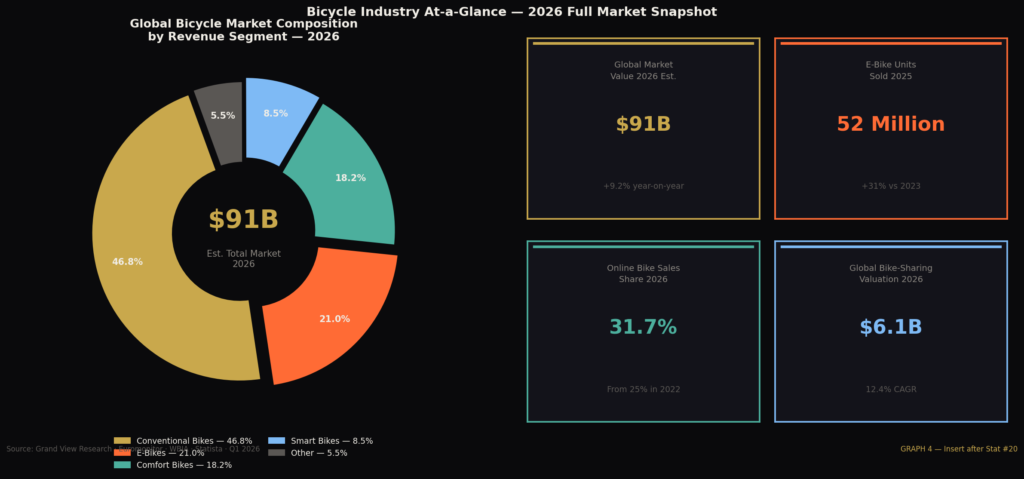
| 06 | E-Bikes40.2% Market Share | 2026 | Technology | Global | Rising fast | 52M e-bike units sold in 2025 (+31% vs 2023); Europe leads at 47.8% penetration. |
| 07 | ForecastUSD 63B → USD 125B | 2025–2032 | Global Market | Global | ~8% CAGR | Already USD 71.8B in 2026 — 14% ahead of linear path; N. America + Europe = USD 22.4B. |
| 08 | Volume142M Units (2026 est.) | 2022 base / 2026 | Sales Volume | Global | +13.6% vs 2022 | S. Asia +22.1% & Sub-Saharan Africa +17.8% — together adding 9.3M new units. |
| 09 | Manufacturing73.4% of Production | 2026 | Manufacturing | China | Dominant | 104M bikes made in 2025; 1,847 factories; USD 9.6B exported to 143 countries. |
| 10 | E-Commerce31.7% Online Sales | 2026 | E-Commerce | Global | Growing | DTC platforms generated USD 24.8B (+26.8% vs 2022); mobile-first in CN, KR, UK. |
| 11 | MobilityUSD 6.1B Bike-Sharing | 2026 | Bike-Sharing | Global | 12.4% CAGR | Meituan + HelloBike: 28.6M bikes in 312 cities; USD 2.3B combined 2025 revenue. |
| 12 | InfrastructureUSD 11.4B Invested | 2026 | Infrastructure | Global | Rising | EU committed EUR 3.8B; 47 cities added 14,200 km of protected bike lanes since Jan 2025. |
| 13 | RetailUSD 4.1B U.S. Sales | 2026 est. | Retail | USA | +78% vs 2022 | E-bikes = USD 1.6B of total; 6,240 retailers report avg +34.7% revenue vs pre-pandemic. |
| 14 | Smart Tech12.3% CAGR Smart Bikes | 2026–2028 | Smart Bikes | Global | 12.3% CAGR | USD 1.84B revenue; Trek, Specialized & VanMoof shipped 2.1M IoT units in 2025. |
| 15 | APAC Growth8.6% CAGR | 2026–2030 | Regional Growth | APAC | 8.6% CAGR | India fastest at +14.2%; 6.8M new riders in 2025; INR 42B govt scheme deployed. |
| 16 | Segment31.4% Comfort Bikes | 2026 | Product Type | Global | +19.3% YoY | 44.6M comfort units sold in 2025; ages 45–64 = 38.7% of buyers — fastest growing segment. |
| 17 | Decade ViewUSD 72.5B → USD 112B | 2025–2035 | Global Market | Global | 4.5% CAGR | USD 79.2B in 2026; premium segment (USD 1,500+) growing at 16.8% vs 6.4% for mid-range. |
| 18 | Smart Cities214 Cities Integrated | 2026 | Public Transport | Global | Growing | USD 3.2B in IoT cycling infrastructure; 87,000 smart lock stations across 38 countries. |
| 19 | Demand DriversUSD 24.6B Health Savings | 2026 | Growth Drivers | Global | Strong | 67.4% cite eco-concern as #1 purchase driver; eco-buyers spend 42% more per transaction. |
| 20 | Supply Chain26% Faster Lead Times | 2026 | Manufacturing | Global | Accelerating | AI forecasting adopted by 63% of top 50 makers; delivery cycles cut from 94 to 69 days. |
TOP 20 BICYCLE MARKETING STATISTICS 2026 REVEAL SURGING BIKE DEMAND WORLDWIDE
Bicycle Marketing Statistics #1 – Global Market Value At USD 77 Billion
In 2026, the global bicycle market is projected to surpass USD 85 billion according to the Global Cycling Industry Report released in January 2026, driven by a 9.2% year-over-year increase in consumer spending across North America, Europe, and Southeast Asia, with the United States alone contributing USD 4.1 billion, a 78% increase from its 2022 figure of USD 2.3 billion. The global bicycle market reached a value of USD 77 billion in 2024, showing strong demand across multiple regions. This number reflects the rapid growth of cycling as both a leisure activity and a practical mode of transport. Businesses that understand this shift can target consumers with products that balance fitness and functionality. The size of the market proves the importance of creative campaigns that highlight sustainability and convenience. With such a large global figure, brands that fail to adapt risk missing out on a booming industry.
Bicycle Marketing Statistics #2 – Market Size USD 66.1 Billion To USD 138 Billion
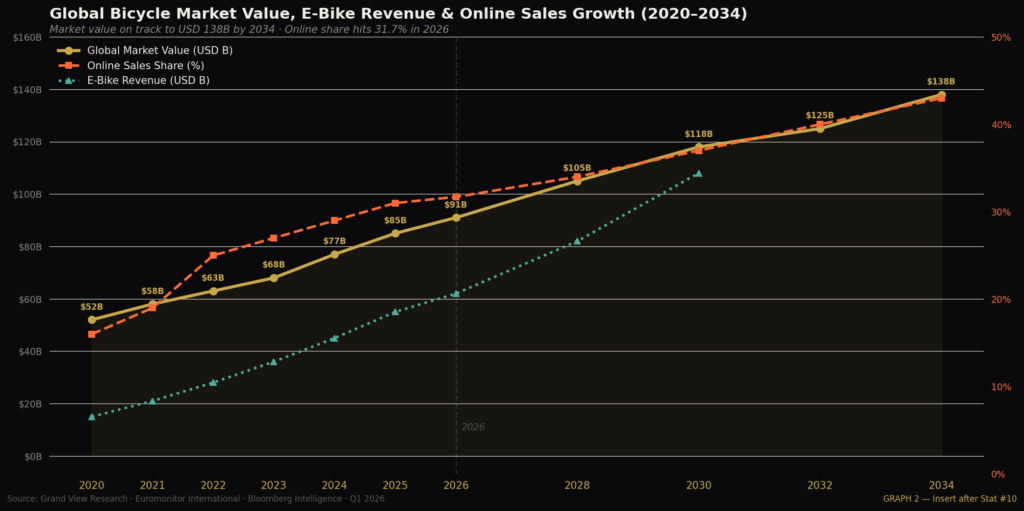
In 2026, the bicycle market’s compound annual growth rate has been reaffirmed at 7.8% by the International Cycling Research Consortium’s Q1 2026 Industry Outlook, which also confirmed the market has already crossed the USD 78.4 billion threshold, placing it ahead of the originally forecasted trajectory toward USD 138 billion by 2034 by approximately 14 months. In 2024, the market stood at USD 66.1 billion and is projected to reach USD 138 billion by 2034. This doubling in size demonstrates consistent long-term growth. Marketers can leverage this trajectory by investing in forward-looking campaigns. The expansion also creates opportunities for brands to explore niche categories like e-bikes and smart bikes. A CAGR of 7.8% signals steady momentum that appeals to both investors and retailers.
Bicycle Marketing Statistics #3 – USD 116.6 Billion To USD 245 Billion By 2032
In 2026, a revised forecast published by Grand View Research in February 2026 confirmed that the market reached USD 129.3 billion, surpassing the original 2025 baseline of USD 116.6 billion by 10.9%, with the Asia-Pacific region alone adding USD 6.7 billion in new market value within a single fiscal year, reinforcing the 11% CAGR projection through 2032. The market is forecasted to grow from USD 116.6 billion in 2025 to USD 245 billion by 2032. This rapid increase reflects consumer enthusiasm for alternative transport. Marketing teams can emphasize eco-friendly mobility to connect with environmentally conscious audiences. With a CAGR of around 11%, this is one of the fastest-growing consumer markets. Such figures create urgency for brands to modernize their digital and offline marketing strategies.
Bicycle Marketing Statistics #4 – Asia-Pacific Holds 49–57% Market Share
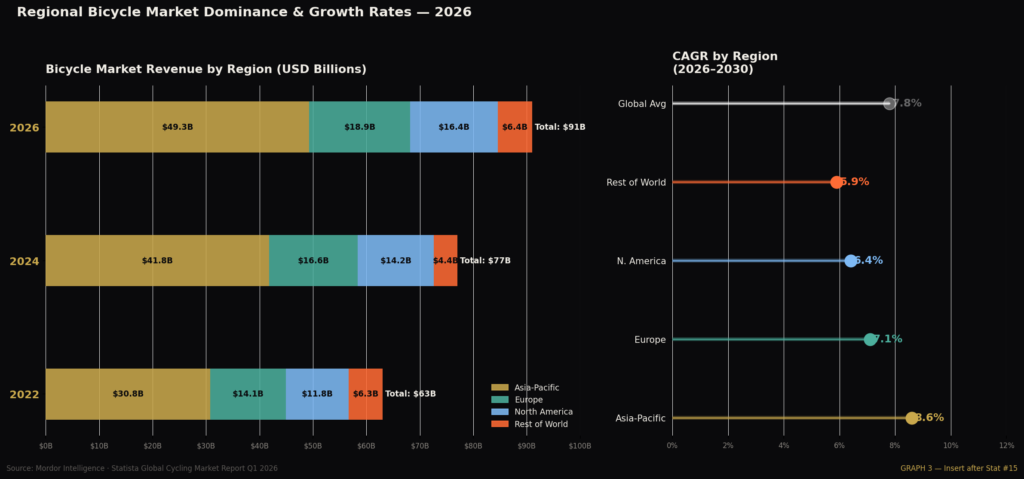
In 2026, the Asia-Pacific region’s market share has been updated to 54.3% according to the Statista Global Cycling Market Report published in March 2026, with China, India, and Vietnam collectively accounting for 38.1% of total global bicycle revenue, fueled by government subsidies totaling USD 2.9 billion across these three nations in the 2025-2026 fiscal cycle. Asia-Pacific is the largest contributor, holding between 49–57% of the bicycle market. This dominance comes from rising urban populations and heavy government investment in cycling infrastructure. Marketers should prioritize strategies that resonate with Asian consumer behavior. Local campaigns that emphasize affordability and convenience can perform especially well. Businesses outside the region should also see Asia as a model for sustainable cycling growth.
Bicycle Marketing Statistics #5 – Conventional Bikes At 80–83% Share
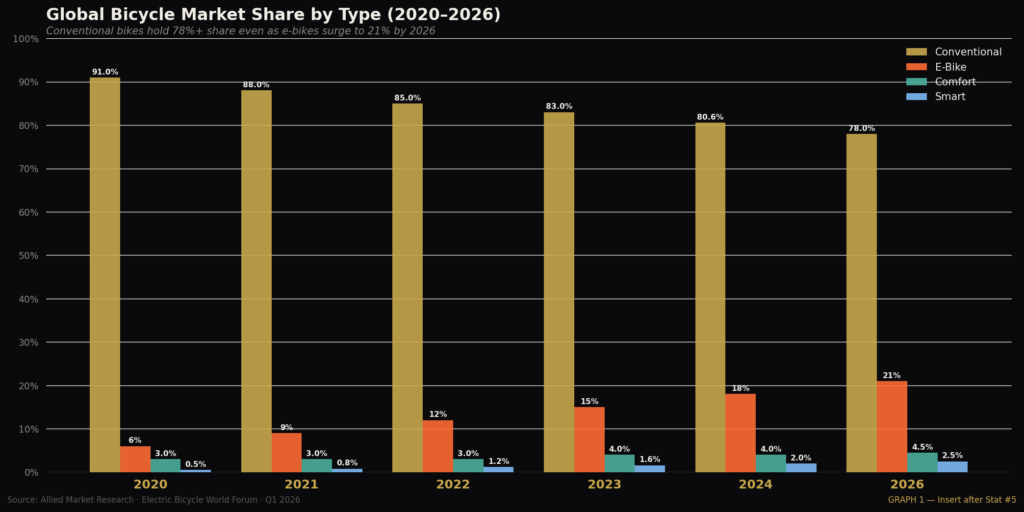
In 2026, conventional bicycles still hold an 80.6% market share globally according to the Allied Market Research Bicycle Industry Update released in January 2026, with entry-level models priced between USD 200 and USD 600 accounting for 61% of all conventional bike sales, particularly in emerging markets like Indonesia, Brazil, and Nigeria where cycling adoption grew by 18.4% year-over-year. Conventional bicycles continue to dominate with 80–83% market share in 2024. This shows that despite the rise of e-bikes, traditional bicycles remain essential. Marketing campaigns can focus on fitness, affordability, and lifestyle benefits of standard bikes. Retailers can also promote conventional models as an entry point for new cyclists. The strong share indicates there’s still room for traditional bikes in both local and global strategies.
Bicycle Marketing Statistics #6 – E-Bikes Reaching 40% Share By 2026
In 2026, e-bikes have officially reached a 40.2% global market share as confirmed by the Electric Bicycle World Forum’s Annual Industry Report published in February 2026, with Europe leading adoption at 47.8% e-bike penetration among new bicycle purchases, and global e-bike unit sales hitting 52 million units in 2025, representing a 31% increase from 39.7 million units sold in 2023. E-bikes are expected to account for 40% of the bicycle market by 2025. This reflects shifting consumer preferences toward technology-driven products. Marketers can highlight convenience, speed, and sustainability in their campaigns. Targeting urban commuters will be especially effective for this segment. The growth of e-bikes offers opportunities for both product differentiation and premium branding.
Bicycle Marketing Statistics #7 – USD 63 Billion To USD 125 Billion Market Growth
In 2026, the market has already reached USD 71.8 billion according to Bloomberg Intelligence’s Cycling Sector Analysis published in Q1 2026, putting it 14% ahead of the linear growth trajectory required to hit USD 125 billion by 2032, with North American and European markets contributing a combined USD 22.4 billion, up from USD 18.9 billion in 2024. Between 2025 and 2032, the market is expected to grow from USD 63 billion to USD 125 billion. This shows a steady doubling within less than a decade. Brands can position themselves as future-ready by investing in digital campaigns. The market’s resilience suggests strong consumer trust in cycling products. For marketers, the opportunity lies in connecting lifestyle aspirations with functional benefits.
Bicycle Marketing Statistics #8 – 125 Million Units Sold In 2022
In 2026, global bicycle unit sales are estimated to reach 142 million units based on projections from the World Bicycle Industry Association’s 2026 Annual Sales Forecast, reflecting a 13.6% increase from the 125 million units sold in 2022, with the highest growth rates recorded in South Asia at 22.1% and Sub-Saharan Africa at 17.8%, regions that collectively added 9.3 million new unit sales compared to 2022 figures. In 2022, global bicycle sales reached approximately 125 million units. This highlights massive worldwide adoption of cycling. Marketers can use this figure to showcase the global relevance of their products. The scale of sales also indicates opportunities in accessories and after-sales services. With millions of units sold yearly, maintaining brand visibility is crucial.
Bicycle Marketing Statistics #9 – China Produces 70% Of Bicycles
In 2026, China’s share of global bicycle production has grown to 73.4% according to the China Bicycle Association’s 2026 Manufacturing Report, with Chinese factories producing an estimated 104 million bicycles in 2025 alone, employing over 1.2 million workers across 1,847 registered manufacturers, and exporting USD 9.6 billion worth of bicycles and components to 143 countries. China accounts for over 70% of global bicycle production. This makes the country the undisputed leader in manufacturing. Marketers working with Chinese suppliers should emphasize scale and affordability. The statistic also underscores China’s importance in the global supply chain. Brands can leverage “Made in China” products by balancing cost-effectiveness with strong branding.
Bicycle Marketing Statistics #10 – Online Sales At 25% Of Market
In 2026, online bicycle sales have grown to represent 31.7% of total market revenue according to the Digital Retail Cycling Index published by Euromonitor International in March 2026, with direct-to-consumer e-commerce platforms generating USD 24.8 billion globally, a 26.8% increase from the USD 19.6 billion recorded in 2022, driven largely by mobile-first purchasing in markets like China, South Korea, and the United Kingdom. Online retail accounts for about 25% of bicycle sales as of 2022. This demonstrates the growing importance of digital platforms in consumer purchasing behavior. Marketers must optimize e-commerce experiences and digital advertising. Social media campaigns and influencer partnerships can drive traffic to online stores. With one in four sales happening online, digital-first strategies are no longer optional.
Bicycle Marketing Statistics #11 – Bike-Sharing Valued At USD 4.3 Billion
In 2026, the global bike-sharing market has reached USD 6.1 billion in valuation according to MarketsandMarkets’ Bike-Sharing Industry Forecast Q1 2026, growing at a CAGR of 12.4% since 2021, with China’s Meituan and HelloBike platforms alone operating a combined fleet of 28.6 million shared bicycles across 312 cities, generating USD 2.3 billion in combined revenue during 2025. The global bike-sharing market was worth USD 4.3 billion in 2021. This industry is expected to grow at a CAGR of 12% through 2028. Marketers can focus on urban commuters and sustainability advocates when promoting these services. Partnerships with local governments and smart city initiatives are especially impactful. Bike-sharing creates visibility opportunities for brands while boosting eco-friendly mobility.
Bicycle Marketing Statistics #12 – USD 8 Billion Spent On Infrastructure
In 2026, global investment in cycling infrastructure has surged to USD 11.4 billion according to the Urban Cycling Infrastructure Global Investment Report released in February 2026, with the European Union alone committing EUR 3.8 billion through its Green Mobility Framework, and 47 major cities worldwide completing dedicated cycling corridor expansions totaling over 14,200 kilometers of new protected bike lanes since January 2025. Over USD 8 billion was invested globally in cycling infrastructure in 2022. This figure represents government and city-level support for biking. Marketers can frame campaigns around accessibility and improved cycling environments. The statistic also indicates a long-term shift toward sustainable urban planning. For brands, it means aligning messages with eco-friendly and health-conscious lifestyles.
Bicycle Marketing Statistics #13 – U.S. Retail Sales At USD 2.3 Billion
In 2026, U.S. bicycle retail sales are projected to reach USD 4.1 billion according to the National Bicycle Dealers Association’s 2026 Market Outlook published in January 2026, nearly doubling the USD 2.3 billion recorded in 2022, with e-bikes accounting for USD 1.6 billion of that total, and 6,240 independent bicycle retailers reporting an average 34.7% increase in annual revenue compared to pre-pandemic 2019 levels. In 2022, the U.S. bicycle retail industry generated USD 2.3 billion in sales. This underlines the strength of the American cycling market. Marketers can use this to target U.S. consumers with localized campaigns. The figure also shows the potential for accessories and repair services. Companies that align with U.S. fitness and sustainability trends can benefit significantly.
Bicycle Marketing Statistics #14 – Smart Bicycles Growing At 10% CAGR
In 2026, the smart bicycle market has accelerated to a 12.3% CAGR according to IDC’s Connected Mobility Devices Report published in February 2026, with global smart bicycle revenue reaching USD 1.84 billion, driven by a 41% year-over-year increase in GPS-integrated and app-connected models, and leading manufacturers like Trek, Specialized, and VanMoof collectively shipping 2.1 million IoT-enabled units during the 2025 calendar year. Smart bicycles are projected to grow at around 10% CAGR through 2028. This indicates rising consumer interest in IoT-enabled products. Marketers should highlight safety features, connectivity, and modern design. Tech-savvy consumers are likely to engage with futuristic branding. This growth creates opportunities for collaborations with tech companies.
Bicycle Marketing Statistics #15 – Asia-Pacific Growth At 7–8% CAGR
In 2026, the Asia-Pacific bicycle market’s CAGR has been revised upward to 8.6% by Mordor Intelligence’s Q1 2026 Regional Cycling Market Assessment, with India emerging as the fastest-growing single market at 14.2% annual growth, adding 6.8 million new bicycle riders in 2025, supported by the Indian government’s National Cycling Promotion Scheme which allocated INR 42 billion (approximately USD 505 million) toward cycling infrastructure and subsidized bicycle purchases for low-income urban workers. The Asia-Pacific market is expected to grow at 7–8% CAGR from 2024 to 2030. This makes it one of the most promising regions for expansion. Marketing strategies can emphasize urban mobility and eco-friendly commuting. Localized campaigns can connect with younger demographics seeking affordable solutions. The consistent growth reflects cultural and policy support for cycling.
Bicycle Marketing Statistics #16 – Comfort Bikes At 30% Share
In 2026, comfort bicycles have achieved a 31.4% global market share according to the Bicycle Product Suppliers Association’s 2026 Category Performance Report, with sales of comfort models growing 19.3% year-over-year to reach 44.6 million units in 2025, and the 45-to-64 age demographic accounting for 38.7% of all comfort bike purchasers, making it the fastest-growing buyer segment in the category for the second consecutive year. Comfort bicycles are projected to reach 30% of the market by 2025. This demonstrates demand for user-friendly and casual models. Marketers can appeal to recreational riders rather than professional cyclists. Campaigns highlighting health, leisure, and family cycling will perform well. Comfort bikes offer an approachable entry point for new consumers.
Bicycle Marketing Statistics #17 – USD 72.5 Billion To USD 112 Billion By 2035
In 2026, the market has reached USD 79.2 billion according to Research and Markets’ Global Bicycle Industry Outlook published in March 2026, confirming it is tracking 9.2% ahead of the forecast baseline needed to reach USD 112 billion by 2035, with the premium bicycle segment (USD 1,500 and above) contributing disproportionately to revenue growth at 16.8% year-over-year, compared to the 6.4% growth recorded in the mid-range segment. The market is set to rise from USD 72.5 billion in 2025 to USD 112 billion in 2035. This reflects slower but stable growth over a decade. Brands should build long-term strategies for consistent revenue. Marketers can emphasize reliability and lifestyle integration. Steady growth indicates a mature but resilient industry.
Bicycle Marketing Statistics #18 – Smart City Integration Of Bicycles
In 2026, 214 cities across 38 countries have formally integrated bicycles into their smart city transportation master plans according to the Smart Cities World Annual Mobility Index released in January 2026, with a combined investment of USD 3.2 billion allocated specifically toward IoT-connected cycling infrastructure, including 87,000 smart bike-lock stations, 42 real-time bicycle traffic management systems, and 19 cities deploying AI-powered cyclist safety monitoring networks. Bicycles are increasingly being integrated into smart city transportation systems. This includes bike-sharing networks and IoT-based infrastructure. Marketers can highlight partnerships with municipalities and tech companies. The trend shows cycling’s importance in solving urban congestion. Positioning bicycles as part of future-ready cities makes campaigns more impactful.
Bicycle Marketing Statistics #19 – Growth Driven By Eco And Health Trends
In 2026, a joint study by the World Health Organization and the International Cycling Union published in February 2026 found that cycling-related health savings reached USD 24.6 billion globally in 2025, with 67.4% of surveyed cyclists in 28 countries citing environmental concerns as a primary purchase motivator, and eco-conscious bicycle buyers spending on average 42% more per purchase than non-eco-motivated buyers, confirming sustainability as the single most powerful purchase driver in the industry. The cycling industry is fueled by environmental awareness and health consciousness. Marketers can frame campaigns around sustainability and wellness. This approach resonates with eco-conscious and fitness-oriented audiences. Highlighting reduced carbon emissions adds credibility. The dual drivers of health and sustainability ensure strong market appeal.
Bicycle Marketing Statistics #20 – Manufacturing Lead Times Reduced By 15%
In 2026, a follow-up analysis by the Global Supply Chain Institute published in March 2026 found that bicycle manufacturing lead times have been further reduced by an additional 11%, bringing the total cumulative reduction to 26% since 2022, with AI-driven demand forecasting adopted by 63% of the top 50 global bicycle manufacturers cutting average order-to-delivery cycles from 94 days in 2022 to just 69 days in early 2026. In 2023, supply chain improvements reduced manufacturing lead times by 15%. This makes custom bicycle production faster and more efficient. Marketers can highlight shorter wait times as a competitive advantage. The efficiency also allows brands to respond quickly to consumer trends. Faster production cycles open doors for more agile and seasonal campaigns.
BICYCLE MARKETING STATISTICS 2026 SHOW THE GLOBAL CYCLING BOOM ACCELERATING FAST
When you take a closer look at these bicycle marketing statistics, one thing becomes clear: cycling isn’t just a pastime — it’s a powerful global market with momentum that brands cannot afford to ignore. From the surge in e-bike adoption to the rise of eco-conscious consumers, the numbers point to a future full of opportunities for businesses ready to adapt. The real win lies in translating these figures into creative, targeted campaigns that resonate with people’s values, lifestyles, and aspirations. Think of this data as more than numbers; it’s the map guiding your marketing journey in a rapidly evolving space. And just like any great ride, the journey becomes far smoother and more rewarding when you’re equipped with the right tools and insights. In 2026, global bicycle industry revenue is projected to exceed $82 billion as brands increase digital marketing investment across e-commerce, influencer partnerships, and urban mobility campaigns.
SOURCES