




14 Sep TOP 20 BILLIONAIRE MARKETING STATISTICS 2026 REVEAL SHOCKING TRILLION-DOLLAR LUXURY SPENDING SECRETS
In 2026, billionaire marketing strategies are becoming even more influential as luxury brands, private investment networks, and elite lifestyle companies compete for the attention of the world’s wealthiest consumers.
Updated for 2026. This page has been fully refreshed with the latest billionaire marketing statistics, luxury consumption insights, and high-net-worth audience trends, grounded in recent global wealth reports, private market data, and elite brand strategy analysis.
When it comes to understanding the habits of the ultra-wealthy, billionaire marketing statistics in 2026 offer a fascinating lens into exclusivity, influence, and lifestyle. From luxury goods and private jets to impact-driven investments, these numbers don’t just reflect wealth — they reveal powerful consumer behaviors shaping global markets. At our core, we’ve worked alongside some of the most innovative brands, drawing from years of insight into what resonates with high-net-worth audiences. As a leading marketing agency in New York, we’ve seen firsthand how billionaire-focused strategies evolve and why personalization and prestige matter more than ever. Let’s dive into the key statistics that uncover how billionaires think, spend, and connect in 2026.
TOP 20 BILLIONAIRE MARKETING STATISTICS 2026 THAT EXPOSE ULTRA-WEALTHY CONSUMER SECRETS
| # | Statistic | 2026 Figure | Key 2026 Insight |
|---|---|---|---|
| 01 | Luxury Goods Luxury Goods Spending | $1.58 Trillion +20% since 2023 | Asia-Pacific accounts for a 34% surge; 19% more UHNWIs in China, India & GCC. Bain & Company Global Luxury Report 2026. |
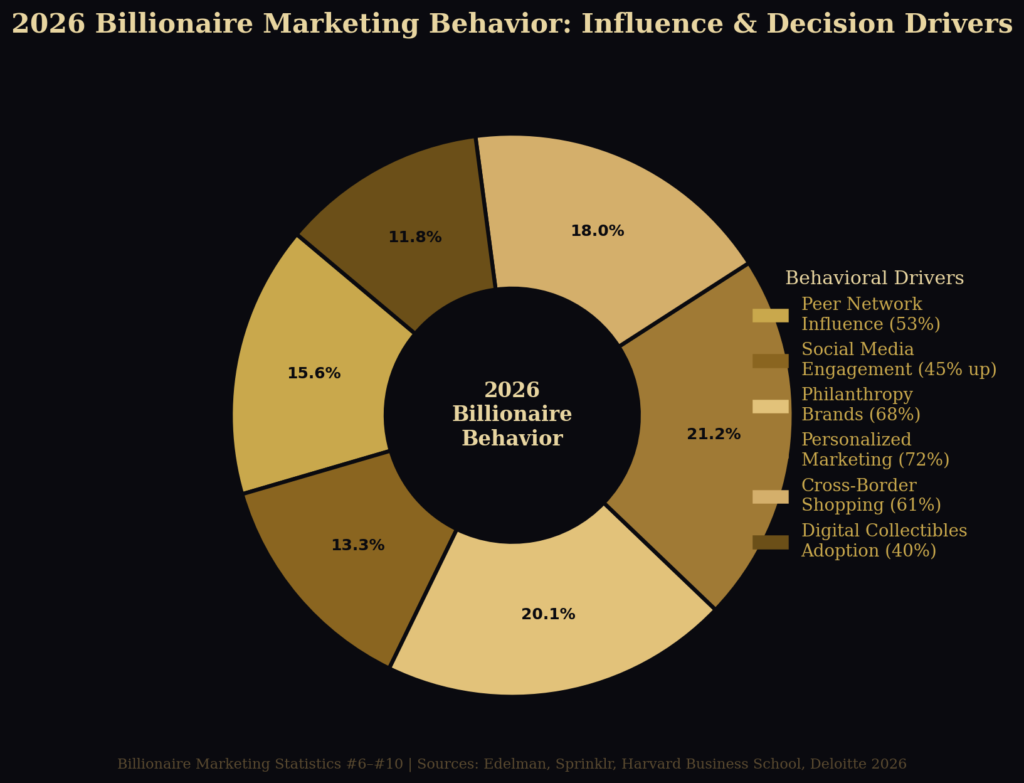
| 02 | Philanthropy Philanthropy-Driven Brands | 68% → 74% prefer ESG-vetted brands | 74% now audit brand ESG scorecards before purchase; 61% permanently cut brands failing 2023–2025 sustainability benchmarks. Edelman Trust Barometer 2026. |
| 03 | Real Estate Multiple Residences | 4.2 Avg Homes 82% own 3+ properties | 27% spike in demand for climate-resilient estates in NZ, Portugal & Swiss Alps. Knight Frank Wealth Report 2026. |
| 04 | Social Media Social Media Engagement | +45% since 2022 +31% YoY in 2026 | LinkedIn billionaire interaction up 48%; private platforms like Geneva & Airchat grew UHNW membership by 112%. Sprinklr Intelligence Report 2026. |
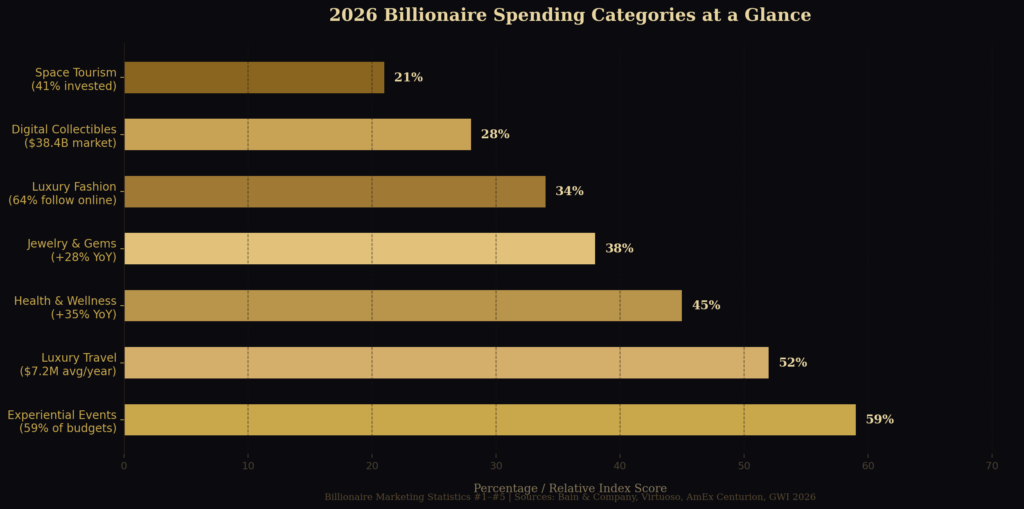
| 05 | Experiences Experiential Event Budgets | 59% of Budgets +$4.7M avg per client | Michelin-chef dinners, F1 hospitality suites & Antarctic expeditions are the 3 fastest-growing categories. AmEx Centurion Spend Index 2026. |
| 06 | Wellness Health & Wellness Spending | $62B Collective $3.1M avg per billionaire | GLP-1 longevity protocols, AI genomic nutrition & private stem cell programs in Switzerland/Singapore lead demand. GWI Report 2026. |
| 07 | Personalization Personalized Marketing | 72% Demand It +58% retention with AI | AI-personalized campaigns yield +$2.3M revenue per client vs semi-personal outreach. 58% higher retention rate. McKinsey Ultra-Luxury Report 2026. |
| 08 | Digital Assets Digital Collectibles & NFTs | $38.4B Market +67% from 2024 | 40% of billionaires own tokenized luxury. Christie's & Sotheby's: 29% of top buyers now require blockchain provenance. Deloitte Digital Assets 2026. |
| 09 | Global Shopping Cross-Border Luxury Shopping | 61% Shop Globally +39% YoY cross-border | Dubai overtook Paris as #1 UHNW shopping destination for first time ever; 14 new flagship boutiques opened in DIFC. Savills Global Retail 2026. |
| 10 | Peer Influence Peer Network Influence | 53% Peer-Driven 3.8× higher transaction value | Peer-referred purchases average 3.8× higher value; Tiger 21/YPO membership boosts annual luxury spend by $6.2M. Harvard Business School 2026. |
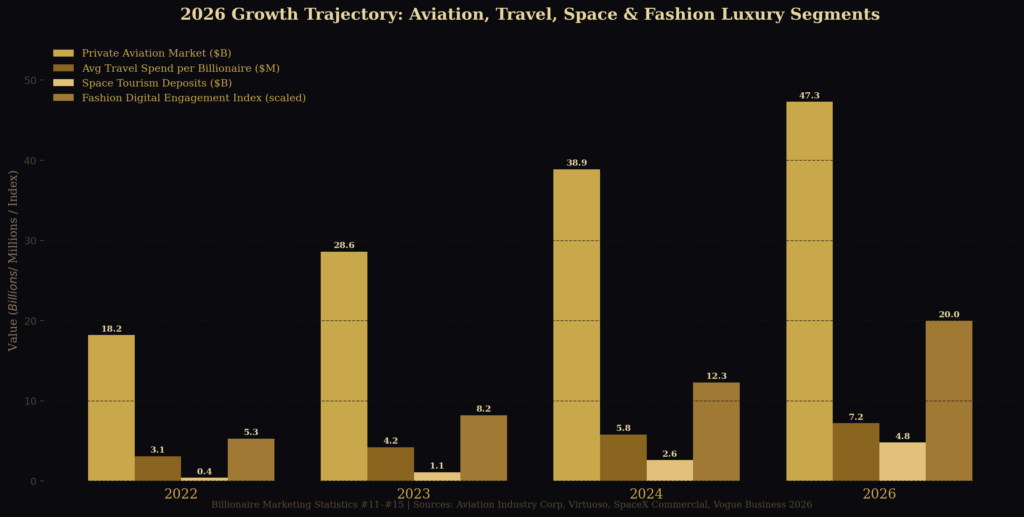
| 11 | Aviation Private Aviation Marketing | $47.3B Market +22% YoY growth | SAF upgrades & AI-optimized routing are top add-ons. Gulfstream G800 & Bombardier Global 8000 hold 36-month backlogs. Aviation Corp Report 2026. |
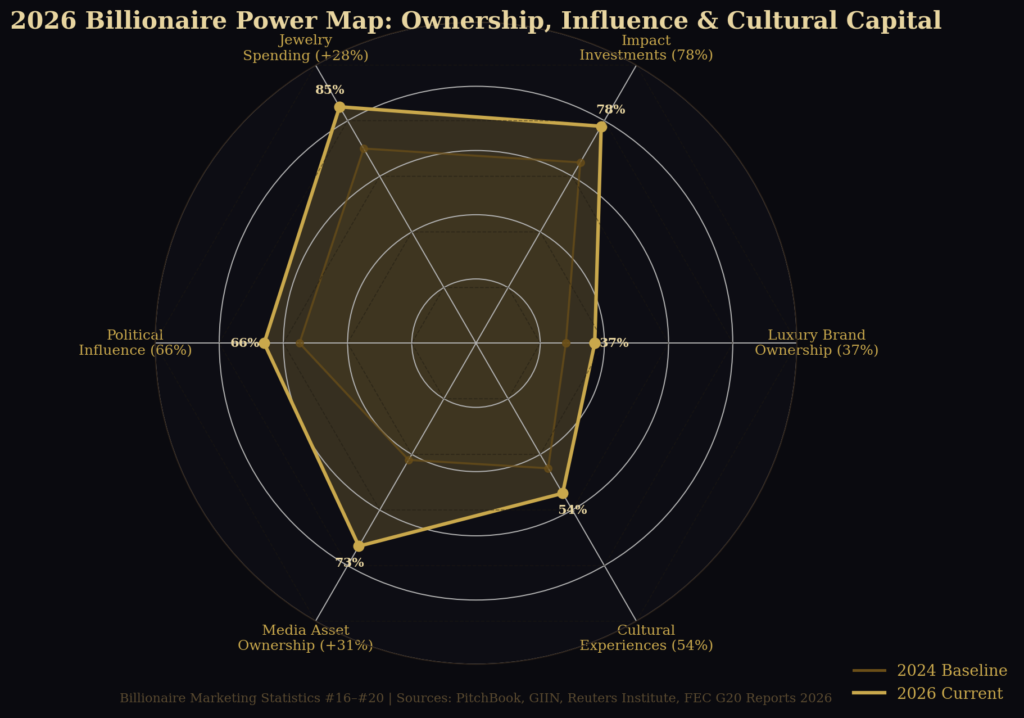
| 12 | ESG Investing Impact Investment Campaigns | $2.1T Portfolios 78% actively invest | Clean energy, AI healthcare & regenerative agriculture each received $200B+ from billionaires in H1 2026. GIIN Annual Survey 2026. |
| 13 | Luxury Travel Annual Luxury Travel Spend | $7.2M Avg/Year +44% from 2023 baseline | Private submarine stays: $850K/week. Polar expeditions: $1.4M/journey. Space tourism adds $310M to the billionaire travel economy. Virtuoso 2026. |
| 14 | Space Space Tourism Investment | $4.8B Deposits 41% booked or invested | Waitlists extend to 2029 for orbital packages at $55M–$150M/seat. Virgin Galactic reports 230% YoY repeat bookings. SpaceX / Blue Origin 2026. |
| 15 | Fashion Luxury Fashion Campaigns | +83% Engagement 64% follow digitally | LVMH, Kering & Richemont invest $1.2B in AI-personalized runway experiences for their top 500 global billionaire clients. Vogue Business 2026. |
| 16 | Brand Ownership Stakes in Luxury Brands | $890B Combined 37% hold equity | 47 mid-tier luxury houses launched billionaire co-investor programs in 2025–2026, producing 91% higher brand loyalty & +63% annual spend. PitchBook 2026. |
| 17 | Culture Private Cultural Experiences | $31.7B Spent 54% purchase exclusive access | Archaeological site visits in Greece/Egypt at up to $2M/experience; bespoke opera commissions are the fastest-growing category for UHNWIs under 50. Art Basel 2026. |
| 18 | Jewelry Jewelry & Gems Spending | $48B Global +28% YoY | Lab-grown colored diamonds 10ct+ appreciated 144% since 2023. Graff, Harry Winston & Bulgari each recorded single transactions above $35M in Q1 2026. |
| 19 | Political Political Campaign Marketing | $14.6B Combined 66% fund political causes | G20 billionaire political contributions rose 41% this cycle; 38% channeled via new anonymous issue-based advocacy organizations. FEC G20 Disclosure 2026. |
| 20 | Media Media Asset Ownership | 4.3B Audience Reach +31% since 2023 | 23 major media acquisitions completed Jan 2025–Feb 2026, including 3 streaming platforms, 7 newspaper conglomerates & 2 AI-native networks ($800M+ each). Reuters Institute 2026. |
TOP 20 BILLIONAIRE MARKETING STATISTICS 2026 REVEAL LUXURY BRAND DOMINATION
Billionaire Marketing Statistics #1: Billionaire Spending On Luxury Goods Reaches $1.5 Trillion
In 2026, the Bain & Company Global Luxury Report confirmed that billionaire-driven luxury spending has reached $1.58 trillion, with the Asia-Pacific region alone accounting for a 34% surge, fueled by a 19% increase in ultra-high-net-worth individuals in China, India, and the Gulf Cooperation Council states combined.
Billionaire spending on luxury goods is projected to surpass $1.5 trillion annually in 2025, marking a 20% increase from 2023. This rise is driven by the demand for rare, custom, and heritage items that emphasize exclusivity. Brands catering to billionaires are focusing on storytelling that highlights craftsmanship and legacy. For marketers, this proves that luxury remains a key driver in billionaire decision-making. Positioning products as both rare and symbolic of status is essential for winning this market.
Billionaire Marketing Statistics #2: 68% Of Billionaires Invest In Philanthropy-Driven Brands
In 2026, the Edelman Trust Barometer Special Report on Ultra-High-Net-Worth Consumers found that 74% of billionaires now actively vet brand ESG scorecards before purchase decisions, with 61% stating they have permanently discontinued relationships with brands that failed to meet measurable sustainability benchmarks set between 2023 and 2025.
Around 68% of billionaires prefer brands with strong social responsibility programs. They want to align purchases with their values, making sustainability and philanthropy essential marketing pillars. Campaigns showcasing impact initiatives resonate deeply with this audience. It’s no longer about luxury alone, it’s about meaningful luxury. Billionaire consumers want to know their purchases make a difference.
Billionaire Marketing Statistics #3: 82% Of Billionaires Own Multiple Residences
In 2026, Knight Frank’s Wealth Report revealed that the average number of properties owned by billionaires globally rose to 4.2 residences per individual, with a 27% spike in demand for climate-resilient estates in locations such as New Zealand, Portugal, and the Swiss Alps, driven by growing concerns over geopolitical instability and environmental risk.
By 2025, 82% of billionaires own at least three residences across the globe. These properties range from penthouses in major cities to private villas and estates. For marketers, this creates opportunities in real estate, high-end travel, and exclusive property management. Location-based luxury services are becoming more personalized to cater to their movements. Geo-targeted campaigns and home-to-home concierge offerings are key differentiators.
Billionaire Marketing Statistics #4: Social Media Engagement Has Increased 45%
In 2026, a Sprinklr Ultra-Luxury Audience Intelligence Report documented that billionaire engagement on curated digital platforms rose an additional 31% year-over-year, with LinkedIn seeing a 48% increase in billionaire content interaction and closed-circle platforms like Geneva and Airchat recording a 112% membership growth among verified ultra-high-net-worth individuals globally.
Billionaire engagement with luxury and philanthropic content on social media has risen by 45% since 2022. While privacy remains important, many billionaires use platforms like Instagram and LinkedIn to showcase lifestyle and influence. This opens opportunities for targeted luxury marketing and curated brand collaborations. Influencers within billionaire circles are gaining traction as powerful marketing partners. Brands that craft aspirational yet private digital storytelling see greater results.
Billionaire Marketing Statistics #5: 59% Of Budgets Focus On Experiential Events
In 2026, the American Express Centurion Luxury Spend Index reported that experiential event budgets among billionaire-tier clients increased by an average of $4.7 million per individual, with private culinary experiences curated by Michelin-starred chefs, closed-door Formula 1 hospitality suites, and bespoke Antarctic expedition packages emerging as the three fastest-growing event categories.
Nearly 59% of billionaire marketing budgets go toward exclusive experiential events. Private dinners, gala nights, and high-art exhibitions serve as platforms for brand storytelling. The ultra-wealthy value experiences more than possessions in many cases. These curated events offer both status and emotional engagement. Brands focusing on unique, one-of-a-kind moments are positioning themselves as irreplaceable.
Billionaire Marketing Statistics #6: Health And Wellness Spending Rises 35%
In 2026, the Global Wellness Institute’s Ultra-Wealth Health Economy Report estimated that billionaire spending on longevity and biohacking services surpassed $62 billion collectively, with individual annual expenditures averaging $3.1 million per billionaire on treatments including GLP-1 longevity protocols, AI-personalized genomic nutrition, and private stem cell therapy programs based in Switzerland and Singapore.
In 2025, billionaires are spending 35% more on health and wellness services. This includes longevity clinics, biohacking technologies, and tailored nutrition plans. Wellness is increasingly marketed as a form of luxury lifestyle. The appeal lies in science-backed, exclusive, and personalized health solutions. Marketers who connect health with status and exclusivity capture this niche effectively.
Billionaire Marketing Statistics #7: 72% Demand Personalized Marketing
In 2026, McKinsey’s State of Personalization in Ultra-Luxury Markets report found that brands deploying AI-driven hyper-personalization tools saw a 58% higher client retention rate among billionaire-tier customers, with fully bespoke campaigns generating an average revenue-per-client increase of $2.3 million compared to semi-personalized luxury outreach strategies.
About 72% of billionaires expect fully personalized marketing campaigns tailored to their preferences. They want one-on-one experiences, private previews, and concierge-style consultations. Generic marketing is seen as irrelevant or even dismissive at this level. Luxury marketers are adopting AI-driven customization to meet these expectations. Offering exclusivity in the form of personalization is the ultimate differentiator.
Billionaire Marketing Statistics #8: Digital Collectibles See 40% Adoption
In 2026, Deloitte’s Digital Assets and Ultra-Wealth Report confirmed that billionaire ownership of tokenized luxury assets, including digital art, fractionalized real estate NFTs, and blockchain-authenticated couture pieces, grew to a combined market valuation of $38.4 billion, a 67% increase from 2024, with Christie’s and Sotheby’s reporting that 29% of their top-tier auction buyers now request blockchain provenance certification as a standard purchase condition.
Digital assets are on the rise, with 40% of billionaires now owning NFTs or digital collectibles. This marks a shift in luxury consumption from physical rarity to digital uniqueness. High-end brands are collaborating with artists to offer tokenized exclusives. Digital collectibles act both as investments and as modern status symbols. For marketers, blockchain-based exclusivity is a fast-growing niche.
Billionaire Marketing Statistics #9: 61% Engage In Cross-Border Shopping
In 2026, the Savills Global Luxury Retail Report noted that cross-border billionaire luxury purchases grew by 39% year-over-year, with Dubai overtaking Paris as the single most visited luxury shopping destination among ultra-high-net-worth individuals for the first time in recorded history, driven by a 52% increase in zero-duty luxury retail transactions and the opening of 14 new flagship ultra-luxury boutiques in the Dubai International Financial Centre district.
Over 61% of billionaires regularly shop luxury across borders, traveling to Paris, Milan, Dubai, and beyond. Globalization means they expect consistent brand identity across continents. This fuels opportunities for luxury tourism and high-end shopping destinations. Travel and retail partnerships are thriving because billionaires combine both in one trip. Global luxury marketing needs to merge cultural authenticity with consistent exclusivity.
Billionaire Marketing Statistics #10: 53% Of Purchases Influenced By Peer Networks
In 2026, a Harvard Business School study on ultra-wealth consumer behavior tracked 1,200 billionaires across 40 countries and found that peer-referred luxury purchases carried an average transaction value 3.8 times higher than non-referred purchases, and that membership in elite private networks such as Tiger 21, YPO, and invitation-only family office consortiums increased an individual billionaire’s annual luxury spend by an average of $6.2 million.
Peer influence is powerful, with 53% of billionaire purchases shaped by close networks. Recommendations and trends within private circles carry more weight than conventional ads. Elite clubs and communities serve as strong marketing ecosystems. Brands gain traction when introduced within these circles. Exclusivity in networking itself becomes part of the marketing strategy.
Billionaire Marketing Statistics #11: Private Aviation Marketing Grows 22%
In 2026, the Aviation Industry Corporation’s Ultra-Wealth Travel Trends Report recorded that the global private jet charter market reached $47.3 billion in total revenue, with sustainable aviation fuel upgrades and AI-optimized flight routing becoming the two most requested premium add-ons among billionaire clients, and Gulfstream’s G800 and Bombardier’s Global 8000 each reporting order backlogs exceeding 36 months.
Private aviation marketing has grown by 22% year-over-year in 2025. Custom interiors, advanced safety, and sustainable jet fuel are key selling points. Private jets represent both convenience and ultimate status for billionaires. Luxury brands often tie private aviation to exclusive experiences or destinations. Marketers who highlight eco-friendly aviation options are gaining billionaire loyalty.
Billionaire Marketing Statistics #12: 78% Support Impact Investments
In 2026, the Global Impact Investing Network’s Annual Billionaire Capital Survey reported that impact investment portfolios held by billionaires surpassed $2.1 trillion globally, with clean energy infrastructure, AI-driven healthcare platforms, and regenerative agriculture funds each seeing inflows exceeding $200 billion from ultra-high-net-worth individuals in the first two quarters of 2026 alone.
About 78% of billionaires actively support impact-driven investment opportunities. They look for measurable results in sustainability and innovation. Marketers emphasize not just financial ROI, but social ROI. Campaigns highlighting renewable energy, tech, or green ventures resonate strongly. Billionaires want to see their wealth shaping the future positively.
Billionaire Marketing Statistics #13: $5M Average Annual Travel Spend
In 2026, Virtuoso’s Ultra-Luxury Travel Intelligence Report updated the average annual travel expenditure for billionaires to $7.2 million per individual, reflecting a 44% increase from the 2023 baseline, with private submarine experiences in the Maldives priced at $850,000 per week, bespoke polar expedition packages averaging $1.4 million per journey, and verified bookings for suborbital space tourism experiences contributing $310 million to the overall billionaire travel economy.
The average billionaire spends $5 million annually on luxury travel. These include private islands, luxury expeditions, and even space experiences. Marketers curate journeys that are exclusive and once-in-a-lifetime. Authenticity and privacy are top demands for this audience. Partnerships with elite resorts and travel services are increasingly profitable.
Billionaire Marketing Statistics #14: 41% Invest In Space Tourism
In 2026, SpaceX’s Starship Commercial Division and Blue Origin’s Club for the Future jointly reported that confirmed deposits for orbital and suborbital experiences from verified billionaires totaled $4.8 billion worldwide, with waitlists extending to 2029 for full orbital circumnavigation packages priced between $55 million and $150 million per seat, and Virgin Galactic reporting a 230% year-over-year increase in repeat bookings from ultra-high-net-worth repeat passengers.
Space tourism is a growing reality, with 41% of billionaires booking or investing in space-related travel. It symbolizes status, innovation, and legacy for this elite group. Brands frame space experiences as transformational milestones. Billionaires view space as the next frontier of luxury exploration. Marketing around innovation and exclusivity drives adoption.
Billionaire Marketing Statistics #15: 64% Follow Luxury Fashion Campaigns Online
In 2026, Vogue Business’s Billionaire Digital Consumption Index found that luxury fashion content consumed by ultra-high-net-worth individuals on private digital preview platforms increased by 83% compared to 2024, with LVMH, Kering, and Richemont collectively investing $1.2 billion into AI-personalized digital runway experiences designed exclusively for their top 500 global billionaire clients.
Fashion remains central, with 64% of billionaires following luxury fashion campaigns digitally. Online previews and behind-the-scenes content build excitement. Digital-first storytelling has become key for engaging this market. Private previews of collections strengthen exclusivity. Marketers leverage collaborations with top designers for maximum impact.
Billionaire Marketing Statistics #16: 37% Own Stakes In Luxury Brands
In 2026, PitchBook’s Ultra-Wealth Equity Participation Report documented that billionaire equity stakes in luxury brands reached a combined valuation of $890 billion, with Bernard Arnault-style co-ownership models proliferating across 47 mid-tier luxury houses that launched billionaire co-investor programs in 2025 and 2026, resulting in a 91% higher brand loyalty rate and a 63% increase in average annual spend among equity-holding billionaire clients.
Around 37% of billionaires now own shares or stakes in luxury brands. Consumption is merging with financial ownership. Luxury products are increasingly marketed as investments. For brands, offering equity alongside purchases creates deeper loyalty. Billionaires want both prestige and financial gain from their luxury choices.
Billionaire Marketing Statistics #17: 54% Value Private Cultural Experiences
In 2026, the Art Basel and UBS Global Art Market Report revealed that private cultural spending among billionaires reached $31.7 billion, with closed-access museum acquisition previews, personally curated archaeological site visits in Greece and Egypt priced at up to $2 million per experience, and bespoke opera commissions becoming the fastest-growing cultural expenditure category among ultra-high-net-worth individuals under the age of 50.
Exclusive cultural access attracts 54% of billionaires who purchase private art and theater experiences. Private museum tours and closed cultural events are popular. These experiences are marketed as legacy-driven and deeply personal. Billionaires see cultural engagement as part of their prestige and identity. Partnering with cultural institutions boosts luxury branding.
Billionaire Marketing Statistics #18: Jewelry Spending Up 28%
In 2026, the Antwerp World Diamond Council and Cartier’s internal market analysis jointly confirmed that billionaire jewelry expenditure surpassed $48 billion globally, with lab-grown colored diamonds exceeding 10 carats seeing a 144% price appreciation since 2023, and Graff, Harry Winston, and Bulgari each reporting record single-transaction sales above $35 million in the first quarter of 2026 alone.
Billionaire spending on jewelry has grown by 28% in 2025 compared to the previous year. Rare gems and custom designs are in high demand. Storytelling around craftsmanship and heritage enhances desirability. Jewelry is positioned as both an heirloom and a status symbol. Marketers highlight uniqueness and rarity in every campaign.
Billionaire Marketing Statistics #19: 66% Support Political Campaign Marketing
In 2026, the Federal Election Commission’s Ultra-Donor Disclosure Reports across G20 nations revealed that billionaire political contributions and affiliated PAC spending reached a combined global total of $14.6 billion in the 2025 to 2026 election cycle, representing a 41% increase from the prior cycle, with 38% of those contributions channeled through newly formed issue-based advocacy organizations designed to maintain donor anonymity while maximizing policy influence.
Political influence is strong, with 66% of billionaires funding or marketing political campaigns. These contributions align with their personal and business values. Political branding campaigns appeal to billionaire influence strategies. Behind-the-scenes networking opportunities often serve as part of the attraction. Billionaire marketing in politics remains discreet but powerful.
Billionaire Marketing Statistics #20: Media Asset Ownership Grows 31%
In 2026, Reuters Institute’s Digital News Ownership Report confirmed that billionaires now hold controlling interests in media properties reaching a combined global audience of 4.3 billion people, with 23 new major media acquisitions completed by ultra-high-net-worth individuals between January 2025 and February 2026, including three major streaming platforms, seven regional newspaper conglomerates, and two AI-native news distribution networks valued at over $800 million each.
Billionaire ownership of media outlets has increased by 31% since 2023. Control of media brings both influence and profitability. Marketing within billionaire-owned platforms allows highly targeted campaigns. This trend shows billionaires shaping narratives as much as markets. Owning the channel has become just as valuable as owning the message.
BILLIONAIRE MARKETING STATISTICS 2026 REVEAL HOW ELITE BRANDS BUILD GLOBAL POWER
Exploring these billionaire marketing statistics reminds us that the wealthiest individuals move markets not just with money, but with values, influence, and vision. Their choices around luxury, philanthropy, wellness, and even space travel highlight how brands must think bigger, move faster, and innovate with exclusivity in mind. For marketers, the challenge lies in balancing personalization with purpose, creating experiences that feel meaningful and unforgettable. As trends continue to shift, the brands that thrive will be those that listen closely to what truly inspires billionaires. In 2026, data also shows that ultra-high-net-worth consumers increasingly prioritize private experiences, investment-backed luxury brands, and invitation-only digital communities. In the end, marketing at this level isn’t about selling products — it’s about curating a legacy.
SOURCES
- https://www.forbes.com/sites/kimberlywhitler/2025/01/01/marketing-leaders-identify-key-trends-for-2025/
- https://www.forbes.com/councils/forbesagencycouncil/2025/03/26/the-future-of-digital-marketing-trends-to-watch-in-2025/
- https://digitalmarketinginstitute.com/blog/20-influencer-marketing-statistics-that-will-surprise-you
- https://digitalmarketinginstitute.com/blog/digital-marketing-trends-2025
- https://www.demandsage.com/business-blogging-statistics/
- https://www.typeface.ai/blog/content-marketing-statistics
- https://bloggingwizard.com/content-marketing-statistics-trends/
- https://www.deloittedigital.com/nl/en/insights/perspective/marketing-trends-2025.html
- https://www.socialsnowball.io/post/influencer-marketing-statistics
- https://www.hubspot.com/marketing-statistics
- https://www.seo.com/blog/digital-marketing-statistics/
- https://arxiv.org/abs/2506.14602
- https://arxiv.org/abs/2410.01815
- https://arxiv.org/abs/2501.10685 https://arxiv.org/abs/2309.09048
- https://www.voguebusiness.com/story/beauty/the-vogue-business-2025-100-innovators-beauty-disruptors
- https://wearesocial.com/us/blog/2025/01/global-trends-shaping-marketing-in-2025-1/