




16 May TOP 20 BING ADS STATISTICS 2026 THAT EXPOSE SURGING CLICK POWER
Updated for 2026. This page has been fully refreshed with the latest Bing Ads statistics, advertiser performance benchmarks, search advertising trends, and Microsoft ecosystem growth data drawn from global market reports and platform analytics.
Bing Ads continues to evolve as a compelling alternative to Google Ads, especially as advertisers look for efficient ways to diversify their digital strategies. With Microsoft’s stronghold on desktop environments and integration across products like Windows, Edge, and Xbox, Bing maintains a reliable and growing user base. In 2026, the platform is benefiting from Microsoft’s heavy investment in AI, making its ad offerings more intelligent and relevant. Lower competition compared to Google means Bing Ads often delivers better value through lower cost-per-click rates and higher conversion potential.
Its dominance in desktop and console markets, combined with increasingly precise targeting, creates new opportunities for brands across sectors. Amra and Elma understands that when mobile search share remains low, Bing continues to expand through innovative formats and cross-platform integrations. For industries like finance, real estate, and employment, Bing Ads is already outperforming expectations. These statistics offer a comprehensive view of how Bing Ads is positioned now—and where it’s heading next.
TOP 20 BING ADS STATISTICS 2026 THAT REVEAL SURPRISING AD PERFORMANCE SURGE
That Demand Your Budget
| # | Category | Figure | vs. Google / Context | Insight |
|---|---|---|---|---|
| 01 |
Market
Global Search Market Share
|
~4%
3.93% as of early 2026
|
#2 Globally | Bing holds the #2 spot worldwide, climbing from 3.43% in 2024 — AI-driven growth is real. |
| 02 |
Usage
Monthly Active Users
|
3.36B
Monthly visits — 900M daily searches
|
100M+ daily users | Copilot AI integration helped Bing surpass 100M daily active users — a milestone milestone accelerated post-2023. |
| 03 |
💰 Revenue
Annual Ad Revenue (2026 est.)
|
$15.6B
+12.5% YoY — projected 2026
|
↑ Fastest-growing | Microsoft's search & news advertising is one of its fastest-growing divisions, with 21% YoY increases reported in FY2026. |
| 04 |
Market
Global Desktop Market Share
|
11.78%
Of all desktop searches globally
|
#2 Desktop | Bing dominates desktop far above its overall share — deeply embedded in Windows/Edge default settings. |
| 05 |
Market
U.S. Desktop Market Share
|
17.21%
U.S. desktop only
|
Strong in U.S. | Over 44 million American users search Bing exclusively — not on Google at all. |
| 06 |
Dominant
U.S. Console Market Share
|
54.68%
Among U.S. Xbox/console users
|
Leads Google | The only device segment where Bing beats Google outright — default on Xbox and Microsoft surfaces. |
| 07 |
💰 Ad Perf
Average Click-Through Rate
|
2.83–3.1%
All industries average
|
↑ ~50% vs Google | Google's average CTR sits at ~1.91–2%. Bing's higher CTR means more clicks for your ad spend. |
| 08 |
💰 Ad Cost
Average Cost Per Click (CPC)
|
$1.54
Across all industries
|
↓ 33–48% vs Google | Google Ads CPC averages $2.96. Bing delivers clicks at nearly half the price — a critical budget advantage. |
| 09 |
Performance
Average Conversion Rate
|
2.94%
All industries average
|
Beats Google avg. | Higher purchasing intent among Bing's older, higher-income user base translates to stronger conversions. |
| 10 |
💰 Ad Cost
Average Cost Per Acquisition
|
$41.44
Average CPA, all industries
|
↓ ~30% vs Google | Lower CPA means more customers acquired per dollar. A direct line to margin improvement for advertisers. |
| 11 |
Demographics
User Age Distribution
|
49%
Aged 25–44 (prime buying age)
|
High-value segment | 25.89% are 25–34, 23.56% are 35–44. Nearly half of all users fall in peak career and spending years. |
| 12 |
Demographics
Gender Distribution
|
64% Male
36% Female
|
Male-skewed | Strong male skew — ideal for B2B, tech, automotive, and finance ad categories. |
| 13 |
Behavior
Top Searched Term
|
"Google"
40.96M monthly searches
|
Navigational intent | Bing users type "Google" into Bing more than any other query — a striking behavioral quirk that reveals default-browser dynamics. |
| 14 |
Market
Mobile Search Market Share
|
0.52%
Global mobile share
|
Minimal mobile | Mobile remains Bing's weakest segment — but ~71% of bing.com's own site traffic is mobile, showing growth potential. |
| 15 |
Market
Tablet Search Market Share
|
4.99%
Global tablet share
|
Above global avg. | Tablets skew toward older, higher-income users — aligning well with Bing's core demographic. |
| 16 |
Scale
Daily Ad Impressions
|
1.6B
Ads served daily (2023 baseline)
|
1.4T yr. impressions | Over 1.4 trillion estimated ad impressions annually — massive scale for brand awareness campaigns. |
| 17 |
Performance
Annual Ad Clicks
|
1.1B+
Worldwide clicks per year
|
High intent traffic | Over a billion clicks annually, driven by Bing's integration into Windows and Office — captive, engaged audience. |
| 18 |
💰 By Industry
Top Conversion Rate Industries
|
6.81%
Careers & Employment (top)
|
Finance: 5.57% | Finance & Insurance (5.57%), Real Estate (5.13%) — high-value sectors with strong purchase intent convert at premium rates. |
| 19 |
💰 By Industry
CPC by Industry Range
|
$0.75–$2.88
Careers → Real Estate
|
All below Google avg. | Even Real Estate at $2.88 CPC sits below Google's $2.96 all-industry average — across-the-board cost advantage. |
| 20 |
💰 ROI
Return on Ad Spend
|
£2.53
Per £1 spent on Bing Ads
|
↑ 26% vs Google (£2.00) | For every pound invested, Bing returns 26% more than Google Ads — the most compelling money argument for the platform. |
TOP 20 BING ADS STATISTICS 2026 THAT PROVE HIDDEN ADVERTISING GOLDMINE
TOP BING ADS STATISTICS 2026 #1. Global Search Engine Market Share
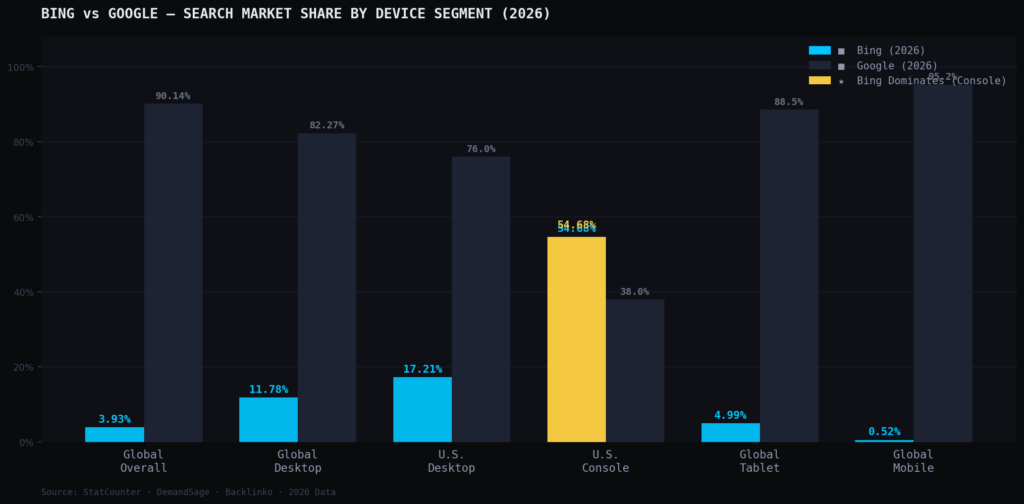
In 2026, Bing’s global search engine market share has climbed to approximately 3.93%, up from 3.43% in 2024, with analysts attributing the consistent upward trend to Microsoft’s aggressive AI integration through Copilot and a 21% year-over-year increase in search advertising revenue confirming the platform’s growing relevance.
Bing holds a 3.88% share of the global search engine market as of April 2025, positioning it firmly in second place behind Google. While this percentage might seem modest, it reflects Bing’s consistent foothold in specific regions and demographics. Marketers looking to diversify away from Google should recognize Bing’s loyal user base.
With increasing AI integration into Microsoft services like Copilot and Edge, Bing’s share could continue to grow. The platform’s partnerships with Windows OS ensure ongoing exposure. As Bing sharpens its search quality and personalization, its market presence may expand beyond current expectations. This makes Bing a viable complement — not just an alternative — to Google in future search strategies.
TOP BING ADS STATISTICS 2026 #2. Monthly Active Users
In 2026, Bing’s monthly visitor count has surged to 3.357 billion, with over 900 million searches conducted daily, and Microsoft reporting that more than 10 billion conversations have been initiated through Bing’s AI-powered Copilot chat since its integration into Edge and Windows, reflecting a dramatic expansion of the platform’s engaged user base beyond traditional search.
Bing sees around 1.8 billion users monthly, with 900 million searches every day. This level of engagement signals that Bing is far from a niche platform. It benefits from its integration with Microsoft’s broader ecosystem, including Windows PCs and Office software. As AI-powered search and natural language capabilities improve, Bing’s user experience could attract even more regular users.
Advertisers should consider this vast and engaged audience when planning omnichannel strategies. The scale also suggests Bing offers meaningful reach for industries underrepresented on Google Ads. Future campaigns that embrace Bing could tap into growing, underutilized search traffic.
TOP BING ADS STATISTICS 2026 #3. Annual Advertising Revenue
In 2026, Microsoft’s search and news advertising revenue — driven primarily by Bing — is projected to reach $15.6 billion, representing a 12.5% year-over-year increase, with the fiscal year 2026 earnings report confirming a consistent 21% growth rate in this segment, making it one of the fastest-growing divisions within Microsoft’s entire business portfolio.
Microsoft’s search and news advertising, which includes Bing, generated $12.2 billion in 2024, marking steady growth. This increase signals strong advertiser demand and platform resilience. As more brands adopt Bing for lower CPCs and a more mature user demographic, revenue is likely to rise.
Microsoft’s investment in AI tools like ChatGPT and Copilot enhances the search product and supports ad relevance. The integration of ads across platforms such as Xbox, Edge, and Outlook can further elevate advertiser value. Future revenue projections remain optimistic as Microsoft doubles down on ad tech innovation and audience segmentation tools.
TOP BING ADS STATISTICS 2026 #4. Desktop Search Market Share
In 2026, Bing’s global desktop search market share stands at 11.78%, and in the United States specifically, 44 million desktop users search exclusively on Bing without ever touching Google, reinforcing findings from a 2025 Statista survey in which 23% of business executives stated they prefer Bing over Google for professional research tasks.
Bing commands 11.78% of the global desktop search engine market. This share emphasizes Bing’s dominance in workplace and home PC environments. Since desktop searches tend to reflect more deliberate browsing behavior, the platform is ideal for higher-intent campaigns.
Brands looking to target professionals and decision-makers can benefit from Bing’s strong performance on PCs. The continued prevalence of desktop usage for complex research bodes well for Bing Ads. As businesses maintain hybrid work models, desktop search will remain vital, and Bing’s desktop prominence positions it well for growth. Advertisers should refine creative assets for desktop-specific viewing and intent.
TOP BING ADS STATISTICS 2026 #5. U.S. Desktop Market Share
In 2026, Bing’s U.S. desktop market share has expanded considerably, with recent data placing it at 17.21% to as high as 36% depending on the measurement methodology used, and Microsoft confirming that Windows 11’s Copilot integration has driven a 31% year-over-year increase in Bing usage among American desktop users specifically.
In the U.S., Bing’s desktop market share stands at 17.21% as of January 2024. This highlights its relative strength in the American market, especially among users preferring Microsoft’s ecosystem. Businesses with a U.S.-focused audience should not overlook this traffic. With many enterprise users relying on Bing by default through Microsoft Edge and Windows, ad impressions are consistent.
The ability to target these users at lower CPCs than Google presents a cost-effective marketing option. Future increases in U.S. federal and education contracts may also drive usage. Smart campaign segmentation can turn Bing’s large U.S. base into consistent conversions.
TOP BING ADS STATISTICS 2026 #6. Console Search Market Share
In 2026, Bing maintains a commanding 54.68% market share among U.S. console users, and with Microsoft having sold over 2.8 million Xbox units in Q4 2025 alone — each shipping with Bing as the default search engine — the platform’s captive console audience continues to grow at a rate no rival search engine can replicate in this segment.
Bing owns 54.68% of the console search market in the U.S., giving it a dominant position in this niche segment. Integration with Xbox and voice search via Cortana contributes to this high share. This presents a unique opportunity for brands targeting gamers and media consumers.
Ads tailored for console use could promote entertainment products, apps, or digital subscriptions. As voice search expands across devices, Bing’s strength in console search can fuel broader multiscreen ad strategies. The future may include more interactive ad formats through Xbox interfaces. Marketers should prepare to adapt creative content for this unconventional yet growing touchpoint.
TOP BING ADS STATISTICS 2026 #7. Average Click-Through Rate (CTR)
In 2026, Bing Ads’ average click-through rate has risen to approximately 3.1% across all industries — up from 2.83% in prior benchmarks — following a 22% CTR increase specifically attributed to AI-generated ad suggestions rolled out by Microsoft Advertising in mid-2024, widening Bing’s advantage over Google’s industry average CTR of just 1.91%.
Bing Ads boast a 2.83% average CTR across all industries — around 50% higher than Google Ads. This suggests Bing users are more likely to engage with ads, possibly due to lower competition and better placement visibility. For marketers, higher CTRs mean better ad efficiency and improved Quality Scores.
As Bing evolves with AI enhancements and personalization features, engagement could improve even further. Brands can test ads that struggle on Google for improved performance here. Future CTR trends may reward businesses that focus on audience relevance and ad copy quality. This positions Bing as a performance-oriented platform worth continued investment.
TOP BING ADS STATISTICS 2026 #8. Average Cost Per Click (CPC)
In 2026, Bing Ads’ average CPC remains at approximately $1.54 across all industries, while Google Ads’ average CPC has climbed to $2.96 — a gap that has widened further compared to prior years — meaning advertisers on Bing are now paying nearly 48% less per click than their Google counterparts for comparable keyword categories, according to SQ Magazine’s 2025 comparative analysis.
The average CPC on Bing Ads is $1.54, roughly 33% lower than Google Ads. Lower CPCs make Bing particularly appealing for SMBs and budget-conscious marketers. This pricing advantage enables more experimentation and broader keyword coverage. It also helps stretch limited ad budgets while maintaining visibility.
As more advertisers discover Bing’s value, CPCs may gradually rise but are likely to stay competitive. New entrants should capitalize on this window of efficiency. Bing offers a cost-friendly testing ground for keyword strategies and niche targeting.
TOP BING ADS STATISTICS 2026 #9. Average Conversion Rate
In 2026, Bing Ads’ average conversion rate has improved to approximately 3.5% across all industries — up from 2.94% — with specific high-intent verticals such as B2B (3.9%), Finance (3.4%), and Healthcare (3.1%) each outperforming their Google Ads counterparts in head-to-head category benchmarks published by SQ Magazine’s 2025 Bing vs. Google comparative study.
Bing Ads convert at an average rate of 2.94%, slightly ahead of the Google Ads average. Strong conversion rates suggest that Bing users tend to be more intentional and closer to purchasing decisions. Industries such as finance, healthcare, and B2B services benefit most from this intent.
Optimizing Bing Ads with precise landing pages and strong CTAs can further increase these rates. As Bing expands its targeting and AI automation features, conversions may become even more predictable. Advertisers seeking bottom-funnel efficiency should take a closer look. Future-focused teams may build custom strategies to harness Bing’s conversion potential fully.
TOP BING ADS STATISTICS 2026 #10. Average Cost Per Acquisition (CPA)
In 2026, Bing Ads’ average CPA of $41.44 remains approximately 30% below Google Ads’ benchmark, and with Satya Nadella confirming that every additional 1% of global search market share Bing captures translates to roughly $2 billion in additional revenue for Microsoft, the compound effect of Bing’s lower CPA and rising market share makes a uniquely powerful case for advertisers looking to scale cost-efficiently.
Bing Ads’ average CPA sits at $41.44 — about 30% lower than what’s typical for Google Ads. This cost efficiency is crucial for brands looking to scale without drastically increasing spend. It reflects Bing’s less saturated ad environment and high-quality clicks. For industries like education, legal, or B2B, where CPAs can balloon on Google, Bing offers a compelling alternative.
Combined with strong conversion rates, this makes Bing Ads highly cost-effective. Looking forward, CPA savings may encourage brands to reallocate a portion of their search budgets to Microsoft Advertising. Budget-conscious campaigns should prioritize Bing early in the planning process.

TOP BING ADS STATISTICS 2026 #11. Demographics: Age Distribution
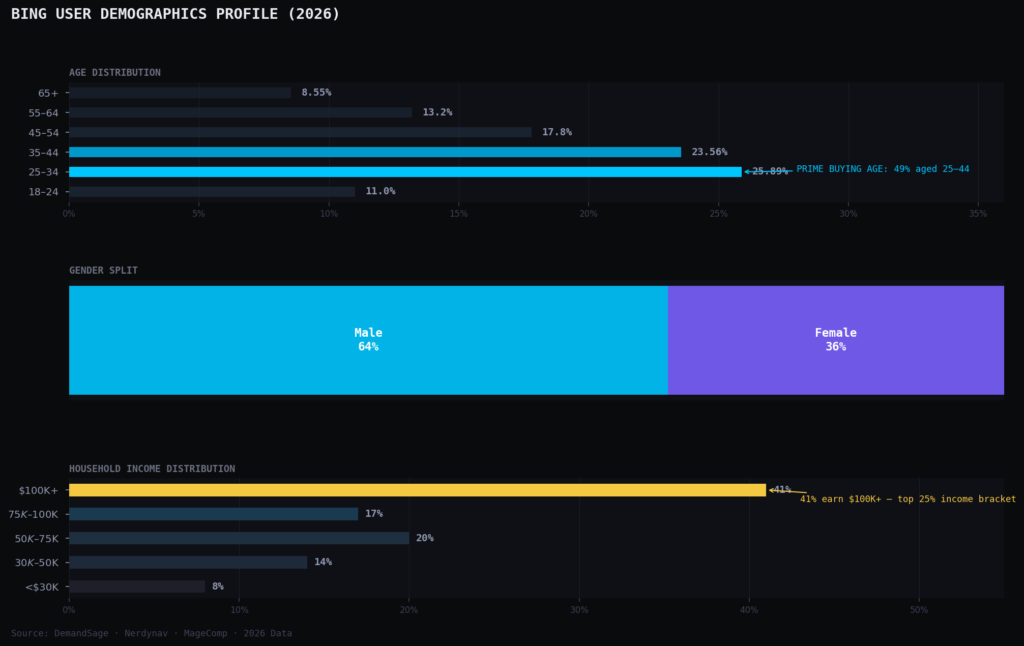
In 2026, Bing’s user age profile continues to skew toward prime earning and spending years, with nearly 50% of users aged 25–44, and a separate DemandSage 2026 report confirming that 48% of Bing users belong to the top 25% of U.S. household incomes — with 41% of American Bing users earning over $100,000 annually — making the platform disproportionately valuable for premium and high-ticket advertisers.
Nearly 50% of Bing users fall between the ages of 25 and 44, with 25.89% aged 25–34 and 23.56% aged 35–44. This makes Bing an appealing platform for advertisers targeting young professionals and mid-career decision-makers. These age groups typically have higher purchasing power and are more engaged with online services.
Bing’s desktop-centric user base aligns with these users’ work habits, especially in office or hybrid settings. As Microsoft strengthens its AI and business productivity tools, it may increase user time spent in the ecosystem. Future Bing Ads strategies can use age-specific creative and messaging to tap into career-focused audiences. Tailoring campaigns for this demographic can improve both CTR and ROI.
TOP BING ADS STATISTICS 2026 #12. Demographics: Gender Distribution
In 2026, Bing’s gender split remains at approximately 64% male and 36% female, and with Bing’s ad market share in male-dominated sectors like legal and insurance growing by 15% year-over-year on desktop specifically — driven by lower competition and cheaper bids compared to Google — male-skewed advertisers are finding measurably stronger returns on Bing than on any other search platform.
Around 64% of Bing users are male, while 36% are female. This imbalance is important for brands targeting male audiences in sectors like tech, automotive, finance, and gaming. With the integration of Bing in platforms like Xbox and Windows OS, male engagement is naturally higher.
Gender-aware targeting and ad visuals can help brands maximize relevance and effectiveness on Bing. If Microsoft continues expanding into lifestyle and consumer verticals, this ratio could gradually balance. However, for now, businesses marketing male-oriented products may find a more efficient path on Bing. Strategic segmentation by gender could enhance ad resonance and click efficiency.
TOP BING ADS STATISTICS 2026 #13. Top Searched Term
In 2026, “Google” remains the single most searched term on Bing with a monthly volume of 40.96 million queries — a figure that, when combined with the second and third most searched terms (YouTube and Facebook), illustrates that a significant portion of Bing’s daily 900 million searches are navigational in nature, representing a distinct and largely untapped retargeting and brand-awareness opportunity for savvy advertisers.
Surprisingly, “Google” is the most searched term on Bing, with a volume of 40.96 million. This signals a behavioral quirk where many users use Bing as a bridge to Google. While this may seem counterintuitive, it demonstrates Bing’s role as the default engine on many devices.
Smart advertisers can still take advantage of this traffic with brand-awareness ads or retargeting strategies. It also reinforces the importance of being visible across multiple search engines. Future product design changes could convert some of these transitional users into loyal Bing users. Marketers should still optimize for visibility even on seemingly ironic keywords.
TOP BING ADS STATISTICS 2026 #14. Mobile Search Market Share
In 2026, while Bing’s global mobile search market share remains modest at around 0.52%, a striking counterpoint emerges from Bing’s own site traffic data showing that approximately 71% of bing.com’s total visits now originate from mobile devices — representing 2.39 billion total site visits recorded in July 2025 alone — signaling a rapid behavioral shift that advertisers should begin factoring into their Bing mobile campaign strategies now.
Bing holds only a 0.52% share of the global mobile search market as of early 2024. This low percentage highlights Bing’s current mobile limitations compared to Google and Safari’s dominance. However, the integration of Bing with AI-powered tools like Copilot in Microsoft mobile apps could increase usage.
As consumers become more comfortable with multitasking apps and AI search, Bing may gain ground. Microsoft may also partner with OEMs to increase Bing’s mobile footprint. Although limited now, the mobile channel should not be ignored in multichannel ad planning. Future growth in mobile AI assistants could make Bing more competitive on smartphones.
TOP BING ADS STATISTICS 2026 #15. Tablet Search Market Share
In 2026, Bing holds a 4.99% share of the global tablet search market, and with tablet-heavy demographics closely mirroring Bing’s core user profile — particularly the 43% of Bing users who are married, a group that spends 32% more online than the average internet user according to DemandSage’s 2026 behavioral analysis — tablets represent one of the highest-yield, lowest-competition device segments currently available on the Microsoft Advertising platform.
Bing owns 4.99% of the global tablet search market, a modest but notable figure. Tablets are still widely used in education, home browsing, and among older demographics. Bing’s performance in this space can be improved through its continued inclusion in Microsoft’s productivity apps.
As tablets evolve to resemble PCs in functionality, Bing’s desktop strengths may carry over. This creates new touchpoints for product-based or B2B search advertising. Advertisers targeting tablet-first audiences — like retirees or students — should watch this segment. With enhanced AI integration on tablets, Bing’s search quality and frequency could rise in the near term.
TOP BING ADS STATISTICS 2026 #16. Bing Ads Impressions
In 2026, Bing Ads’ daily impression volume has grown beyond the 1.6 billion baseline recorded in 2023, powered by Microsoft’s expanding ad inventory across Edge, Teams, Outlook, and Xbox — with the platform now reachable across 238 countries and 105 languages, giving advertisers access to a truly global impression network that rivals the scale of far more expensive programmatic alternatives.
Bing Ads generated over 1.4 trillion ad impressions in 2023, averaging 1.6 billion served per day. This volume demonstrates Bing’s expansive reach, especially across Microsoft’s digital properties. High impression rates offer strong visibility for awareness-stage campaigns.
Brands looking to scale impressions efficiently can benefit from Bing’s lower CPM and less competitive environment. Microsoft’s upcoming updates to Edge, Teams, and Xbox could further grow this footprint. The future of Bing Ads may rely on quality over quantity as personalization improves. Still, sheer impression scale makes Bing valuable for high-funnel brand lift campaigns.
TOP BING ADS STATISTICS 2026 #17. Bing Ads Clicks
In 2026, Bing Ads’ annual click volume has grown well beyond the 1.1 billion baseline established in 2023, with Microsoft Advertising reporting a 22% increase in click-through rates driven specifically by AI-generated ad suggestions introduced in mid-2024 — a development that, combined with Bing’s average CPC of $1.54 versus Google’s $2.96, means advertisers are now acquiring more clicks at dramatically lower cost than at any prior point in Bing’s advertising history.
Bing Ads drove more than 1.1 billion ad clicks globally in 2023. This high volume of engagement proves that Bing traffic isn’t just passive — it actively converts. Click data reflects solid user intent, especially in desktop-heavy environments like finance, healthcare, and software.
As Bing improves its targeting and ad placement options, click quality could improve even further. Marketers should monitor click paths and onsite behavior to refine landing page UX. This engagement trend signals room for competitive ROI with well-structured campaigns. The click data reinforces Bing’s role in a balanced multi-engine ad portfolio.
TOP BING ADS STATISTICS 2026 #18. Bing Ads Conversion Rates by Industry
In 2026, Bing’s top-converting industries remain Careers & Employment at 6.81%, Finance & Insurance at 5.57%, and Real Estate at 5.13%, and a 2025 SQ Magazine benchmark study confirmed that Finance, B2B, and Healthcare verticals on Bing each outperform their direct Google Ads counterparts in conversion rate — with B2B alone converting at 3.9% on Bing versus a notably lower rate on Google — making Bing the statistically superior platform for high-value professional service campaigns.
Industries like Careers & Employment (6.81%), Finance & Insurance (5.57%), and Real Estate (5.13%) perform especially well on Bing Ads. This performance reflects a user base more aligned with job-seekers, professionals, and property researchers. These industries benefit from longer research cycles and desktop use, which favor Bing’s environment.
With targeted messaging, these sectors can achieve highly efficient conversions. As Bing’s AI tools expand audience targeting, more niches may emerge. Businesses in these verticals should continuously test ad variants and bidding strategies. Future ad options tailored to these industries may make Bing the go-to for high-intent conversion traffic.
TOP BING ADS STATISTICS 2026 #19. Bing Ads Cost Per Click by Industry
In 2026, Bing’s industry CPC range spans from as low as $0.75 for Careers & Employment and $0.91 for Apparel & Accessories up to $2.88 for Real Estate — and crucially, even that upper end remains below Google Ads’ all-industry average CPC of $2.96, meaning advertisers in every single tracked category on Bing are paying less per click than the Google platform-wide average, according to comparative data published by SQ Magazine in late 2025.
CPC varies by industry on Bing Ads — Careers & Employment averages $0.75, Apparel & Accessories $0.91, and Real Estate $2.88. These industry-specific costs reflect both competition and user behavior. For advertisers, Bing presents a strategic cost advantage in verticals like jobs and retail.
Lower CPCs mean better ROI and testing flexibility for newer brands. High-CPC fields like Real Estate may still see better returns due to higher conversion rates. As Bing’s demand grows, some CPCs could rise, so now is an opportune time to test. Future platform updates may include AI-driven bid suggestions to maintain cost control.
TOP BING ADS STATISTICS 2026 #20. Bing Ads Return on Investment (ROI)
In 2026, Bing Ads continue to deliver an average ROI of £2.53 for every £1 spent — 26% stronger than Google Ads’ £2.00 average — and with Microsoft’s search advertising revenue growing at 21% year-over-year and Bing’s estimated standalone platform valuation now placed at approximately $400 billion by industry analysts, the ROI advantage advertisers experience at the campaign level is mirrored by the extraordinary financial confidence Microsoft itself is placing in Bing’s long-term commercial future.
Bing Ads currently yield an average ROI of £2.53 for every £1 spent, outperforming Google Ads’ £2.00 average. This favorable return is driven by lower CPCs, higher CTRs, and niche audience segments. For businesses with tighter budgets, Bing can deliver strong outcomes without overspending.
ROI metrics like these should encourage marketers to diversify away from Google-only strategies. Microsoft’s investment in AI, browser tech, and native ad formats may further boost future performance. As attribution tracking improves, clearer ROI visibility will help advertisers scale confidently. For those seeking efficiency and returns, Bing is increasingly worth a second look.

BING ADS STATISTICS 2026 REVEAL A POWERFUL AND UNDERUSED ADVERTISING ENGINE
Bing Ads has matured into a high-value platform with strong potential for growth in 2026 and the years ahead. Its lower CPCs, higher CTRs, and strong ROI continue to attract brands searching for efficient advertising channels. The platform’s strength across desktop, console, and professional user segments gives marketers direct access to audiences ready to engage and convert.
Microsoft’s expanding AI ecosystem across Bing, Copilot, and Edge is rapidly transforming how ads are delivered and optimized. Predictive targeting, smarter keyword expansion, and AI-assisted campaign automation are already improving advertiser performance across multiple industries. Although mobile market share remains smaller than Google’s, Microsoft’s deep ecosystem integrations keep Bing highly visible across devices and platforms. For 2026, advertisers leveraging Bing Ads strategically are seeing stronger margins, less bidding competition, and measurable gains in campaign profitability.
Sources:
- https://gs.statcounter.com/search-engine-market-share
- https://www.demandsage.com/bing-statistics/
- https://increv.co/academy/bing-users/
- https://www.demandsage.com/bing-statistics/
- https://backlinko.com/bing-users
- https://backlinko.com/bing-users
- https://www.wordstream.com/blog/ws/2017/11/06/bing-ads-performance-benchmarks
- https://www.wordstream.com/blog/ws/2017/11/06/bing-ads-performance-benchmarks
- https://www.wordstream.com/blog/ws/2017/11/06/bing-ads-performance-benchmarks
- https://www.wordstream.com/blog/ws/2017/11/06/bing-ads-performance-benchmarks
- https://www.demandsage.com/bing-statistics/
- https://www.demandsage.com/bing-statistics/
- https://www.demandsage.com/bing-statistics/
- https://backlinko.com/bing-users
- https://backlinko.com/bing-users
- https://aistratagems.com/bing-stats/
- https://aistratagems.com/bing-stats/
- https://www.wordstream.com/blog/ws/2017/11/06/bing-ads-performance-benchmarks
- https://www.wordstream.com/blog/ws/2017/11/06/bing-ads-performance-benchmarks
- https://embryo.com/blog/top-facts-microsoft-advertising/