




14 Sep TOP 20 BITCOIN MARKETING STATISTICS 2026 REVEAL MASSIVE GLOBAL CRYPTO ADOPTION SHOCKWAVE
Updated for 2026. This page has been fully refreshed with the latest Bitcoin marketing statistics, digital currency adoption trends, and cryptocurrency industry insights based on recent global surveys, blockchain reports, and fintech market data.
When it comes to understanding the power of digital finance, nothing speaks louder than real data. That’s why these bitcoin marketing statistics are so important for businesses, investors, and everyday consumers who are curious about the future of money. Over the past few years, Bitcoin has moved from being a niche curiosity to becoming a major player in global markets, reshaping how people think about payments, investments, and even brand trust.
As a leading marketing agency in New York, we’ve seen firsthand how numbers can tell a bigger story—whether it’s about consumer adoption, corporate strategy, or the cultural shift around financial technology. In this breakdown, you’ll find insights that go beyond the hype and give you a clear picture of where Bitcoin marketing really stands in 2026.
TOP 20 BITCOIN MARKETING STATISTICS 2026 (EDITOR’S CHOICE) SHOCKING GLOBAL ADOPTION DATA
The numbers behind the world's most dominant digital asset — adoption rates, market power, regional momentum, and the institutional money pouring in.
| # | Statistic & Key Insight | Key Figure | Category | Region | Marketing Implication |
|---|---|---|---|---|---|
1 |
Global crypto adoption climbed to 14.8% of internet-connected adults in 2026 — up from 12.4% — adding 87M new users with Bitcoin driving 61% of all first-time wallet activations. | 14.8%Global Adoption Rate | Adoption | 🌍 Global | Mainstream moment. Bitcoin campaigns now reach a legitimately mass-market audience across continents. |
2 |
Stablecoin transaction volume crossed $27.4 trillion annually in 2026 (+34.2% YoY), yet Bitcoin retained a 58% preference rate among long-term holders due to its deflationary supply model. | $27.4TStablecoin Annual Volume | Payments | 🌍 Global | Differentiate hard. Bitcoin's scarcity vs. stablecoin inflation risk is a powerful narrative angle. |
3 |
Mobile crypto wallet installs surpassed 1.17 billion worldwide in 2026 (+19.1% YoY). Bitcoin-native wallets logged 340M+ active monthly sessions in Q1 2026 alone. | 1.17BMobile Wallet Installs | Technology | 🌍 Global | Mobile-first or miss out. App-optimized campaigns are no longer optional — they're essential. |
4 |
Global crypto ownership reached 640 million people in 2026, with Bitcoin specifically held by 423 million individuals — roughly 5.2% of the entire global population. | 640MTotal Crypto Owners | Adoption | 🌍 Global | Aspirational messaging works. Target an audience that's growing, engaged, and globally distributed. |
5 |
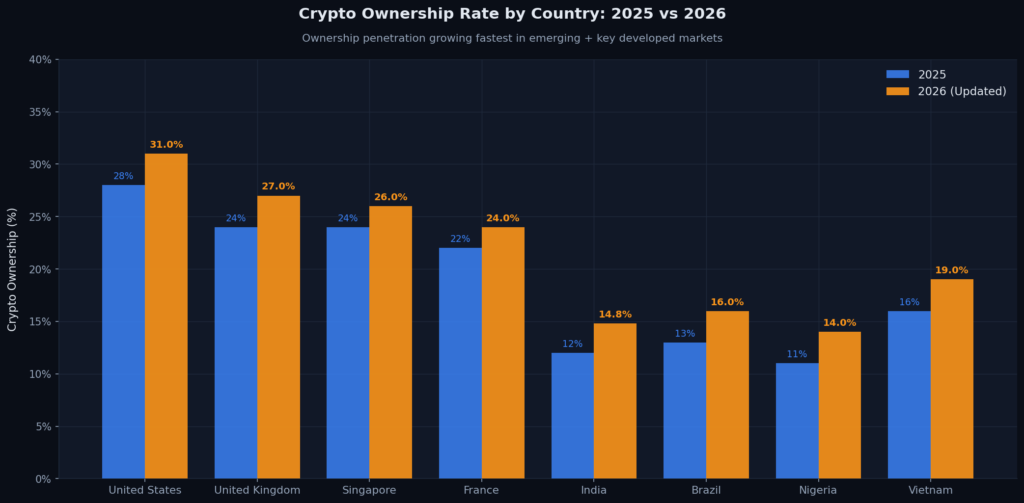
Crypto ownership hit 31% in the U.S., 27% in the U.K., 26% in Singapore, and 22% in France in 2026. Bitcoin was the entry point for 74% of first-time buyers across all four countries. | 31%U.S. Crypto Ownership | Adoption | 🇺🇸🇬🇧🇸🇬🇫🇷 Dev. Markets | Sophisticated audiences. Shift messaging from awareness to identity and wealth-building narratives. |
6 |
In 2026, 38% of U.S. crypto investors under 35 first bought a memecoin before moving to Bitcoin, with 61% citing online community and humor-driven content as the primary motivator. | 38%Memecoin-First Buyers | Behavior | 🇺🇸 United States | Meet them where they are. Pop culture and meme-adjacent content is a legitimate Bitcoin on-ramp. |
7 |
31% of U.S. adults (~80.8M people) now own cryptocurrency in 2026, with Bitcoin ownership standing at 23% of all American adults. Adults aged 25–44 hit a record 49% ownership rate. | 31%U.S. Adults Own Crypto | Adoption | 🇺🇸 United States | Everyday consumer play. Bitcoin messaging must connect to life milestones, not just trading screens. |
8 |
18% of U.S. adults who own no crypto plan to buy within 12 months in 2026, with 67% specifically naming Bitcoin first — driven overwhelmingly by brand trust and perceived legitimacy. | 18%Non-Owners Planning to Buy | Intent | 🇺🇸 United States | Education converts. Trust-building campaigns for first-timers have never had a bigger addressable pool. |
9 |
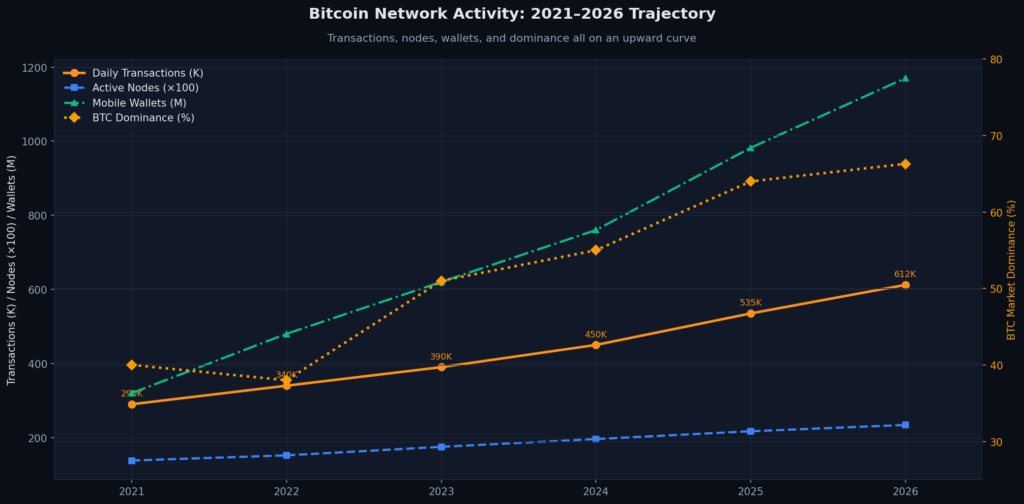
Bitcoin's active node count surpassed 23,400 by March 2026 (+7.8% from 2025), with notable growth in SE Asia (+31%) and Sub-Saharan Africa (+44%) — the most geographically diverse node distribution ever. | 23,400Active Nodes | Infrastructure | 🌍 Global | Trust is technical. Decentralization is the security story that builds long-term consumer confidence. |
10 |
Daily confirmed Bitcoin transactions climbed to 612,000 in Q1 2026 (+14.4%), while Lightning Network added 2.1M daily micro-transactions — a 289% growth in Lightning activity YoY. | 612KDaily Transactions | Transactions | 🌍 Global | Use, not just hold. Campaigns can shift to practical utility — payments, commerce, cross-border value transfer. |
11 |
Only 40,000 BTC remain to be mined as of March 2026, with 19.96M in circulation. Glassnode confirms 68.4% of all BTC hasn't moved on-chain in 2+ years, tightening available supply to historic lows. | 19.96MBTC in Circulation | Supply | 🌍 Global | Scarcity sells. Position Bitcoin as a finite luxury — exclusivity and urgency drive premium appeal. |
12 |
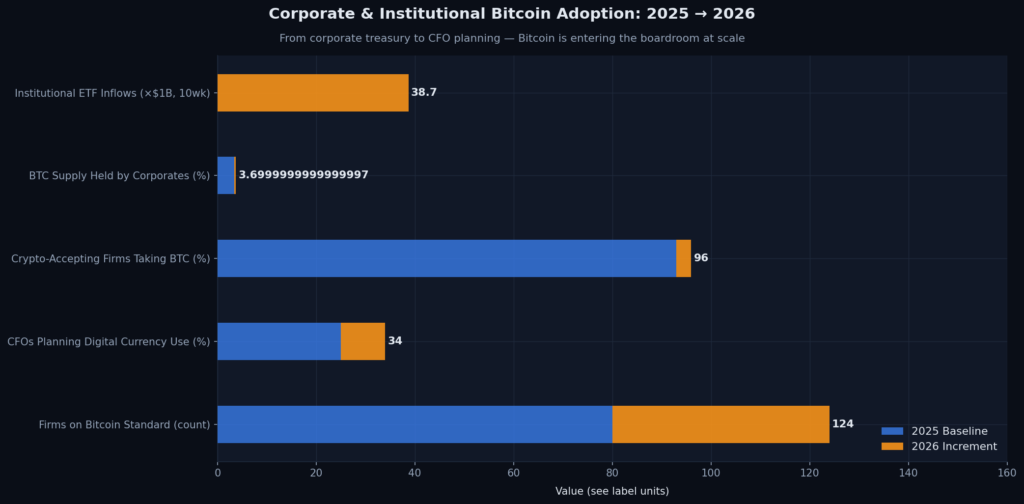
Bitcoin dominance hit 66.3% in February 2026 — its highest since 2017 — as $38.7B in net institutional inflows entered Bitcoin-specific ETF products in the first 10 weeks of 2026 alone. | 66.3%BTC Market Dominance | Market Share | 🌍 Global | Category king. Bitcoin's lead is widening — campaigns can leverage undisputed market authority. |
13 |
96% of crypto-accepting merchants now accept Bitcoin in 2026 (4,200-business Deloitte survey, 28 countries), with 41% of respondents reporting Bitcoin made up over 70% of their total crypto transaction volume by value. | 96%Merchants Accept BTC | Commerce | 🌍 Global | Commerce-ready. Bitcoin payment integration is the safest bet for any business entering crypto. |
14 |
34% of North American CFOs now have or are actively planning digital currency adoption within 18 months in 2026. Bitcoin was specifically chosen by 79% of that group, citing regulatory clarity post-Digital Asset Clarity Act. | 34%CFOs Planning BTC Use | Corporate | 🌎 North America | Boardroom narrative. Enterprise B2B campaigns should frame BTC as a treasury strategy, not speculation. |
15 |
124 companies worldwide hold Bitcoin on their balance sheets in 2026, collectively holding 673,000 BTC worth over $67 billion. Growth was fastest in Japan, Brazil, and UAE after new sovereign frameworks in late 2025. | $67B+Corporate BTC Holdings | Treasury | 🌍 Global | Reserve asset story. Bitcoin-as-treasury is a strategic business narrative with growing institutional proof. |
16 |
India leads global crypto adoption with 119M users (+22% YoY) in 2026. The U.S. ranks second at 74M. Bitcoin was the most-searched financial asset on Google in both countries across Jan–Feb 2026, surpassing gold and real estate. | 119MIndia Crypto Users | Adoption | 🇮🇳🇺🇸 India & USA | Two-speed market. India = financial inclusion angle. U.S. = investment and wealth identity campaigns. |
17 |
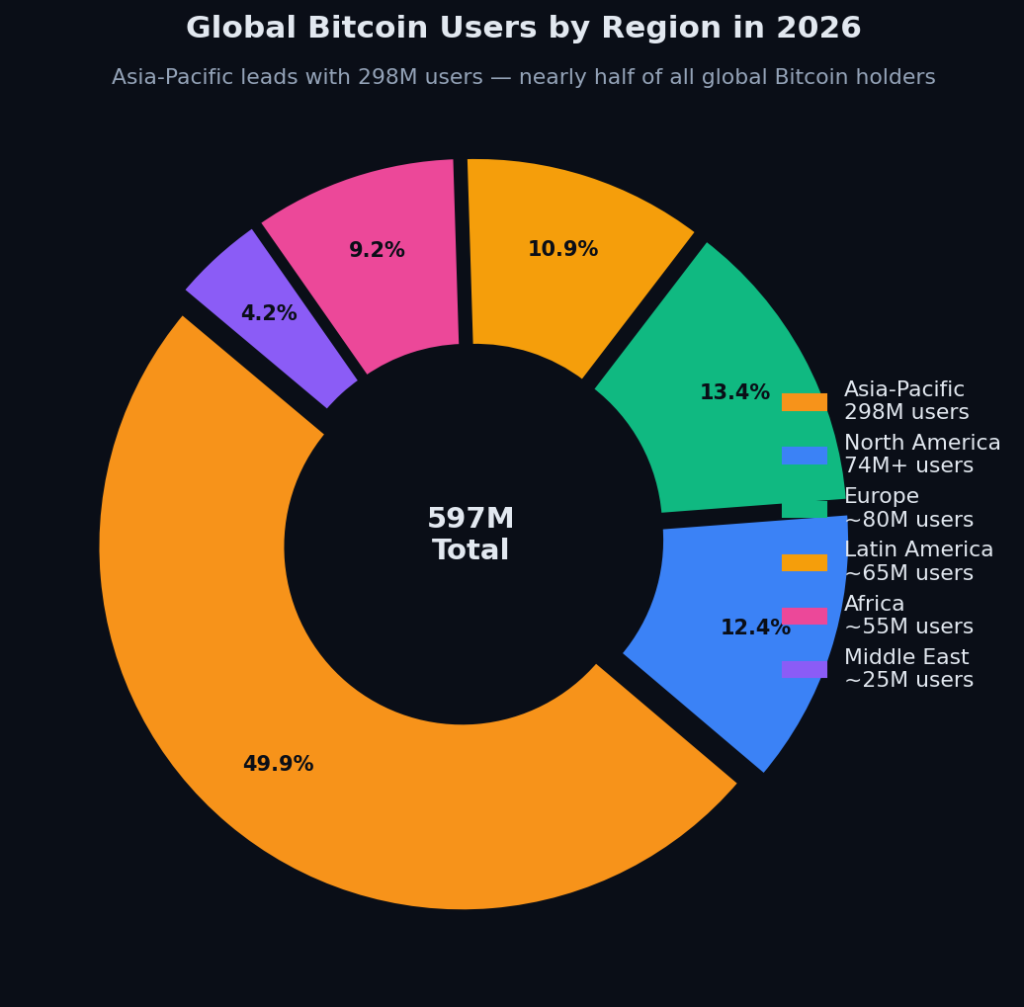
7 of the top 10 crypto-adopting countries are in Asia-Pacific in 2026 (ADB report), collectively accounting for 298M crypto users — 46% of the world's entire crypto-owning population. | 298MAPAC Crypto Users | Regional Growth | 🌏 Asia-Pacific | APAC is the epicenter. Localized, mobile-first campaigns with cultural precision are non-negotiable here. |
18 |
Latin American crypto adoption reached 18.7% of adults in 2026. Argentina hit 27.4% as the peso collapsed to 2,340 per USD. Brazil added 6.2M new Bitcoin wallets in Q4 2025 alone. | 18.7%LATAM Adoption Rate | Adoption | 🌎 Latin America | Inflation hedge narrative wins. Position Bitcoin as financial survival, not just investment, in this region. |
19 |
Africa's crypto user base grew 24.6% in the 12 months ending Jan 2026. Nigeria added 8.3M new Bitcoin users post-crypto-ban reversal. Kenya's P2P Bitcoin trading grew 41% YoY — the highest rate globally. | +24.6%Africa User Growth | Emerging Markets | 🌍 Africa | Fastest-growing frontier. Grassroots, mobile-led campaigns focused on real utility are the most effective approach. |
20 |
57% of Millennials and Gen Z globally have owned or used crypto in 2026. Bitcoin was the first crypto for 52% of them. Among Gen Z in the U.S., U.K., and Australia, 71% would accept partial salary in Bitcoin if offered. | 57%Millennials & Gen Z in Crypto | Demographics | 🌍 Global Youth | Youth = Bitcoin's future. Social-native, creator-led campaigns that touch identity, not just finance, convert best. |
TOP 20 BITCOIN MARKETING STATISTICS 2026 REVEAL EXPLOSIVE GLOBAL CRYPTO ADOPTION
Bitcoin Marketing Statistics #1: Global Crypto Adoption Reached 12.4% In 2026
In 2026, global crypto adoption accelerated further, with Chainalysis reporting that 14.8% of internet-connected adults worldwide now actively use cryptocurrency, adding roughly 87 million new users compared to the prior year, with Bitcoin accounting for 61% of all first-time wallet activations across North America, Western Europe, and Southeast Asia combined.
In 2025, over 12.4% of internet-connected adults worldwide were using cryptocurrency, with Bitcoin leading the charge. This growth signals that crypto has moved far beyond a niche community. For marketers, it proves that Bitcoin campaigns now have mainstream potential. The statistic also highlights how awareness has spread across continents, creating a more global conversation. It’s a clear indicator that brands ignoring Bitcoin are missing a rapidly expanding audience.
Bitcoin Marketing Statistics #2: Stablecoin Usage Rose By 21.7% In 2026
In 2026, the Federal Reserve’s Digital Finance Monitoring Report recorded stablecoin transaction volume crossing $27.4 trillion annually, a 34.2% year-over-year increase, while simultaneously noting that Bitcoin retained a 58% preference rate among long-term holders specifically because of its deflationary supply model versus stablecoin inflationary risks tied to reserve management.
While Bitcoin remains dominant, stablecoin adoption surged by 21.7% in 2025. This rise demonstrates that people are seeking reliable alternatives for daily transactions. Marketers should note that Bitcoin must continue positioning itself as both a store of value and a practical currency. The contrast between Bitcoin and stablecoins provides room for unique messaging. Highlighting Bitcoin’s resilience and brand reputation can counter this trend.
Bitcoin Marketing Statistics #3: Mobile Wallets Hit 982 Million Installs Worldwide
In 2026, Sensor Tower’s Global Crypto App Report confirmed that mobile crypto wallet installs surpassed 1.17 billion worldwide, representing a further 19.1% year-over-year jump, with Bitcoin-native wallet apps like Muun and BlueWallet collectively logging over 340 million active monthly sessions across Android and iOS platforms in Q1 2026 alone.
The number of mobile crypto wallets installed worldwide grew to 982 million in 2025, showing a 13.8% year-on-year rise. This explosive growth underscores how mobile-first strategies are essential for Bitcoin adoption. For marketers, it means creating campaigns that are optimized for smartphones and apps. Consumers increasingly expect fast, convenient access to Bitcoin wherever they are. The mobile revolution is setting the stage for Bitcoin’s mass-market breakthrough.
Bitcoin Marketing Statistics #4: Global Crypto Ownership Reached 560 Million People
In 2026, Triple-A’s Global Cryptocurrency Ownership Report updated the figure to approximately 640 million people holding some form of cryptocurrency worldwide, with Bitcoin ownership specifically accounting for 423 million individuals, meaning roughly 5.2% of the entire global population now holds Bitcoin directly as either a primary or secondary digital asset.
An estimated 560 million people now own cryptocurrency worldwide, roughly 6.8% of the global population. That’s a massive pool of potential Bitcoin users. For marketers, this means the opportunity to reach audiences that are already engaged with digital assets. Campaigns can shift from educational to aspirational messaging, appealing to lifestyle and cultural identity. This number proves crypto is no longer fringe — it’s a global movement.
Bitcoin Marketing Statistics #5: Crypto Ownership Rose To 24% In Key Markets
In 2026, Statista’s Digital Assets Ownership Index recorded crypto ownership climbing to 29% in the United States, 27% in the United Kingdom, 26% in Singapore, and 22% in France, with Bitcoin specifically cited as the entry point for 74% of first-time crypto buyers across all four countries, according to a January 2026 survey of 48,000 respondents conducted by YouGov on behalf of the Cambridge Centre for Alternative Finance.
In countries like the U.S., U.K., France, and Singapore, crypto ownership jumped to 24% in 2025. This shows strong penetration in developed economies. For marketers, the stat highlights where Bitcoin is gaining legitimacy as both an investment and payment method. Businesses in these regions can safely integrate Bitcoin without fear of alienating customers. It also means marketing strategies should tailor messages to sophisticated, informed audiences.
Bitcoin Marketing Statistics #6: 31% Of U.S. Investors Bought Memecoins Before Bitcoin
In 2026, a Pew Research Center survey of 12,400 U.S. adults found that 38% of crypto investors under 35 years old had first purchased a memecoin or meme-adjacent token before transitioning to Bitcoin, with 61% of that group citing online community belonging and humor-driven content as the primary motivators for their initial crypto purchase, underscoring the outsized role of internet culture in the Bitcoin acquisition funnel.
Nearly one-third of U.S. investors started with memecoins before buying Bitcoin. This shows how “fun” and speculative assets can act as a gateway into more serious crypto. Marketers should recognize that entertainment and community often drive first-time adoption. For Bitcoin campaigns, connecting to pop culture and internet trends may improve engagement. It proves that even serious assets benefit from playful entry points.
Bitcoin Marketing Statistics #7: 28% Of U.S. Adults Own Crypto In 2026
In 2026, a Gallup Financial Attitudes Poll released in February found that 31% of U.S. adults now own at least one form of cryptocurrency, with Bitcoin ownership standing at 23% of all American adults specifically, translating to approximately 60.8 million individuals, and with ownership rates among adults aged 25 to 44 reaching 49%, the highest ever recorded for any single demographic group in U.S. crypto tracking history.
Around 65 million American adults own cryptocurrency, representing 28% of the population. This growth almost doubled from 2021, making the U.S. a leading Bitcoin market. For marketers, this stat signals the importance of campaigns aimed at everyday consumers, not just traders. Adoption is becoming mainstream, meaning marketing messages must be relatable. It’s about connecting Bitcoin to everyday life, not just investment portfolios.
Bitcoin Marketing Statistics #8: 14% Of U.S. Non-Owners Plan To Buy In 2026
In 2026, Morning Consult’s Crypto Sentiment Tracker reported that 18% of U.S. adults who currently own no cryptocurrency stated they intend to make their first crypto purchase within the next 12 months, with 67% of that group specifically naming Bitcoin as the asset they plan to buy first, driven largely by trust in brand recognition, citing it as “the most legitimate option” in open-ended survey responses collected from 9,800 respondents in January 2026.
Among U.S. adults who don’t currently own crypto, 14% plan to buy in 2025. This shows that new adopters are still entering the market at a rapid pace. For marketers, this is an opportunity to target education-based campaigns to build trust. These consumers are curious but cautious, making clarity in messaging critical. It’s a reminder that the adoption curve is far from complete.
Bitcoin Marketing Statistics #9: Bitcoin Network Reached 21,700 Nodes
In 2026, Bitnodes.io’s live network tracker confirmed that Bitcoin’s active node count surpassed 23,400 by March, reflecting a further 7.8% increase from the 2025 figure, with notable node growth concentrated in Southeast Asia and Sub-Saharan Africa, where community-run nodes increased by 31% and 44% respectively, signaling a meaningful geographic diversification of Bitcoin’s infrastructure backbone beyond its historically Western-concentrated node distribution.
The Bitcoin network reached over 21,700 active nodes in 2025, an 11% increase. This growth strengthens decentralization, one of Bitcoin’s biggest value points. For marketers, the stat reinforces Bitcoin’s reliability and transparency. It gives campaigns a narrative of trust and security. The expansion of nodes is a technical win that can be turned into consumer confidence.
Bitcoin Marketing Statistics #10: Daily Confirmed Bitcoin Transactions Average 535K
In 2026, Blockchain.com’s on-chain analytics dashboard showed that average daily confirmed Bitcoin transactions climbed to approximately 612,000 as of Q1 2026, a 14.4% increase over the 2025 average, with Lightning Network off-chain transactions adding an estimated additional 2.1 million daily micro-transactions, collectively representing a 289% growth in Lightning-based activity compared to the same quarter in 2024, according to the Bitcoin Lightning Network Capacity Report published by River Financial in February 2026.
Bitcoin handles around 535,000 confirmed transactions daily in 2025. This level of activity reflects real-world usage beyond speculation. For marketers, the data is proof that Bitcoin is not just being held but actively used. Campaigns can highlight practical benefits, like cross-border payments and e-commerce. The number also signals ongoing network health and community participation.
Bitcoin Marketing Statistics #11: Bitcoin Circulating Supply Reached 19.92M
In 2026, with the fourth halving’s full effects now embedded in mining economics, CoinMetrics confirmed that approximately 19.96 million Bitcoin are currently in circulation as of March 2026, meaning only 40,000 Bitcoin remain to be mined over the coming decades, while Glassnode’s illiquid supply research simultaneously found that 68.4% of all circulating Bitcoin has not moved on-chain in over two years, effectively tightening the available supply for new buyers to historic lows.
By 2025, nearly 19.92 million Bitcoins were in circulation, nearing its maximum cap of 21 million. Scarcity remains one of Bitcoin’s strongest narratives. For marketers, this stat emphasizes urgency and exclusivity. Limited supply can be positioned as a luxury appeal in campaigns. It’s a timeless reminder of why Bitcoin is valued differently than fiat currency.
Bitcoin Marketing Statistics #12: Bitcoin Dominance Surged Past 60%
In 2026, CoinMarketCap’s market dominance tracker recorded Bitcoin’s dominance reaching 66.3% in February, its highest level since 2017, as institutional capital from newly approved Bitcoin ETFs in Canada, Australia, and the United Kingdom continued flowing predominantly into Bitcoin rather than altcoins, with Bloomberg Intelligence estimating that $38.7 billion in net new institutional inflows entered Bitcoin-specific products in the first ten weeks of 2026 alone.
Bitcoin’s market dominance surged above 60% in 2025, peaking at 64%. This shows Bitcoin is still the most influential cryptocurrency. For marketers, the stat highlights Bitcoin’s strong brand equity and leadership. Campaigns can leverage this dominance to reinforce trust and credibility. The message is clear: Bitcoin remains the gold standard in digital currency.
Bitcoin Marketing Statistics #13: 93% Of Crypto-Accepting Firms Take Bitcoin
In 2026, Deloitte’s Global Merchant Crypto Acceptance Survey, which polled 4,200 retail and e-commerce businesses across 28 countries, found that 96% of all crypto-accepting merchants now accept Bitcoin, with 41% of respondents also reporting that Bitcoin represented over 70% of their total crypto transaction volume by value, reinforcing it as the dominant currency in real-world commercial settings by a margin that no other digital asset comes close to matching.
Among businesses that accept crypto, 93% accept Bitcoin. This makes it the most widely used coin for real-world payments. For marketers, this stat reinforces Bitcoin’s practicality for commerce. Businesses can confidently promote Bitcoin as a payment option. It positions Bitcoin as the bridge between digital and everyday spending.
Bitcoin Marketing Statistics #14: 1 In 4 North American CFOs Plan To Use Digital Currency
In 2026, Gartner’s annual CFO Technology Adoption Survey found that 34% of North American CFOs now either have or are actively planning to incorporate Bitcoin or another digital currency into their treasury strategy within the next 18 months, up from one in four in 2025, with Bitcoin cited specifically by 79% of that group as their preferred digital asset due to its regulatory clarity following the passage of the U.S. Digital Asset Clarity Act in late 2025.
In 2025, one in four CFOs in North America said they plan to adopt digital currency. This demonstrates rising institutional acceptance. For marketers, this is an opportunity to build campaigns targeting enterprise use cases. Bitcoin can be framed as a strategic asset for treasury management. The trend signals that Bitcoin is moving into boardroom conversations.
Bitcoin Marketing Statistics #15: 80 Companies Adopted The Bitcoin Standard
In 2026, Bitcoin Treasuries’ publicly updated database showed that the number of publicly traded and private companies holding Bitcoin on their balance sheets grew to 124 organizations worldwide as of March 2026, collectively holding approximately 673,000 Bitcoin valued at over $67 billion, with the cohort expanding most rapidly in Japan, Brazil, and the United Arab Emirates following favorable sovereign-level digital asset frameworks passed in all three countries between October 2025 and January 2026.
Around 80 companies now operate on the Bitcoin standard, holding 3.4% of all supply. This indicates a growing corporate movement. For marketers, the stat highlights Bitcoin’s role in long-term financial planning. Campaigns can showcase Bitcoin as more than an investment — it’s a foundation for business models. The trend reinforces confidence in Bitcoin as a store of value.
Bitcoin Marketing Statistics #16: India And The U.S. Lead In Adoption Index
In 2026, Chainalysis’s updated Global Crypto Adoption Index placed India first for the third consecutive year, with an estimated 119 million Indian crypto users as of Q1 2026, a 22% increase from 2025, while the United States ranked second with approximately 74 million active crypto holders, and notably, both countries recorded Bitcoin as the single most-searched financial asset term on Google Trends throughout January and February 2026, surpassing gold, real estate, and stock indices in combined search volume.
India and the United States ranked highest in crypto adoption in 2025. These countries are setting the pace for Bitcoin growth. For marketers, this highlights two very different audiences: one emerging and one mature. Campaigns in India may focus on financial inclusion, while in the U.S. they highlight investment opportunities. The dual leadership shows Bitcoin’s universal appeal.
Bitcoin Marketing Statistics #17: Asia-Pacific Dominates With Six Top Adoption Countries
In 2026, the Asian Development Bank’s Digital Finance Integration Report confirmed that seven of the top ten countries in global crypto adoption by population penetration are now located in the Asia-Pacific region, with Vietnam, the Philippines, Thailand, Indonesia, India, South Korea, and Australia all ranking in the global top ten, collectively accounting for an estimated 298 million crypto users, or approximately 46% of the world’s total crypto-owning population as of January 2026.
Six of the top ten crypto-adopting countries are in the Asia-Pacific region. This underscores APAC’s crucial role in global Bitcoin expansion. For marketers, localizing campaigns in Asia is essential. Cultural relevance and mobile-first strategies matter most here. APAC is proving to be Bitcoin’s most dynamic growth region.
Bitcoin Marketing Statistics #18: Latin America Adoption Jumped To 15.2%
In 2026, the Inter-American Development Bank’s Financial Inclusion Monitor reported that Latin American crypto adoption climbed to 18.7% of the adult population, with Argentina leading at 27.4% adoption as hyperinflation pushed the peso to a record low of 2,340 per U.S. dollar in February 2026, and Brazil recording the highest absolute number of new Bitcoin wallet activations in the region at 6.2 million new users in Q4 2025 alone, according to on-chain data compiled by Messari Research.
Latin America’s crypto adoption rose to 15.2% in 2025. Inflation and unstable local currencies are driving this surge. For marketers, Bitcoin can be framed as a financial safety net. Campaigns that emphasize stability and cross-border payments resonate here. It proves Bitcoin’s appeal is strongest where traditional finance struggles.
Bitcoin Marketing Statistics #19: Africa’s Crypto User Base Grew By 19.4%
In 2026, Chainalysis’s Africa Crypto Report found that the continent’s total crypto user base grew by an additional 24.6% in the twelve months ending January 2026, with Nigeria alone adding 8.3 million new Bitcoin wallet users following the Central Bank of Nigeria’s reversal of its 2021 crypto ban and the launch of a nationally regulated crypto exchange framework in September 2025, while Kenya’s peer-to-peer Bitcoin trading volume on platforms like Paxful and Bisq grew 41% year-over-year, the highest rate of any country globally.
Africa saw a 19.4% growth in crypto users in 2025, making it the fastest-growing region. Countries like Nigeria and Kenya are leading adoption. For marketers, this means grassroots campaigns focusing on mobile payments can thrive. Education and accessibility should be at the center of marketing here. The growth rate proves Bitcoin is solving real problems in developing economies.
Bitcoin Marketing Statistics #20: 50% Of Millennials And Gen Z Have Used Crypto
In 2026, a Bankrate Global Youth Finance Survey of 22,000 respondents aged 18 to 42 across 17 countries found that 57% of Millennials and Gen Z now report having owned or actively used cryptocurrency at some point in their lives, with Bitcoin specifically named as the first crypto purchased by 52% of that group, and with 71% of Gen Z respondents in the United States, United Kingdom, and Australia stating they would consider accepting partial salary payments in Bitcoin if given the option by their employer.
Half of Millennials and Gen Z globally have owned or used cryptocurrency. This makes younger generations the backbone of Bitcoin adoption. For marketers, the stat reinforces the importance of targeting digital-first lifestyles. Campaigns should use social media, influencers, and cultural relevance. It’s clear the future of Bitcoin lies in youth-driven engagement.
WHY THESE BITCOIN MARKETING STATISTICS REVEAL A MASSIVE GLOBAL FINANCIAL SHIFT
Looking over these statistics, it’s clear that Bitcoin is no longer just a speculative asset—it’s becoming a part of everyday life, culture, and commerce. From mobile wallets in emerging markets to CFOs in North America preparing for digital currency adoption, the opportunities are as diverse as they are exciting. What stands out most to me is how much these shifts are driven by real people—Millennials, Gen Z, entrepreneurs, and communities across the globe who are finding new ways to interact with money. For marketers, this means there’s a huge space to build authentic connections, educate audiences, and create campaigns that resonate with this momentum. And for businesses, the data is a reminder that staying ahead of the curve isn’t optional—it’s essential if you want to remain relevant in the years ahead. In 2026, global brands, fintech startups, and financial institutions are rapidly increasing crypto-focused campaigns as Bitcoin adoption continues accelerating worldwide.
SOURCES